
RFP Executive Summary: Importance & How to Write One in 2026
Discover how to write an RFP executive summary that makes a strong first impression, showcases your solution’s value, and drives RFP success.

Co-founder & CEO, AutoRFP.ai··10 min read
Think of the RFP executive summary as the moment you prove you truly understand the customer problem. Display your knowledge of the customer’s current way of doing things. RFP research has shown that teams with 50%+ proposal win rate, attribute customer insight as the number one reason they win.
Instead of leading with features, you frame their priorities, risks, and constraints, then position your solution as the most credible path to value.
The goal is for decision-makers to finish that section thinking, “They get us, and this feels like a safe, smart choice.”
In this article, we’ll define what an RFP executive summary is, how it affects the rest of your proposal, and the key components in it.
You’ll learn how to write an effective summary, best practices, examples of winning approaches, and how an RFP automation tool can help you enhance the way you respond to RFPs.
What Is an RFP Executive Summary?
An RFP executive summary is the one-page opening section of your response. It distills the opportunity, shows you understand the buyer’s priorities and evaluation criteria, and positions your solution as the best fit.
More than just an intro, it’s a strategic sales document: it captures attention fast, sets the tone for your full bid proposal, and highlights the value you’ll deliver if they choose you.
How the Executive Summary Impacts Your Entire Proposal?
The executive summary sets the lens evaluators use to read and score the rest of your proposal. When it clearly ties your solution to the buyer’s priorities, it guides what they notice, what they believe, and how confident they feel in your ability to deliver across every section that follows.
That’s why it can potentially improve win rates. AutoRFP.ai’s 2026 Proposal Win Rate Report notes that even a one-percent uplift can be worth millions in annual revenue. When the narrative is customer-centric and value-driven, the rest of your content benefits automatically.
Here’s a quick table that summarizes how your executive summary shapes the rest of your proposal:
| Impact | How the executive summary influences it |
|---|---|
| Evaluator engagement | Acts as the “front door” to your proposal, earning attention early so busy reviewers don’t skim or deprioritize your response. |
| Narrative framing | Sets the core story about the customer’s problem, your approach, and the value you’ll deliver, giving reviewers enough insight to decide quickly whether your proposal deserves deeper review. |
| Value proposition clarity | Distills complex capabilities into a simple “problem, solution, impact” message that’s easy to understand and remember. |
| Differentiation | Highlights what makes you different from competitors in a way evaluators can easily remember and repeat. |
| Scoring and weighting | Spotlights strengths against key criteria, nudging evaluators to score those areas more favorably. |
What to Include in an RFP Executive Summary?
Below is what every high-impact executive summary must include to win attention and set the tone for the entire proposal.
1. Client Context and Objectives
Outline who the client is, the situation they’re in, and the key business objectives or strategic initiatives they’ve highlighted in the RFP. This section should anchor the summary in the client’s world, not your product.
2. Core Problems and Challenges
Summarize the main pain points, risks, and operational or strategic challenges the client wants to solve. Tie these directly to the requirements and constraints they’ve spelled out in the RFP.
3. Recommended Solution Overview
Provide a concise description of what you’re proposing (product, service, or package) and the high-level approach you’ll take. This should make it clear how your solution maps to the client’s problems and objectives without going into full technical detail.
4. Business Outcomes and Value
Set out the concrete business results the client can expect if they choose your solution. Focus on outcomes such as efficiency gains, risk reduction, performance improvements, revenue protection, or compliance.
5. Quantified Impact and ROI
Where possible, indicate the expected impact using numbers: percentage improvements, cost savings, time reductions, or payback period. This section should make the commercial value and return on investment feel tangible and defensible.
6. Why You: Key Differentiators
Highlight the 2-4 factors that make your organization and approach a better fit than alternatives. This can include your methodology, technology, support model, pricing structure, or any other strengths that align closely with the client’s priorities.
7. Proof and Credibility
Include evidence that you can deliver what you’re promising: relevant experience, similar clients, brief case examples, certifications, or compliance credentials. This section should reassure evaluators that your claims are backed by a track record.
8. High-Level Delivery Plan and Path Forward
Outline how the engagement will run at a high level: phases or milestones, indicative timeline, and key roles or ownership. This should give the client a clear sense of how you’ll move from approval to implementation and measurable results.
How to Write an Effective RFP Executive Summary?
Use this step-by-step framework below to build an executive summary that aligns to the buyer’s priorities and makes your value easy to score.
Step 1: Mirror the Scorecard Before You Write
Your executive summary should be a “translation layer” from evaluation criteria → decision-ready narrative.
Do this:
Pull the evaluation criteria, weights, and any pass/fail requirements.
Convert them into a simple checklist (your “scoring mirror”).
Note what you must prove vs what you must promise.
Output: A one-page scoring mirror that every paragraph can map to.
Step 2: Build an Insight Pack (Then Get It Approved)
High-performing teams win because they build clarity about the customer, competition, and decision criteria, that’s the differentiator.
And the directive is explicit: do not begin response drafting until insights are documented and approved.
Do this (keep it short, but specific):
Customer context: What’s changing, what’s broken, what’s at risk
Decision drivers: What they’ll reward, what they’ll penalize
Competitive reality: Likely alternatives and how they’ll position themselves
Constraints: Timeline, stakeholders, non-negotiables, risk sensitivities
Proof pool: The evidence you can cite (results, case studies, references, metrics)
Output: a 1-2 page insight pack your team agrees is “true.”
Step 3: Convert Insight Into 3-5 Win Themes
Relationships can get you access, but they don’t win by themselves.
“Relationships help you win access. Insight helps you win.” – Jasper Cooper, CEO of AutoRFP.ai
High win teams take what they learn and convert it into clear win themes + evidence-supported narratives.
For each win theme, write a “theme card”:
Theme (claim): What you want evaluators to believe
Customer tie: Which priority / pain / criterion it supports
Proof: What you can point to (metric, case, reference, capability)
So what: The outcome they get (speed, risk reduction, cost, compliance, adoption)
Side note: Win themes aren’t “nice to have.” Win themes mean measurable uplifts in evaluator scoring, and formalizing them early improves shortlist probability and can lift win rate by several points.
Output: 3-5 win theme cards you’ll reinforce throughout the summary.
Step 4: Write the Executive Summary as 6 Blocks (Structure First)
Don’t write it like an essay. Write it like an evaluator-friendly decision brief.
Use these blocks (in order):
Decision statement (1-2 sentences): the outcome + why you’re the credible choice
Customer situation + stakes: prove you understand their world
Your approach (high level): what you’ll do and how it addresses the criteria
Differentiators (win themes): 3-5 bullets tied to proof
Delivery + risk control: how you’ll execute; how you’ll reduce risk
Commercial framing + next step: reinforce value, then make the path forward clear
Output: A complete outline you can draft fast without rambling.
Step 5: Draft Fast, Then Make It Sharper (Don’t Polish Too Early)
Write a first draft in one pass. Then do a second pass that replaces “feature talk” with “decision talk.”
Upgrade moves that make summaries feel senior (not generic):
Replace “we offer” with “you get”
Add “because / so that” to connect claims to outcomes
Swap vague proof (“experienced team”) for specific proof (“delivered X in Y time,” “reduced Z”)
Side note: The best proposal still demonstrates the deepest customer understanding and most credible solution fit, systems and automation create capacity, but they don’t replace strategy.
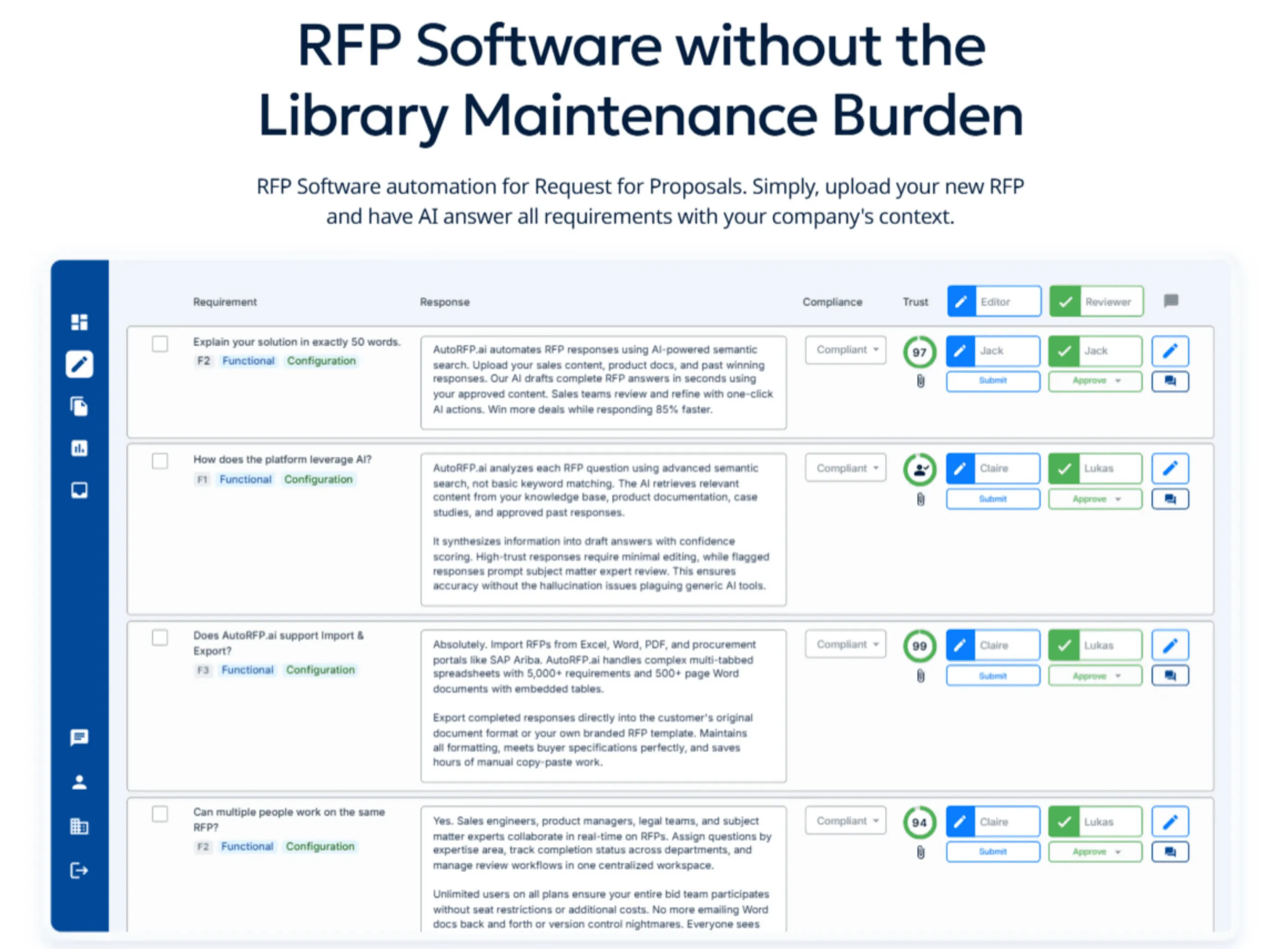
Automation won’t win the bid, but it gives you time back. By speeding up drafting and content reuse, AI lets you focus on what lifts evaluator scores: a sharper narrative, tighter win themes, and answers tailored to the buyer.
Platforms like AutoRFP.ai help you move faster without losing strategy, so your executive summary stands out for the right reasons.
Step 6: Use SMEs for Validation, Not Authorship
This is one of the highest-leverage process changes you can make.
SME-led drafting predicts low performance in winning RFPs.
Why? SMEs write for precision and completeness, not persuasion, then proposal teams inherit a patchwork they must rewrite under deadline, risking compliance and losing a consistent voice.
Do this instead:
Proposal team drafts the executive summary.
SMEs review in a structured checklist:
Accuracy: True/false
Risk: What’s risky or overstated
Missing must-say points: what’s essential for compliance/credibility
Evidence: What proof strengthens key claims
Output: A clean narrative with SME-approved truth.
Step 7: Run the Evaluator Test (10 Minutes, Every Time)
Your final pass should simulate evaluator reading behavior.
Do these checks:
Criteria trace: Can you map each paragraph to a criterion in your scoring mirror?
Proof check: Does every major claim have evidence or a credible mechanism?
Skim check: If someone reads only the first sentence of each paragraph, do they still get the story?
This matters because without insight discipline, teams misalign with evaluator priorities and revise late to fix direction instead of polishing messaging.
Step 8: Tighten for Executive Reading
Final polish is not “make it prettier.” It’s “make it easier to score.”
Do this:
Short paragraphs. No throat-clearing.
Front-load outcomes and risk reduction.
Make win themes scannable (bullets help).
Keep language confident, but don’t overreach.
Best Practices for Successful Executive Summaries
Follow these best practices to keep your executive summary sharp, relevant, and credible.
| Best practice | How to apply it |
|---|---|
| Keep it concise | Aim for one-page maximum and avoid complex jargon and lengthy descriptions |
| Mirror the RFP’s language | Use the buyer’s exact terms for goals, stakeholders, and requirements; avoid “clever” rephrases |
| Keep names and terms consistent | Define acronyms once; use the same labels for teams, modules, and metrics throughout |
| Use proof by mechanism | If you can’t cite numbers, explain the mechanism: “Because X, we reduce Y, which improves Z.” It reads more believable than broad claims |
Examples of Winning Executive Summaries
Here are ready-to-use RFP executive summary examples and templates you can reference for your own:
RFP Executive Summary Example 1: The Business Case Builder
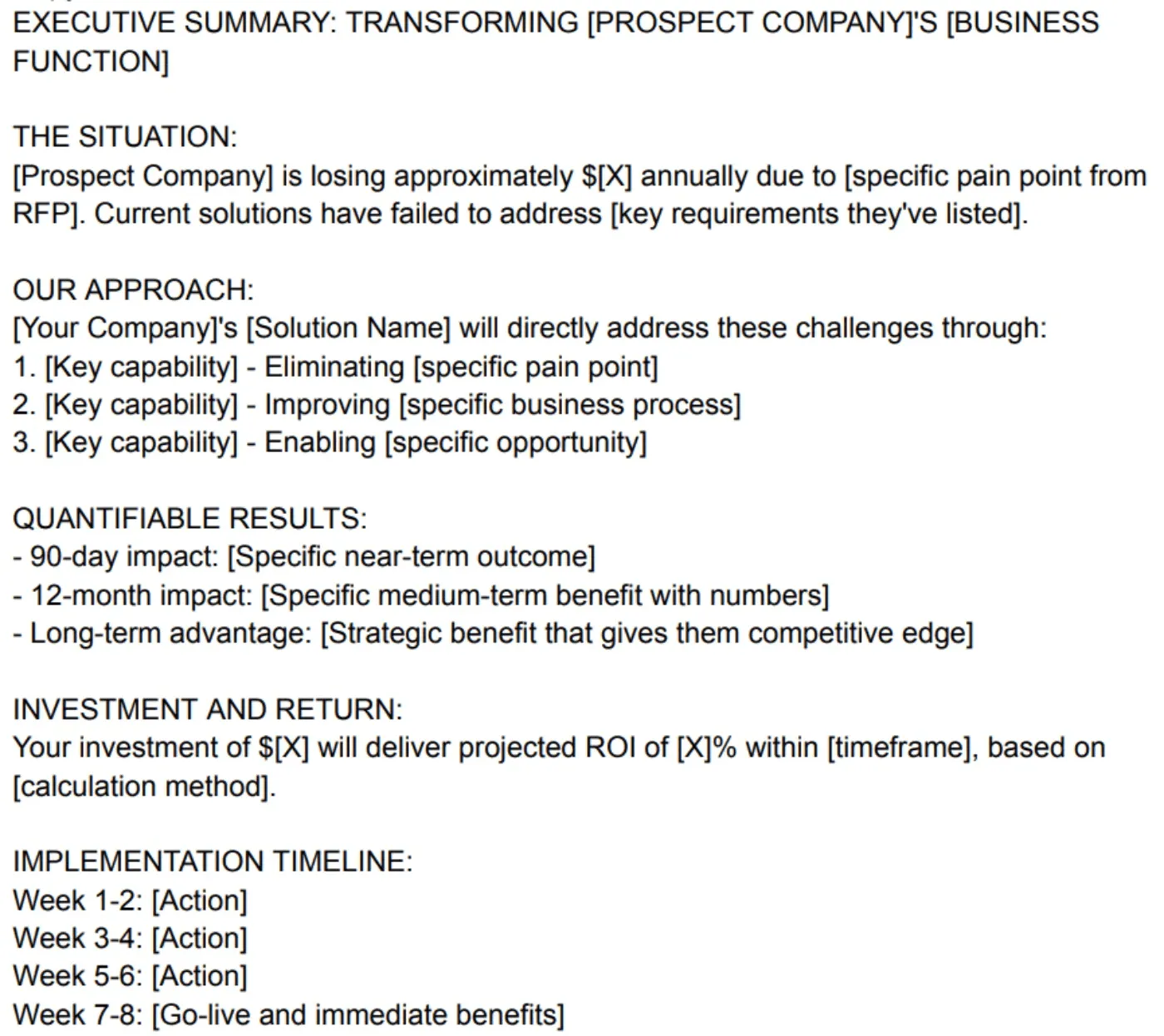
Why this approach works:
It frames everything in business terms, not technical features
It uses specific numbers to build credibility
It shows you’ve thought through implementation
It makes ROI concrete and believable
It creates urgency through immediate benefits
RFP Executive Summary Example 2: The Strategic Partner Position
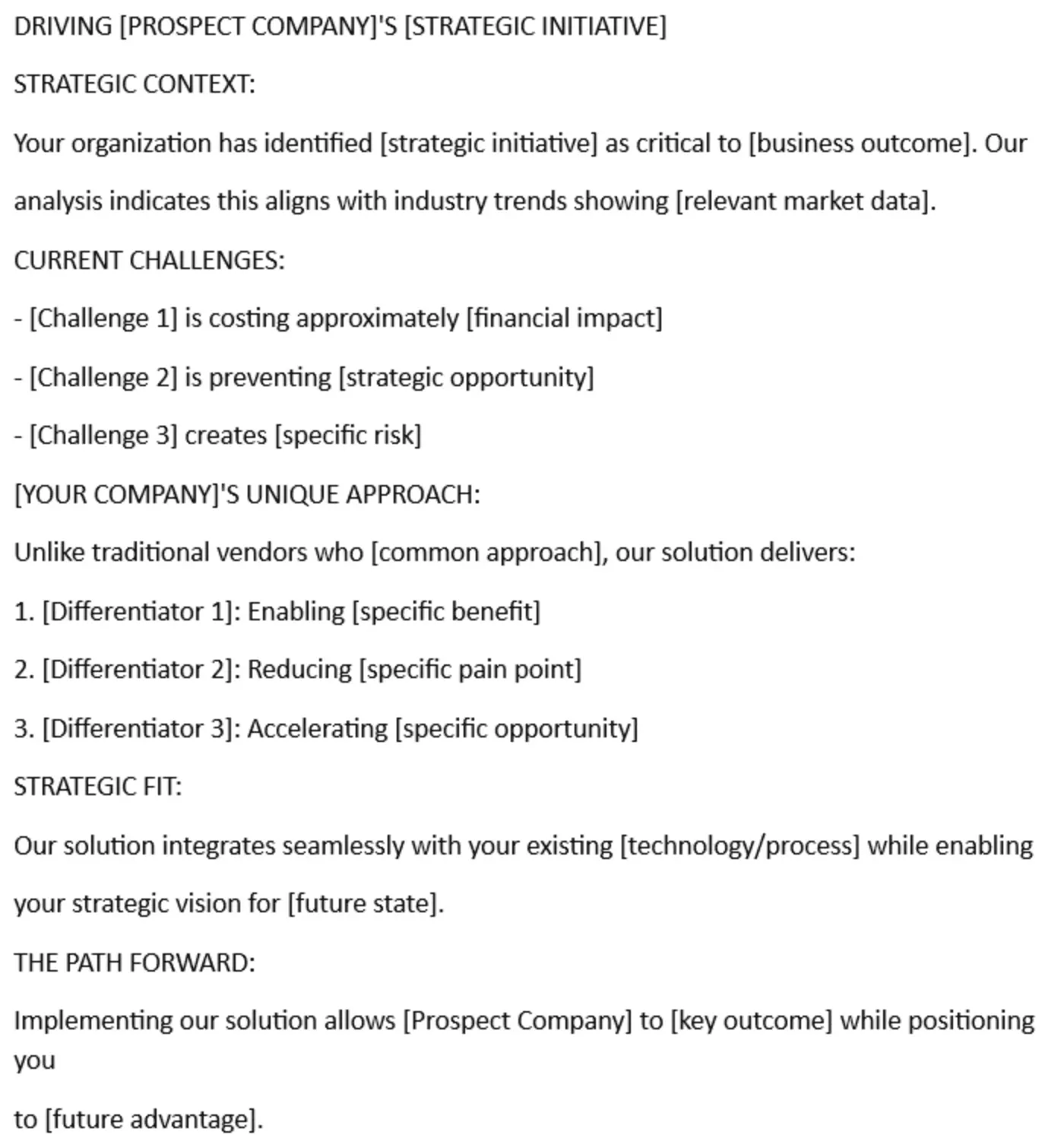
Why evaluators trust this:
This executive summary positions you as a strategic partner by clearly reflecting the buyer’s business context and priorities, not just your solution.
It differentiates your approach without naming competitors and connects your proposal to their strategic initiatives and future benefits.
RFP Executive Summary Example 3: The Metrics-Driven Executive Summary
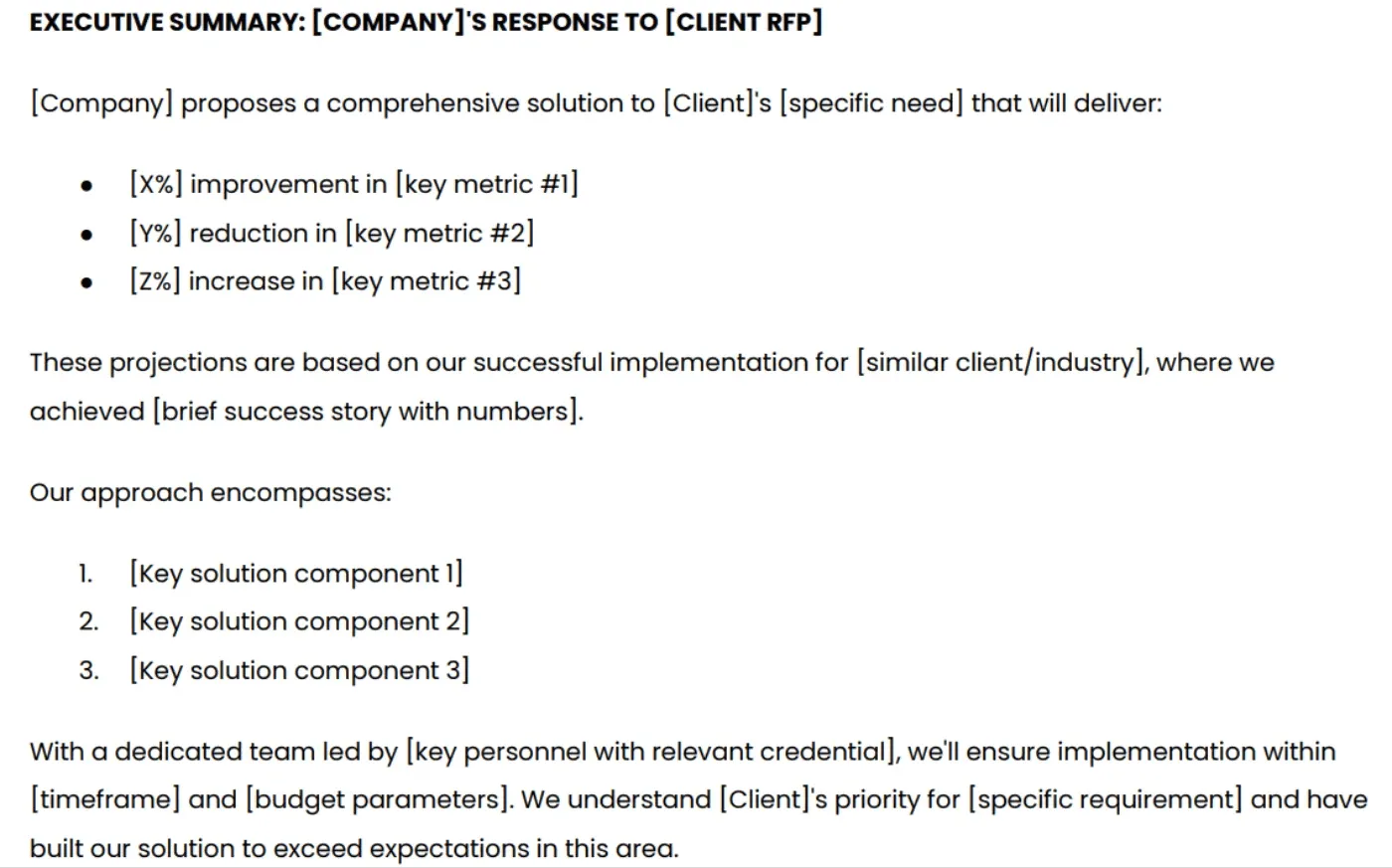
Download this and more RFP executive summary templates
This template leads with measurable outcomes, immediately anchoring the proposal in business value rather than features.
It builds credibility through proof, presents a clear solution structure, and reassures evaluators with delivery ownership, timelines, and alignment to the client’s stated priorities.
RFP Executive Summary Example 4: The Differentiator Executive Summary
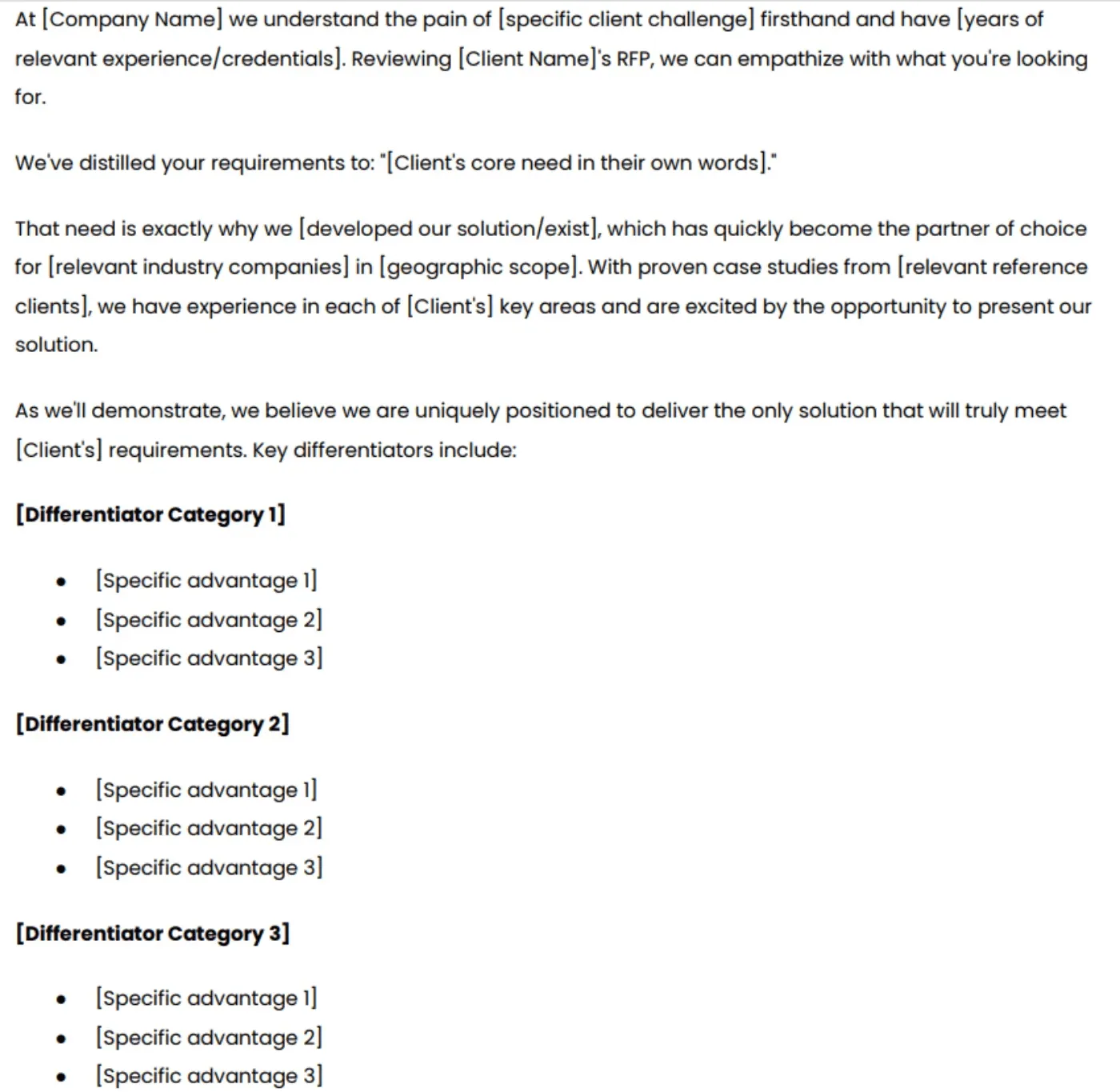
This template leads with empathy and buyer language, immediately showing you understand the client’s real challenge.
It builds credibility through relevant experience, then differentiates clearly by grouping advantages into decision-friendly categories evaluators can scan, compare, and score confidently.
Maximize RFP Response Success with AutoRFP.ai
Strong executive summaries are built on insight, not speed. AutoRFP.ai gives you that insight fast by generating accurate drafts in minutes using AI trained on your past wins.
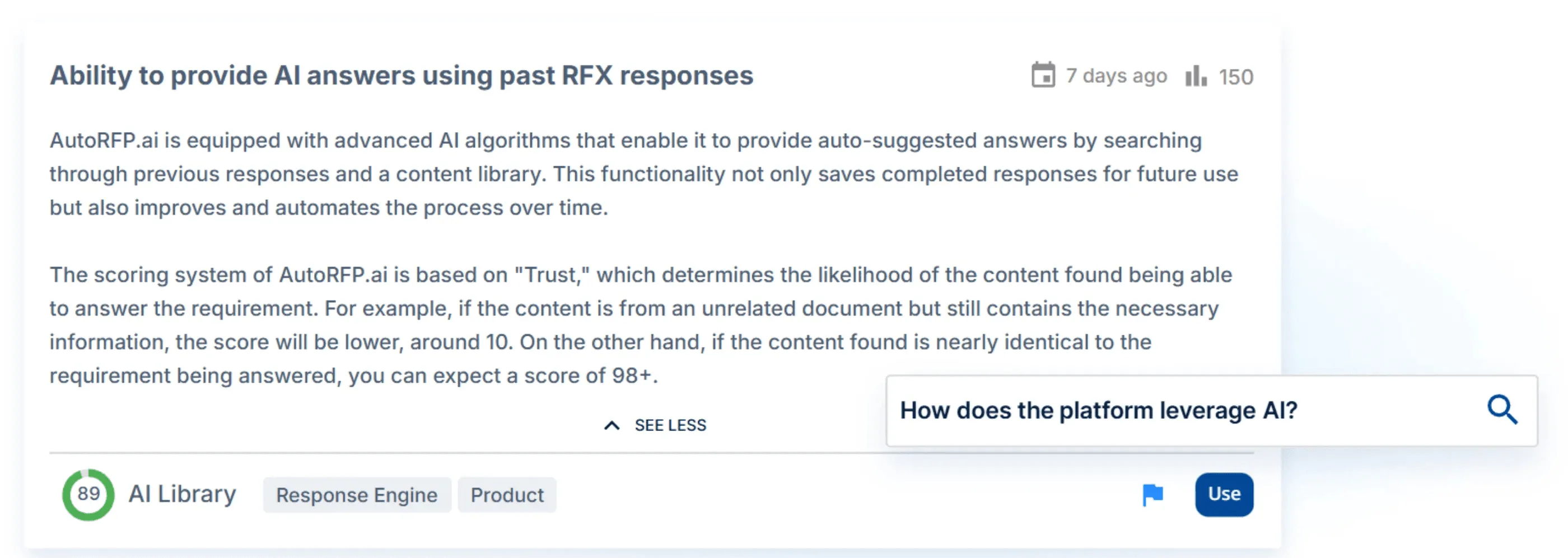
When you upload an RFP, AutoRFP.ai parses and organizes requirements across sections, even when they are scattered, so real decision drivers don’t get missed.
With clearer inputs and less manual work, you can focus on what actually moves evaluator scores: shaping a compelling, buyer-aligned executive summary that clearly signals, “We understand what matters, and we’re aligned.”
Use AutoRFP.ai to write executive summaries that evaluators trust and remember.
About the author

Co-founder & CEO
Co-founder and CEO of AutoRFP.ai. Spent 7 years running global RFPs and personally completed 500+ RFPs before founding the company.
LinkedIn
