
2026 RFP Project Management: Optimize & Win More Bids
Manage RFP responses efficiently with structured workflows, clear timelines, and smart tools. Improve coordination, cut delays, and submit strong proposals.

Co-founder & CEO, AutoRFP.ai··12 min read
Most RFP teams don’t lose bids because of bad writing. They lose because their project management process collapsed under pressure.
Treating bids like revenue-critical projects means clear roles, realistic timelines, governed content, and structured reviews, including an early colour-team strategy review. Done right, it makes all the difference between a reactive team pulling all-nighters and a repeatable engine that consistently delivers better proposals in less time. That project discipline is a core part of strategic response management when RFPs, questionnaires, and DDQs share one operating model.
This guide shows what derails RFP performance at scale, what high-win teams do differently, and how AutoRFP.ai plugs in.
What is RFP Project Management?

Video transcript
Transcript is auto-generated and may contain minor errors.
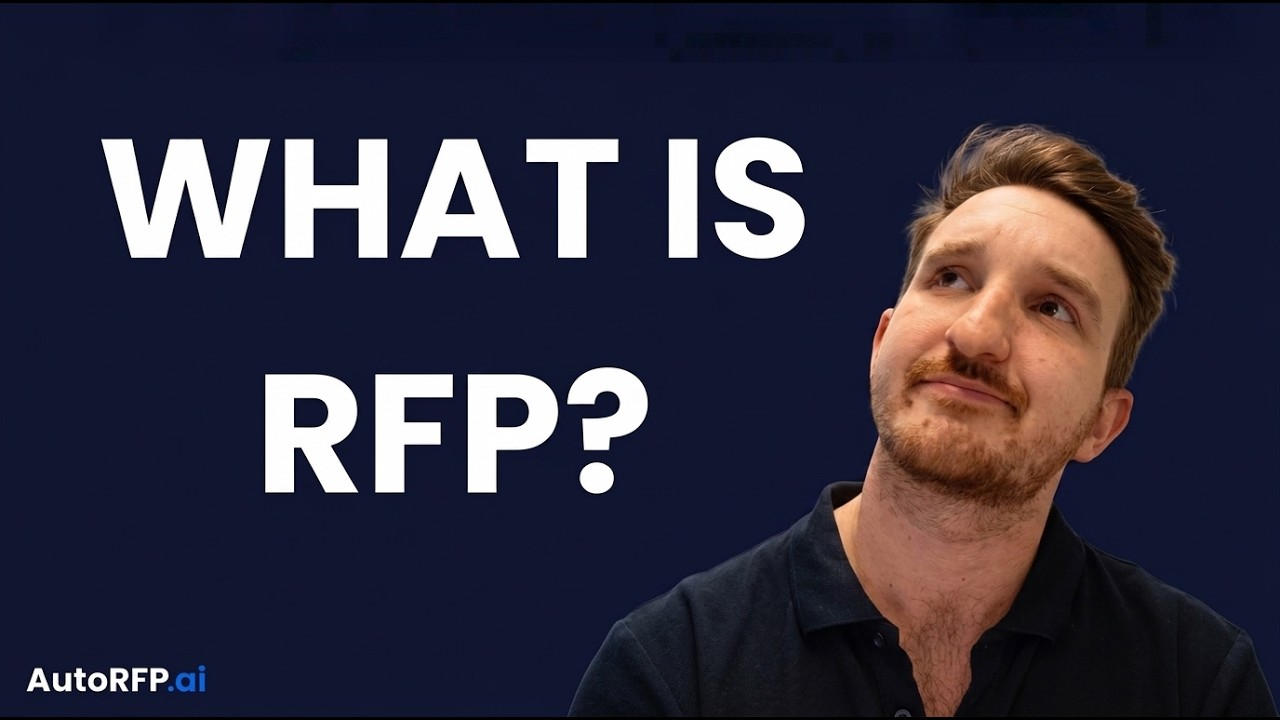
Hey there. My name is Rob and I'm from auto rfp.ai. We're going to jump into what is an RFP or request for proposal. We're going to be breaking down all the different terminologies around an RFP and the different terms you might come across when selling your software or services and products. We're going to be jumping into a couple of examples that I've built up around what an RFP might look like in an Excel spreadsheet, what it might look like in a Word document. Then I'm going to be covering off all kind of different information in relation to what your RFP response might look like with an executive summary as well as a guide I can share with you on how you can provide a checklist to make sure you're answering an RFP with all the necessary information. So what is an RFP? Well, it's when a buyer, let's use the example
of say a government agency, let's say a local library and a county in the United States, wants to procure some new HR applicant tracking software. Doesn't have to be software though. It could be construction for a new building, archival services, products, and various different things. Request for proposals are used all around the globe for large organizations to procure products and services. In this example, our library is going to approach the market. That's a reverse auction. It's when, let's say in this example, the library is going to come up with all its different requirements, whether they're functional, non-functional, different attributes in relation to the company. As a library in a government, I might have different procurement guidelines I'll have to follow. And effectively, as the buyer of these product or services, in my example, it's a I'm a buyer of HR
tech, I'm going to approach multiple suppliers. So, I'll go out to all the different suppliers, reach out to them, and say, "We've prepared a request for proposal. We'd like you to respond. You have 2 weeks to respond to our RFP, and from there, we over the next 3 months, we're going to be running our full procurement cycle to purchase new applicant tracking software." Before we jump into all of that, let's just quickly cover some of those other topics around terminology for an RFP. So, we've got an RFP, which we've just covered as a request for proposal, where there's different requirements that a buyer goes out to market to have the suppliers answer. We've got a request for information, which is a lot more broad, but usually we don't As a buyer, they wouldn't have fully fledged requirements. It's You're more going out to market saying, "Hey, can you provide information about your solutions? We're not quite sure what
exactly we're looking for." We've got a RFQ, which is more just around request for quote. So, it's really on the pricing side. So, we're saying, "Hey, provide a quote for your solutions to us. These are our requirements and what solution we're looking for, and therefore, you should be able to create a effective quote, provide that to us." And you're still going out to this the buyer is still going out to multiple suppliers in most cases for this. You've got a security questionnaire. Not quite Usually, it's in the procurement cycle, but it's not necessarily to do with an RFP. The IT or security team at this organization has to provide a bunch of questions to any supplier that comes on board for that buyer they have to answer for them to be able to procure their software, services, or the products. DDQ is really different and I've just left it there cuz it's common for managed investment funds and finance and DDQ is a due diligence questionnaire.
It's a bit different to an RFP but we'll cover that in another video. So, we've got an RFP with all our different requirements. It might look like this. They'll have different numbering and IDs for each requirement, different categories, and then provide the requirement if it's an Excel spreadsheet and here's one that I've prepared. It will then provide information as to the vendor, where they can provide a response, and any kind of additional comments or attachments they wish to provide. So, as a buyer, I'm going through and kind of talking to the different stakeholders within the business of what these requirements should be for for us and then I'm providing that to the vendor, the supplier to answer. Here's an example of RFP in a Word document. So, this one will have other different information and here I'm actually playing as a grocery store looking to procure a HR onboarding and digital workforce platform. So, here it's got information regarding our
company, what our challenges are, what our strategic goals are, and then I'll have all the information here usually in a table within the Word document to answer that information. So, here are my requirements. It has to integrate with our background checks and everything else. And you can see that all that information there in that request for proposal. And usually this would be the size of a request for proposal. So, you can see from the size of the document for the buyer, takes a lot of effort to create this and as a seller it takes a lot of effort to answer it. Even though there's a lot of effort on both sides, it matches up and puts in writing what the buyer is looking for and what the seller is selling and so it can generally provide a really good match between those two things. So when you're going to answer your RFP, we actually have a lot of great resources that you'll find in the description below and for instance, here's our RFP executive summary template. This is a really good template
which you can download for free via our website at auto rfp.ai. Here we'll provide an example of how you can write that executive summary because it's important when you're answering an RFP, you might have the completed security questionnaire or word document RFP, but you still want to try to sell. An executive summary is a great way to really succinctly provide competitive differentiation and different information around your your company and your solution as to why they should choose you in relation to the RFP and here we have different templates you can provide as well. When you go to submit your RFP, if you are doing an RFP, here we have our ultimate pre-submission RFP checklist again that you can find at our website at auto rfp.ai and here you can download for free and this is an entire checklist that you can use to really make sure that you're fully having all the information required for an RFP when you go to submit. So make
sure it's been reviewed by the team, what you're looking to what are the requirements and document and finalization, submission readiness, making sure you're submitting it on time not the night before and all the other information you can find here in our pre-submission RFP checklist. So really quickly, that was what an RFP is. It's a request for proposal where a buyer usually a large organization but not always is going out to market with a list of their requirements and then the market, i.e. the sellers, can then answer that RFP, provide it back to the buyer so they can run their procurement process. Thanks. That was Robert from AutoRFP.ai.
RFP project management is the end-to-end process of organizing, coordinating, and executing a response to a Request for Proposal. It treats the bid as a project with defined scope, contributors, dependencies, deadlines, and a quality bar that must be met before submission.
How is this different from simply preparing a response for an RFP? Writing is just one aspect. RFP project management refers to everything that makes that deliverable possible:
Deciding whether to bid in the first place (Go/No-Go qualification)
Assigning sections to the right contributors with hard internal deadlines
Setting project timelines that account for review cycles, not just the submission date
Coordinating SMEs without letting them bottleneck the draft
Managing content sourcing, version control, and compliance checks
Running a structured proposal review and approval before the clock runs out
An RFP response is a structured deliverable with real commercial consequences. Treating it like a project, with the discipline that it implies, is what separates teams that consistently win from those that consistently scramble.
Main Challenges of RFP Project Management As Businesses Scale
More products, more prospects, more concurrent bids, more stakeholders: these are all elements that complicate RFP management as organizations grow. Here are the five main challenges that cause coordination and performance to deteriorate.
Challenge #1: No Single Owner, No Accountability
When RFP responses are owned across sales, pre-sales, and marketing with no dedicated proposal manager, accountability dissolves. Sections get missed. Reviews happen late. Submission becomes a patchwork of tones, assumptions, and inaccuracies stitched together under deadline pressure.
The 2026 Proposal Win Rate Report found that 14% of Low Win teams have no dedicated bid role at all. This points to structural failure. Ownership is a pre-condition for winning.
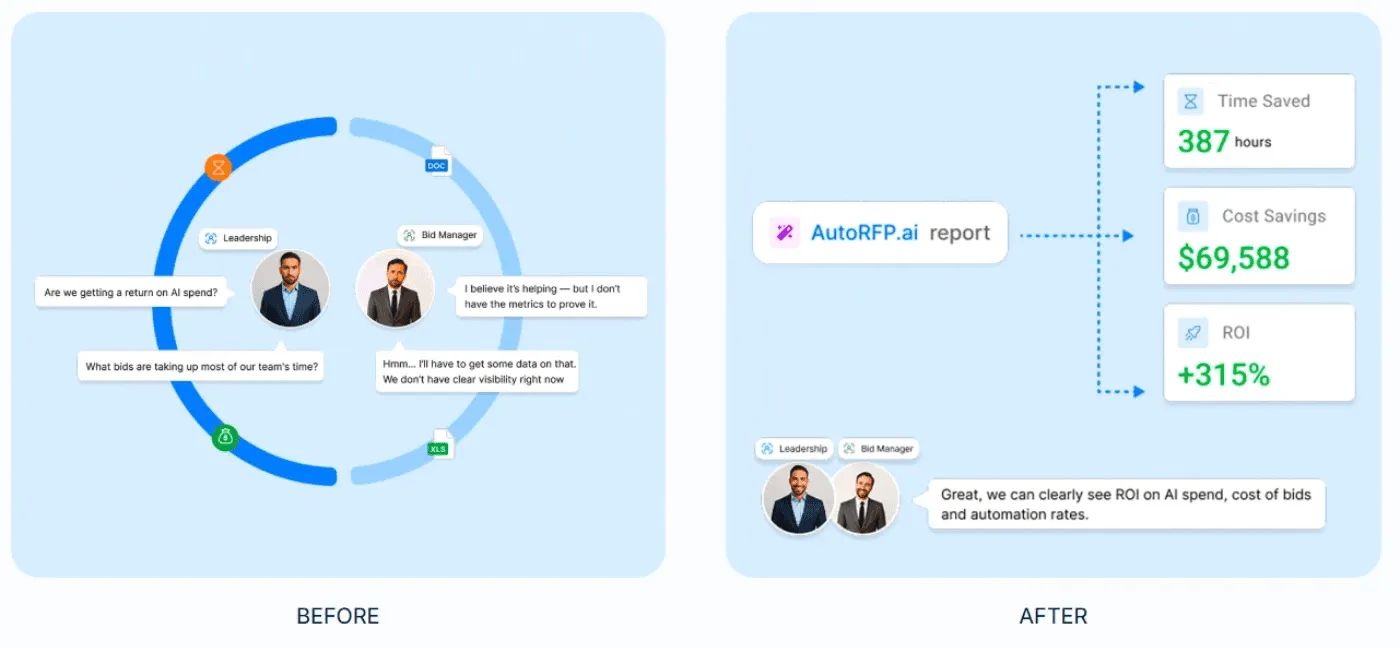
MedeAnalytics described their pre-RFP project managed world as ‘herding cats.’ Without clear ownership, their Sales Operations lead Katie Huff was spending hours chasing contributors across departments, manually tracking progress, and watching deadlines close in with no system keeping anyone accountable.
“AutoRFP.ai has been one of the most life changing tools that I’ve used in my career.” — Katie Huff, Sr. Director, Sales Operations, MedeAnalytics
After deploying AutoRFP.ai, MedeAnalytics eliminated 100% of that administrative overhead.
Challenge #2: SMEs Bottlenecking the Draft
The instinct to put technical SMEs in charge of first-draft writing feels logical. Who better to answer a technical requirement than the product expert? Experience would say otherwise.
SMEs write for precision, not persuasion. They prioritize completeness over competitive differentiation. Proposal teams inherit a patchwork of styles, jargon, and incomplete answers that need full rewrites under deadline.
The risk isn’t just inefficiency. It’s that SME-led drafting fragments the proposal’s strategic voice at exactly the moment it needs to be sharpest. The fix is structural: the proposal team owns the narrative, SMEs validate for technical truth.
SugarAI hit this wall hard, experiencing unsustainable volumes with each question consuming 20+ minutes of engineering time.
“A lot of the security questionnaires we get can contain 500–2,000 questions. These were sometimes taking several hours to complete. There were always 15–20 questions that required our Subject Matter Experts, using up their valuable time.”— Shana Sweeney, Executive Leader, SugarAI
AutoRFP.ai helped SugarAI automate 90% of the initial response work. The result: 15 of their top 25 enterprise customers won through that leaner, faster RFP process through just one team managing their global RFP volume.
Challenge #3: Content That Lives Everywhere and Helps No One
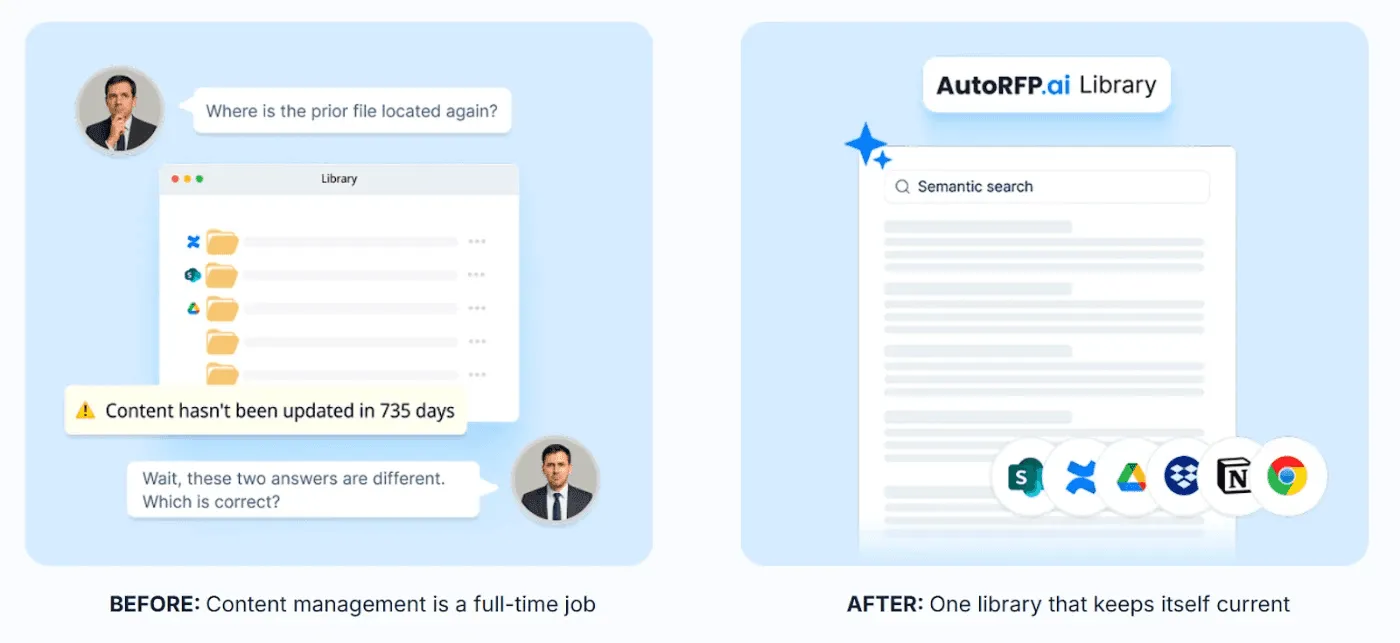
Most mid-market B2B teams respond to RFPs while their best content is scattered across shared drives, email threads, old decks, and someone’s local folder. Every new bid requires a full excavation with no guarantee what surface is current, accurate, or the version that actually won.
Legacy RFP software tried to solve this with content libraries. But the maintenance burden quickly became the new problem.Teams spent more time tagging, organizing, and auditing the library than responding to bids. The tool that was meant to save time created its own overhead.
AutoRFP.ai’s software takes a different approach. There’s no need for teams to maintain a library upfront because it learns from every approved response automatically. Every submission that gets signed off feeds back into the system, improving future AI-generated answers over time.
Workforce.com was caught in exactly this cycle. Managing responses across multiple product suites for a global market had the team locked in repetitive content creation with no scalable path out.
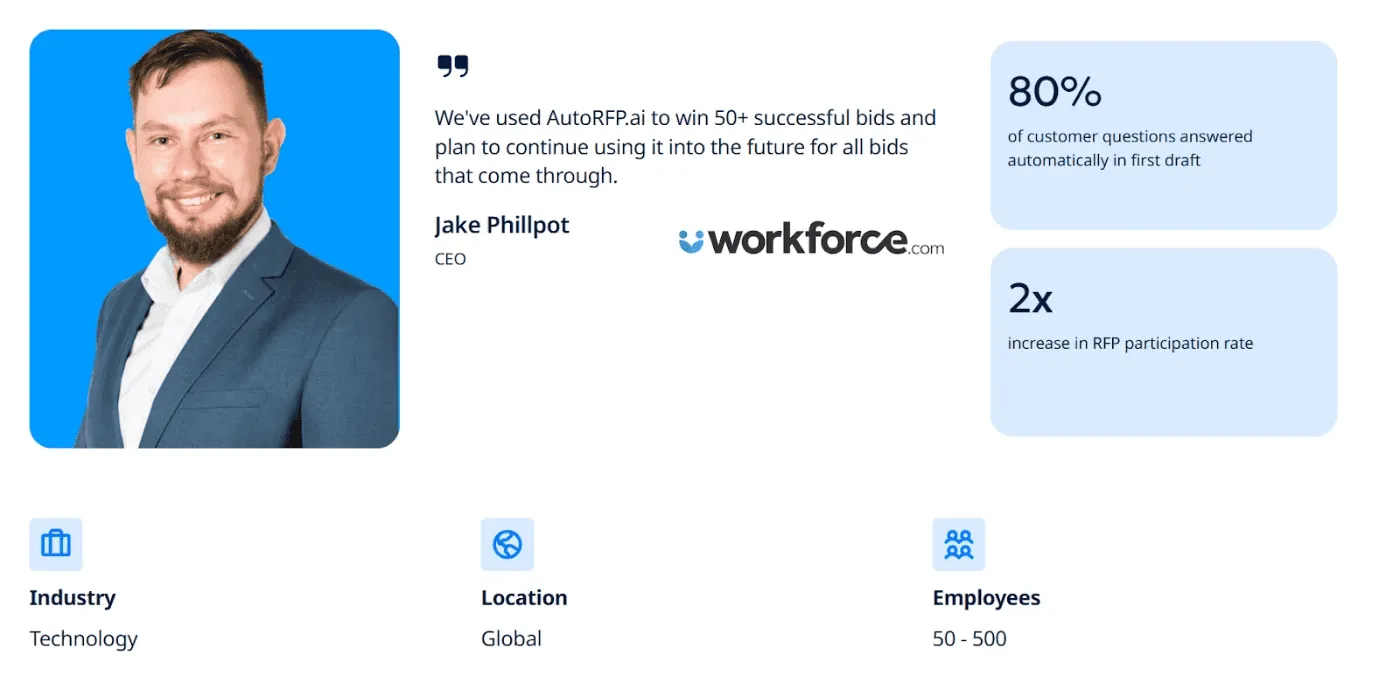
I’m really impressed that when we go and bid with AutoRFP.ai, in most cases 80% of the questions the customers have are answered with the first instance. — Jake Phillpot, CEO, Workforce.com
AutoRFP.ai helped Workforce.com double their RFP participation rate and close 50+ successful bids on the platform without adding headcount or building a content library from scratch.
Challenge #4: Timelines That Ignore the Reality of Coordination
A 10-day RFP window looks workable on day one. By day seven, with three contributors who haven’t submitted their sections, a compliance review still pending, and SMEs unreachable, it becomes a crisis managed in real time.
Most RFP timelines are built backwards from the submission deadline without accounting for the actual coordination load: review cycles, SME availability windows, the legal teams’ sign-off, and the inevitable scope clarifications that arrive mid-process.
Effective bid management means building timelines forwards from the moment the RFP lands with realistic buffers and hard internal deadlines set 48 to 72 hours before external submission.
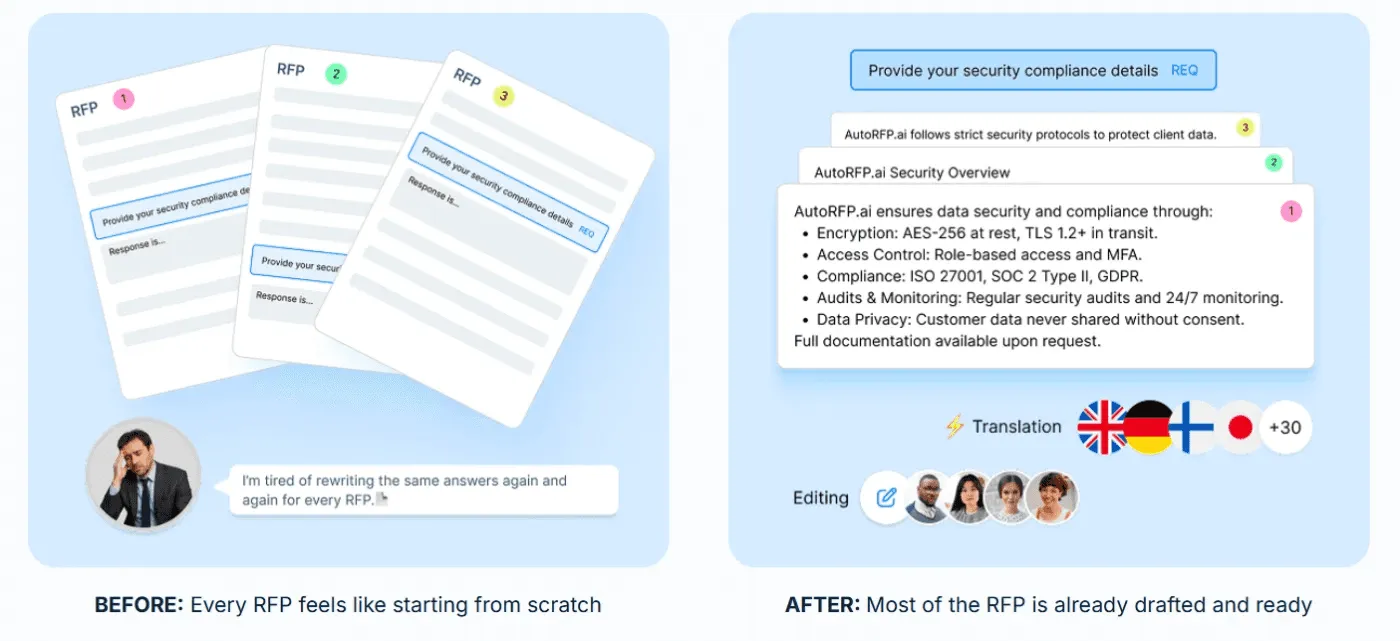
Fiddler AI’s breaking point came when their COO spent far too much time on a single government RFP.
“The COO was working on an RFP for a government contract, and he spent the entire weekend, about eight hours, answering this one RFP. We knew this wasn’t scalable as we continued to grow.” — Amanda Bell, Senior Manager of Revenue Operations, Fiddler AI
After implementing AutoRFP.ai, that same class of security questionnaire dropped from 30 collective hours to 3 to 4. That’s an 87% time reduction.
Challenge #5: Volume Outpacing Capacity
This is the silent performance killer. As RFP volume grows, teams absorb the load through sheer effort spent on longer hours, faster turnarounds, and fewer quality checks. Win rates don’t collapse immediately, so the problem stays invisible until it’s critical.
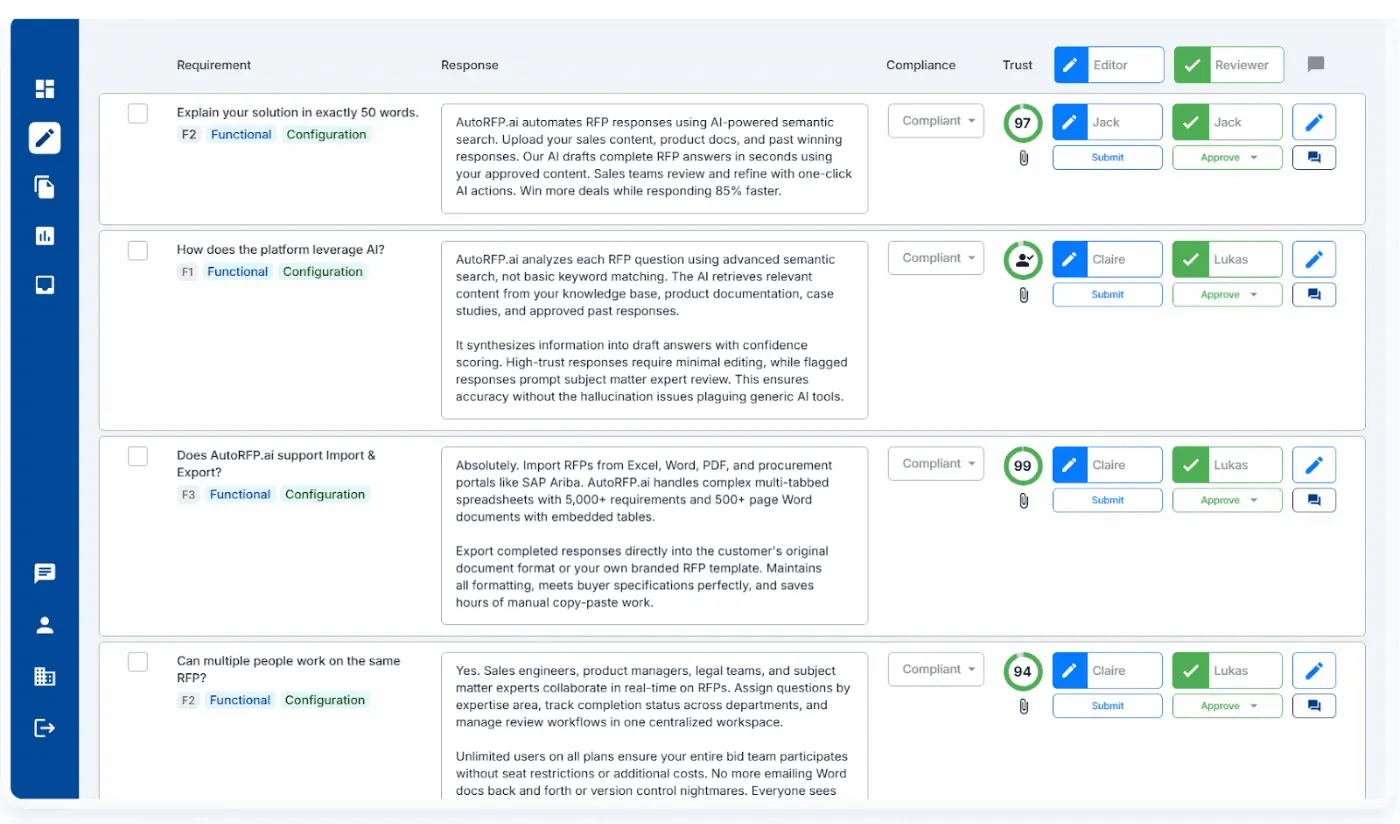
A 2026 study shows that this is unambiguous:
“Performance collapses when volume per FTE rises beyond sustainable thresholds. Teams managing high bid loads without proportional capacity demonstrate the weakest win rates in the dataset regardless of maturity, experience, or how good their writers are.”
Overload degrades the quality of responses in exactly the areas that matter most: customer insight, win theme development, tailored narrative. The bid goes out. But it has no edge.
Benefits of a Well Optimized RFP Project Management Process


Video transcript
So you've just received an RFP. Maybe it's the first time you're doing it. Potentially you're an experienced bid manager, and you wanna understand what is the RFP management process, like process, challenges, and how do you win these highly competitive and challenging bids? In this video I'm gonna show you through the exact RFP management process, challenges, share with you some data in relation to winning bid teams and how they win these complex bids that can really elevate your business. Let's jump into it So why does RFP management matter? An RFP or request for proposal is when a large organization, let's say an enterprise with 10,000 staff, or federal government body wants to procure products or services. Where RFP management matters is we surveyed with between AutoRFP.ai and Stargazy over ninety-seven bid professionals in our twenty
twenty-six proposal win rate report. You can find the link below if you wanna have a look yourself of the proposal win rate report. In this report, we found that fifty-one percent of teams without content automation sit in the low win cohort. So in our RFP management video today, we're gonna go into content automation. We're gonna talk about how ninety-four percent of high win teams use joint collaboration with their subject matter experts, not having the subject matter expert drafting. And where this all matters is the median shortlist rate. So the rate of which your RFP makes it to the next stage and isn't disqualified is sixty-three percent for high win teams versus thirty-eight percent for low win teams. So the teams that have very strong RFP management processes and structure, not only are they winning more, but they're making it through the RFP process to the next step almost double or triple the rate of other teams with content automation, joint collaboration with SMEs, and a lot of other things.
So let's jump into it. But before that, I wanted to leave you with this quote: " Most teams lose RFPs because their system is perfectly designed to produce the results they currently achieve." That was in the Proposal Win Rate report from Christina, the founder of the Stargazy community, a bid manager community, and that really stuck with me, is that if you have a poor system for your RFP management and response, you are setting yourself up to fail, which is why RFP management and systems and processes matter a lot more than heroic efforts one-off bid that you spent, hours and hours fine-tuning. But actual process and repeatable ways to win will get you and your business more revenue than just the one-off effort of trying to win a random bid. And finally, sixty-five percent of the bid teams that win the most
use AI proposal tech, which is what Audirfp.ai is and where I'm from. So what is RFP management? RFP management is how you organize everything that happens between receiving an RFP and submitting your response. Think about it could be everything from when you first discover an RFP on a public tender notice board. Let's say it was for a public tender notice board. Receiving an RFP and submitting your response. It involves people, content, and process. So what is the RFP management process? It starts off with a kickoff meeting. When you see it or you receive that private or public RFP, think about who needs to be involved. Get executive stakeholders on board quickly, especially if it's a very highly competitive and commercial bid. What is the response strategy? How are we going to make our response best fit for the evaluation criteria to win the RFP? Draft and assign. Who is doing what section?
How are we going to complete those sections? And overall, what does a great first draft look like? That is where AI can help the most. Review and submit. Who gets final say on the pricing and commercial? Who gets final say on legal? Who gets final say privacy, security, and compliance measures? Make sure that's clear from the start, and be ready when you have your first draft and everything is ready to be reviewed, that it can be submit cleanly to the right people at the right time. Audit and analyze. Something we don't do often enough in bid management is think about how could we do better with this bid? What feedback can we do, and how can we improve for next time? Which leads into that next one, continuous improvement, and that is the difference between a one-off effort and a systematic approach to RFP management and bid response that will get you to win bid after bid versus just that random one bid that you were lucky to get. An effective kickoff meeting does not just rehash to everyone
exactly what the RFP is saying. It is about establishing clear deadlines, where we talked about who is going to submit each answer each section, who's gonna draft each section, who's going to review each section. That's where you wanna have all those people there to establish clear deadlines for each of those contributors. Then you should already have somewhat of an understanding here, but this is where you can kinda lean on the people in this meeting to develop win themes. A win theme is what is your clear competitive advantage or way that you are going to structure your response with persuasive writing, with clear customer stories, that will get you the win in this RFP. For instance it could be an enterprise that cares a lot about security and privacy, and it could be based in the EU, is looking for a vendor who meets certain requirements. And you could be the only vendor, and you may know that you're the only vendor who meets the high-level requirements in relation to security and privacy, and you believe that's a competitive advantage for your company and for this bid.
Overall make sure that you plan all your supporting documents, so everything that the final submission should include. And you can use like an RFP checklist. We've got a pre-submission checklist in the links below. But you can use a pre-submission checklist to make sure, again, all of that is taken care of when you go to submit. And then assign a single project owner who drives accountability. This would often be a bid manager or at least, or a project manager, someone who is keeping an eye on all the deadlines. Clarification questions is an often overlooked part of the RFP process that can really help you understand that buyer and should be used every time. What you don't wanna be doing is submitting a question for the sake of submitting a question. Don't ask something that is very clear in the RFP. That could reflect negatively. But do think of some useful questions, that you can submit back to the buyer that will, help understand their current solution better and what they're currently doing. Map requirements to identify capabilities.
You could look at, for instance, there could be Moscow ratings, there could be mandatory nice to have, must-have, and so on. But each of those requirements you can compare to, evaluation criteria, and you can look at where do you stack up. But every single one of those requirements, where do you stack up just at a first glance? Even better is that step is in your AI go, no go or your go, no-go process before you even start to bid on, start contributing resources. You've already seen if you're actually a good fit for this bid before jumping headfirst. Build a response plan with section owners, deadlines, and review cycles. We discussed that just before. And decide your competitive angle before writing a single word Now, drafting response and assigning owners.
So this is where we actually start to write. So each of the reviewers and writers they begin to work. Use real-time collaboration so multiple people can work simultaneously. You never wanna have a bid that only one person can access at a time. That's not very conducive to strong teamwork. Pull from your your content library for common questions instead of writing from scratch. So at the start of the video, I mentioned how a strong content library often underpins a winning bid team, and here is the time that you can use that. So if you have pre-filled answers or approved answers in regulatory environments that you can pull from readily to answer common requirements, then this is where you use that. Make sure, though, you're not just mindlessly copy and pasting. Make sure that where appropriate, you're weaving in that win theme throughout the RFP and bid response. AI tools, and this is where a company like and product like ours, AutoRFP.ai, really shines, is generating that first draft.
AutoRFP will demonstrate a first draft in a matter of seconds from a blank RFP document and it'll leverage your content library for that, really speeding up the RFP response time, increasing participation rate, and giving you more time to write even stronger and better responses. So it goes into kind of like an AI feedback loop to continuously improve your responses. That can be one part tooling, and tooling can be one part of your RFP management process and response process that can really underpin a winning strategy. Some larger bids and structured processing involve a different colored reviews, where it goes through multiple and sequential reviews of different sections for relevant people. One trap around reviewing is making sure that the value of the bid and that win theme isn't lost through people's opinion. If you have ten different people review a section, you're gonna have ten lots
of different feedback and potentially some of them are contradictory or some of them are the same. But you wanna make sure that, of course, you're applying feedback if they're experts in that space. But you as the editor or project owner of that section should ensure that the win theme and what makes that a winning bid isn't lost. That's the review trap And finally, just before you go to that final review, run your pre-submission checklist, spelling, grammar, compliance, consistency and so on. And again, in the description below, we've got our pre-submission checklist that you can download for free, and that can be part of your winning process. Finally, we've now submitted that RFP. So some kinda top-level metrics that you should track is your stages the bid goes through. How many do you not bid for because it wasn't a good fit? That's a good thing to measure. Make sure there's endless opportunities, but you wanna bid what actually makes sense. The ones that you bid for, what were the outcomes of those b-
The ones that you bid for, what are the outcomes for those bids? Was it won? Was it lost? Did you withdraw? Did you stop the bid because of resourcing issues and never submitted it? Next level, once you have that data in terms of the status of your bids , is what were the size of the bids and what was the cost of the bid? That's a really tricky thing to measure. There's some great resources out there around cost of bid, but effectively you wanna make sure that these bids are profitable. So if there's a ten percent chance on a ten million dollar bid, but it costs two hundred grand to bid, that's a really tough one to make. And then also make sure that, you wanna make sure, in a good system or a good AI RFP software like AutoRFP or other software out there in the RFP software market, should automatically be using your responses that you're working on and add them into your library and intelligently store that and categorize that content so it can be used for next time. That's where it's really important to consistently write better and
better, and your content library kind of builds over time, and your systems are set up to produce better results as your company gets, makes bid management and RFP response and the management, RFP management process a competitive advantage of the company And finally, continuous improvement. So it's really not out there to ask for feedback, whether that's a private enterprise bid or if it's government bid. Often this may even be posted publicly. But you wanna make sure you get feedback on the bid, and not just on the bids that you win, but the bids that you lose are sometimes more important. You may unearth that you shouldn't have bid on that in the first place, that it wasn't a good fit from the start. You may realize a flaw in your RFP management process and where something needs to be sharpened up for next time. And continuous improvement in your RFP management process implementing that will just kinda make it better and better every time, and that's what really helps companies go from winning the occasional RFP worth a million dollars
to consistently winning million-dollar RFPs and substantially growing the business's footprint in the enterprise so what are some of the common RFP management challenges? Outdated systems and bottlenecks. Thinking about that process is where is the most amount of friction? That could be following up people to review. So you're always having to message them and be like, "Hey, can you review a section? This was due yesterday." It could be that your content lives in ten different systems. You can never find the right answer. It could be technical docs. It could be SharePoint. It could be Google Drive or whatever. And then and then content library paralysis. So if forty percent of saved references may reference outdated information, no one has the full data to update them. Now, here's some best practices to help you win RFPs consistently and land those million-dollar contracts. Automate the repetitive work. AI has come so far and can help out in particular places of the RFP management process.
Whether it be automating the repetitive work of a first draft and finding the relevant information out of your content library, AI is incredibly strong in that. AutoRFP.ai customers consistently get eighty percent plus AI first draft rate off their existing content, and you wanna make sure that standardized templates. Centralize everything, so it's easy to find the right and source the right information. Cross-functional collaboration, multiple people can edit at once. Reviewers it's easy for someone to review. It's an easy-to-use system. You don't want some clunky software that they have to log in, and an SME can never use it, and therefore, they hate having to help you on an RFP. And track performance metrics automatically. Every time you are moving through your CRM or your relevant software, these opportunities that the bid software is also updating, or at least your bid process data is there. Automating routing questions to the right SMEs, so you don't have to think about who should this go to. Real-time progress tracking so nothing falls through the cracks, and automatic importing of different documents to get a really high level of AI first
draft, and trust scores telling you which answers need human review. So the AI is doing a lot of heavy lifting. That's kinda what AI RFP management looks like is the AI is taking care of that manual work, and the human is coming in to ensure that the win themes are strong, that the pricing is competitive, and that evaluation criteria are met, and they're going to win that bid. All right. What I wanted to leave you with today was a live demo of just the project management capabilities with an AutoRFP.ai and how that can help your RFP management process. So looking in here, we have an RFP project. You can see here that already forty-five of my responses have been submitted and reviewed, nine have been, nine have been submitted but not reviewed, and there's still fourteen left drafted. So I can quickly click into my Drafted, see what ones are left left need to be edited, and then I can look after those as needed. So I can click into my fourteen draft and see, okay, we're still waiting for someone here to to submit those, and I can go in, submit, and make changes. So it's a very easy kinda multiplayer capability, seeing where everything's at.
Can go to my Project Overview and see that the project is due in five days. This is everyone who worked on that project, when it's due. My first draft was highly AI automated, ninety-seven point one percent draft. And overall we have sixty-two percent exceed compliance, thirty-five percent fully compliant, and I can quickly see what response is partially compliant and understand why that's partially compliant and kinda review that. By just having one look and a couple of clicks, I can see, against the evaluation criteria, what responses need to be improved or where we're potentially weak on this competitive bid before having to really do a lot of work. I can see project attachments and everything else going into this bid. And so that's what a project overview dashboard for a competitive bid looks like. If you wanted to have a look at AutoRFP and give it a try, you can go to our website autorfp.ai. Here, you can have a look and learn more about our product and everything else that kind of goes into it and what kind of automation rates our customers are achieving with autorfp.ai. And you can also book a demo to spend time with our team, and in this demo, they'll
provide a really guided walkthrough of the platform, help understand your business, and see really if it's a good fit or not. Thanks. I'm Rob from autorfp.ai. Hopefully, that was helpful in relation to your RFP management process. See ya.
Getting RFP management right isn’t about administrative tidiness. It’s a direct performance lever with measurable commercial impact.
Impact #1: Faster Response Cycles Without Sacrificing Quality
Structured project management compresses timelines by eliminating wasted hours in:
Hunting for content
Chasing contributors
Rewriting SME drafts
Running emergency last-minute reviews
When roles are clear, content is accessible, and timelines have real buffers, teams move faster by removing this friction.
AutoRFP.ai accelerates this further by automating the first-draft stage entirely. When an RFP lands, the AI immediately generates draft responses pulled from existing content and prior approved submissions. Your team gets a working document to refine, not a blank page to fill.
| 2xRFP participation rate — Workforce.com | **87%**time reduction per questionnaire — Fiddler AI | **90%**initial response work automated — SugarAI |
|---|
Impact #2: Higher Quality Submissions That Actually Win
Capacity saved on drafting is capacity redirected to strategy.
When bid managers aren’t writing from scratch or hunting for old answers, they focus on the elements that actually move evaluator scores such as:
Win themes that speak directly to the prospect’s priorities
Differentiated narratives
Responses that demonstrate genuine customer insight
Teams combining content automation with systematic insight routines are 3x less likely to sit in the bottom tier of win-rate performance. That’s the compound effect of automation software plus insight plus content reuse. By understanding the core principles of how to win a bid, teams can redirect the time saved by automation into high-impact strategy and differentiation.
Impact #3: A Scalable Process That Gets Better Every Time You Use It
A well-structured RFP project management process compounds over time in these ways:
Repeatable workflows mean every bid runs faster than the last
Approved responses feed back into your content system
Lessons from wins and losses sharpen future Go/No-Go decisions
The infrastructure improves with every cycle
This structural advantage is what separates high-volume winning teams from teams stuck in permanent reactive mode.
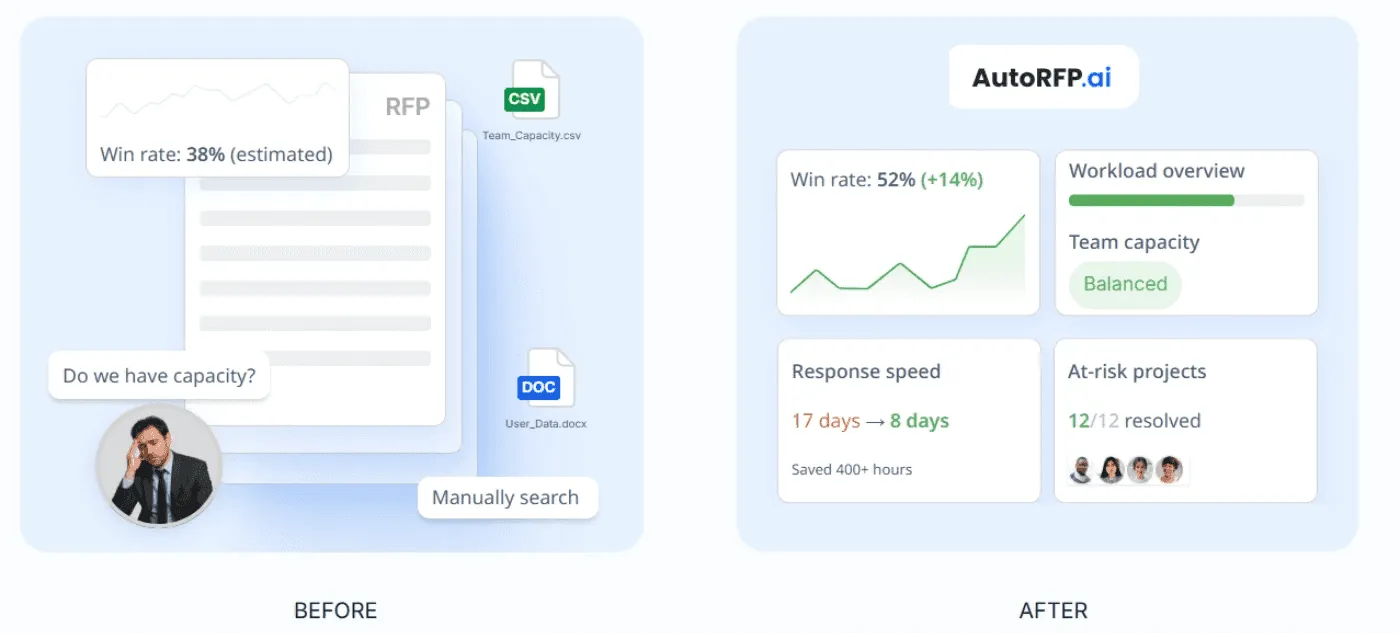
As AutoRFP.ai CEO Jasper Cooper puts it, “The real advantage isn’t simply automating content. It’s what teams do with the time they get back. The winners use it to invest in their processes and provide more insightful responses.”
RFP Project Management Optimization Strategies (By Experts)
Here are the best practices that consistently show up in high-win teams, backed by the data and validated by practitioners in the field.
Strategy #1: Run a Disciplined Go/No-Go Before Every Bid
The fastest way to improve your win rate is to stop responding to RFPs you were never going to win. Every low-fit bid your team says yes to is time, headcount, and strategic capacity stolen from an opportunity you could actually close.
A rigorous Go/No-Go evaluates prospect fit, competitive position, insight advantage, team capacity, and whether you can articulate a compelling reason to win. If you can’t answer those questions confidently before kickoff, you have no business committing to a response.
“Winning sales teams use a data-driven Go/No Go qualification matrix. The matrix helps them know if the opp is a good bid or a dud. Without it, we’re either closing churn or something unwinnable.” — Christina Godrey Carter, Founder, Stargazy
71% of high-win teams enforce a formal Go/No-Go qualification step. The difference between high- and low-win teams is whether leadership actually holds the line on their processes. High-win teams disqualify more often, bid fewer low-fit opportunities, and concentrate resources where they have genuine competitive advantage.
AutoRFP.ai’s AI Go/No-Go feature scans an incoming RFP and generates a structured bid/no-bid analysis in minutes by surfacing fit gaps, flagging compliance risks, and giving bid managers a defensible decision framework without hours of manual analysis.
| Criteria | Ask Before You Commit |
|---|---|
| Strategic Fit | Does this prospect match our ICP? Do we have relevant reference cases? |
| Competitive Position | Do we have a genuine differentiator, or are we filling capacity for its own sake? |
| Insight Advantage | Have we spoken with this prospect? Do we know their evaluation criteria and priorities? |
| Team Capacity | Can we absorb this bid without degrading quality on concurrent opportunities? |
| Win Theme Clarity | Can we articulate in one sentence exactly why we should win this specific RFP? |
Strategy #2: Assign Roles Before Kickoff, Not During the Bid
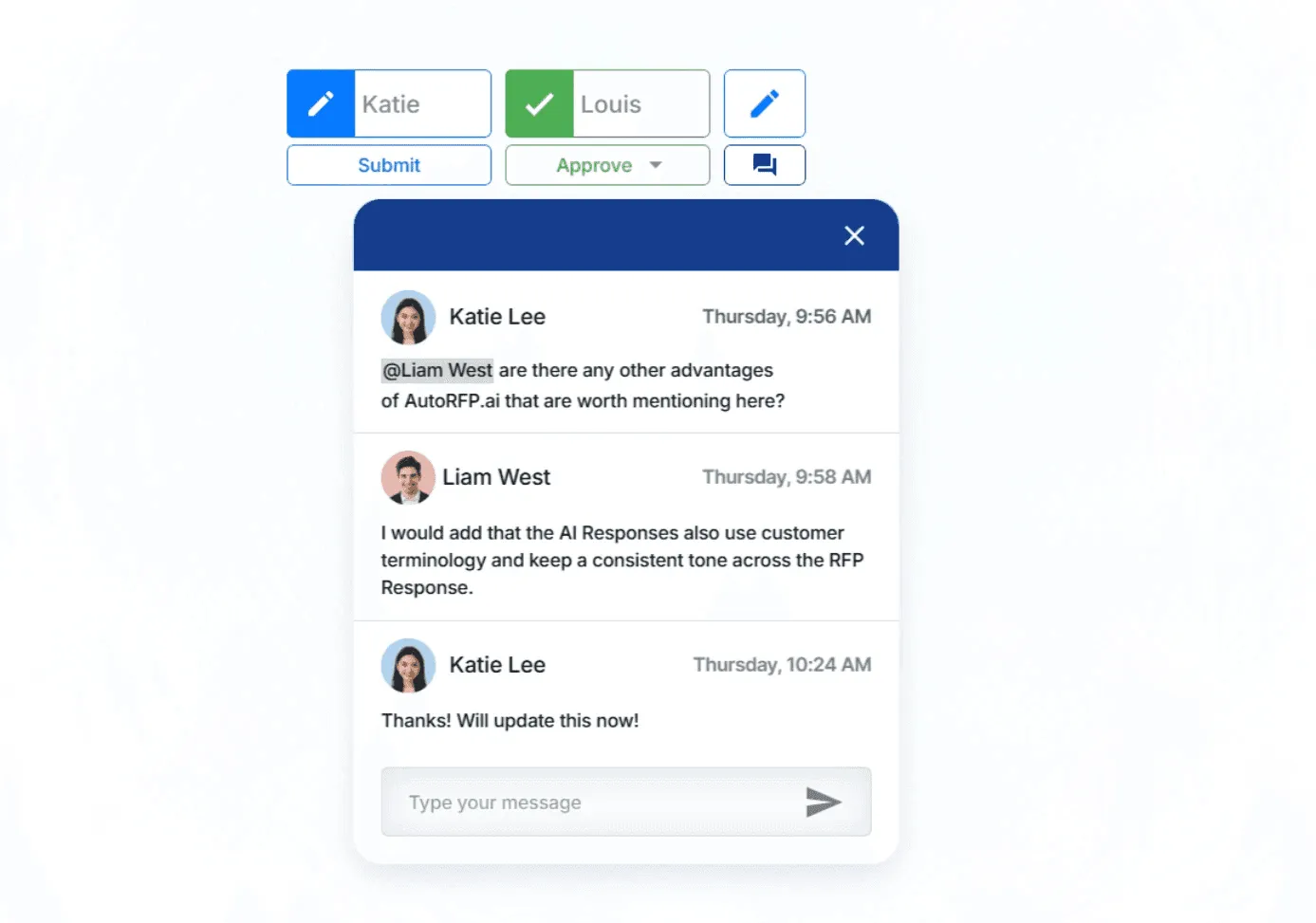
Every bid should launch with a kickoff that assigns explicit ownership: who writes each section, who reviews it, who holds final approval authority, and what the internal deadlines are. This sounds obvious but it isn’t standard practice.
One of the most common failure modes in RFP project management is roles that are assumed rather than assigned. The gap only surfaces at the review stage, too close to submission, when there’s no time to fix it.
So, what’s the structure that consistently correlates with high win rates?
Proposal teams that own the first draft
SMEs validating technical accuracy
Bid manager owning the narrative coherence and final review
In fact, studies show that SME-led drafting correlates with the lowest win rates in the dataset.
MedeAnalytics eliminated their entire administrative follow-up burden after implementing AutoRFP.ai’s built-in project management. Automatic assignment, progress notifications, and clear ownership tracking replaced the manual coordination cycle entirely.
Strategy #3: Define Win Themes Before Anyone Writes a Word
Win themes are the strategic arguments that tie your entire response together. They answer the question every evaluator subconsciously asks:
“Why should we choose this vendor for this specific requirement?”
A win theme is not a feature list. It’s a proof-backed argument that links your specific capability to the prospect’s specific problem. It’s differentiated from competitors and expressed in the prospect’s language. One win theme per major evaluation criterion is the target.
Define win themes at kickoff before a single section is drafted. When every contributor knows what strategic argument their section supports, the responses cohere into a case rather than a collection of answers.
Without defined win themes, you get individually competent responses that fail to make a compelling cumulative argument.
Key Data: Teams that formalize win themes before drafting begins show measurable shortlist rate improvement across every sector. 71% of high-win teams use formal win themes consistently. Among low-win themes, the number drops sharply and that gap compounds with every bid run without them.
Strategy #4: Automate the Boilerplate to Protect Strategic Time
The most valuable hours in any RFP response are the ones spent on customer insight, win theme refinement, and tailored narrative. These are the elements that move evaluator scores. They’re also the elements most likely to get cut when teams are under time pressure.
Automating the first-stage draft protects the team’s time for work that automation cannot do such as:
Understanding the prospect’s real priorities
Crafting a narrative that positions your solution compellingly
Making the judgment calls that turn a compliant response into a winning one
AutoRFP.ai generates 80%+ usable AI-drafted answers from day one, connecting to your existing content sources (such as Google Drive, Confluence, SharePoint, Notion, and Salesforce) so the response engine draws from your most current, accurate information. Your team reviews, refines, and redirects. The machine handles the first draft. Your team handles the strategy.
Fiddler AI validated this in one practice. Across Q1 2025, 63% of all AI-generated responses required zero or one-word changes. Not a rough draft to rewrite but a near-finished answer that freed their team to focus entirely on differentiation.
“The dread of a new Security Questionnaire hitting our inbox is gone. AutoRFP.ai makes the process so much easier, the workflow is a breeze and we haven’t lost weekends to RFPs since.” — Amanda Bell, Senior Manager of Revenue Operations, Fiddler AI
Strategy #5: Review in Layers, Not All at Once
Last-minute all hands document review are an antipattern. When everyone reviews everything simultaneously, issues compound such as:
Formatting conflicts
Inconsistent messaging
Factual errors
SME corrections across different document versions simultaneously
Structured bid teams use layered reviews which include:
A technical accuracy check from SMEs at the section level
A narrative coherence pass from the bid manager at the document level
A compliance check confirming every requirement has a direct answer
These happen sequentially, each with dedicated time.
AutoRFP.ai supports this model with inline commenting, section-level approval workflows, and version tracking so reviewers work their specific layer without creating the version chaos that kills late-stage bids.
Strategy #6: Replace Manual Content Hunting with Semantic Search
The hours bid teams spend hunting for prior responses and relevant content is one of the most expensive wastes in the RFP process. It is also one of the most avoidable.
Legacy RFP software used keyword search. You needed to know exactly how an old answer was tagged to find it. Search for ‘GDPR compliance’ and you’d miss everything filed under ‘data protection’ or ‘EU privacy.’
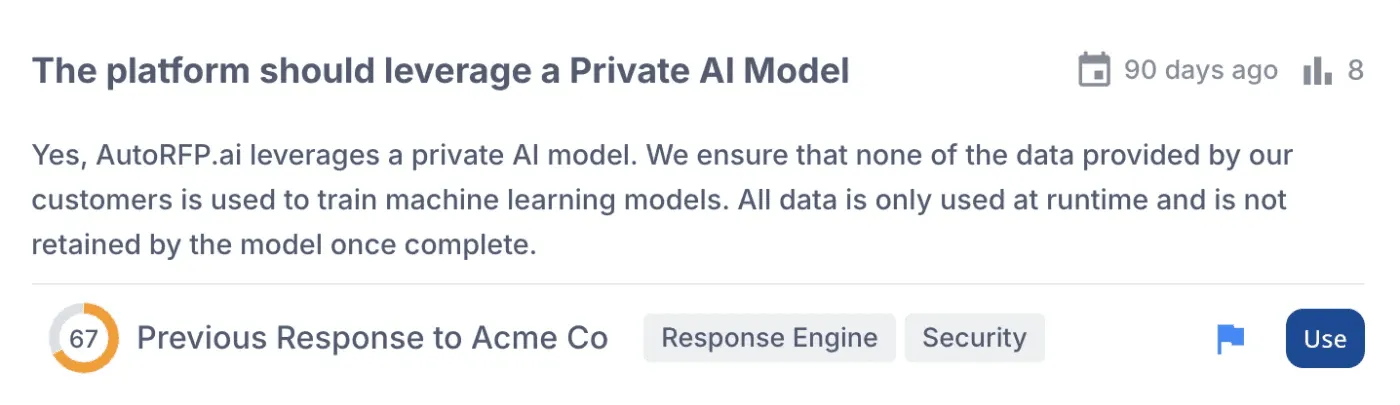
AutoRFP.ai uses semantic AI search. It understands the intent behind a question and surfaces conceptually related content across your full response history, regardless of how it was originally tagged or worded.
This removes a significant coordination burden from bid managers. It also means AI-generated first drafts are grounded in accurate, contextually relevant content from day one.
Optimize The Management of RFPs & Responses with AutoRFP.ai
RFP project management is only as good as the system underneath it. Clear roles, structured timelines, win themes, and layered reviews require a platform that keeps teams aligned, content accessible, and progress visible without adding friction.
AutoRFP.ai delivers this by automating first drafts, learning from approved responses, surfacing content through semantic search, and managing end-to-end collaboration.
The result? A bid management process that gets faster, sharper, and more reliable with every bid you run.
If your bid management team still relies on email, clunky legacy tools, or Excel sheets, the process you have now will not scale to the growth you’re targeting.
Book Demo with AutoRFP.ai to see the platform in action or explore AutoRFP.ai’s features to see how it fits your workflow.
Data in this article is drawn from the 2026 Proposal Win Rate Report, a survey of 97 bid professionals covering win rate cohort analysis, capacity benchmarks, and the structural patterns behind sustained high performance. Download the report for the full data.
About the author

Co-founder & CEO
Co-founder and CEO of AutoRFP.ai. Spent 7 years running global RFPs and personally completed 500+ RFPs before founding the company.
LinkedIn