Win Themes: How to Create Bid-Winning Themes in 2026
Learn what win themes are, how to develop them, and how to use them to improve proposal success and RFP win rates.

Co-founder & CEO, AutoRFP.ai··10 min read
Win themes are the lines people repeat in the evaluation room when your slide deck is not in front of them.
They connect the dots between the customer’s priorities, your solution design, and the value you can prove, in a few simple phrases that feel specific and credible.
When they are missing, evaluators see a lot of detail but not a clear reason to choose you.
In this article, we’ll look into what win themes are, why they matter, and the core components behind them. Win themes sit inside the customer-insight stage of response strategy for high-value bids, before serious drafting begins.
You’ll learn how to develop effective win themes, best practices, examples of weak vs. strong versions, common mistakes to avoid, and how an RFP automation tool can help you win more RFPs with strong win themes.
According to the 2026 Proposal Win Rate Report, where AutoRFP.ai surveyed 100+ winning bid teams. We found that teams that win over 50% of their RFPs, 71% use win themes. Compared to teams with less that 50% win rate, only 42% use win themes.
Winning teams use Win Themes. It’s a solid way to drastically improve your bid win rates.
What Are Win Themes?
Win themes are concise, persuasive statements that tell the evaluator, in plain terms, why you should win over your competitor based on what they care about and how they’ll score the decision.
They’re strategic because they translate the buyer’s priorities, desired outcomes, and decision criteria into a few repeatable claims you can prove across the entire proposal.
A win theme isn’t “we have X feature.” It’s “because you need Y outcome. Features are supporting details. Win themes are the decision logic.
Example statement:
- **ROI: “**We will reduce processing time by 30% within 90 days by automating the highest-volume stepsfirst, backed by baseline metrics and a measured benefits plan.”
Once set, these statements become the foundation for all proposal messaging. Every section should reinforce and prove them.
Why Win Themes Matter in Competitive RFPs?
Let’s look at the key reasons they matter and how they shape stronger, more focused RFP responses.
| Impact of win themes | What it changes (and why it matters) |
|---|---|
| Better evaluator scoring + shortlist odds | Win themes move evaluation outcomes by giving evaluators clear, evidence-backed reasons to award points, improving shortlist probability, and driving win-rate uplift. |
| Measurable win-rate uplift | Teams with defined win themes average 37% win rates vs. 29% without, showing direct outcome impact. |
| Direct revenue impact | Even a 1% increase in win rate can translate into millions in additional revenue for high-value RFP pipelines, according to AutoRFP.ai’s Proposal Win Rate Report 2026. |
| Proven high-performance behavior | High-win teams use win themes 71% of the time, vs. 42% for low-win teams, suggesting a correlation with disciplined bid execution. |
| Differentiation in competitive bids | When multiple vendors meet baseline requirements, win themes highlight what sets you apart, so you’re not judged as a commodity. |
| Clarity & memorability for evaluators | Evaluators skim dense proposals. Win themes simplify and repeat the key message, making your value easy to recall during scoring and internal discussions. |
| Risk mitigation (proof, not promises) | Strong win themes bundle evidence (metrics, case studies, delivery approach) so evaluators can justify higher scores and feel confident in execution risk. |
| Lower buyer risk with proof | Win themes act as the “golden thread” across sections, keeping contributors aligned and reinforcing a single buyer-relevant story. |
Core Components of Strong Win Themes
Win themes work when they’re built from these elements that evaluators notice, remember, and reward.
1. Evaluator-First, Not Vendor-First
A strong win theme is written in the language of RFP evaluation criteria. It makes it obvious what the evaluator should score you highly on.
2. Built From Real Customer Insight
It comes from capture and discovery, not internal assumptions. High performers win because they embed customer intelligence and defined win themes, not just “good content.”
3. One-Sentence Strategic Message (Clear Enough to Stand Alone)
Write each win theme as a single sentence that would still make sense and feel persuasive even if an evaluator read only that sentence.
4. Capability That Directly Meets Decision Criteria
Tie the theme to concrete requirements and qualifications that prove you can meet the buyer’s must-haves.
5. Differentiator That Competitors Can’t Credibly Claim
Highlight what you uniquely do better (your unique selling proposition) or have access to that rivals can’t match without stretching the truth.
6. Specific Language
Use precise, tangible wording so the evaluator and your writers don’t have to guess what you mean.
7. Outcome-Led
It connects your approach to the buyer’s outcomes (time, risk, cost, compliance, adoption). Not feature lists.
8. Proof-Backed
Every theme needs receipts: metrics, case studies, references, or operational evidence. If you can’t prove it, it’s not a win theme; it’s a claim.
9. Tight Set of Themes (1-3) Repeated Consistently Across the Proposal
Limit themes to a small set so your message stays clear, then reinforce them throughout the response from multiple angles.
10. Risk-Reducing by Design
It should reduce perceived risk by showing control: delivery plan, governance, expertise, and evidence that you’ve done this before.
How to Develop Effective Win Themes (Step-by-Step)
Here are the practical steps high-performing teams use to develop effective win themes:
The end-to-end walkthrough shows how to generate win themes with Claude before the draft, using the buyer’s priorities, stakeholders, competitive field, and evaluation criteria as inputs.
Step 1: Analyze the Customer and the Opportunity
Research the customer’s context and the specific solicitation before you touch drafting.
Build a quick snapshot covering:
customer issues / “hot buttons” (what’s pushing them to act)
motivators + goals (what success looks like internally)
who the decision-makers/evaluators are (and what each likely cares about)
official evaluation criteria (what gets points, what gets you disqualified)
Why it matters: Win themes only work when they’re anchored to what the buyer will actually reward. This step prevents you from building themes around what you want to sell instead of what they need to score.
Step 2: Run a Dedicated Discovery Session With Sales + the Bid Team
Hold a focused working session (not a status call) to align on the deal, constraints, and what’s still unknown.
Why it matters: Win themes live or die on insight. If you skip this, you end up drafting without a coherent narrative and fixing direction late.
Step 3: Pull Out the Evaluator’s Recurring Priorities From the RFP
Identify the 3-4 priorities that show up repeatedly (requirements, scoring language, risk sections, delivery expectations).
Why it matters: Insight is the multiplier that determines whether your content actually influences evaluator scoring.
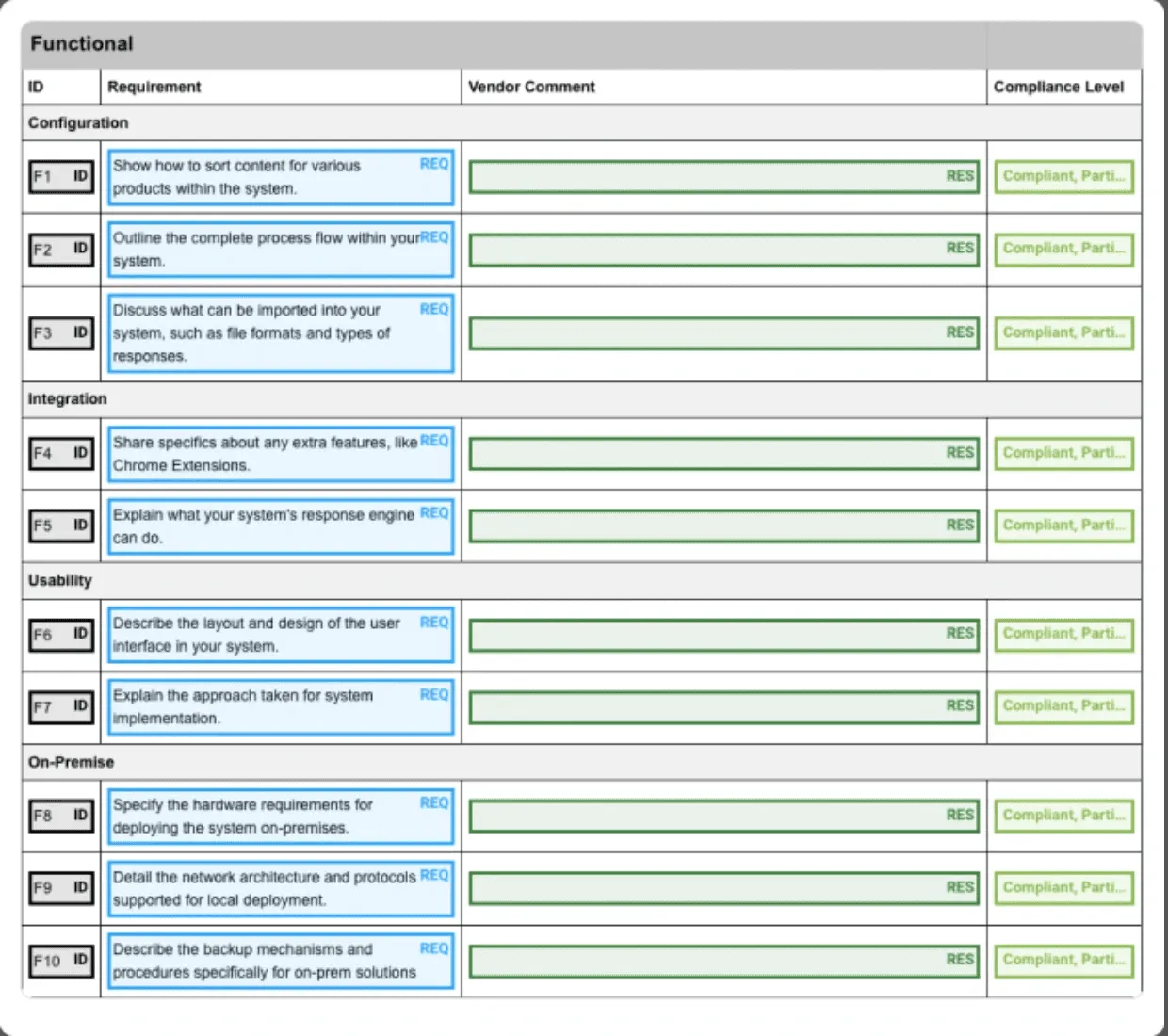
You can use AutoRFP.ai to upload RFPs of any format to identify requirements, sections, and context you need, so you can spot scoring language, compliance gates, and risk areas more quickly before you form themes.
Step 4: Close the “Unknowns” Early (Clarifications + Reasonable Outreach)
Turn gaps into questions, then resolve them through the official Q&A, discovery notes, incumbent intel, or direct prospect contact when appropriate.
Why it matters: Don’t start drafting until insights are documented and approved; you burn time on rewrites instead of polish.
Step 5: Convert Priorities Into “Why Choose Us” Angles
For each priority, map the most credible reason your approach is the safer/faster/better-fit option (process, tools, operating model, outcomes).
Why it matters: High performers win on customer understanding + credible solution fit, not generic writing effort.
Step 6: Do a Quick Competitor Gap Scan
Check competitor websites, case studies, and review signals to see what they routinely claim, then identify the gap you can own.
Why it matters: If you don’t pressure-test differentiation, your “themes” drift into commodity claims that evaluators can apply to anyone.
Step 7: Narrow to 3-5 Win Themes & Keep Them Distinct
Consolidate overlapping ideas and pick the few themes that cover the biggest buyer risks and outcomes.
Why it matters: Evaluators remember and reward what’s clear and repeatable.
Step 8: Attach Proof Points to Each Theme (Before You Write Sections)
For every theme, line up evidence (metrics, case studies, references, delivery approach, controls).
Why it matters: Win themes drive measurable uplifts in evaluator scoring and shortlist probability when formalized early, and even a 1-point win-rate shift can mean millions.
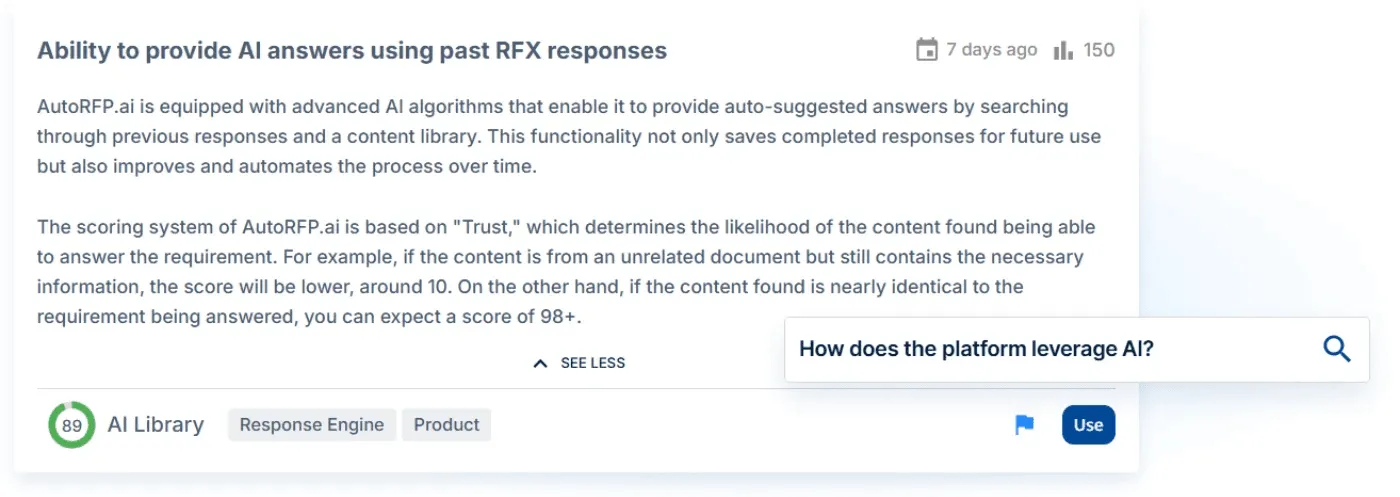
This is where an RFP content library with semantic search helps most: you can pull the strongest approved proof fast (not “whatever someone remembers”), then draft around evidence.
Step 9: Validate with SMEs, but Keep the Proposal Team Owning the Narrative
Use SMEs to verify accuracy, feasibility, and proof; don’t default them into first-draft writing.
Why it matters: SME-led drafting is a strong predictor of low performance; SMEs optimize for precision, not persuasion, and it increases inconsistency and rework.
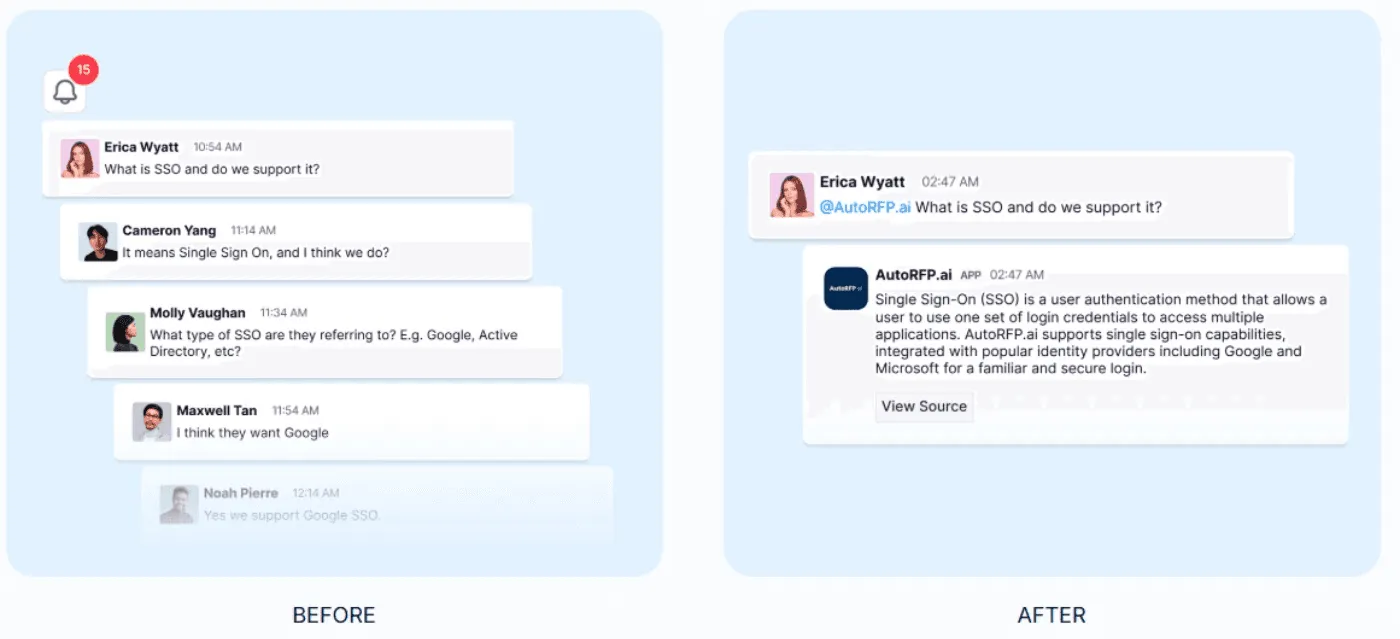
An AI Q&A bot can answer common “what’s our approach to X?” questions (e.g., GDPR, security controls, delivery model) in seconds via web/Slack/Teams. So, SMEs spend time validating only the items that truly require expert review.
Step 10: Thread Themes Through the Full Response With Governance Checks
Make win themes the “golden thread” across the exec summary, technical answers, and proof sections, and ensure they carry seamlessly into your RFP presentation, so your verbal narrative reinforces exactly what you asked evaluators to score.
Why it matters: Structured process is a key separator for winners; win rate is a repeatable operating model, not last-minute heroics.
Best Practices for High-Impact Win Themes
These best practices show how top teams build win themes that resonate with evaluators.
| Best practice | Why it matters |
|---|---|
| Anchor each win theme to a scoring outcome | Win themes should clearly map to what earns points, not just what sounds persuasive. This helps evaluators quickly connect your message to the score they are assigning. |
| Pressure-test win themes early with sales and delivery | Early validation prevents themes that look good on paper but fall apart under technical, commercial, or delivery scrutiny later in the process. |
| Limit win themes to what you can prove repeatedly | A smaller set of defensible themes is stronger than many weak ones. Repetition with evidence builds credibility and recall for evaluators. |
| Use visuals to reinforce win themes | Graphics, charts, and tables highlight key messages and reduce dense text for evaluators. |
| Enforce consistency across all sections and volumes | In long responses, consistency ensures every section reinforces the same bid story. |
Examples of Weak vs. Strong Win Themes
These examples show a side-by-side comparison of weak versus strong win themes.
| Weak win theme (generic/self-centered) | Strong win theme (client-centric/specific) | Why the strong version is stronger |
|---|---|---|
| We deploy quickly, and our setup is automated. | We will meet your go-live date through a phased rollout, pre-built integrations, and a cutover checklist that minimizes operational disruption while keeping users productive from day one. | Adds how you’ll deliver speed, links it to buyer risk (disruption), and makes success tangible. |
| We have an experienced and qualified team. | Our team, with an average of 15 years of experience in the healthcare sector, will streamline your system integration, reducing data migration time by an estimated 30%. | It ties experience to a clear problem, method, and measurable customer outcome. |
| We provide advanced security and 24/7 monitoring. | We support audit success with controls mapped to requirements, evidence-ready reporting, and prioritized remediation that has helped teams close critical findings up to 40% faster. | Shifts from features to compliance outcomes that evaluators can score. |
| Our platform is modern and easy to use. | We improve throughput by simplifying workflows and reducing manual handoffs, cutting administrative effort by 15-25% so teams can focus on higher-value work. | Connects usability to operational efficiency, not subjective preference. |
Common Mistakes With Win Themes
Avoiding these common pitfalls helps ensure your win themes actually influence evaluation decisions.
Vague, generic claims: Using clichés like “high quality” or “strong experience” without specific, verifiable proof.
Late or rushed development: Creating win themes at the last minute instead of through structured, early insight work that pressure-tests win themes before writing starts.
Inconsistent across sections: Different RFP writers tell different stories, so evaluators don’t see a single clear reason to award you the win.
No content plan: Failing to integrate themes into the entire proposal through a storyboard or RFP content management.
Win More RFPs With AutoRFP.ai
AutoRFP.ai’s features will help you win more RFPs by generating accurate first drafts that already reflect your win themes.
It keeps your message integrated, consistent, proof-backed, and easy for evaluators to remember, so your team spends less time rewriting and more time sharpening evidence, reducing risk, and making the “why choose us” feel undeniable.
About the author

Co-founder & CEO
Co-founder and CEO of AutoRFP.ai. Spent 7 years running global RFPs and personally completed 500+ RFPs before founding the company.
LinkedIn