5 Best Loopio Alternatives in 2026 for Winning More RFPs
The best Loopio alternatives in 2026 include AutoRFP.ai, Responsive, Qvidian, AutogenAI and Ombud, compared on AI accuracy, pricing and library upkeep.
Written by

Co-founder & CEO, AutoRFP.ai
- Updated
- Reading time
- 21 min
Loopio boasts a whopping 4.7 stars on G2, but a closer look into reviews reveal overpromised features, clunky imports, and limited language support.
If you’re an existing customer looking to switch or an interested prospect, this deep dive into Loopio alternatives (based on hands-on research and real customer feedback) will point you toward a better fit. If your shortlist also includes knowledge-layer vendors, compare tools that compete with SiftHub and tools that compete with Tribble on RFP automation.
How We Compared Loopio Alternatives
In AutoRFP.ai’s 2026 Proposal Win Rate Report, produced with Stargazy, 59% of high-win respondents used content library automation, compared with 36% of low-win respondents.
That finding makes the way a platform manages and reuses approved knowledge a useful starting point for this comparison. For teams evaluating Loopio alternatives, the practical question is how each platform helps them build on their existing content and keep it useful.
We used the report’s findings on content automation and governance, alongside the practical requirements of evaluating or switching platforms, to shape four comparison criteria.
1. Existing Knowledge and Library Upkeep
An established response library contains answers and expertise that teams have already invested time in approving.
We consider how each platform brings that knowledge into its workflow, makes relevant answers searchable, and captures newly approved responses for future use. Connected-source updates, content ownership, and review controls also help clarify how routine upkeep works and where content managers remain involved.
2. Answer Quality and Source Verification
Reusing content is valuable when the answer remains accurate and relevant to the question.
Our comparison considers whether reviewers can inspect supporting sources, identify content that needs updating, and distinguish supported answers from questions requiring expert input. We also look at how teams can reuse approved wording or adapt it to a buyer’s requirements.
3. Review, Ownership, and Governance
The report found that 65% of high-win respondents had formal review or governance processes, compared with 42% of low-win respondents.
This makes review controls an important part of the comparison. We consider assignments, approval stages, permissions, version history, and audit trails to assess how platforms support clear responsibility for contributions and final sign-off.
4. Migration and Day-to-Day Fit
Alongside the research-informed criteria, we consider library import, implementation support, document handling, integrations, contributor access, and pricing.
We also distinguish between platforms suited to structured questionnaires, complex enterprise response operations, long-form proposal writing, and broader presales knowledge workflows. These differences help readers judge which alternative fits the work their team handles.
The report examines self-reported proposal practices across teams, rather than outcomes from switching away from Loopio. Its findings inform our criteria. High-win respondents reported win rates of 51% or more; low-win respondents reported 25% or less.
| Name | Best for | Standout feature | Price starting point |
|---|---|---|---|
| AutoRFP.ai | Accurate AI responses and automated library upkeep | Source-grounded responses with Trust and Feedback Scores | $899/month (paid yearly) |
| Responsive | Mature enterprise proposal operations | Mature proposal management and cross-functional workflows | From $10,000 |
| Qvidian | Document-heavy enterprise proposal teams | Structured Word, Excel, and PowerPoint document automation | Contact sales |
| AutogenAI | Long-form proposal and tender writing | AI-native proposal writing with built-in research and review tools | Contact sales |
| Ombud | Enterprise presales and response management | OmMatch-powered content matching and response automation | Contact sales |
The 5 Best Loopio Alternatives in 2026
These five Loopio alternatives offer different strengths across AI automation, enterprise proposal management, long-form bid writing, and presales workflows.
1. AutoRFP.ai: Best for Accurate AI Responses and Automated Library Upkeep
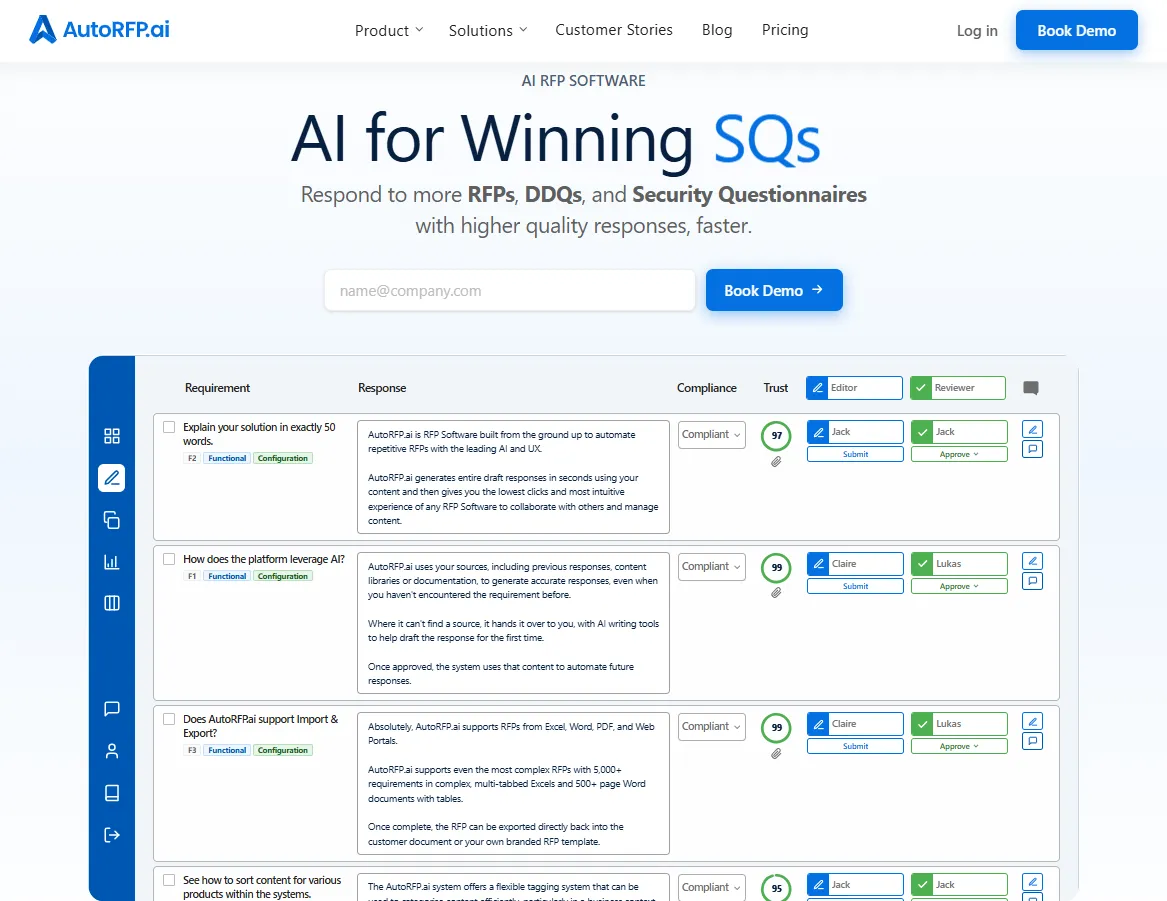
AutoRFP.ai is the accuracy-first, AI-native platform for RFPs, security questionnaires, and DDQs: every answer is written from content your team has approved, and shows the sources behind it.
For teams considering a Loopio alternative, AutoRFP.ai builds on the library and expertise they already have. Existing answers become the foundation for AI drafting, while approved-response capture and connected-source updates help that knowledge grow and stay current.
AutoRFP.ai is a strong fit for teams prioritizing source verification, answer-quality checks, and automated library upkeep with content owners still in control.
Key Features
1. Source-Grounded Responses With Trust and Feedback Scores
AutoRFP.ai is built for zero hallucination by design: its response engine drafts from approved company content, cites the supporting sources, and flags questions it cannot support for human input.
Each generated answer carries two separate review signals. The Trust Score reflects the strength of its supporting source material, while the Feedback Score evaluates how fully the draft answers the requirement, including relevance, clarity, and appropriate detail.
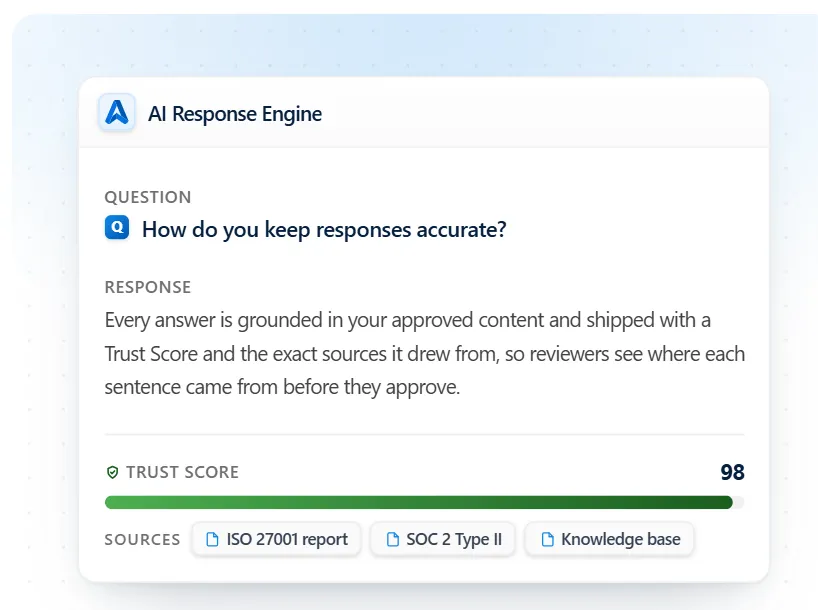
Reviewers can inspect the supporting passages and source dates, then prioritize answers needing attention. Approved content also guides tone and structure, helping responses sound like the business. When an approved answer already matches the question, it can be reused directly.


Video transcript
AutoRFP.ai is like having a team member that never sleeps. We've responded to more than double the number of RFPs after implementing AutoRFP.ai than we did the year before. I'll look back on 2025, we'd saved something like 949 hours. It was mind-blowing. Oh my gosh, this can be done automatically. Being able to answer those consistently and accurately puts us in a position to be a trusted vendor for our clients.
Using AutoRFP.ai has definitely helped me increase my closing ratio. Before, we were using Google Drive to store all of our library content and previous responses. It was a very manual process. If the keyword was there, you would find it. If not, then you wouldn't. I would say 60% of the deals that come through in my market are RFP bids.
But as the team was scaling, it quickly became apparent that this wasn't sustainable. I, of course, looked at tools that we had available to us in-house. Became clear that it worked in some ways, but it wasn't built to respond to complex RFPs with multiple questions and moving parts. So what was different about AutoRFP.ai is that we're able to upload multiple documents in all different formats, PDF, Word, Excel, and it will ingest all of those documents and pull out the requirements, even tables within documents instantly.
The Excel sheets just blew our mind because we hadn't seen this anywhere else. As we work in multiple regions, the ability of AutoRFP.ai to translate into multiple languages is really impressive, and it really felt like it was going to be a partnership rather than a transaction. We spend a lot more time now focusing on the strategy for a bid.
The bids are a lot more tailored and a lot more focused on the prospect in a way that we couldn't do before. The quality of our output is just completely different. Do you feel like it's gonna blow their mind because they're like, "Oh, you've said exactly what we needed to hear." Thinking back to that particular deal in Q3, the deadline was coming up.
Having missed the deadline would have meant for me not hitting my quarter, but I also didn't wanna let down my team. Having a bank of information of answers that I could trust really allowed me to just push everything out as quickly as possible, knowing that what I was saying was accurate and true.
Trusting that when that is submitted, more than 50% of the job is done, and I'm really excited to say that, yes, we did win the deal, made me look like a hero, so thank you. We've been able to respond to 20 to 30% more RFPs quarter on quarter. We've been able to increase the capacity of the team. We've saved 45% of the time it would've taken us to respond to the same number of RFPs.
Our shortlist rate has been outstanding, and it just gets better and better I would say don't wait until volumes spike and quality starts to drop. Every bid that your team submits manually is costing you more than you think, not just in hours, but in quality and consistency There's absolutely no way we would want to go back to the previous way AutoRFP.ai is like having a team member that never sleeps, keeps getting smarter, and allows my team to focus on the stuff that they're really good at
2. A Library That Maintains and Improves Itself
AutoRFP.ai brings existing libraries into the response workflow, preserving the knowledge teams have already invested in. Supported library exports can be imported with answers, categories, and metadata intact, with options to manage tags and consolidate folders during setup.
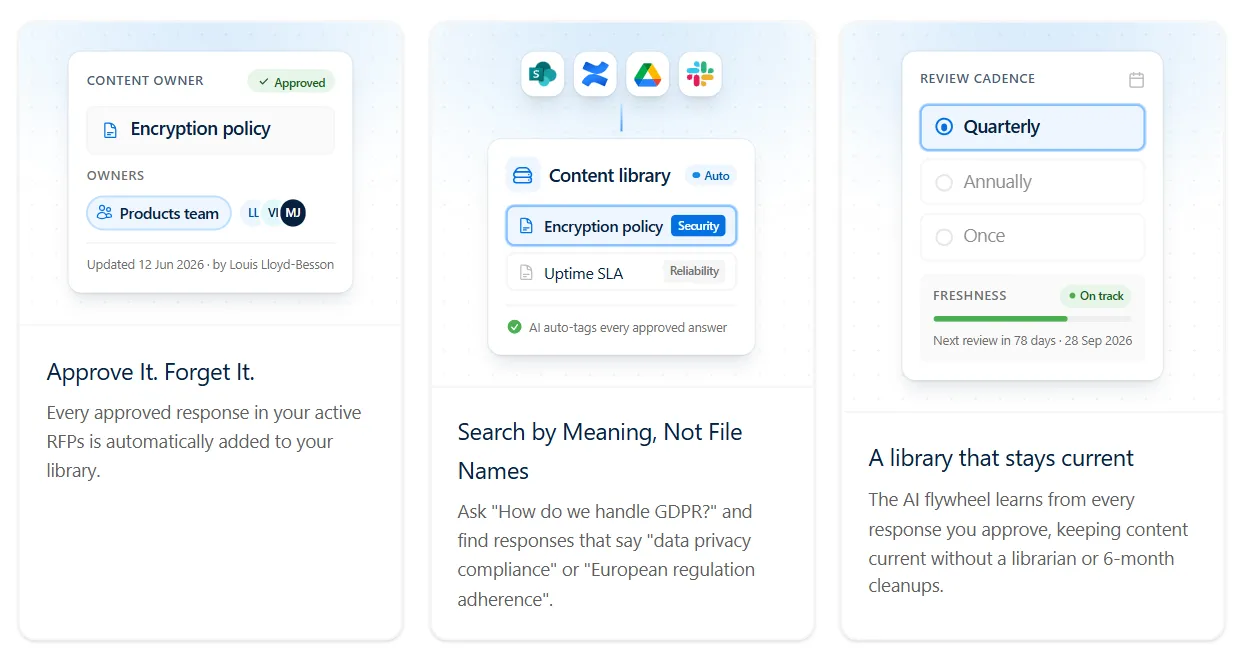
As teams approve responses, automatic capture makes that knowledge available for future projects. Content owners can promote selected answers into shared library collections and manage changes through configured permissions and review controls.
The result is a library that becomes more useful through everyday work. Content managers continue to direct organization, curation, and approval, with automation handling routine capture and upkeep.
Webinar replay
How Winning Teams setup their Content Libraries

3. Connected Knowledge and Meaning-Based Search
AutoRFP.ai connects with SharePoint, Google Drive, OneDrive, Confluence, Notion, Box, Seismic, and other knowledge sources. Automatic daily syncing is available for selected connected content, helping the response library reflect changes to the underlying documentation.
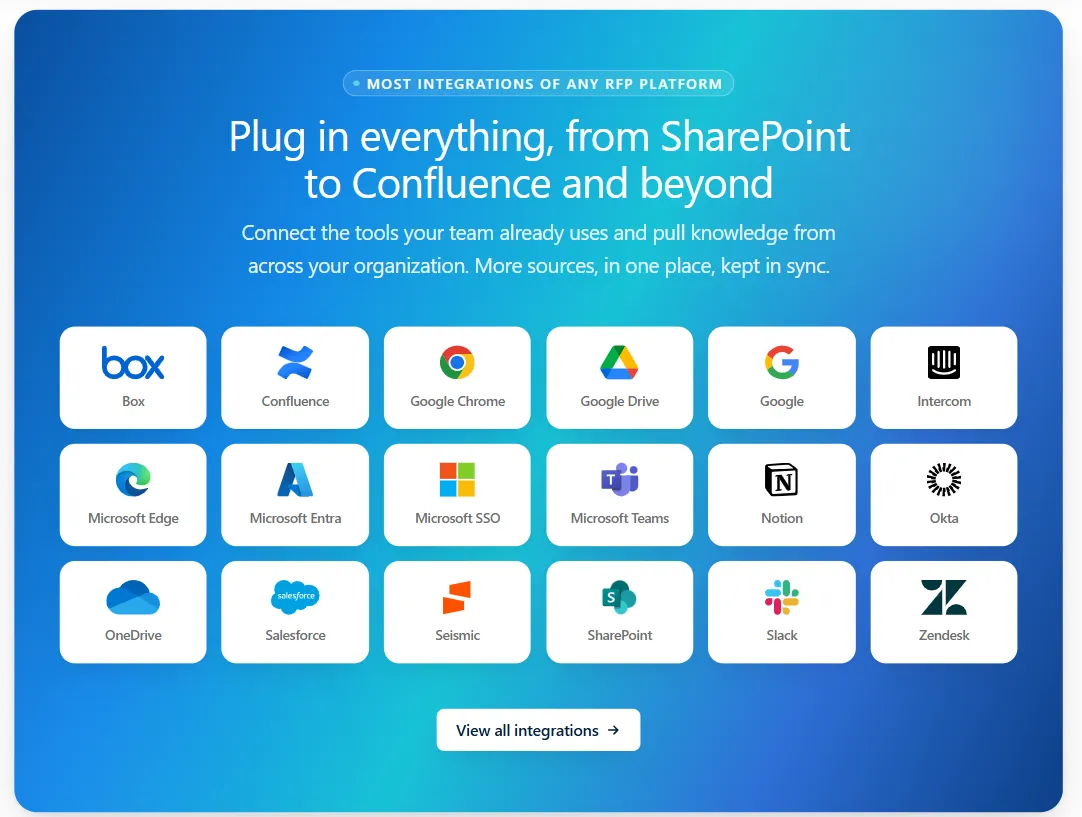
Semantic search matches questions by meaning across accessible library content, past project answers, and documentation. A question about where customer data is stored can therefore find relevant information filed under hosting or data residency.
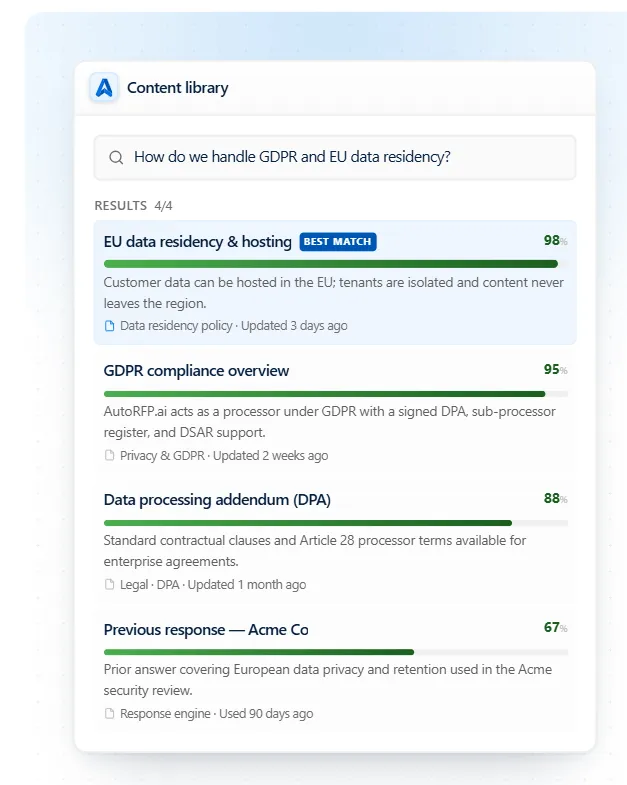
Responses show the sources behind them, so reviewers can check the evidence without searching through separate systems.
4. Complex Document Import and Original-File Export
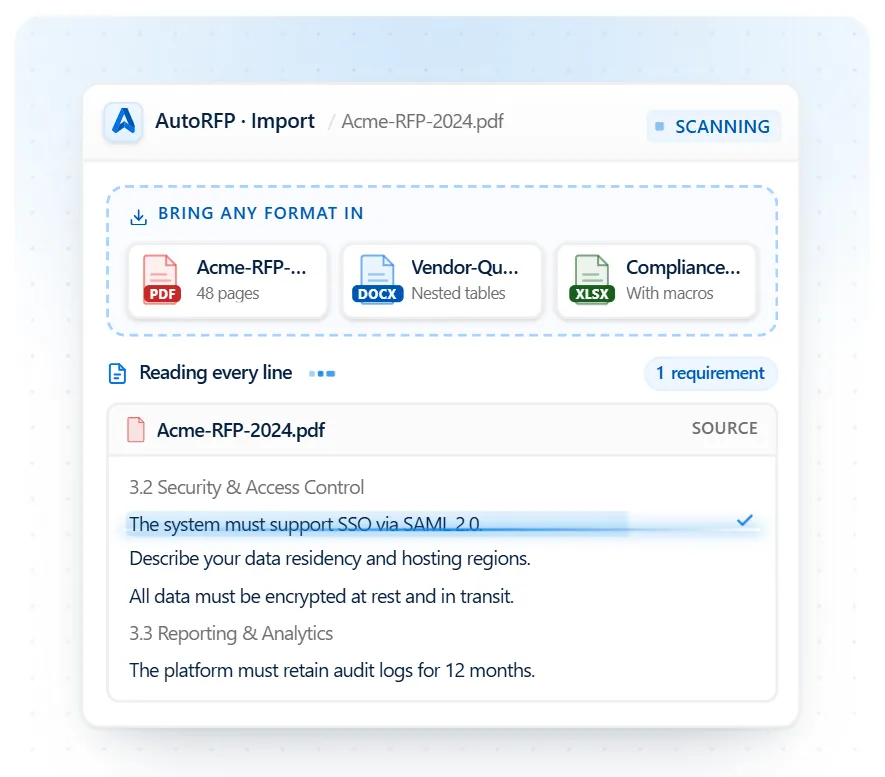
AutoRFP.ai imports Word, Excel, and PDF questionnaires, including multi-sheet and macro-enabled Excel workbooks. AI-assisted mapping identifies questions, answer fields, and compliance selections for the team to confirm.
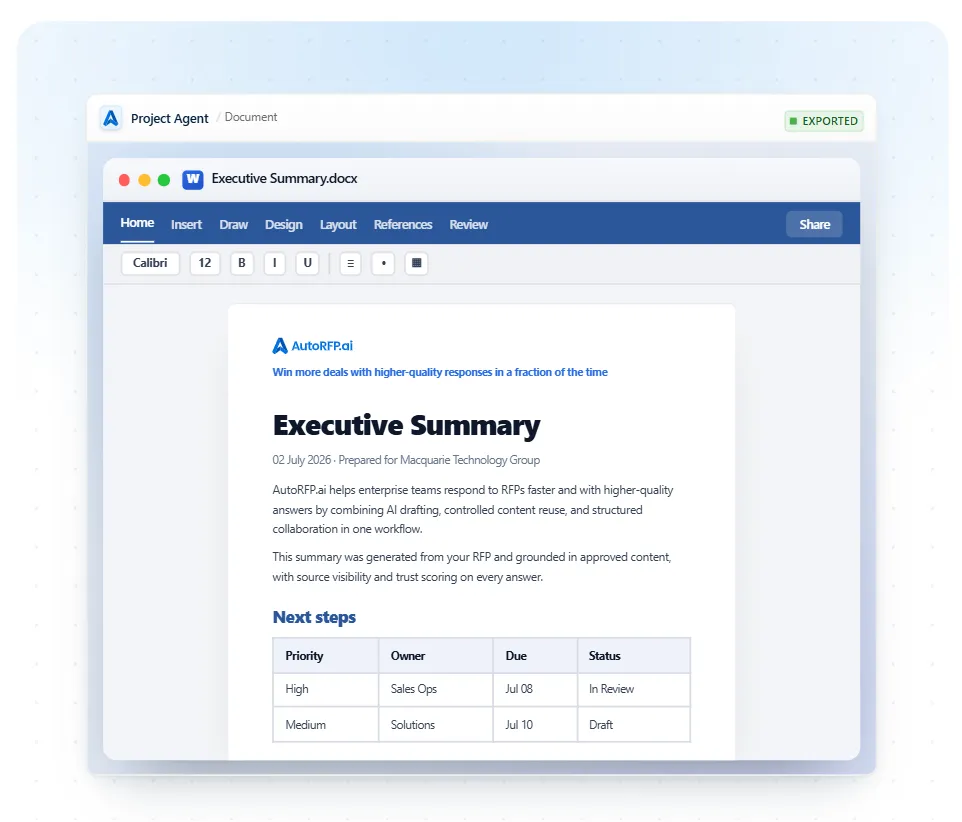
For supported Excel and Word files, approved answers export back into the buyer’s original document. Excel sheet structure, formulas, macros, and validation dropdowns remain in place, reducing the work needed to prepare the final submission.
PDF questionnaires can also be imported and answered, with completed responses exported as Word documents.
5. Portal Agent for Procurement and Security Questionnaires
Portal Agent brings questions from procurement and security portals into the same response workflow used for uploaded documents. Supported portals include SAP Ariba, UpGuard, OneTrust, and DiligenceVault.
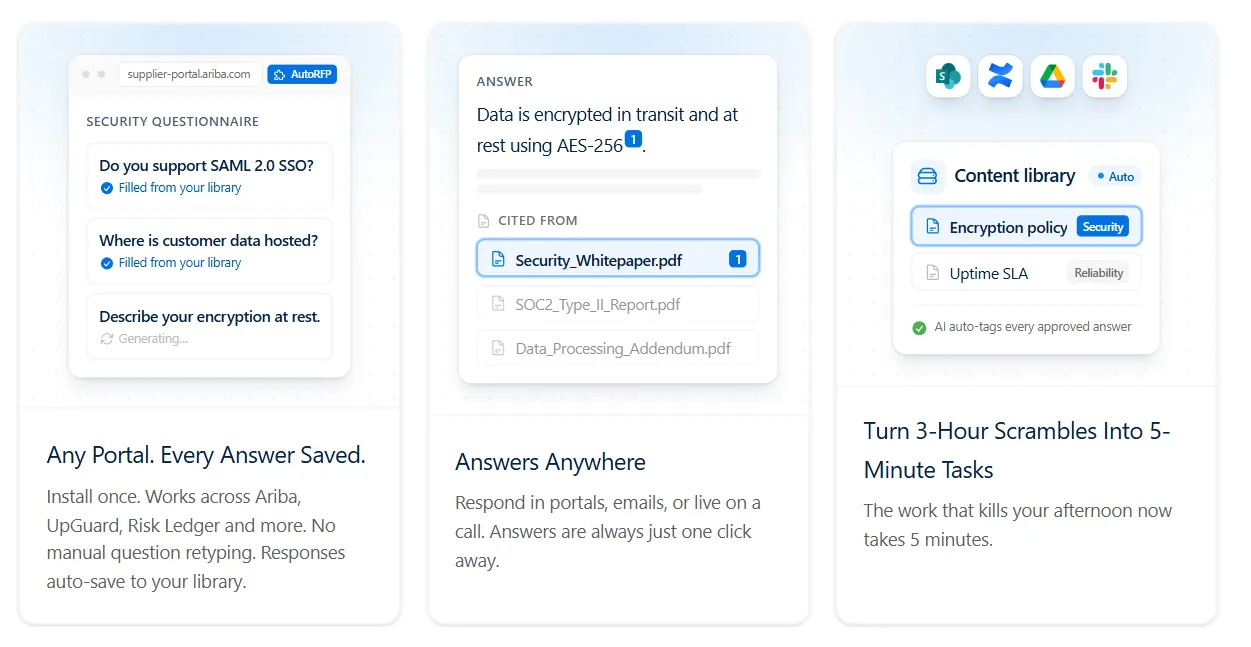
Teams can import requirements, generate answers from approved knowledge, and coordinate reviews inside AutoRFP.ai. Finished responses appear alongside the portal for copying into the relevant fields, reducing repetitive retyping while keeping human review part of the process.
6. Cross-Functional Collaboration and Approvals
Proposal managers can assign requirements to sales engineers, security specialists, legal reviewers, and other subject matter experts. Sequential reviews, requirement-level comments, version history, and audit trails keep decisions attached to the relevant response.
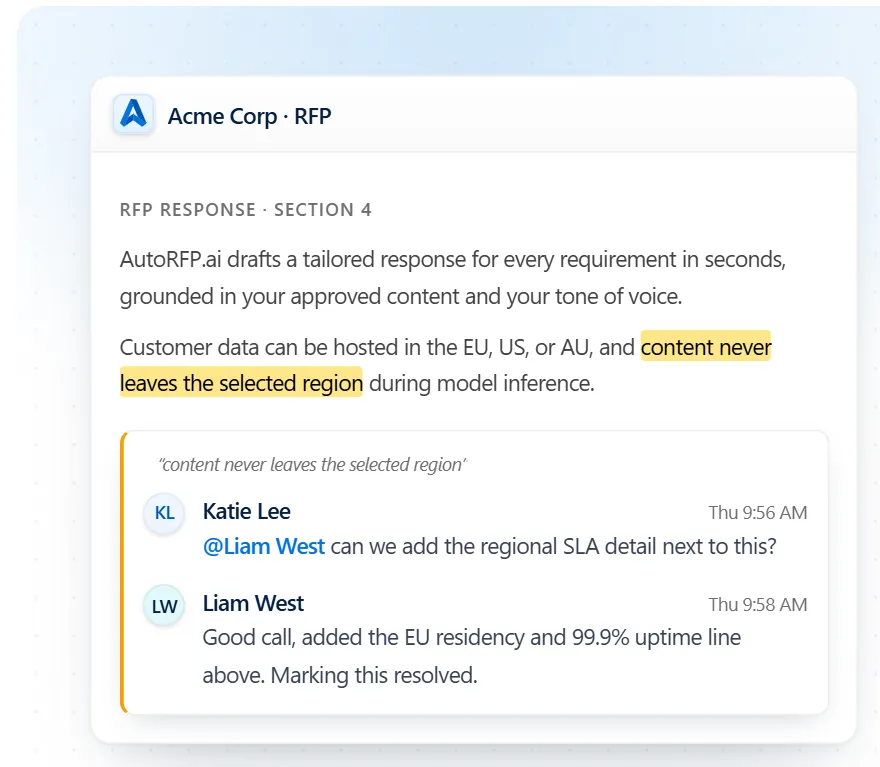
AutoRFP.ai also supports tasks and deadlines for library upkeep, including tag updates. Review requests and reminders reach contributors through Slack, Microsoft Teams, or email.
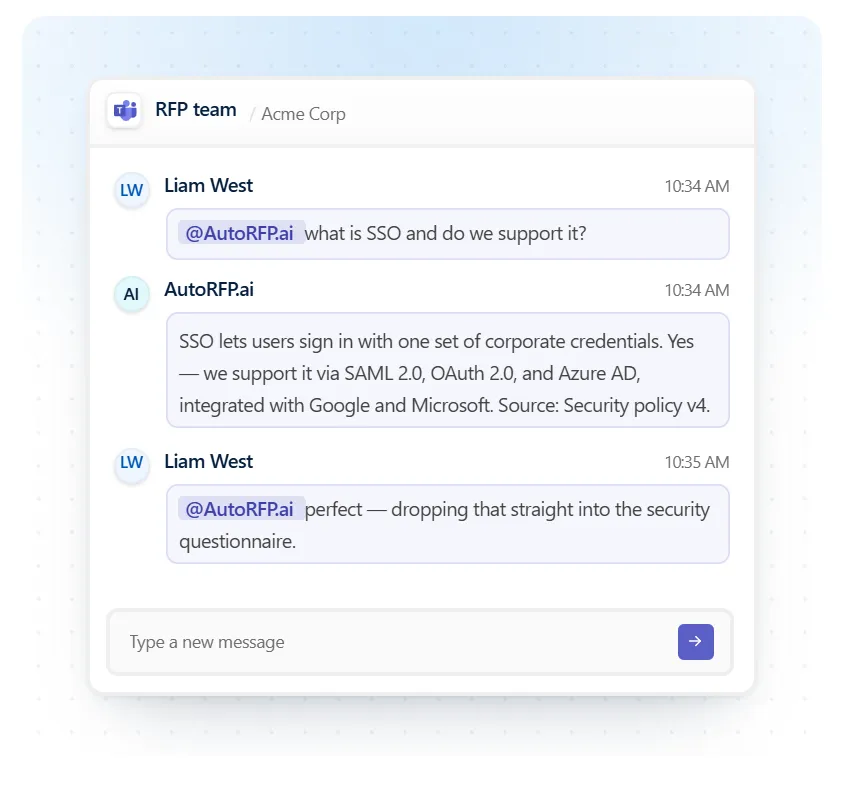
The Q&A Agent extends access to approved knowledge through Slack and Teams, providing sourced answers within the user’s permissions. Unlimited users allow occasional reviewers to participate without additional seat charges.
7. Enterprise Security and Data Controls
AutoRFP.ai is ISO 27001 certified and SOC 2 Type II audited, with supporting documentation available through its Trust Center for vendor security reviews.
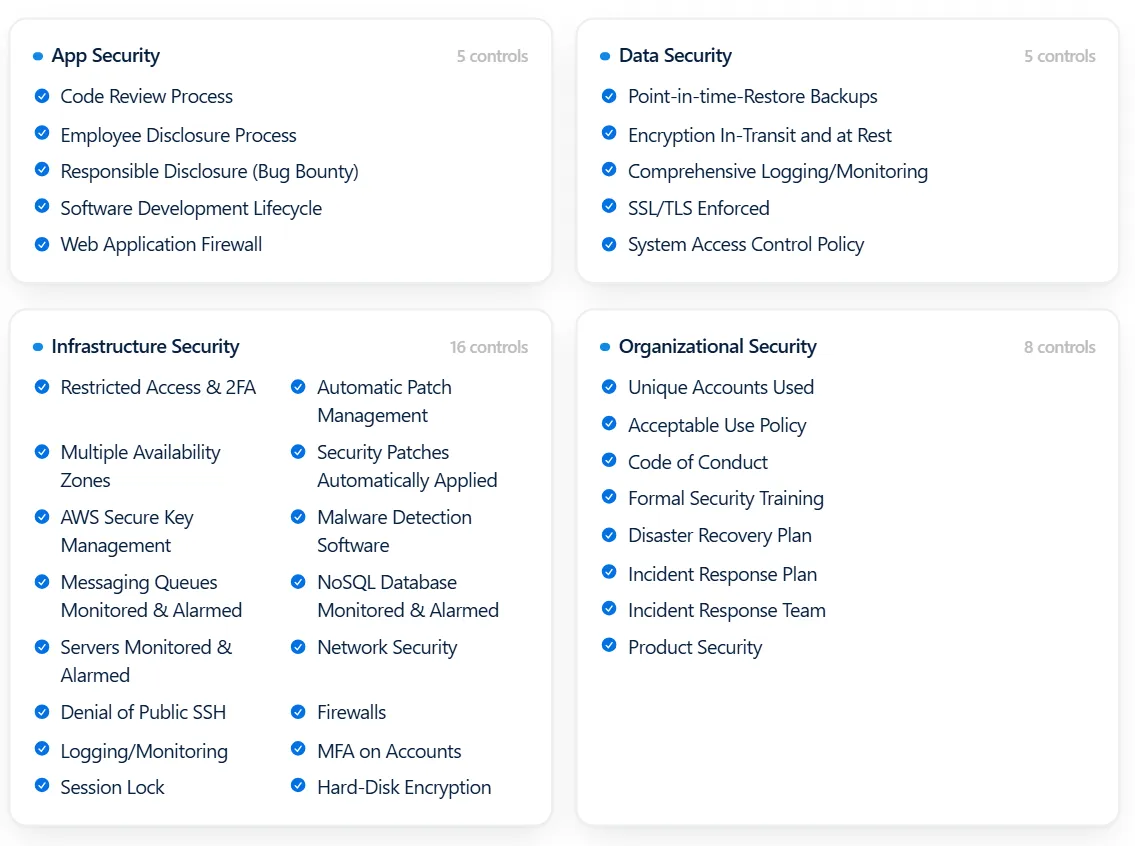
Organizations can select US, EU, or Australian hosting according to their requirements. Customer content is not used to train AutoRFP.ai’s models or public AI models. Role-based access, organization-level data isolation, SSO, and SCIM provisioning support controlled access across larger teams.
Pricing
AutoRFP.ai prices by project volume, with unlimited users and all features included across its plans.
| Plan | Price | Key Inclusions |
|---|---|---|
| Scale | $899/month (paid yearly) | 24 projects per year, unlimited AI, unlimited content, unlimited users, all features, SSO (Google & Microsoft), 18+ integrations, ISO 27001:2022 and SOC 2, unlimited support, online training |
| Accelerate | $1,299/month (paid yearly) | 50 projects per year, unlimited AI, unlimited content, unlimited users, all features, SSO (Google & Microsoft), 18+ integrations, ISO 27001:2022 and SOC 2, unlimited support, online training |
| Enterprise | Flexible pricing that scales with your business | Scalable projects per year, unlimited AI, unlimited content, unlimited users, all features, SSO (Google & Microsoft), 18+ integrations, ISO 27001:2022 and SOC 2, unlimited support, bespoke implementation, bespoke terms |
A project covers an RFP, DDQ, tender, or security questionnaire, including its associated requirements and clarifications. Teams should choose a plan based on annual response volume.
Where AutoRFP.ai Shines
- Value from an existing library: Teams can bring approved answers and established organization into AutoRFP.ai, then build on them through automatic capture and connected-source updates.
- Visible answer-quality checks: Citations, Trust Scores, and Feedback Scores help reviewers assess both the evidence behind a response and how well it answers the question.
- Clear handling of missing evidence: Unsupported questions are flagged for human input, making knowledge gaps visible during review.
- Support for content owners: Library organization, review responsibilities, and approval controls remain part of the workflow as routine upkeep becomes easier.
- Flexible team participation: Unlimited users make it practical to involve legal, security, product, and technical specialists across projects.
- Practical submission workflows: Document import and original-file export, alongside Portal Agent, help teams carry approved responses through to the buyer’s required submission format.
Where AutoRFP.ai Falls Short
- Complex deadline and team management: Loopio has more mature functions in this area. Teams whose main priority is detailed workback planning and contributor workload coordination should compare those workflows closely.
- Narrative-heavy proposal authoring: Organizations primarily producing long-form persuasive bids or design-heavy proposal documents may prefer a specialist authoring platform.
- Buyer-side procurement: AutoRFP.ai focuses on responding to RFPs and questionnaires. Issuing supplier RFPs, evaluating vendors, and managing quote-driven procurement require a different tool.
Customer Reviews
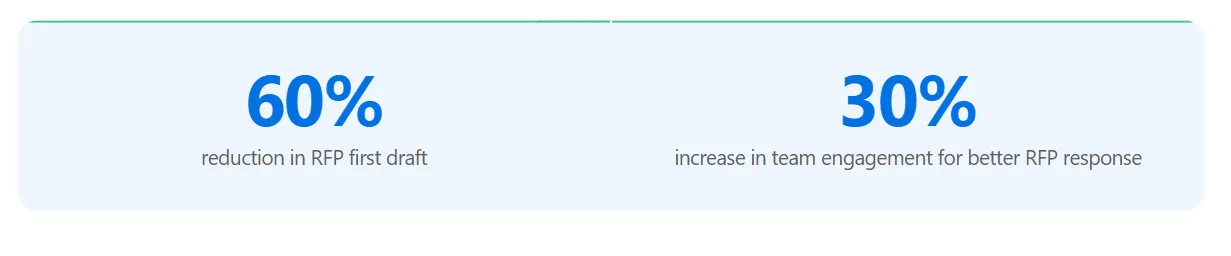
A Director of Sales said: “As someone who spends a significant amount of time responding to complex RFIs and RFPs, AutoRFP has become an invaluable part of our process! Instead of searching through countless previous proposals, I can quickly locate our best, most current answers from our content library. I like how we can assign questions to owners, approvers, and SMEs, and overall, it’s made collaboration across our org much more efficient.”
A Sales Manager said: “The team has been excellent in terms of detailed knowledge transfer, and they take every step to make sure the users are comfortable with all the specific details of this tool. The tool has helped our organization close the gap in terms of the RFP process.”
Bryn Tardent-Powell, Head of Sales & Marketing at Cubiko, said: “Being in healthtech, we get a lot of security questionnaires. AutoRFP helped me save time so I could provide better quality results.”

Jason McGeorge, Solutions Architect at ecoPortal, said: “It’s faster, it’s more engaging and it’s more accurate than our previous legacy RFP Software.”
Who AutoRFP.ai Is Best For
- Teams switching from Loopio with an established library: Organizations that want to preserve approved knowledge and improve how it supports future responses.
- Content managers handling repetitive upkeep: Teams seeking automatic knowledge capture and source updates alongside ownership, curation, and review controls.
- Enterprise sales and presales teams: Businesses answering technical RFPs and security questionnaires that require accurate, source-grounded responses.
- Cross-functional response teams: Organizations involving sales, solutions engineering, security, legal, compliance, and product in the same submission.
- Financial services and other regulated businesses: Teams handling DDQs and customer questionnaires where source traceability, controlled approvals, and audit history matter.
Book a demo to arrange a two-week proof of concept using your own RFPs and existing library. Assess the supporting sources, review workflow, and how much editing your team needs before submission.
2. Responsive: Best for Mature Enterprise Proposal Operations
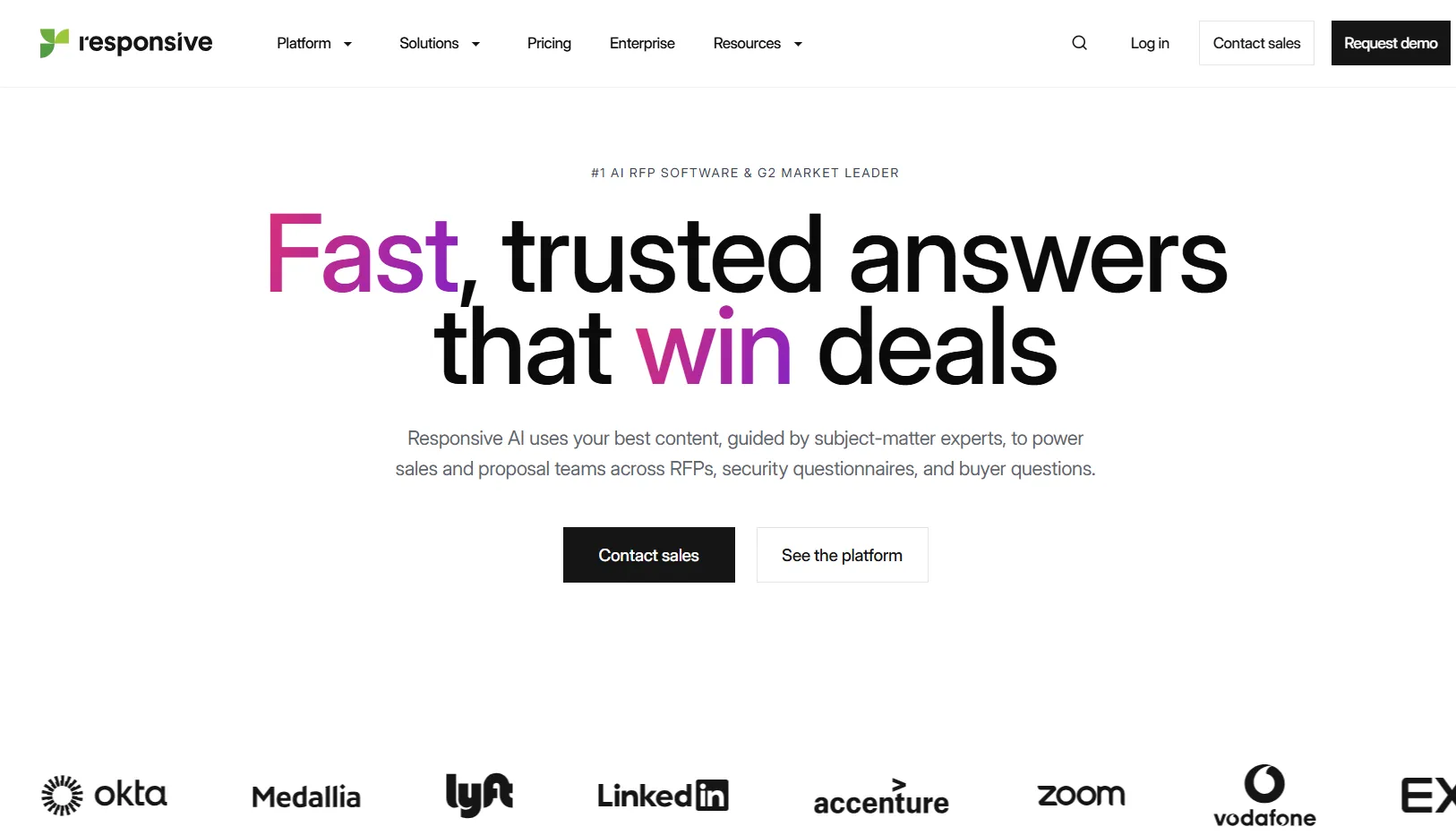
Responsive, formerly RFPIO, is a mature strategic response management platform for teams handling RFPs, RFIs, DDQs, security questionnaires, and other complex response workflows. It combines response projects, content management, collaboration, AI, reporting, and security-document sharing in a broad enterprise suite.
Responsive is particularly well suited to established proposal teams that need mature project management, reporting, and cross-functional workflows across sales, legal, security, and other departments. Its breadth is a strength for complex organizations, although it can require more implementation and process setup than lighter response tools.
Key Features
- Content Library and Smart Search: Responsive centralizes reusable content and supports natural-language and question-based search to help teams find relevant information and generate source-backed answers.
- Integrations: With 20+ native integrations and 75+ APIs across CRM, productivity, cloud storage, and other business systems, Responsive connects with a broad enterprise tech stack.
- Trust Center: Teams can create public or private Trust Centers for sharing certifications, security documents, questionnaires, and approved compliance information with customers and auditors.
- TRACE Score: Responsive scores AI-generated answers across trustworthiness, relevance, accuracy, completeness, and explainability, helping reviewers identify responses that require closer attention.
Pricing
| Plan | Pricing | Notes |
|---|---|---|
| Emerging Edition | From $10,000 | Unlimited Response Projects, AI and automation, content, collaboration, integrations, reporting, and support |
| Growth Edition | Contact sales | Adds intake workflows, advanced integrations, stronger access controls, and flexible hosting |
| Enterprise Edition | Contact sales | Adds custom AI, enterprise security controls, advanced reporting, and premium connectors |
Responsive states that final deployment pricing combines the platform fee, user licenses, and selected add-ons or services.
Where Responsive Shines
- Robust collaboration features: Responsive lets teams assign tasks, track progress, and coordinate contributors across complex response projects.
- Advanced analytics: Its reporting capabilities give proposal teams visibility into response activity, performance, workload, and other operational metrics.
- Mature proposal management: Responsive has established deadline, task, and team-management capabilities that suit organizations running structured proposal operations.
Where Responsive Falls Short
- More involved implementation: Responsive’s broad feature set can require more setup, onboarding, and process configuration than lighter response tools.
- Complex pricing structure: While Responsive publishes a starting price for its Emerging plan, total costs can include user licenses and additional products or services.
- Search can feel inconsistent at scale: Responsive has upgraded its search capabilities with Smart Search, but users working with large content libraries may still need additional review to identify the most relevant answer.
Customer Reviews
“The ability to import RFPs directly from Excel sheets is a game-changer, it saves me a ton of time by allowing quick uploads and immediate action on large datasets,” shares Gabriel L.
“The text editing console is super basic, making content formatting tedious. Tables are flat out impossible - no formatting functionality at all,” says Cristine C.
Who Responsive Is Best For
Responsive is best for established mid-market and enterprise proposal teams that need mature collaboration, project management, reporting, and governance across multiple departments. It is particularly relevant for organizations with dedicated proposal operations, frequent cross-functional input, and complex or multi-region response workflows.
3. Qvidian: Best for Document-Heavy Enterprise Proposal Teams
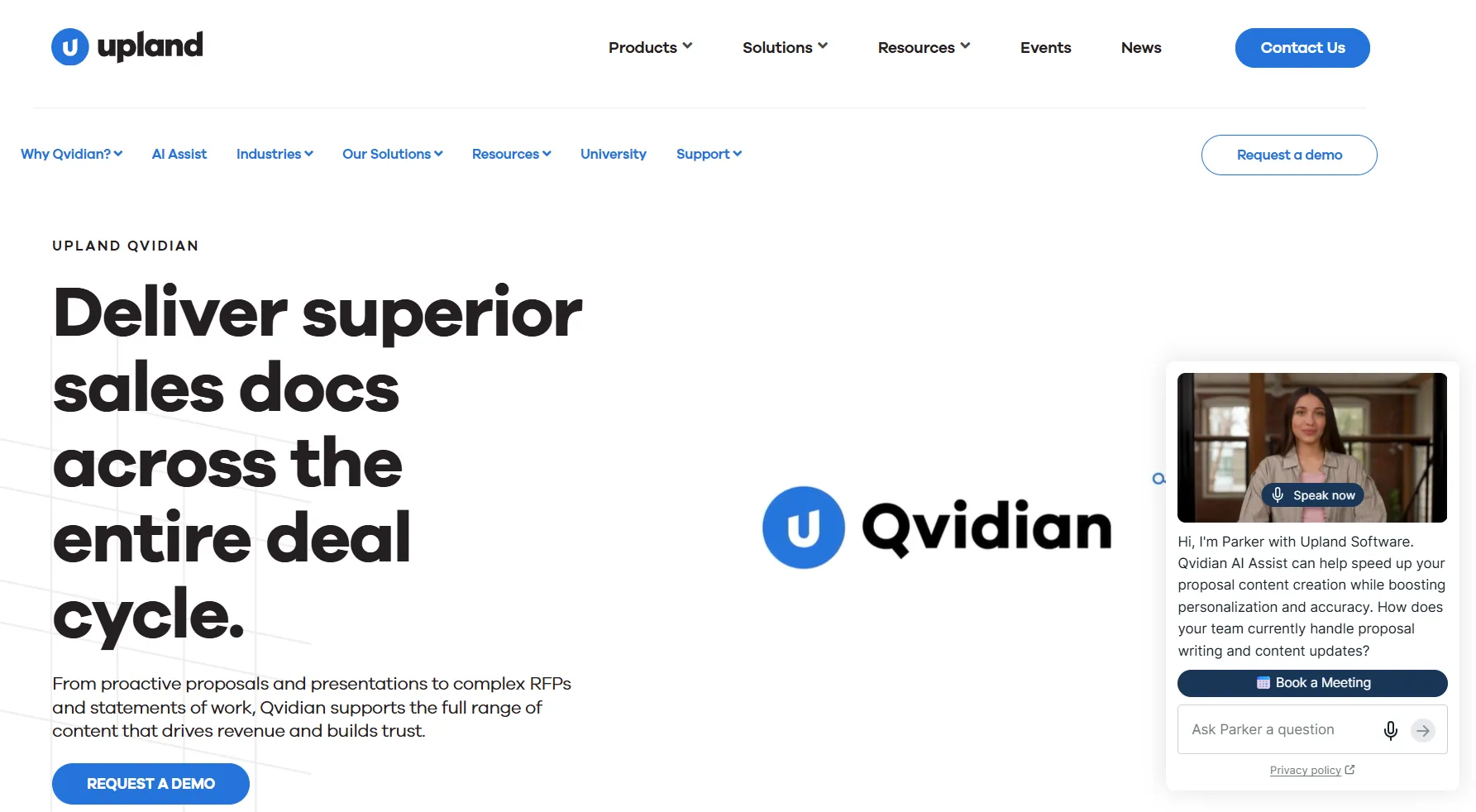
Qvidian, part of the Upland Software family, is an established proposal automation platform built around structured content management, document generation, collaboration, and governance. It is particularly suited to large organizations managing complex proposal libraries and repeatable Word, PowerPoint, and Excel workflows.
Its mature content and reporting capabilities make it a strong option for teams that need structured proposal operations, although its established architecture and learning curve may feel heavier than newer AI-native platforms.
Key Features
- Central content library: Qvidian centralizes approved proposal content in a structured repository so teams can search, reuse, and govern responses across projects.
- Intelligent AutoFill: Qvidian can automatically populate RFP and questionnaire responses using content from its library, with AI Assist adding generative suggestions and rewriting capabilities.
- Review workflows: Teams can create multi-step review and approval workflows with automated routing, notifications, permissions, and audit tracking.
- Document automation: Qvidian supports structured Word, Excel, and PowerPoint workflows, making it particularly useful for organizations producing complex, highly formatted proposals.
Pricing
Qvidian does not publicly list its pricing. Organizations need to contact the sales team for a quote.
Where Qvidian Shines
- Document-heavy proposal workflows: Qvidian is particularly strong for enterprises producing structured Word documents, Excel-based questionnaires, and branded PowerPoint proposals.
- Reporting and governance: Its mature reporting, audit trails, version control, permissions, and review workflows provide strong oversight for large proposal operations.
Where Qvidian Falls Short
- Legacy architecture: Qvidian has added generative AI and machine-learning capabilities to an established proposal and content-library platform rather than being designed around modern generative AI from the start.
- Complex UI and learning curve: Users may need more training to become comfortable with its interface, workflows, and more advanced configuration options.
- Content-library administration: Teams relying heavily on Qvidian’s structured library still need processes for maintaining, reviewing, and governing reusable content.
Customer Reviews
“It helps me save time by auto filling in response content within a matter of minutes rather than spending hours chasing people for responses located in various time zones,” shares Nicole C.
“Hoping for the AI to be useful in a way that makes sense for our organization in the future,” says Sierra.
Who Qvidian Is Best For
Qvidian is best for large, document-heavy enterprises with established proposal teams, structured content libraries, and complex review requirements. It is particularly relevant for organizations that need strong Word, PowerPoint, reporting, governance, and document-assembly capabilities.
4. AutogenAI: Best for Long-Form Proposal and Tender Writing
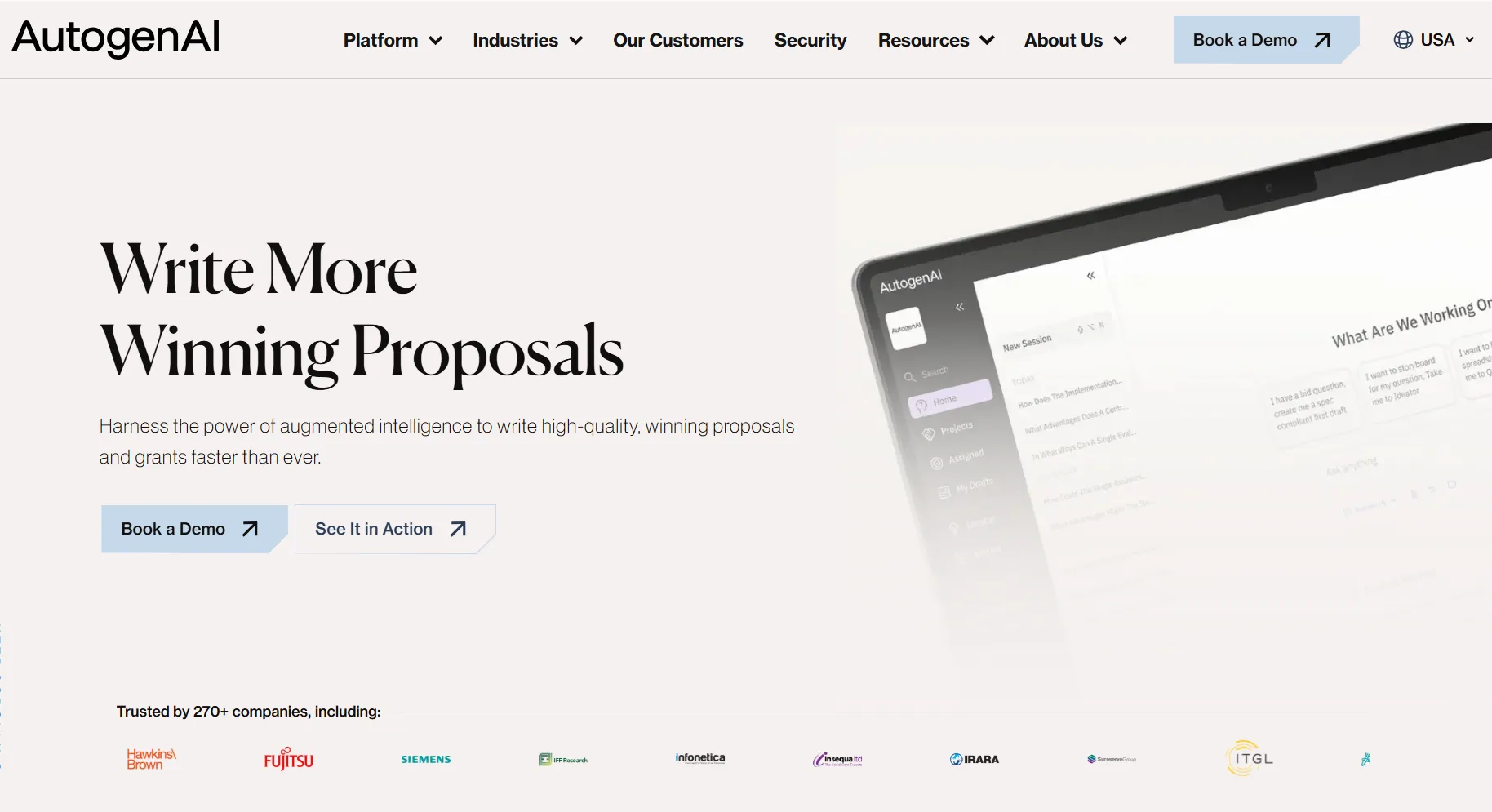
AutogenAI is an AI-native proposal writing platform built primarily for teams producing long-form bids, proposals, and tenders. It supports the proposal lifecycle from opportunity qualification and research through drafting, collaboration, review, and final submission.
Its strength is persuasive proposal writing rather than questionnaire-style response automation, making it particularly relevant for teams where narrative quality and detailed tender responses matter.
Key Features
- AI-powered Extract tool: Teams can analyze RFP requirements and qualification criteria to help determine whether an opportunity is worth pursuing.
- Research Assistant: AutogenAI gathers and analyzes information from internal knowledge sources and the internet to support proposal research and strategy.
- Gamma Review™: Gamma Review brings proposal reviews into a structured workflow to help teams assess compliance and improve content before submission.
- Proposal writing workspace: Teams can generate and refine long-form responses using organizational knowledge, proposal-specific prompts, and collaborative writing tools.
Pricing
AutogenAI does not publicly list its pricing plans. Organizations need to contact the sales team for a custom quote.
Where AutogenAI Shines
- Long-form proposal writing: AutogenAI is designed around persuasive, narrative-heavy bids and tenders, making it a strong fit when writing quality is central to the submission.
- Research and strategy support: Its combination of organizational knowledge and external research can help proposal teams gather evidence and develop stronger bid narratives.
- End-to-end proposal workflow: Qualification, writing, research, collaboration, and review can all be managed within the same proposal environment.
Where AutogenAI Falls Short
- Less focused on questionnaire-heavy workflows: Teams primarily completing high-volume security questionnaires, DDQs, or structured RFP question sets may prefer software built specifically around repeatable question-and-answer automation.
- Open-web generation requires additional governance: AutogenAI can incorporate internet research into proposal work, so teams with strict requirements to generate responses only from internally approved sources may need additional review controls.
- Human review remains important: Generative proposal writing still requires experienced reviewers to check accuracy, relevance, tone, and whether the response properly addresses the evaluator’s requirements.
Customer Reviews
“Being able to scan previous submission content makes it super easy to extract relevant stats or processes, which speeds up writing tenders significantly,” shares Niamh C.
“I find the lack of integration with Word and PDF formats an inconvenience. Transferring proposals often requires cutting and pasting, which is time-consuming,” shares Dave E.
Who AutogenAI Is Best For
AutogenAI is best for proposal teams producing long-form, persuasive bids and tenders where narrative quality, research, and strategic writing matter. It is particularly relevant for construction, government contracting, professional services, and other sectors with detailed written submissions.
5. Ombud: Best for Enterprise Presales and Response Management
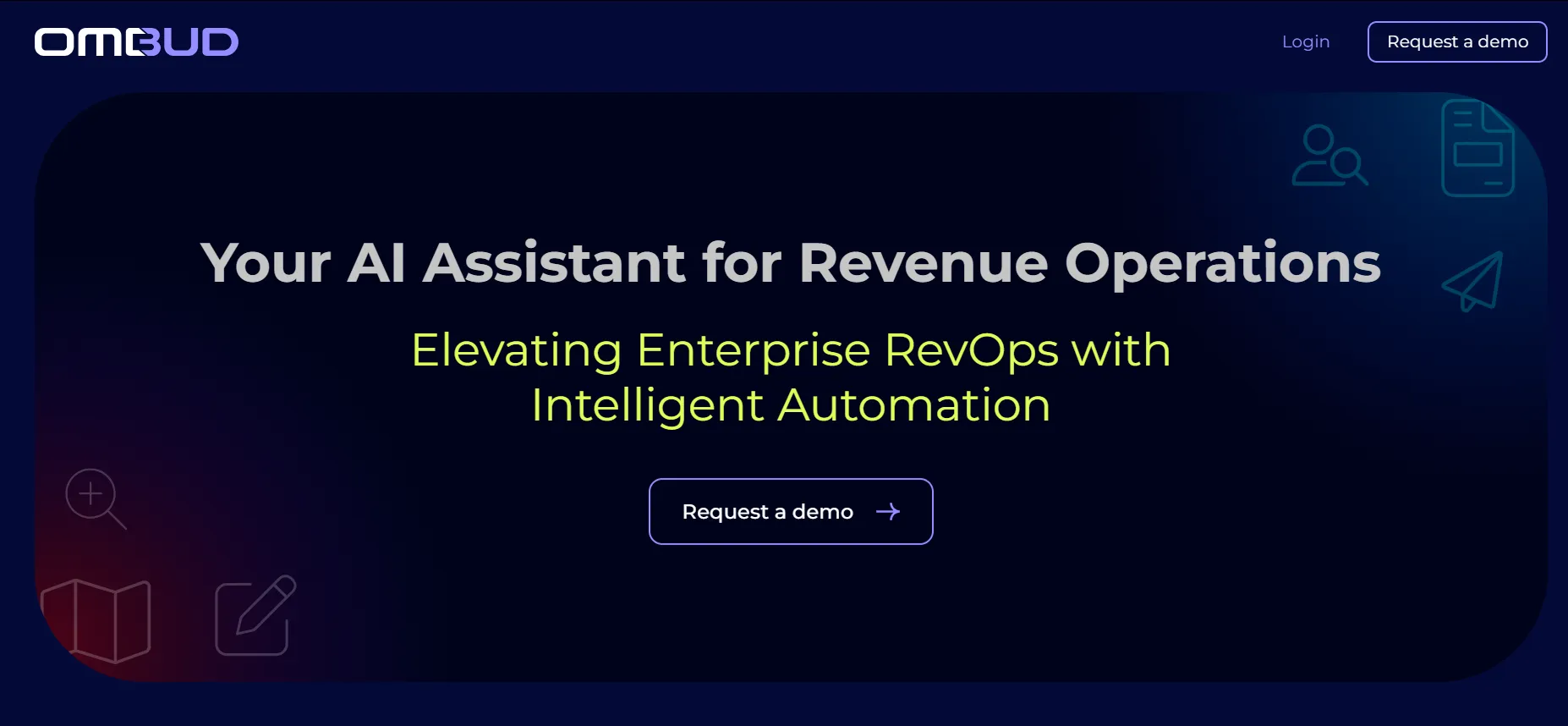
Ombud is an automated response management platform for RFPs, RFIs, DDQs, security questionnaires, proposals, and other presales content. It combines a centralized knowledge repository, response automation, collaboration, and broader sales-content workflows.
Its wider presales focus makes it a practical option for enterprise revenue teams that want reusable knowledge to support both formal RFP responses and other customer-facing sales activities.
Key Features
- Curated knowledge: Ombud centralizes reusable sales and proposal knowledge in a searchable repository that grows as teams complete new work.
- OmMatch: Ombud’s matching engine recommends relevant content and helps automatically complete RFP and questionnaire responses.
- Collaborative workspace: Teams can assign work, coordinate contributors, track responses, and manage complex RFP projects in a shared environment.
- Multi-format delivery: Completed responses can be delivered through formats such as Word, Excel, PDF, or a customer-facing web experience.
Pricing
Ombud does not publicly list its pricing. Organizations need to contact the company directly for a quote.
Where Ombud Shines
- Knowledge reuse: Ombud captures and reuses organizational knowledge so teams can spend less time repeatedly searching for previous responses.
- Broader presales workflows: Beyond RFPs, Ombud supports security questionnaires, proposals, statements of work, and other customer-facing sales content.
Where Ombud Falls Short
- User experience can take adjustment: Some customers report that parts of the interface, including assignments and collaboration workflows, are not always intuitive.
- Pricing is not transparent: Buyers cannot compare plans or starting costs without contacting the sales team.
- Broad rather than highly specialized: Ombud covers several presales and revenue workflows, so teams looking specifically for deep AI-native RFP, DDQ, or security-questionnaire functionality should compare its response capabilities carefully against more specialized platforms.
Customer Reviews
“Using the response library allows me to quickly search previous responses that may align to the current question, and, if necessary, quickly adjust the response to fit the current request,” says Jeremy M.
“UX is not the best. Sometimes I find it hard to assign questions to others, and find out what are my assignments,” shares Roy A.
Who Ombud Is Best For
Ombud is best for mid-sized and enterprise revenue or presales teams that want to manage RFP responses alongside security questionnaires, reusable sales knowledge, proposals, and other customer-facing content.
Why Consider a Loopio Alternative?
While Loopio has established itself as a recognizable name in proposal software, our analysis of 610+ user reviews reveals consistent pain points that impact productivity and performance.
1. Overpromised “Magic” Feature
Consider a Loopio alternative if you need AI that can handle more than straightforward, repetitive questions. Users report that Loopio’s AI “Magic” feature can be useful for basic responses but struggles when requirements become more nuanced or context-heavy.
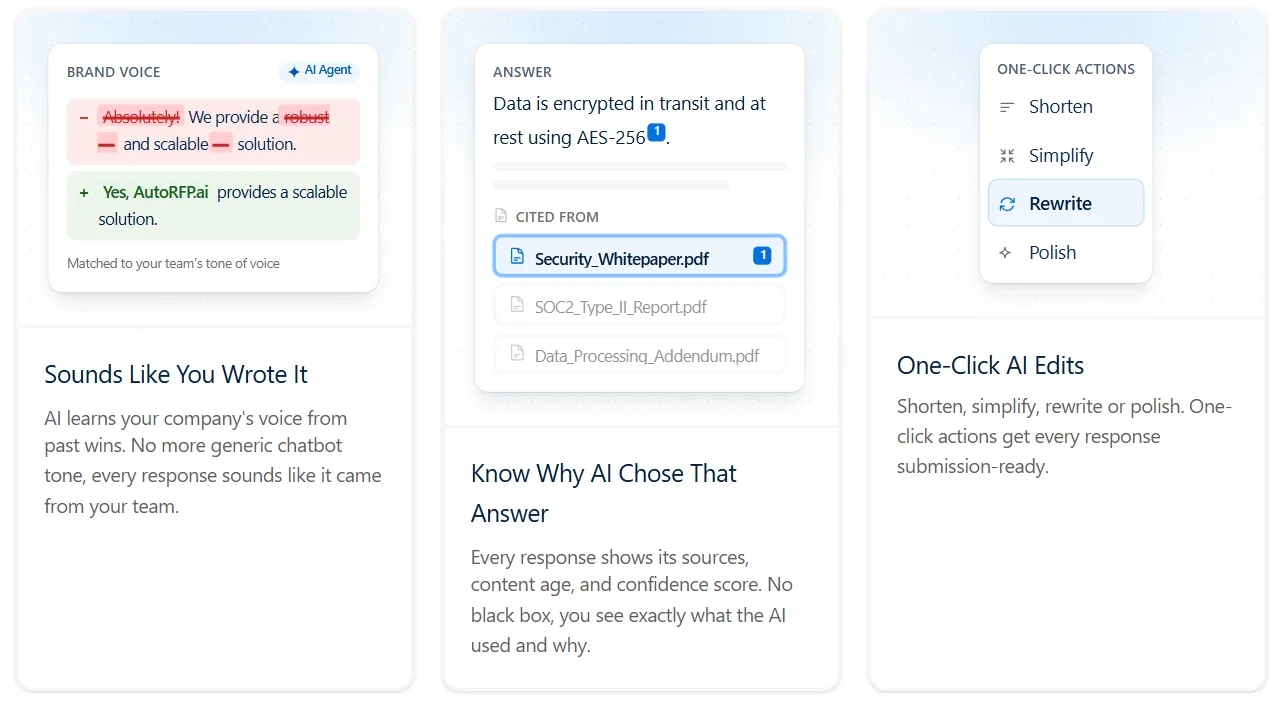
AutoRFP.ai takes a more controlled approach to response generation. Its AI drafts from your approved content, shows the sources behind each response, and assigns a Trust Score so reviewers can see how strongly the available evidence supports the answer. Questions the AI cannot adequately support are flagged for a person rather than guessed.
2. High-Maintenance Content Library
Consider an alternative if keeping your content library accurate and current has become another recurring workload. Loopio users report that as libraries grow, reviewing and maintaining large volumes of content can become increasingly difficult over time.
AutoRFP.ai builds on the library your team already trusts instead of asking you to abandon it. Approved answers can be captured for future reuse, connected sources can feed updated knowledge into the workflow, and content owners retain control over curation, review, and approvals.
The aim is a library that maintains and improves itself as your team works, with automation handling more of the routine upkeep.
3. Content Import Issues
Consider an alternative if complex customer documents regularly create extra import, export, or reformatting work. Loopio users report difficulties with some complex RFP formats and with getting completed responses back into the format customers originally provided.
AutoRFP.ai supports RFP imports from Excel, Word, and PDF, including complex spreadsheets with nested tables, hidden tabs, and macros.
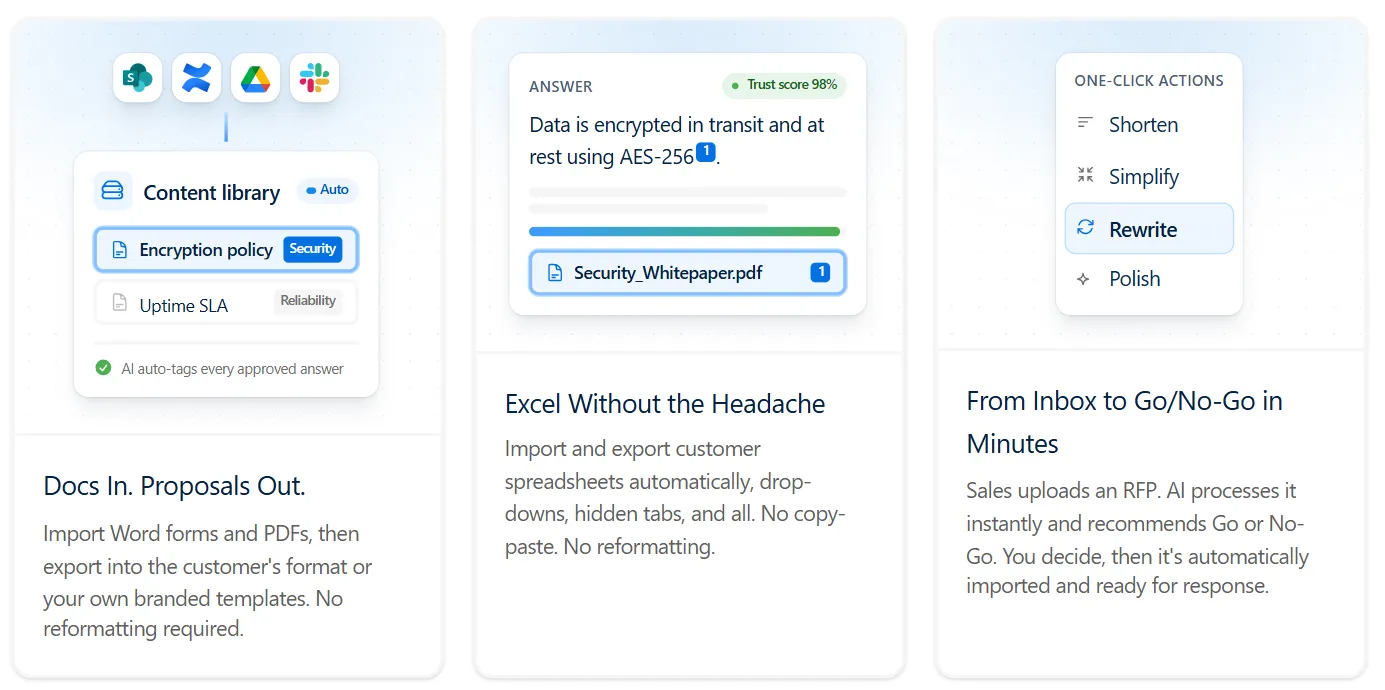
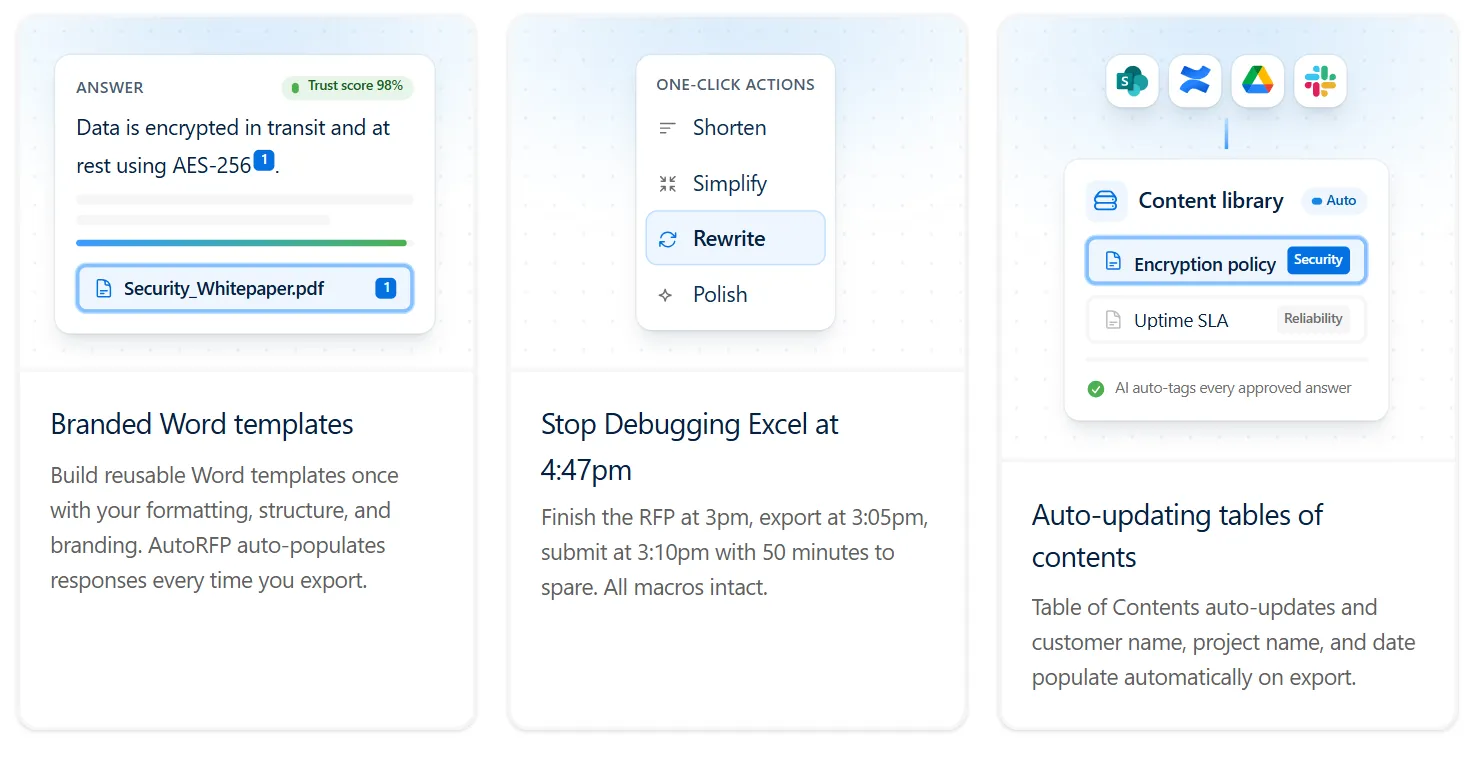
Once the response is complete, teams can export answers back into the customer’s Excel or Word format, helping reduce manual rebuilding before submission.
Automate Your RFP Response Workflow with AutoRFP.ai
Each of the Loopio alternatives above comes with its own strengths and trade-offs. The best way to know which RFP software fits your workflow is to test its capabilities against your own RFP process.
With AutoRFP.ai, you can do that with less risk. Every plan comes with a 30-day money-back guarantee, giving you time to put the platform to work on real RFPs before committing. And you probably won’t need the refund: more than 50 G2 reviewers have given AutoRFP.ai five stars.
Ready to win more bids? Book a demo with AutoRFP.ai today.
FAQs
1. What Should You Test Before Choosing a Loopio Alternative?
Test the software with your own RFPs, existing content, and normal reviewers. Compare answer accuracy, source traceability, editing required, document handling, SME collaboration, and how easily completed responses can be returned to the buyer’s required format.
2. Can You Switch From Loopio Without Rebuilding Your RFP Content From Scratch?
Potentially, yes. Look for alternatives that can import your existing approved responses, categories, metadata, and supporting documents. The important question is how much of your existing knowledge structure survives migration and how easily that content can be maintained afterward.
3. Do Loopio Alternatives Charge Per User?
It depends on the platform. Some RFP tools combine platform fees with user licenses, while others include unlimited users. Teams involving occasional contributors from security, legal, product, or engineering should compare the total collaboration cost rather than only the advertised starting price.
4. How Long Does It Take to Move to a Loopio Alternative?
Implementation time varies with the size of your content library, integrations, security requirements, and workflow complexity. A smaller team may transition quickly, while an enterprise deployment with large libraries, permissions, integrations, and approval processes usually requires more configuration and validation.
5. Can Loopio Alternatives Handle Security Questionnaires and DDQs as Well as RFPs?
Many can, but capabilities vary. Teams handling several response types should check whether RFPs, security questionnaires, RFIs, and DDQs use the same approved knowledge, review workflows, permissions, and automation rather than requiring separate processes.
6. Can AutoRFP.ai Import an Existing RFP Content Library?
Yes. AutoRFP.ai can build on an existing library rather than requiring teams to abandon it. Supported library exports can be imported with existing answers, categories, and metadata, while approved responses and connected-source updates can continue strengthening that knowledge over time.
About the author

Co-founder and CEO of AutoRFP.ai. Spent 7 years running global RFPs and personally completed 500+ RFPs before founding the company.
LinkedIn