
RFP Tracker: Solutions, Metrics, and Smart Automation Strategies
Learn what an RFP tracker is, which metrics and tools matter, and how automation helps proposal teams manage deadlines, pipelines, and win more bids.

Co-founder & CEO, AutoRFP.ai·Updated ·10 min read
An RFP tracker centralizes opportunity data, deadline management, and team ownership in one place.
In this guide, you’ll learn what an RFP tracker does, how high-performing teams structure theirs, and how automation upgrades tracking.
What’s an RFP Tracker?
An RFP tracker is a centralized system that records, manages, and monitors every Request for Proposal (RFP), tender, and Due Diligence Questionnaire (DDQ) from intake to submission.
At its core, it answers four questions for every bid in flight:
What’s the status? (Qualification, drafting, review, submitted, won/lost)
Who owns it? (Proposal manager, SMEs, reviewers)
**When is it due? (**Submission deadline, internal review checkpoints)
What does it need? (Outstanding sections, pending approvals, missing inputs)
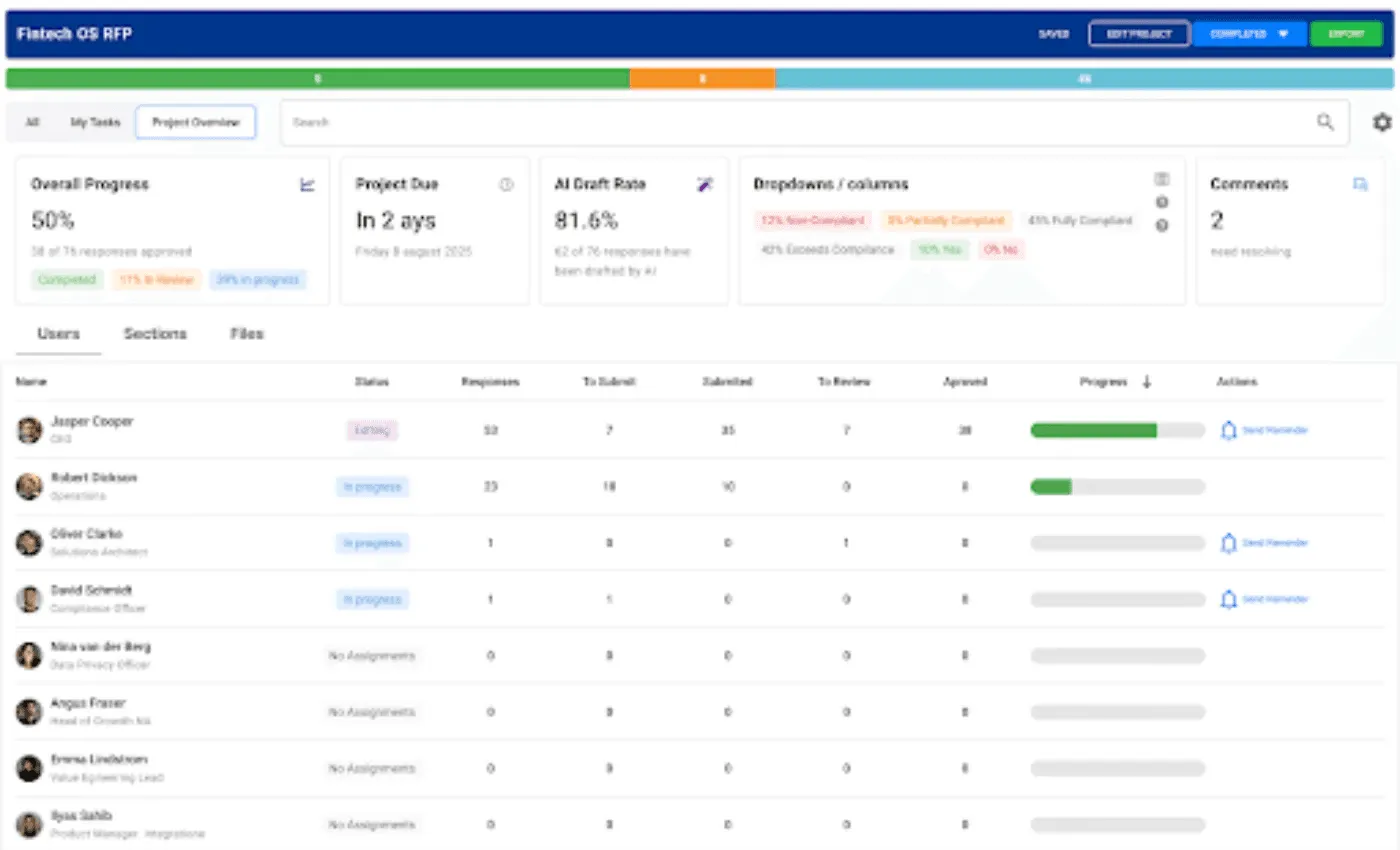
Informal Tracking vs Structured RFP Tracking
| Tracking method | What it looks like | Risk level | Revenue visibility |
|---|---|---|---|
| Email + spreadsheet | One master sheet, manual updates, version confusion | High | Low |
| CRM only | Opportunity logged, but no bid workflow visibility | Medium | Partial |
| Structured RFP Tracker | Dedicated tracking system with owners, stages, compliance checkpoints, and reporting | Low | High |
This is why mature teams use structured tracking tied to their RFP response process and RFP management workflows, instead of scattered spreadsheets.
The Hidden Cost of Poor RFP Tracking
Weak tracking systems create stress for your team and revenue leakage for your business with:
Late Go or No-Go Decisions
If you’re not tracking qualification criteria centrally, you may waste days drafting before realizing the opportunity should have been declined.
This overloads Subject Matter Experts (SMEs) and reduces capacity for high-fit deals.
Duplicated SME Effort
Without centralized tracking, multiple team members ask the same SME similar questions across bids. The result: wasted time, inconsistent messaging, and burned-out contributors.
Missed Compliance Checkpoints
If submission formats, mandatory forms, or eligibility criteria are not tracked explicitly, teams discover gaps too late.
Strong trackers align with compliance matrices and processes, reducing disqualification.
No Pipeline-Level Visibility
Without structured tracking, leadership questions about live RFPs, win rates, and deal status can only be answered with guesswork. High-maturity teams connect trackers to win-loss analysis workflows for strategic decision-making.
The Architecture of a High-Performing RFP Tracker
As teams scale from 10 RFPs per quarter to 100+, their tracker must evolve from basic logging to structured governance.
Here’s the blueprint:
Opportunity Intake and Logging
Every RFP, tender, or DDQ must be entered into one controlled system for a clan pipeline view.
At intake, you should capture the:
Prospect’s name
Deal value
Deadline
Submission format
Internal owner
Sector and strategic fit
Qualification and Scoring Layer
High-performing teams bid on qualified opportunities that align with revenue targets, delivery capability, and clear win themes.
Include these details for every opportunity:
Margin assessment
Competitive landscape
Capacity check
Risk flags
Ownership and Responsibility Mapping
Did you know: 100% of high-win teams (51%+ win rate) have at least one dedicated bid manager?
A mature tracker shows these for every RFP:
Section owner
SME validator
Due date
Current status
Blockers
Deadline and Milestone Controls
RFP timelines are fixed. So, how can internal discipline be optional?
Your tracker should include:
Draft completion deadlines
Pricing lock deadlines
Compliance review checkpoints
Final submission confirmation
Your team will thank you when they don’t have to scramble for the details last minute.
Content and Knowledge Visibility
Want to build scalable RFP content management processes? Make sure your RFP system links:
Approved response sources
Reusable answers
Compliance matrices
Win themes
Past submission performance
Pair these building blocks with a ready-made RFP templates so your team drafts new bids faster instead of rebuilding responses every time.
Side note: 59% of high-win teams use content library automation vs just 36% of low-win teams.
Performance Reporting Layer
Your tracker should be able to show you:
Win rate by segment
Average turnaround time
Shortlist rate
SME workload distribution
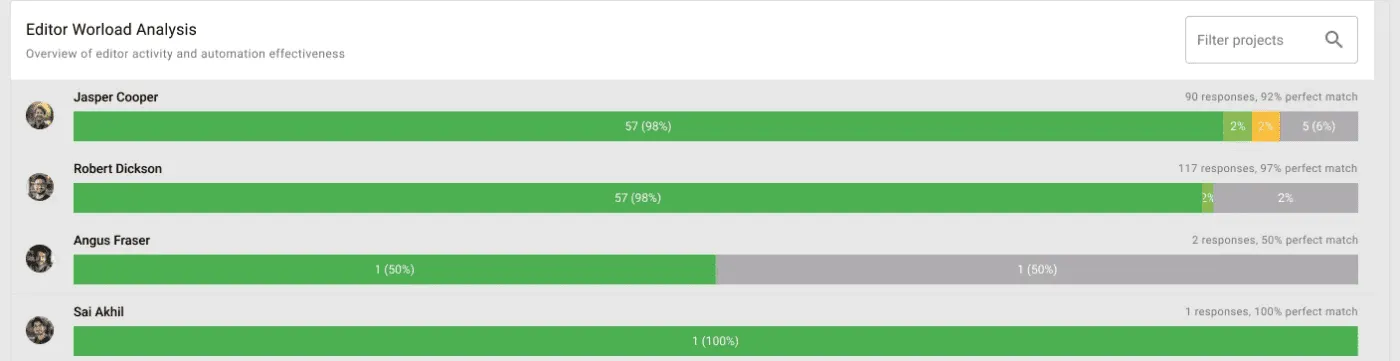
It’s the foundation you need to turn proposals into a strategic growth lever.
Manual vs Automated RFP Tracking
Manual tracking works at low volume but struggles as complexity increases.
The 2026 Proposal Win Rate Report by AutoRFP.ai highlights this “capacity cliff”: win rates fall sharply when bid volume outpaces team structure and process maturity.
| Category | Manual tracking (Spreadsheets + Email) | Automated RFP tracking platform |
|---|---|---|
| Intake | Opportunity details copied manually | Auto-extraction from Word, Excel, PDF, and portal uploads |
| Owner Visibility | Status updated manually; often outdated | Real-time dashboard showing section-level progress |
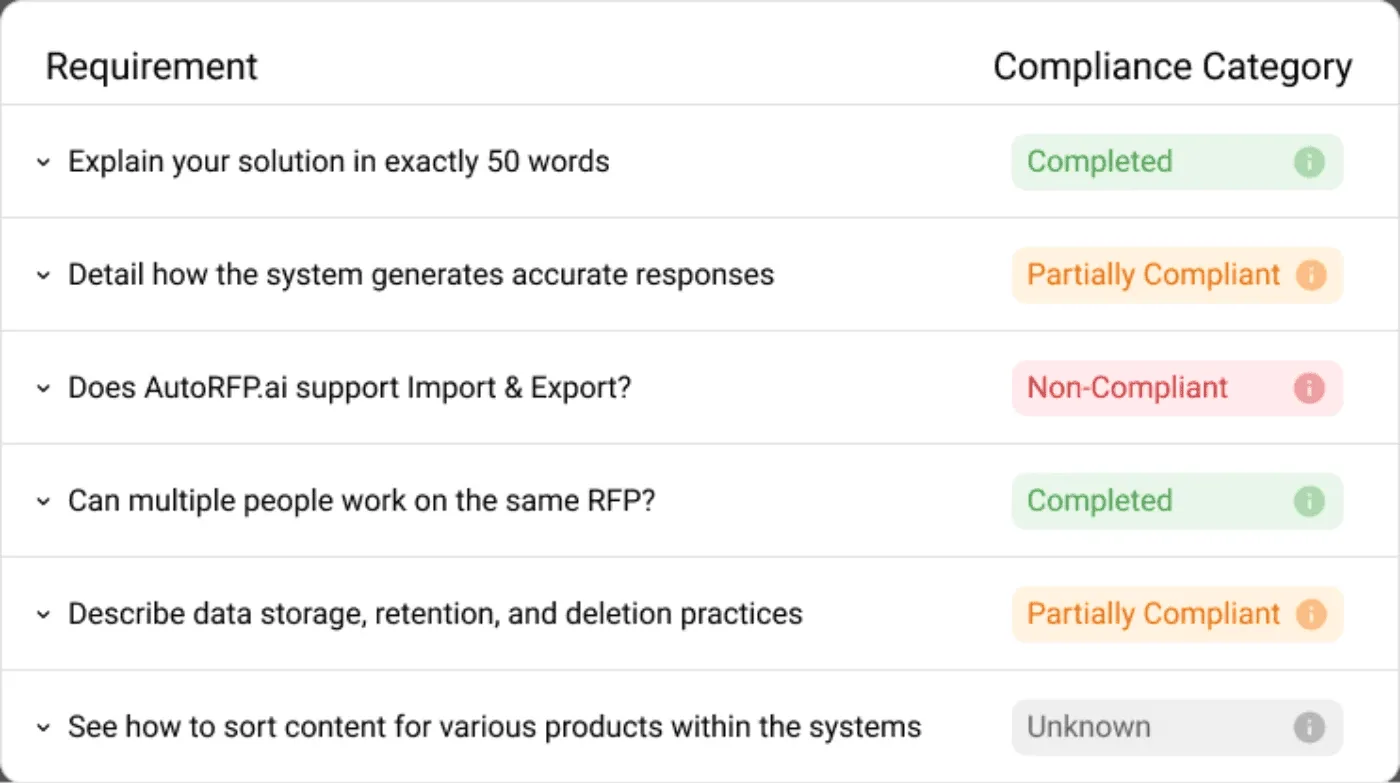
| Compliance Tracking | Static checklist maintained separately | Structured requirement mapping for proposals tied to each question |
| Collaboration | Email threads and shared drives | Centralized workspace with live task assignment |
| Reporting | Manual win-rate analysis | Automated analytics on win rate, capacity, and shortlist rate |
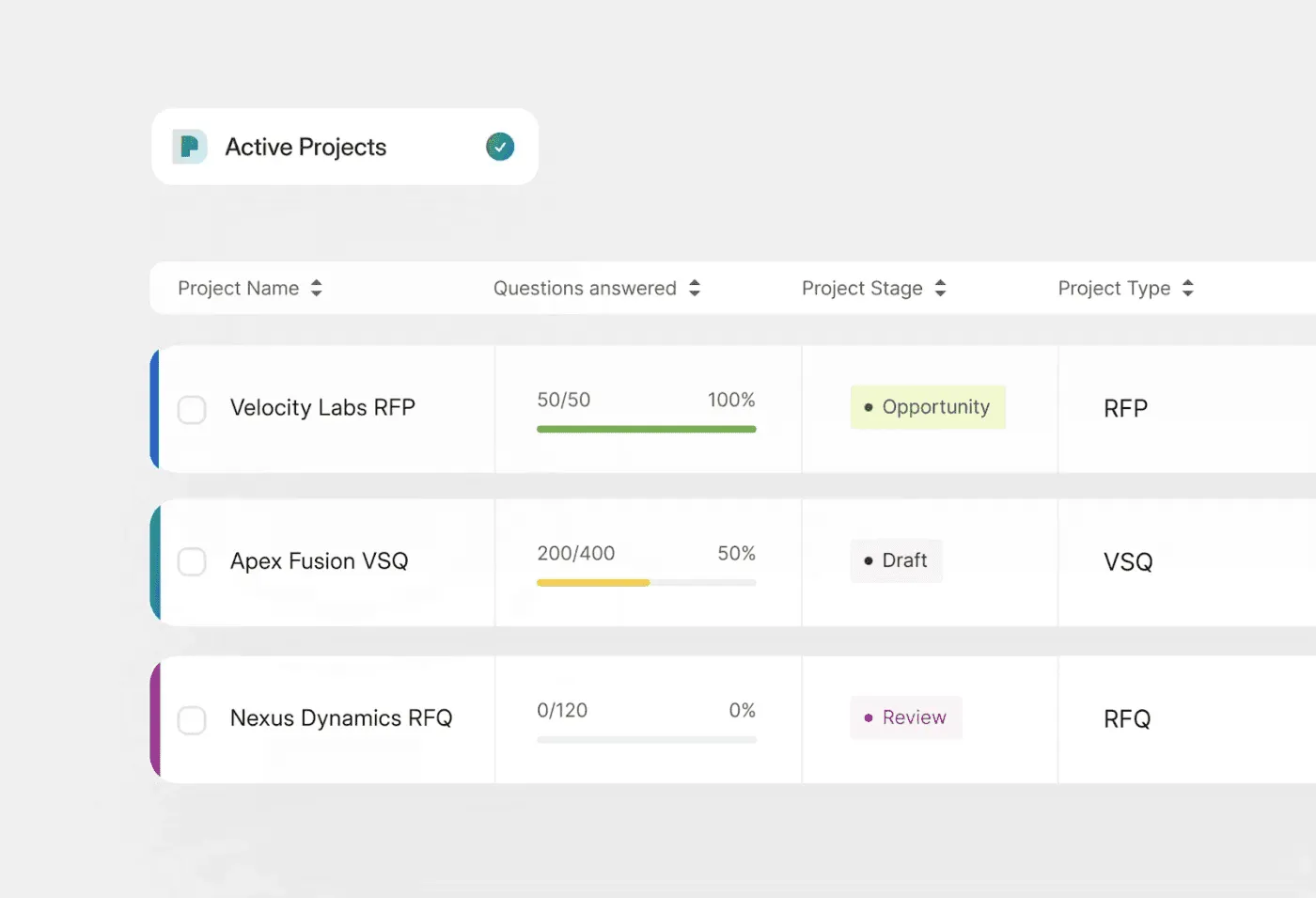
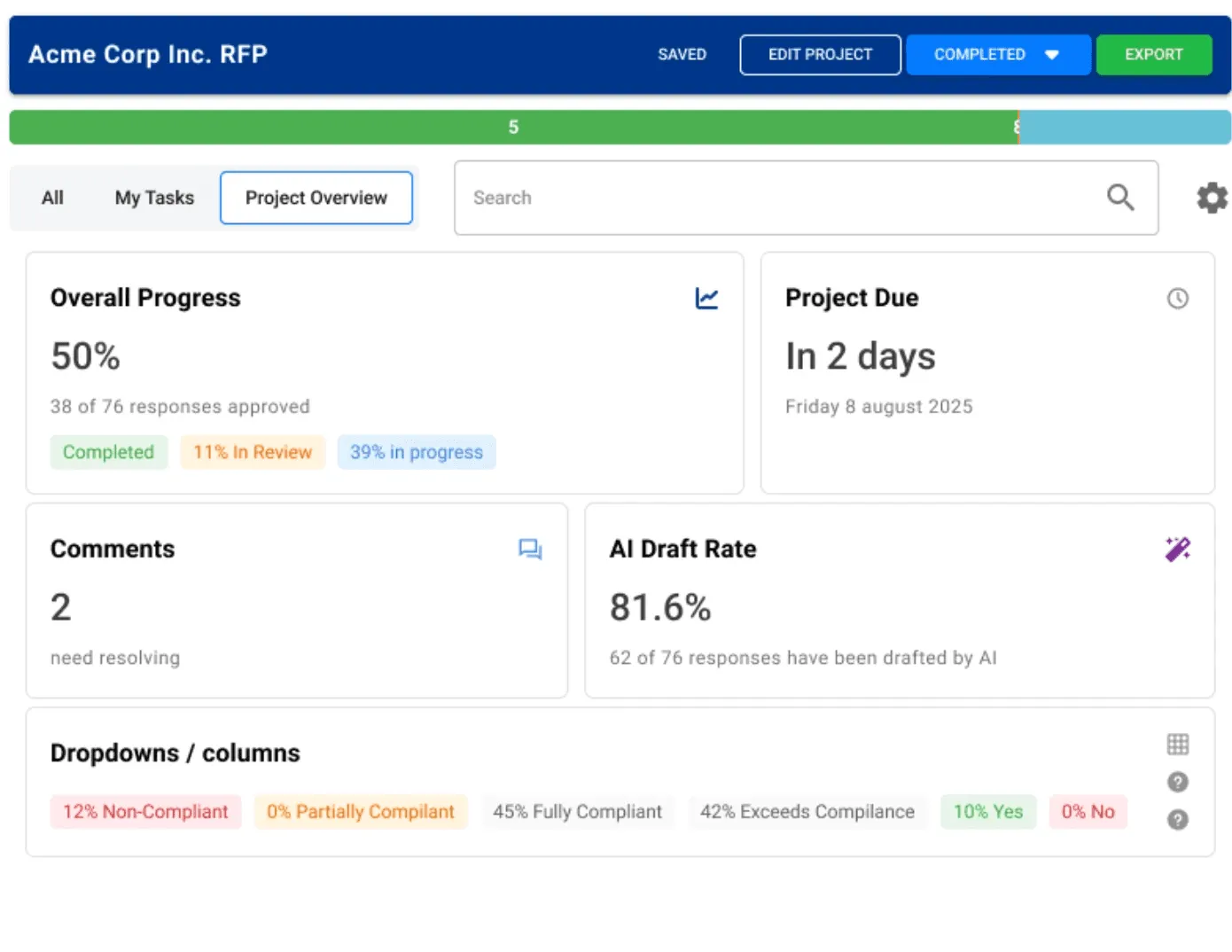
For example, platforms with integrated RFP project management dashboards show live ownership and progress across all RFPs, tenders, and security questionnaires in flight.
And when tracking connects directly to AI drafting through an RFP response engine, teams eliminate duplicate admin work while maintaining compliance controls.
See how AutoRFP.ai’s RFP software automation platform integrates automated tracking with AI-driven drafting and live reporting.
Automation Strategies for Smarter RFP Tracking
The best RFP automation strategies don’t replace your process. They remove the manual steps that slow it down and create blind spots.
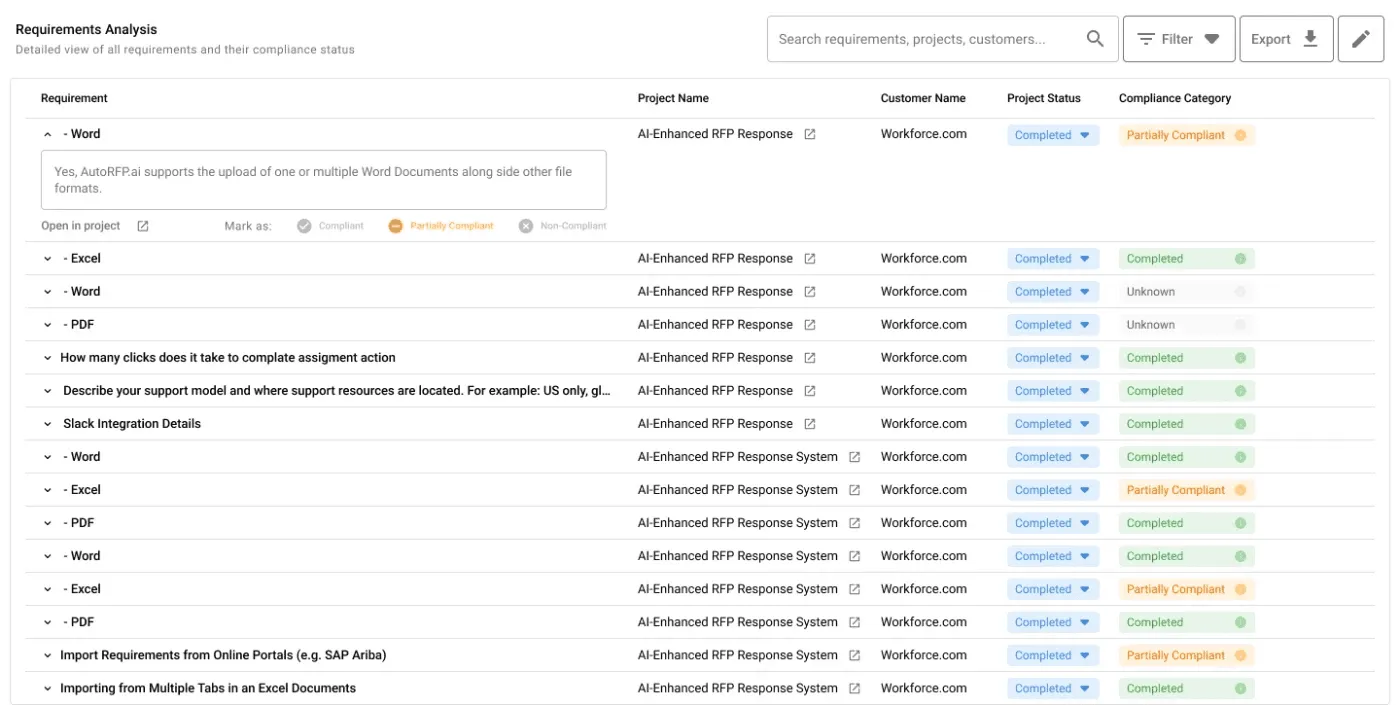
Automate Requirement Extraction
Modern systems import RFP documents and auto-extract:
Sections
Questions
Submission instructions
Deadlines
Compliance requirement
This eliminates intake lag and reduces early-stage errors.
Use Go/No-Go Scoring Triggers
Manual go/no-go processes rely on someone remembering to run the evaluation. Automated triggers do it for you.
When a new RFP is logged, a scoring workflow can prompt the bid manager to evaluate it against predefined criteria such as fit, contract value, and competitive risk, before any drafting work begins.
Pro tip: Tools like AutoRFP.ai’s go/no-go feature can scan incoming RFP documents early, flagging impossible requirements before a team commits hours to a losing bid.
Automate Win/Loss Data Capture
Build automated prompts that trigger when a bid is marked as won or lost:
A short, structured form asking for the outcome reason
Evaluator feedback (if available), and
Any debrief notes
Over time, this builds the performance dataset that informs better decisions and stronger win themes.
RFP Metrics to Track and Monitor
A high-performing RFP tracker measures performance, predicts capacity, and informs bid strategy.
If you’re wondering, “What RFP data should I track?”, here’s a lowdown:
Bid Win Rate
Win rate is the number of won bids divided by the total number of submitted bids, expressed as a percentage.
It sounds simple, but most teams don’t track it consistently.
Without a clean win rate by vertical, prospect type, or bid size, you can’t tell whether your go/no-go criteria are working or whether certain segments are draining your team’s time.
Bid Win Rate by Segment
This is a refinement of the overall win rate: how you perform across specific verticals, deal sizes, or buyer types.
This metric tells your team where to concentrate effort and where to tighten qualification criteria.
Average RFP Turnaround Time
How long does it take your team to go from receiving an RFP to submitting a response?
Longer average response times can indicate inadequate content reuse or SME bottlenecks.
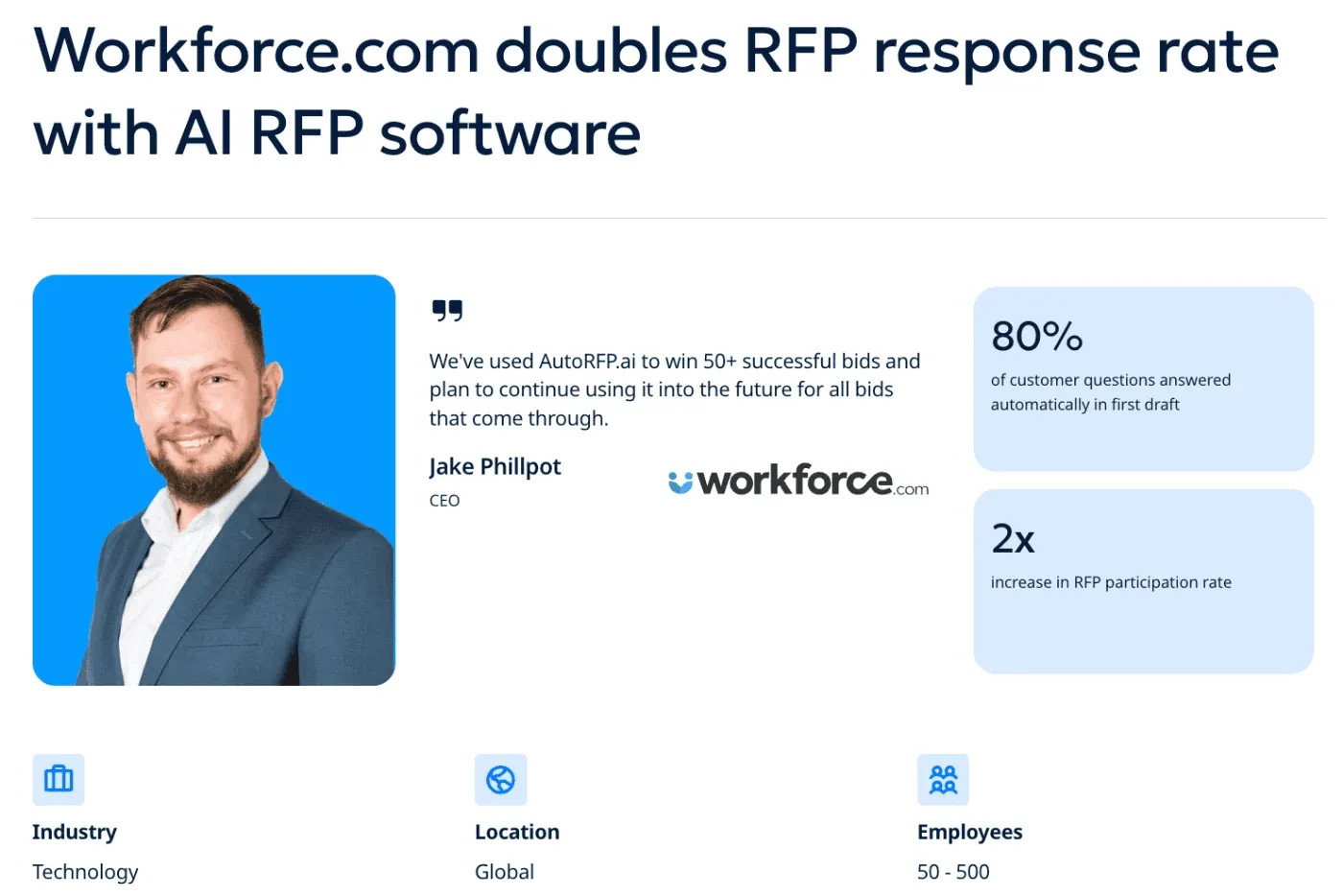
Side note: Workforce.com doubled RFP response rate using AutoRFP.ai’s AI response drafting.
Compliance Pass Rate
This metric tracks what percentage of your submitted proposals clear all mandatory compliance requirements on first submission.
A compliance pass rate below 100% indicates a process gap. Either checklist items are being missed, ownership of compliance attachments is unclear, or review gates aren’t catching errors before submission.
RFP Tracking Tools for Proposal Teams
An RFP tracker can live in a spreadsheet. But at scale, proposal teams need structured software.
Here’s a quick breakdown of the best RFP management tracker software:
1. AutoRFP.ai: Best for AI-Driven RFP Tracking and Automation
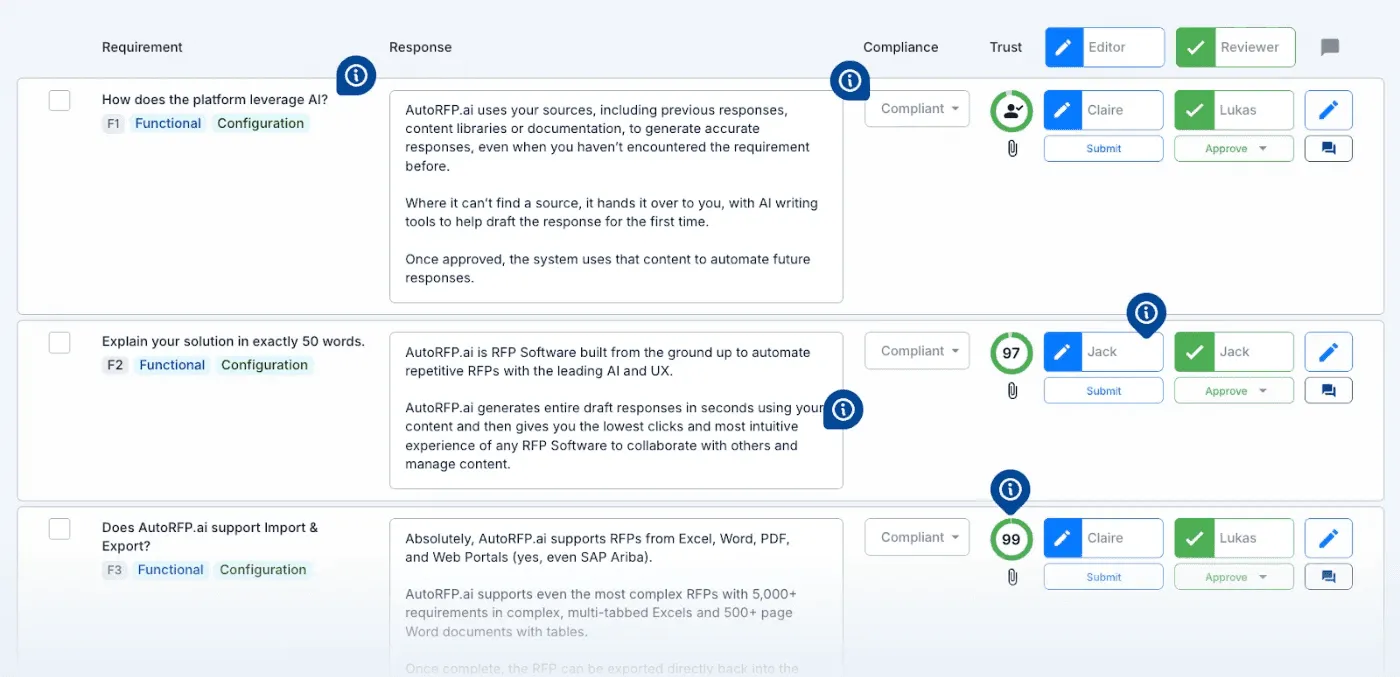
AutoRFP.ai is an AI-first RFP response platform built for enterprise B2B teams managing high volumes of structured bids.
It combines pipeline tracking, SME assignment, deadline management, and AI-assisted drafting in a single system.
Key Features
AI-powered response drafting: Generates first drafts using semantic search across your prior submissions, not just keyword matching. Teams report 80%+ usable AI-generated answers out of the box.
Project management and assignment tracking: Assigns sections to SMEs, tracks completion status, and surfaces blockers before they hit the submission deadline. Full visibility via a live dashboard.
Automation and reporting: Trigger-based alerts, go/no-go scoring, and on-demand performance reporting replace manual status updates and weekly check-in calls
Pros
Starts from the response library already in use, then files signed-off answers back in so the next bid is faster. Tag choices and approval stay with the people who own the content.
Connects ideas automatically across your entire response history
Unlimited users, content, and AI on all plans
Strong security and privacy controls (ISO 27001 certified & SOC 2 compliant)
Straightforward, project-based pricing
Cons
Not ideal for highly bespoke Architecture, Engineering & Construction (AEC) and Government Contracting (US Federal) segments
Advanced analytics are still evolving compared to some enterprise BI tools
Best For
It’s the best RFP management tracker for mid-market to enterprise B2B SaaS companies responding to structured, repeatable RFPs at scale.
Book Demo with AutoRFP.ai to see the tracking and response engine working together on a live bid.
2. Loopio: Best for Structured Teams with Dedicated Content Managers
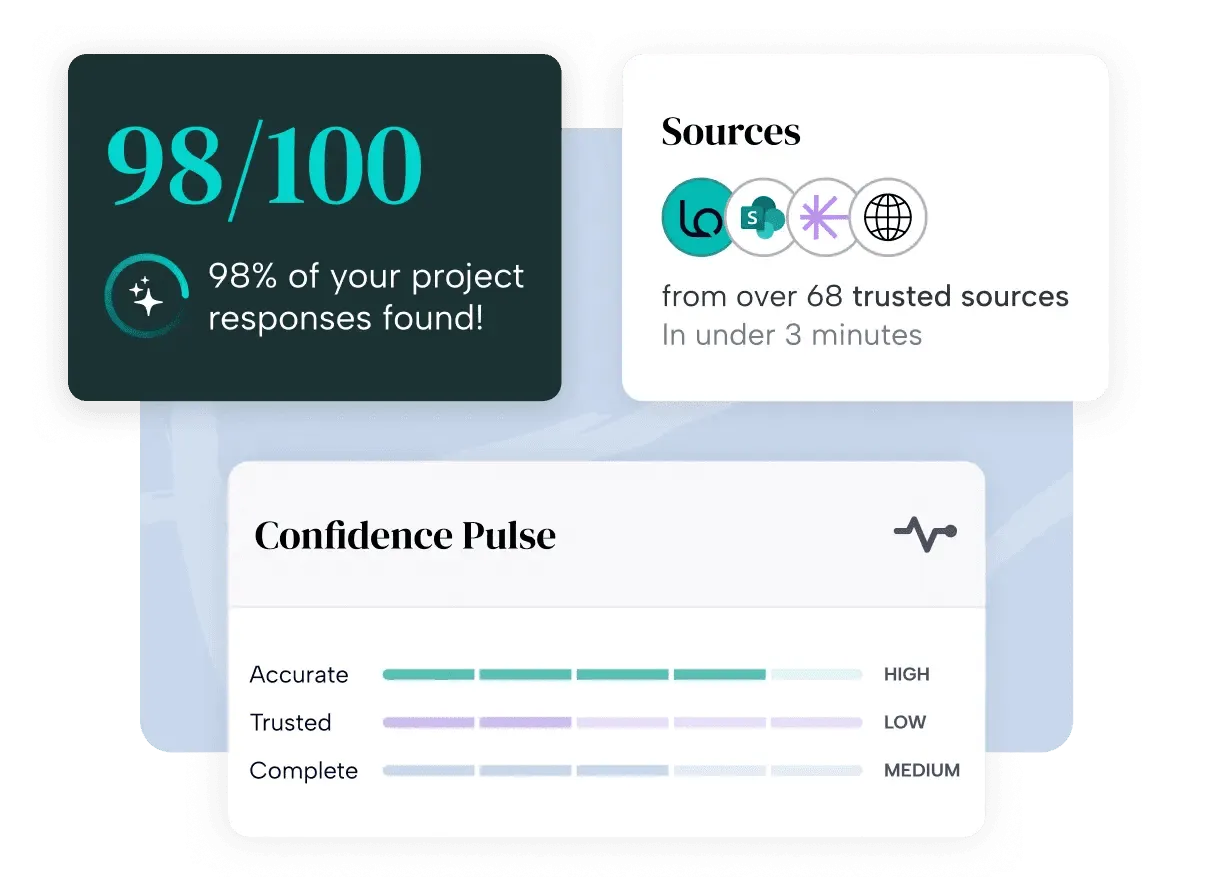
Loopio is a legacy RFP management tool known for the depth of its content library and project visibility.
Key Features
Centralized content library with categorized Q&A pairs
Task assignment and workload tracking via real-time dashboards
Pros
User-friendly interface
Strong customer support reputation
Cons
Generic AI suggestions that often require heavy manual editing
That library only stays trustworthy if someone keeps doing the manual clean-up
Per-seat pricing can become expensive at scale
Best For
Mid-to-large companies with an established proposal function and a content manager who can own library hygiene.
Further reading: AutoRFP.ai vs Loopio comparison
3. Responsive: Best for Complex Enterprise Environments
Responsive is a mature RFP platform focused on response intelligence and enterprise reporting.
Key Features
Automated RFP import for Word, Excel, and PDF formats
Built-in requirement analysis and bid/no-bid scoring
Robust analytics with 10 built-in report templates
Pros
20+ native integrations and 75+ API connections
Familiar, MS-Word-like editing interface
Cons
AI-generated responses often repeat library content rather than tailored answers
Implementation timelines can be longer
Heavily reliant on keyword matching
Best For
Enterprise teams operating in complex tech environments.


Video transcript
Transcript is auto-generated and may contain minor errors.
Hey, I'm Rob from Auto RFP.ai. We're going to go into the best RFP software in the market. What is RFP software? And jumping into it, looking at some of the different major players, and helping you hopefully decide which ones are worth having a look at. If you are interested in having a look at them, I recommend going to their website. RFP software in the market in 2025, you can break down some of the best players into two main markets or two main camps. You've got your legacy RFP software providers, like Loopio, Responses, Qvidian, which I'm going to go into detail. And then you've got your AI native players, like Auto RFP.ai I'm from. You've got Tribal, HeyRFP, Shift Hub, and and plenty of others as well. So, what are the difference between the two? Your legacy RFP software, they have generally been around since early 2000s. They brought software to the RFP process. RFP software providers
effectively built an ability for a company to store all their documentation and information and kind of questions and answers. So, it's like a question and answer bank. They built these big banks of answers and questions for companies. Then when they would get a new response or new RFP, it would use keyword search to copy and paste from the Q&A bank into that new RFP uh that they just received. So, that's what a legacy RFP software is. Then you have your AI native players who have launched since the huge uptick in AI with ChatGPT in uh what was that? 2021. So, Auto RFP.ai, we actually launched a couple of weeks just before ChatGPT came out. I've been building the product over the last three or four years with hundreds of customers. And effectively, your native AI players don't have all that legacy tech debts. They're built with a basis of being a vector database, which is a specific term with AI. They then use AI semantic
search, which effectively takes in the context of responses. And when you get a blank RFP, it'll pull in not just information from your Q&A bank, but from your website, from your case studies, from your integrations and different knowledge sources, and eventually use that to answer the RFP. So, that's kind of the nuts and bolts of it. You've got your legacy players who some do actually have AI now as well. And then you've got your AI native players. As I mentioned, you have all your content. That is generally your Q&A banks, your past responses, it might be your Google Docs, your SharePoint, Confluence, Notion, all your different information that you think holds relevant content for an RFP response. You upload that to the system or you integrate great and pull it through automatically. Then, when you have an RFP, you upload the RFP, create a new project. The AI, generally speaking, your AI native players, this is how it works.
It's going to automatically start drafting the responses or using a powerful AI semantic search to use to find relevant verbatim responses and effectively draft responses. It's going to allow your team to collaborate, set project deadlines, bring in subject matter experts to help answer that RFP. The really big thing about AI RFP software is it uses reinforcement learning to continually improve. And from your new responses, as you approve them, it gets better and better as time goes by. That's your RFP software in a nutshell. Now, how you can help determine what are the best RFP software. I would really recommend jumping on G2 or Gartner, having a look through actual verified user reviews. They'll have lots of different information regarding the RFP software. You can kind of click into each of those and understand it a bit better, the pros and cons, and so on. The RFP software is a pretty fast-moving
market, so I'd definitely recommend looking at a number of tools. Most of the providers here that you'll that I'll go into, you can book in for, you know, a 30-minute, 45-minute online demo just from their website. Hopefully, they don't have to do too many discovery questions. They jump on that call and they show you through the platform. So, your RFP software, like I said, you've got your Responsive, your Loopio. So, when you're looking at G2, you can look at, you know, the number of responses, but also you want to focus on the quality of responses, so what the actual total score is. And I would say anyone who has more than 50 or so reviews, as you can see, that's kind of how I made the short list today, is generally kind of worth a consideration to have a look at as well. Then you have Gartner. So, Gartner for your best RFP software has all the relevant information in relation to those different providers. Again, the reviews. You can understand more about each of those providers and what people are actually saying about those software. So, we've had a look at the review slides. Let's jump into some of the RFP software market's providers for 2025.
Loopio is an RFP software provider, one of those what you might classify as a legacy provider. They have a lot of really great large logos. They have been in the market for quite a long time now. Effectively, the basis of that product is kind of a question and answer bank using your past responses to then copy and paste when you bring in a new empty RFP. It's kind of the general gist of the product, and you can find out more information about Loopio from their websites. You can book in for a demo to chat to their team to understand more about them, and so on. Under plans, they have some information about their pricing. They don't have public pricing, but you can request a quote and get more information regarding their pricing. I believe their pricing plan has add-ons, so you can take that into account in relation to finding the right package that meets your requirements for what you're looking at. Responsive or responsive.io, they are also acquired a company called RFP360. If someone's referencing RFP360, that also is responsive.io or responsive.
Responsive is an RFP software. Again, one of those legacy providers that have been around for quite a while, have a lot of really large customers, and you can kind of get to know more about their product by going to their website. So, you can see here like I said, you effectively have a question and answer bank of your past responses, and then you can upload documents, your blank RFPs, and it helps answering those and has your different reporting and project management capabilities, and so on. If you want to chat to their team, you can request a demo, get to know them better. Or, in their pricing, the yeah, their pricing isn't available on the website, but you can obviously get a quote from their team, and I believe they also have paid add-ons as well in some ways. There you go, paid add-ons as well to find a plan that meets your your business's requirements as well. So, that's responsive.io. Now, jumping onto the next best RFP software, we have Qvidian. So, Qvidian is part of a much larger
family called Upland. They have a lot of products across their entire suite. Qvidian is one of those legacy RFP software providers that is a Q&A bank and uses your past RFP answers to help answer RFPs. You can, of course, find out more information on their websites. You can request a demo, and so on. What we found is that Qvidian generally has a lot of financial services customers, so those in managed investment funds, and so on. Next you have order rfp.ai. So that's where I'm from. Order RFP, we were one of the first AI native RFP software. So like I mentioned, that means our entire premise of product is based on effectively a vector database which is all your relevant context that might be used to answer an RFP. Then when you have a blank RFP, it comes in and then our system uses AI to generate responses, provide trust scores to see if you can trust the responses, has AI
actions to iterate and improve on the responses as you go and kind of work through your RFP. Then you then export that RFP back into the exact same format, translate it if necessary to different languages and so on. You can of course find out more about order to our team. If you'd like to book a demo with our team across the globe, we have global offices. You can find out more about some of our customers on our website as well. And then in our pricing, we do show our pricing in relation to some of our different plans there as well. So you can kind of see what makes sense for you. Our pricing is based off projects per year. Oh, I didn't mention about Loopio and Responsive. As far as I'm aware, their pricing is based off like seats. So number of team members that you might have used the tool. So you might actually come across different pricing models across some of the RFP software in a list of top best RFP software. You can find out more about order rfp.ai and chat to our team if you'd like. Go Jumping on to next, you've got Hey Iris. So Hey Iris is another AI RFP native
software provider. Again, one of the newer ones. They've got a video there that kind of showcases and goes through parts of their product, some of their customers as well if those are relevant customers to yourself. I don't believe they have pricing on their websites, but if you'd like to get in touch with their team, you can of course book a demo to understand more about them as well. Then you've got another one which I wanted to throw in is Shift Hub. Shift Hub is a little bit different to some of the others where they just focus on security questionnaire automation. Although all the RFP software I mentioned, whether it's Loopio, Auto RFP, Hey Iris, they all can do security automation questionnaire automation. Shift Hub just focus just on that. And you can find out more about their site by going there. And again, similar to Auto RFP and Hey Iris, you know, using AI to help answer those security questionnaires and so on. And you can kind of I don't believe they have pricing on their website, but you can understand more about them by obviously booking a demo and chatting to their team as well.
Next, you have Tribble. So, Tribble or tribble.ai is a little bit different to the other ones as well. Tribble, as far as I'm aware, isn't necessarily a product you log into, but it's a Chrome extension that then works in where you work. So, that might be Google Docs, Google Spreadsheets, you know, kind of completing RFPs in G Suite. It then comes in and answers different questions within those documents for you. So, that's Tribble. Yeah, they they again still integrate with like your knowledge base and support docs and those different information just like Auto RFP does. And you know, pulls in different information to help to help answer that as well. Don't believe they have pricing on the their website, but I'm sure there's some more information here as well so you can understand you can get to know them better. And you of course can book a demo as well and chat to their team if you'd like to learn more. So, that was our comprehensive list of best RFP software for 2025. So, we've got your legacy players, like I mentioned, your Loopio, Responsive, Qvidian. And then you've got your AI
native players or kind of like disruptors in the space, you know, your Auto RFP, Hey Iris, Tribble, Shift Hub, and so on. If you'd like to find out more about Auto RFP, obviously get in touch or any of the others, you can obviously visit their website and book in for a demo. So, that was the best RFP software for 2025. Thank you.
How to Choose the Best RFP Tracker Solution for Your Business
Not every RFP tracker is built for the same level of volume, complexity, or governance.
We suggest using these three core evaluation areas:
Structured Workflow and Ownership Control
Your tracker must clearly show:
Who owns each section
What is pending
What is blocked
When reviews are due
AutoRFP.ai provides real-time visibility across all active RFPs through its integrated project dashboard. Proposal managers use it to see blockers immediately. See it in action here.
AI-Driven Drafting Integrated with Tracking
Look for platforms that:
Generate first drafts instantly
Surface approved past responses using semantic understanding
Provide source validation and trust indicators
Reduce repetitive SME rewriting
AutoRFP.ai integrates its AI response engine directly into the tracking workflow, allowing teams to generate structured drafts while maintaining compliance visibility.
SugarCRM now handles 2000-question security RFPs with just one full-time employee using AutoRFP.ai’s automated tracking and response engine. Try it here.
Reporting and Revenue Visibility
Executives care about:
Win rate
Capacity
Volume trends
Automation rate
Revenue impact
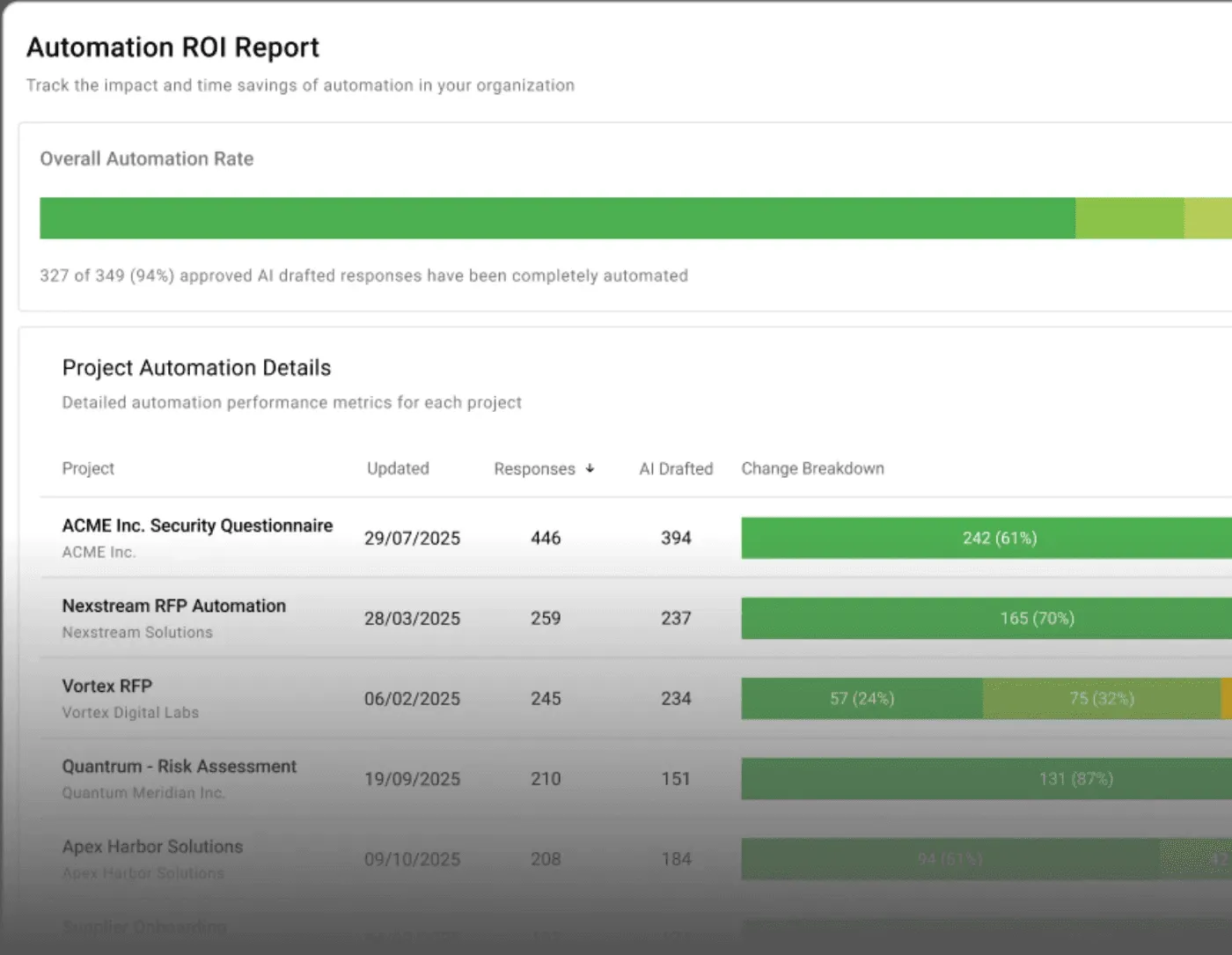
Choose a tracker that surfaces these performance analytics automatically. A tool like AutoRFP.ai includes built-in automation and ROI reporting.
Simplify RFP Project Management with AutoRFP.ai
When tracking, drafting, compliance, and reporting live in separate systems, teams lose visibility. You also risk your SMEs burning out while win rates stagnate.
AutoRFP.ai connects intake, go or no-go qualification, AI-generated first drafts, ownership tracking, compliance mapping, and performance reporting to track RFPs in one governed workflow.
The result is measurable:
Faster first drafts
Fewer missed requirements
Better capacity planning
Higher shortlist and win rates
If RFPs represent a meaningful share of your revenue, they deserve dedicated infrastructure, not improvisation.
See how AutoRFP.ai transforms RFP tracking into a structured revenue engine. Book Demo today.
About the author

Co-founder & CEO
Co-founder and CEO of AutoRFP.ai. Spent 7 years running global RFPs and personally completed 500+ RFPs before founding the company.
LinkedIn