Steerlab is a lighter AI-native option whose strongest public case is the security-team workflow. The longer sourced write-up is AutoRFP.ai vs Steerlab. Generated answers carry sources and confidence scores, and the product says it tells the reviewer when it does not know. Human review, comments, assignments, and project tracking sit around that questionnaire drafting layer.
AutoRFP.ai is the accuracy-first, AI-native platform for RFPs, security questionnaires, and DDQs: every answer is written from content your team has approved, and shows the sources behind it. The review layer uses two separate signals. Citations sit on the sentence: a quoted passage, a named file or connected system, and the person behind that source. Trust Score shows how strongly the content supports a draft, while Feedback Score evaluates whether the response answers the requirement.
Steerlab has a credible security-questionnaire lane
Steerlab’s security-team page says every answer comes with a confidence score and that unsupported questions are identified rather than invented. Its features page publishes sourced generative answers, an auto-managed content library, project tracking, comments, and collaboration. Those are genuine strengths for presales and security teams evaluating a newer AI-native product.
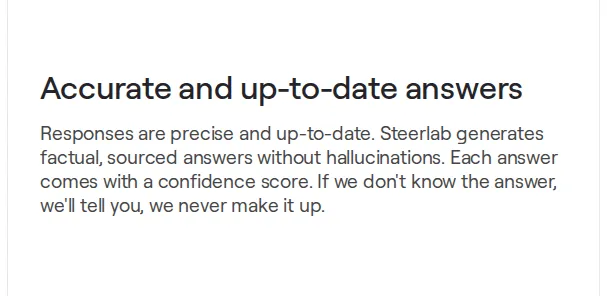
Steerlab security-teams page, captured August 26, 2026: sourced answers, a confidence score on each answer, and “If we don’t know the answer, we’ll tell you, we never make it up.”
The free first RFP or questionnaire is another practical strength. A buyer can put one real document in front of internal subject-matter experts before discussing a paid contract.
Compare what the review signals mean
Steerlab publishes a confidence score per answer and linked source documents. AutoRFP.ai separates the review question into two parts: whether the source supports the draft, and whether the draft fully answers the requirement. Citations sit on the sentence: each claim carries a quoted passage, a named file or connected system, and the person behind that source. Unsupported questions are flagged for a person, while inspectable quotes stay attached to supported sentences.
That distinction is best tested with evidence. Add one unsupported question and two source documents that disagree. Record whether each product drafts, flags, or abstains; what its score measures; and whether the reviewer can open the exact sentence, file, and person behind the claim.
Enterprise diligence goes beyond a security headline
Steerlab’s primary security page publishes SOC 2, AES-256 encryption at rest, TLS 1.2 in transit, customer isolation, European AWS data storage, SSO, MFA, and fine-grained user roles. It does not state the SOC 2 report type or list ISO 27001. European AWS storage is an EMEA fact, not Americas or APAC coverage. Other Steerlab-authored pages claim ISO 27001, so buyers should request the current certificate and scope rather than infer it from either page.
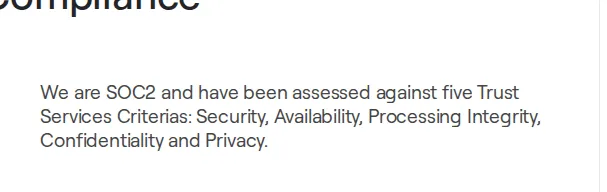
Steerlab security page, captured August 26, 2026: “We are SOC2 and have been assessed against five Trust Services Criterias.” The page does not name Type I or Type II.
AutoRFP.ai publishes ISO 27001, SOC 2 Type II, SCIM, regional hosting, and a self-service Trust Center. The subprocessor register names the services involved. Procurement can inspect those artifacts before a proof of concept.
Integrations are a close comparison, not a blank space
Steerlab’s integrations page names Google Drive, SharePoint, OneDrive, Dropbox, Box, Slack, Microsoft Teams, HubSpot, Dynamics 365, Salesforce, Chrome, Confluence, Notion, Okta, Google SSO, Auth0, and Microsoft Entra ID.
The published directory names the systems, but does not define the CRM objects, triggers, or write-back behavior. A G2 review dated June 3, 2026 asks for “stronger native integration with some of the smaller consumer service CRMs we use.” Another dated April 24 says its CRM sync was quick and improved sales and engineering collaboration. Buyers should test the exact CRM workflow rather than infer depth from either a logo or one review.
AutoRFP.ai connects the same core knowledge and collaboration stack, then documents the job each connection performs. Salesforce carries intake and two-way project status. Slack and Teams carry review requests and sourced answers. SharePoint, Drive, Box, Confluence, and Notion supply permission-aware content and source links. The integration directory is the current record.
The evaluation belongs on the returned file
Steerlab publishes Excel, Word, PDF, narrative-proposal, and browser workflows. A G2 review surfaced by AWS Marketplace, dated June 6, 2026, says, “When exporting with structured templates, the formatting sometimes shifts slightly.” That is a useful test condition, not a reason to reject the product.
Use a workbook with formulas, macros, validation lists, nested sheets, and an ambiguous answer column. AutoRFP.ai keeps the original Office file and writes approved answers into its mapped cells or paragraphs. The returned files show whether either workflow matches the issuer’s requirements.
Paid pricing is still a procurement question
Steerlab offers the first RFP or questionnaire free. Its paid subscription price, usage limits, overages, and billing terms are not public. The AWS Marketplace listing uses private offers and does not define what one billing Unit represents.
AutoRFP.ai publishes Scale and Accelerate plans, both with unlimited users. A buyer can map the response year to a published allowance before procurement.
The evaluation is free on both sides, with different scope. One free questionnaire ends after one document. The AutoRFP.ai proof of concept runs for two weeks with the full platform open, no usage cap, your content sources connected, and implementation support while live work goes through it.
Public legal terms
Steerlab’s Legal Terms (last updated June 19, 2026) govern “access to and use of the Services.” They bar use where interactions would be subject to HIPAA or FISMA, and bar use that would violate GLBA. The Services are provided as-is, with no obligation “to maintain and support the Services.” Steerlab may change the terms without specific notice, and may terminate an account and delete posted content “FOR ANY REASON OR FOR NO REASON” without warning. Liability excludes direct damages and is capped at amounts paid in the prior six months. Contributions “may be treated as non-confidential and non-proprietary,” and the terms do not define a Customer Data category that excludes uploaded questionnaires. The privacy notice names Anthropic, OpenAI, Mistral AI, and Cohere as AI processors of input, output, and personal information, and states that Steerlab does not process sensitive personal information. /dpa and /msa returned HTTP 404 on August 27, 2026.
AutoRFP.ai publishes an MSA, DPA, and SLA. The MSA says the customer owns Customer Data and Outputs, and that AutoRFP.ai will not train its or third-party models on that data except tenant-specific models for that customer. Ask whether a signed Steerlab order form replaces the website terms before a production proof of concept.
Company maturity and customer evidence
Steerlab is a newer, smaller vendor. Its about page says it was founded in 2023, is based in Paris, and lists Paris leadership. It does not name a second office. It announced a $1.9 million pre-seed round in September 2024. Tracxn lists 14 employees as of July 31, 2026 at that Paris-based company. A 14-person Paris team is a different implementation and coverage profile from AutoRFP.ai’s published offices in New York, Vancouver, Stockholm, and Brisbane, with support across North America, Europe, and Asia-Pacific. Treat 24x7 and global staffed coverage as contract questions.
Its public site shows customer logos and short testimonials. As of August 26, 2026, no full case-study library with implementation detail and attributable outcomes was found. Buyers should ask for customer calls from teams with similar volume, file complexity, security requirements, and approval structure.
The G2 evidence surfaced by AWS is useful but mixed. Reviewers praise source traceability, ease of adoption, and support. Dated reviews also ask for better reporting, more flexible dashboard exports, stronger native support for smaller CRMs, and more reliable structured-template formatting. Those comments define practical proof-of-concept tests.
Run the same proof through both
Bring a difficult live questionnaire, the content your reviewers already trust, and the real approval policy. Test unsupported and conflicting questions, source inspection, review routing, the returned Office file, and an identity change.
We’d rather show you than tell you: two weeks of your real response workload, unlimited access, and our team alongside yours, then let the reviewers who sign off decide which submission record they trust.