
RFP Library: Structure, Benefits & How to Build (2026 Guide)
Struggling with scattered RFP content? Build an organized RFP library that streamlines responses, improves consistency, and supports faster submissions.

Technical Account Manager, AutoRFP.ai·Updated ·10 min read
Most bid teams technically have an RFP library, it’s just split across old proposals, SME inboxes, SharePoint folders, email threads, shared drives, and “final_v7_really_final” docs.
Every new RFP starts with the same scramble to find that one perfect answer you “know is somewhere.” A structured RFP library fixes that by turning scattered content into a single, trusted source of truth your whole team can reuse.
In this guide, we’ll define what an RFP library is, what it should include, and how to build one step by step. You’ll also learn best practices to maintain it, how traditional libraries compare with AI-automated ones, the strategic benefits, and how to get more value with an AI-powered RFP automation tool.
What Is an RFP Library?
An RFP library is a centralized repository where you can store reusable, pre-approved content for request for proposal (RFP) responses, request for information (RFI) documents, request for quotation (RFQ) submissions, due diligence questionnaires (DDQs), and security questionnaires (SQs).
You can also review common security question examples to understand the types of data buyers typically request in these documents.
It gives bid and sales teams a single source of truth, ensuring every response is consistent, assembled quickly, accurate, and controlled, with clear version history and ownership.
A strong RFP library typically holds standard questions and answers, company and product descriptions, legal and security language, implementation and pricing notes, plus templates and past responses, all organized into categories with tags, owners, and review dates.
What Should an RFP Library Include?
Here’s what your RFP library should contain so your team can quickly find accurate, reusable answers for every RFP:
| Library content area | What belongs in your library |
|---|---|
| Company story, solutions & proof | Company profile, solution overview, ideal customers, key differentiators, plus short case studies, testimonials, and headline outcomes |
| Product & feature details | Descriptions of each product or module, core features, supported use cases, and any standard limitation notes |
| Q&A and reusable content blocks | Pre-approved answers to common RFP, RFI, RFQ, DDQ, and a collection of frequently asked questions and their answers |
| Pricing explanations (not pricing) | How your pricing works, what’s included or excluded, cost drivers, and common add-ons, without numbers |
| Risk, security & contractual terms | Key policies, certifications, data protection practices, data processing terms, liability positions, renewals, termination, and agreed fallback clauses |
| Integrations & technical ecosystem | Supported integrations, APIs, data flows, simple architecture views, and system requirements for buyers and IT |
| Reusable templates & formats | Proposal shells, section templates, executive summary outlines, SOW skeletons, and standard table or matrix layouts |
| Governance, metadata & version control | Content owner, approver, audience, tags, last-reviewed date, and version history |
How to Build an RFP Library (Step-by-Step)
To build an effective RFP library, you will need to:
1. Define the Scope and Goals of Your Library
Before you upload a single answer, decide what this library is for rand what it will include (RFPs only or also RFIs, RFQs, DDQs, security questionnaires, and which products, regions, and languages).
Then agree on a few clear success metrics, such as faster response times, higher win rates, or more consistent answers.
2. Audit Your Existing Content
Next, review your current RFP materials for high-quality content rather than starting from a blank page.
Collect recent proposals: Focus on the last 10-20 won or late-stage opportunities.
Extract reusable answers: Pull company overviews, product descriptions, security answers, and implementation sections into a working document.
Tag standouts and red flags: Mark strong answers as “gold,” and flag anything outdated, too bespoke, or risky so it doesn’t enter the library.
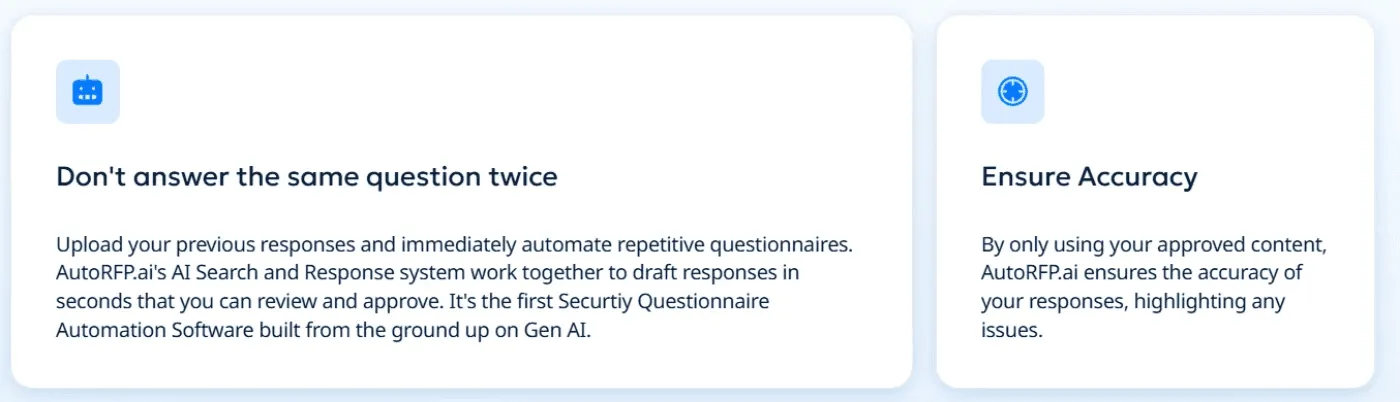
Side note: With AutoRFP.ai, the audit is the heavy part, and you only do it once. From there, every answer your team approves files itself back into the library, so the content you just cleaned up keeps growing instead of drifting toward another clean-up project. If someone proposes rebuilding that loop as internal software, the build versus buy decision for RFP tools is the honest next conversation.
3. Design Your Structure, Categories, and Metadata
Before loading content into a tool, decide how everything will be organized, so people can actually find it.
| Action | Description |
|---|---|
| Create high-level categories | e.g., Company overview, Product & features, Implementation & support, Pricing explanations, Policies & compliance, Security, Legal, Customer stories, Integrations, Templates |
| Define metadata fields | At minimum, include content owner, audience, product/solution, region, language, tags, and last-reviewed date |
| Standardize naming | Use consistent titles like “Security – Encryption at rest” or “Product – Core features – Platform X” so search results make sense |
4. Build and Clean Your Core Content Set
Now you turn raw answers into clean, reusable blocks that anyone can drop into a response.
Apply metadata and status: Mark each item as draft, under review, or approved so writers know what’s safe to use.
De-identify without weakening: Remove client names, confidential numbers, and one-off concessions but keep the strongest proof and positioning where possible.
Tag for reuse: Categorise each block by market, industry, and competitor scenario so teams can pull the most relevant version.
Create variants: Store a default/base answer plus optional market/industry/competitor variants (and note when each should be used).
5. Choose the Right Tool and Import Content
Once your core content is in good shape, bring it into the system that your team will actually use day to day.
Pick your software: This might be a dedicated RFP platform like AutoRFP.ai.
Configure search and filters: Ensure users can filter by project, owners, documentation, and tags.
Set up version control: Ensure the tool tracks changes, shows who edited what, and lets you roll back if needed.
Import in batches: Import high-value content types first.Use a tool that lets you upload completed projects, documentation, and existing libraries from different sources, instead of trying to move everything in one go.
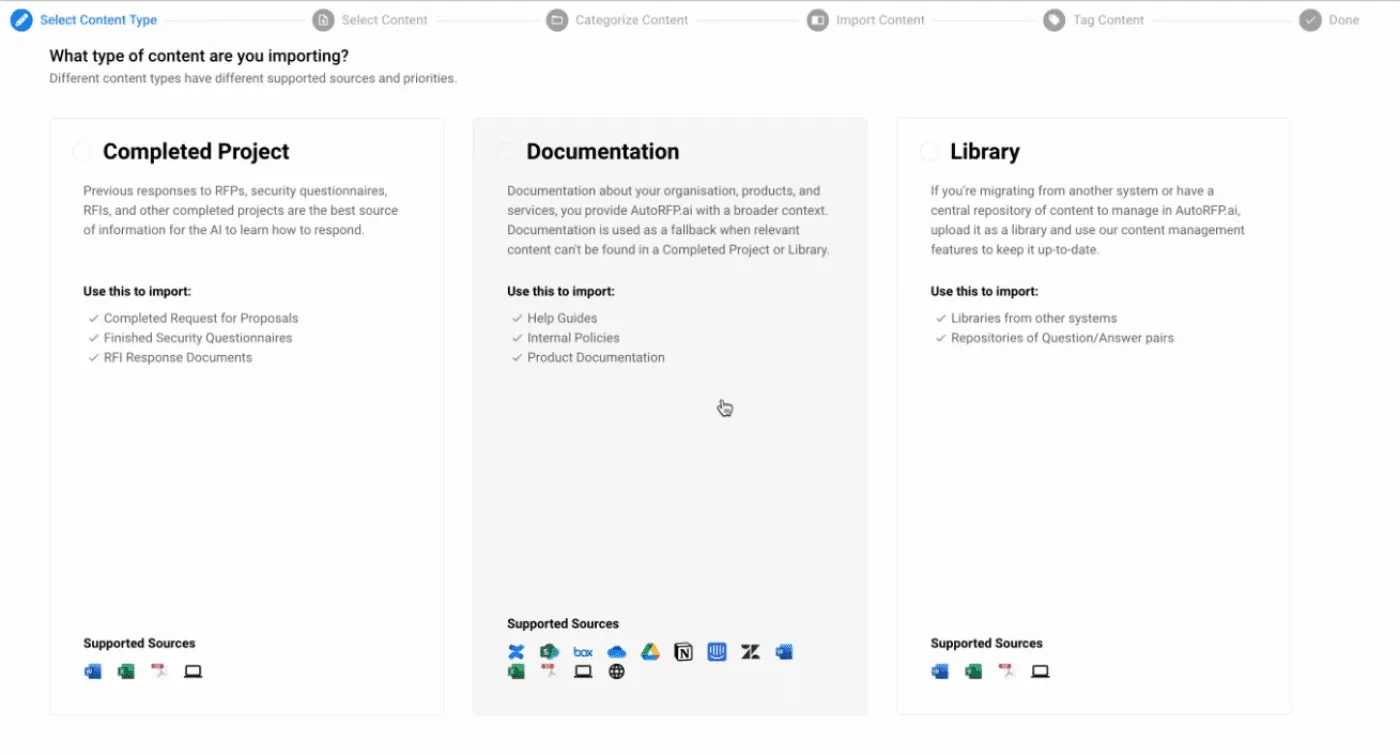
Example of AutoRFP.ai’s import, where you choose whether to import Completed Projects, Documentation, or an existing Library into your RFP content hub.
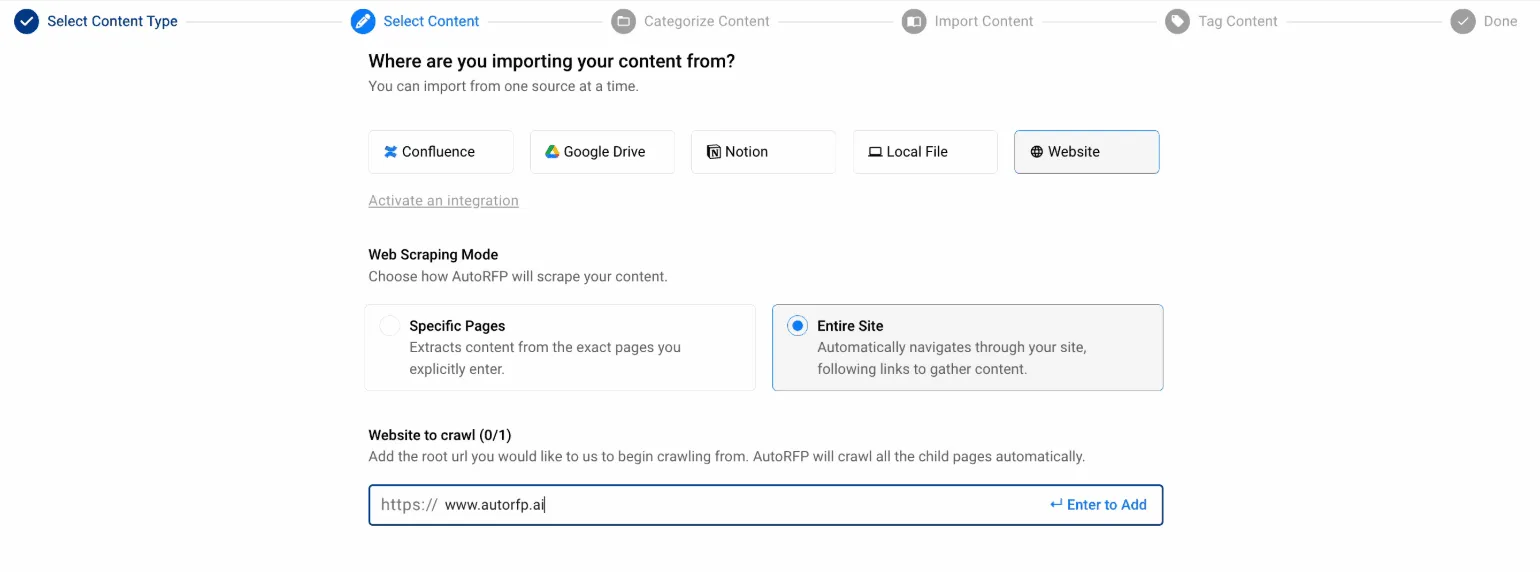
Example of AutoRFP.ai importing content from a website, with options to scrape specific pages or automatically crawl the entire site and turn it into library content.
6. Establish Governance and Maintenance Routines
An RFP library only works if the underlying content is governed, not just stored.
Map critical content across the organization: Think holistically about which teams and content types your responses depend on most (e.g., product, legal, security) and focus governance there first.
Prioritize high-dependence answers: For content you reuse constantly, make sure it is accurate, vetted, and up to date, and map entries to the critical themes, questions, and objections you see most often from customers.
Make governed content easy to access: Store approved answers in a system where a quick search or a few tags surface the right content in seconds.
7. Roll It Out, Train Your Team, and Improve Over Time
Finally, make sure people know the library exists and how to use it in daily work.
| Action | Description |
|---|---|
| Run short training | Show writers and SMEs how to search, filter, reuse content, and request updates with real scenarios |
| Embed in the process | Make “search the library first” a standard step in your RFP playbook |
| Collect feedback | Regularly ask your team what’s hard to find, what’s missing, or where answers feel too generic or too detailed |
| Measure and refine | Track reuse, time saved, and SME effort, then tweak categories, metadata, and content based on what you see |
Best Practices for Maintaining an RFP Library
Here are the best practices to keep your RFP library organized, accurate, and easy for your team to use:
1. Only Keep Content You’ll Actually Reuse and Update
Archive content that might still be useful later, such as past product details or old policies, but don’t keep it in the active library. Delete content only when it’s completely obsolete and won’t be needed again.
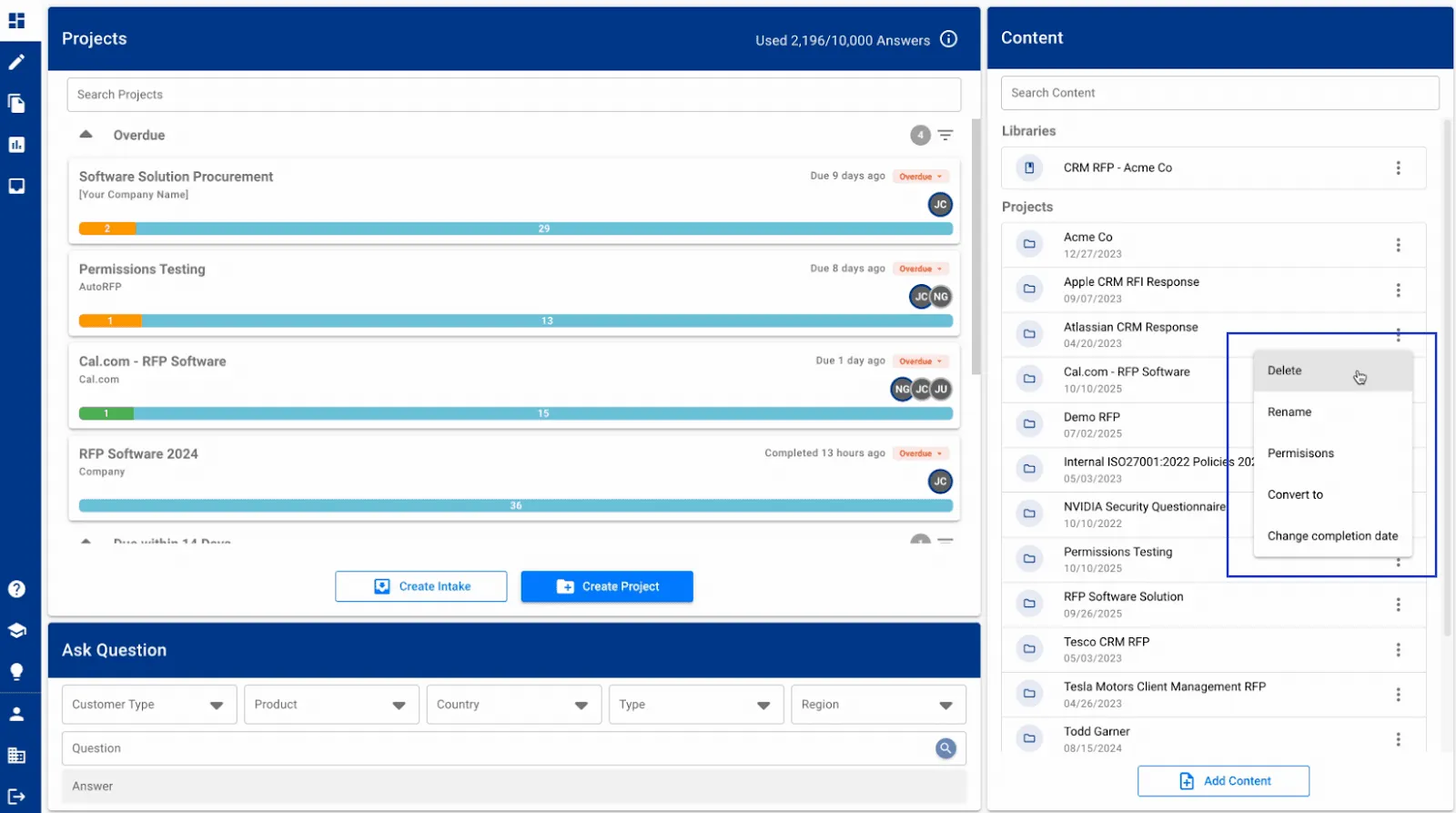
Example of deleting outdated content from the RFP library in AutoRFP.ai
2. Integrate Your RFP Library With the Tools Your Team Already Uses
Sync your library with platforms like Notion, Confluence, or Google Drive, where content is already being updated. This keeps responses fresh, reduces manual uploads, and ensures product and policy updates flow directly from your SMEs into the library.
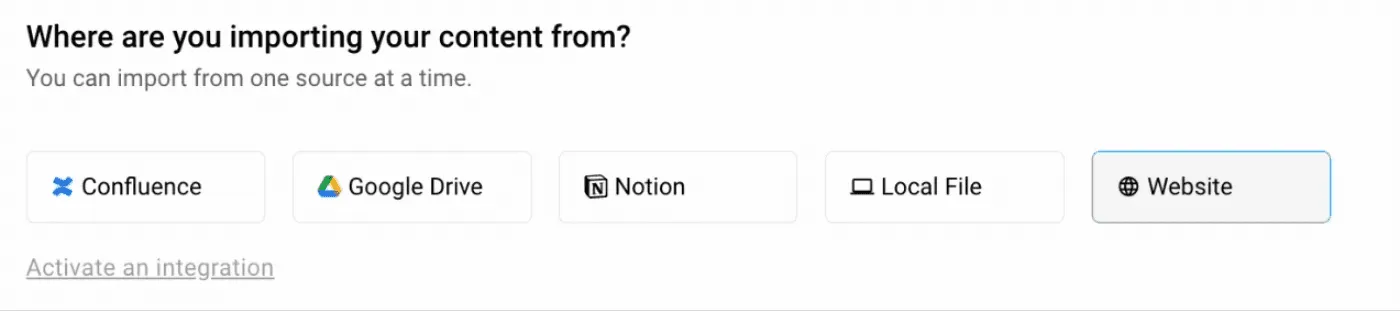
AutoRFP.ai’s import features support content sources such as Confluence, Google Drive, Notion, local files, websites, and more.
3. Stop Over-Maintaining the Long Tail Content
For questions that appear once in hundreds of RFPs, it may be more practical to go back to the original source each time than to maintain a parallel copy in the library. Save your maintenance effort for the content that’s used often and really matters to your win rate.
4. Flag Content for Review
Mark answers that need updates so teams can quickly identify what’s outdated or inaccurate. This keeps your library clean and prevents old information from slipping into live proposals.
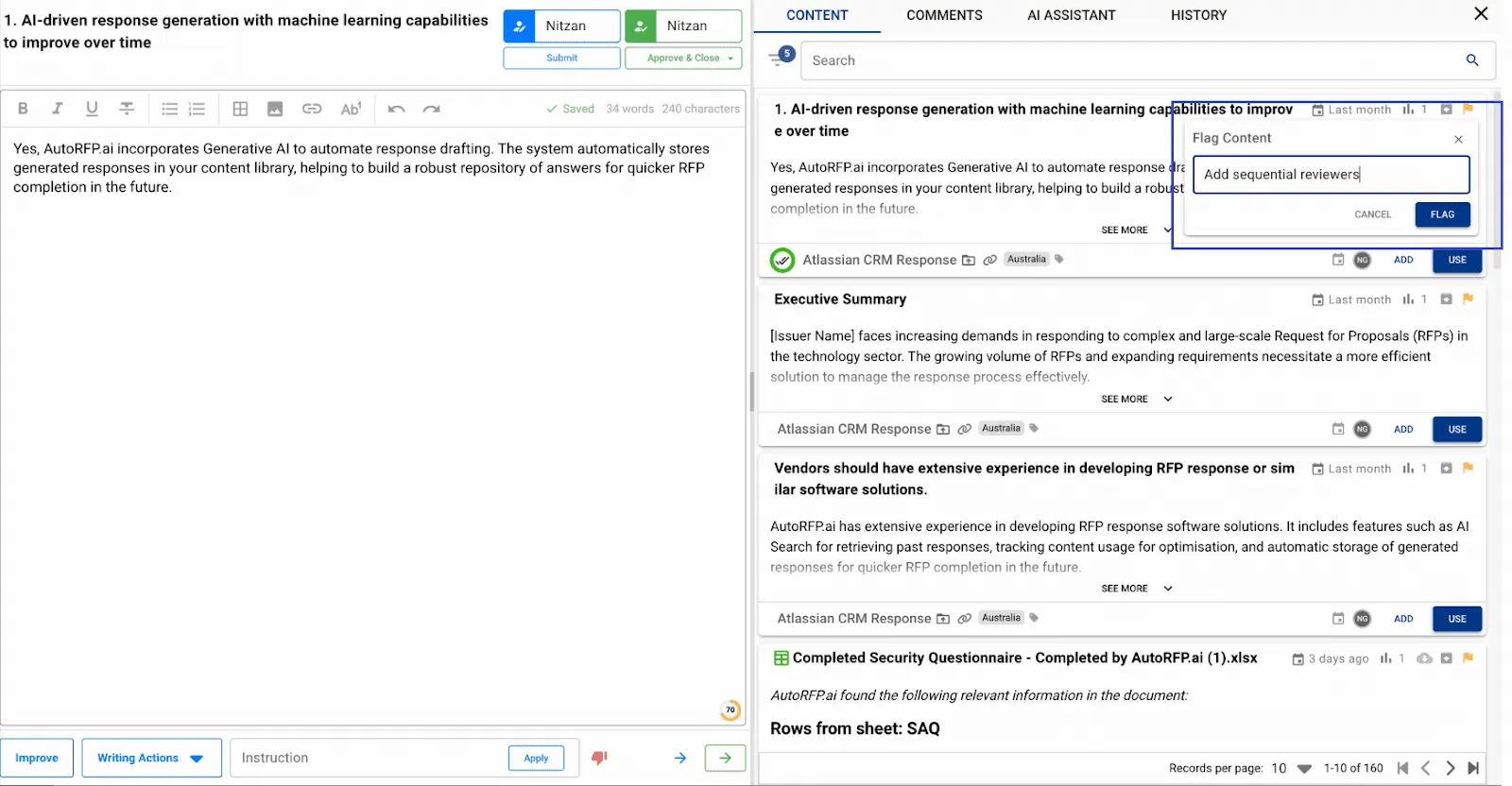
Example of flagging a response for review in AutoRFP.ai, with a note added so content owners know what to update in the library.
5. Assign Clear Content Owners
Give each content item a single owner or multiple owners (e.g. teams) responsible for accuracy and updates. This avoids confusion, ensures accountability, and keeps high-stakes sections (like security or product details) consistently maintained.
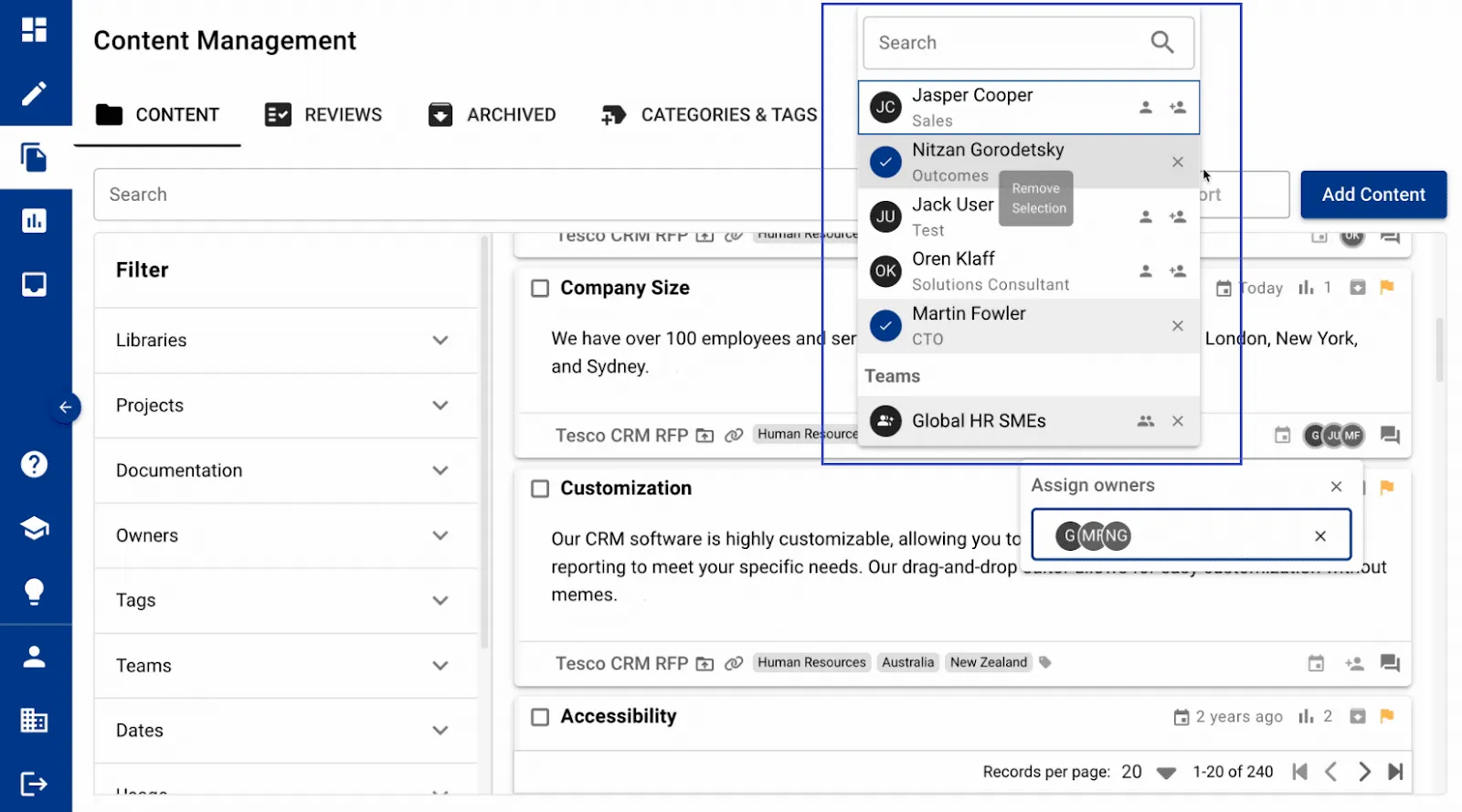
Example of assigning multiple content owners in AutoRFP.ai’s Content Management view
6. Let AI Carry the Routine Upkeep, Like High-Win Teams Do
65% of high-win teams use AI proposal technology, according to AutoRFP.ai’s 2026 Proposal Win Rate Report, which means teams that are closing more deals have their library working alongside AI rather than maintained entirely by hand. With a tool like AutoRFP.ai, you can:
Connect directly to help sites, knowledge bases, and other sources of truth that actually stay updated, so their changes reach your library.
Let the system automatically prioritize recent, approved responses and resolve conflicting answers in real time.
Hand the repetitive filing and ranking to AI, while your content owners keep deciding what gets approved and what needs another look.
Get started with AutoRFP.ai today!
Traditional vs AI Automated RFP Libraries
Traditional RFP libraries require ongoing maintenance, including tagging, version updates, and cleaning outdated entries. High-win teams are handing that routine work to software, with 59% now using content library automation.
Here’s a quick comparison of traditional vs. AI-driven libraries.
| Criteria | Traditional RFP libraries | AI-automated RFP libraries |
|---|---|---|
| RFP Content management | Manual tagging, versioning, and clean-up; duplicates and stale content build up over time | AI suggests tags and learns from approved responses, while content owners keep review and approval control |
| Response generation | Users hunt, copy-paste, and rewrite answers; quality varies by who responds | AI reads the question and suggests the best-fit approved answer, ready for light tailoring |
| Collaboration & governance | Ownership and approvals handled in email or chat; limited visibility into changes and reviews | Built-in workflows for assigning, reviewing, approving, and flagging content with audit trails |
| Scalability | Becomes harder to manage as products, markets, and volume grow; structure degrades over time | Scales across products and regions while staying organized through automation and smart ranking |
| Team time & impact | Content upkeep takes time away from proposal and strategy improvement | Less admin work; more time for deal strategy and personalization |
Strategic Benefits of RFP Libraries
Once your library is up and running, here’s how it pays off at a strategic level.
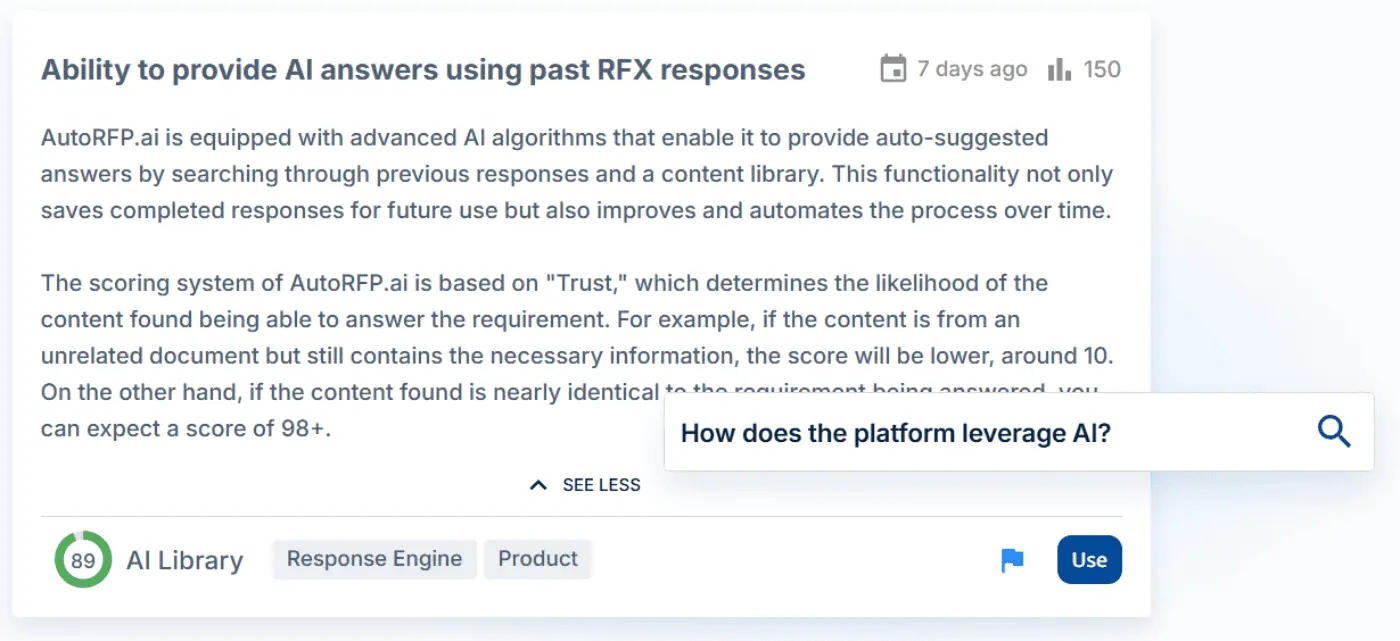
1. Enable AI-Powered, Auto-Suggested Responses
A structured RFP library feeds AI-powered RFP tools like AutoRFP.ai with trusted content, so the best answers are auto-suggested in seconds instead of being written from scratch.
2. Lift Win Rates With Consistently Strong Answers
By reusing your best-performing product, security, and legal language on every bid, you raise the overall quality of proposals and increase your chances of landing more deals.
3. Strengthen Compliance and Reduce Risk
Centralizing approved wording for sensitive topics means writers default to compliant, vetted answers, reducing the risk of over-promising or sending conflicting statements.
4. Save Scarce SME Capacity for High-Value Work
Capturing SME expertise once in the library cuts repeat questions and frees them to focus on complex, strategic opportunities instead of basic questionnaires.
“The differentiator is not the library alone. It is how the library connects to the rest of the operating model. High-performing teams combine content automation with customer insight, capture inputs, and clear win themes. This integration enables faster assembly, sharper messaging, and more consistent alignment with evaluator priorities.” – Jasper Cooper, CEO of AutoRFP.ai
Make The Most of Your RFP Library With AutoRFP.ai
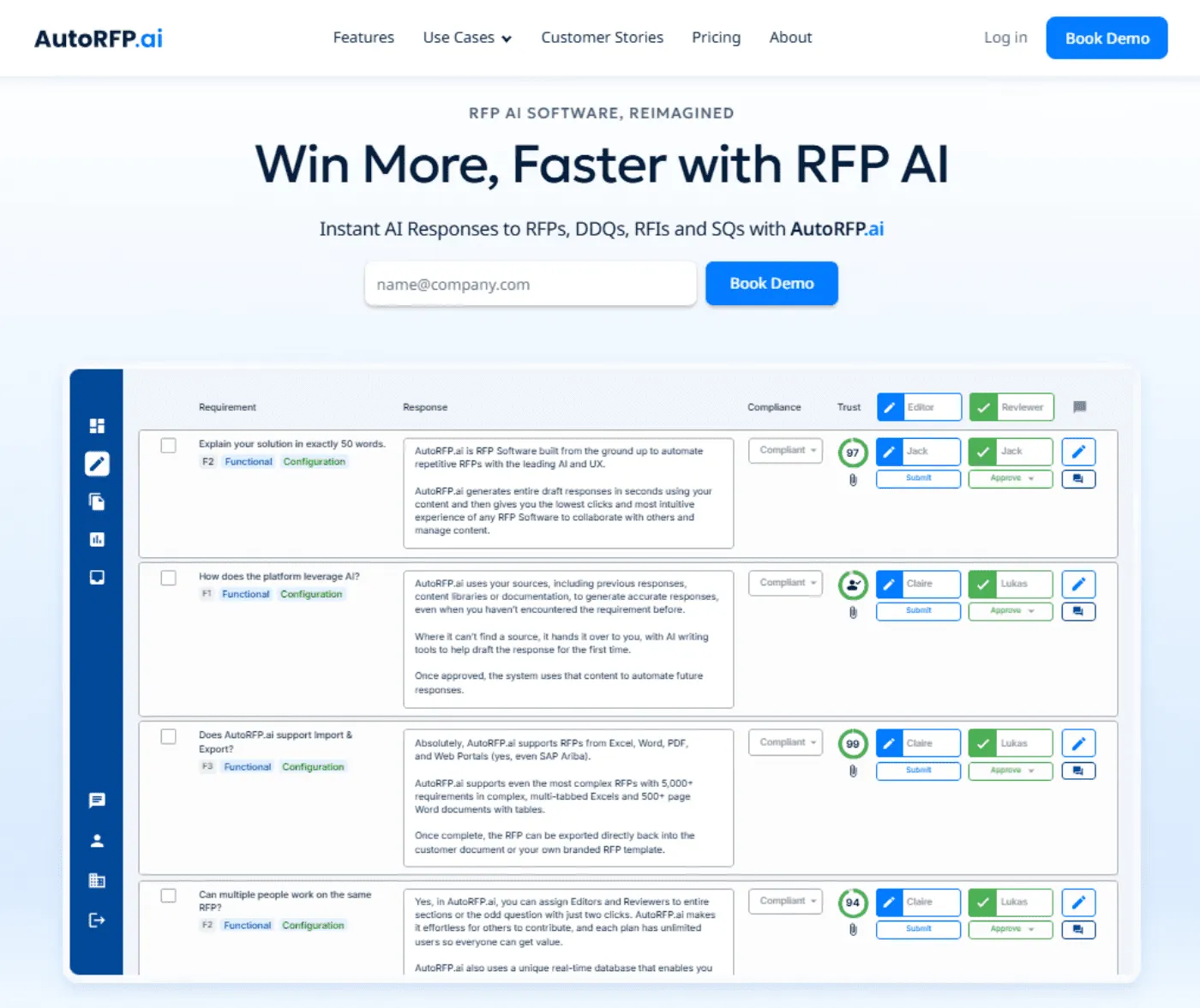
Even with a solid structure, a library can fall behind when products, pricing, or regulations change.
AutoRFP.ai is built so that the upkeep happens as your team works: a library that maintains and improves itself, with your people still deciding what gets approved. It:
Brings in the library, categories, and tags you already have, so you build on the work your team has done
Files each approved response back in automatically, with customer names stripped out before it is reused
Picks up changes from connected sources such as Confluence, Google Drive, and Notion
Leaves tagging, ownership, and review calls with your content owners
About the author

Technical Account Manager
Technical Account Manager at AutoRFP.ai. Background in asset management completing institutional RFPs and DDQs; now implements AutoRFP.ai for some of the company's largest accounts.
LinkedIn
