
2026 RFP Content Management: Build a Winning Response Workflow
Learn how to build, organize, and govern an RFP content library, faster responses, fewer errors, stronger answers, and smoother SME collaboration.

Technical Account Manager, AutoRFP.ai··10 min read
An outdated content library does more harm than waste your team’s productivity - it hurts your chances of winning future bids.
That’s why 59% of high-win teams use content library automation to streamline their RFP response process.
This article breaks down the steps of an effective RFP content management process and shares practical tips and best practices to follow.
What Is RFP Content Management?
RFP content management is the discipline of creating, organizing, governing, and reusing approved response content, so proposal teams can respond faster without sacrificing accuracy or differentiation.
An effective RFP content library includes the content repository itself (answers, proof points, case studies, etc.) plus workflow automation, governance protocols, and performance measurement.
It’s an internal operating model for proposal teams to ensure fewer rewrites, consistent brand messaging, reduced SME friction, and fewer compliance mistakes that disqualify bids.
Why You Need a Solid RFP Content Management System
Teams lose time and deals when RFP content is scattered across Word files, email threads, and individual memory.
An RFP content management system is more than a tool. It brings together clear ownership, streamlined processes, content standards, and the right technology. When done well, it delivers five clear outcomes that improve how you respond to RFPs.
Respond to RFPs Faster
Proposal teams spend a major chunk of their time hunting for previous answers instead of crafting persuasive responses.
A centralized content management system ends this “search tax” by providing instant access to approved content. According to RFP statistics, teams that reuse more content are nearly twice as likely to achieve high win rates.
Maintain a High Quality of Responses
When proposal writers respond to RFPs from scratch, the quality and positioning of answers vary. Each person interprets the value proposition differently, which leads to inconsistent messaging and diluted differentiation.
Strong RFP content management fixes this. It ensures every response reflects your core value offering, latest success stories, and approved messaging. Prospects see a clear, consistent story every time, which builds trust and directly improves win rates.
Reduce Compliance and Security Risks
Legal, security, and compliance mistakes in proposals expose your company to contract disputes, regulatory violations, and disqualifications.
An effective content system ensures only approved answers make it into prospect-facing documents.
With version control and approval workflows in place, every update is traceable. This creates a clear audit trail that protects the business.
Scale Without Adding Headcount
As RFP volume grows, most companies respond by hiring more proposal writers and project coordinators. RFP content management solves this scaling problem by improving team productivity through content reuse.
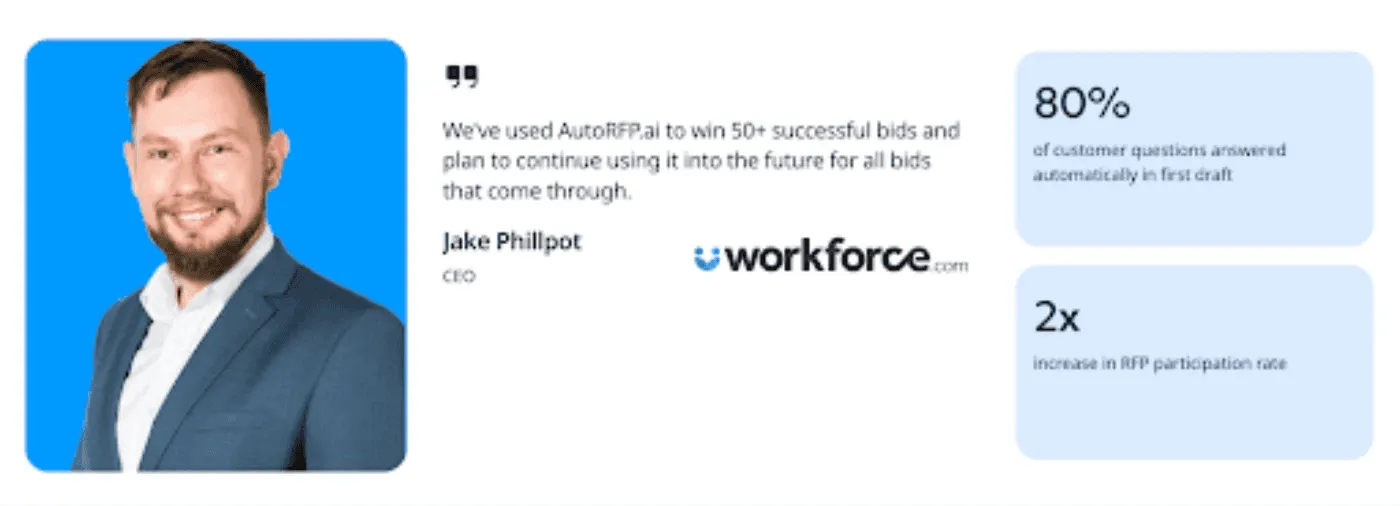
A good example of this is Workforce.com that used AutoRFP.ai to double their response rate without expanding their team.
Learn and Improve with Performance Data
Without content management, you can’t measure what works and what doesn’t. Modern RFP software tracks which answers correlate with wins versus losses, which content gets reused most, and where gaps exist.
This helps your team refine messaging, fill content gaps, and continuously improve proposals to increase win rates.
How RFP Content Management Works
RFP content management works as a continuous loop, improving content based on real results. Instead of just storing content and forgetting it, it captures your team’s knowledge, makes it easy to reuse, controls updates, allows tailored responses, and evolves over time.
| Phase | Activities | Outcome |
|---|---|---|
| Capture | Mine previous proposals, interview SMEs, and extract win themes | Raw content inventory |
| Normalize | Clean, format, tag with metadata and keywords | Searchable library |
| Govern | Set up approval workflows, track versions, and assign content ownership | Compliant content |
| Reuse | Match questions and tailor responses | Fast and accurate responses |
| Update | Analyze win/loss data, refresh outdated content, and fill gaps | Up-to-date library |
Step 1: Capture Existing Answers and Knowledge
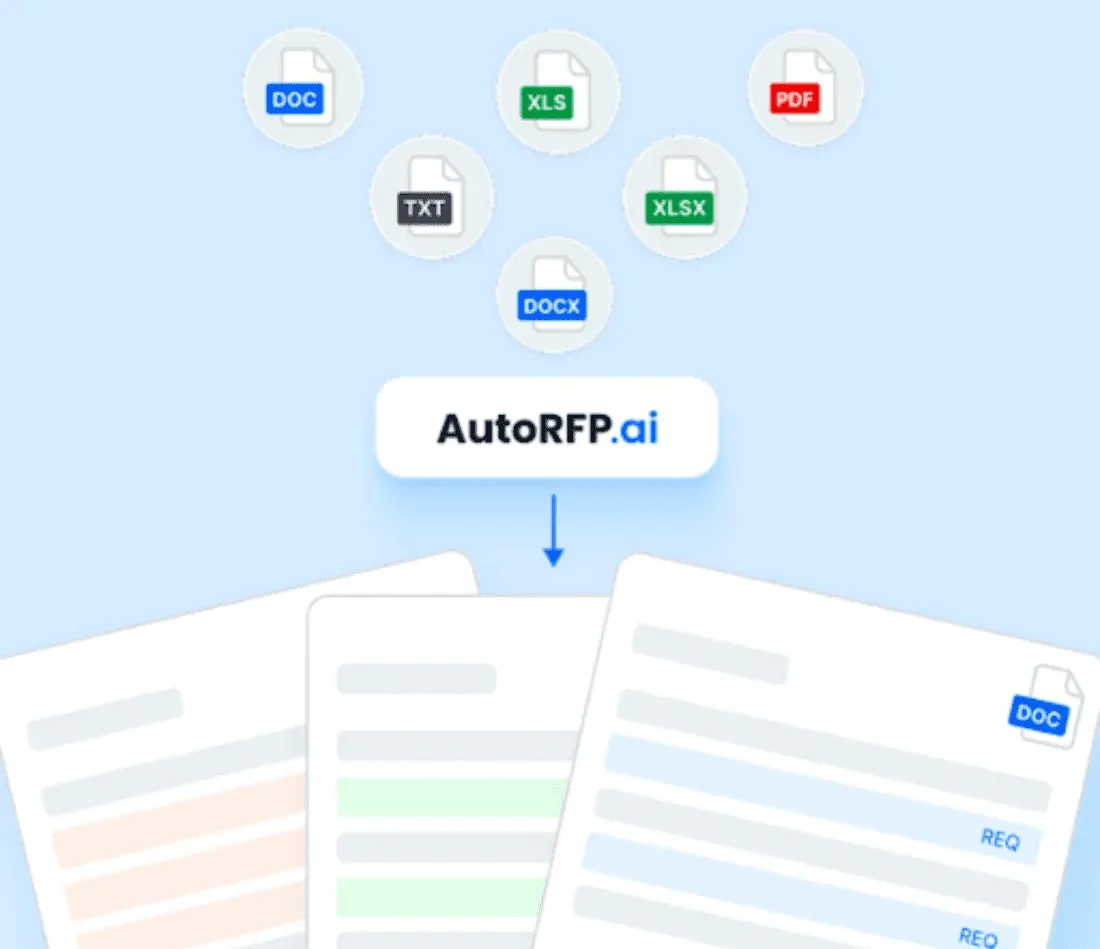
Start by mining your highest-performing proposal responses, especially in target verticals. Interview subject matter experts to capture tribal knowledge and designate content owners by domain (product, security, legal, etc.).
Step 2: Normalize for Discoverability
Raw captured content needs standardization before it’s reusable.
Create templates for different content types (case studies, compliance certifications, etc.). Tag each item with metadata including topic, product line, industry, last review date, and approval status. Then, create a taxonomy that reflects the way your team naturally searches for industry-specific terms.
Step 3: Establish Governance and Approval Workflows
Define who can create, edit, approve, and archive content for each category. Implement version control to ensure teams always use the most current answers while keeping a record of past versions.
Set up approval workflows that automatically route content to the appropriate departments, such as sending pricing updates to finance for review.
Step 4: Test Your Content Library
Use the content hub by searching for answers to common RFP questions.
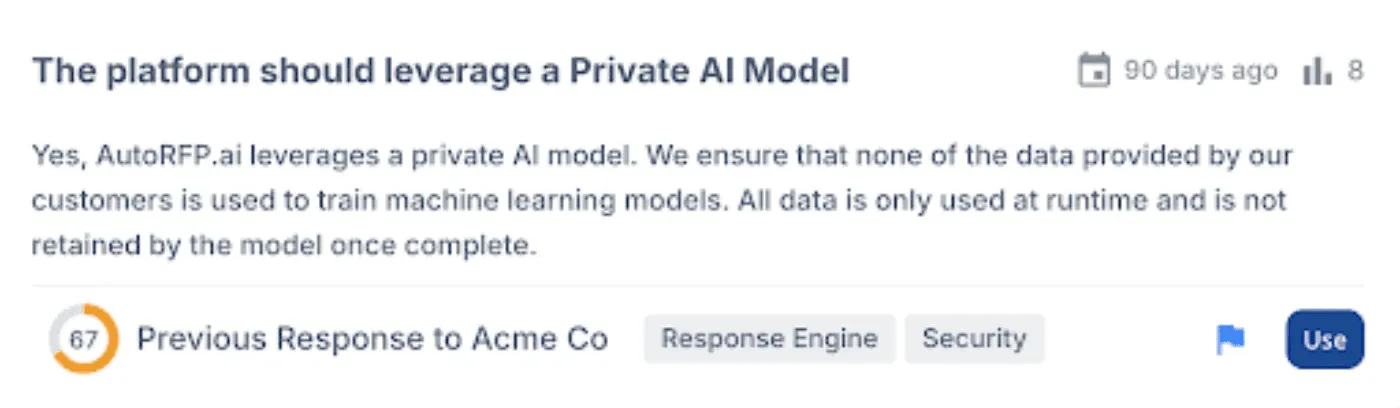
Go beyond simple keyword searches by using semantic understanding to find the most relevant and contextually accurate content. AutoRFP.ai is the tool that makes the latter happen. It also provides AI-generated responses with source references to avoid hallucinations.
Step 5: Update Based on Findings
After each submission, tag the opportunity outcome (win or loss) and capture feedback from evaluators. Analyze which content appears in winning versus losing proposals. Deleted outdated answers, flag gaps where teams repeatedly create custom responses, and prioritize updates to high-usage content.
How to Optimize And Make The Most of Your RFP Content Management System
Building your content library is just the beginning - regular optimization keeps it useful as your business grows. Implement the below tips to make the most of your RFP management.
1. Integrate Content Decisions Into Your Go/No-Go Process
Before committing to an RFP, assess how well your existing content aligns with the required sections. Go/no-go tools can automatically evaluate an RFP against your content library, identify gaps, and help you decide whether a response is worth the effort.
Side Note: Download the AI Go/No-Go prompt for RFP analysis to systematically evaluate whether your content positions you to win before investing hours drafting a response.
2. Run Pre-Submission Content Quality Audits
Before responding to RFPs, review your content for accuracy, consistency, and relevance. Check that answers are up to date, approved, and aligned with your current value proposition.
A quick quality audit helps catch outdated claims and weak messaging before they reach the prospect.
3. Test High-Impact Answers
For your competitive differentiators or frequently used responses, have two or three approved variations and track which version appears in winning versus losing proposals. This pattern recognition over 10-20 proposals can reveal which messaging resonates more than others.
4. Build Content Playbooks for Common RFP Scenarios
Create content playbooks for recurring RFP scenarios or industries. Each playbook should group the most commonly required, high-impact answers, already tagged and ready to use, paired with a broader RFP toolkit of templates and checklists, this gives writers a complete starting kit for every bid. This reduces decision fatigue under tight deadlines and ensures teams consistently include the content that performs best in each context.
5. Create a “New Content Request” Workflow
When proposal writers or bid managers can’t find relevant content, they should submit a content request that routes to the relevant SME for review and then adds the approved content to the library.
Track these requests over time to spot patterns. Frequent requests highlight areas where your library needs more content, while one-off requests help you avoid bloating the system with edge cases.
Best Practices for Successful RFP Content Management
The difference between a content library that actually helps your team and one that just sits unused comes down to good processes. These practices help prevent the common mistakes that make teams give up on their library.
#1. Add Competitor Tags on Differentiators
Tag every competitive claim in your library with the specific competitor it addresses. This guides writers to choose the most relevant differentiators for each RFP and avoids generic claims, like we’re the best.
#2. Build “Customization Zones” Into Standard Answers
For content that’s reused often but still needs personalization, include clear placeholders like “[insert client-specific challenge].” This shows writers which sections are fixed and which need tailoring. It also helps them avoid over-customizing approved content or under-customizing and sending generic responses.
#3. Gamify Content Contribution and Reuse
Low adoption is a major reason content libraries fail. Track and display metrics showing which teams contribute the most winning answers or which individuals reuse content most effectively. Recognize contributors in team meetings and include content metrics in performance reviews.
Common Challenges and How to Overcome Them
Even the best content management systems run into common challenges after launch. These issues tend to surface once the initial excitement wears off and teams start using the system in day-to-day work.
Content Ownership Becomes Diffused and No One Updates Anything
Root cause: Content responsibilities get assigned during implementation but aren’t built into anyone’s job description or performance goals.
Symptoms: A few months post-launch, your library content is outdated, but no one feels accountable for fixing it because “everyone” owns content management.
Practical fix: Designate specific SMEs as “content domain owners” to take responsibility for defined content areas, and track their performance by measuring content accuracy and response times in quarterly reviews.
The Library Grows Too Large and Teams Stop Trusting Search Results
Root cause: Teams keep adding content without archiving redundant answers. Hence, making the library bloated.
Symptoms: Proposal writers complain that searching returns too many irrelevant results, so they stop using the library and go back to asking SMEs directly or looking through old RFP responses.
Practical fix: Hold a yearly archive sprint where content owners review their areas and remove or combine outdated or duplicate content. Limit the number of active items per category to focus on what’s most important, and link old content to its updated version using a “superseded by” system.
Proposal Teams Complain Library Content Is Too Generic
Root cause: The library focuses on legal compliance and broad use, not on competitive edge. As a result, the content becomes technically accurate but strategically weak.
Symptoms: Win rates don’t improve despite having a content library.
Practical fix: Split your library into “foundation” content (compliance, basic capabilities, company information) and “competitive” content (differentiators, proof points, ROI stories).
Train teams to use foundation content as-is but heavily customize competitive content for each RFP context.
Respond Faster And Win More With AutoRFP.ai
RFP content management can turn your proposals from slow, resource-heavy tasks into scalable revenue drivers, but only when speed, quality, governance, and flexibility are all in balance.
AutoRFP.ai’s platform delivers on all fronts: AI-powered content libraries that learn from your wins, semantic search that finds the most relevant answers, approval workflows that streamline processes, and analytics that reveal what’s driving results.
Book Demo to discover how AutoRFP.ai can transform your RFP workflow.
About the author

Technical Account Manager
Technical Account Manager at AutoRFP.ai. Background in asset management completing institutional RFPs and DDQs; now implements AutoRFP.ai for some of the company's largest accounts.
LinkedIn
