
RFP Compliance Matrix: Template, Best Practices & More
Learn what a compliance matrix is, how to build one for RFPs, and use templates and examples to track every requirement with confidence.

Co-founder & CEO, AutoRFP.ai··8 min read
If your RFP process still relies on “I think we covered that,” you are one appendix away from a preventable loss. The hardest part is not writing. It is tracking every requirement, assigning ownership, and verifying coverage before the deadline chaos hits. A strong compliance matrix gives you that control.
This guide includes a template you can copy, best practices for turning requirements into trackable work, and simple ways to keep the matrix updated from kickoff through submission. For a deeper walkthrough of how to build a proposal compliance matrix end to end (including automation), see the companion guide.
What Is a Compliance Matrix?
A compliance matrix is a structured checklist used to track whether specific requirements, standards, or rules have been met. It helps teams review each requirement clearly, identify gaps, and make sure nothing important is missed.
An RFP compliance matrix applies this same approach to an RFP response. It maps every buyer requirement in the RFP against the vendor’s response, so proposal teams can confirm that each question, clause, and instruction has been addressed before submission.
It usually includes:
Requirement reference: The section, question number, or clause from the RFP.
Requirement description: A short summary of what the buyer is asking for.
Compliance status: Whether the response is compliant, partially compliant, or non-compliant.
Response location: Where the answer can be found in the proposal.
Owner: The person responsible for completing or reviewing the response.
Notes or evidence: Supporting details, documents, proof points, or comments.
For RFP teams, a compliance matrix helps reduce missed requirements, improve review accuracy, and keep stakeholders aligned. It gives proposal managers, SMEs, sales teams, and legal reviewers one clear place to track response readiness before the final submission.
The Hidden Costs of RFP Non-Compliance
A non-compliant RFP response does more than weaken one submission. It can waste internal resources, reduce evaluator confidence and create missed revenue opportunities. A compliance matrix helps prevent this by giving proposal teams a structured way to track every requirement, owner, response status and supporting evidence before submission.
1. Wasted Team Capacity
Proposal teams can spend dozens of hours gathering inputs, reviewing requirements, chasing SMEs and polishing responses. If the proposal is later marked non-compliant because a requirement was missed or answered incorrectly, that effort becomes wasted capacity.
A compliance matrix reduces this risk by showing which requirements have been addressed, which sections still need input and which answers need supporting evidence before final review.
2. Lost Revenue and Disqualification Risk
Some RFPs include mandatory requirements that vendors must meet to stay in contention. Missing one required document, certification, pricing detail or technical response can lead to disqualification, even if the rest of the proposal is strong.
This makes compliance tracking a revenue protection step, not just an administrative task.
3. Lower Evaluator Confidence
Non-compliant or incomplete responses can make evaluators question whether the vendor fully understands the buyer’s needs. Even small gaps can create doubt, especially in competitive enterprise deals where buyers compare multiple qualified vendors.
A clear compliance matrix helps teams submit cleaner, more complete responses that are easier for evaluators to review. In public tenders, it is also the starting point for answering each of the buyer’s selection criteria.
4. Poor Go/No-Go Decisions
RFP non-compliance can also reveal a deeper issue: the team may be pursuing opportunities that are not a strong fit. If requirements are repeatedly missed, unclear or difficult to satisfy, the business may need a stronger go/no-go process.
Tracking compliance early helps teams identify deal-breakers before they invest too much time in a low-fit opportunity.
What to Include in a Compliance Matrix
A winning compliance matrix is not just a checklist. It is a strategic framework that transforms how your team approaches enterprise deals. Here’s how to transform your matrix from administrative burden into competitive weapon:
| What to include | Why it matters |
|---|---|
| Requirement reference | Captures the RFP section, question number, paragraph, or clause so your team can trace every requirement back to the original document. |
| Requirement description | Summarizes what the buyer is asking for in clear language, so SMEs and reviewers understand the requirement quickly. |
| Compliance status | Shows whether your response is compliant, partially compliant, non-compliant, or still pending review. |
| Proposal response location | Identifies the exact section, page, or answer where the requirement is addressed in the proposal. |
| Assigned owner | Names the team member responsible for drafting, reviewing, or approving the response. |
| Risk level | Flags requirements that may create legal, technical, pricing, security, or delivery concerns. |
| Response notes | Adds context for SMEs, such as buyer priorities, clarification needs, assumptions, or internal comments. |
| Supporting evidence | Tracks documents, certifications, case studies, policies, screenshots, or proof points needed to support the response. |
| Deadline tracking | Sets due dates for each requirement, especially when inputs are needed from multiple teams. |
| Review status | Shows whether the answer has been drafted, reviewed, revised, approved, or is still blocked. |
| Strategic alignment | Connect each requirement to your win themes, differentiators, or value proposition, so the response supports your overall proposal strategy. |
Compliance Matrix Template: What It Looks Like in Practice
Here is what an RFP compliance matrix can look like when your team uses it to track requirements, ownership, risks, and response progress in one place.
| Requirement reference | Requirement description | Compliance status | Response location | Assigned owner | Risk level | Notes or evidence | Deadline |
|---|---|---|---|---|---|---|---|
| Section 2.1 | Vendors must provide SOC 2 certification. | Compliant | Security response, page 6 | Security lead | Low | SOC 2 report attached. | 12-Mar |
| Section 2.2 | Vendors must support SSO integration. | Compliant | Technical response, page 9 | Solutions engineer | Low | Supported through SAML and OAuth. | 12-Mar |
| Section 3.4 | Vendors must provide implementation within 30 days. | Partially compliant | Implementation plan, page 14 | Project manager | Medium | Timeline depends on customer data readiness. | 14-Mar |
| Section 4.1 | Vendors must offer 24/7 support. | Non-compliant | Support section, page 18 | Customer success lead | High | The current support model is business hours only. | 15-Mar |
| Section 5.3 | Vendors must include three enterprise customer references. | Pending | Case studies section | Sales lead | Medium | Waiting for approval from reference customers. | 16-Mar |
You can adapt this template based on the format of the RFP you receive:
For Word or PDF RFPs: Use section numbers, page numbers, headings, and clause references so every requirement can be traced back to the original document.
For Excel-based RFPs: Keep the buyer’s original sheet names, row numbers, columns, and question IDs so your team does not lose context while responding.
For portal-based RFPs: Recreate the portal sections in your matrix first, then track each question, owner, status, and supporting evidence before uploading the final answers.
For long enterprise RFPs: Add columns for risk level, review status, approval notes, evidence, dependencies, and deadlines to manage complex inputs across teams.
For smaller RFPs: Keep the matrix simple with requirement reference, requirement description, owner, compliance status, and response location.
How RFP Teams Build a Competitive Advantage Through a Compliance Matrix
The teams winning more enterprise deals are not just organized. They use their compliance matrix to move faster, reduce risk, and make every response more strategic.
1. Assign Requirements Early
Assign subject matter experts to specific matrix sections as soon as the RFP is released. This helps the team work in parallel instead of waiting for one person to review the entire document first.
This gives RFP teams an advantage because they can:
Start technical, legal, security, and pricing inputs earlier.
Reduce last-minute SME follow-ups.
Give each owner clear deadlines and responsibilities.
Spot unanswered or blocked requirements before the final review.
Keep proposal managers focused on quality instead of chasing updates.
With AutoRFP.ai, teams can make this easier through project management features that show workload by team member, blocked responses, open comments, section completion, and progress across assignments.
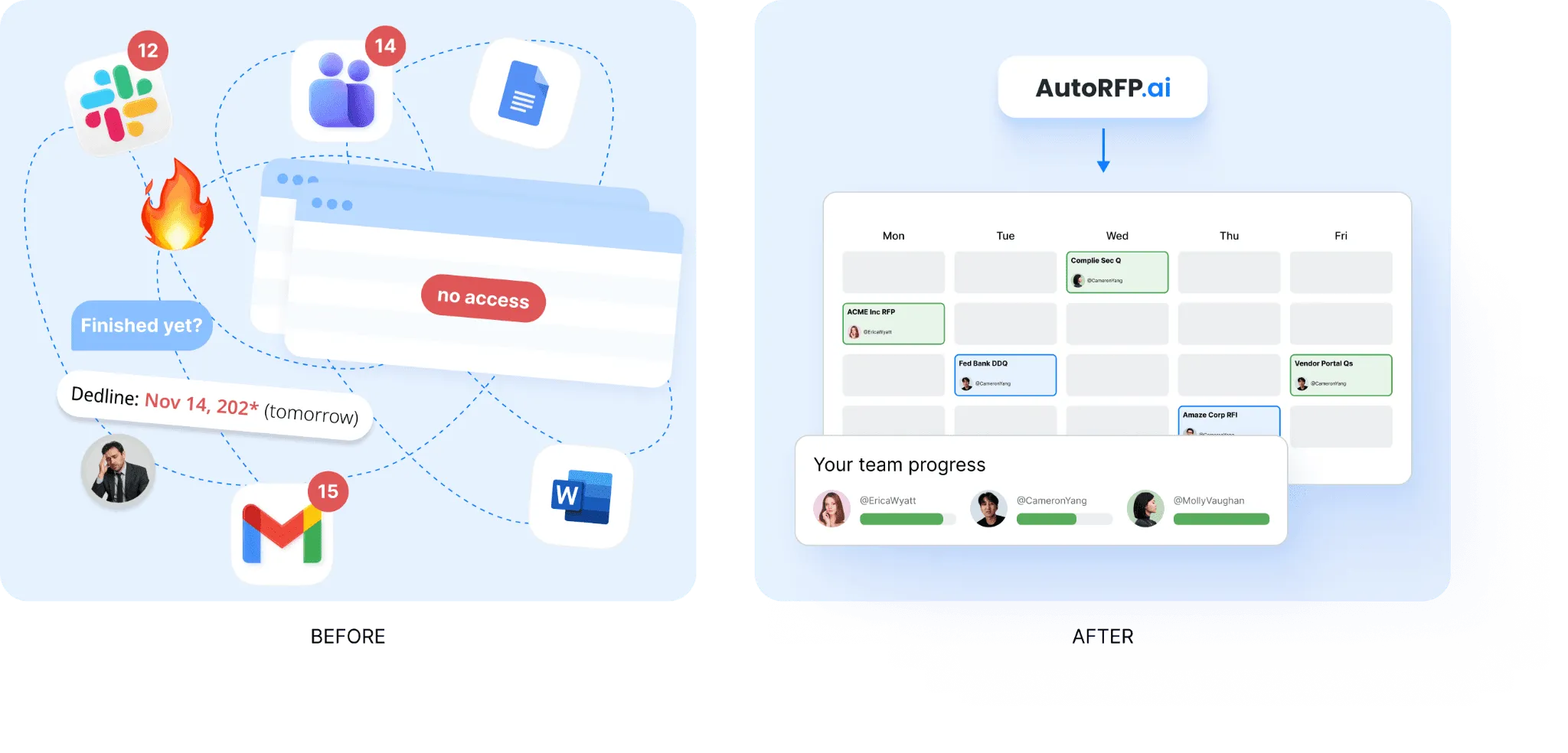
This helps proposal teams see who is stuck without relying on long email chains or status meetings.
2. Prioritize High-Risk Requirements First
Not every requirement carries the same level of risk. Some are simple admin checks, while others can disqualify your proposal if they are missed or answered poorly.
A strong compliance matrix helps teams flag high-risk items such as:
Mandatory certifications.
Security and privacy requirements.
Data residency requirements.
Insurance or legal terms.
Integration requirements.
Delivery timelines.
Pricing or commercial exceptions.
By reviewing these first, teams can decide whether to proceed, clarify the requirement, propose an alternative, or escalate it internally before too much time is spent on the response.
3. Use The Matrix To Improve Stakeholder Communication
A compliance matrix also works as an internal communication tool. Instead of asking executives, SMEs, and sales leaders to read the full RFP, proposal teams can show them the requirements that need attention.
This helps internal stakeholders understand:
Which requirements affect deal qualification.
Which sections need their input.
Which risks could affect the bid.
Which deadlines are approaching.
Which gaps need leadership approval.
This is especially useful for enterprise RFPs, where multiple teams may need to contribute but not everyone has time to review the full buyer document.
4. Extract Requirements Faster From Different RFP Formats
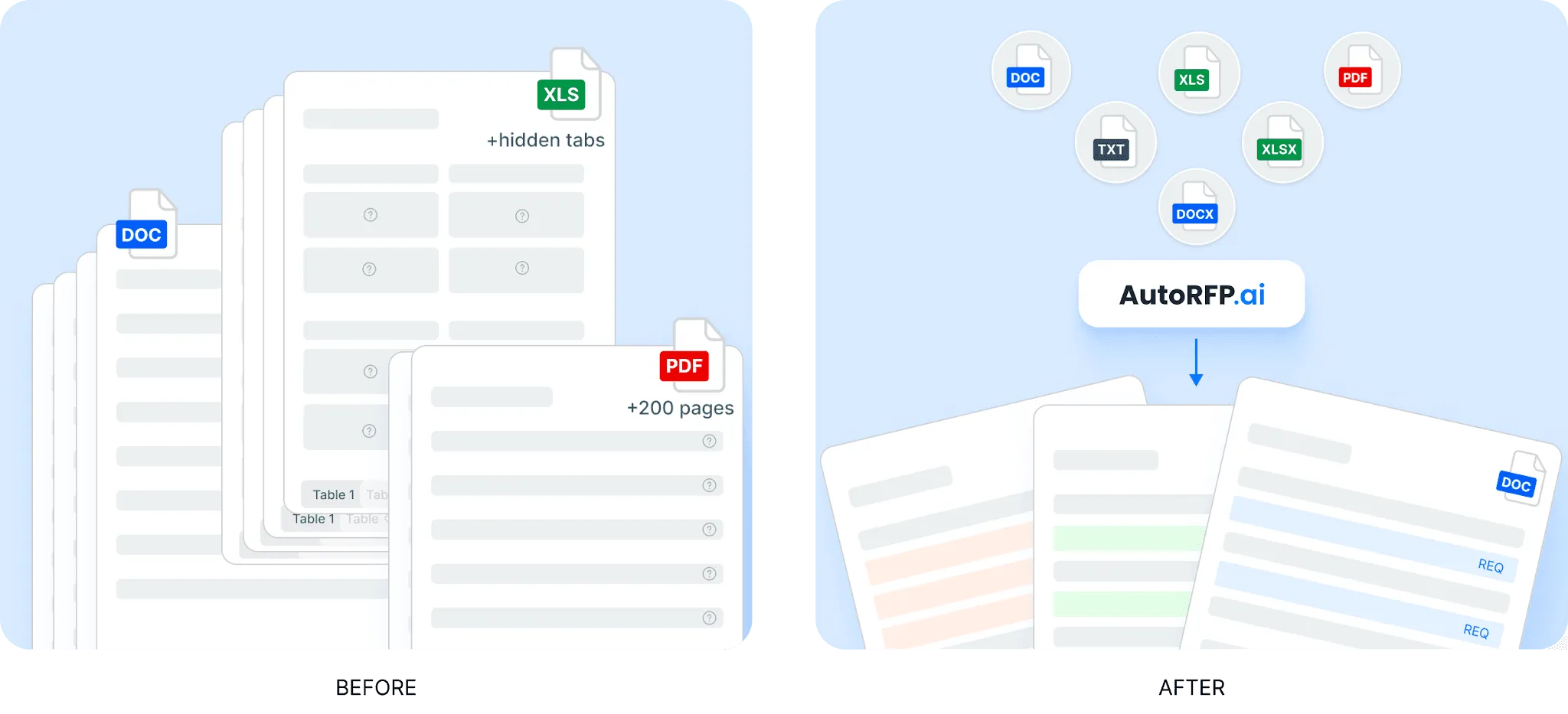
RFPs often arrive in messy formats. Some come as PDFs, some as Word documents, some as Excel files, and some include nested tables, compliance matrices, or multiple attachments.
A strong RFP team uses the compliance matrix to turn all those formats into one structured working document. This saves time because the team can start reviewing requirements instead of manually copying, cleaning, and reorganizing the RFP.
With AutoRFP.ai, teams can import Word, Excel, PDF, and ZIP files, then automatically extract requirements, sections, and context into a structured project. Teams can also refine the structure inside the platform without reformatting or re-uploading the document.
5. Connect Compliance To Win Themes
A compliance matrix should not only prove that your team answered every requirement. It should also help you identify where to strengthen the proposal.
For example, your team can use the matrix to mark where each requirement connects to:
A key differentiator.
A customer proof point.
A case study.
A security certification.
A product capability.
A measurable business outcome.
A strategic win theme.
This makes the response more competitive because every major requirement is not just answered. It is supported with evidence that reinforces why your company is the right choice.
6. Turn Compliance Gaps Into Future Strategy
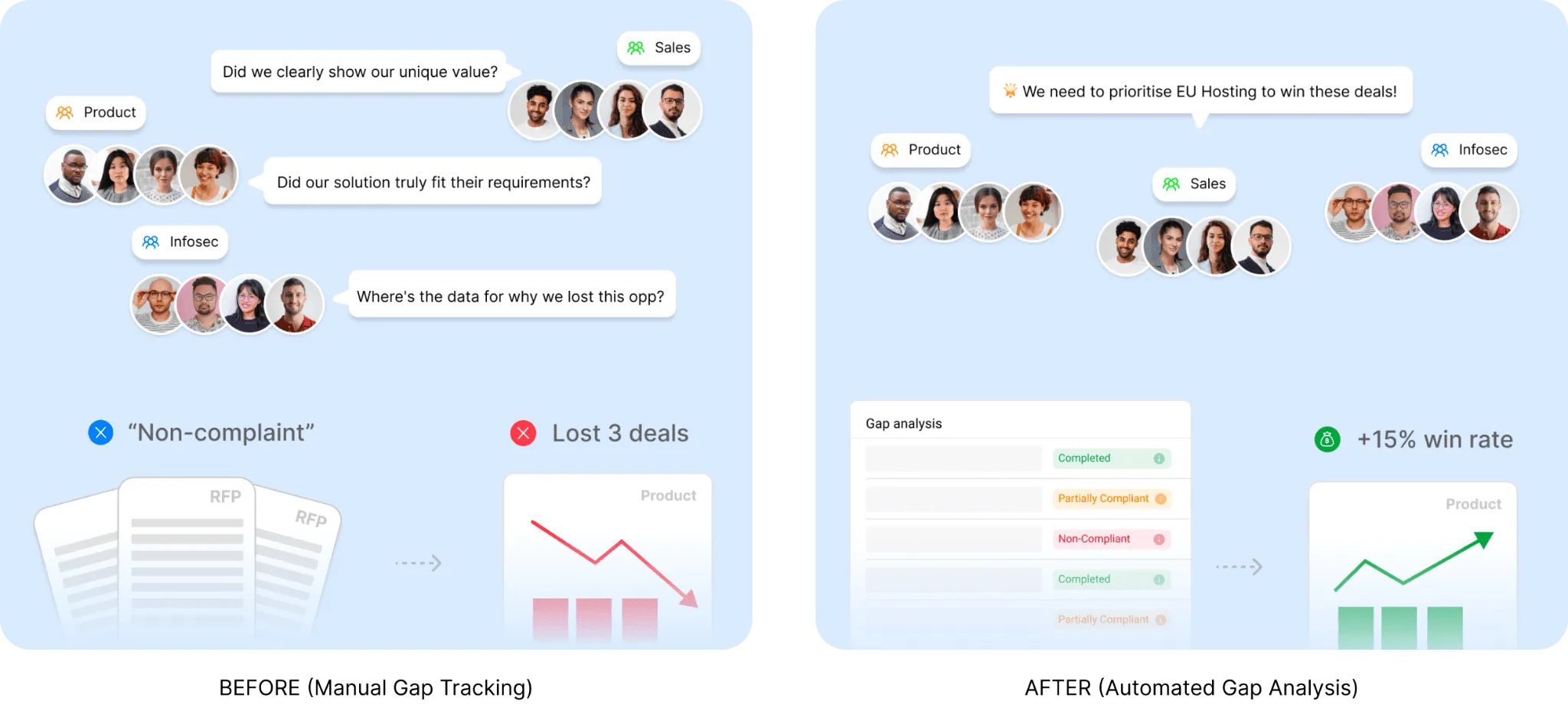
The value of a compliance matrix should not end after submission. Over time, it can show patterns in which your team is repeatedly compliant, partially compliant, or non-compliant.
This helps teams identify:
Product gaps that keep appearing in lost deals.
Security requirements that need stronger documentation.
Common buyer objections.
Repeated legal or commercial blockers.
Requirements that slow down the response process.
Gaps that should influence product or sales strategy.
AutoRFP.ai supports this through RFP gap analysis reporting, which tracks compliance answers across completed RFPs. It can show patterns in non-compliant, partially compliant, and exceeded requirements, group them by category, and connect them to affected deal value or trends.
Pro tip: Treat your compliance matrix as both a response checklist and a deal intelligence tool. The best teams use it to manage today’s submission while collecting the insights they need to win more future RFPs.
Modern Solutions: AI-Powered Compliance Management
Manual Excel-based compliance tracking can still work for simple bids, but it becomes harder to manage when RFPs include hundreds of questions, multiple file formats, tight deadlines, and several internal reviewers. AI-powered RFP tools help teams extract requirements, assign owners, track risks, and monitor compliance progress with less manual effort.
The Claude walkthrough shows how to shred an RFP into a compliance matrix in Claude, then use its checklist and evaluation criteria before drafting begins.
1. Automated Requirement Detection
Modern AI-powered RFP tools can analyze RFP files and pull out requirements automatically. Instead of manually copying questions from Word, Excel, PDFs, portals, or nested tables, teams can turn the buyer’s document into a structured response workspace much faster.
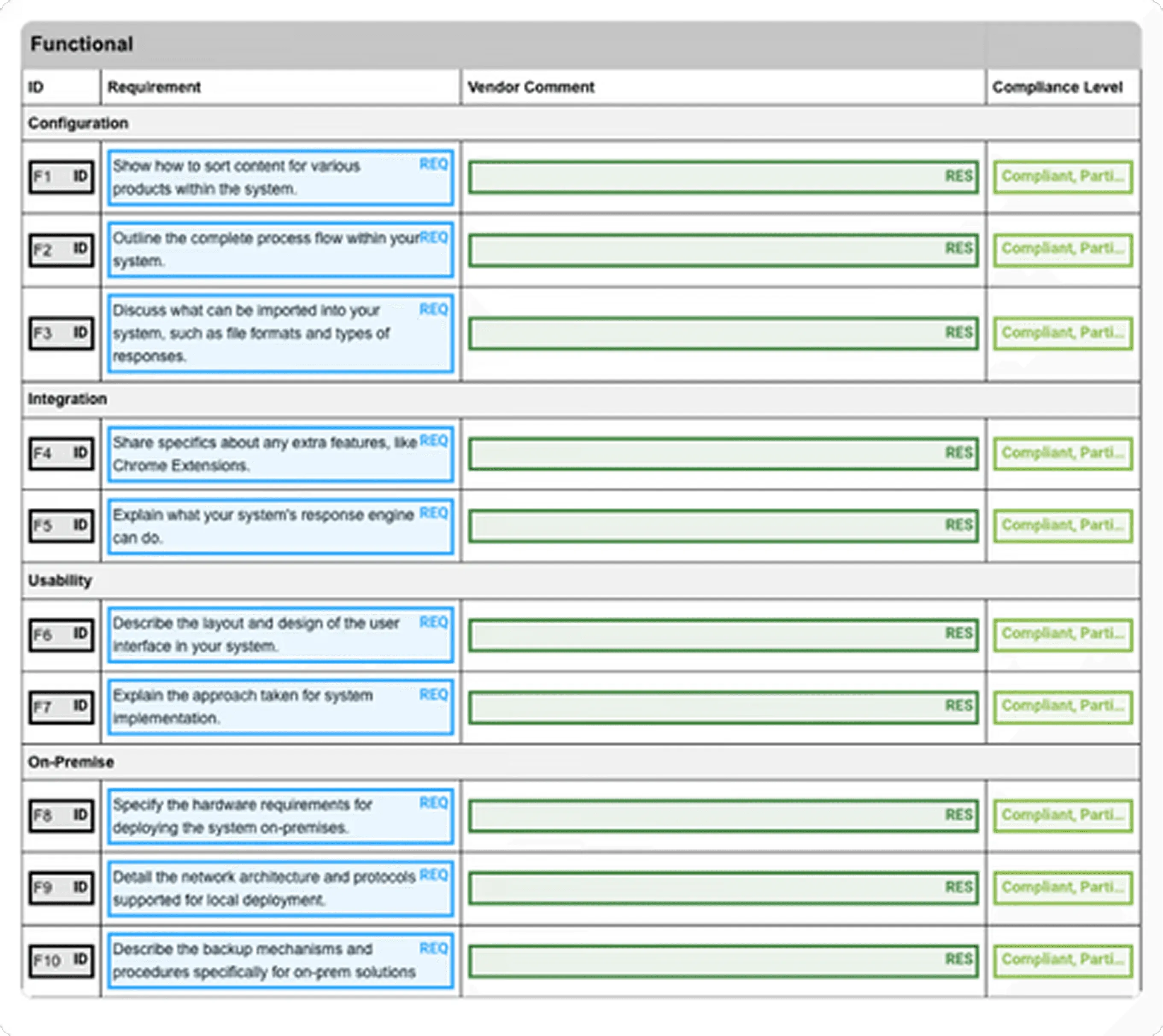
This helps teams:
Extract requirements from Word, Excel, PDF, and other RFP files.
Identify sections, questions, instructions, and supporting context.
Reduce manual setup before drafting begins.
Keep requirement references tied to the original buyer document.
Export responses back into the customer’s format or a branded proposal template.
Pro tip: Use automated requirement detection at the start of every bid, not after drafting begins. This helps your team catch hidden instructions, mandatory attachments, and deal-breaker requirements before work is assigned.
2. Real-Time Collaboration
A compliance matrix becomes more useful when the whole team can work from the same version. Cloud-based RFP tools allow proposal managers, SMEs, sales teams, legal reviewers, and security teams to update their assigned sections without creating multiple spreadsheet versions.
This helps teams:
Assign owners to specific requirements.
Track open comments and blocked responses.
Send reminders without chasing people manually.
Keep feedback attached to the right question.
Maintain a clear audit trail of changes and approvals.
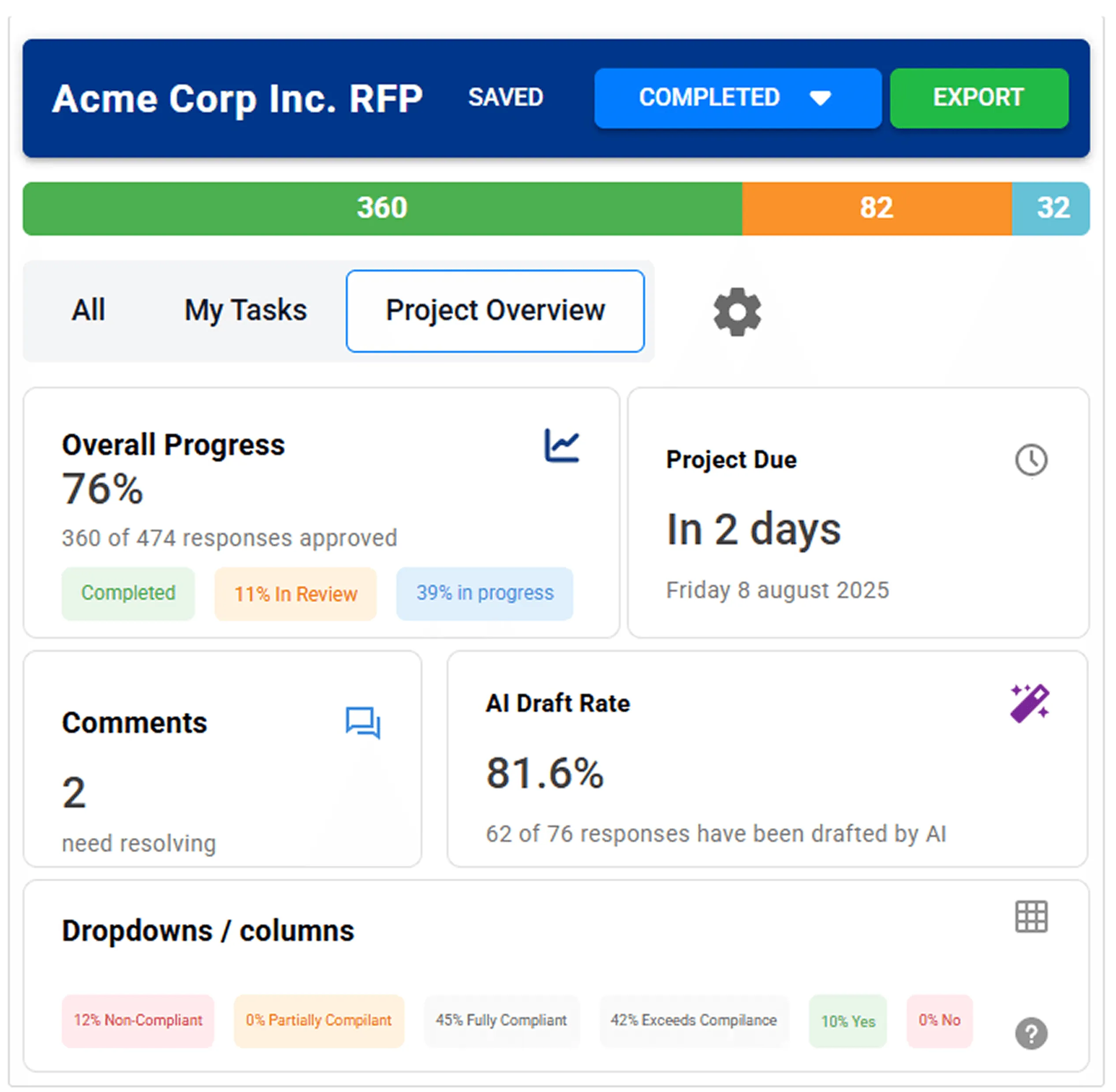
Side note: Version control is one of the biggest hidden risks in compliance management. When teams work from separate spreadsheets, it becomes easier to miss comments, overwrite changes, or submit outdated answers.
3. Dynamic Progress Tracking
AI-powered compliance management also gives proposal teams clearer visibility into response progress. Instead of waiting until the final review to find missing answers, teams can see which sections are complete, in review, blocked, or still waiting for input.
This helps teams monitor:
Overall completion progress.
Requirements by compliance status.
Sections that are behind schedule.
High-risk or non-compliant answers.
Open comments that need resolution.
Workload by owner or department.
This makes compliance management more proactive. Teams can fix blockers early instead of discovering them right before submission.
Pro tip: Review progress by risk level, not just by completion percentage. A bid can look 90% complete while still having major gaps in security, legal, pricing, or implementation requirements.
4. Compliance Gap And Reporting Insights
Modern RFP platforms can also turn compliance data into business intelligence. After multiple RFPs, teams can see which requirements they keep marking as non-compliant, partially compliant, or difficult to answer.
This helps teams identify:
Product gaps that keep appearing in enterprise deals.
Security or compliance requirements that slow down reviews.
Common buyer questions that need stronger approved answers.
Requirements linked to lost deals or stalled opportunities.
RFP types, deal sizes, or segments with stronger win rates.
Team capacity before accepting another large RFP.
For example, if your team keeps failing requirements around data residency, SCIM, SOC 2, or uptime commitments, reporting can show how often those gaps appear and how much pipeline they affect. That gives sales, product, and leadership a clearer reason to act.
Side note: Compliance reporting should not only help proposal teams submit better responses. It should also help product, security, legal, and leadership understand what buyers repeatedly expect.
5. AI Q&A Support For Faster Answers
RFP compliance work often slows down because teams cannot find the right answer quickly. A security lead may know the GDPR response, a sales engineer may know the API limits, and a proposal manager may know where the approved answer lives, but that knowledge is often scattered across old RFPs, documents, spreadsheets, and internal chats.
AI Q&A bots help by making approved knowledge searchable through natural questions.
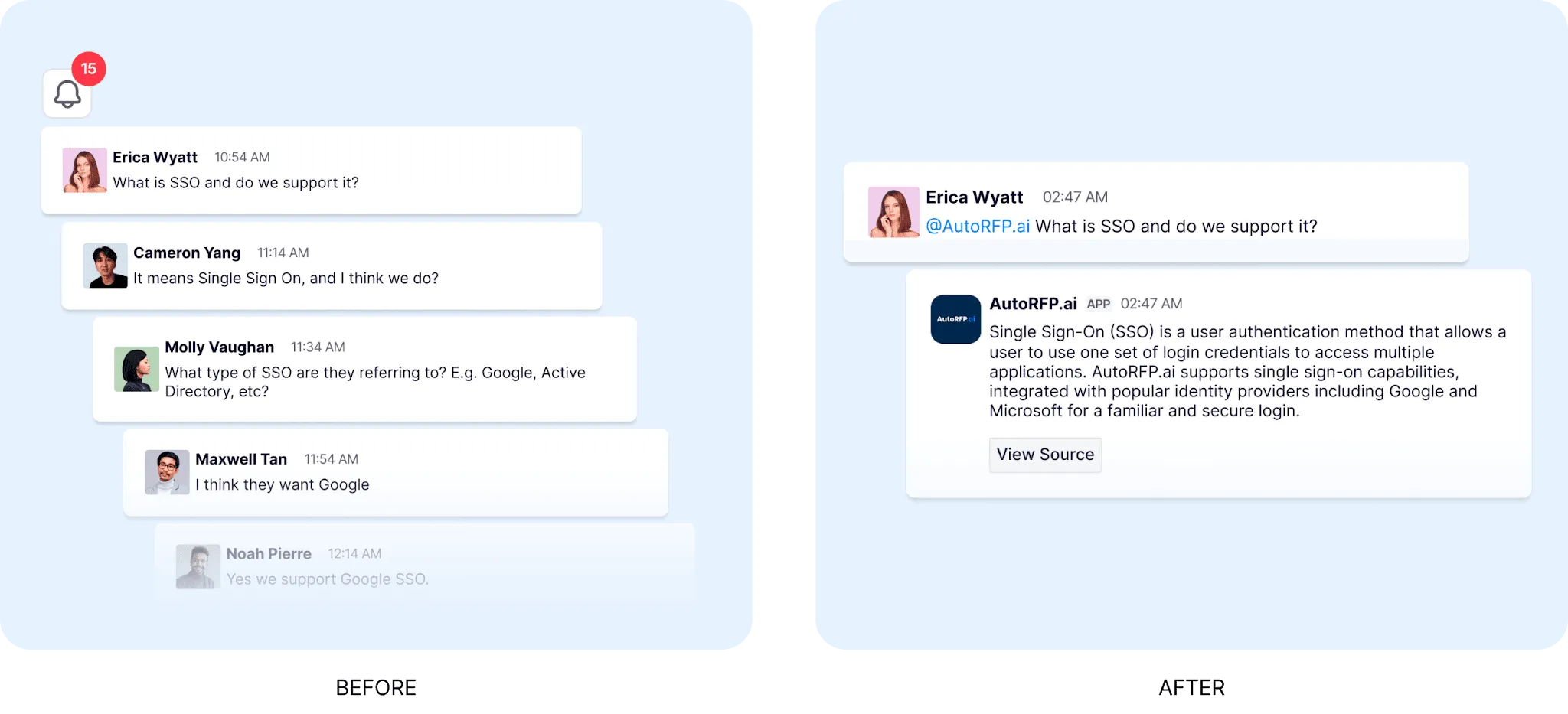
This helps teams:
Ask questions directly from Slack, Teams, or a web app.
Get sourced answers from past RFPs, DDQs, security questionnaires, and content libraries.
Reduce interruptions for SMEs.
Avoid conflicting answers across different team members.
Find approved responses without digging through folders.
Use source-backed answers with more confidence.
This is especially useful for recurring compliance questions, such as GDPR, uptime, hosting, encryption, access controls, integrations, or data handling. Instead of starting from scratch, teams can quickly find the best available answer and adapt it for the current RFP.
Pro tip: Treat AI Q&A as a starting point, not the final answer. The best teams still review answers for buyer context, current product accuracy, and compliance risk before submission.
Implementation Best Practices That Drive Results
Strong compliance management starts with a clear process, not just a completed matrix. The best RFP teams use the matrix to analyze requirements early, assign ownership, control quality, and measure what improves future win rates. A compliance matrix works best alongside RFP response best practices that keep qualification, ownership, and pre-submission audits just as disciplined.
Here are the best practices to follow when building and managing your RFP compliance matrix:
| Best practice | How it drives better results |
|---|---|
| Start with RFP analysis | Review the full RFP before building the matrix so your team understands the buyer’s requirements, submission rules, evaluation criteria, and potential risks. |
| Separate mandatory and optional requirements | Flag must-have requirements early so the team can focus first on anything that could affect eligibility or disqualify the proposal. |
| Map requirements to capabilities | Connect each buyer requirement to your product, service, technical capability, proof point, or customer example so the response is stronger and easier to validate. |
| Flag deal-breakers early | Identify requirements that may create legal, security, pricing, delivery, or product concerns before the team invests too much time in the response. |
| Assess resource needs by section | Check which sections need input from sales, legal, security, product, finance, or implementation teams so you can plan capacity early. |
| Assign one clear owner per requirement | Give every requirement a single accountable owner. Shared ownership often leads to missed answers, unclear updates, and delayed reviews. |
| Set deadlines for each owner | Add internal due dates that are earlier than the final submission deadline so reviewers have enough time to check accuracy and quality. |
| Build in quality gates | Create review checkpoints for requirement interpretation, draft completion, SME validation, legal review, and final compliance checks. |
| Track completion status clearly | Use statuses such as not started, in progress, in review, approved, blocked, partially compliant, and non-compliant to keep progress visible. |
| Document risks and assumptions | Add notes for unclear requirements, dependencies, exceptions, alternative responses, or assumptions that need buyer clarification. |
| Attach supporting evidence | Link each major claim to proof points, case studies, policies, certifications, screenshots, or approved response content. |
| Run a final validation check | Before submission, confirm that every requirement has been answered, reviewed, and mapped to the correct response location. |
| Monitor compliance performance | Track metrics such as compliance completion rate, time to first draft, review cycle efficiency, and win rate correlation. |
Common Compliance Matrix Mistakes (and How to Avoid Them)
Even a well-built compliance matrix can create confusion if it is too vague, outdated, or disconnected from the actual proposal response. Here’s the mistakes that you should avoid:
| Common mistake | How to avoid it |
|---|---|
| Missing hidden requirements | Look beyond obvious questions. Capture instructions from appendices, submission guidelines, pricing notes, legal terms, and evaluation criteria. |
| Using vague compliance labels | Avoid unclear statuses like “done” or “okay.” Use specific labels such as compliant, partially compliant, non-compliant, pending, blocked, or needs review. |
| Not linking answers back to the proposal | Include the exact response section, page, or file location so reviewers can quickly verify where each requirement is addressed. |
| Ignoring buyer terminology | Use the buyer’s original wording where possible. This reduces misinterpretation and makes it easier to match your response to their expectations. |
| Letting outdated answers stay in use | Check that reused content reflects the latest product capabilities, security policies, pricing, integrations, and compliance updates. |
| Failing to track exceptions clearly | Mark any deviations, assumptions, alternative approaches, or partial compliance notes so they are reviewed before submission. |
| Leaving evidence until the final review | Add proof points, certifications, policy links, case studies, or screenshots while drafting so the final check is faster and more accurate. |
Measuring Compliance Success
You cannot improve compliance quality if you do not measure it. Track these KPIs to understand where your RFP process is strong, where it slows down, and where compliance gaps affect deal outcomes.
| KPI | What it measures |
|---|---|
| Compliance completion rate | Measures the percentage of requirements that are fully addressed before submission. A low rate may signal missed requirements, unclear ownership, or weak final review. |
| Time to first draft | Tracks how long it takes to create the first usable response draft after the RFP is received. Shorter draft times give SMEs and reviewers more time to improve quality. |
| Review cycle efficiency | Measures the time between first draft, SME review, legal review, and final approval. This helps identify where responses get stuck or delayed. |
| Compliance accuracy rate | Tracks how many requirements were answered correctly without major rework. This helps teams understand whether they are interpreting buyer requirements clearly. |
| Exception rate | Measures how often your team marks requirements as partially compliant, non-compliant, or requiring clarification. A high exception rate may reveal product, legal, security, or delivery gaps. |
| Evidence readiness | Tracks whether supporting documents, certifications, case studies, policies, or proof points are ready when needed. This prevents last-minute scrambling before submission. |
| Win rate correlation | Compares compliance quality with proposal outcomes. This helps teams see whether stronger compliance tracking leads to higher win rates, fewer disqualifications, or better buyer scores. |
The Strategic Imperative
RFP compliance is not just about following rules. It is about respecting the buyer’s process while positioning your solution for maximum impact.
When your team manages compliance well, you earn the right to be evaluated on merit. Every requirement is answered clearly, every risk is visible, and every reviewer can see why your solution fits.
Teams that treat compliance as a strategic advantage consistently outperform those that treat it as admin work. They move faster, reduce missed requirements, build stronger buyer confidence, and scale their response process more effectively.
This is why better compliance management is no longer optional. As competitors adopt AI-powered RFP software to extract requirements, track ownership, manage gaps, and monitor progress, manual processes become harder to defend.
Transform your RFP process from last-minute scrambling into structured execution. With the right compliance matrix and RFP software, your team can protect deal quality, improve win rates, and stay ahead of revenue targets.
Automate RFP Responses With AutoRFP.ai
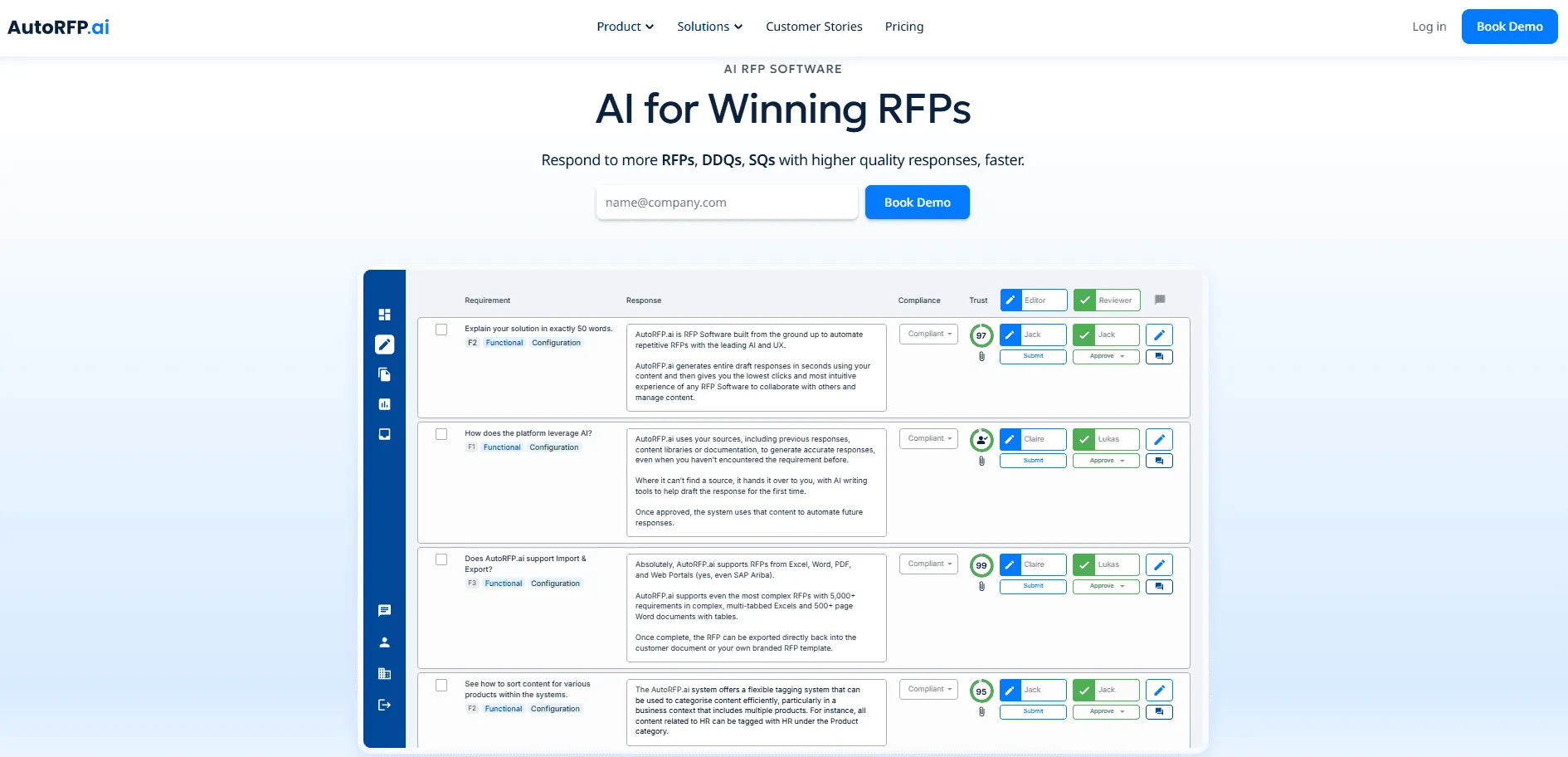
Once your compliance matrix is clear, the next step is making the whole response process faster and easier to manage. Manual spreadsheets can help teams track requirements, but they still depend on copying, pasting, chasing updates and checking every answer by hand.
That is where a cutting-edge AI RFP automation platform like AutoRFP.ai can help. Instead of building every matrix and response from scratch, your team can extract requirements, assign owners, draft answers and track compliance in one workflow.
AutoRFP.ai helps RFP teams streamline compliance management with:
AI Document Importer: Upload Word, PDF, Excel or ZIP files and extract requirements, sections and context automatically.
AI RFP Response Engine: Generate first-draft answers using approved past responses, content libraries and company documentation.
RFP Content Library: Reuse approved answers, security language, product details and supporting evidence without searching across old files.
RFP Project Management: Track owners, blocked responses, comments, completion status and SME progress from one dashboard.
RFP Gap Analysis Report: Identify recurring non-compliant and partially compliant requirements across past RFPs.
Go/No-Go Analysis: Spot deal-breakers earlier before your team spends hours on an RFP that may not be worth pursuing.
For RFP teams, this turns the compliance matrix from a static tracking document into a smarter response workflow. You can see what needs attention, who owns each requirement and which gaps keep affecting deals.
If your team wants to reduce manual compliance work, improve response quality and move faster on complex RFPs, book a demo with AutoRFP.ai today.
About the author

Co-founder & CEO
Co-founder and CEO of AutoRFP.ai. Spent 7 years running global RFPs and personally completed 500+ RFPs before founding the company.
LinkedInFrequently asked questions
What Makes A Compliance Matrix Template Effective?
An effective compliance matrix template gives proposal teams one clear place to track every RFP requirement, owner, status, response location, risk, and supporting evidence. The strongest templates also connect requirements to win themes, customer priorities, and reviewer expectations, so the matrix supports both compliance and proposal strategy.
How Do I Handle Complex RFPs With Scattered Requirements?
For complex RFPs, review the full document line by line and capture every instruction, requirement, evaluation criterion, attachment, and submission rule. Pay close attention to words like “must,” “shall,” “will,” “required,” and “provide.” AI-powered tools can also extract and organize requirements from long RFPs faster, but human review is still important.
Who Should Own The Compliance Matrix Process?
The proposal manager usually leads the compliance matrix because they coordinate the full response process. However, the matrix should not sit with one person alone. SMEs, sales engineers, legal, security, finance, and reviewers should own their assigned sections, update statuses, provide evidence, and flag risks early.
How Can Compliance Matrices Improve Proposal Quality?
Compliance matrices improve proposal quality by making sure every buyer requirement is addressed, reviewed, and easy to verify. They also help teams spot gaps early, reduce the risk of missed mandatory requirements, and align answers with evaluation criteria, proof points, and differentiators.
What Tools Work Best For Compliance Matrix Management?
Excel can work for smaller or simpler RFPs, but modern RFP software is better for complex, high-volume, or multi-stakeholder responses. Strong tools should support requirement extraction, ownership tracking, real-time collaboration, review workflows, evidence management, progress dashboards, and reporting across RFPs. AI-powered platforms can also help identify gaps before submission.
