9 Best 1up RFP Alternatives: Compare Features, Pricing & More
Explore the best 1up.ai alternatives for RFP and proposal automation. Compare features, pricing, workflows, and integrations to find the right solution.

Co-founder & CEO, AutoRFP.ai·Updated ·15 min read
RFP software should help teams move faster without creating new review problems. But when a platform struggles with shallow context understanding, inaccurate or outdated responses, and shallow requirement shredding, it can still leave proposal teams doing too much manual cleanup.
If you are looking beyond 1up RFP, this guide compares the best alternatives by features, pricing, and overall fit. Lean MSP and presales teams often start with 1up; the RFP software for MSPs and IT services comparison covers when a fuller response platform is a better fit. For a plan-by-plan view of how much 1up costs before you switch, see the pricing breakdown. Related vendor roundups, such as 5 Best Steerlab Alternatives, use the same feature-and-fit structure. Teams comparing adjacent knowledge-automation vendors can also review alternatives to SiftHub or Tribble alternatives.
If your shortlist is already down to these two products, the AutoRFP.ai vs 1up.ai comparison uses current help documentation to compare answer verification, file return, approvals, reporting, integrations, and pricing.
| Tool | Best for | Standout feature | Starting price |
|---|---|---|---|
| AutoRFP.ai | Mid-to-large teams that need deeper requirement extraction, less manual cleanup, and stronger workflow control | Deep requirement extraction, self-updating content, and exact-format exports | $899/month (Scale) |
| Responsive | Enterprise proposal teams with complex workflows | Library-backed teamwork and structured ownership | Contact sales |
| Loopio | Teams with large answer libraries and repeat questionnaires | Central response library with defined team workflows | $20,000/year (Foundations) |
| Inventive.ai | AI-first teams that want faster, more tailored drafts | Context-aware drafting and freshness checks | Contact sales |
| Qvidian | Large enterprises with formal, document-heavy proposal processes | Office-centric workflows | Contact sales |
| Proposify | Teams managing lighter, client-facing proposal workflows | Proposal creation and deal tracking | $29/user/month (Basic) |
| PandaDoc | Sales teams that want proposals, approvals, and e-signatures in one flow | E-signatures and payment collection | $35/seat/month |
| AutogenAI | Teams focused on formal tenders and high-quality bid writing | Narrative proposal writing | Contact sales |
| Arphie | Regulated teams that need source-grounded, high-confidence answers | Source-grounded responses | Contact sales |
1. AutoRFP.ai
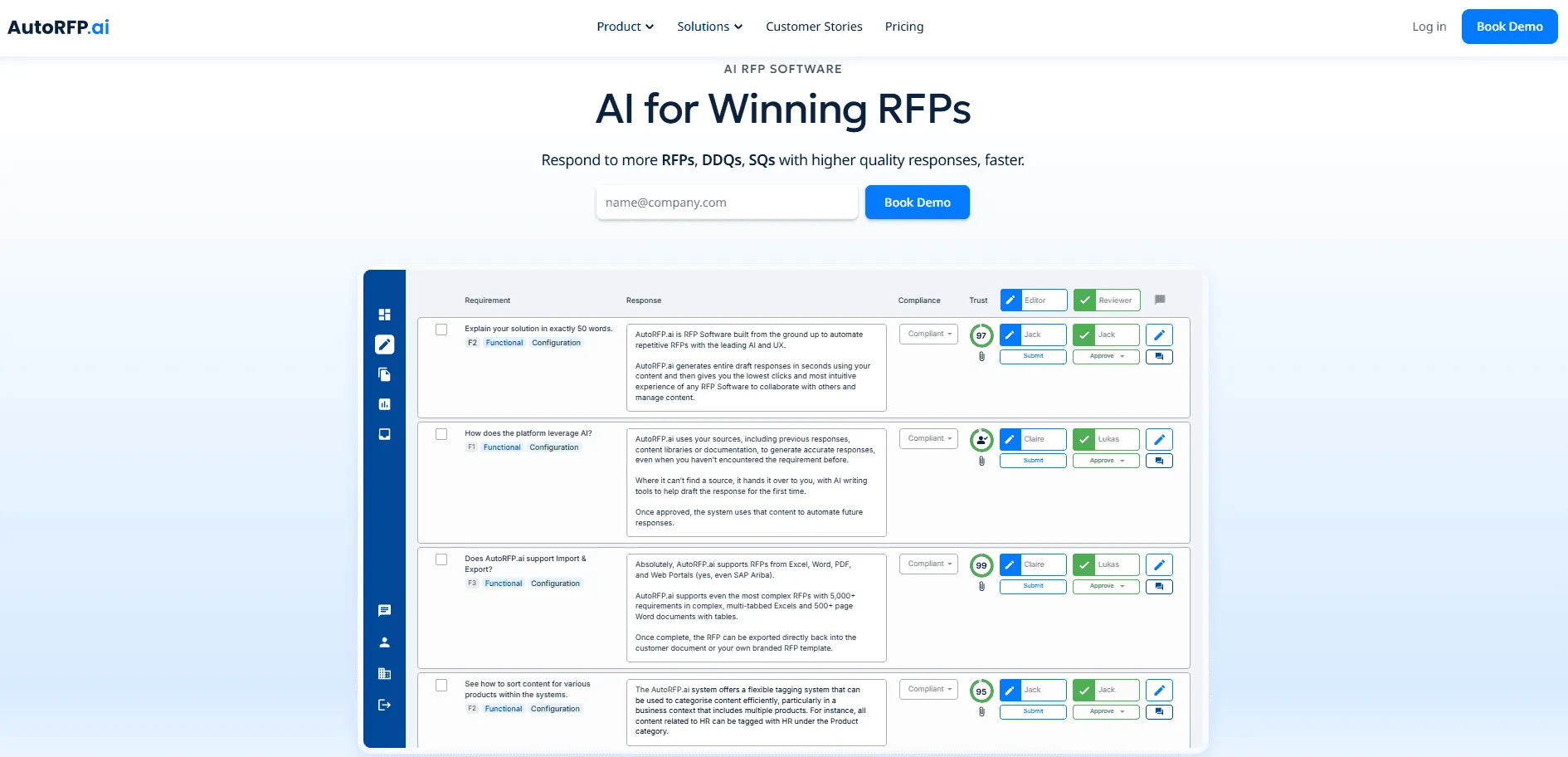
AutoRFP.ai is a strong 1up alternative for teams that need fast, accurate responses to RFPs, DDQs, and security questionnaires.
It can ingest Word, Excel, and PDF files, then extract requirements, sections, and supporting context automatically. This helps teams move from document intake to a usable first draft much faster.
AutoRFP.ai is built for more than answer generation. It supports structured workflows, review processes, and governance controls that help teams manage complex responses with greater accuracy and consistency.
It is also better suited to multi-team and global organizations that need enterprise security, workflow flexibility, and scalable response management.
Key Features
Here are the main features that make AutoRFP.ai stronger than 1up RFP, especially when speed, accuracy, requirement extraction, a self-updating library, enterprise features, and collaboration matter.
1. AI Document Importer For RFPs
AutoRFP.ai gives teams a faster way to start complex RFPs, DDQs, and security questionnaires. It can ingest Word files, PDFs, and Excel documents, including compliance matrices, macros, and nested tables, then automatically extract requirements, sections, and context.
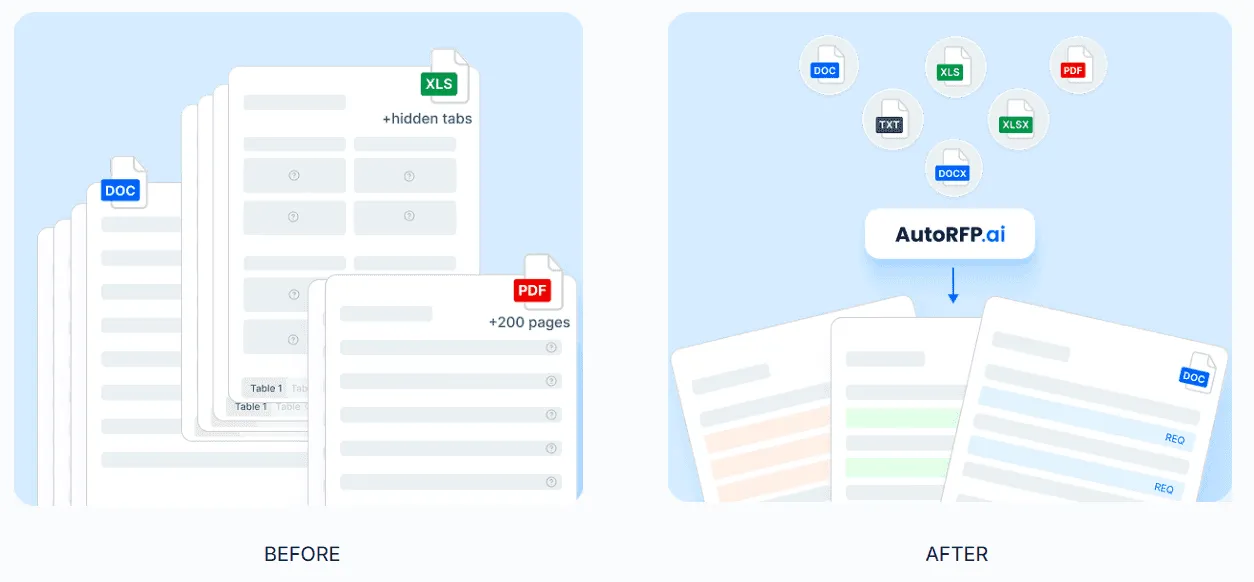
That makes it a better fit than 1up for teams that need deeper requirement extraction with less manual cleanup. Instead of spending hours reformatting files, teams can start with a structured draft-ready project much sooner.
Users can then refine the extracted requirements, add context, reorganize sections, and manage edits directly in the platform. They can also export responses in the customer’s original format or a branded template without repeating the upload and formatting work.
2. AI RFP Response Engine
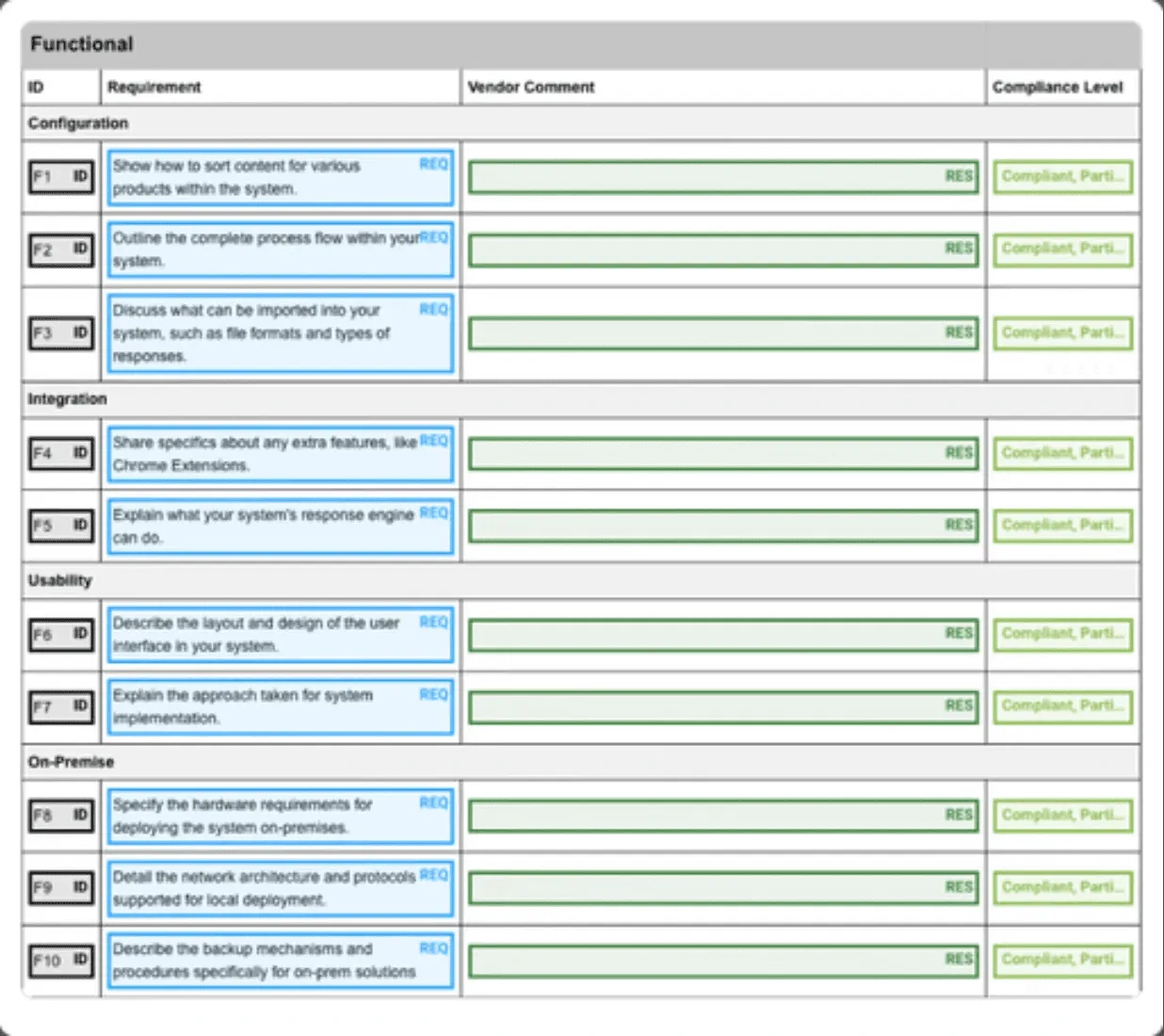
AutoRFP.ai generates complete first drafts in seconds using approved past responses, content libraries, and company documentation.
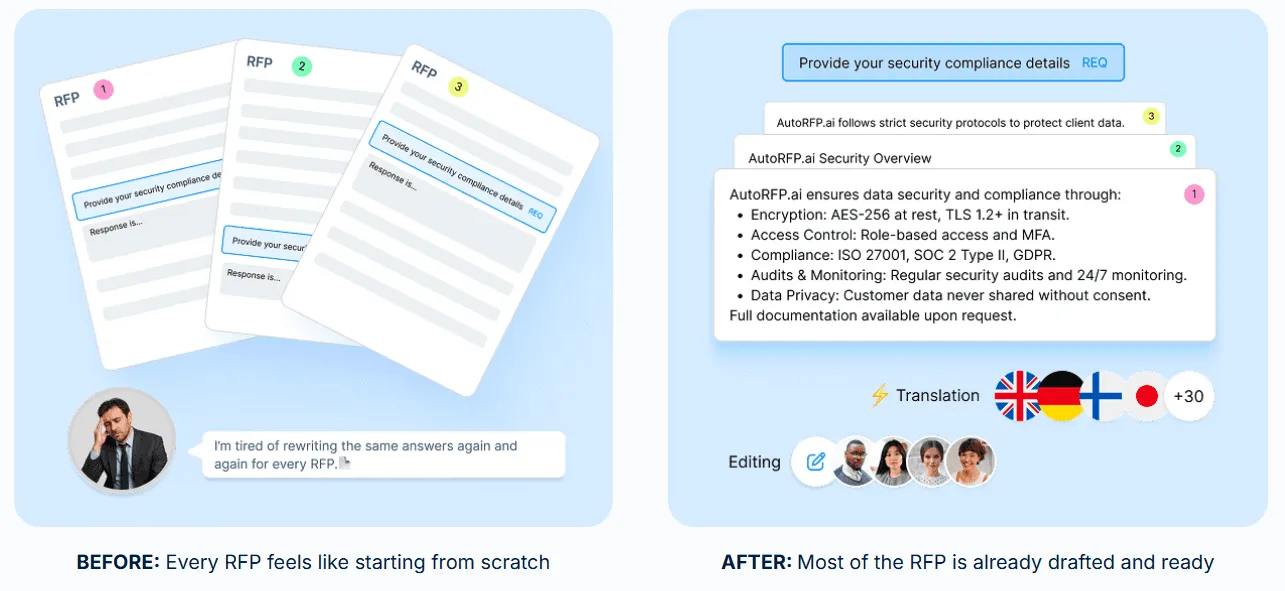
That makes it a stronger 1up alternative for teams that need accurate, tailored answers instead of generic AI output that needs heavy rewriting.
Instead of relying on freeform generation, AutoRFP.ai first searches trusted source content, then drafts responses using the customer’s terminology and your team’s preferred tone.
If no strong source exists, it flags the gap for human review and provides AI writing tools to help teams draft the answer safely.
Every response includes visible sources, content age, and a confidence score, which gives reviewers more control over accuracy and approval.
As more answers are approved, the platform reuses that knowledge in future bids, helping responses stay consistent, on-brand, and faster to produce.
3. Self-Updating RFP Content Library
AutoRFP.ai gives teams a content library that becomes more useful over time, without relying on heavy manual upkeep before the platform delivers value.
That makes it a stronger 1up alternative for teams that do not want to spend hours building, tagging, and maintaining a library just to get reliable answers.
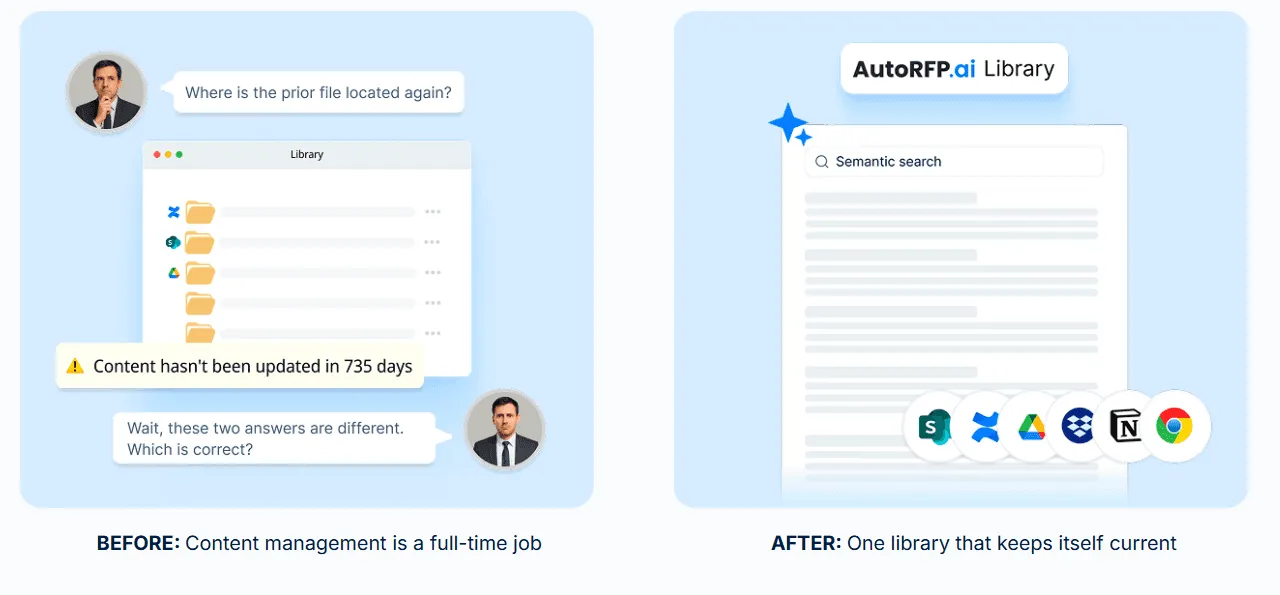
Every approved response can be added back into the library automatically, where AI tags and organizes it for future use. This helps teams keep content current as messaging, proof points, and company information evolve.
Its semantic AI searches by meaning, not just keywords, so it can find relevant answers even when the wording is different. That gives teams a better chance of surfacing useful content from past responses, internal documents, and connected sources such as SharePoint, Google Drive, and Confluence.
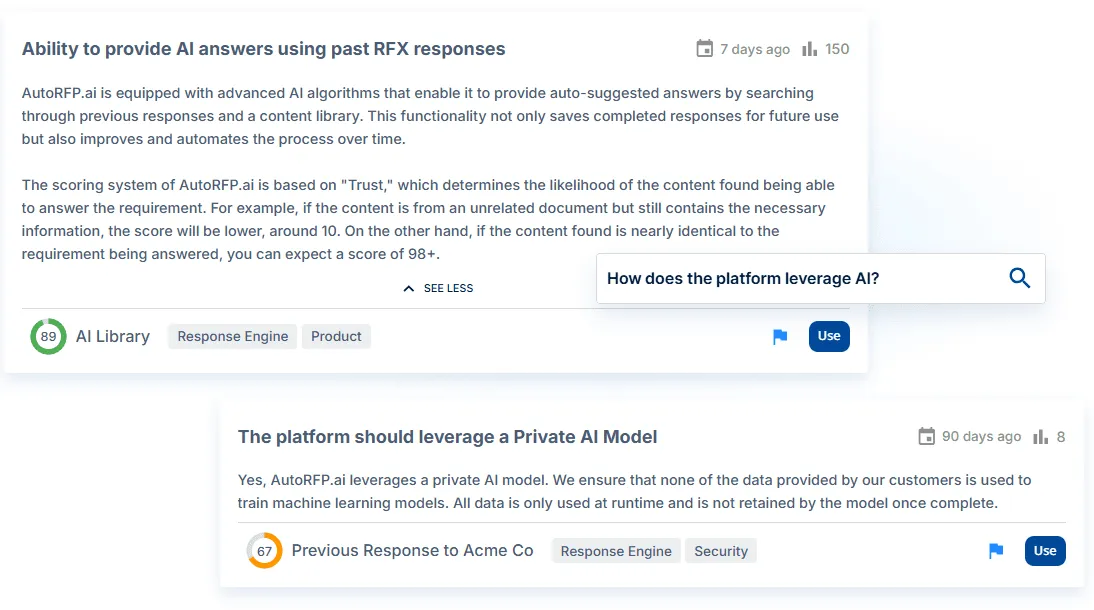
As a result, proposal teams spend less time managing stale content and more time reviewing answers that are easier to trust, reuse, and adapt.
4. RFP Project Management Software
AutoRFP.ai helps teams manage complex RFPs, RFIs, DDQs, and security questionnaires from one central dashboard.
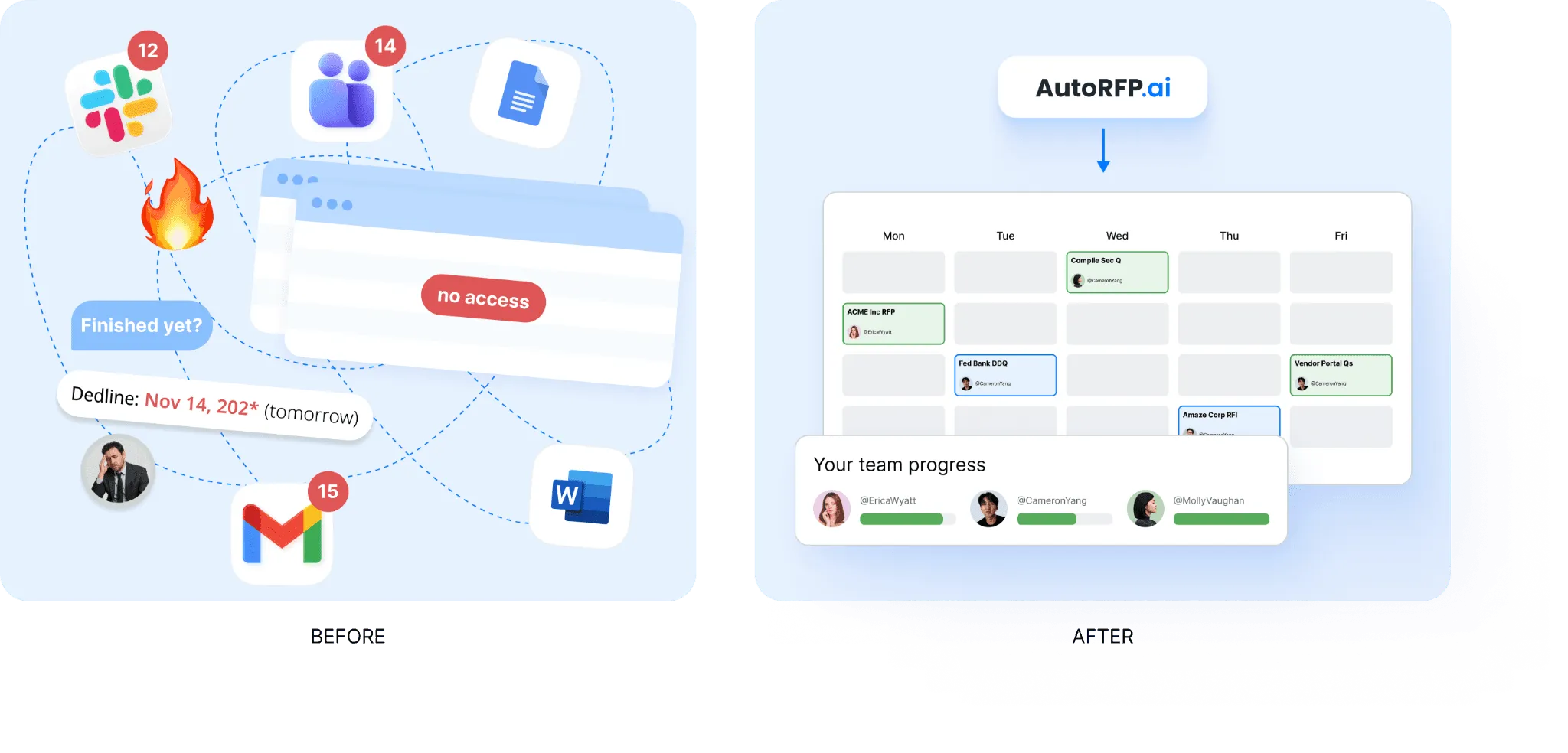
It gives teams real-time visibility into workloads, blocked responses, open comments, due dates, section progress, and overall completion. That makes it a better fit than 1up for high-stakes response workflows that need more than basic collaboration.
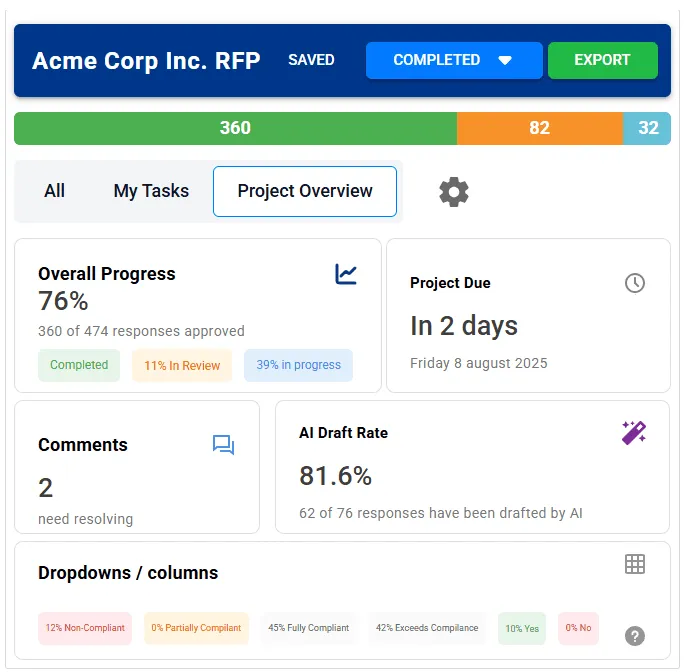
Instead of juggling spreadsheets, email threads, and manual check-ins, teams can spot delays early, send reminders, and keep SMEs and reviewers accountable in the same workspace. Comments, @mentions, and notifications through email, Slack, or Teams also help keep every discussion tied to the right response.
5. AI Go/No-Go Risk Screening
AutoRFP.ai helps teams assess whether an RFP is worth pursuing before they commit time, budget, and internal resources to the response.
That makes it a stronger 1up alternative for teams that need structured pre-bid screening instead of discovering major issues halfway through the process.
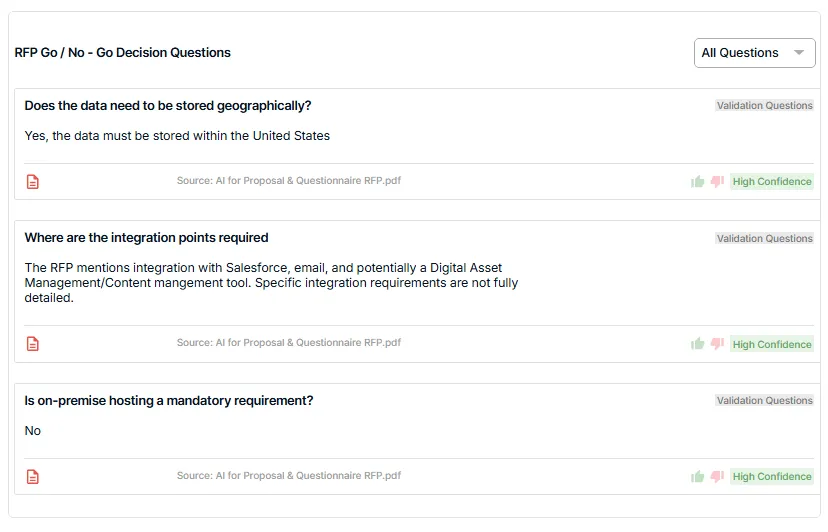
Teams can define go/no-go criteria across areas such as compliance, deployment, legal, support, integrations, and timelines. AutoRFP.ai then screens the document against those criteria automatically and highlights potential deal-breakers early.
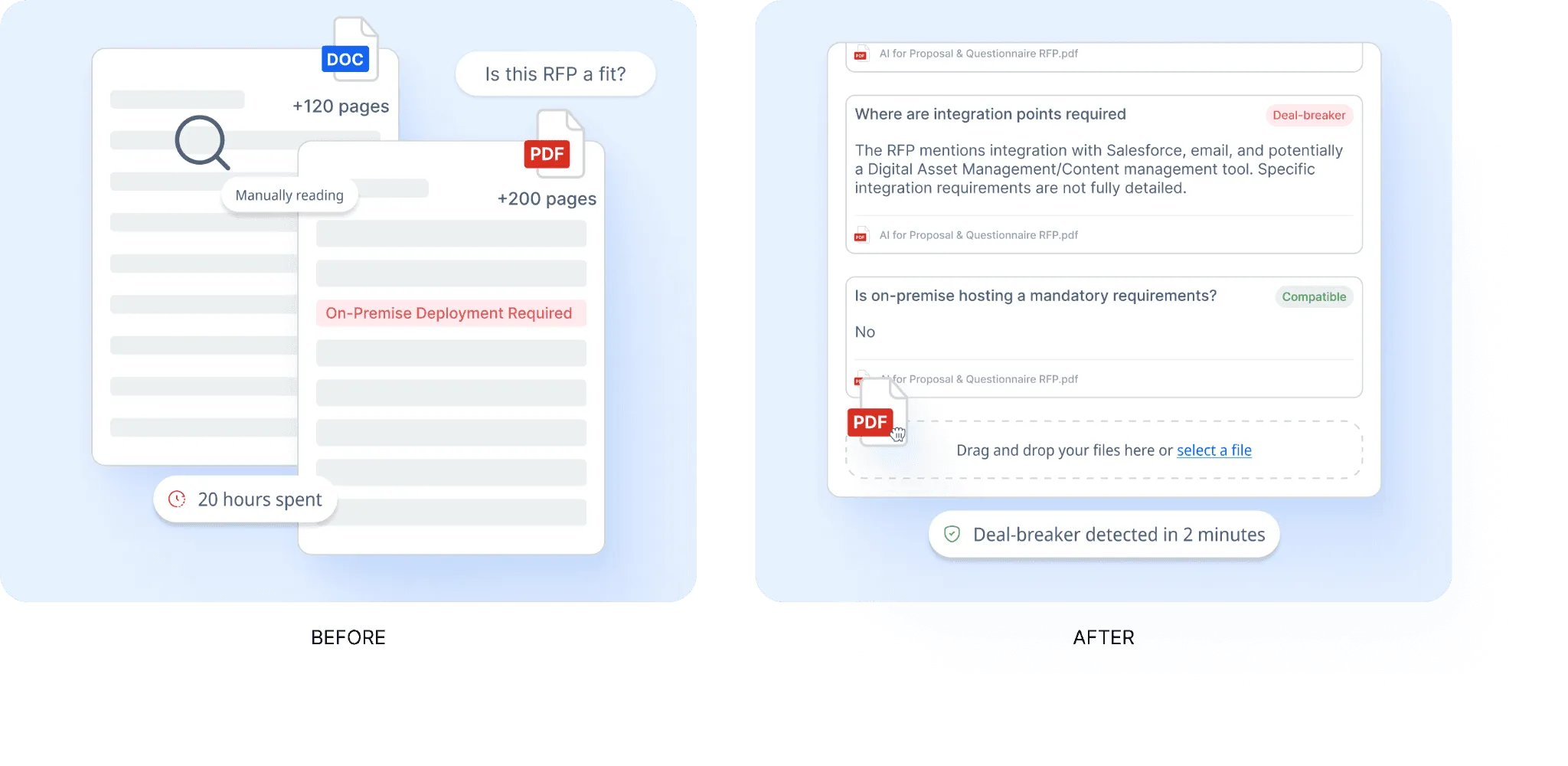
It also provides source-backed answers and confidence scoring, which helps teams review findings faster and make better decisions with less manual reading. If a requirement is unclear, teams can investigate it further before moving the bid forward.
As a result, proposal teams can identify poor-fit opportunities in minutes rather than spending hours on bids that were unlikely to progress in the first place.
6. RFP Reporting And Capacity Planning
That makes it a stronger 1up alternative for teams that need more than basic activity tracking. Instead of guessing whether the team can take on another RFP, leaders can see workload, deadlines, project status, and overall capacity before committing.
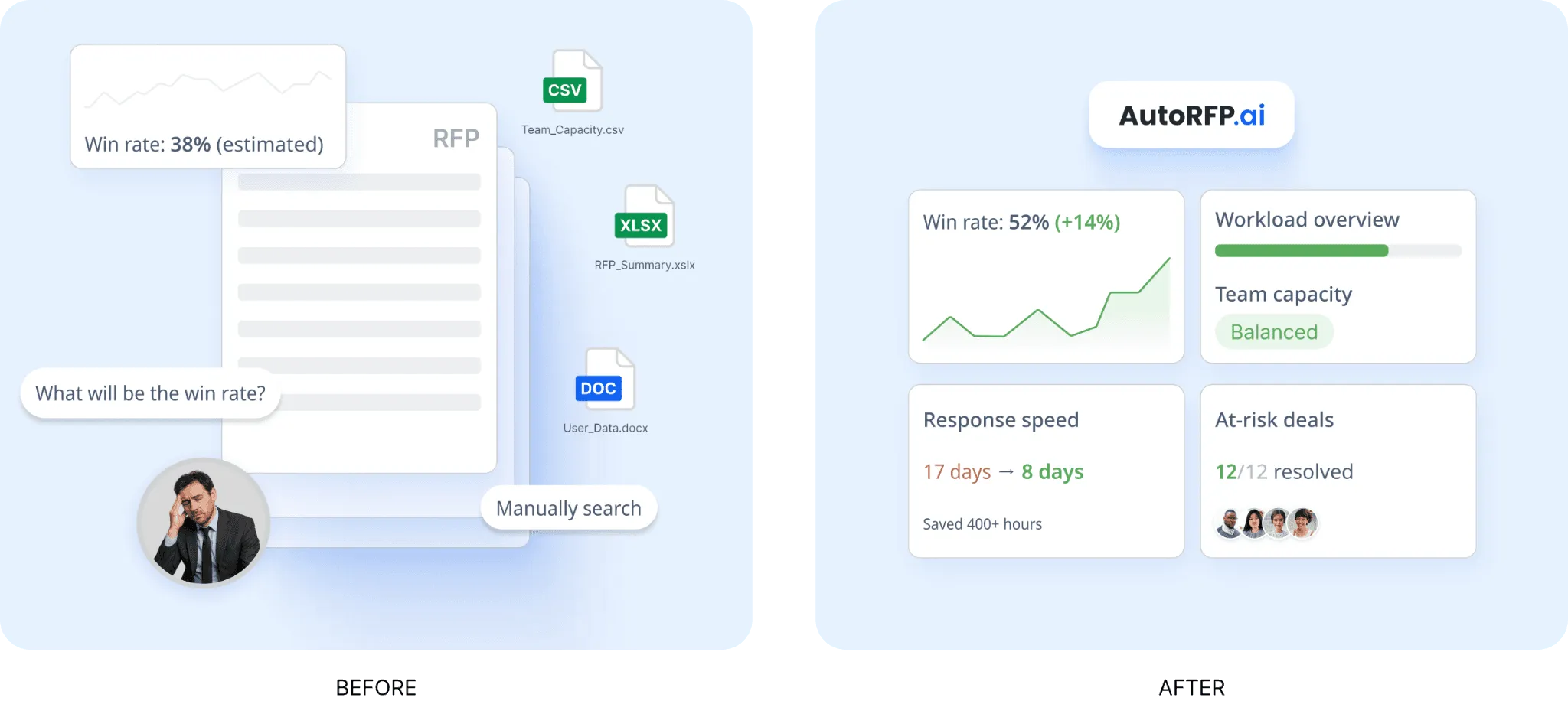
It also helps teams understand which RFP types, deal sizes, and segments convert best, so they can focus effort on higher-value opportunities and avoid overcommitting to lower-yield work.
With better reporting across pipeline volume, resourcing, and outcomes, proposal leaders can plan more confidently, improve response speed, and make stronger decisions about where the team’s time will have the biggest impact.
7. Project Agent
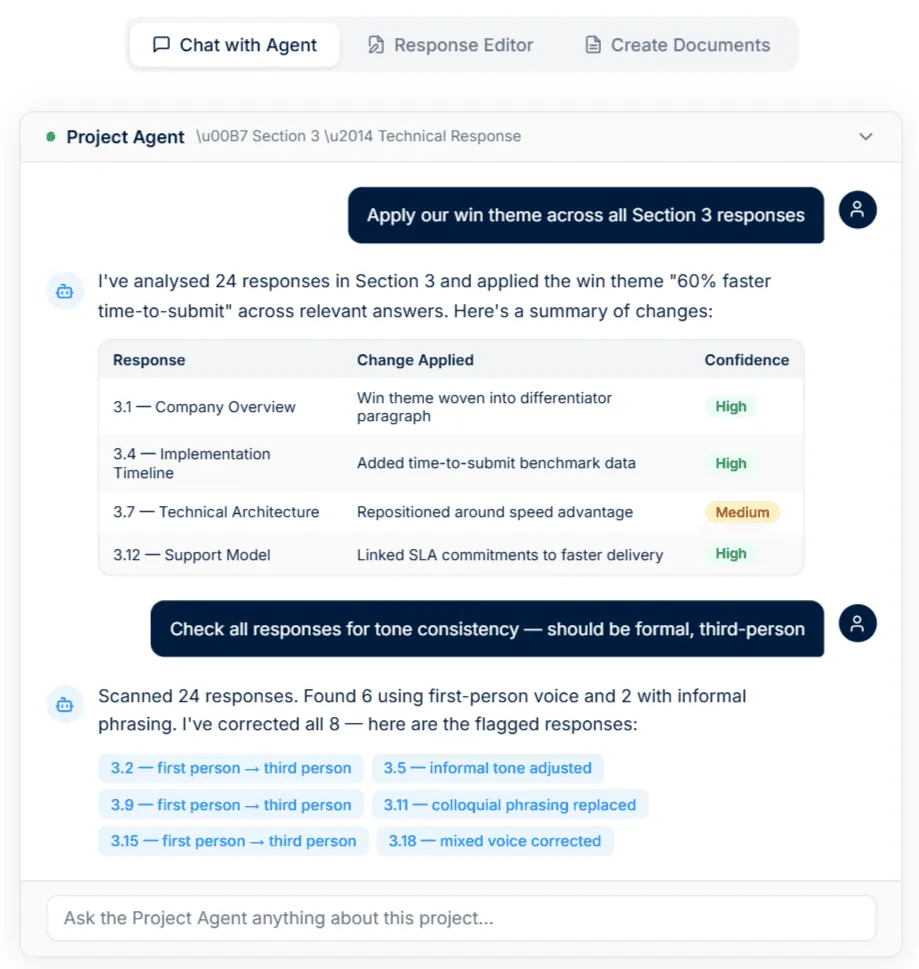
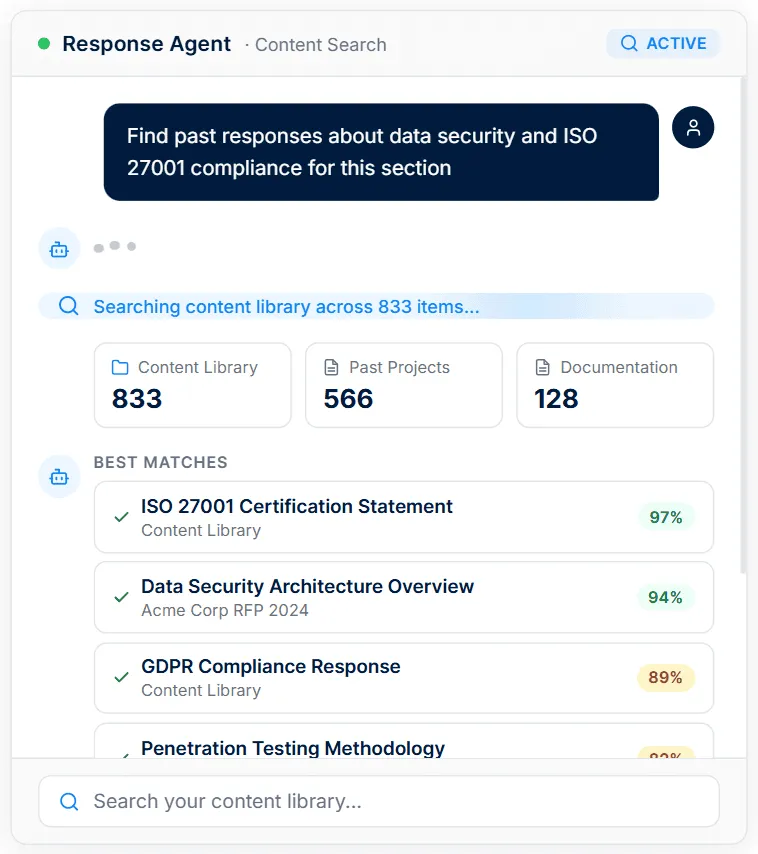
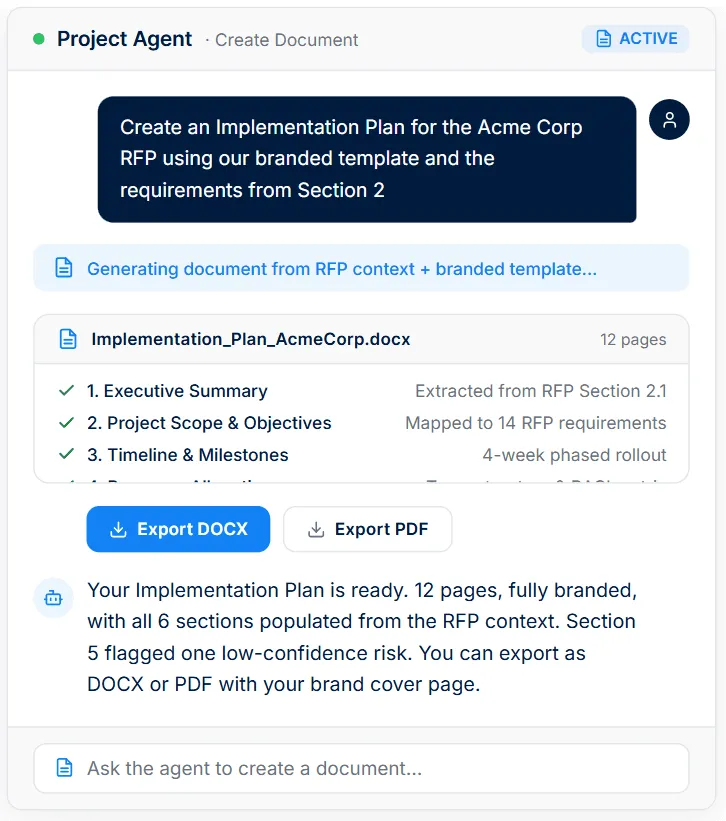
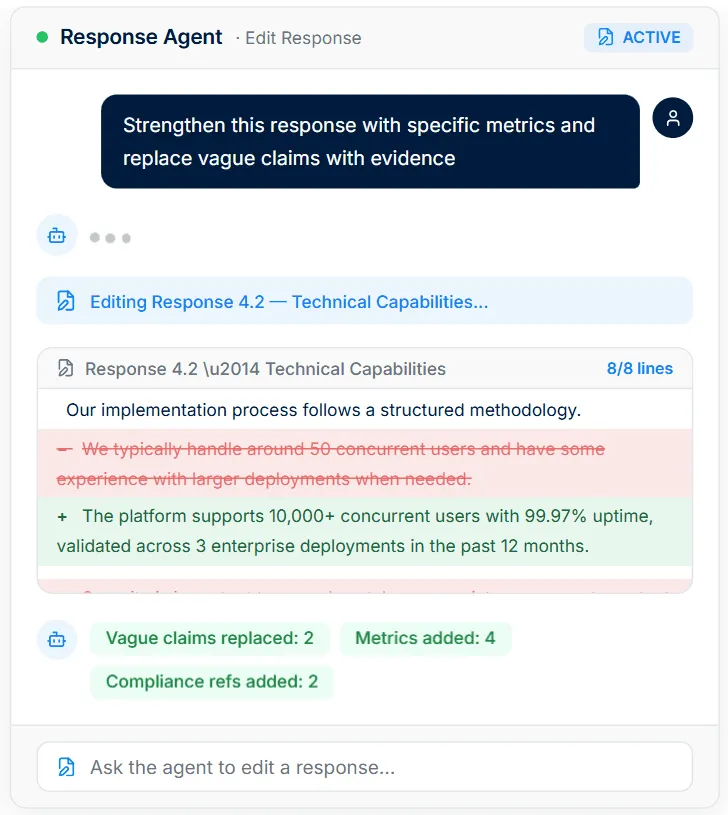
AutoRFP.ai’s Project Agent helps teams manage editing, document creation, content discovery, and live research from one place.
It searches across your content library, previous projects, and uploaded documents to find approved content that fits each requirement.
It can create supporting documents such as executive summaries, implementation plans, and cover letters based on the project context.
It also revises responses directly in the workflow, helping teams improve wording, strengthen evidence, and keep messaging aligned across sections.
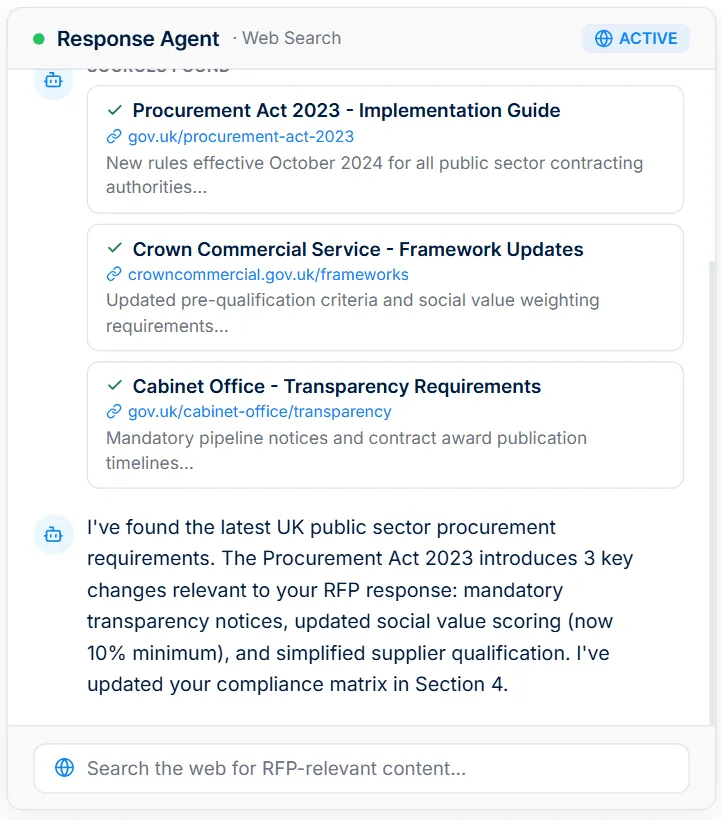
The agent can pull in live web information such as regulatory updates, industry data, and prospect-specific details to support stronger responses.
Pricing
| Plan | Monthly Cost | Key Inclusions |
|---|---|---|
| Scale | $899 | Unlimited AI responses, users, content, and integrations |
| Accelerate | $1,299 | Everything in Scale, plus advanced analytics and priority support |
| Enterprise | Custom | Custom integrations, a dedicated success manager, and tailored security and compliance features with SSO |
AutoRFP.ai comes with a 30-day money-back guarantee, personalized onboarding, and tailored training to help teams get started quickly. Every plan includes unlimited users with no per-seat fees, and teams can be up and running in as little as 48 hours.
Where AutoRFP.ai Shines
Portal questionnaire automation: AutoRFP.ai can scrape questions from portals, generate answers, and export them back automatically. It supports platforms like Ariba, UpGuard, and Jaggaer.
Ask-a-bot answers: Ask a question once and get a sourced answer in seconds. Teams can use it directly in Slack or Microsoft Teams without switching tabs.
Wide integrations: AutoRFP.ai connects with around 16 tools across SSO, knowledge bases, communication platforms, help centers, file storage, and CRM systems, helping teams keep workflows aligned.
Where AutoRFP.ai Falls Short
- Not a great fit for AEC, US GovCon/defense, custom software development, or highly bespoke professional services: Responses in these sectors are often too unique to follow repeatable patterns.
Customer Reviews
Saxon W., Senior Workforce Management Consultant, shared in a Software Finder review, “AutoRFP is an absolute game-changer for me because, without it, I simply wouldn’t have the time to complete RFPs regularly. It saves an exceptional amount of time. What truly sets it apart is the quality of its responses: they’re far better than other systems on the market because AutoRFP understands context, unlike tools that just regurgitate irrelevant answers from previous RFPs. The initial setup was completely painless, and on top of an excellent product, the team works closely with customers and continues to innovate, making the entire experience fantastic.”
In a Reddit thread on finding the right RFP tool, a user shared that “AutoRFP.ai was a solid option, nice enough UI, easy to project manage, and decent support. It also seemed to be significantly cheaper than competitors like Loopio and Responsive when we were shopping last year”.
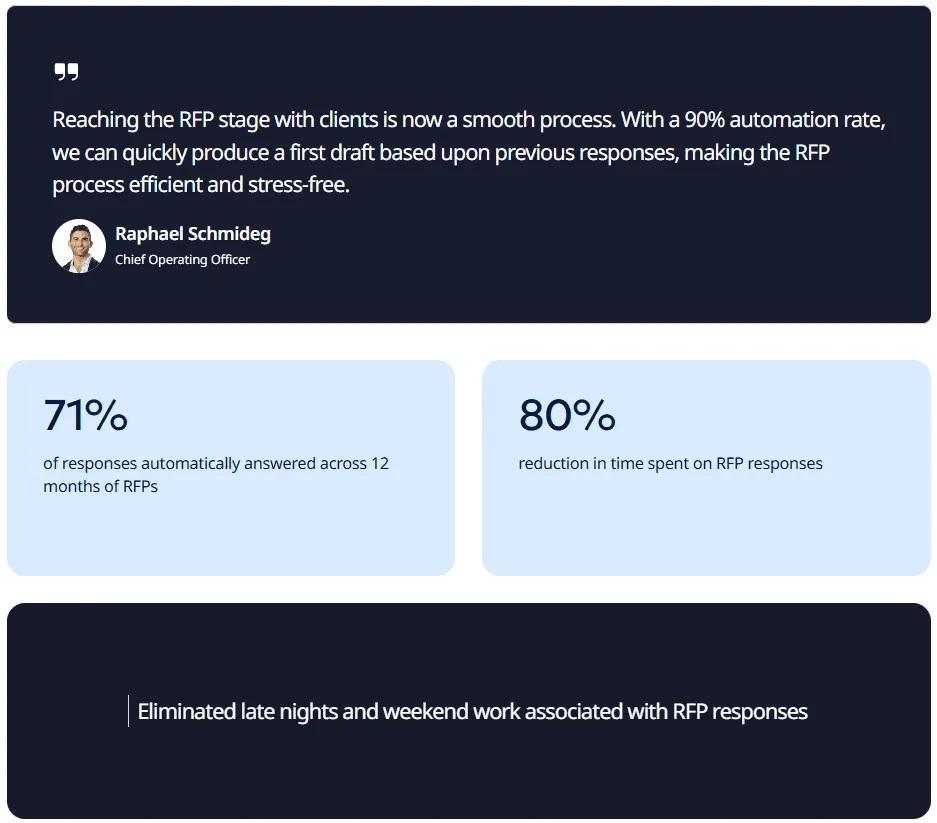
Raphael Schmideg, Chief Operating Officer at IMTC, said, “Reaching the RFP stage with clients is now a smooth process. With a 90% automation rate, we can quickly produce a first draft based upon previous responses, making the RFP process efficient and stress-free.”
Who AutoRFP.ai Is Best For:
Mid-to-large B2B SaaS: Teams handling high volumes of enterprise RFPs and RFIs that need faster first drafts, stronger requirement extraction, and less manual cleanup than 1up typically requires.
Enterprise deal teams: RFP managers, bid writers, pre-sales engineers, and enterprise AEs coordinating SME-heavy responses across tight timelines who need deeper project tracking, better workflow visibility, and more structured collaboration than 1up offers.
Financial services: Managed funds, insurance firms, and asset managers running high-stakes DDQs and security reviews that need more accurate, context-aware answers, stricter approvals, and stronger reporting than basic AI response tools like 1up provide.
Regulated enterprises: Healthcare, fintech, and cybersecurity teams answering compliance-heavy DDQs and security questionnaires that need deeper requirement shredding, go/no-go risk screening, and exact-format exports beyond 1up’s more limited workflow support.


Video transcript
Transcript is auto-generated and may contain minor errors.
Hey, I'm Rob from autoRFP.ai. What is autoRFP.ai? Well, autoRFP.ai is an AI software as a service or SaaS application that does AI for proposal or RFP responses. That includes RFIs, like request for informations, includes due diligence questionnaires or DDQs, and includes security questionnaires. So, you can find all about us at autoRFP.ai. So, we're a technology company. We have offices all across the globe including Brisbane, Australia, Vancouver as well. And effectively, our tool allows, whether it be bid managers, sales people, proposal writers, RevOps team members, sales leadership, answer complicated request for proposals. So, what is a request for proposal? You can see one of our other videos below in the description. But effectively, our system
looks something like this. And it lets team members, and you can have unlimited number of people log in to autoRFP.ai, good product, allows people to go in, create projects, which would be for instance an RFP. I can go in here, create my information from my zip file, and that includes, you know, like an Excel spreadsheet, PDF, Word doc. We can run an AI go no go project analysis on the RFP. And then effectively from that, we can bring in all the information in terms of what are the questions, where our AI automatically scans the documents and figures out what is being asked of the RFP, whether it's multiple tabs in an Excel spreadsheet and everything else, whether it's drop-downs. And that all happens automatically through the power of AI. Then, we generate our response, and we can do it in in 40 plus different languages and adding languages all the time. Once you've imported your RFP into order rfp.ai,
you can collaborate with your team members assigning different people to answer the questions, review the questions, looking at an overview of the entire project and project managing due dates. Now AI effectively starts automatically answering those different questions based on your knowledge documentation. So that might be your website, your help docs, your technical documentation, your past RFP answers or security questionnaires, your security policies. But effectively all that different company information you import into order RFP and then our AI leverages that to create an AI first draft of an RFP response. Once we're happy with all those requests, we can approve it. That goes into the model to learn from and add to. So your current responses are automatically used for new responses and then you can export that as well. And then the final cool thing about order RFP is you have a lot of different
integrations that you can pull in, whether it's knowledge documentation from places like Notion, Google Drive and so on. So that's order RFP. We're an AI SaaS app. Uh you can host globally. We do not use customer data for training purposes or to send it back to LLMs. So we're secure and private. We have our ISO 2701 certificate and our SOC 2 certificate and then you can find up-to-date pricing and information on our website. Or if you came to learn more, you can book a demo and schedule time with our team. Thanks.
2. Responsive (Formerly RFPIO)
Responsive is one of the strongest all-around RFP response platforms for larger teams because it combines AI drafting, governed content reuse, requirements analysis, and cross-functional collaboration in one strategic response management platform.
It is built for RFPs, RFIs, DDQs, and related questionnaires, and it keeps expanding beyond classic library search into AI-assisted planning and portal workflows. That makes it a strong fit for teams that want a mature system for both response speed and process control.
Key Features
AI-assisted response projects: Drafts answers and manages collaborative workflows for RFPs, RFIs, DDQs, and questionnaires.
Requirements analysis: Extracts and sorts requirements into structured tables to assess fit, assign work, and reduce compliance misses.
Knowledge and response tools: Combines content reuse, search, and AI support across response workflows.
Pricing
| Plan | Monthly Cost |
|---|---|
| Lite Edition | Contact sales |
| Emerging Edition | Contact sales |
| Growth Edition | Contact sales |
| Enterprise Edition | Contact sales |
Where Responsive Shines
Broad workflow coverage: It handles response drafting, collaboration, requirements breakdown, and knowledge reuse in one system.
Strong enterprise fit: It is built for teams handling recurring RFPs, DDQs, and security questionnaires at scale.
Helpful collaboration layer: Review themes consistently highlight real-time collaboration, speed, and response consistency.
Where Responsive Falls Short
Steeper learning curve: New users often need time to get comfortable with the structure.
Search and navigation friction: Some reviewers say it can be hard to locate content or uploaded files quickly.
Less lightweight for small teams: It is better suited to formal response programs than ad hoc proposal work.
Can feel process-heavy: Teams that only want simple answer reuse may find the platform broader than they need.
Customer Reviews
Brian Z., Sr. RFP Manager, shared on Capterra, “Hundreds of hours were saved in responding to questionnaires and RFPs. RFPIO offers very competitive cost savings compared with most larger RFP software providers. It delivers the same functionality at a fraction of the cost of the bigger players. Customer support is top-notch, and all questions or requests for help are addressed within the same day, or within 24 hours at most. The management team provides great, direct support, with no call centers or outsourced product support. You get assistance from the people who helped build the product.”
Christian F., Proposal Writer, shared, “Ease of use could be improved. I want more hotkey customizability so I can move around the software with fewer clicks and rely more on the keyboard instead of the mouse. More features should also be available through right-click and open in a new window. The ribbon in the commenting area should be adjustable so different tabs can sit next to each other. For example, I want Comments, Activity, and Recommendations next to each other because they are the features I use most, but it is annoying when they are far apart and require multiple clicks to switch back and forth.”
Who Responsive Is Best For
Large proposal and sales engineering teams: Best for organizations that need governed response automation across many contributors.
Security and compliance-heavy teams: A strong fit when DDQs, VSQs, and security questionnaires are a major part of the workflow.
3. Loopio
Loopio remains one of the clearest response-management options for teams that care most about content quality, answer governance, and repeatable questionnaire workflows.
Its platform is centered on AI-powered answer recommendations, content management, portal response support, and integrations across the tools proposal teams already use.
Compared with more AI-native entrants, Loopio still feels more grounded in trusted content reuse, but it has clearly expanded into first drafts, project insight, and portal-based response management.
Key Features
Response intelligence: Generates vetted answers from approved sources of truth and supports review and quality control.
Portal response support: Imports questions, organizes them, and helps teams respond in web portals and documents faster.
Integrations and reporting: Connects with systems like Salesforce, SharePoint, Google Drive, Slack, and more, with reporting tied to pipeline and win-rate tracking.
Pricing
| Plan | Monthly Cost |
|---|---|
| Foundations | $20,000/year |
| Enhanced | Contact sales |
| Enterprise | Contact sales |
Where Loopio Shines
Excellent knowledge management: It is especially strong for approved-answer reuse and library health.
Strong user experience: Review themes frequently praise implementation, usability, and day-to-day adoption.
Where Loopio Falls Short
Formatting issues still come up: Reviewers continue to mention export or formatting pain points.
Library upkeep still matters: The platform works best when teams actively maintain content quality.
Less narrative-first than AI-native tools: It is strongest on questionnaire-style reuse, not fully generative long-form proposals.
Some workflow friction remains: Review feedback mentions missing features, limitations, and occasional inaccuracy concerns.
Customer Reviews
Brian F., Senior Proposal Manager, shared on Capterra, “I love the ‘Close the Loop’ functionality because it makes adding to your library much easier. It is easy to categorise content, add alternative questions, and update existing content with better material from a recent response. Their customer support team is fantastic, and I could not ask for more from them. They are fast, creative, and always make you feel supported. The pricing is also very competitive and offers great value.”
Trena P., shared, “If you use graphics in your proposals, this is not the right product for you. As an IT firm, we use a lot of graphics to explain our solution. I asked about graphics during the demo, and it was never made clear that they would need to be converted into pictures and uploaded. I do not feel the demo was an honest representation of the product. I tried to make the product work, but I never found a workaround.”
Who Loopio Is Best For
Proposal teams with large answer libraries: Best for organizations that already have strong content and need to scale its use.
Teams handling repeat questionnaires: A strong fit for RFIs, RFPs, DDQs, and security questionnaires with recurring content patterns.
4. Inventive.ai
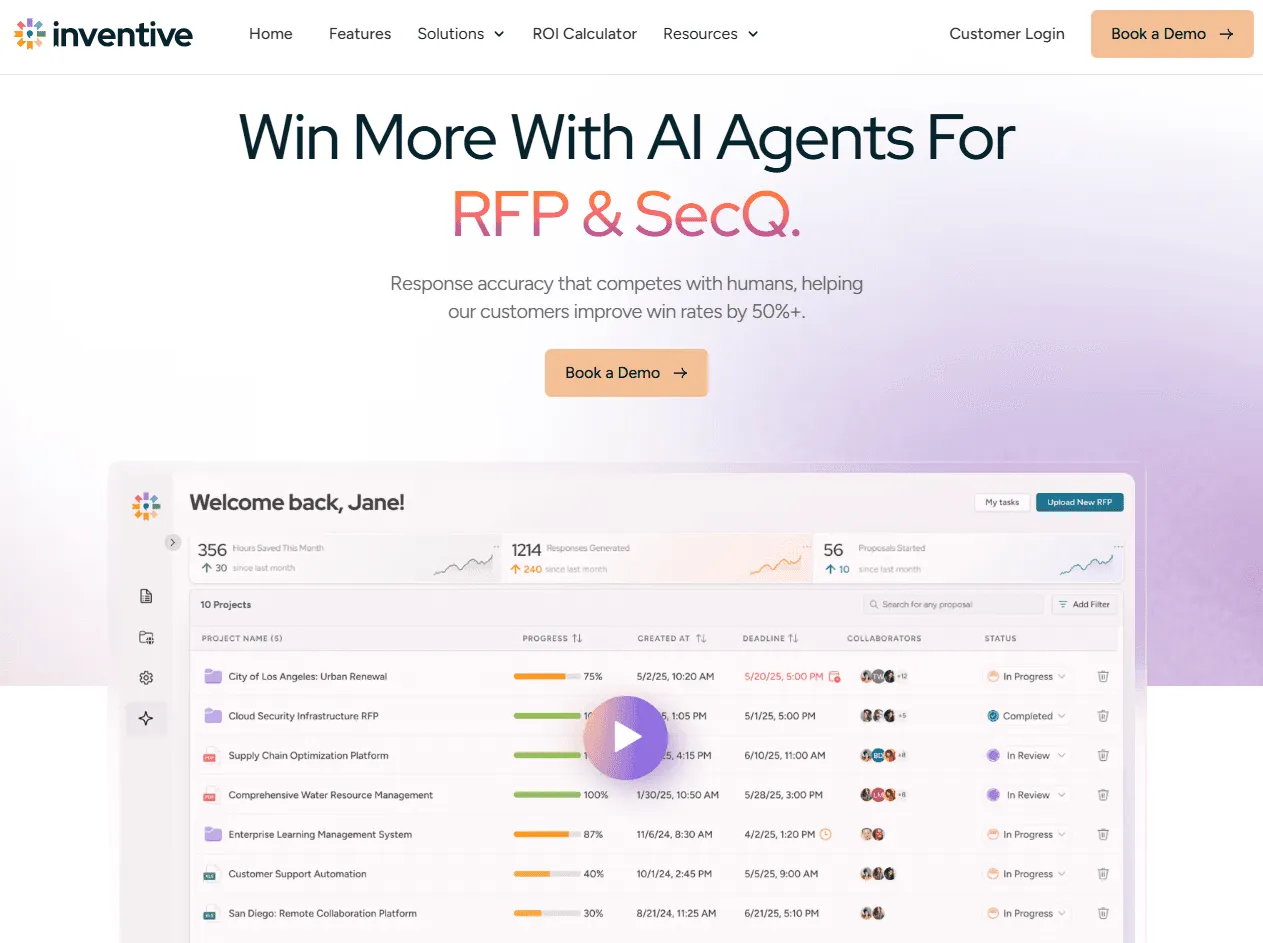
Inventive.ai is one of the most AI-native tools in this category. Instead of leaning mainly on library search, it positions itself around an AI RFP agent, context-aware drafting, freshness checks, narrative proposal writing, and specialized agents for strategy work such as win themes and competitor research.
It is also clearly built for both RFPs and security questionnaires, which makes it especially appealing for fast-moving B2B teams that need better first drafts without losing control over accuracy.
Key Features
AI RFP agent: Generates responses for RFPs and security questionnaires with a strong AI-first workflow.
Context-aware drafting and freshness checks: Produces tailored answers and flags outdated or conflicting content before submission.
Specialized AI agents: Supports win themes, positioning, brainstorming, and competitor research beyond basic answer generation.
Pricing
- Contact them for a tailored pricing.
Where Inventive.ai Shines
Very fast drafting: Official positioning and review themes both emphasize major time savings.
Stronger narrative support: It is better than library-first tools when teams need more than short questionnaire answers.
Strong security-questionnaire fit: It clearly supports SecQ workflows, internal knowledge integration, and collaboration.
Where Inventive.ai Falls Short
Analytics need more depth: Review themes point to limited reporting visibility for some teams.
Notifications can feel noisy: Some external comparisons cite overwhelming notifications and unclear trails.
Still a newer platform than legacy leaders: It has momentum, but it does not yet have the same long market history as older incumbents.
Best fit assumes you want AI-first workflows: Teams that mainly want conservative library reuse may prefer a more traditional platform.
Customer Reviews
Shikha C., Sr. Product Manager, shared, “Inventive helps speed up RFP responses and keeps things organised. There is a small learning curve, but it is a useful tool.”
A verified user on Capterra shared, “At times, the AI-generated content needs manual fine-tuning to align more closely with company tone and requirements. The reporting and analytics features could also be more detailed.”
Who Inventive.ai Is Best For
Revenue teams that want better first drafts: Best for organizations that want AI to do more than just retrieve old answers.
Teams with heavy security and compliance work: A strong fit when security questionnaires and RFPs share the same approved knowledge base.
Teams weighing Inventive against AutoRFP on edit rate, export, and reporting can start with AutoRFP.ai vs Inventive AI.
5. Qvidian
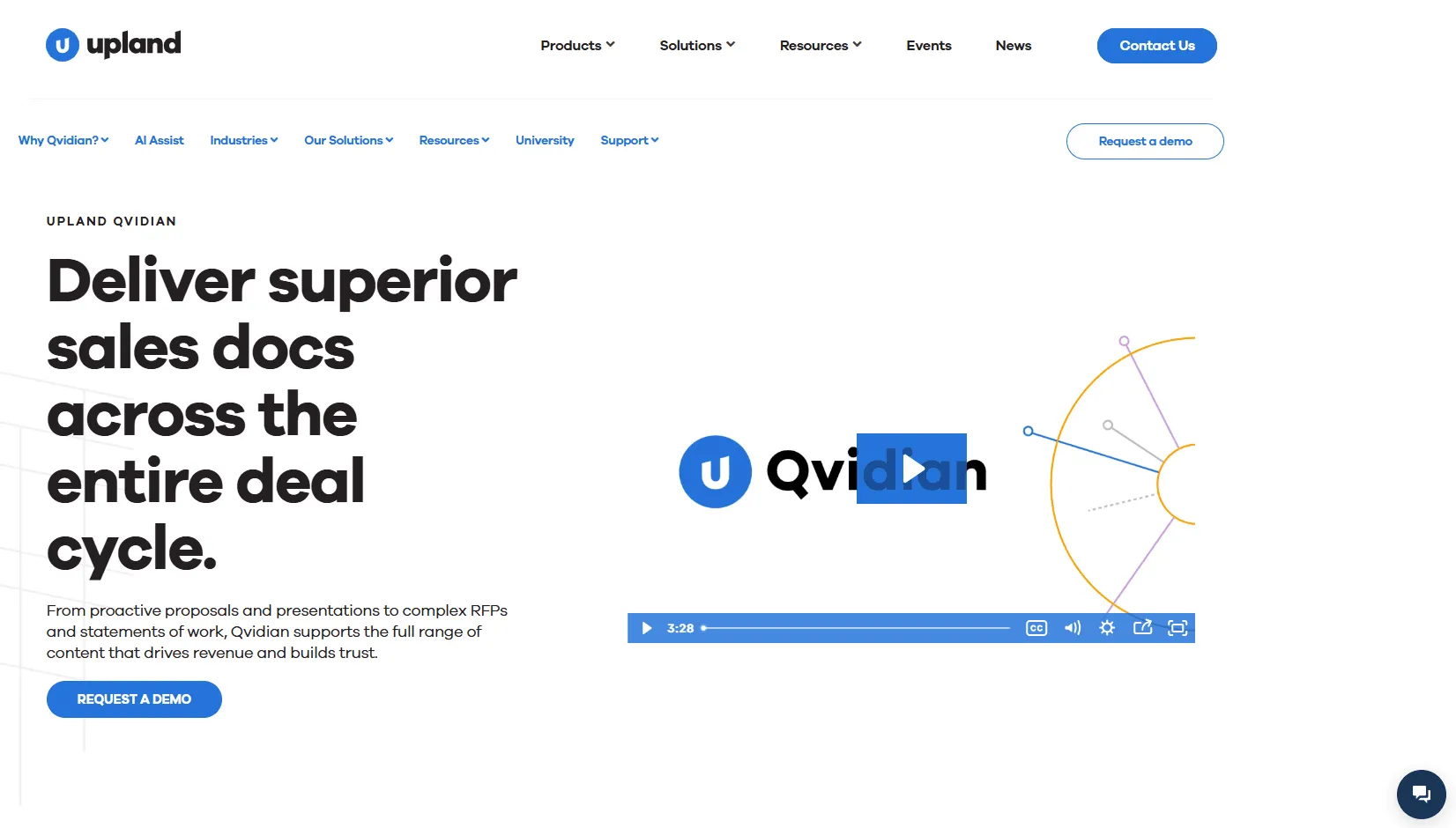
Qvidian is the legacy heavyweight in this list. It is still built for enterprise-scale proposal automation, with a strong approved content library, Word and Excel workflows, structured collaboration, and detailed analytics around productivity and win rates.
It is not as AI-native as newer entrants, but it remains relevant for organizations with large content repositories, formal proposal processes, and complex enterprise document requirements.
Key Features
Approved content library: Centralizes response content for reuse across RFPs, RFQs, RFXs, DDQs, and security questionnaires.
Office-centric workflows: Strong support for Word templates, Excel questionnaires, and formatted document automation.
Qvidian analytics: Tracks productivity, trends, content usage, and win-related performance metrics.
Pricing
- Qvidian’s pricing isn’t publicly listed, so you’ll need to contact Upland’s sales team for a quote.
Where Qvidian Shines
Built for document-heavy enterprise teams: It is well suited to formal proposal environments with strict formatting needs.
Strong content governance: Search, libraries, and controlled content reuse remain core strengths.
Where Qvidian Falls Short
Interface can feel dated: Review summaries repeatedly point to an older UI.
Search can feel quirky or slow: Some reviewers say finding the right answer takes more effort than it should.
Implementation can be heavy: External review roundups describe adoption as more rigid than modern tools.
Library maintenance is still a burden: Like other library-first tools, long-term content upkeep remains a real workload.
Customer Reviews
A verified reviewer shared, “The search function in the library is amazing. Qvidian Advanced Search makes it very easy and efficient to find specific content for specific products for our RFPs.”
Kartikk M., Senior Manager, Sales Operations, shared, “A lot of human intervention is needed to fully utilise all the features and functionality of this tool.”
Who Qvidian Is Best For
Large enterprises with mature proposal operations: Best for teams that already run formal, document-heavy response processes.
Teams that depend on Office-based outputs: A strong fit when Word templates, Excel questionnaires, and formatting control matter a lot.
6. Proposify
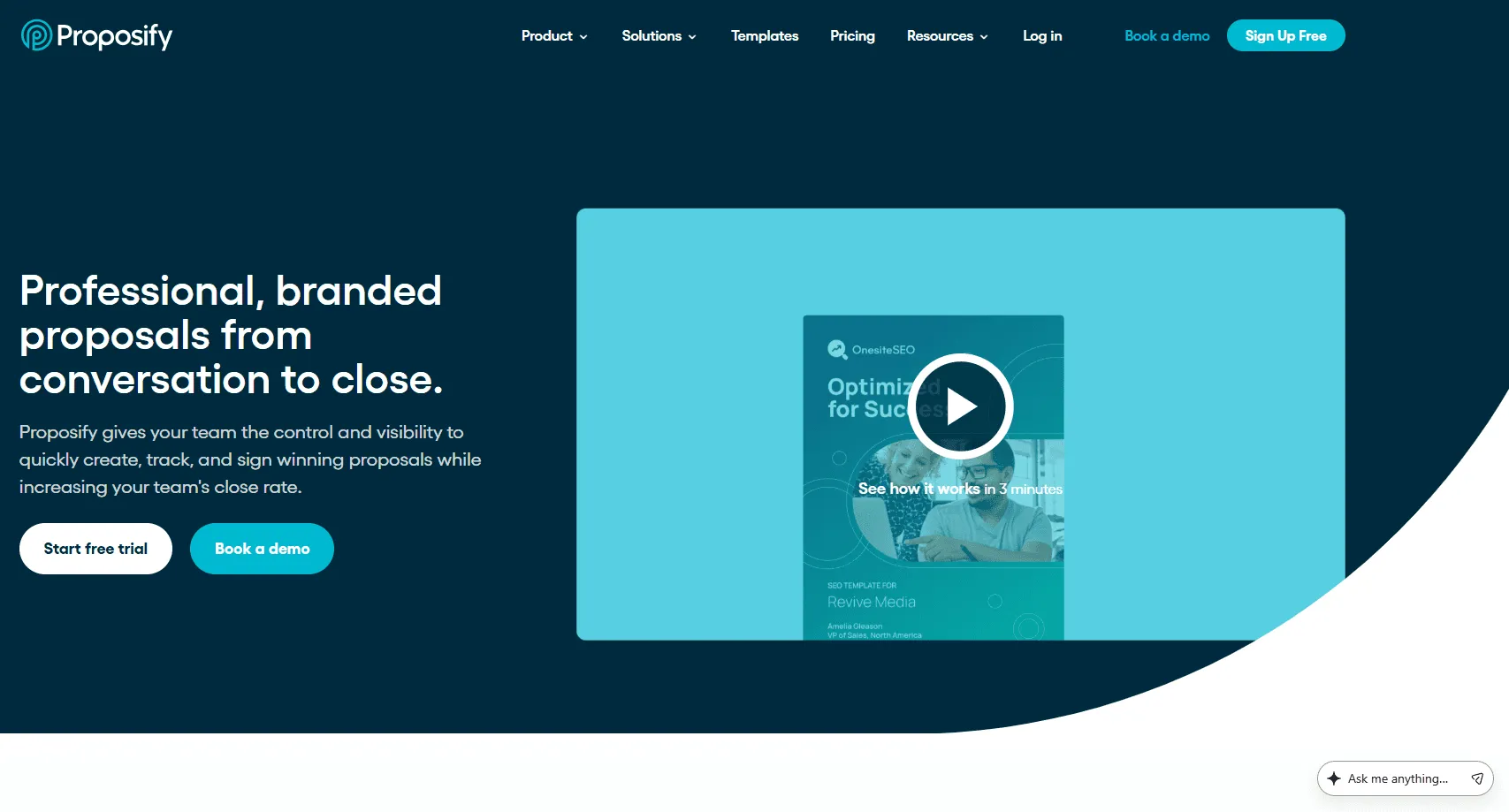
Proposify is more focused on proposal creation and deal execution than full RFP automation, but it still fits into this category for teams handling lighter or less structured RFP workflows.
It allows users to create visually polished proposals, manage reusable content, and track engagement from prospects, which helps sales teams move faster from proposal to close.
While it lacks deeper questionnaire automation and requirements analysis, it is useful for organizations where proposals are more narrative-driven and client-facing, rather than compliance-heavy or questionnaire-based.
7. PandaDoc
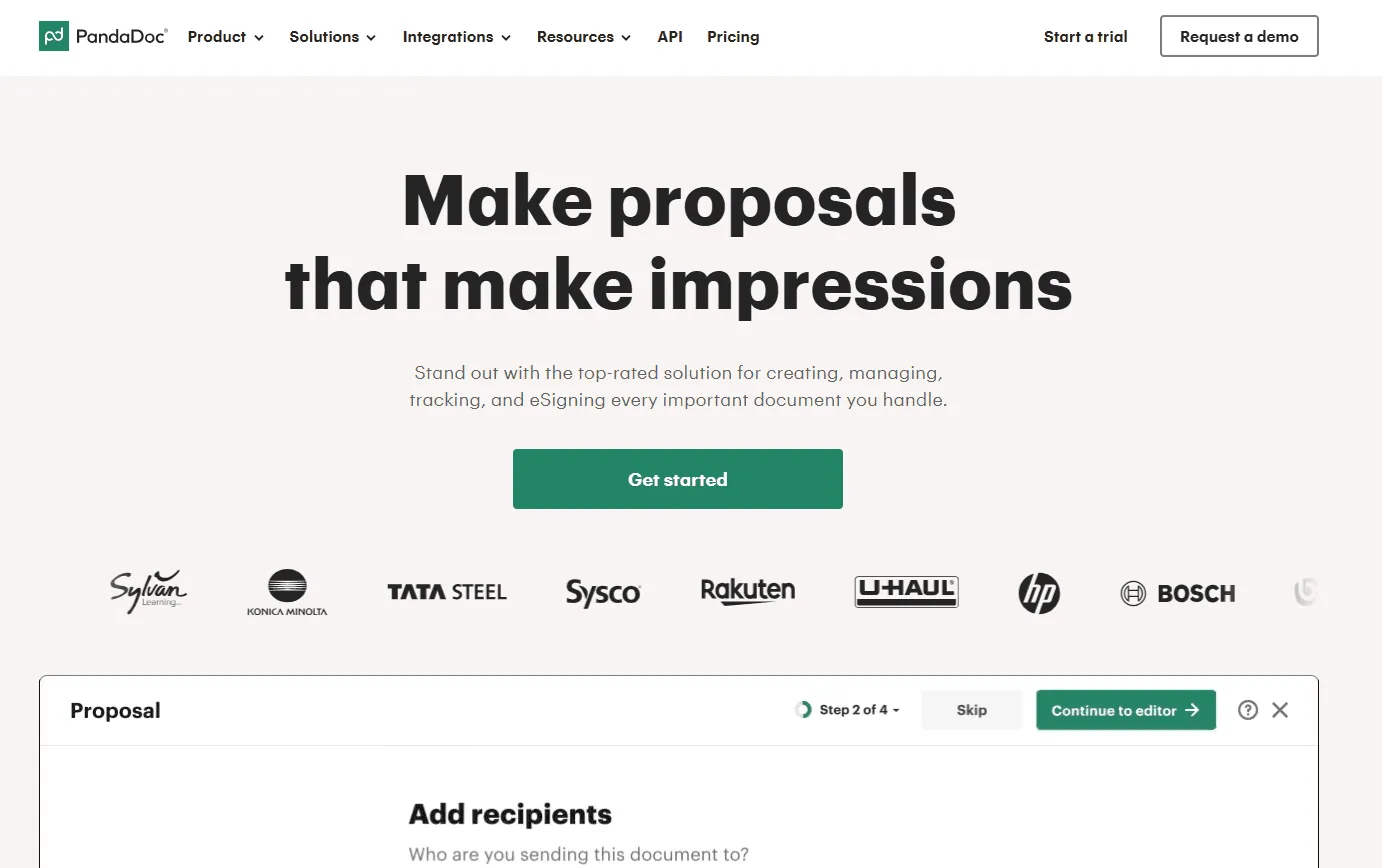
PandaDoc is a document automation platform that supports proposal creation, approvals, e-signatures, and payment collection in one system. It is often used by sales teams that want to streamline the entire document lifecycle rather than focus specifically on RFP responses.
For simpler RFP workflows or client proposals, it can be effective because it combines templates, content reuse, and tracking in one place.
However, for complex RFPs with multiple stakeholders, structured questionnaires, and detailed compliance requirements, it is more of a supporting tool than a primary RFP response platform.
8. AutogenAI
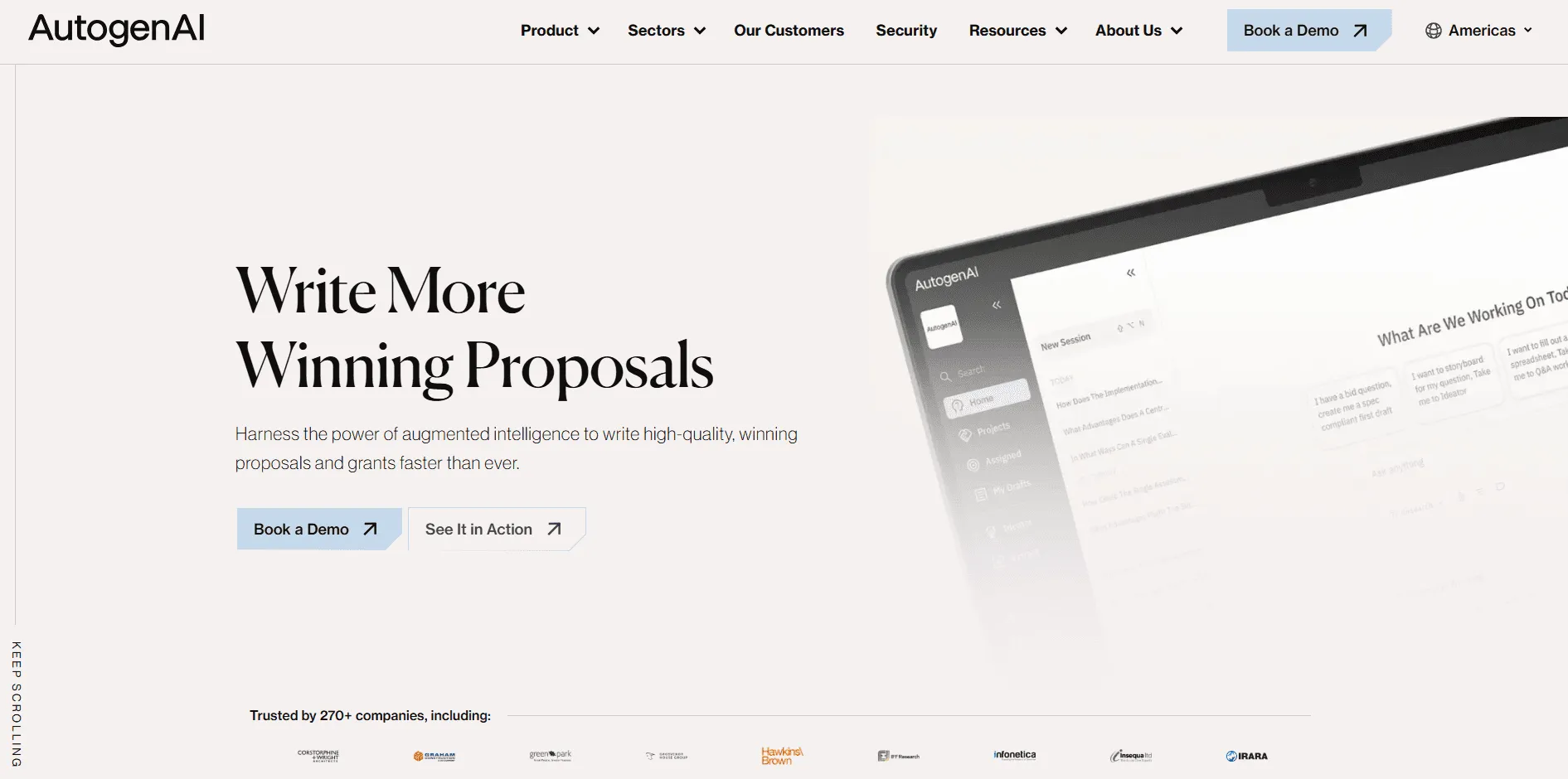
AutogenAI is an AI-first proposal writing platform designed to help teams generate high-quality, compliant responses quickly. It is particularly strong in environments where writing quality, clarity, and alignment with requirements are critical, such as public sector bids and formal tenders.
The platform focuses on transforming requirements into structured drafts and improving narrative strength rather than relying heavily on traditional content libraries. This makes it a good option for teams that want more than just answer reuse and instead need AI to support persuasive, well-structured proposal writing at scale.
9. Arphie
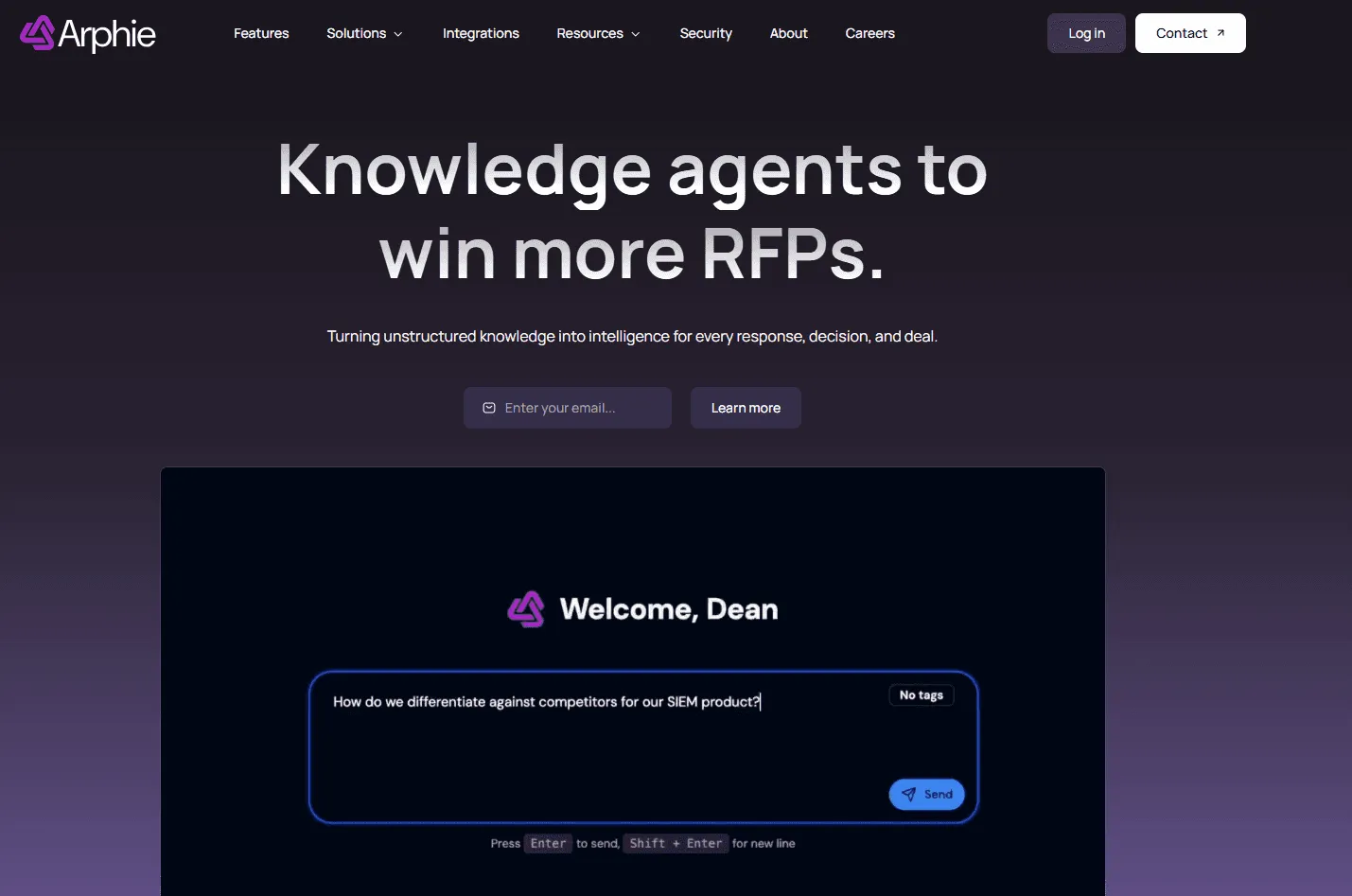
Arphie is a newer AI-native platform built specifically for RFPs, DDQs, and security questionnaires, with a strong emphasis on accuracy, traceability, and source-based responses. Instead of relying purely on generative output, it focuses on grounding answers in approved internal data, which makes it especially relevant for regulated industries and high-stakes deals.
It also supports structured workflows and collaboration, helping teams respond faster without losing control over content quality. While still growing in market presence, it stands out for teams that want both AI speed and confidence in the answers they submit.
Reasons to Consider an Alternative to 1up RFP
Here’s how to choose the right alternative to 1up RFP:
1. No Automated Stale Content Detection
1up RFP does not automatically flag outdated content in your library. That creates a real risk of pulling old answers, policies, or product details into live submissions. When your team is moving fast, manually checking every response is not always realistic.
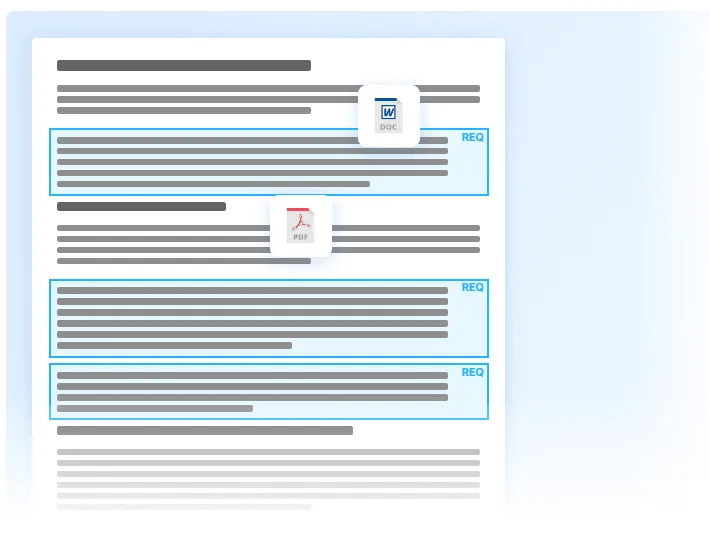
AutoRFP.ai helps reduce that risk by letting teams import Word files and PDFs, then export responses back into the customer’s original format or into branded templates, so content stays easier to manage in real workflows.
2. Not a True End-to-End Response Workflow
1up can help generate answers, but the workflow often stops there. Teams still need extra effort to rewrite, polish, simplify, and prepare responses for final submission. That can slow down reviews and create more manual work for SMEs and editors.
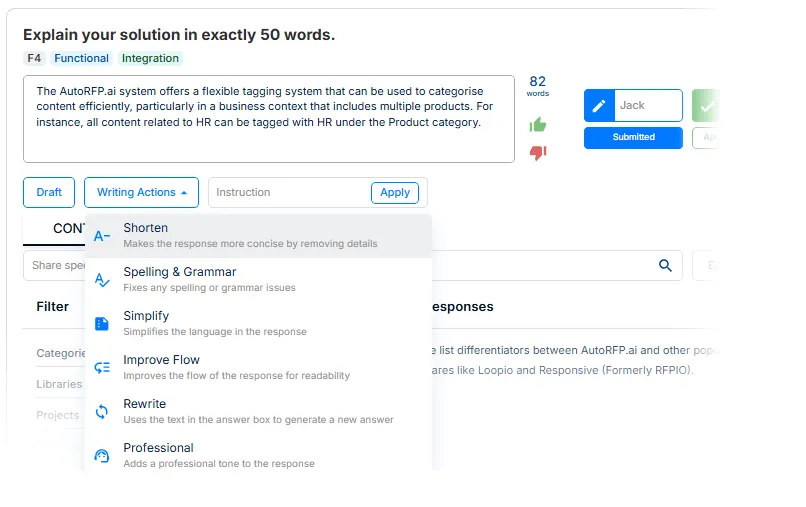
AutoRFP.ai supports a more complete workflow with one-click AI edits, grammar and spelling fixes, custom prompts, and response generation in any language, while also avoiding per-seat pricing for larger teams.
3. Lack of Scalability and Advanced Workflow Features
1up is not always the best fit for large, complex RFP operations. Teams handling high submission volumes usually need stronger controls, clearer permissions, better reporting, and enterprise-grade security.
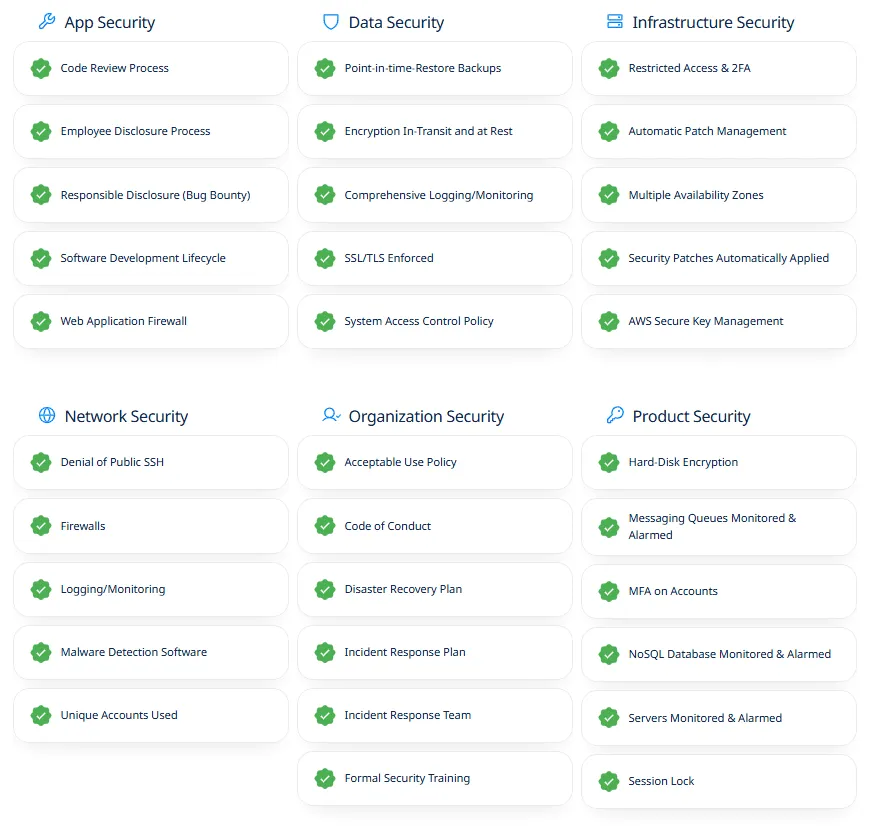
AutoRFP.ai is better suited for scale, with SOC 2 Type II and ISO 27001 certifications, audit trails, SSO, advanced permissions, and analytics for teams managing large RFP volumes.
4. High Initial Setup Effort
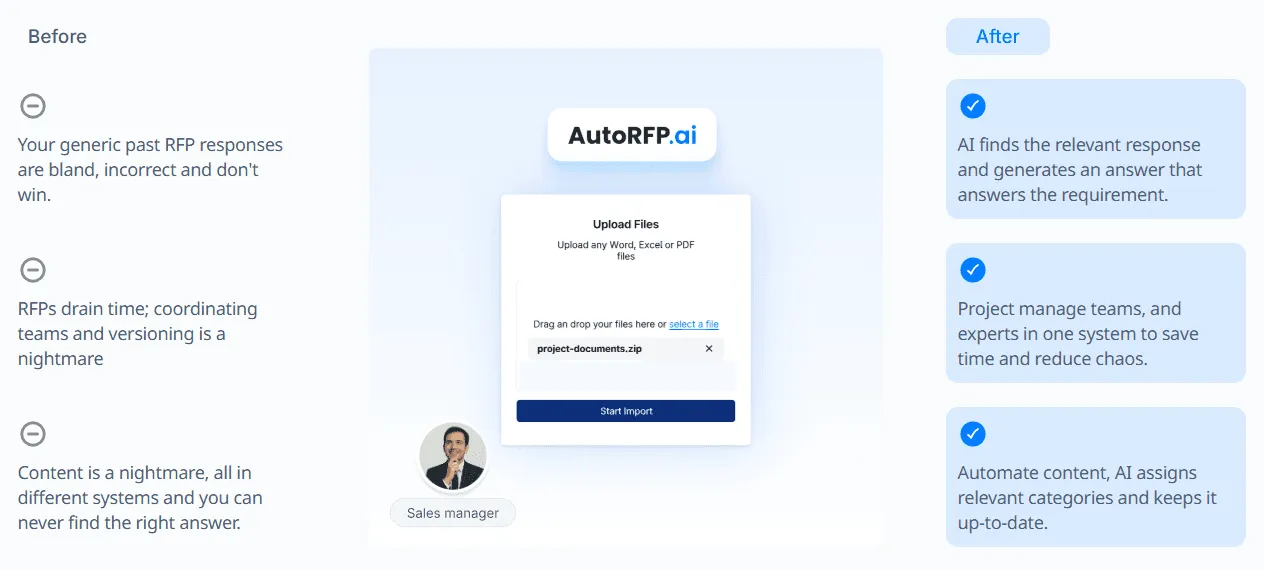
1up often requires significant time upfront to build and maintain the content library before teams get consistent value from it. That setup burden can slow adoption.
AutoRFP.ai takes a lighter-maintenance approach with a self-updating system that learns from approved responses, helping teams stay current without needing constant manual library management.
5. Limited Reporting And ROI Visibility
1up’s reporting is relatively limited for teams that need to prove impact, justify spend, and show leadership that AI is actually paying for itself. It is not enough to generate answers faster if you cannot clearly show where automation is saving time, reducing manual work, and freeing the team to focus on higher-value tasks.
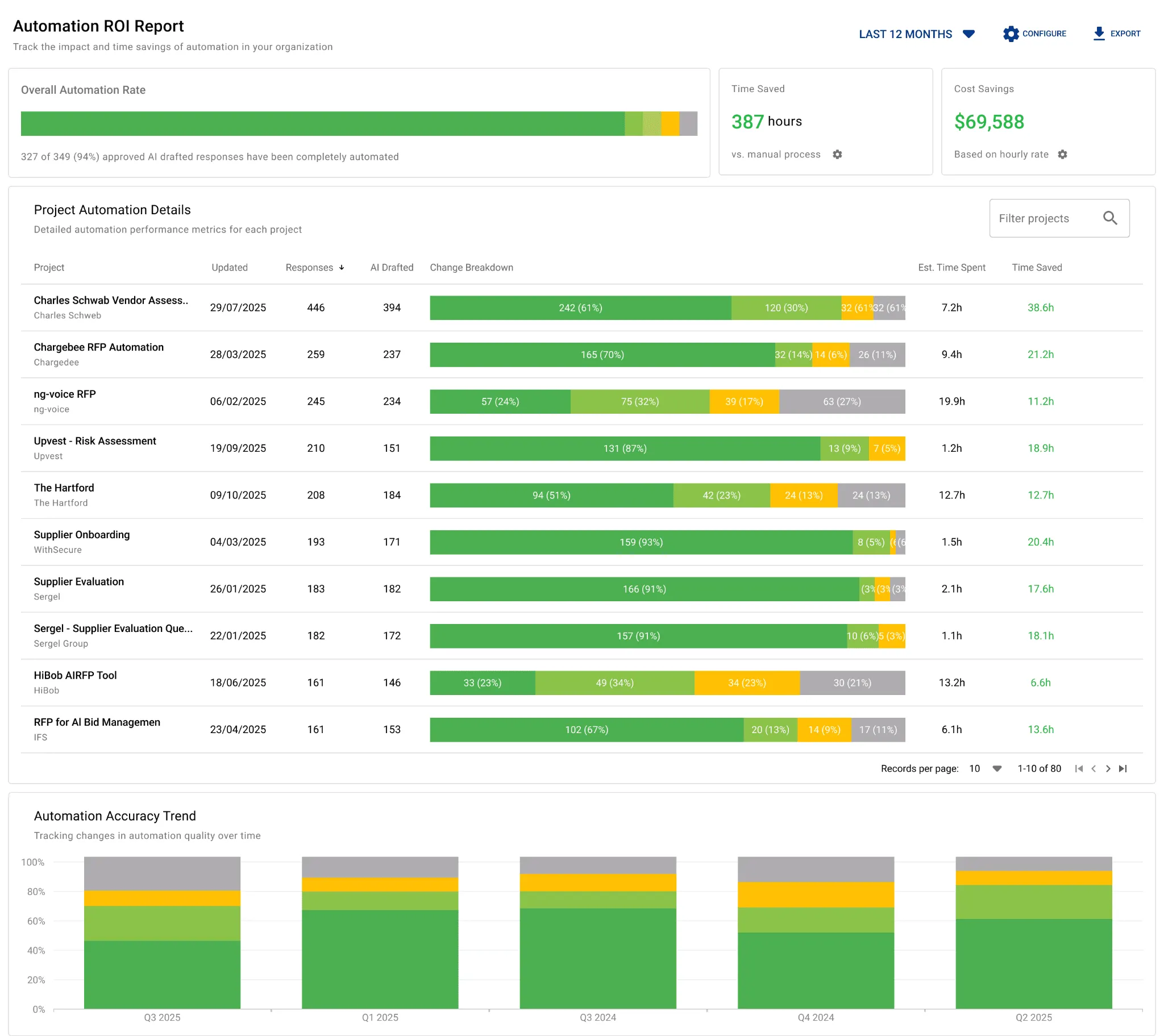
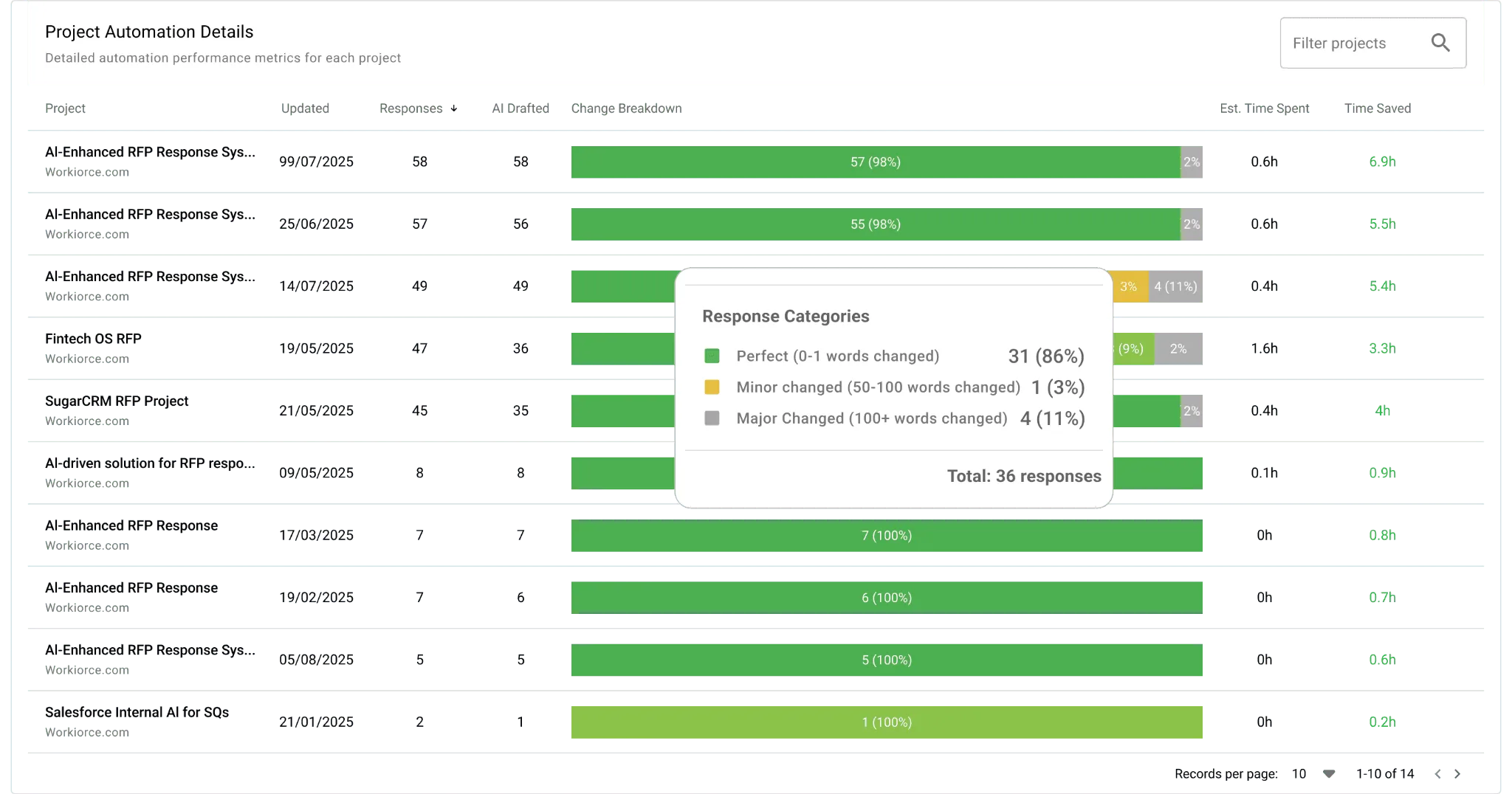
AutoRFP.ai does this well with ROI reporting that automatically tracks automation rate, cost savings, team efficiency, capacity freed by person, response type breakdowns, and quarterly accuracy trends across completed projects. That gives teams the data they need to prove real return on investment, not just talk about speed.
6. No Clear Visibility Into What Is Costing You Deals
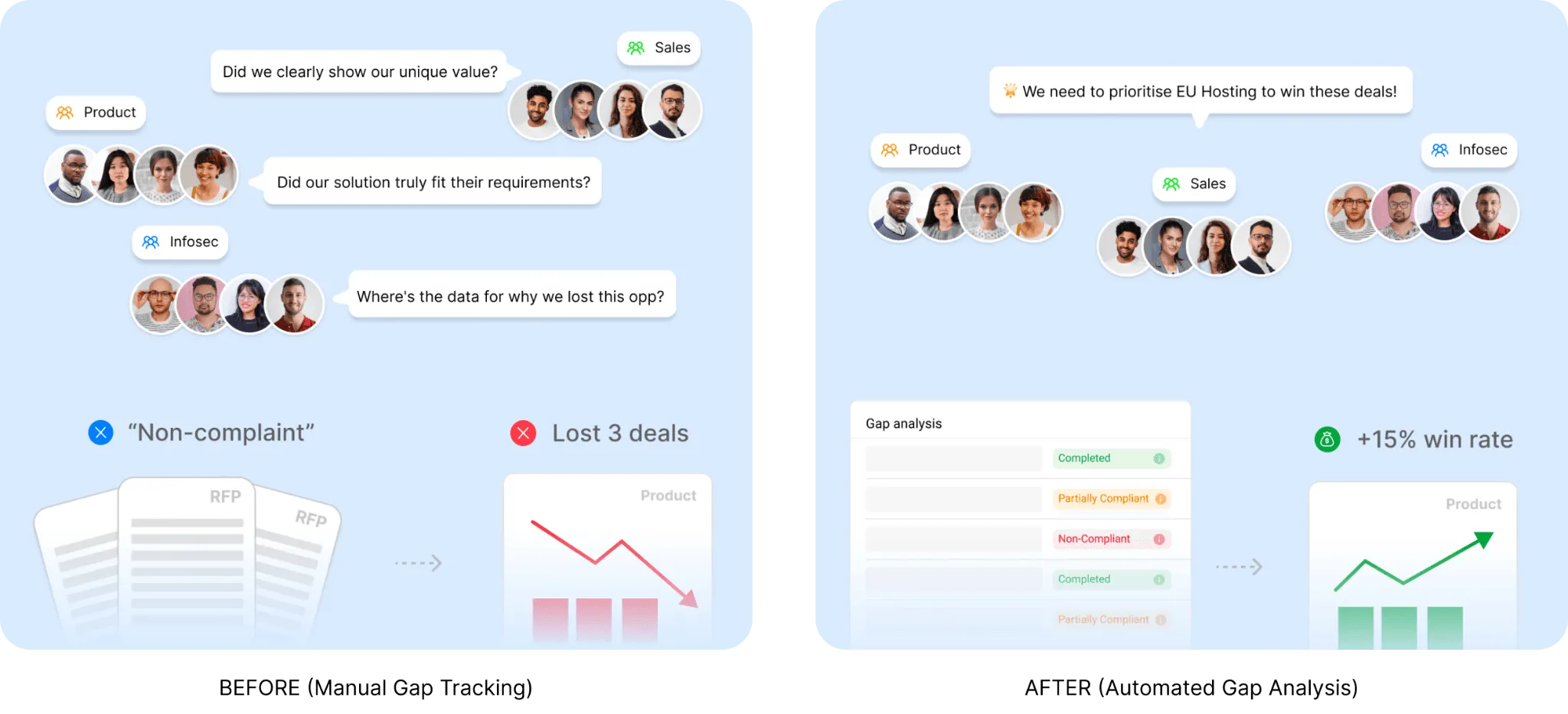
Winning more deals is not only about responding faster. Teams also need to understand which gaps, weak answers, or compliance issues are hurting performance across past submissions. Without that visibility, it is harder to improve future responses in a meaningful way.
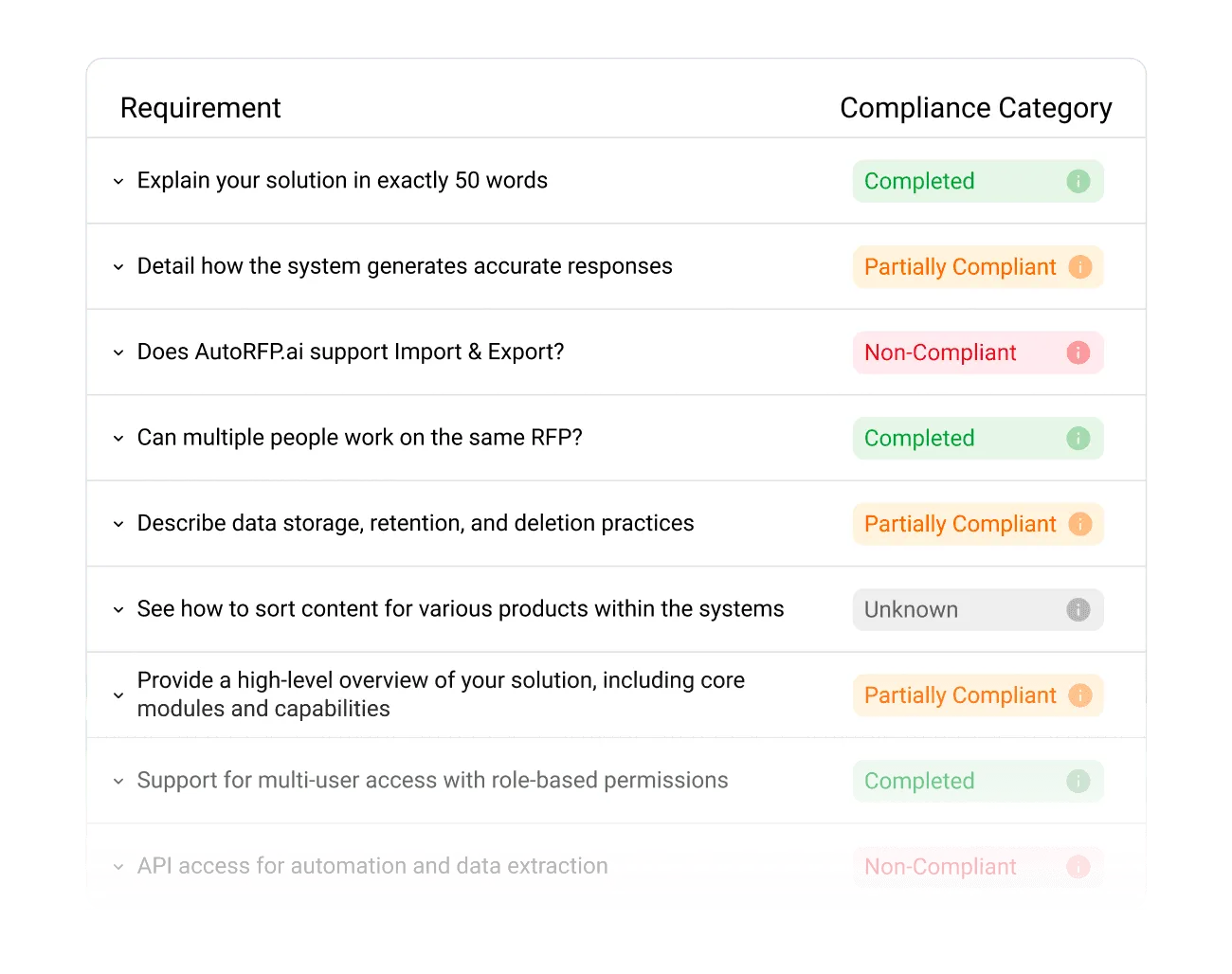
AutoRFP.ai helps here by tracking compliance answers across the team’s response history, with owner-reviewed tags rather than a blank-slate tagging project. That makes it easier to spot patterns, understand what is blocking deals, and turn those insights into stronger responses, better product priorities, and smarter bid decisions.
Automate Your RFP Responses and Win More Deals with AutoRFP.ai
Winning more deals is not just about answering faster. It is about turning complex RFPs, DDQs, and security questionnaires into accurate, polished submissions without draining your team.
AutoRFP.ai helps you move from intake to final draft with stronger requirement extraction, cleaner workflows, and less manual rework, so your team can focus on strategy instead of admin.
Book Demo today and see how AutoRFP.ai can help you respond faster, stay in control, and close more opportunities.
About the author

Co-founder & CEO
Co-founder and CEO of AutoRFP.ai. Spent 7 years running global RFPs and personally completed 500+ RFPs before founding the company.
LinkedIn
