5 Best SiftHub Alternatives: Industry Expert's Top Picks
The top SiftHub alternatives include AutoRFP.ai, Loopio, and Responsive, compared on citation tracking, enterprise controls, pricing, and response volume.

Co-founder & CEO, AutoRFP.ai·Updated ·22 min read
SiftHub is one of several AI-powered platforms helping teams manage customer questions and internal knowledge, but it is not the only option available.
Depending on your priorities, you may need a platform with stronger RFP automation, deeper security questionnaire support, better content governance, or more advanced enterprise workflows.
We evaluated five SiftHub alternatives to show how each tool compares and which types of organizations they are best suited for.
5 Best SiftHub Alternatives: At a Glance
| Name | Best for | Standout feature | Price starting point |
|---|---|---|---|
| AutoRFP.ai | Teams that need governed RFP, DDQ, and security questionnaire automation | Source-grounded responses with citations, Trust Scores, Portal Agent, Automation Reporting, and a self-maintaining library | $899/month |
| Loopio | Established proposal teams with dedicated content managers | Mature content Library with AI-assisted responses and structured review workflows | From $20,000/year |
| Responsive | Enterprise teams managing high-volume response operations | Advanced project management, reporting, governance, and AI response workflows | From $10,000/year |
| AutogenAI | Teams creating complex, narrative-heavy proposals | Proposal-specific AI writing, Source Finder, and bid-review workflows | Contact sales |
| 1up | Lean teams needing lightweight RFP and knowledge automation | Company knowledge answers across Slack, Teams, browser, and questionnaires | Free; Starter $300/month |
1. AutoRFP.ai: Best for Accurate, Governed RFP Response Automation
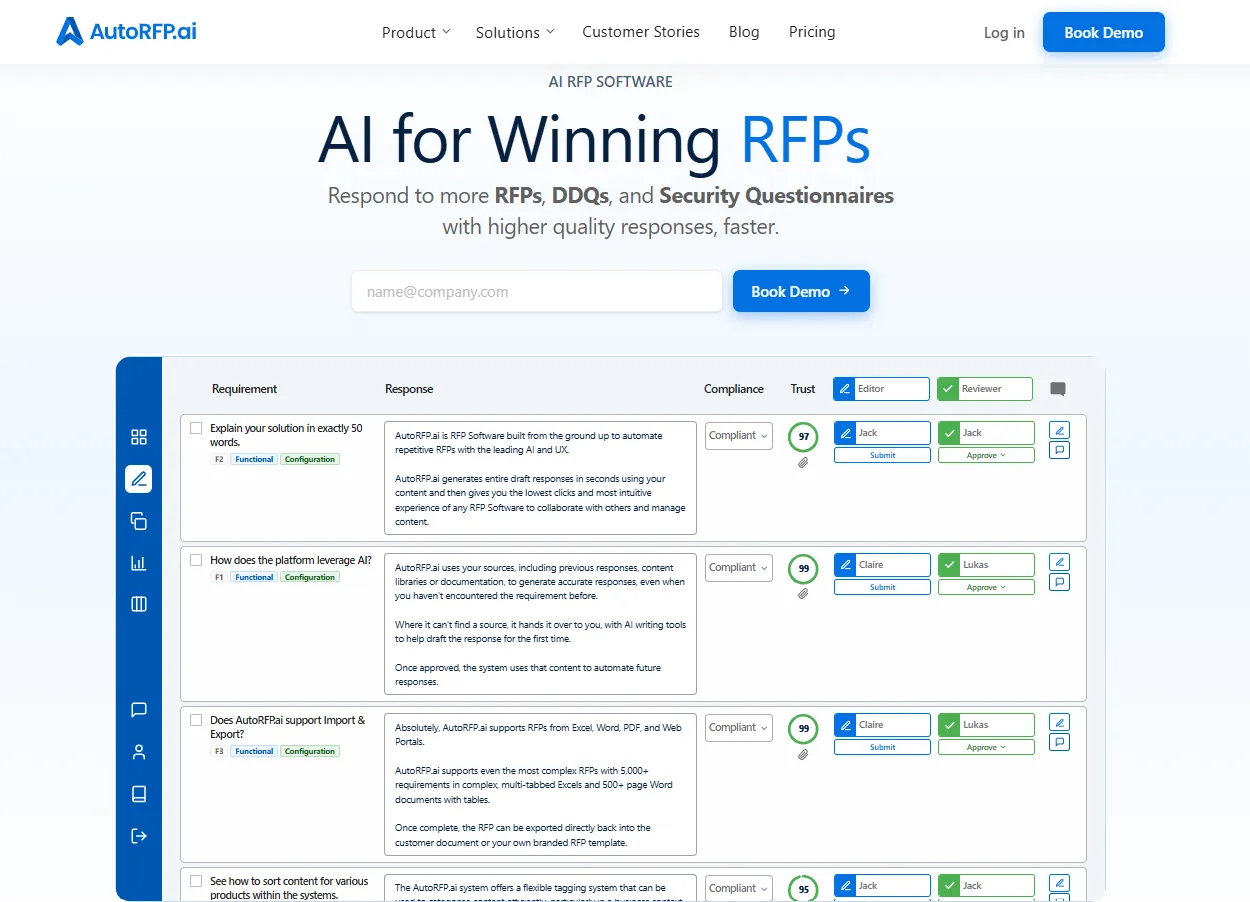
SiftHub buyers who want accuracy-first drafting use AutoRFP.ai for RFPs, security questionnaires, and DDQs. Each answer stays source-grounded and citable, while owners keep library review.
Compared with SiftHub, the main difference is the depth of response governance. SiftHub combines RFP automation with broader presales workflows, helping revenue teams connect customer questions with deal context and sales processes.
AutoRFP.ai focuses on making every response traceable, reviewable, and defensible, giving proposal, security, legal, and technical teams confidence that customer-facing answers are supported by approved company knowledge.
For organizations where RFP responses are reviewed by procurement, InfoSec, compliance, or legal teams, AutoRFP.ai provides a more controlled workflow for generating, validating, approving, and improving responses over time.
Key Features
1. Source-Grounded Response Generation With Trust Scores
AutoRFP.ai is built for zero hallucination by design, generating responses from approved company knowledge instead of relying on generic AI-generated text. The platform searches connected sources, identifies relevant information, and creates first drafts based on existing company documentation, previous responses, and approved materials.
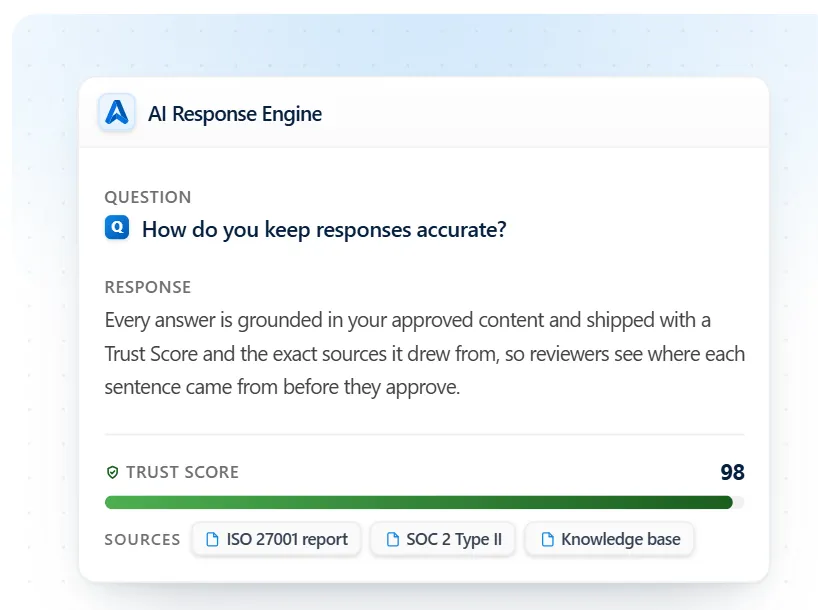
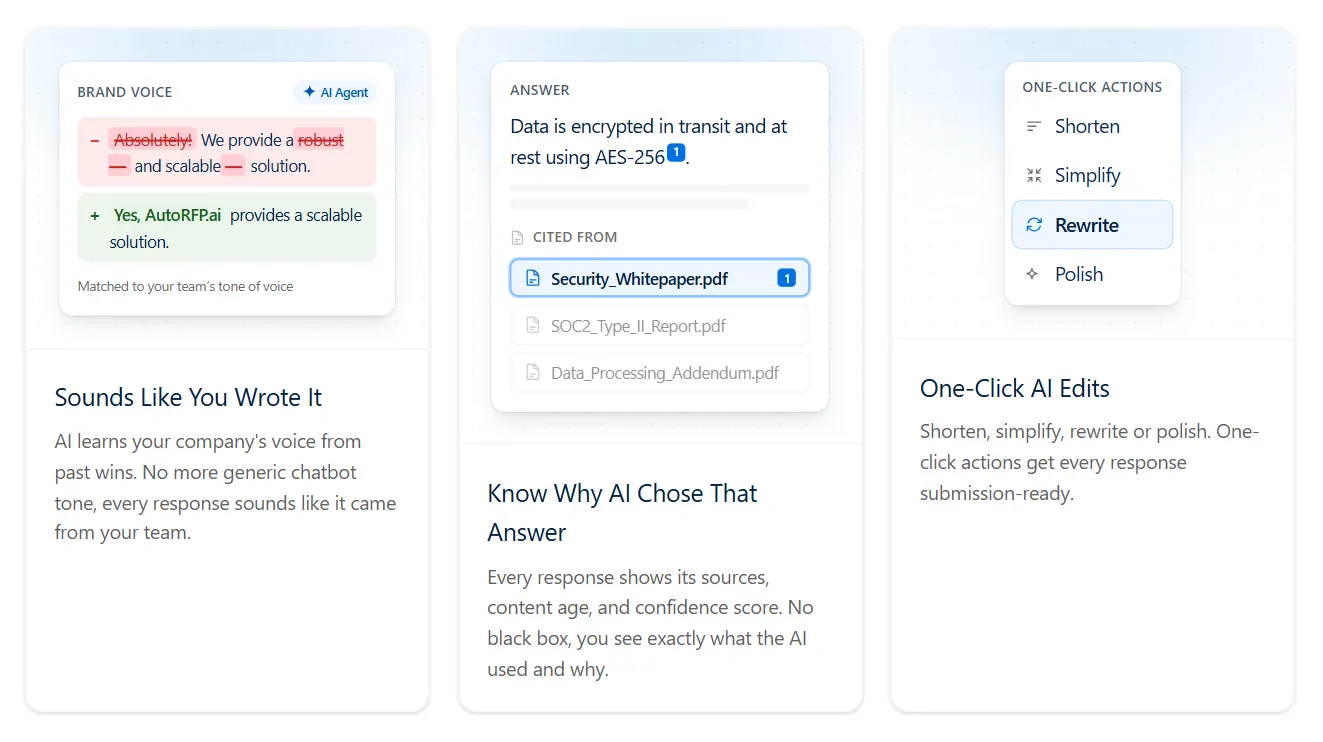
Each answer includes supporting sources and a Trust Score, allowing reviewers to understand the evidence behind the response before approving it. This helps teams reduce the risk of unsupported claims appearing in customer submissions while allowing SMEs to focus their time on validating complex or sensitive answers.
When the platform cannot find enough reliable information, AutoRFP.ai does not force a response. Instead, unsupported questions can be escalated for human input, creating a clearer separation between AI-assisted drafting and expert decision-making.


Video transcript
AutoRFP.ai is like having a team member that never sleeps. We've responded to more than double the number of RFPs after implementing AutoRFP.ai than we did the year before. I'll look back on 2025, we'd saved something like 949 hours. It was mind-blowing. Oh my gosh, this can be done automatically. Being able to answer those consistently and accurately puts us in a position to be a trusted vendor for our clients.
Using AutoRFP.ai has definitely helped me increase my closing ratio. Before, we were using Google Drive to store all of our library content and previous responses. It was a very manual process. If the keyword was there, you would find it. If not, then you wouldn't. I would say 60% of the deals that come through in my market are RFP bids.
But as the team was scaling, it quickly became apparent that this wasn't sustainable. I, of course, looked at tools that we had available to us in-house. Became clear that it worked in some ways, but it wasn't built to respond to complex RFPs with multiple questions and moving parts. So what was different about AutoRFP.ai is that we're able to upload multiple documents in all different formats, PDF, Word, Excel, and it will ingest all of those documents and pull out the requirements, even tables within documents instantly.
The Excel sheets just blew our mind because we hadn't seen this anywhere else. As we work in multiple regions, the ability of AutoRFP.ai to translate into multiple languages is really impressive, and it really felt like it was going to be a partnership rather than a transaction. We spend a lot more time now focusing on the strategy for a bid.
The bids are a lot more tailored and a lot more focused on the prospect in a way that we couldn't do before. The quality of our output is just completely different. Do you feel like it's gonna blow their mind because they're like, "Oh, you've said exactly what we needed to hear." Thinking back to that particular deal in Q3, the deadline was coming up.
Having missed the deadline would have meant for me not hitting my quarter, but I also didn't wanna let down my team. Having a bank of information of answers that I could trust really allowed me to just push everything out as quickly as possible, knowing that what I was saying was accurate and true.
Trusting that when that is submitted, more than 50% of the job is done, and I'm really excited to say that, yes, we did win the deal, made me look like a hero, so thank you. We've been able to respond to 20 to 30% more RFPs quarter on quarter. We've been able to increase the capacity of the team. We've saved 45% of the time it would've taken us to respond to the same number of RFPs.
Our shortlist rate has been outstanding, and it just gets better and better I would say don't wait until volumes spike and quality starts to drop. Every bid that your team submits manually is costing you more than you think, not just in hours, but in quality and consistency There's absolutely no way we would want to go back to the previous way AutoRFP.ai is like having a team member that never sleeps, keeps getting smarter, and allows my team to focus on the stuff that they're really good at
2. AI-Native Knowledge Management With a Library That Stays Current
Traditional RFP platforms often depend on teams continuously maintaining a centralized answer library. AutoRFP.ai takes a different approach by connecting directly with existing company knowledge sources, allowing teams to use the information they already maintain across the organization.
The platform can connect with systems such as SharePoint, Confluence, Google Drive, OneDrive, Notion, Box, and other knowledge repositories to retrieve relevant information during response creation.
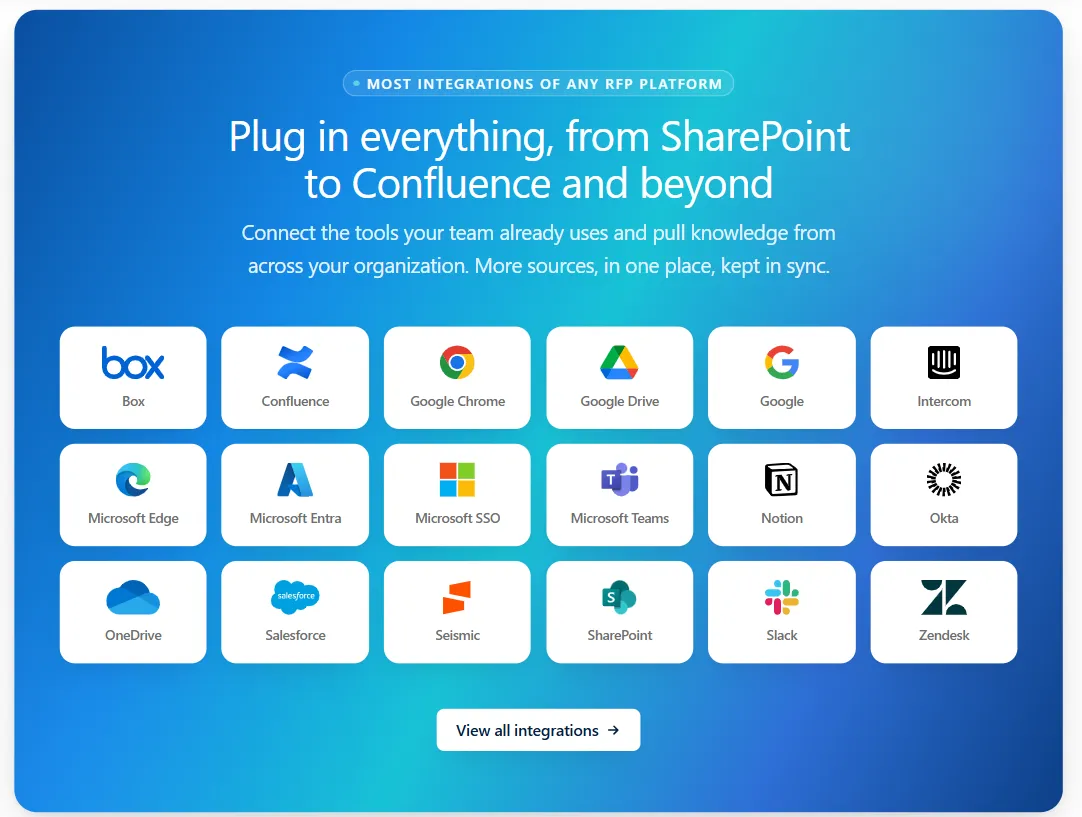
This reduces the operational burden of manually updating thousands of Q&A entries whenever products, policies, security controls, or company information changes.
For teams managing frequent RFPs and questionnaires, this means less time spent maintaining content libraries and more time improving response quality and business readiness.
3. Complex Document Processing and Portal-Based Response Automation
Enterprise buyers rarely send simple questionnaires. Responses often involve complex Excel workbooks, Word templates, PDFs, and browser-based procurement or security portals that require careful formatting and completion.
AutoRFP.ai can process these different formats, identify requirements, generate responses, and return completed answers while preserving the buyer’s original document structure.
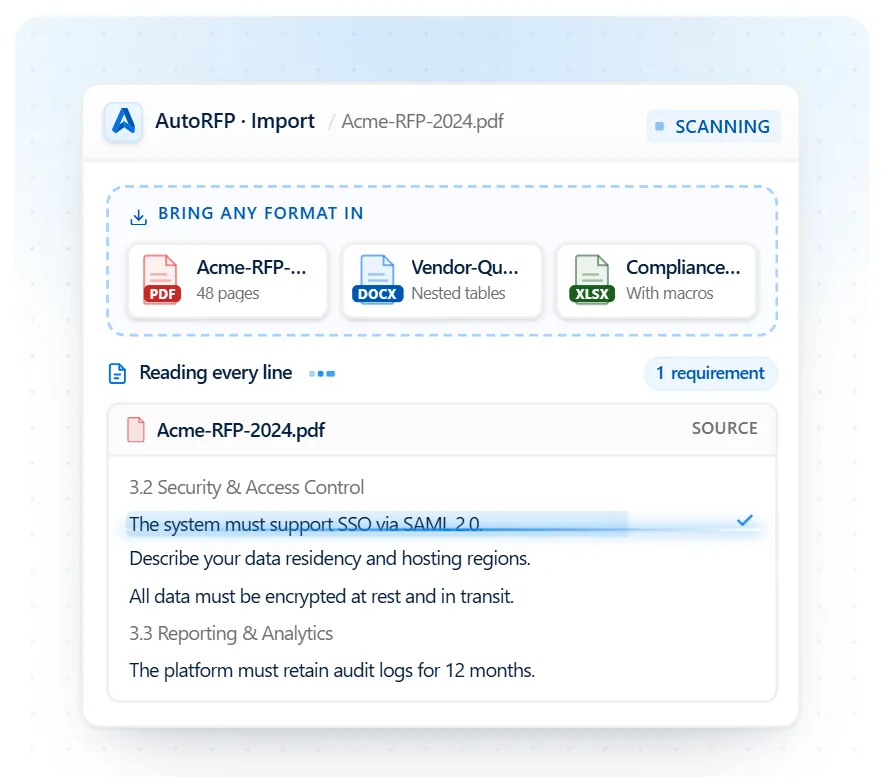
This helps teams avoid spending additional hours manually rebuilding submissions after the AI drafting process is complete.
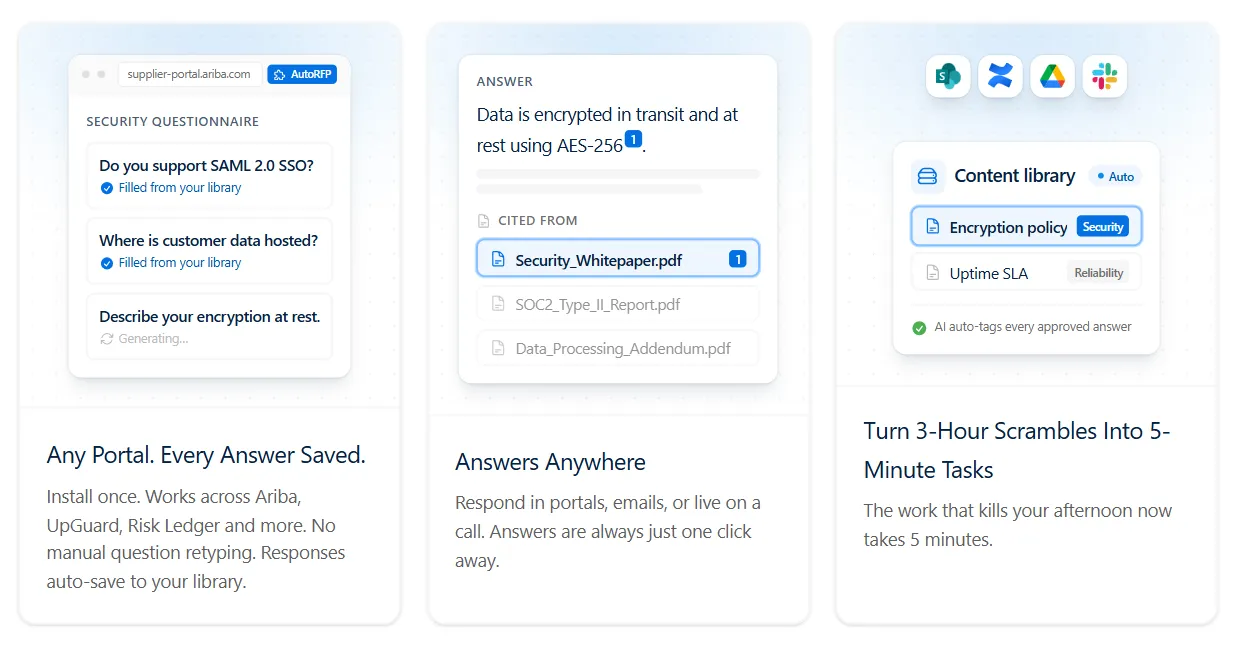
Its Portal Agent extends automation into browser-based workflows by helping teams capture questions, generate responses from approved knowledge, and complete external questionnaires more efficiently.
4. Automation Reporting and Response Performance Measurement
Many AI platforms focus on generating answers, but fewer help teams understand whether those answers actually improve the response process. AutoRFP.ai provides Automation Reporting that measures what happens after AI-generated responses go through human review.
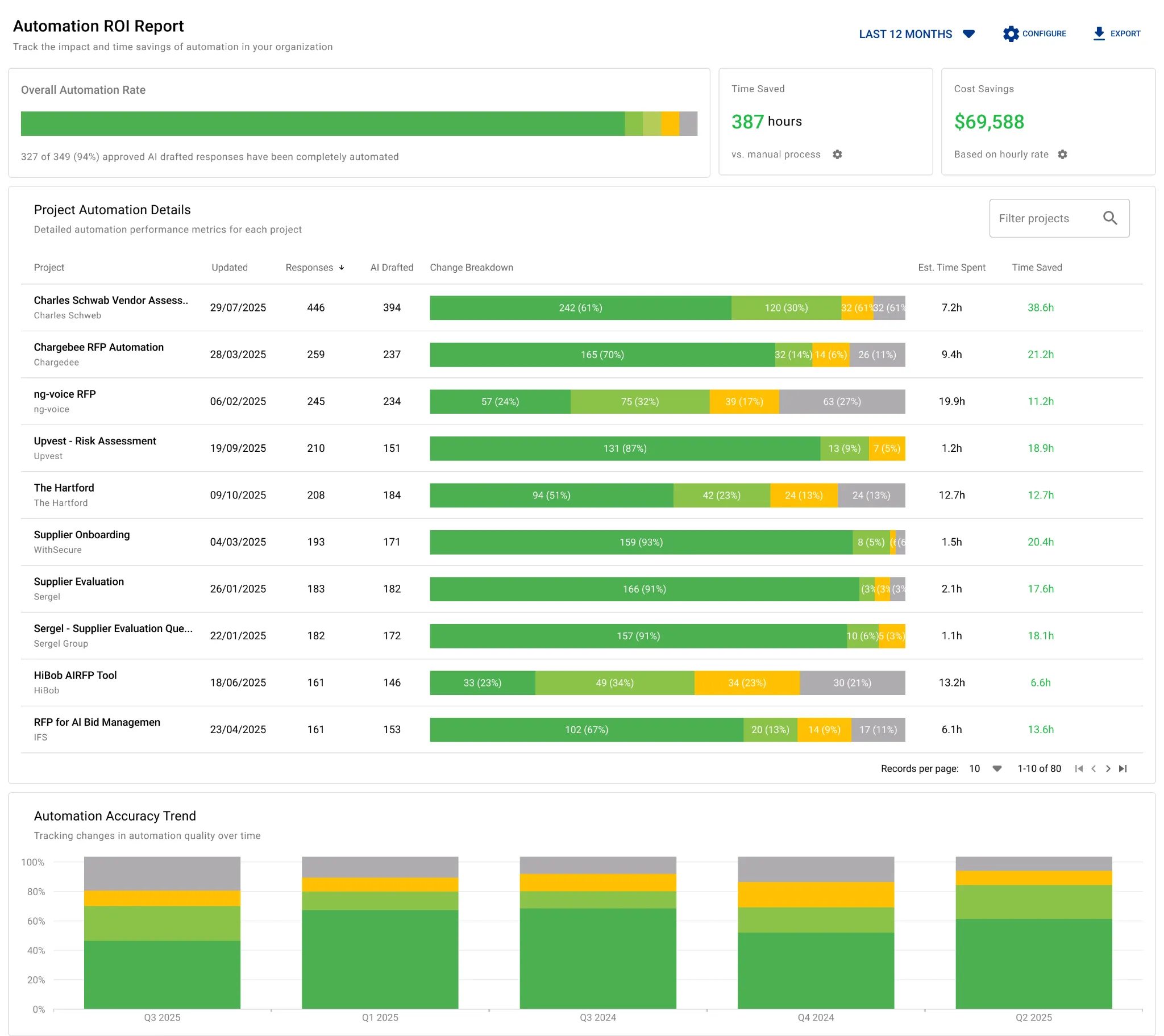
Teams can see which answers were accepted without changes, which required minor or major edits, and which needed manual completion. This gives proposal leaders measurable insight into where automation is creating value and where additional knowledge, documentation, or SME involvement is needed.
Over time, these insights help organizations improve their response strategy instead of simply increasing the number of AI-generated drafts.
5. Gap Analysis and Continuous Response Improvement
AutoRFP.ai helps teams identify recurring weaknesses across their RFP and questionnaire workflows. Instead of treating every submission as a standalone project, organizations can analyze patterns across responses to understand where gaps repeatedly appear.
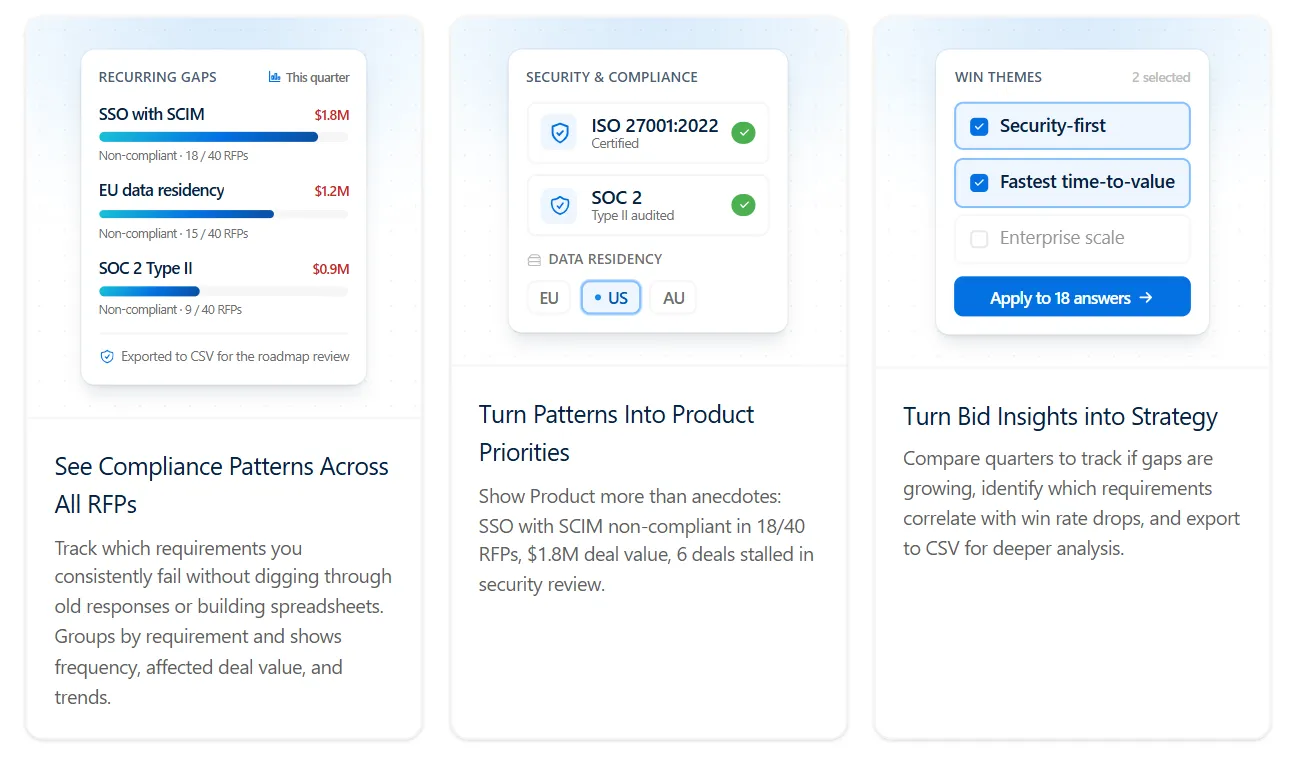
Teams can identify requirements that frequently require manual answers, missing documentation that slows submissions, or technical questions that consistently require additional SME input. These insights help organizations improve internal readiness and strengthen the information available for future opportunities.
For growing teams, this turns RFP automation into a continuous improvement process rather than only a faster way to complete individual responses.
6. Cross-Functional Collaboration and Enterprise Governance
Complex RFPs require input from multiple departments, including sales, solutions engineering, security, legal, compliance, product, and operations. AutoRFP.ai provides a shared workflow where these contributors can review responses, provide feedback, and approve content without managing disconnected documents and email threads.
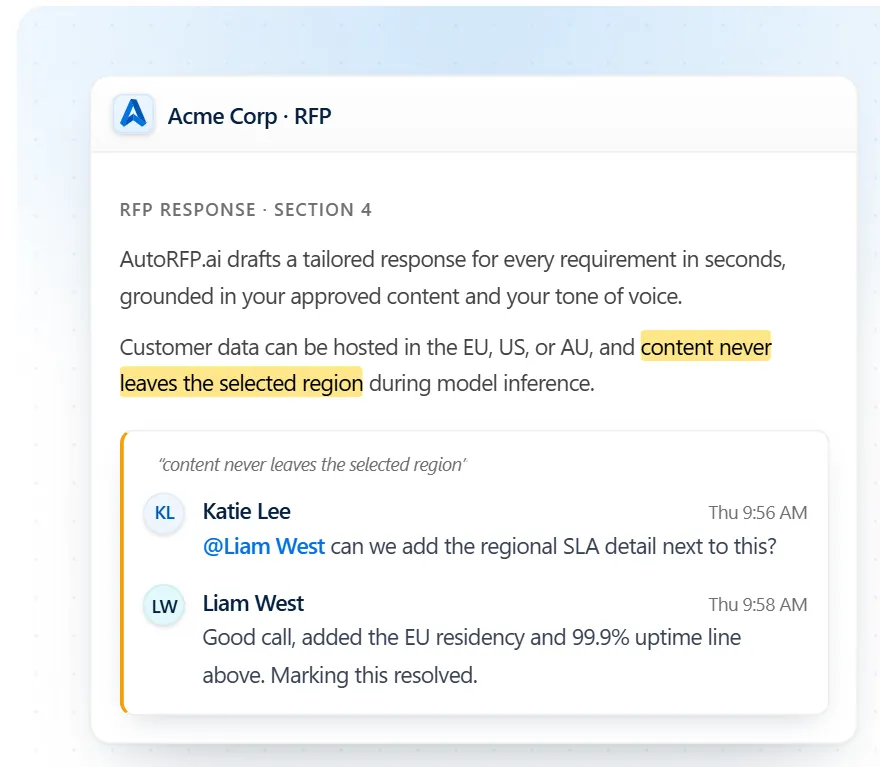
Teams can assign requirements to specific reviewers, track approval stages, maintain version history, and preserve an audit trail of response decisions. This creates stronger accountability and makes it easier to understand who reviewed critical answers before submission.
For organizations handling high-value enterprise deals, these governance controls help balance AI speed with the human oversight required for accurate customer commitments.
Pricing
| Plan | Price | Key Inclusions |
|---|---|---|
| Scale | $899/month (paid yearly) | 24 projects per year, unlimited AI, unlimited content, unlimited users, all features, SSO (Google & Microsoft), 18+ integrations, ISO 27001:2022 and SOC 2, unlimited support, online training |
| Accelerate | $1,299/month (paid yearly) | 50 projects per year, unlimited AI, unlimited content, unlimited users, all features, SSO (Google & Microsoft), 18+ integrations, ISO 27001:2022 and SOC 2, unlimited support, online training |
| Enterprise | Flexible pricing that scales with your business | Scalable projects per year, unlimited AI, unlimited content, unlimited users, all features, SSO (Google & Microsoft), 18+ integrations, ISO 27001:2022 and SOC 2, unlimited support, bespoke implementation, bespoke terms |
Where AutoRFP.ai Shines
Accuracy-focused response workflows: Strong fit for organizations where customer answers need clear evidence and reviewability.
Mixed RFP and questionnaire environments: Supports commercial RFPs, security questionnaires, and DDQs within one governed workflow.
Technical and security-heavy submissions: Helps SMEs validate complex answers without repeatedly drafting the same information.
Large contributor groups: Unlimited users make it easier to involve specialists across departments.
Organizations reducing manual upkeep: Reduces dependence on constantly maintained answer libraries.
Enterprise governance requirements: Supports approvals, audit trails, source visibility, and controlled collaboration.
Where AutoRFP.ai Falls Short
- Creative proposal development: Teams primarily producing long-form narrative proposals may prefer tools focused specifically on proposal writing.
Customer Review
Travis K., General Manager, said: “AutoRFP’s RFP responses are extremely tailored and takes the context of how the question is asked into consideration much more than other systems I have previously used. The company is new and the dev and support team is fast to take into account feedback and updates.”
Elia W., Presales Manager, said: “AutoRFP.ai makes responding to RFPs much faster and easier. It reduces the time spent on manual work by pulling in relevant past responses and structuring them in a clear format. The setup and integration process requires significantly less effort compared to competitors, and once it’s configured with past RFPs and the right company and product content, it streamlines the response workflow significantly. It’s extremely useful for empowering the sales team to generate initial answers to RFPs or security questionnaires themselves, while the presales team can then focus on reviewing and ensuring the AI-generated responses are accurate.”
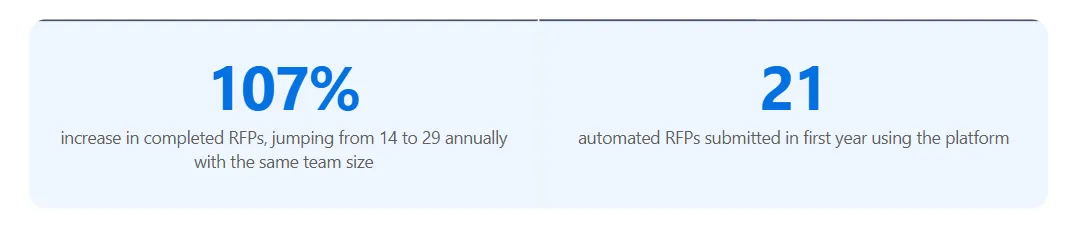
Rachel Millward, Head of Bid Management, Europe at Perk, said: “We’ve responded to more than double the number of RFPs after implementing AutoRFP.ai than we did the year before.”

A Procurement Specialist at a Pacific Northwest Utility Company, said: “The platform significantly reduces the time required for RFPs, particularly for security questionnaires and standard company information.”
Who AutoRFP.ai Is Best For
Enterprise response teams: Organizations managing complex RFPs, DDQs, and security questionnaires.
Security-focused sellers: Companies where customer security reviews are part of the buying process.
Cross-functional teams: Businesses involving sales, technical, legal, compliance, and security stakeholders.
Organizations moving beyond traditional libraries: Teams that want governed AI responses without continuous manual content maintenance.


Video transcript
Did you know the average RFP can take thirty-two hours of manual grueling work? Now, in this video, in under ten minutes, I'm gonna show you how you can use AI RFP automation to drastically reduce the amount of time it takes to get to a first draft for your RFP, DDQ or security questionnaire using AutoRFP.ai. Sick. Let's jump into it. So at AutoRFP, we're an AI RFP software automation platform, across the globe with hundreds of customers using our software every day, battle-tested AI to help you automate RFPs. First, what's the problem? So an RFP or request for proposal or due diligence questionnaire or security questionnaire is a pain felt across all industries, whether it's construction, software, technology, finance, healthcare, anyone selling
to government or private businesses. And these glorified question and answers take hours and hours for people to complete, for them to win new business. It's a crucial part for your business to win enterprise and government contracts, which really help you grow sustainably and quickly. But when you go to bid on one, you are met with the RFP. Average response times are thirty to forty hours, usually involve five to eight people, seventy percent of content is reused but hard to find, and the average win rate across all industries is only forty-three percent. So you're spending hours with uncertainty that you may win, which is where efficiency and writing better responses, leveraging AI helps you win more faster. Now, looking into RFP automation, you have a number of options.
You can pick up a legacy RFP software. They've been around since the late nineties. They brought software to the RFP problem. Effectively, a glorified question and answer bank, like a database. You upload Q&A pairs, and then they try to use keyword matching to find the most relevant to then help you answer questions that you get in your new RFPs and tenders. You can also do AI builds yourself. So you might use ChatGPT or Claude, and you can see our other videos about how you can potentially use them. But effectively, you hit a ceiling where it's hallucinating, it's taking more time now to fix things than it should, and just doesn't have enough context to find the right answer most of the time. Or you can choose an actual AI native leader like AutoRFP.ai. Built from AI from the get go and have built the engine around zero
hallucination, multimodal architecture to leverage the latest models across all your major providers, self-maintaining library approach, so it doesn't take a lot of time to maintain the system, really high automation rates and enterprise security built in from day dot. So why do teams choose AutoRFP.ai? The reason is your knowledge is always current. We integrate with over twenty different systems, and we pull in from all your various file management and different software to make sure that your data is always up to date, and you don't have to maintain it across multiple different places. We're most accurate in the category because we leverage the different models, including specialized re-ranker models, embedding models, search models, and your large language models where they're best. And our team of over fifteen software engineers and AI engineers make sure that this is battle-tested, evals are correct, and it produces the correct answer based off your source context. And it's one platform for every stage of the RFP journey, from intake to new RFP
to AI-powered go/no-go to drafting to reviewing and using agents to review and update your RFP response, translation to collaboration across SMEs and different team members, ensuring that they can easily collaborate in an easy-to-use platform, and then exporting as well. Let's start with the AI native auto library. This is the core of the platform where your different content sources and past projects and up- and web scraping all live in the one place and- Any question that comes up, whether it's in an RFP or a team member asking the question, can be automatically answered with trust-based scores, specific semantic search, and ensures that the correct answer is found and used to then answer and generate an appropriate response. Then effectively, you upload a blank RFP.
The AI-powered response engine then automatically generates responses, translates it and everything to have the correct answers. Then your team can very easily edit, review, integrates with Slack and Teams, and everyone's notified on project deadlines. Now, I've spoken enough. Let's jump into the actual product, and you can see AI RFP automation from the start. We start by creating a project, which is a new RFP. We've got our portal agent that can scrape your requirements from web portals like SAP, Ariba and others, automatically ingesting those answers into your AutoRFP.ai instance, and then automatically drafting responses for you to easily enter back into the portal. Or you can upload a zip that contains a PDF, Excel, Word doc of your RFP and import that into the platform.
First we have our AI go, no-go. This ask different questions of your RFP based on your company context to ensure that should we actually bid on this RFP before we start it. It'll automatically grab out key details and link it to our CRM via our integration with Salesforce and so on. And here it's answered each question, and you can see it has confidence levels, it has trust built in, and you can then look back and see where the original source and what, for instance, table or other information. Our AI importer automatically selects every requirement, child requirements, dropdown pick lists response cells, everything else that's required for that RFP. We can manually change it if needed, but it automatically pulls that in. Then we can choose what content from our library or just choose every content, and our intelligent tagging and hierarchy system will make sure that the most relevant content is used for that response. And then I can create my project.
Next, the AI response engine then automatically starts sourcing the correct content from your auto library, re-ranking and finding the most relevant information, using that to then draft, redraft, and edit responses vi- with AI, and then provide those responses back to you in matter of seconds. And you can see here my thirty or so requirements automatically being filled out across the entire project. It's chosen the relevant pick lists, and each one of these have trust scores that I can understand further where this came from. It also has our AI-powered feedback score, and this is where AutoRFP is different to other systems. We don't wanna just help you source the correct answers. We wanna help you write better responses. And this goes into our feedback loop, where as you use the platform and write better responses, the AutoRFP system learns from those responses, and continually, your responses get better to help you win more faster.
Here we can do inline comments, so I can notify my team and so they can jump in, get notifications. I can submit, approve, add attachments, and everything else I can do in this platform. Finally, we have our project overview, which is our project management HQ for this particular RFP, making sure everyone understands deadlines. You can send reminders out to team members and just know when something needs to be completed by and when completed by and who is completing it, making sure that your RFP response is submitted on time and you're not faced with five PM Friday deadlines, calling someone to make sure you can get the correct answer to the correct question that's our short introduction to AutoRFP.ai. There's a lot more in RFP automation and AI RFP software that you can learn but feel free to reach out to our team. We'd love to provide a detailed demonstration to you so you can understand if this is a good fit for your business Already, AutoRFP.ai is in forty-four-plus countries across the globe with hundreds
of customers across different industries like technology, finance, and healthcare, and our customers are winning more faster. One of our customers like Shana Sweeney from SugarCRM won fifteen of their top twenty-five enterprise customers using AutoRFP.ai. They're using AI RFP automation to win more today, and it's a competitive advantage for their businesses. Our pricing is incredibly transparent. You can find more information on our website, to get in touch with our team, head over to our website, AutoRFP.ai. Book in a demo today and learn more and see if we can help you win more faster.
2. Loopio: Best for Mature Content-Library Workflows
Loopio is an established response-management platform built around a centralized library of approved content. It supports RFPs, RFIs, security questionnaires, DDQs, and sales proposals through structured projects, reusable knowledge, AI-assisted drafting, and SME collaboration.
Compared with SiftHub, Loopio is a stronger fit for organizations that deliberately want a mature, library-led response operation. SiftHub extends further into buyer-specific deal context, calls, battlecards, meeting preparation, and other presales workflows.
Key Features
Automated answers: Generates first-pass responses from approved Library content and connected company sources, with citations and confidence information for reviewers.
Content library: Organizes reusable answers with categories, tags, ownership, permissions, and recurring reviews.
Confidence Pulse: Helps reviewers identify which generated answers require closer attention based on answer quality and supporting evidence.
SmartScan: Detects questions in Word, Excel, and PDF documents and converts them into structured response projects.
Portal workflows: Lets teams capture and respond to questionnaires from browser-based procurement and security portals.
Collaboration: Supports assignments, contributors, deadlines, reviews, and project oversight across response teams.
Pricing
| Plan | Pricing | Notes |
|---|---|---|
| Foundations | From $20,000/year | Includes 10 seats, unlimited projects, unlimited Library entries, generative AI, customizable themes, and standard support. |
| Enhanced | Custom quote | Adds multi-language Library support, confidential projects, multi-step reviews, and additional themes. |
| Enterprise | Custom quote | Adds separate business units, sandboxes, custom seat counts, and premium support. |
Loopio also offers add-ons for translations, onboarding, and industry integrations.
Where Loopio Shines
Established proposal operations: Works particularly well when a company already has dedicated proposal professionals and formal response processes.
Repeatable content reuse: Teams answering similar questions across many submissions can benefit from a mature system for finding and reusing vetted material.
Reviewer prioritization: Confidence signals and citations help SMEs spend more time on questionable answers rather than checking every response equally.
Broad RFx coverage: One platform can support proposal, security, due diligence, and sales-response teams.
Market maturity: Loopio has a large installed customer base and substantial third-party review coverage.
Where Loopio Falls Short
Library maintenance: The quality of the system still depends heavily on keeping the underlying Library organized, reviewed, and current.
Dedicated ownership: Larger deployments benefit from someone taking responsibility for content governance and recurring reviews.
Deal-specific intelligence: SiftHub more directly uses CRM records, call information, and opportunity context to shape material around an active buyer.
Broader presales orchestration: Meeting briefs, sales-to-CS handoffs, battlecards, and other deal-stage workflows sit outside Loopio’s core response-management model.
Entry cost: The Foundations plan begins at $20,000 annually, which may be difficult to justify for smaller or occasional response teams.
Customer Review
A Finance Associate shared on Gartner, “As my team is mostly involved in DDQs and RFPs, Loopio has been fully integrated into our response process, improving team productivity and accuracy. The bulk upload and bulk edit features are among the best in this category, the library is easy to search, and the Microsoft Word integration is a lifesaver because we can find and populate responses directly within the same document.”
A Procurement Associate wrote, “Loopio is a great tool for proposal teams and a massive time saver. I use it for all my projects and would recommend it to anyone in the proposal field. However, the AI tool needs improvement, as responses can still be longer than needed and include unnecessary content even when asked to provide direct summaries.”
Who Loopio Is Best For
Dedicated proposal teams: Organizations with an established RFP function and recurring response volume.
Content managers: Teams with clear ownership of approved reusable material.
Library-first organizations: Companies that prefer structured Q&A governance over a broader presales knowledge layer.
Enterprise RFx teams: Organizations handling RFPs, DDQs, and security questionnaires through repeatable workflows.
3. Responsive: Best for Large-Scale Enterprise Response Operations
Responsive is a broad enterprise response-management platform designed for RFPs, RFIs, DDQs, security questionnaires, and other complex information requests.
Its strongest fit is a mature response organization that needs deeper project management, governance, reporting, integrations, and administrative control. SiftHub is more tightly connected to the wider presales deal cycle, while Responsive goes deeper into managing the formal response operation itself.
Key Features
Response Projects: Manages intake, assignments, contributors, deadlines, reviews, and response completion across complex projects.
AI response generation: Drafts from verified company knowledge and provides source information for reviewer validation.
TRACE Score: Evaluates generated responses across factors including trustworthiness, relevance, accuracy, completeness, and explainability.
Content management: Centralizes approved information and supports content-health and governance workflows.
Requirements Analysis: Helps teams assess and organize requirements before committing resources to a response.
Enterprise reporting: Tracks response projects, content activity, workloads, and operational performance.
Pricing
Responsive combines an annual platform subscription with user licenses and optional add-ons or services.
| Plan | Pricing | Notes |
|---|---|---|
| Emerging Edition | From $10,000 | Includes unlimited Response Projects, AI and automation, unlimited content and collaboration, integrations, reporting, and support. |
| Growth Edition | Contact sales | Adds intake workflows, LookUp, eSignature, advanced integrations, access controls, and flexible hosting. |
| Enterprise Edition | Contact sales | Adds flexible custom AI, enterprise security controls, advanced reporting, and premium connectors. |
Where Responsive Shines
High-volume operations: Strong fit for teams running numerous concurrent RFPs and questionnaires with many contributors.
Complex organizational structures: Advanced controls are useful when responses cross regions, business units, legal, InfoSec, and compliance teams.
Operational visibility: Reporting gives proposal leaders clearer insight into workload, content usage, capacity, and response activity.
Formal response governance: Mature project-management and administrative controls suit organizations with defined proposal processes.
Enterprise scalability: Unlimited Response Projects allow firms to expand response volume without paying per individual project.
Where Responsive Falls Short
Heavier implementation: Its breadth may require more setup, training, governance, and platform administration than smaller presales teams need.
Content-management burden: The Content Library still requires ownership and ongoing governance even as AI automates parts of the process.
Live buyer context: CRM and opportunity workflows exist, but call-driven buyer context and broader deal orchestration are more central to SiftHub’s product.
Occasional contributors: Organizations with large groups of infrequent reviewers should examine how user licensing affects total cost.
Pricing complexity: The final cost can include the platform subscription, licenses, add-ons, and professional services.
Customer Review
Justin B., Lead Underwriting Analyst, shared, “I have had a good experience using Responsive and find it to be a valuable resource. It provides a central place for all stakeholders in the RFP process, where requests, conversations, and workflows can be managed together. It is easy to track completed responses, identify remaining reviews, and assign team members to keep workflows moving.”
A Technical Writer wrote on Capterra, “Responsive offers strong flexibility and options for managing and reviewing content, making it a major improvement over previous tools. However, the extensive functionality can sometimes lead to bugs and glitches, although the support team is responsive in addressing issues.”
Who Responsive Is Best For
Large proposal teams: Organizations with substantial RFP and questionnaire volume.
Enterprise response operations: Companies coordinating complex projects across multiple departments.
Governance-heavy teams: Organizations requiring detailed permissions, reporting, and administrative oversight.
Mixed-workload teams: Groups handling RFPs, DDQs, and security questionnaires in the same formal process.
4. AutogenAI: Best for Narrative-Heavy Proposal Writing
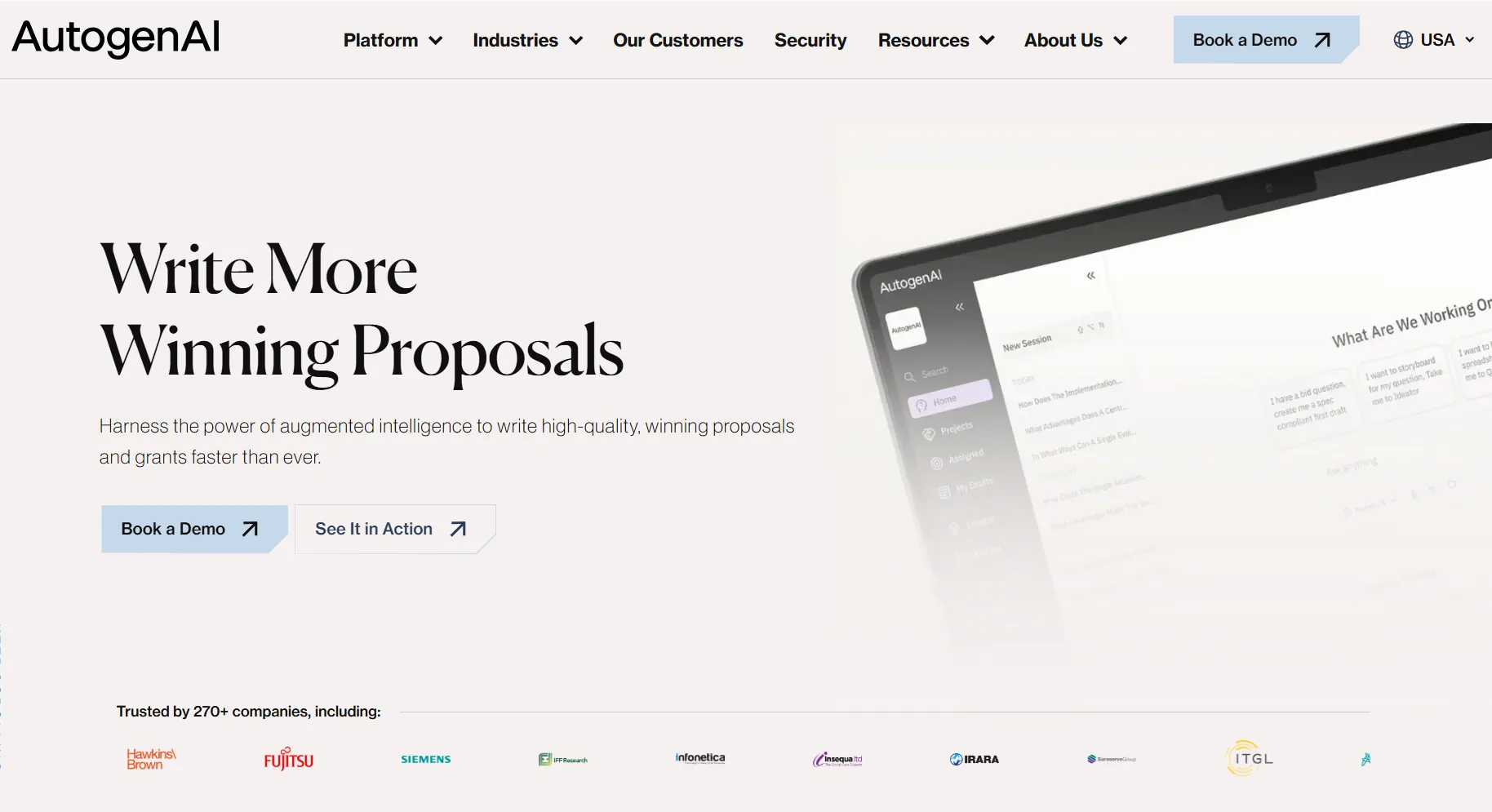
AutogenAI is a proposal-writing and management platform built around the full bid lifecycle, from qualification and requirement analysis through drafting, review, and submission.
Its biggest difference from SiftHub is emphasis. SiftHub combines RFP automation with broader presales and deal orchestration, while AutogenAI focuses more deeply on turning complex requirements into persuasive, structured proposal narratives.
Key Features
Proposal qualification: Analyzes requirements and supports early bid and opportunity assessment.
Storyboard and outlining: Converts complex requirements into structured proposal sections before drafting begins.
Proposal-specific Editor: Generates and transforms content using approved organizational knowledge, external research, case studies, win themes, and writing controls.
Source Finder: Lets writers trace sourced claims back to supporting material within the organization’s knowledge library.
Gamma Review: Reviews proposal content for areas such as compliance, evidence, and quality before submission.
Microsoft Word integration: Brings AutogenAI’s knowledge, drafting, and review capabilities directly into Microsoft Word.
Pricing
AutogenAI does not publish standard subscription prices. What AutogenAI costs depends on the organization’s proposal requirements and deployment scope.
Its current enterprise offering includes end-to-end proposal management, reviewer-only licenses, Microsoft Word integration, security controls, and configuration within the broader package.
Where AutogenAI Shines
Long-form proposal development: Particularly strong when success depends on building a coherent and persuasive narrative rather than primarily completing structured Q&A.
Professional bid writers: Its dedicated writing, storyboarding, transformation, and review tools are designed around the day-to-day work of proposal professionals.
Proposal strategy: Win themes and project inputs help teams carry strategic messaging consistently across large submissions.
Word-centric teams: The native Word experience can reduce disruption for proposal writers who already build final submissions in Microsoft Office.
Complex tender work: Strong fit for detailed tenders where compliance, structure, evidence, and writing quality all influence evaluation.
Where AutogenAI Falls Short
Broader presales enablement: Live-call assistance, buyer-specific battlecards, meeting preparation, deal handoffs, and wider rep enablement are more central to SiftHub.
Learning curve: Current G2 feedback includes users who found navigation or parts of the workflow less intuitive initially.
Content governance effort: Teams still need to manage and verify the knowledge used to support complex or regulated proposals.
Pricing transparency: Public list pricing is unavailable, so buyers need a sales process before they can compare total cost.
Questionnaire-first teams: Organizations dominated by repetitive security questionnaires or short-form RFP Q&A may not need its full narrative-writing toolkit.
Customer Review
Customer reviews for AutogenAI are available but remain limited across major third-party review platforms. Although the platform is recognized for supporting enterprise proposal teams with AI-powered drafting, research, collaboration, and review workflows, there is currently insufficient independent feedback to provide a representative customer quote or draw broader conclusions about overall user sentiment.
Who AutogenAI Is Best For
Professional bid teams: Organizations with dedicated proposal writers.
Narrative-heavy response teams: Companies producing detailed tenders and strategic written proposals.
Microsoft Word-centered teams: Writers who want proposal-specific AI within their existing document workflow.
Complex proposal organizations: Teams that need qualification, storyboarding, writing, and review in one proposal environment.
5. 1up: Best for Lightweight GTM Knowledge and Questionnaire Automation
1up combines RFP, DDQ, and security-questionnaire automation with a broader knowledge-answer layer for sales, presales, security, and other customer-facing teams.
It is a useful SiftHub alternative for organizations attracted to the idea of making company knowledge available beyond a dedicated RFP platform but that do not need the same depth of deal orchestration. Teams can surface answers through Slack, Microsoft Teams, Google Chat, browser tools, and 1up’s questionnaire workflows.
Key Features
Questionnaire automation: Generates responses to RFPs, DDQs, and security questionnaires from connected company sources.
Knowledge connectors: Uses approved documents and systems as the basis for company answers.
Messaging integrations: Makes answers available through Slack, Microsoft Teams, and Google Chat.
Browser extension: Helps users answer customer questions and web-based questionnaires without leaving the browser.
MCP Server: Connects approved organizational knowledge to supported AI workflows.
Human escalation: Can involve a person when an automated answer needs additional input or verification.
Pricing
1up publishes its pricing and offers both subscription and usage-based options.
| Plan | Pricing | Notes |
|---|---|---|
| Free | $0 | Includes 1 admin, 50 knowledge uploads, and 50 answers per month. |
| MCP | $50/month plus usage | Includes the MCP Server, with questionnaire automation charged based on usage. |
| Starter | $300/month | Includes unlimited users and answers, messaging/browser integrations, and 1 questionnaire per month. |
| Plus | $900/month | Adds additional knowledge capabilities, training, and up to 6 questionnaires per month. |
| Enterprise | Custom | Adds enterprise administration and dedicated success support. |
Where 1up Shines
Low adoption barrier: Transparent pricing and a free tier make it easier to test without starting with a large enterprise contract.
GTM-wide knowledge access: Sales and presales employees can use the same information layer for everyday customer questions as well as formal questionnaires.
Lean-team economics: Unlimited users on Starter and Plus can suit teams that want broad participation without purchasing a separate seat for every employee.
Fast implementation: G2 currently reports an average implementation time of less than one month.
In-workflow usability: Messaging and browser access can reduce the need for sales teams to open a dedicated RFP application for routine customer questions.
Where 1up Falls Short
Complex proposal operations: Large bid teams may need deeper project management, approvals, reporting, and submission coordination.
Deal orchestration: SiftHub extends further into CRM and call context, meeting briefs, buyer-specific collateral, battlecards, and sales handoffs.
Narrative proposal development: Long-form proposal strategy and persuasive writing are less central than they are with AutogenAI.
Enterprise depth: Current G2 feedback describes the platform positively but also notes that some capabilities remain limited or continue to evolve.
Complex-answer quality: Reviewers should test difficult technical or nuanced questions rather than assuming that straightforward knowledge retrieval represents every use case.
Customer Review
A Business Development Associate said, “My overall experience with 1up has been excellent. The platform is easy to use, reliable, and improves efficiency in daily work. The intuitive interface makes it easy to learn, collaboration on RFPs is effortless, and the support team is responsive and provides clear guidance.”
A Director of Sales said, “1up is easy to work with and very responsive. The questionnaire automation saves significant time, while its content discovery, source references, and Ask 1up feature help create accurate responses. The platform also offers useful customization without unnecessary complexity.”
Who 1up Is Best For
Lean presales teams: Organizations that need questionnaire automation without a large proposal-management implementation.
Revenue teams: Groups that want approved company knowledge accessible during everyday customer conversations.
Budget-conscious buyers: Teams that value transparent entry pricing and the ability to start small.
Lightweight response operations: Organizations handling RFPs and security questionnaires without a dedicated proposal department.
Reasons to Consider an Alternative to SiftHub
SiftHub is a strong option for organizations that want RFP automation connected with broader presales and revenue workflows. However, some teams may prefer an alternative depending on their response process, governance requirements, and automation priorities.
1. You Need More Transparent Knowledge Retrieval and Semantic Search
Accurate RFP automation depends on more than generating fluent answers. The platform must understand the intent behind a buyer’s question, find the most relevant information across company knowledge, and provide enough visibility for reviewers to validate the result.
AutoRFP.ai uses semantic search to identify relevant answers based on meaning and context rather than relying only on exact keyword matches. This helps teams find supporting information across connected sources even when the wording of a new RFP differs from previous responses or internal documentation.
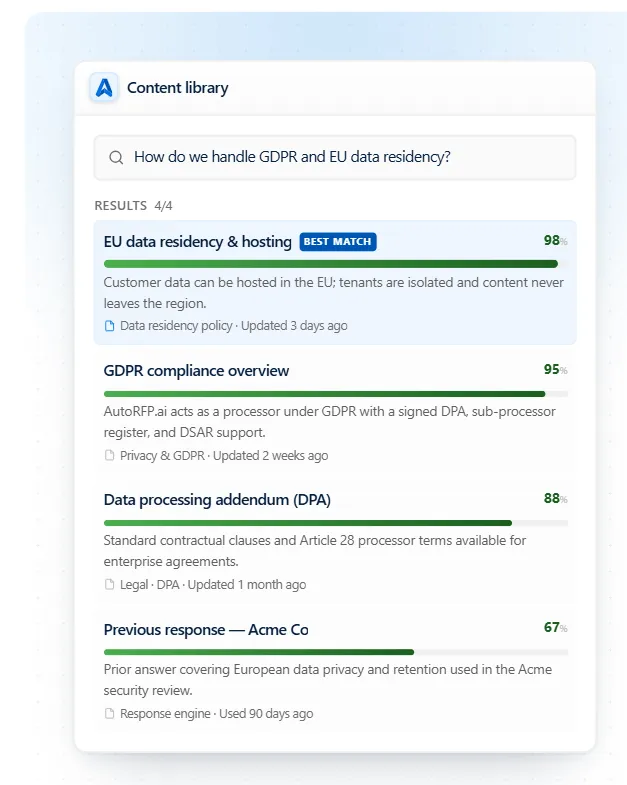
For teams handling complex technical, security, and compliance questions, transparent retrieval matters because reviewers need confidence that the generated response is connected to the right evidence before approving it.
2. Your Primary Challenge Is RFP Accuracy, Not Broader Sales Enablement
SiftHub extends beyond RFP automation into wider presales workflows, including deal context, sales support, and customer-facing activities.
For teams that mainly need accurate RFP, DDQ, and security questionnaire responses rather than broader revenue automation, a dedicated response platform may provide a better fit. AutoRFP.ai focuses specifically on governed response generation, content accuracy, approvals, and submission workflows.
3. You Need More Advanced Response Operations
Large organizations may require deeper workflow management across multiple teams, regions, and business units.
Responsive and Loopio provide mature project management, reporting, content governance, and enterprise administration capabilities for teams managing high volumes of concurrent responses.
4. You Want Less Manual Knowledge Maintenance
Traditional response platforms often depend on teams maintaining a structured answer library.
Organizations that want responses generated from connected company knowledge without constant manual curation may prefer an AI-native approach. AutoRFP.ai connects approved sources and continuously improves future responses based on validated answers.
Scale Your RFP Responses With AutoRFP.ai
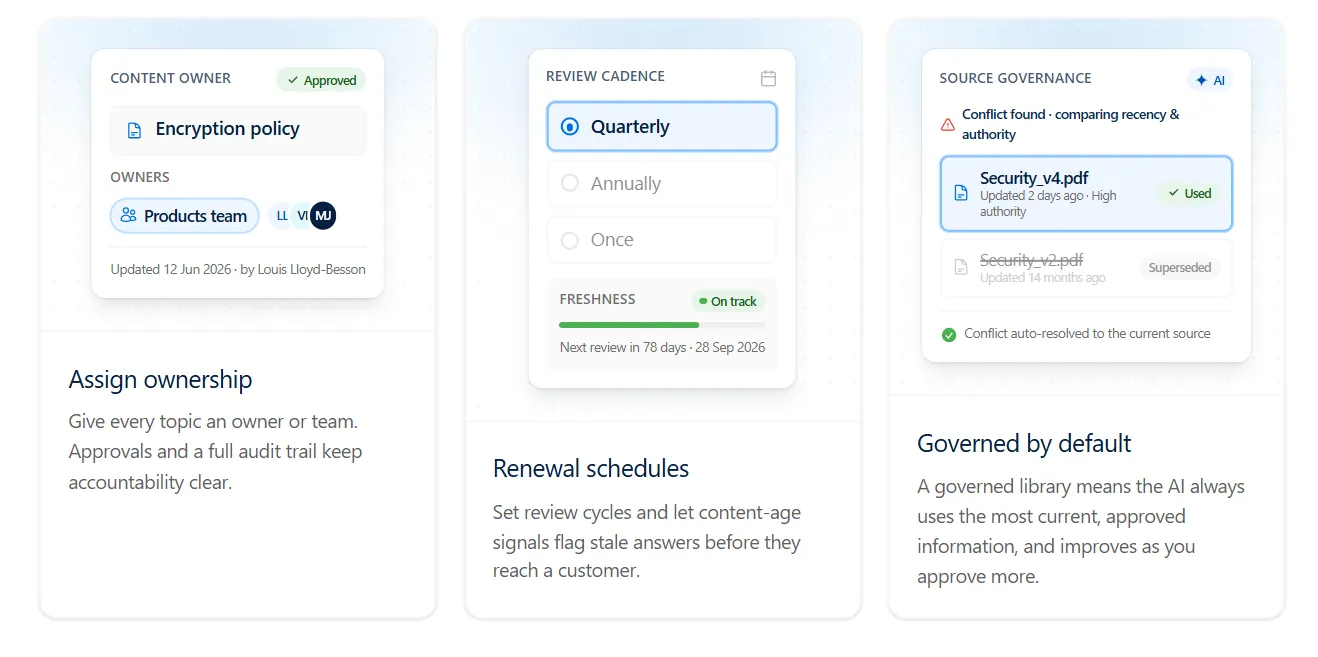
AutoRFP.ai helps teams automate RFPs, DDQs, and security questionnaires while keeping every response connected to approved evidence. Source citations, Trust Scores, Portal Agent, Automation Reporting, approval workflows, and enterprise security controls help sales, technical, security, and compliance teams respond faster without sacrificing accuracy.
Unlike tools built mainly around sales enablement or content libraries, AutoRFP.ai is designed for organizations that need responses they can verify, defend, and continuously improve.
We would rather show you than tell you: prove it on your own RFPs and questionnaires in a two-week proof of concept. Book a demo to see AutoRFP.ai in action today.
FAQs
1. What Is the Best SiftHub Alternative for RFP Automation?
The best SiftHub alternative depends on your response workflow and business requirements. AutoRFP.ai is a strong fit for teams that need governed RFPs, DDQs, and security questionnaires with source-grounded answers, citations, Trust Scores, and approval workflows.
Loopio and Responsive suit established proposal teams that need structured response operations, while AutogenAI is designed for organizations focused on complex narrative proposal development. 1up is better suited for teams looking for lightweight knowledge access and questionnaire automation.
2. Which SiftHub Alternative Is Best for Security Questionnaires and DDQs?
Teams handling security questionnaires and DDQs should evaluate whether the platform supports source verification, approval workflows, complex documents, portal-based questionnaires, and security-focused collaboration.
AutoRFP.ai supports RFPs, DDQs, and security questionnaires in one governed workflow. Other platforms may be better suited depending on whether the priority is GRC, proposal management, content libraries, or broader sales workflows.
3. Do SiftHub Alternatives Require a Content Library?
Not all platforms use the same knowledge-management approach. Traditional response platforms often rely on structured content libraries that require ownership, updates, and governance.
Other platforms connect directly with existing company knowledge sources and reduce the amount of manual library administration required. Buyers should evaluate where their current information lives and how much ongoing content management their team wants to maintain.
4. How Much Do SiftHub Alternatives Cost?
Pricing varies significantly by platform. AutoRFP.ai starts at $899 per month, while Loopio starts at $20,000 per year. Responsive, AutogenAI, and other enterprise platforms typically use custom pricing.
When comparing costs, consider user limits, project volume, implementation requirements, integrations, support, and the internal effort required to maintain response content.
5. What Should Teams Test Before Choosing an RFP Automation Platform?
Teams should test each platform using real customer questionnaires, complex Word or Excel files, difficult technical questions, and responses requiring multiple reviewers.
Evaluate how well each tool retrieves supporting information, handles unsupported questions, preserves document structure, manages approvals, and reduces manual work before submission.
About the author

Co-founder & CEO
Co-founder and CEO of AutoRFP.ai. Spent 7 years running global RFPs and personally completed 500+ RFPs before founding the company.
LinkedIn
