How Much Does AutogenAI Cost in 2026?
AutogenAI pricing is quote-only. See what the platform offers, what affects cost, its pros and cons, and how it compares with AutoRFP.ai.

Technical Account Manager, AutoRFP.ai··11 min read
What Are You Really Paying AutogenAI to Help With?
A strong proposal often starts with scattered information that someone has to turn into a convincing response. AutogenAI helps proposal teams do that work, using company knowledge and external research to develop longer, narrative-heavy bids.
Its Editor supports the writing process as the proposal develops, with tools for finding supporting material and reviewing the draft. That makes AutogenAI especially relevant when writing takes up a large share of your team’s time.
Your needs may look different if most of your work arrives as structured RFPs or security questionnaires with answers that need formal review. This guide looks at AutogenAI’s pricing, what you get for the cost, and the type of response work it supports best.
Why AutoRFP.ai Can Speak to This Comparison
AutoRFP.ai works with response teams across multiple regions and is built specifically for RFPs, security questionnaires, and DDQs. Cubiko, a healthtech customer, reported an 85% reduction in security questionnaire response time after adopting the platform, taking one questionnaire process from about a week to roughly an hour.
How Much Does AutogenAI Cost?
AutogenAI does not publish a standard price, so you’ll need to contact sales for a quote.
Its current enterprise material describes pricing as all-inclusive. One agreement can cover all users and modules, along with onboarding, training, customer success, and access to commercial or FedRAMP High environments.
| Pricing Question | What Is Publicly Known |
|---|---|
| Published starting price | None |
| How to get pricing | Contact AutogenAI |
| Final fees | Defined in the Order Form |
| Editor access | Requires a Full licence |
| Review-only licences | Unlimited and included as standard |
| New Experience capabilities | Included in the standard subscription at no additional cost |
| Standard U.S. contract term | Minimum 12 months unless the Order Form specifies another period |
| Standard renewal | Successive 12-month terms unless properly terminated |
| Standard annual fee provision | Non-discounted fees rise 10% each year unless the Order Form says otherwise |
What Drives the Final AutogenAI Price?
Without published pricing, your final cost comes down to the package in your Order Form and the terms attached to it.
Your Order Form Defines the Package
AutogenAI’s US terms say your services and fees are set in the Order Form. That is where you should check which products and licence types are included, along with any implementation or support terms.
Full and Review-Only Licences Work Differently
AutogenAI requires a Full licence for anyone using its new Editor. Team members who only need to review proposals can use the unlimited review-only licences included as standard, so they do not need the same licence as the people writing responses.
Standard Fees Can Rise 10% at Renewal
AutogenAI’s current U.S. terms allow non-discounted fees to increase by 10% on each annual anniversary of the Services Commencement Date unless your Order Form sets different terms.
Contracts run for at least 12 months and renew for another 12 months unless either party gives at least three months’ written notice. If you are comparing costs beyond the first year, check your Order Form for any negotiated renewal terms or discounts that could change what you pay.
What Does AutogenAI Do?
Break Down the RFP Before You Write
AutogenAI’s Extract tool pulls requirements from large RFP documents, giving your team a clearer view of the work ahead. Research Assistant can then use company knowledge and RFP context to support go/no-go decisions.
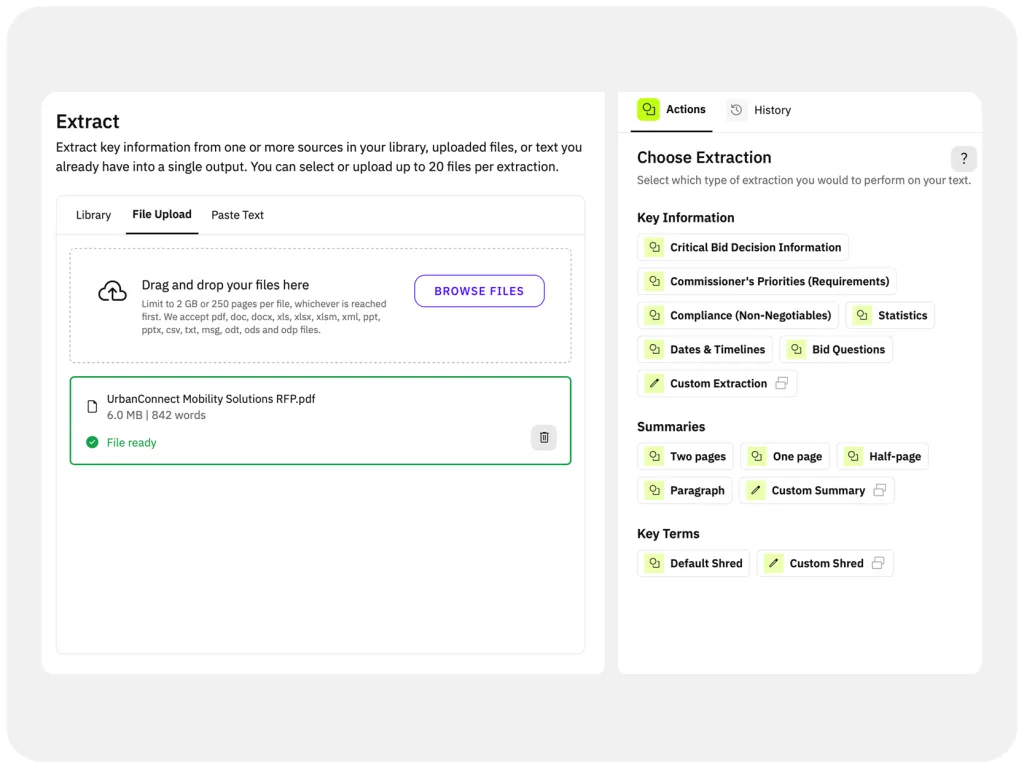
For question-heavy documents, Answer Bank and Q&A Workbooks help teams work through requirements in a more structured format.
Build the Proposal Around the Opportunity
Once you decide to pursue an opportunity, Project Inputs let you bring win themes and other guidance into the project. Storyboard uses those requirements to build an outline that writers can develop into the full proposal.
That guidance follows the proposal into the writing process, helping writers keep the response connected to the opportunity.
Write Longer Proposal Content
AutogenAI’s Editor gives writers a dedicated place to turn that material into a longer narrative. It can work from company knowledge or outside sources as the response develops.
Writers can:
- Develop ideas with Ideator.
- Add supporting evidence or adjust tone.
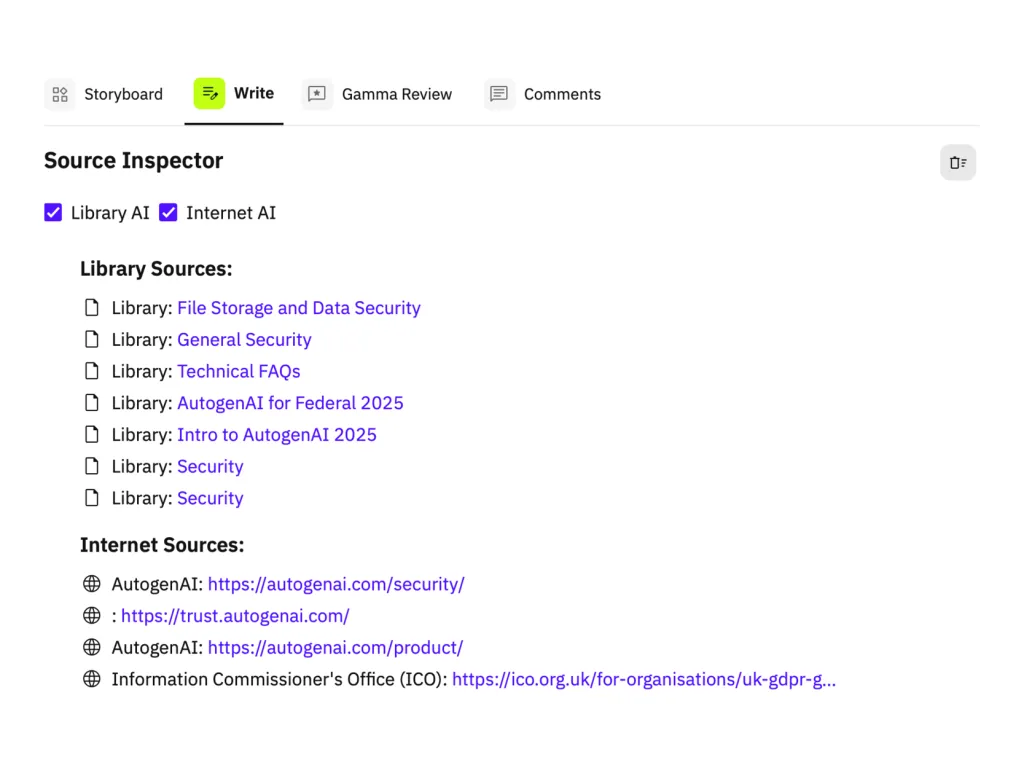
- Trace sourced material with Source Finder.
- Use AutogenAI’s proposal tools directly in Microsoft Word.
For teams that spend much of their time writing narrative-heavy bids, these tools put more of that work in one workflow.
Bring in Outside Research
Research Assistant can search the AutogenAI Library and Answer Bank alongside Bing-powered web search. Teams using Highspot can also search connected content and trace generated material back to the supporting documents.
This gives writers another source of information when the proposal calls for research beyond existing company content.
Review Against the Requirement
Gamma Review checks proposal sections against the bid requirements and points writers toward areas that may need more work. SMEs can then add comments or edit the draft with the proposal team.
Support Federal Proposal Work
Teams pursuing U.S. federal opportunities can use AutogenAI Federal, which is currently FedRAMP High authorized. AutogenAI also states that customer data is not used to train public or shared AI models and that federal environments are privately isolated.
AutogenAI Pros and Cons
Pros
- Long-form proposal writing: AutogenAI helps teams develop detailed, persuasive proposal content inside a purpose-built Editor.
- Broad proposal workflow: The platform supports RFP intake, drafting, research, and review in one system.
- External research: Writers can use web search alongside company content when outside evidence is useful.
- Microsoft Word integration: AutogenAI brings its proposal tools directly into Word.
- Federal contracting: AutogenAI Federal is currently FedRAMP High authorized and built for U.S. federal proposal work.
Cons
- No public pricing: Buyers need to contact sales to get a dollar figure.
- Standard fees can increase annually: Unless the Order Form says otherwise, AutogenAI’s U.S. terms increase non-discounted fees by 10% on each annual anniversary.
- Generated drafts can need refining: G2 reviewers note AI-generated content sometimes needs extra editing to match tone and specifics.
- Learning curve: G2 feedback includes users who found AutogenAI’s initial setup difficult and its interface complex, so some teams may need time to get comfortable with the platform.
Where AutoRFP.ai Fits Better Than AutogenAI
AutogenAI is built around proposal creation and long-form writing, making it a strong fit for teams developing narrative-heavy bids. AutoRFP.ai focuses more closely on structured RFPs, security questionnaires, and DDQs, where the quality of each individual answer needs closer attention.
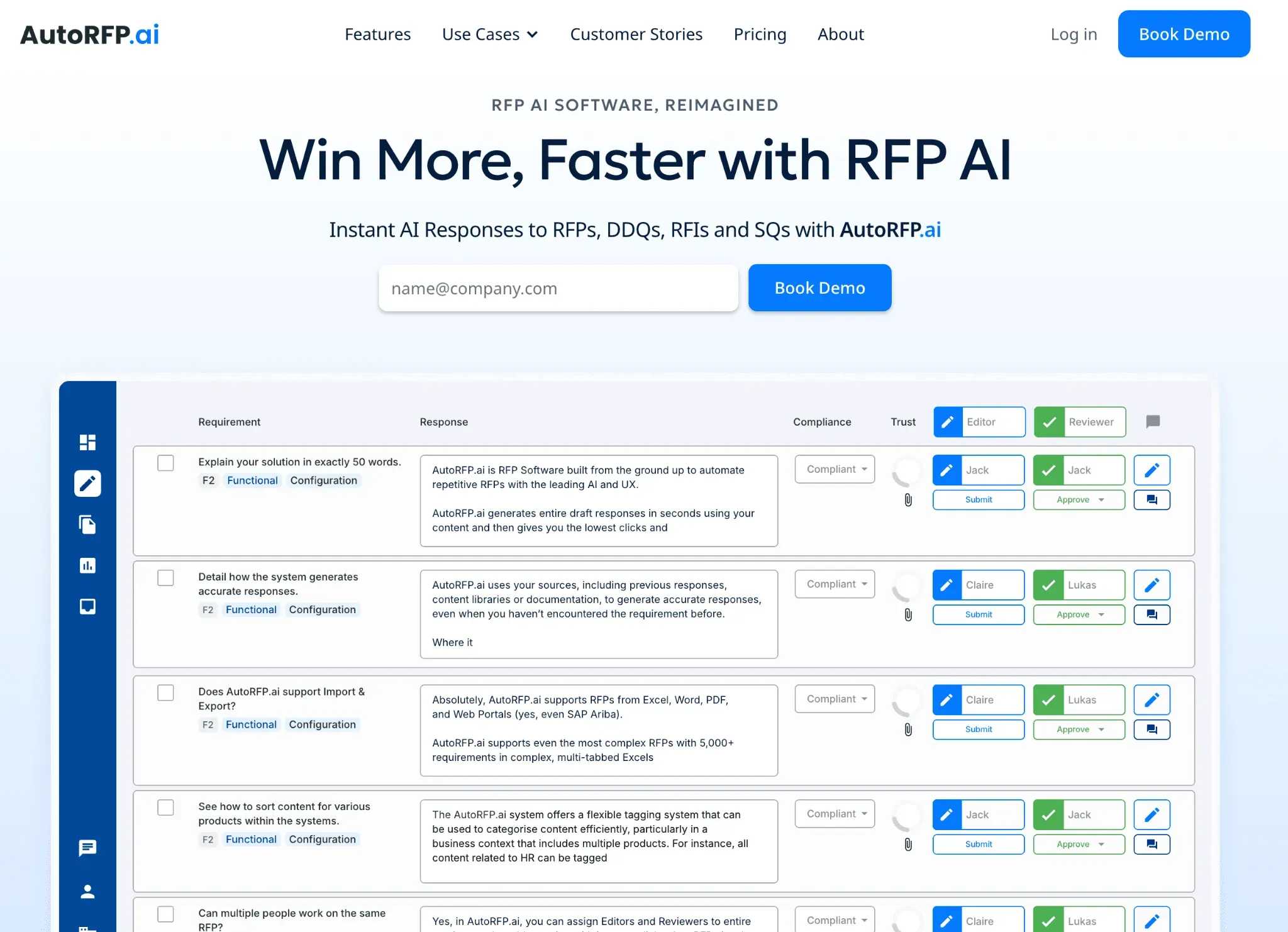
Its accuracy-first, AI-native approach grounds responses in approved company content and shows reviewers the sources behind them. That gives teams a clearer way to check each answer before submission, with review controls that support more formal compliance workflows.
See Which Answers Need a Closer Look
AutoRFP.ai separates source strength from how well the response answers the requirement:
- Trust Rankings: Exact Match, Near Match, High Trust, Low Trust, and No Results Found help reviewers prioritize responses.
- Feedback Scores: Flag answers that may be supported but still need more detail.
- Exact Matches: Previously approved responses can be reused when appropriate.
- Unsupported requirements: No Results Found sends the question to a person rather than filling the gap.
Reviewers can also inspect the supporting content behind generated responses. This per-answer workflow is the basis for AutoRFP.ai’s zero hallucination by design approach.
Work With Structured Questionnaires
AutoRFP.ai handles requirements from Excel, Word, PDF, and web portals, making it easier to work with questionnaires that contain hundreds of individual questions.
For portal-based work, the Portal Agent can bring requirements into AutoRFP.ai without manual retyping. Teams can then review the completed project before exporting it.
Set Clear Rules for Approval
Response Policies give admins more control over what happens after an answer has been reviewed.
Teams can:
- Lock responses at defined points.
- Control who can reopen submitted or approved answers.
- Require reviewers to approve responses in sequence.
- Add approval before the final project can be exported.
These controls can help when security or legal teams need their sign-off to hold through submission.
AutoRFP.ai is also ISO 27001:2022 certified and SOC 2 Type II audited. Customer data is not used to train AI models, and its Trust Center gives security teams access to the documentation they need during vendor review, which can help shorten the process.
Keep Outside Research Separate
AutoRFP.ai’s standard response workflow centers on company content. When outside information is useful, users can access web research through a separate agent workflow.
Admins can also control whether broader AI drafting is available, keeping externally researched material distinct from the normal company-content workflow.
Bring More Reviewers Into the Process
AutoRFP.ai’s published plans include unlimited users, so bringing more SMEs into a project does not add seat costs.
The platform also connects response work with the tools teams already use:
- Knowledge: SharePoint, Google Drive, Confluence, and Notion.
- Collaboration: Slack and Microsoft Teams.
- Sales: Salesforce.
- Other systems: Seismic, Zendesk, Intercom, Okta, and Microsoft Entra.
For teams spending more of their time on structured questionnaires than long-form proposal writing, these requirement-level review and approval controls are where AutoRFP.ai becomes worth a closer look.
How Much Does AutoRFP.ai Cost?
AutoRFP.ai publishes pricing for its two standard plans, so you can see the starting cost before talking to sales. The Scale and Accelerate figures below come from the AutoRFP.ai pricing page (Sep 2026).
| Plan | Price | Projects per year |
|---|---|---|
| Scale | $899/month, billed annually | 24 |
| Accelerate | $1,299/month, billed annually | 50 |
| Enterprise | Custom | Scalable |
Scale and Accelerate include unlimited users and AI usage, along with all features, integrations, support, and online training.
Your plan depends on annual project volume rather than how many people need access. AutogenAI also offers broad enterprise packaging, but you’ll need a custom quote to see what your team would pay.
AutoRFP.ai Pros and Cons
Pros
- Built for structured responses: AutoRFP.ai handles RFPs, RFIs, security questionnaires, and DDQs at the individual requirement level.
- Separate quality signals: Trust Rankings assess source support, while Feedback Scores check how well the response answers the requirement.
- Clear approval controls: Teams can use response locking, sequential reviews, and export approval for formal sign-off.
- Unlimited users: Published plans let you add SMEs and reviewers without extra seat costs.
- Questionnaire support: AutoRFP.ai works with Excel, Word, and PDF files, while the Portal Agent handles web-based questionnaires.
Cons
- Less focused on long-form proposals: AutogenAI offers more tools for narrative-heavy proposal writing and federal bids.
- Annual billing: Scale and Accelerate are billed annually.
- Project limits: Scale includes 24 projects per year, while Accelerate includes 50 (AutoRFP.ai pricing page, Sep 2026).
- Content needs ownership: The shared library still needs people to review and manage company knowledge.
Which One Fits Your Team
- If your work is long-form, persuasive proposals or U.S. federal and defense bids: AutogenAI.
- If accuracy and a defensible compliance review on structured RFPs and questionnaires matter most: AutoRFP.ai.
- If you want AI-native drafting that still passes a commercial security or audit review: AutoRFP.ai.
- If you want published, self-serve pricing rather than a custom quote: AutoRFP.ai.
For context on RFP software pricing insights across per-user, project-based, and quote-only vendors, see the market comparison guide.
AutogenAI vs. AutoRFP.ai
| Feature | AutogenAI | AutoRFP.ai |
|---|---|---|
| Best Fit | Long-form, persuasive proposals and federal bids | Structured RFPs, security questionnaires, and DDQs |
| Published Pricing | No standard dollar price | Scale $899/month; Accelerate $1,299/month, both paid yearly (AutoRFP.ai pricing page, Sep 2026) |
| Commercial Model | Enterprise offer described as all-inclusive | Project-based with unlimited users |
| Core Workflow | End-to-end proposal creation | Requirement-level response automation and governance |
| Long-Form Writing | Standout strength | Supported, but not the primary focus |
| Requirement Extraction | Extract and Smart Workflows | Automated document import and Portal Agent |
| Structured Questionnaires | Q&A Workbooks and question workflows | Core product workflow |
| Internal Sources | Library, Answer Bank, datasets, integrations | Shared content library, approved responses, synced repositories |
| Web Research | Integrated into Research Assistant and writing workflows | Separate, user-controlled research and broader drafting paths |
| Source Visibility | Source Finder and citations | Sources shown per response with Trust Rankings |
| Answer Completeness | Gamma Review against criteria and requirements | Separate Feedback Score per response |
| When Evidence Is Missing | Human review remains part of the proposal workflow | No Results Found and low-trust responses can be prioritized for human input |
| Review Model | Proposal and section review with Gamma Review and comments | Per-response submission, approval, sequential review, locking, and export approval |
| Microsoft Word | Deep Word integration with proposal engine inside Word | Word import/export within structured response workflow |
| Web Portals | Not a documented focus; AutogenAI centers on Word and document workflows | Portal Agent imports online requirements |
| Federal Contracting | Major strength, including FedRAMP High positioning | Not the primary lane |
| Security | FedRAMP High, DoD IL5, ISO 27001, SOC 2 (federal-grade) | SOC 2 Type II, ISO 27001:2022, SSO, regional hosting, audit trails |
| Users | Enterprise packaging says all users included; Full and review-only licences are distinguished in product documentation | Unlimited users on public plans |
| Integrations | Includes Microsoft Word, Highspot, and other proposal sources | Native connections across content, CRM, communications, help centers, file storage, and identity systems |
| Evaluation | Demo-led buying process | Two-week proof of concept on the buyer’s own RFPs |
Test AutoRFP.ai on Your Own RFP
AutoRFP.ai is built for structured RFPs and questionnaires where teams need clear sources and formal review controls.
You can test that workflow using your own content and a real RFP, so you can see the first draft and review process before committing.
We would rather show you than tell you: prove it on your own RFPs in a two-week proof of concept. Book a demo and we will run AutoRFP.ai on one of your own RFPs or security questionnaires.
About the author

Technical Account Manager
Technical Account Manager at AutoRFP.ai. Background in asset management completing institutional RFPs and DDQs; now implements AutoRFP.ai for some of the company's largest accounts.
LinkedIn
