
Best RFP Software for MSPs and IT Services: 6 Tools Compared (2026)
The best RFP software for MSPs in 2026 includes AutoRFP.ai, Loopio, Responsive, and more. Compare AI automation, workflows, security, and pricing.

Technical Account Manager, AutoRFP.ai·Updated ·22 min read
6 Best RFP Software for MSPs and IT Services in 2026: At a Glance
| Platform | Best for | Standout feature | Content reuse | Handles SOWs | Public pricing | G2 rating |
|---|---|---|---|---|---|---|
| AutoRFP.ai | High-volume MSP bidding and IT service teams managing complex RFPs | Source-grounded AI responses with semantic search, Trust Scores, Portal Agent, and reusable knowledge without manual library maintenance | Yes | Yes | Yes ($899/month) | 4.8/5 |
| Loopio | Library-led proposal teams with dedicated content owners | Structured content Library with AI-assisted responses and enterprise collaboration workflows | Yes | Partial | Partial (~$20,000/year) | 4.7/5 |
| Responsive | Large bid desks managing complex enterprise response operations | Strategic Response Management with project workflows, reporting, integrations, and governance controls | Yes | Partial | No (quote-based) | 4.5/5 |
| Arphie | SMB teams wanting AI-powered RFP automation | AI-generated responses with source references and confidence scoring | Partial | Partial | No (quote-based) | 5/5 |
| 1up | Teams needing lightweight RFP answers through existing tools | AI answer engine across Slack, Microsoft Teams, Salesforce, browser workflows, and connected knowledge sources | Partial | No | Yes (from $300/month) | 4.9/5 |
| Qvidian | Organizations prioritizing security, reporting, and structured proposal management | Enterprise content management, reporting, and controlled proposal workflows | Yes | Partial | No (quote-based) | 4.3/5 |
How We Compared These Tools
We weighed five criteria: multi-client content reuse (30%), RFx and SOW breadth (20%), security questionnaire handling and data privacy (20%), response accuracy and tailoring (15%), and pricing transparency (15%). Ratings reference G2, Capterra, and Gartner where a vendor has at least 20 reviews. We do not assign our own star ratings.
1. AutoRFP.ai: Best for Defensible MSP and IT Services RFP Automation
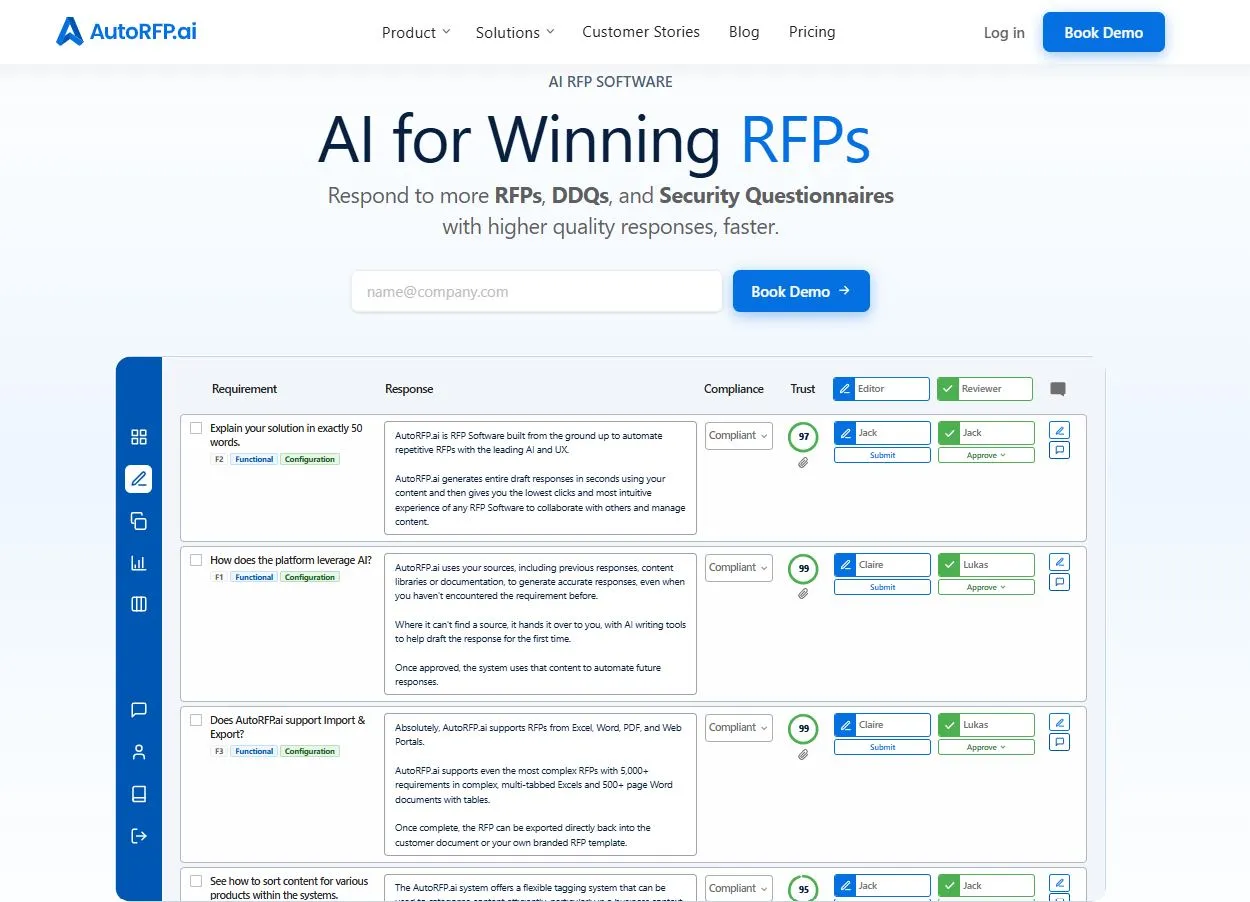
AutoRFP.ai is the accuracy-first AI platform for RFPs, security questionnaires, and DDQs. Every answer is source-grounded and citable, with zero library maintenance.
That model fits MSPs and IT services companies because technical bids often require information from many different sources: service catalogs, SLA documentation, implementation methodologies, architecture diagrams, security policies, business continuity plans, certifications, previous proposals, and product or platform documentation.
AutoRFP.ai searches approved company knowledge, drafts from the supporting material it finds, shows reviewers the evidence behind each response, and routes unsupported questions back to a person instead of relying on guesswork.
Key Features
1. Source-Grounded Technical Answers With Trust Scores and Response Validation
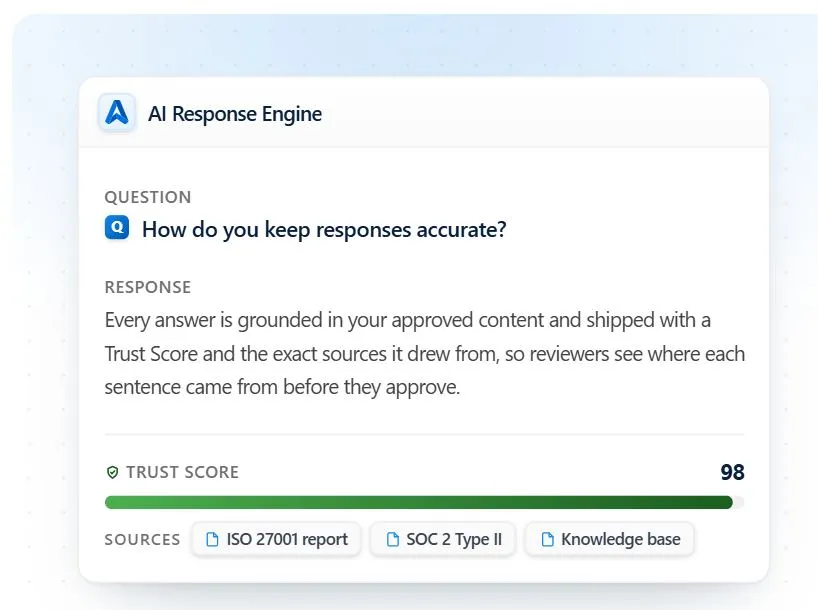
AutoRFP.ai is built for zero hallucination by design, generating responses from approved company knowledge using semantic retrieval and a multi-step AI workflow. The platform retrieves relevant information from connected sources, then uses multiple AI steps to draft, refine, and validate responses before presenting them for review.
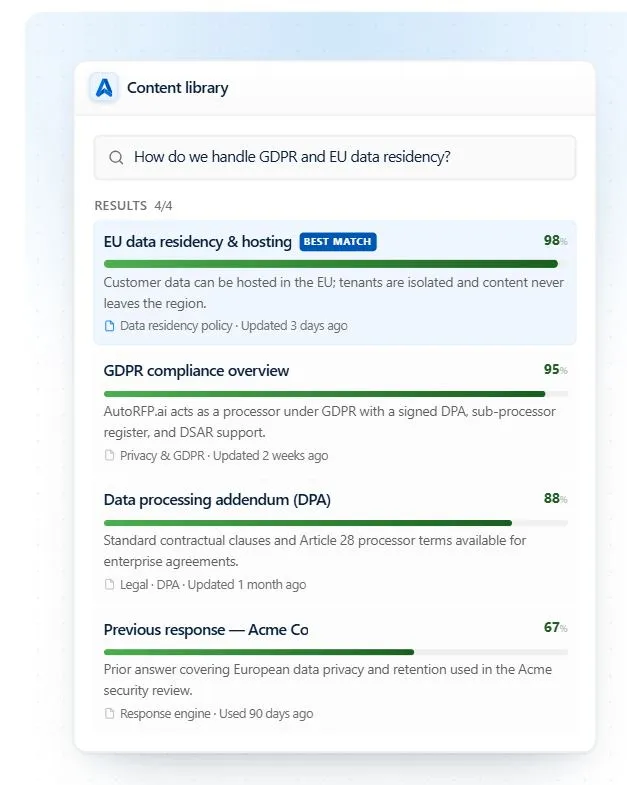
Every answer shows its supporting sources and a Trust Score, so technical reviewers can understand what evidence the draft relies on and identify when additional validation is needed.
A separate Feedback Score assesses whether the response actually addresses what the buyer asked.

This distinction matters when an MSP needs to answer detailed questions about uptime, escalation, encryption, privileged access, recovery, or service coverage rather than simply produce plausible technical language.


Video transcript
AutoRFP.ai is like having a team member that never sleeps. We've responded to more than double the number of RFPs after implementing AutoRFP.ai than we did the year before. I'll look back on 2025, we'd saved something like 949 hours. It was mind-blowing. Oh my gosh, this can be done automatically. Being able to answer those consistently and accurately puts us in a position to be a trusted vendor for our clients.
Using AutoRFP.ai has definitely helped me increase my closing ratio. Before, we were using Google Drive to store all of our library content and previous responses. It was a very manual process. If the keyword was there, you would find it. If not, then you wouldn't. I would say 60% of the deals that come through in my market are RFP bids.
But as the team was scaling, it quickly became apparent that this wasn't sustainable. I, of course, looked at tools that we had available to us in-house. Became clear that it worked in some ways, but it wasn't built to respond to complex RFPs with multiple questions and moving parts. So what was different about AutoRFP.ai is that we're able to upload multiple documents in all different formats, PDF, Word, Excel, and it will ingest all of those documents and pull out the requirements, even tables within documents instantly.
The Excel sheets just blew our mind because we hadn't seen this anywhere else. As we work in multiple regions, the ability of AutoRFP.ai to translate into multiple languages is really impressive, and it really felt like it was going to be a partnership rather than a transaction. We spend a lot more time now focusing on the strategy for a bid.
The bids are a lot more tailored and a lot more focused on the prospect in a way that we couldn't do before. The quality of our output is just completely different. Do you feel like it's gonna blow their mind because they're like, "Oh, you've said exactly what we needed to hear." Thinking back to that particular deal in Q3, the deadline was coming up.
Having missed the deadline would have meant for me not hitting my quarter, but I also didn't wanna let down my team. Having a bank of information of answers that I could trust really allowed me to just push everything out as quickly as possible, knowing that what I was saying was accurate and true.
Trusting that when that is submitted, more than 50% of the job is done, and I'm really excited to say that, yes, we did win the deal, made me look like a hero, so thank you. We've been able to respond to 20 to 30% more RFPs quarter on quarter. We've been able to increase the capacity of the team. We've saved 45% of the time it would've taken us to respond to the same number of RFPs.
Our shortlist rate has been outstanding, and it just gets better and better I would say don't wait until volumes spike and quality starts to drop. Every bid that your team submits manually is costing you more than you think, not just in hours, but in quality and consistency There's absolutely no way we would want to go back to the previous way AutoRFP.ai is like having a team member that never sleeps, keeps getting smarter, and allows my team to focus on the stuff that they're really good at
2. Security Questionnaire and Portal Automation
Security assessments are often part of the same enterprise sales process as the commercial RFP. AutoRFP.ai can generate questionnaire responses from approved security documentation and send them through human review before submission.
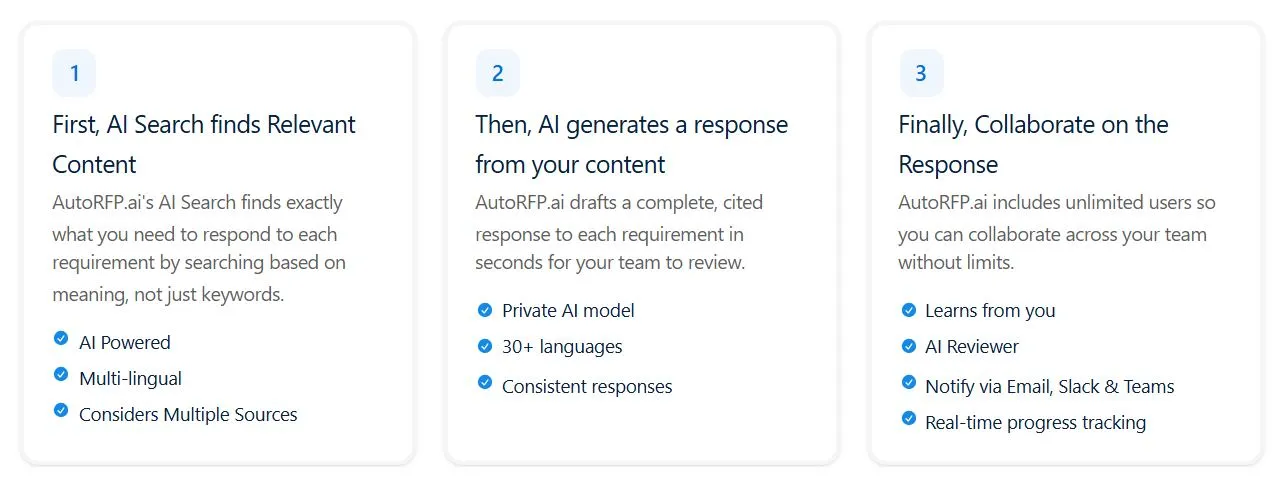
Portal Agent helps teams automate responses directly within procurement and security portals. It can capture questionnaire requirements, generate answers from approved company knowledge, and complete portal-based workflows without forcing teams to manually copy and paste responses between systems.
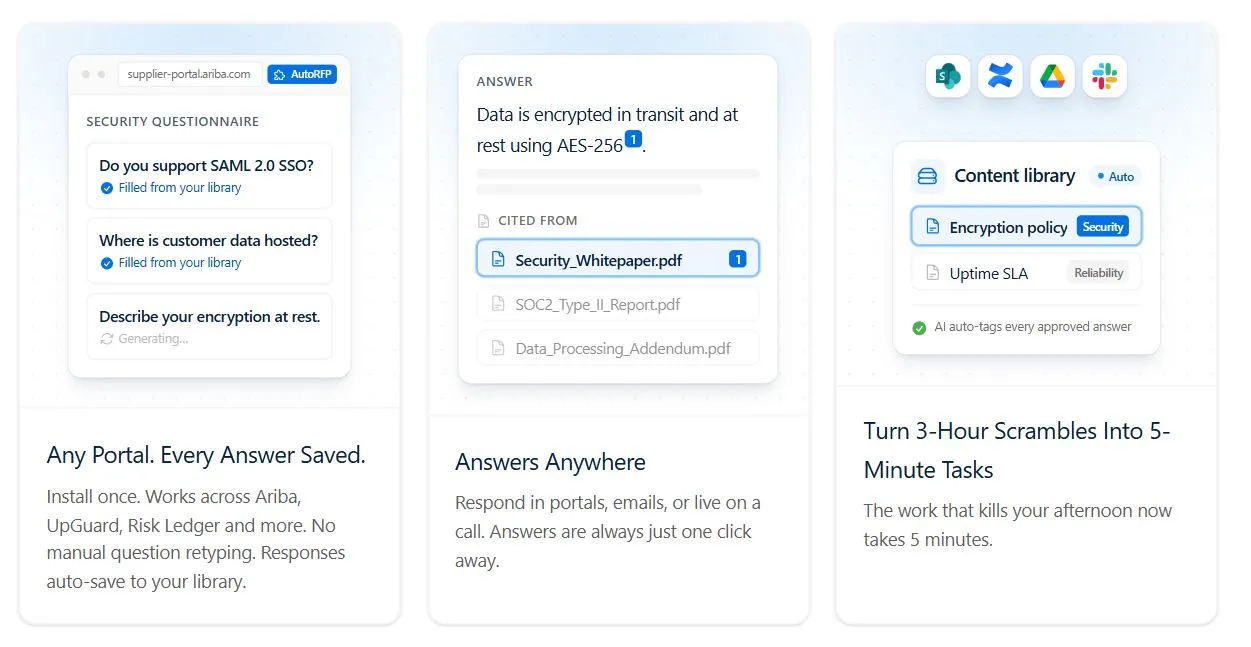
AutoRFP.ai supports portal environments such as Ariba, UpGuard, Jaggaer, and other buyer platforms, helping teams handle external questionnaires more efficiently while keeping responses grounded in approved information.
3. Connected Knowledge Across Services, Security, and Operations
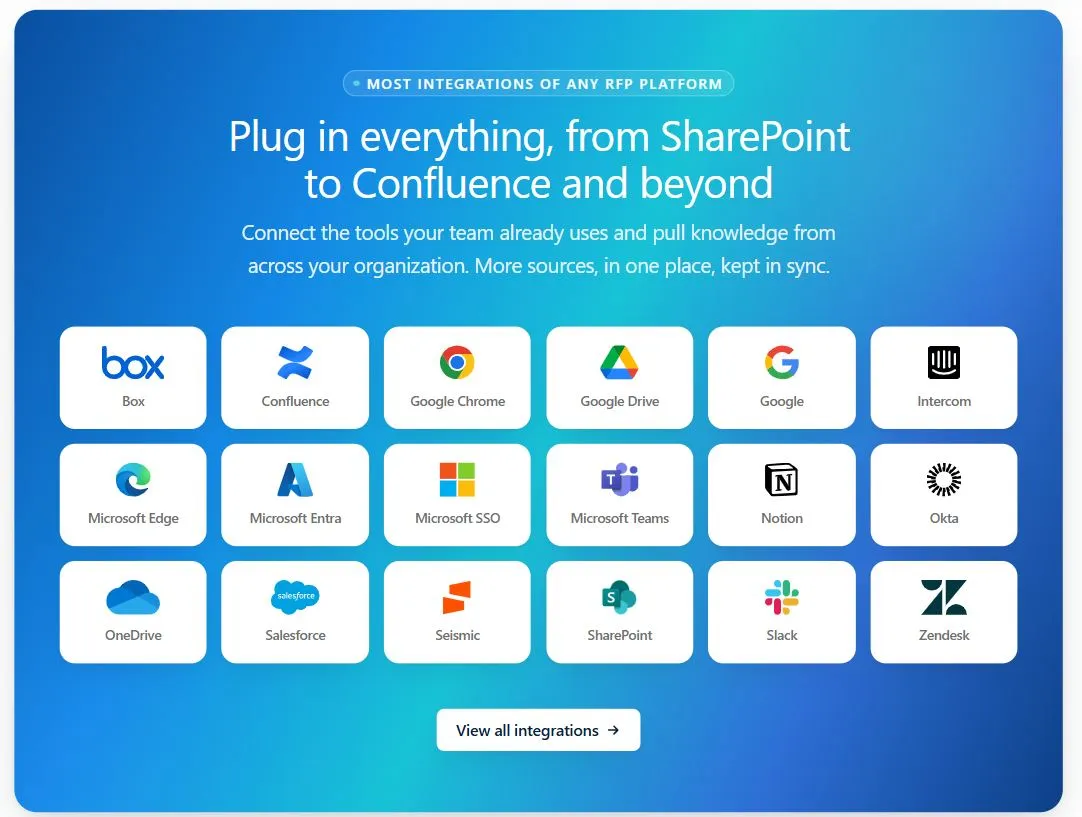
AutoRFP.ai connects knowledge from SharePoint, Confluence, Google Drive, OneDrive, Notion, Box, Seismic, Zendesk, and other systems rather than requiring every answer to be manually copied into a traditional Q&A library.
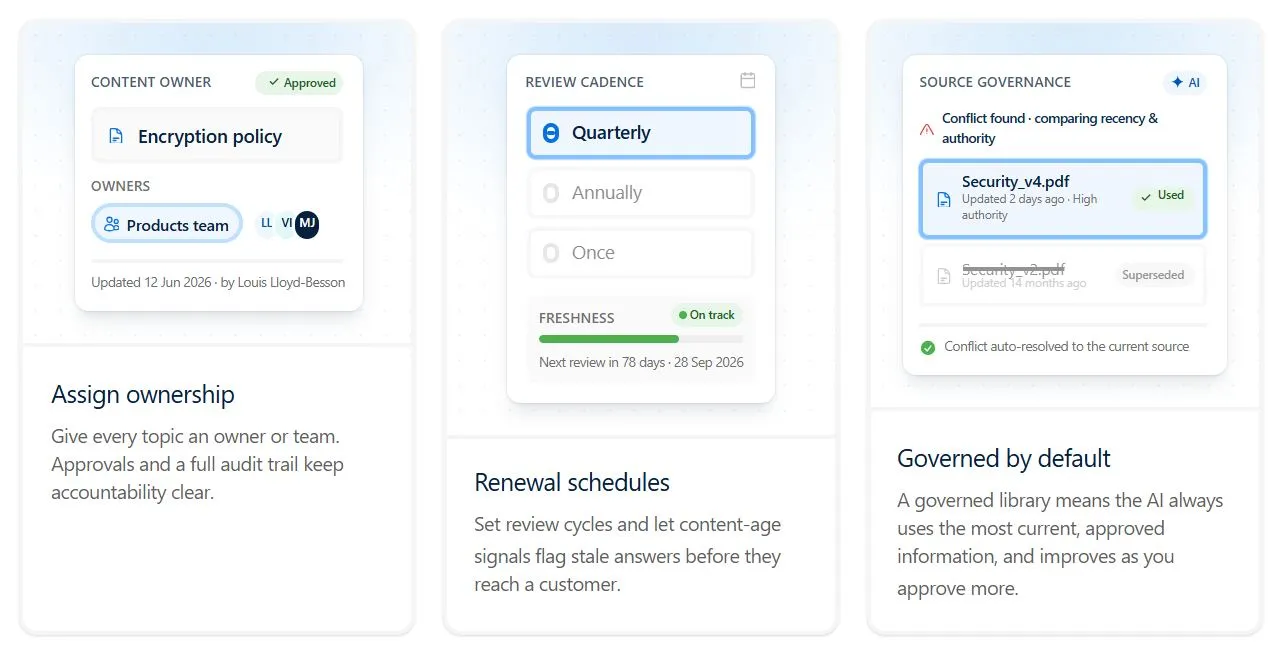
Approved responses are automatically added to future knowledge, while ownership, review cycles, source authority, and conflict resolution remain governed. This helps service and security information stay usable without continuous tagging and library cleanup.
4. Complex File Import and Original-Format Export
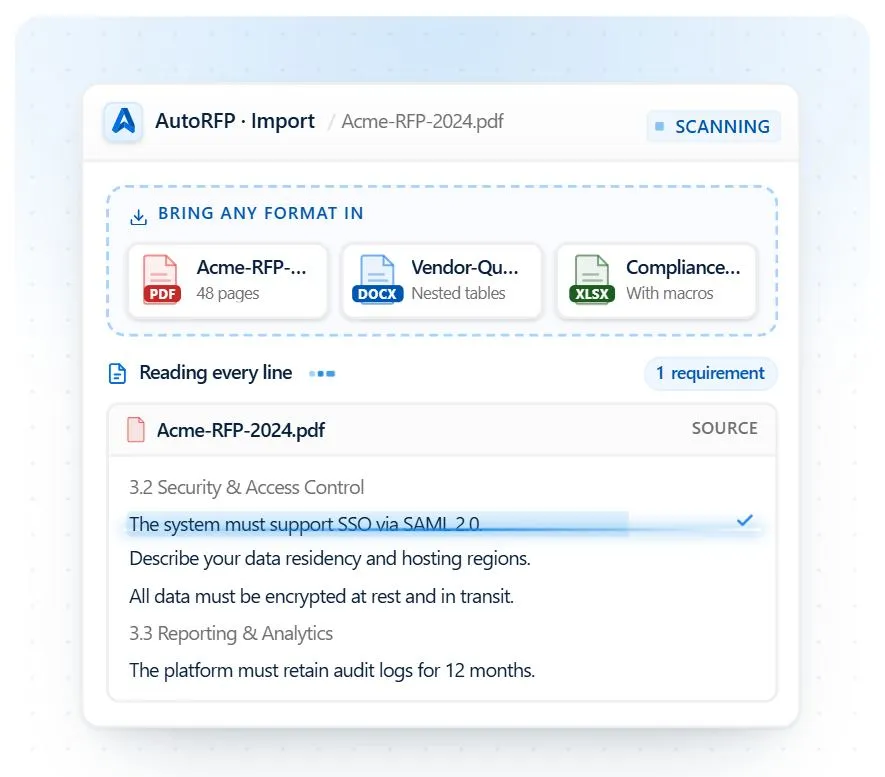
AutoRFP.ai works with Word, Excel, PDF, and web-based requests, including large multi-tab spreadsheets and more complex questionnaire structures.
Completed responses can be exported back into the buyer’s original Word or Excel format while preserving elements such as templates, formulas, macros, and formatting.
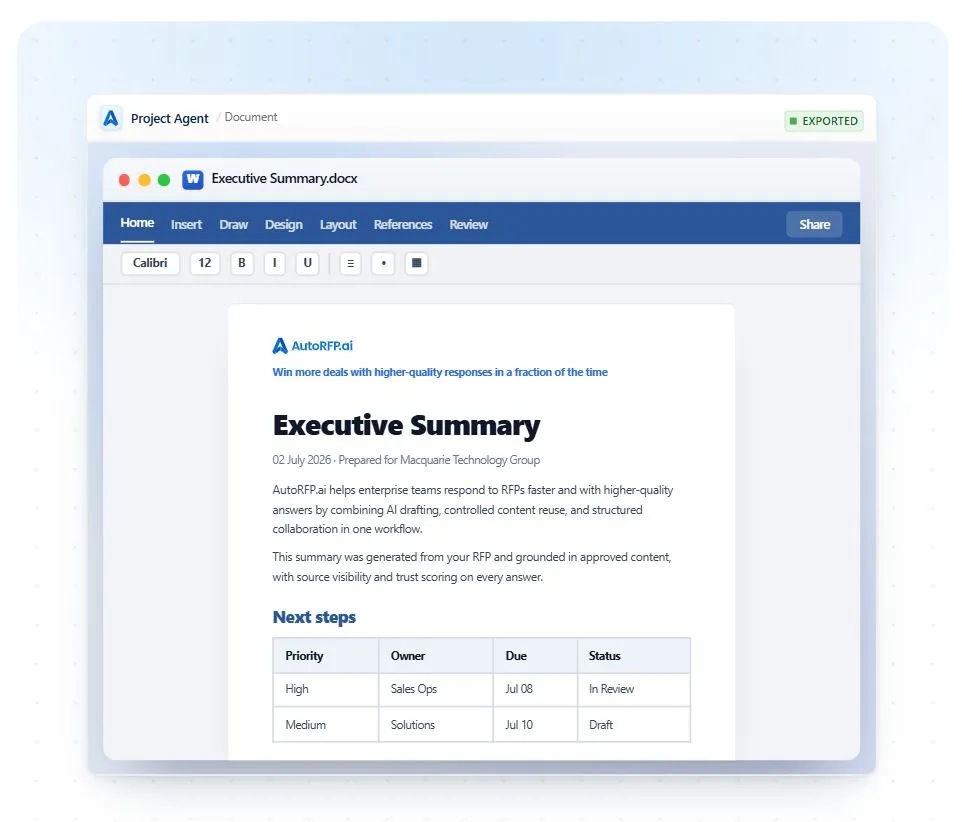
That reduces the manual document reconstruction that can remain even after the questions themselves have been answered.
5. Cross-Functional Collaboration and Approval Controls
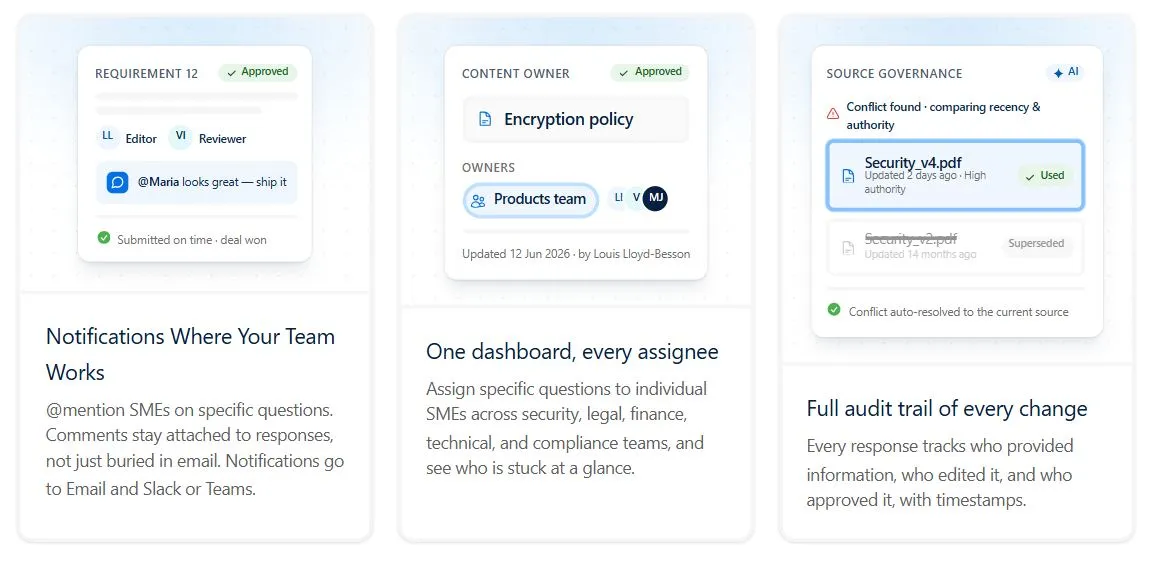
Proposal managers can assign individual requirements to solutions engineers, service-delivery leaders, security specialists, legal reviewers, or other subject matter experts without coordinating separate document versions.
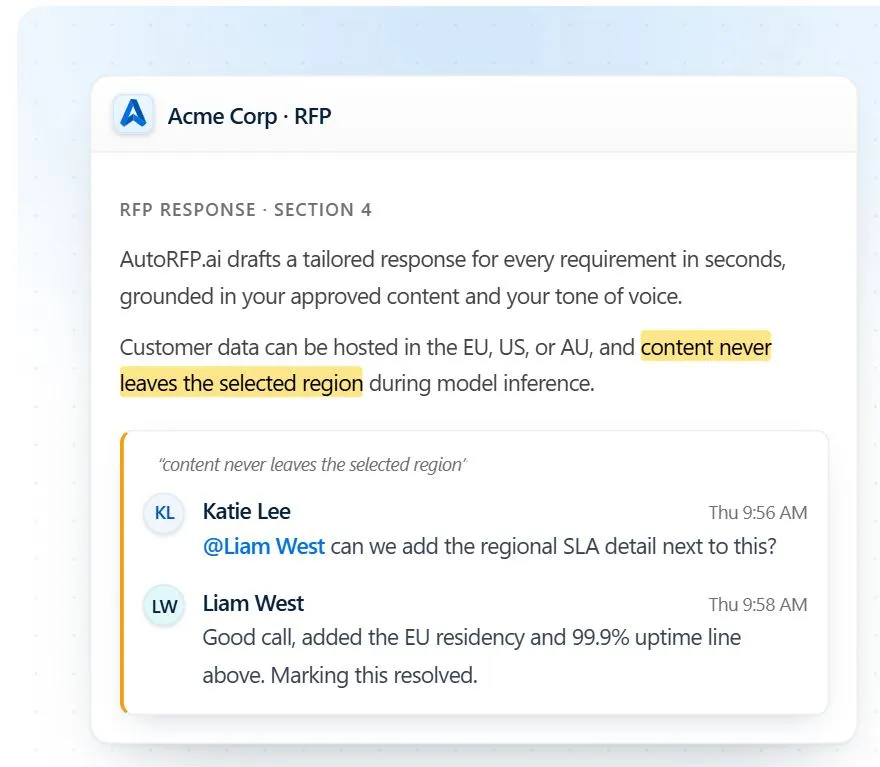
Comments stay attached to individual requirements, while project dashboards track progress, blockers, deadlines, approvals, and open questions. Assignments and reminders can also reach contributors through Slack, Microsoft Teams, or email.
6. Enterprise Security, Identity, and Data Residency
AutoRFP.ai is ISO 27001:2022 certified and SOC 2 Type II audited, so the response platform itself can meet the security expectations that often appear during enterprise IT procurement.
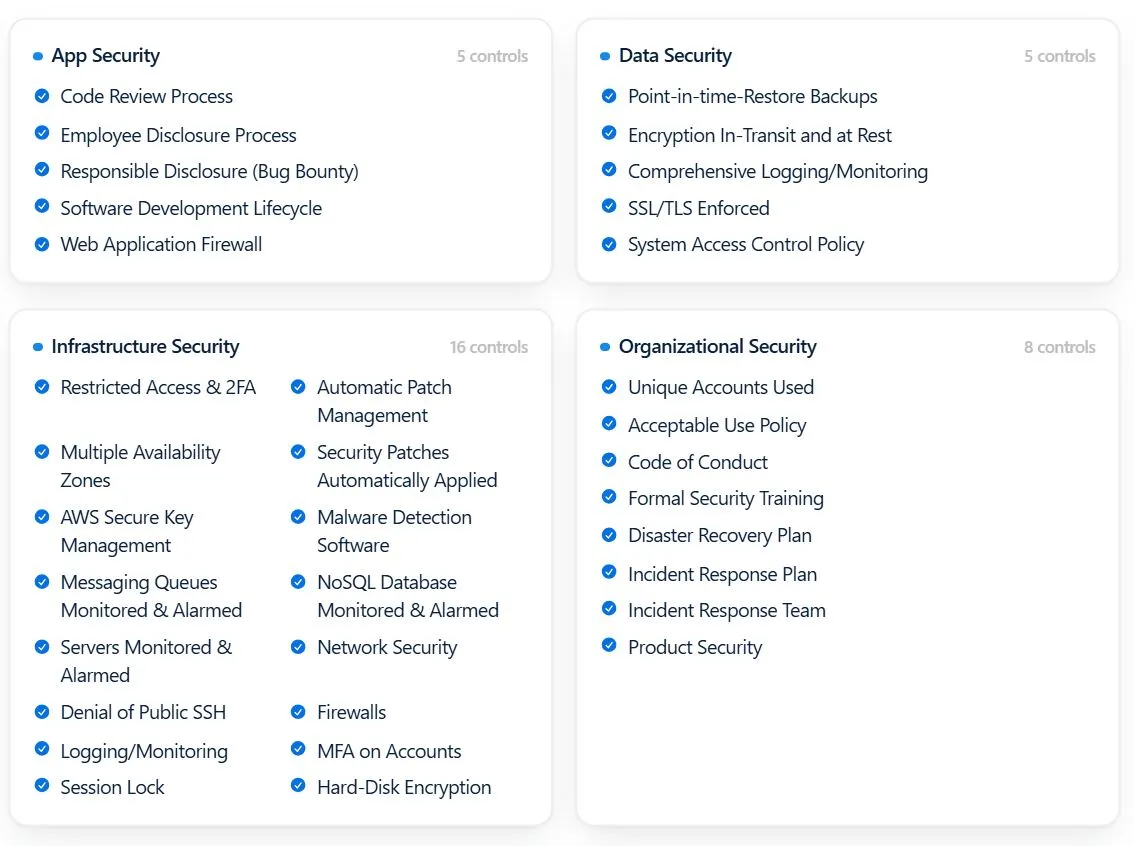
Customer data is not used to train public AI models, and regional data-residency options are available in the US, EU, and AU. Identity integrations include Microsoft Entra, Okta, Google Workspace, and enterprise SSO controls.
Pricing
| Plan | Monthly Cost | Key Inclusions |
|---|---|---|
| Scale | $899 | 24 projects per year, unlimited AI responses, content and users, all features, SSO, 18+ integrations, ISO 27001:2022 and SOC 2, unlimited support and online training |
| Accelerate | $1,299 | 50 projects per year, everything in Scale, advanced analytics and priority support |
| Enterprise | Custom | Scalable projects per year, everything in Accelerate, bespoke implementation, custom integrations, tailored security and compliance, dedicated success support and bespoke terms |
Where AutoRFP.ai Shines
- Blended technical workload: MSPs can manage commercial RFPs and recurring security questionnaires without creating separate response systems.
- Less interruption for engineers: Solutions architects, InfoSec, and service specialists can validate drafted answers instead of repeatedly writing standard technical explanations.
- Complex service portfolios: Connected knowledge is useful when answers need to draw from different service lines, operating models, regions, and technical documentation.
- Buyer portal workflows: Browser-based RFP and security portals are treated as part of the workflow rather than an afterthought.
- Broad SME participation: Unlimited users make it easier to involve specialist reviewers who only contribute to selected bids.
- Predictable collaboration costs: Project-based pricing avoids adding another paid seat every time a technical specialist needs to review a response.
Where AutoRFP.ai Falls Short
- Buyer-side procurement: It helps MSPs and IT services firms respond to RFPs rather than helping enterprises issue and score supplier RFPs.
- Highly designed proposals: Teams whose main requirement is elaborate proposal design and document production may prefer a more document-centric platform.
Customer Review
Trevor C., Solution Consulting Director, said: “AutoRFP has genuinely been a game changer for our team across APAC. It has significantly reduced the time required to respond to RFPs while still maintaining a high standard of quality and accuracy.
Having well-curated responses readily available has allowed us to focus more on solution strategy and customer engagement rather than spending hours searching for content and drafting responses from scratch.”
Verified User in Information Technology and Services said: “Before we had AutoRFP, we used Google Sheets to collaborate and write answers. A lot of time went into reinventing the wheel every time we responded to an RFP. AutoRFP saves us a lot of time suggesting answers for each question. The model just gets better and better as we use it more and train the model. It’s very easy to set up a bid team and collaborate. A concrete feature that has helped us respond more accurately is that it tracks if you have responded to all parts of the question by scoring it 0-100.”
Who AutoRFP.ai Is Best For
- Managed service providers: Firms responding regularly to enterprise service and technology RFPs.
- IT services companies: Organizations coordinating commercial, technical, implementation, and security responses.
- Solutions engineering teams: Groups repeatedly pulled into technical questionnaires and bid responses.
- Growing response operations: Teams that want to increase bid capacity without adding equal amounts of proposal administration.


Video transcript
Did you know the average RFP can take thirty-two hours of manual grueling work? Now, in this video, in under ten minutes, I'm gonna show you how you can use AI RFP automation to drastically reduce the amount of time it takes to get to a first draft for your RFP, DDQ or security questionnaire using AutoRFP.ai. Sick. Let's jump into it. So at AutoRFP, we're an AI RFP software automation platform, across the globe with hundreds of customers using our software every day, battle-tested AI to help you automate RFPs. First, what's the problem? So an RFP or request for proposal or due diligence questionnaire or security questionnaire is a pain felt across all industries, whether it's construction, software, technology, finance, healthcare, anyone selling
to government or private businesses. And these glorified question and answers take hours and hours for people to complete, for them to win new business. It's a crucial part for your business to win enterprise and government contracts, which really help you grow sustainably and quickly. But when you go to bid on one, you are met with the RFP. Average response times are thirty to forty hours, usually involve five to eight people, seventy percent of content is reused but hard to find, and the average win rate across all industries is only forty-three percent. So you're spending hours with uncertainty that you may win, which is where efficiency and writing better responses, leveraging AI helps you win more faster. Now, looking into RFP automation, you have a number of options.
You can pick up a legacy RFP software. They've been around since the late nineties. They brought software to the RFP problem. Effectively, a glorified question and answer bank, like a database. You upload Q&A pairs, and then they try to use keyword matching to find the most relevant to then help you answer questions that you get in your new RFPs and tenders. You can also do AI builds yourself. So you might use ChatGPT or Claude, and you can see our other videos about how you can potentially use them. But effectively, you hit a ceiling where it's hallucinating, it's taking more time now to fix things than it should, and just doesn't have enough context to find the right answer most of the time. Or you can choose an actual AI native leader like AutoRFP.ai. Built from AI from the get go and have built the engine around zero
hallucination, multimodal architecture to leverage the latest models across all your major providers, self-maintaining library approach, so it doesn't take a lot of time to maintain the system, really high automation rates and enterprise security built in from day dot. So why do teams choose AutoRFP.ai? The reason is your knowledge is always current. We integrate with over twenty different systems, and we pull in from all your various file management and different software to make sure that your data is always up to date, and you don't have to maintain it across multiple different places. We're most accurate in the category because we leverage the different models, including specialized re-ranker models, embedding models, search models, and your large language models where they're best. And our team of over fifteen software engineers and AI engineers make sure that this is battle-tested, evals are correct, and it produces the correct answer based off your source context. And it's one platform for every stage of the RFP journey, from intake to new RFP
to AI-powered go/no-go to drafting to reviewing and using agents to review and update your RFP response, translation to collaboration across SMEs and different team members, ensuring that they can easily collaborate in an easy-to-use platform, and then exporting as well. Let's start with the AI native auto library. This is the core of the platform where your different content sources and past projects and up- and web scraping all live in the one place and- Any question that comes up, whether it's in an RFP or a team member asking the question, can be automatically answered with trust-based scores, specific semantic search, and ensures that the correct answer is found and used to then answer and generate an appropriate response. Then effectively, you upload a blank RFP.
The AI-powered response engine then automatically generates responses, translates it and everything to have the correct answers. Then your team can very easily edit, review, integrates with Slack and Teams, and everyone's notified on project deadlines. Now, I've spoken enough. Let's jump into the actual product, and you can see AI RFP automation from the start. We start by creating a project, which is a new RFP. We've got our portal agent that can scrape your requirements from web portals like SAP, Ariba and others, automatically ingesting those answers into your AutoRFP.ai instance, and then automatically drafting responses for you to easily enter back into the portal. Or you can upload a zip that contains a PDF, Excel, Word doc of your RFP and import that into the platform.
First we have our AI go, no-go. This ask different questions of your RFP based on your company context to ensure that should we actually bid on this RFP before we start it. It'll automatically grab out key details and link it to our CRM via our integration with Salesforce and so on. And here it's answered each question, and you can see it has confidence levels, it has trust built in, and you can then look back and see where the original source and what, for instance, table or other information. Our AI importer automatically selects every requirement, child requirements, dropdown pick lists response cells, everything else that's required for that RFP. We can manually change it if needed, but it automatically pulls that in. Then we can choose what content from our library or just choose every content, and our intelligent tagging and hierarchy system will make sure that the most relevant content is used for that response. And then I can create my project.
Next, the AI response engine then automatically starts sourcing the correct content from your auto library, re-ranking and finding the most relevant information, using that to then draft, redraft, and edit responses vi- with AI, and then provide those responses back to you in matter of seconds. And you can see here my thirty or so requirements automatically being filled out across the entire project. It's chosen the relevant pick lists, and each one of these have trust scores that I can understand further where this came from. It also has our AI-powered feedback score, and this is where AutoRFP is different to other systems. We don't wanna just help you source the correct answers. We wanna help you write better responses. And this goes into our feedback loop, where as you use the platform and write better responses, the AutoRFP system learns from those responses, and continually, your responses get better to help you win more faster.
Here we can do inline comments, so I can notify my team and so they can jump in, get notifications. I can submit, approve, add attachments, and everything else I can do in this platform. Finally, we have our project overview, which is our project management HQ for this particular RFP, making sure everyone understands deadlines. You can send reminders out to team members and just know when something needs to be completed by and when completed by and who is completing it, making sure that your RFP response is submitted on time and you're not faced with five PM Friday deadlines, calling someone to make sure you can get the correct answer to the correct question that's our short introduction to AutoRFP.ai. There's a lot more in RFP automation and AI RFP software that you can learn but feel free to reach out to our team. We'd love to provide a detailed demonstration to you so you can understand if this is a good fit for your business Already, AutoRFP.ai is in forty-four-plus countries across the globe with hundreds
of customers across different industries like technology, finance, and healthcare, and our customers are winning more faster. One of our customers like Shana Sweeney from SugarCRM won fifteen of their top twenty-five enterprise customers using AutoRFP.ai. They're using AI RFP automation to win more today, and it's a competitive advantage for their businesses. Our pricing is incredibly transparent. You can find more information on our website, to get in touch with our team, head over to our website, AutoRFP.ai. Book in a demo today and learn more and see if we can help you win more faster.
2. Loopio: Best for MSPs With Mature Content-Library Workflows
Loopio is an established response-management platform centered on a structured Library of approved reusable content.
For MSPs with dedicated proposal operations, this can provide a predictable way to manage recurring answers about service delivery, support models, security, implementation, and company capabilities. Its current platform combines the Library with AI-assisted responses, document scanning, portal workflows, and SME collaboration.
Key Features
- Centralized Library: Organizes approved response content with categories, ownership, tags, and reviews.
- Automated Answers: Uses Library and connected information to generate first-pass responses.
- Confidence indicators: Helps reviewers prioritize generated responses that deserve closer inspection.
- SmartScan: Extracts questions from Word, Excel, and PDF documents.
- Project collaboration: Coordinates assignments, SMEs, reviews, and deadlines.
- Enterprise integrations: Works with tools including Microsoft 365, SharePoint, Salesforce, Slack, and Teams.
Pricing
| Plan | Pricing | Notes |
|---|---|---|
| Foundations | From $20,000/year | Unlimited projects and Library entries, generative AI, themes, and standard support |
| Enhanced | Custom quote | Adds multi-language Library support, confidential projects, and multi-step reviews |
| Enterprise | Custom quote | Adds business units, sandboxes, custom seat counts, and premium support |
Where Loopio Shines
- Established proposal functions: Strong fit when an MSP already has dedicated bid professionals and formal content ownership.
- Repeatable technical responses: Mature reuse workflows work well when buyers repeatedly ask similar service, implementation, and security questions.
- Contributor adoption: Its structured project workflow makes it relatively straightforward to involve SMEs and monitor progress.
- Global RFP programs: Multi-language and enterprise packages suit larger IT services companies working across regions.
Where Loopio Falls Short
- Library maintenance: Teams still need to organize, review, and refresh reusable responses as services and technical controls change.
- Content-owner dependency: Large MSP libraries work best when someone is explicitly responsible for keeping them healthy.
- Initial setup: Building and structuring a useful Library can require significant effort before the full benefit appears.
- Entry price: Foundations begins at $20,000 annually.
- Content drift across services: MSPs with rapidly changing service catalogs need strong ownership processes to prevent similar but outdated answers from being reused.
Customer Review
An Enterprise Account Executive wrote on Gartner, “Loopio provides solid collaboration capabilities for working with cross-functional teams on RFPs. However, the interface can feel clunky and unintuitive, with limited viewing options and a narrow range of export file formats.”
An Information Security Compliance Analyst said, “Pricing could be a challenge for smaller companies and startups, while customization options are limited. Features such as content tagging, advanced search, and workflow automation also have a learning curve and can take time to understand.”
Who Loopio Is Best For
- Established MSP bid teams: Organizations with repeatable proposal processes.
- Dedicated content managers: Teams with clear ownership of reusable technical and service content.
- Library-first operations: Companies comfortable maintaining a governed answer repository.
- Larger IT services firms: Organizations handling substantial recurring RFP and security-questionnaire volume.
3. Responsive: Best for Large IT Services Response Operations
Responsive is a broad enterprise response-management platform for RFPs, DDQs, security questionnaires, and other complex information requests.
Its strongest fit is a larger IT services company with a staffed proposal operation, substantial concurrent bid volume, and a need for deeper project management, reporting, governance, and enterprise administration.
Key Features
- Response Projects: Manages intake, ownership, deadlines, drafting, review, and completion.
- AI-assisted drafting: Generates responses from verified company content.
- TRACE Score: Helps reviewers assess generated responses across trust, relevance, accuracy, completeness, and explainability.
- Requirements Analysis: Helps teams structure and evaluate incoming requirements.
- Content management: Centralizes reusable response knowledge with governance controls.
- Enterprise reporting: Tracks projects, content activity, workload, and response operations.
Pricing
| Plan | Pricing | Notes |
|---|---|---|
| Emerging Edition | From $10,000 | Unlimited Response Projects, AI and automation, content, collaboration, integrations, reporting, and support |
| Growth Edition | Contact sales | Adds intake workflows, advanced integrations, stronger access controls, and flexible hosting |
| Enterprise Edition | Contact sales | Adds custom AI, enterprise security controls, advanced reporting, and premium connectors |
Responsive states that final deployment pricing combines the platform fee, user licenses, and selected add-ons or services.
Where Responsive Shines
- High concurrent volume: Designed for organizations managing many active RFPs and questionnaires at the same time.
- Large service organizations: Strong project controls help coordinate regional teams, solution practices, security, legal, and operations.
- Leadership visibility: Reporting provides more operational insight into workload, content use, and response performance.
- Formal governance: Useful for IT services firms with defined proposal processes and multiple approval layers.
- Broad response scope: RFPs and security questionnaires can run through the same enterprise response environment.
Where Responsive Falls Short
- Implementation weight: Smaller MSPs may not need the full breadth of an enterprise Strategic Response Management platform.
- Content administration: The centralized content model still requires ongoing ownership and governance.
- Contributor cost: Buyers should model licensing when many occasional technical specialists need access.
- Complexity: Infrequent users may face a steeper learning curve than with lighter response tools. G2 currently reports an average implementation time of about two months.
- Total pricing visibility: Final cost can depend on edition, user count, add-ons, and services.
Customer Review
Bill L., Global Institutional Sales Support and Client Relations, said on Capterra, “Responsive has greatly improved my efficiency by making it easy to manage and reuse Q&A pairings. Tags and collections help quickly filter relevant content and avoid irrelevant answers. Overall, it is a very helpful platform.”
Eric S., Customer Service Support in Internet, said, “Responsive helps teams get through RFPs faster and stay organized, although there is a learning curve. The platform can feel dense, exports often need manual formatting cleanup, and the library requires regular management to keep search results from becoming cluttered.”
Who Responsive Is Best For
- Large IT services firms: Organizations running substantial, complex bid pipelines.
- Global MSPs: Companies coordinating proposal work across regions and service lines.
- Dedicated proposal operations: Teams that need detailed governance and reporting.
- Cross-functional enterprises: Organizations involving legal, InfoSec, technical, and commercial teams in most submissions.
4. Arphie: Best for Solutions Engineering Teams Wanting Source Transparency
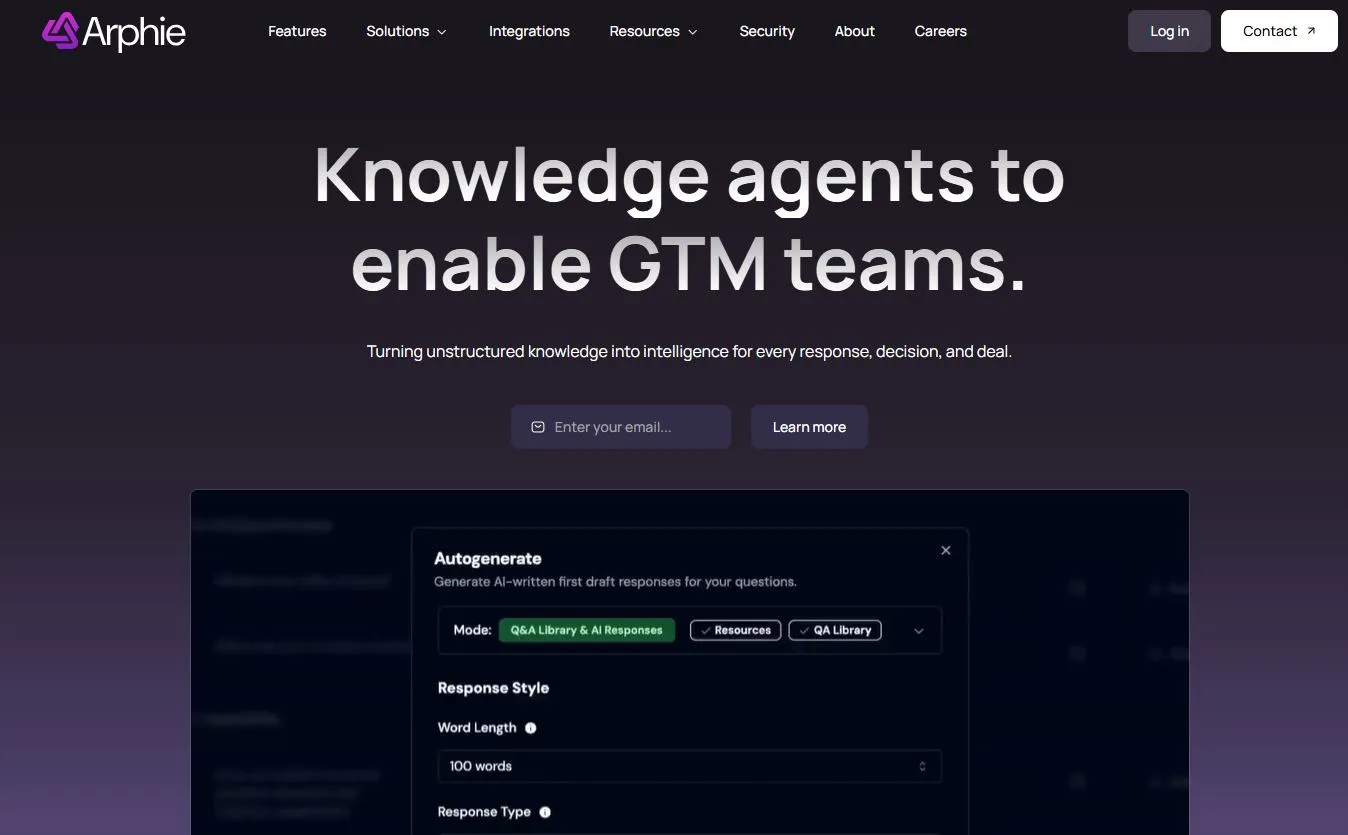
Arphie is a modern RFP and questionnaire platform that generates first-pass responses from company knowledge while showing reviewers the sources used and an AI confidence level.
That makes it particularly relevant to MSP and IT services solutions teams that want technical answers to draw from current documentation rather than depending entirely on a manually curated Q&A repository.
Key Features
- Source-backed drafting: Shows the material used to generate each response and its confidence level.
- Connected knowledge: Syncs with SharePoint, Google Drive, Confluence, Notion, Seismic, Highspot, and other repositories.
- AI customization: Controls vocabulary, tone, detail, and project-specific writing instructions.
- Complex document workflows: Imports Word and Excel files and exports approved responses back into their original format.
- Collaboration: Supports owners, writers, reviewers, comments, permissions, and deadlines.
- Built-in analytics: Tracks progress, editing, and AI-assisted response activity.
Pricing
There is no publicly available pricing tier for Arphie AI. Instead of offering fixed, self-service subscription plans, Arphie uses a quote-based, “contact us” pricing model. This means pricing is tailored to your team’s RFP volume, workflow complexity, and implementation requirements.
Arphie has an indicative pricing range for its services, even though full plans are not publicly listed.
| Annual cost range | Pricing model | Key features | Implementation cost |
|---|---|---|---|
| $36,000-$60,000+ | Concurrent projects | Advanced AI, transparent sourcing, rapid implementation | White-glove included |
Where Arphie Shines
- Solutions engineering fit: Useful for technical teams that want to reduce repetitive response work without losing visibility into the underlying evidence.
- Distributed technical knowledge: Live integrations suit MSPs whose current information is spread across several documentation systems.
- Flexible customer-facing writing: Controls over tone and detail help teams adapt technical answers for different buyers.
- Broad contributor access: Unlimited-user pricing makes it easier to involve architects, security engineers, and other occasional reviewers.
- Modern adoption experience: Current G2 feedback frequently highlights ease of use and significant time savings.
Where Arphie Falls Short
- Shorter market history: It has a smaller long-term enterprise track record than Loopio, Responsive, or Qvidian.
- No fixed dollar pricing: Buyers need to contact sales for an exact quote.
- Reporting depth: Some G2 reviewers have noted that reporting remains an area for continued development.
- High-governance environments: MSPs with highly layered legal, security, or executive approval chains should model their actual sign-off process during the proof of concept.
- Standalone Trust Center: Companies looking primarily for a customer-facing security assurance portal may need a specialist security-review product.
Customer Review
A Director shared on Gartner, “Arphie stood out in side-by-side testing for answer quality, depth, and transparency. Its AI can use synced folders to reduce the need to chase SMEs for content updates, while source visibility and confidence indicators make AI-generated answers easier to trust.”
A Senior Associate said, “Arphie integrates with workflows across Product, Engineering, Security, and Legal, allowing teams to connect directly to designated files and folders for updated information. Its AI uses that content to respond to RFPs and questionnaires, reducing the need to chase colleagues and saving significant time.”
Who Arphie Is Best For
- Solutions engineering teams: MSPs where SEs own a large share of technical RFP work.
- Connected-knowledge organizations: Companies whose service information lives across several repositories.
- Cross-functional technical teams: Firms wanting broad reviewer participation without per-seat restrictions.
- Modern response teams: Organizations seeking a newer source-transparent drafting workflow.
5. 1up: Best for Lean MSP and Presales Teams
1up combines questionnaire automation with an answer layer that makes company knowledge accessible to sales, solutions engineering, security, and other teams.
MSPs can use it for RFPs and security questionnaires while also surfacing company answers inside Slack, Microsoft Teams, Google Chat, and browser workflows. That makes it useful when the underlying problem is as much about finding technical information as coordinating a formal proposal.
Key Features
- Questionnaire automation: Generates RFP and security-questionnaire responses from connected knowledge.
- Knowledge connectors: Pulls information from previous RFPs, company documents, websites, and connected systems.
- Messaging integrations: Surfaces answers in Slack, Teams, and Google Chat.
- Browser extension: Helps answer questions inside third-party web portals.
- MCP Server: Makes approved organizational knowledge available through supported external AI workflows.
- Human escalation: Can bring a person into the process when additional input is required.
Pricing
| Plan | Pricing | Notes |
|---|---|---|
| Free | $0 | 1 admin, 50 knowledge uploads, and 50 answers/month |
| MCP | $50/month plus usage | MCP Server with usage-based questionnaire automation |
| Starter | $300/month | Unlimited users and answers, messaging/browser integrations, 1 questionnaire/month |
| Plus | $900/month | Additional knowledge capabilities and 6 questionnaires/month |
| Enterprise | Custom | Enterprise administration and success support |
Where 1up Shines
- Low entry barrier: Smaller MSPs can test the product without starting with a large enterprise contract.
- Everyday technical Q&A: Engineers and salespeople can retrieve company answers outside formal RFP projects.
- Lean-team economics: Unlimited users on Starter and Plus can suit teams with many occasional contributors.
- Fast adoption: G2 currently reports an average implementation time of less than one month.
- Security-heavy teams: The same answer layer can support security assessments and commercial questionnaires.
Where 1up Falls Short
- Complex proposal operations: Large bid teams may need deeper project management, dashboards, governance, and administrative controls.
- Layered approvals: Organizations requiring several sequential sign-off stages should test the workflow carefully.
- Narrative proposals: Long, strategic proposal development is not the platform’s main specialization.
- Monthly questionnaire allowances: Starter and Plus include defined questionnaire volumes.
- Maturing platform: Current G2 feedback remains positive overall but notes that parts of the feature set are still developing.
Customer Review
A Product Security Program Manager said, “We evaluated more than 20 vendors and 1up was the clear winner for managing our answer knowledge base and RFQs. Its intuitive interface requires almost no training, while the team is highly responsive and willing to make updates based on our requests. 1up has also saved us significant time.”
A Global Bid Manager wrote, “The knowledge base needs to be kept up to date, although that is largely an internal responsibility. Ask 1up also has a character limit, so longer questions with multiple requirements sometimes need to be broken into smaller parts. More detailed usage reporting would also be useful as the user base continues to grow.”
Who 1up Is Best For
- Smaller MSPs: Teams that need practical automation without a heavyweight proposal platform.
- Lean presales organizations: Companies where solutions engineers complete most questionnaires.
- Technical sales teams: Groups that need approved answers during everyday customer conversations.
- Budget-conscious buyers: Organizations that value transparent entry pricing.
6. Qvidian: Best for Document-Heavy IT Services Proposal Teams
Qvidian, part of Upland Software, is a long-established proposal-management platform built around reusable content, Microsoft Office workflows, document automation, formal approvals, and reporting.
For IT services organizations that build substantial customized proposals inside Word, Excel, and PowerPoint, that document-centric model remains a genuine strength. Its AI capabilities now include automated answering, content generation, document analysis, and AI Assist within the wider proposal workflow.
Key Features
- Central content library: Stores approved RFP and proposal information for reuse.
- AutoFill: Uses AI and machine learning to recommend relevant library content.
- AI Assist: Supports drafting, rewriting, and adapting response text.
- Microsoft Office integration: Makes Qvidian content available directly in Word, Excel, and PowerPoint.
- Custom workflows: Supports assignments, approvals, audit tracking, and versioning.
- Reporting: Provides extensive analytics around proposal and content activity.
Pricing
Qvidian does not publish standard subscription pricing. Upland provides pricing through a custom sales quote based on the required deployment and capabilities.
Where Qvidian Shines
- Microsoft Office-heavy workflows: Particularly strong for proposal teams that build detailed final submissions in Word and Excel.
- Document production: Templates and automated builds help create structured, professionally formatted proposals.
- Formal governance: Established workflows, permissions, audit tracking, and versioning suit controlled enterprise environments.
- Large content repositories: Mature content-management capabilities support organizations with substantial reusable proposal material.
- Long operating history: Qvidian has more than 200,000 users according to Upland and a substantial enterprise footprint.
Where Qvidian Falls Short
- Content maintenance: The central library still needs active organization, reviewing, and updating.
- Administrative complexity: Document architecture and structured content workflows can require dedicated platform expertise.
- Implementation effort: G2 currently reports an average implementation time of about four months.
- Modern answer verification: Teams prioritizing per-answer source evidence and confidence signals should test how those controls work on difficult technical questions.
- Pricing transparency: Buyers must complete a sales process before comparing exact cost.
Customer Review
Barry T., Client Solutions Sr. Manager, said on Capterra, “Qvidian is a major time saver for RFPs and complex questionnaires, with strong spreadsheet search, flexible Word and Excel support, and easy response reuse. However, Autosearch can require multiple attempts to find the best answer.”
Cindy B., MarCom Writer, said, “Qvidian improves RFP productivity, response quality, and SME reviews by keeping an edit history. However, user permissions can be difficult to customize, and a more accessible user guide would be helpful.”
Who Qvidian Is Best For
- Large IT services firms: Organizations with mature bid departments and substantial document requirements.
- Microsoft Office-centered teams: Proposal writers who spend most of their working day in Word and Excel.
- Template-heavy responses: Firms producing carefully branded, structured proposals.
- Governance-focused bid functions: Teams requiring formal workflows, reporting, and audit records.
How to Choose the Right RFP Software for MSPs and IT Services
The right RFP platform should fit the realities of selling managed and professional services: highly technical questions, frequent security reviews, service-specific answers, difficult buyer formats, and subject matter experts whose primary job is delivering services rather than writing proposals.
1. Start With the Technical Answers That Carry the Most Risk
Do not evaluate a platform using simple questions about company size or office locations. Test SLA commitments, incident response, privileged access, backup and recovery, data residency, subcontractors, escalation models, and security controls.
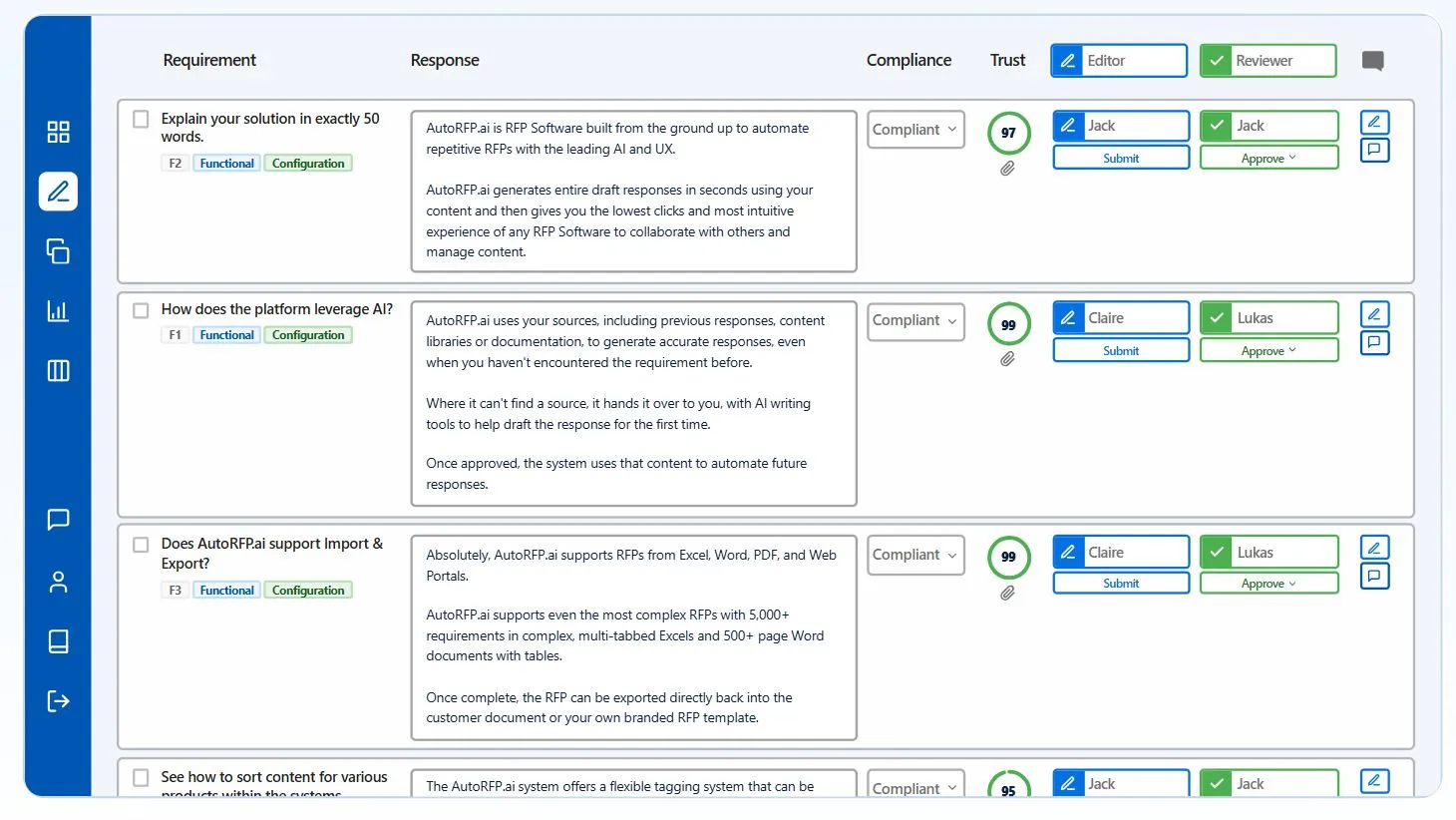
The reviewer should be able to see what evidence supports the answer and recognize when the available information is insufficient. AutoRFP.ai uses source citations and Trust Scores for this purpose and routes unsupported responses back to a person rather than relying on guesswork.
2. Check Whether It Keeps Service Lines and Regions Separate
An MSP may offer managed cloud, cybersecurity, network operations, workplace support, application services, and professional services under the same brand. The correct answer can change depending on which service, delivery team, geography, or infrastructure model the buyer is evaluating.
Loopio can work well when those distinctions are managed through a mature structured Library. Arphie takes a more connected-source approach. Whichever model you choose, test similar questions that deliberately require different answers across service lines.
3. Use the Buyer’s Worst File and Portal During the Demo
A polished in-app demo does not tell you how the software handles a 15-tab spreadsheet, a Word document with nested tables, or a customer portal with no export button.
AutoRFP.ai’s Portal Agent handles browser-based questionnaires, while its file workflow supports Word, Excel, and PDF responses with original-format export. Loopio and Arphie also publish document-import and portal or export capabilities, so test each tool against the formats your largest customers actually send.
4. Measure How Much Engineer Time Is Actually Removed
The wrong automation workflow still leaves solutions architects and security specialists rewriting most of what AI produces.
During a proof of concept, measure edit levels, escalations, reviewer effort, and where technical contributors are still becoming bottlenecks.
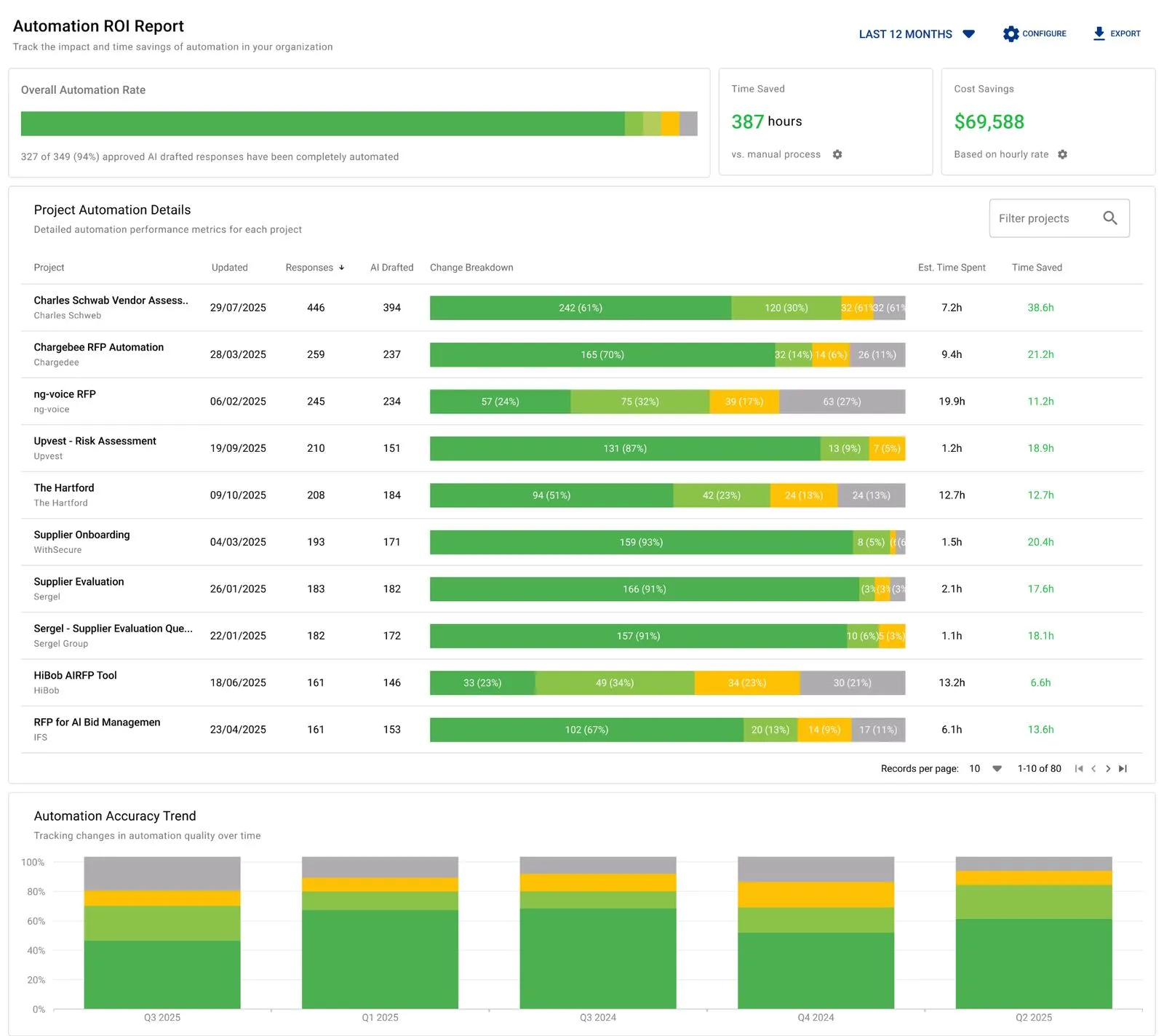
AutoRFP.ai’s Automation Reporting can provide that view, while 1up’s Slack and Teams workflows can be useful when the bigger problem is repeated internal questions.
5. Look at What Happens Before and After the RFP
For MSPs, poor-fit bids can consume days of architecture, commercial, security, and service-delivery effort before the team realizes a mandatory requirement cannot be met.
Responsive provides Requirements Analysis for formal enterprise response programs. AutoRFP.ai adds Go/No-Go Analysis for early qualification and Gap Analysis for identifying requirements that repeatedly block or weaken bids.
Those capabilities become more valuable over time because the RFP process starts informing decisions about certifications, service capabilities, integrations, security controls, and roadmap priorities rather than simply producing another completed document.
Future of RFP Automation for MSPs and IT Services
RFP automation for MSPs and IT services firms will increasingly focus on protecting technical capacity while making complex buyer responses easier to verify. AutoRFP.ai’s 2026 Proposal Win Rate Report found that operating structure, governance, customer insight, and SME involvement explain performance better than AI adoption alone.
- Engineers will validate more and draft less: Solutions architects and security SMEs will increasingly review generated technical responses rather than recreating standard answers.
- RFPs and security questionnaires will converge: Commercial, technical, privacy, and security requirements will increasingly move through the same response workflow.
- Source evidence will become standard: Reviewers will expect technical claims to stay connected to current policies, service documentation, and approved evidence.
- Portal automation will expand: More response work will move directly between governed knowledge and procurement or vendor-risk portals without manual copy and paste.
- Recurring gaps will inform service strategy: Repeated requirements around certifications, integrations, coverage, or controls can become useful input for service and security roadmaps.
- Automation quality will replace autofill volume: Leaders will care more about edit rates, reviewer effort, escalations, and usable capacity than how many cells AI populated.
For MSPs, the next generation of RFP software will therefore be judged by technical reliability, SME efficiency, workflow coverage, and how well response knowledge stays current as services evolve.
Scale Technical RFP Responses With AutoRFP.ai
AutoRFP.ai gives MSP and IT services teams one governed workflow for RFPs, security questionnaires, and DDQs. Technical answers stay connected to approved sources and Trust Scores, while unsupported questions remain with human specialists for review.
Portal Agent, original-format export, current-source governance, unlimited collaboration, enterprise integrations, ISO 27001 and SOC 2 Type II controls, and zero library maintenance help sales, solutions engineering, security, and service-delivery teams work through the same response process.
We would rather show you than tell you: prove it on your own bids in a two-week proof of concept. Book a demo to see AutoRFP.ai in action
About the author

Technical Account Manager
Technical Account Manager at AutoRFP.ai. Background in asset management completing institutional RFPs and DDQs; now implements AutoRFP.ai for some of the company's largest accounts.
LinkedInFrequently asked questions
How much does RFP software for IT services and MSPs cost?
Pricing varies widely depending on users, response volume, integrations, and enterprise requirements. Loopio is reported to start around $20,000/year. Responsive uses quote-based pricing, Arphie provides custom pricing, and 1up publishes plans ranging from free tiers to paid plans starting at $300/month. AutoRFP.ai publishes project-based pricing from $899/month with unlimited users, which can support MSP teams involving sales, technical, security, and delivery stakeholders in the same response workflow.
What is the best RFP software for IT services and MSPs?
AutoRFP.ai, Loopio, and Responsive all serve this market, but they take different approaches: AI-native platforms retrieve and generate responses from connected knowledge sources, while library-first platforms rely more heavily on curated content management and ongoing maintenance.
Why do MSPs need RFP software specifically?
MSPs bid frequently and handle many repeat requirements around SLAs, security posture, staffing models, compliance, and service delivery. Managed-services opportunities also often include security questionnaires and statements of work that require input from technical and operational teams. RFP software helps MSPs reuse approved answers across client bids, keep security responses consistent, and reduce repetitive manual work as bid volume grows.
Can RFP software handle statements of work and RFQs, not just RFPs?
Some RFP platforms can support broader RFx workflows, including RFPs, RFIs, and narrative sections of statements of work. However, purely price-driven RFQs are often better handled by dedicated quoting or CPQ tools. MSPs should evaluate whether a platform can manage document-based responses, reusable service descriptions, technical requirements, and SOW-style content rather than only questionnaire grids.
Is AI RFP software secure enough for MSP client data?
AI RFP software can be secure enough for MSP client data when vendors provide appropriate controls. MSPs often handle sensitive client requirements, security documentation, and operational details, so they should evaluate controls such as SOC 2 Type II and ISO 27001 certifications, commitments that customer data is not used to train public models, SSO, role-based access controls, and audit trails. Since MSPs are frequently evaluated on their own security practices, these requirements should be key considerations when selecting an AI RFP platform.
