
Responsive vs AutogenAI: Which RFP Software Is the Better Fit?
Responsive vs AutogenAI, compared honestly. See where each fits, plus AutoRFP.ai, the source-grounded platform for RFPs, security questionnaires, and DDQs.

Co-founder & CEO, AutoRFP.ai··13 min read
| Responsive | AutogenAI | |
|---|---|---|
| Best for | Mature proposal operations and multi-team response workflows | Long-form bids and persuasive proposal writing |
| Core approach | Content Library plus AI, workflows, reporting, and governance | AI-first proposal research, drafting, and editing |
| RFPs | Yes | Yes |
| Security questionnaires | Strong dedicated workflow | Supported within its proposal workflow, but less central to its positioning |
| DDQs | Yes | Less central to its public product positioning |
| Long-form proposal writing | Capable | Major strength |
| Source visibility | Source citations and TRACE Score | Source Finder for sourced content |
| Knowledge sources | Trusted Content Library and prior responses | Company knowledge plus external sources |
| Public pricing | Emerging Edition starts at $10,000; Growth and Enterprise require a sales conversation | No standard public dollar price |
| G2 rating | 4.5/5 | 4.3/5 |
Is Responsive or AutogenAI Better for Your RFP Team?
The right RFP software should take pressure off the work slowing your team down, whether that’s coordinating approved content or turning a blank page into a strong proposal.
Responsive is built more around the first problem, helping proposal teams manage content and keep response projects moving. AutogenAI focuses more on the writing process, with tools designed to develop longer proposal content.
Your choice ultimately comes down to where your RFP process needs the most help. This guide looks at how each platform supports RFP work and what you can expect from both.
Why this comparison
AutoRFP.ai runs response work for teams across APAC, EMEA, and North America, with the platform supporting 44+ languages. Workforce.com, for instance, doubled its RFP participation rate and has won more than 50 bids using the platform, while Cubiko cut security questionnaire response time by 85%.

Responsive for Complex Proposal Operations
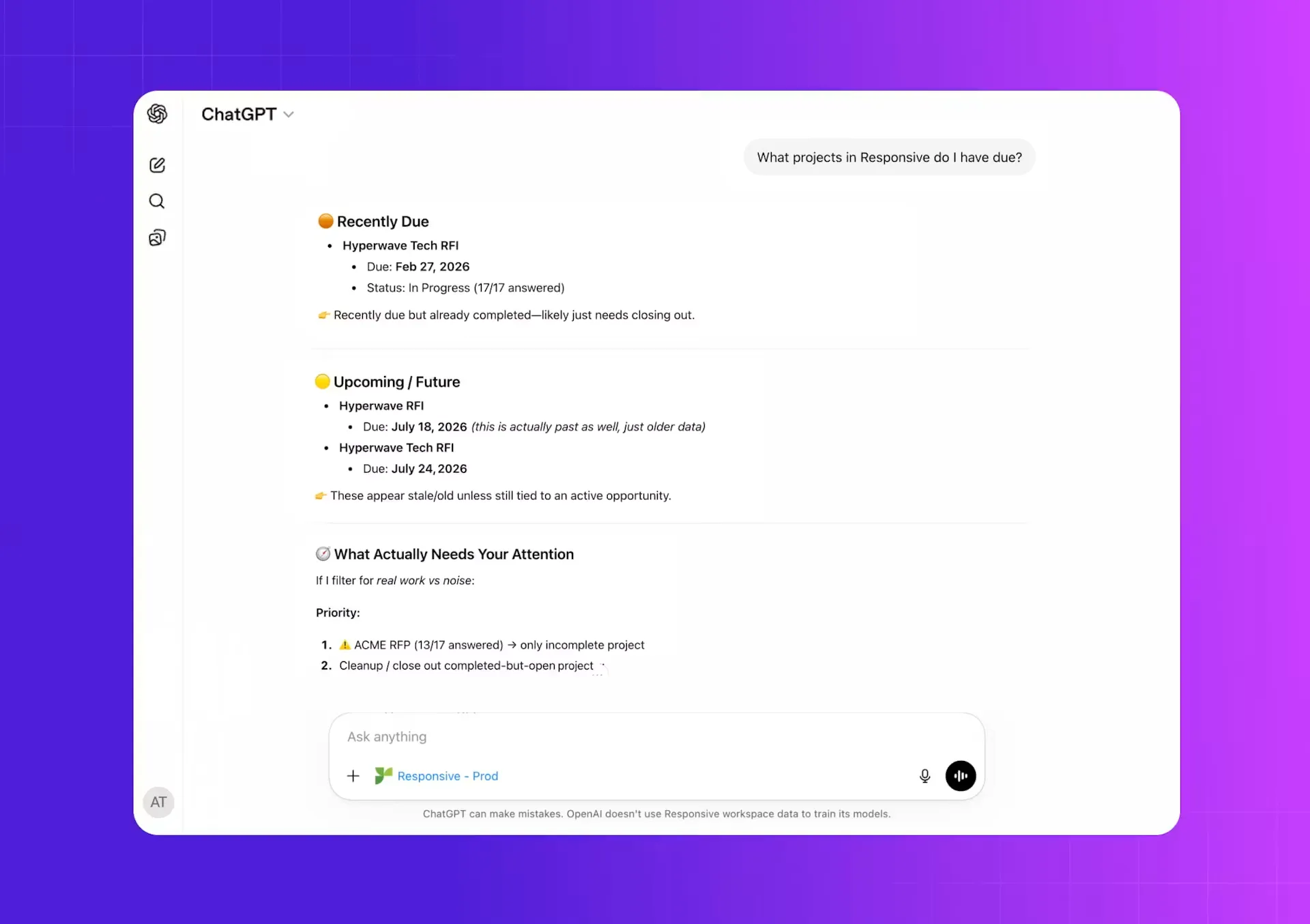
Responsive is built for RFP processes that involve a lot of coordination. Its Response Projects product gives proposal teams a structured place to manage the work from intake through completion.
You can use Responsive to:
- Import questionnaires: Bring Word, Excel, and PDF files into the platform for response.
- Coordinate contributors: Assign questions to the right people and keep track of outstanding work.
- Manage reviews: Set up review workflows and monitor progress as the deadline approaches.
- Reuse approved answers: Search the Content Library for vetted material when similar questions come up.
- Draft with AI: Generate responses from existing content and use source citations to check the material behind them.
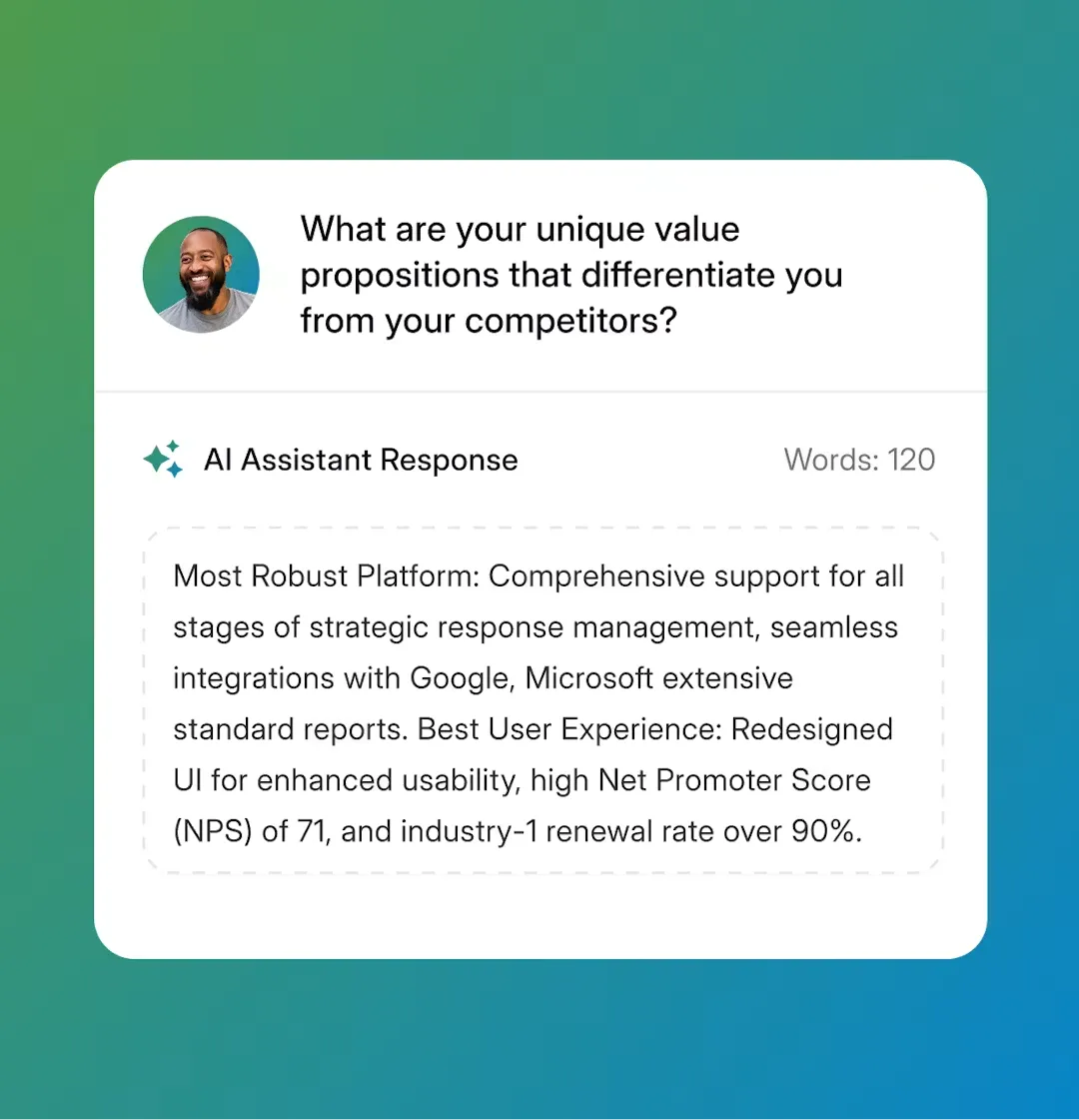
Much of that workflow runs through Responsive’s Content Library, where teams keep vetted answers and find past material when similar questions come up. Responsive AI can draft from this trusted content, with source citations available for verification.
The drawback is the upkeep that comes with a large content library. Answers need to be reviewed and updated over time, and finding the right version can become harder as more content accumulates.
For established proposal teams with a structured response process, that level of management may be expected. Leaner sales or presales teams may prefer an approach that requires less ongoing content maintenance.
Pros
- Proposal operations depth: The project-management and reporting stack in this category is Responsive’s, and distributed teams can run multiple response projects from one place.
- Board-level analytics: Reporting is built for reporting upward, not only for tracking work.
- Buy-side and RFQ coverage: Responsive covers procurement-side and quote-driven workflows. AutoRFP.ai deliberately does not, so this is genuinely their column.
- Professional services depth: Implementation and ongoing services are available for teams that want them.
- Trust Center: A standalone security-document portal for buyers who want one.
Cons
- Content upkeep: The library needs an owner and a maintenance rhythm to stay accurate and findable.
- Setup can take time: G2 reviewers mention a learning curve and some setup work, particularly around organizing content and getting teams comfortable with the platform.
- Human review remains part of the workflow: Responsive explicitly keeps people responsible for reviewing and approving AI-generated content. Buyers should account for the review work that remains after the first draft.
- Pricing visibility: Emerging starts at $10,000 (Responsive pricing page, Sep 2026), while Growth and Enterprise require a quote.
AutogenAI for Long-Form Proposal Writing
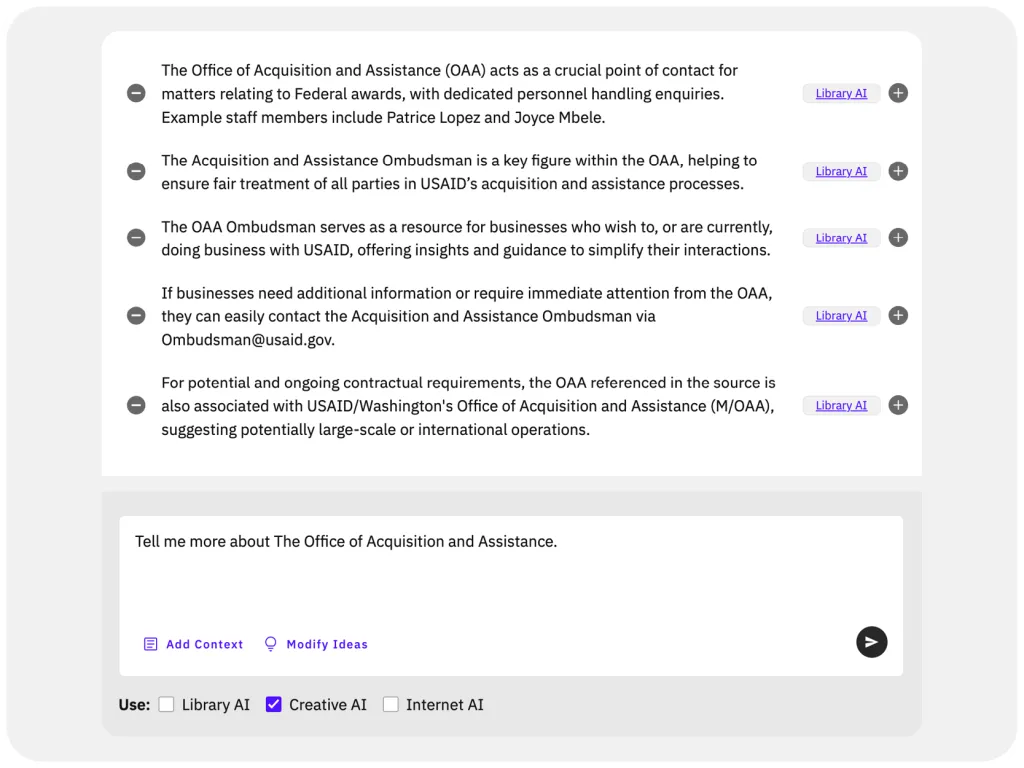
AutogenAI is an AI-powered proposal writing platform built for bid and proposal teams. Its tools focus on developing long-form responses from your existing knowledge, with support for the writing process from early ideas through the finished draft.
Its Editor brings that work into one place. Writers can use Ideator to plan a response, then draw on company knowledge or external sources as they write. Source Finder helps trace supporting material back to the original documentation.
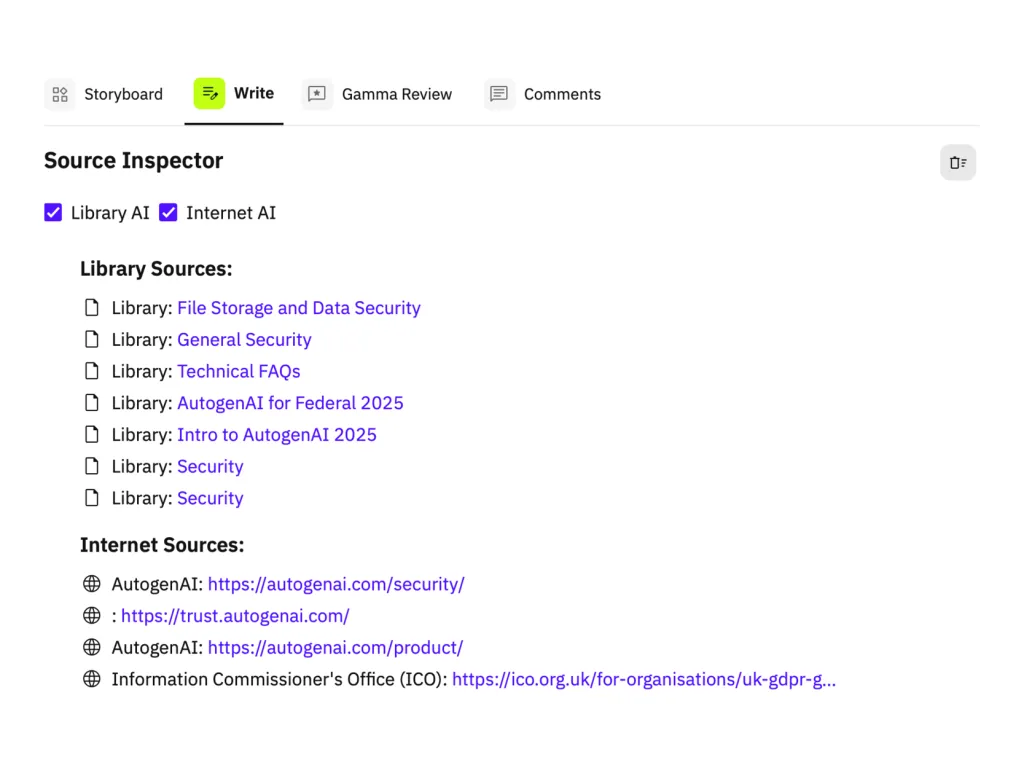
That makes AutogenAI particularly useful when the quality of the narrative carries weight in the evaluation, including detailed methodologies and government tenders. The fit becomes less natural for large security questionnaires or DDQs, where teams need concise answers backed by clear evidence.
Pros
- Long-form writing: Helps writers turn existing material into detailed proposal responses without starting from a blank page.
- Proposal-specific tools: Ideator helps plan responses, while Source Finder connects supporting material back to its source.
- Public-sector bids: AutogenAI has a dedicated federal offering, including a FedRAMP High-authorized environment for U.S. federal proposal work.
- Company knowledge: Draws on existing company content so new drafts can build from material the organization already maintains.
Cons
- Private pricing: AutogenAI does not publish a standard dollar price. Its current U.S. terms (Sep 2026) say purchased services and fees are defined in the customer’s Order Form.
- Drafts may need refinement: G2 reviewers say generated content can sometimes feel generic or repetitive, leaving teams to fine-tune the wording for the specific bid.
- Structured questionnaires: AutogenAI supports Excel-based questionnaires through Q&A Workbooks, though its wider product is centered on end-to-end proposal development. Teams handling mostly large security questionnaires or DDQs may want to compare how its requirement-level workflow fits that work.
- External sources need clear controls: AutogenAI can combine internal knowledge with selected outside sources during generation, so regulated teams may need clear rules around which sources can be used for each response.
- Getting up to speed can take time: G2 reviewers mention a learning curve around AutogenAI’s features and navigation, so new users may need time to learn how to get the most from the platform.
Responsive vs AutogenAI Pricing
Responsive now publishes a starting price for its Emerging Edition at $10,000 (Responsive pricing page, Sep 2026). Growth and Enterprise remain sales-led.
For additional market context, Vendr reports a median Responsive contract of $14,750 per year based on 133 purchases, with observed deals ranging from roughly $5,400 to $40,000 (Vendr marketplace listing, Sep 2026).
AutogenAI does not publish standard dollar pricing, so you will need to contact its sales team for a quote. Its current U.S. terms (Sep 2026) confirm that the services and fees you pay are set in your individual Order Form, making a direct public cost comparison difficult.
Where Responsive and AutogenAI Leave a Gap
Some RFP work leaves very little room for an unsupported answer. A security questionnaire may be reviewed by procurement, while a DDQ can contain claims your company needs to stand behind.
For that kind of work, you need:
Answers grounded only in approved company sources.
A clear source attached to each response.
A system that routes a question to a person when the approved content cannot support an answer.
Responsive relies heavily on the content your team maintains in its library, which means answer quality depends on how well that content is kept up to date. AutogenAI is designed to produce strong proposal copy, but fluent writing alone does not tell you whether every claim is supported.
Why Accuracy Decides High-Stakes Response Work
In a security questionnaire or DDQ, one confident wrong answer can create an expensive problem.
AI can speed up drafting, but current models still produce unsupported answers often enough that regulated teams need every response to be easy to verify.
A 2026 benchmark from Digital Applied tested 5,000 prompts across five frontier models and found hallucination rates ranging from 3.1% to 19.1%, depending on the model and task. For teams working in regulated environments, each answer needs a source they can trace and review before submission.
Responsive’s own 2026 State of Strategic Response Management Report, produced with the APMP, makes a related point from the buyer’s side: as AI becomes standard, the differentiator is no longer having AI but whether the response process can withstand scrutiny.
AutoRFP.ai is built around that requirement. Its zero hallucination by design approach drafts from approved company content, cites the source behind each answer, scores confidence, and routes unsupported questions to a person rather than guessing.
How AutoRFP.ai Approaches the Problem
AutoRFP.ai is the AI-native platform that passes compliance review. Its Verifiable Response Engine drafts only from approved company content and shows reviewers the sources behind each response.
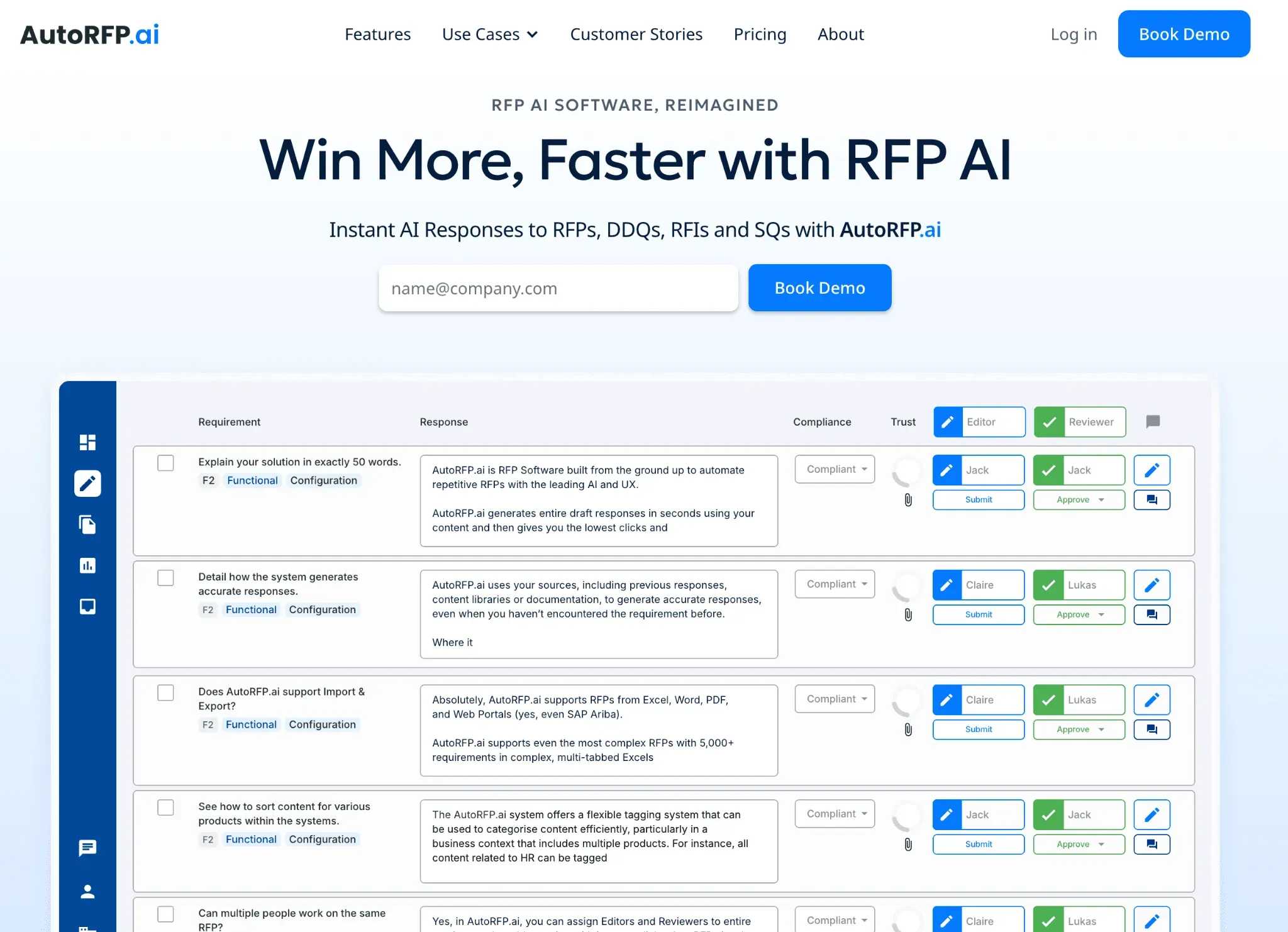
The workflow is built to surface problems before submission:
Verify the answer. The Citation Engine shows the exact sources used, and the Trust Score reports the platform’s confidence in that source material, including how current it is.
Check the response. The Feedback Score reports how fully the answer addresses the requirement, with context and suggestions where it falls short.
Escalate what cannot be supported. Where approved sources do not carry enough evidence, AutoRFP.ai hands the question to a person instead of generating an answer around the gap.
That failure behavior is central to AutoRFP.ai’s approach. The system is designed to abstain when the evidence is missing, so reviewers spend their time resolving genuine gaps rather than trying to spot convincing answers that may not be supported.
What You Get With AutoRFP.ai
AutoRFP.ai is designed to take repetitive response work off your team’s plate without making verification harder. The strongest parts of the platform come down to how it handles answer quality, review work, and day-to-day RFP operations.
Quality Responses That Win
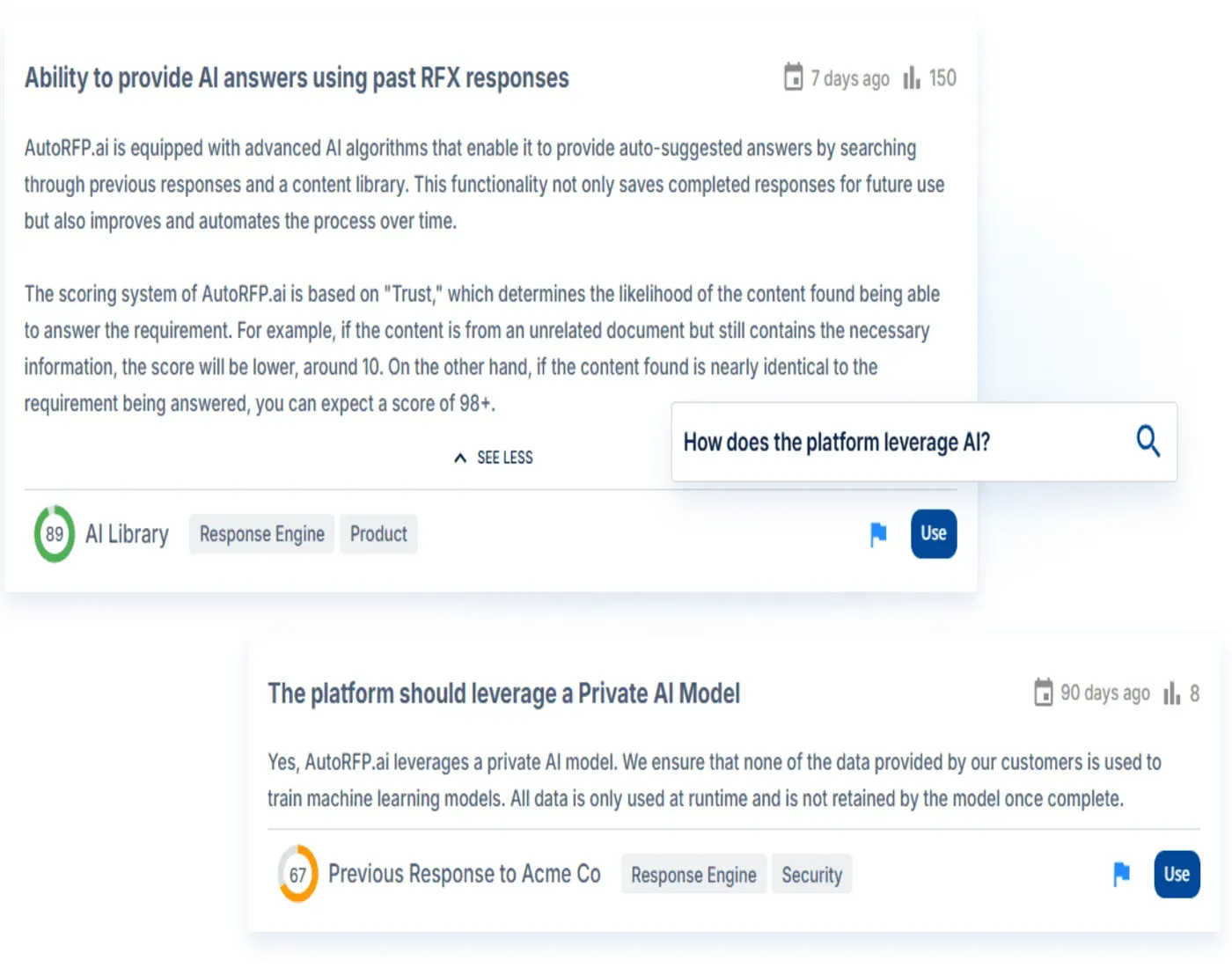
A winning response is correct, complete, and in your company’s voice. AutoRFP.ai measures every answer on all three before a person reads it:
Sources cited and scored
Gaps flagged with specific feedback
Tone learned from the content your team has already approved
In practice, that comes down to two scores and an edit rate. Every answer is scored twice before a person reads it: a Trust Score for the sources behind it, and a Feedback Score for how fully it answers what was asked. The measure of quality is how little your team has to change before submitting.
Generation draws on your approved content and language to produce responses that sound like your business, learning tone, structure, and formatting from material you have already signed off. When a strong approved answer already exists, AutoRFP.ai reuses it; when the requirement is new or worded differently, it drafts a fresh response for the question in front of it. Either way the answer is grounded in approved sources and cites them.
Automate the Mundane and Win on Strategy
RFP teams lose plenty of time outside the actual response. AutoRFP.ai reduces that manual work by connecting the tools where your knowledge and reviewers already live.
It can pull approved information from SharePoint, Google Drive, Confluence, and other knowledge sources. SMEs can review requests through Slack or Microsoft Teams, and the Salesforce integration keeps response work connected to the deal.
For questionnaires locked inside procurement portals, the Portal Agent brings requirements into AutoRFP.ai without manual copying. Once responses are approved, they become available for future projects, reducing the upkeep that comes with large static answer libraries.
Deploy at Scale With Confidence
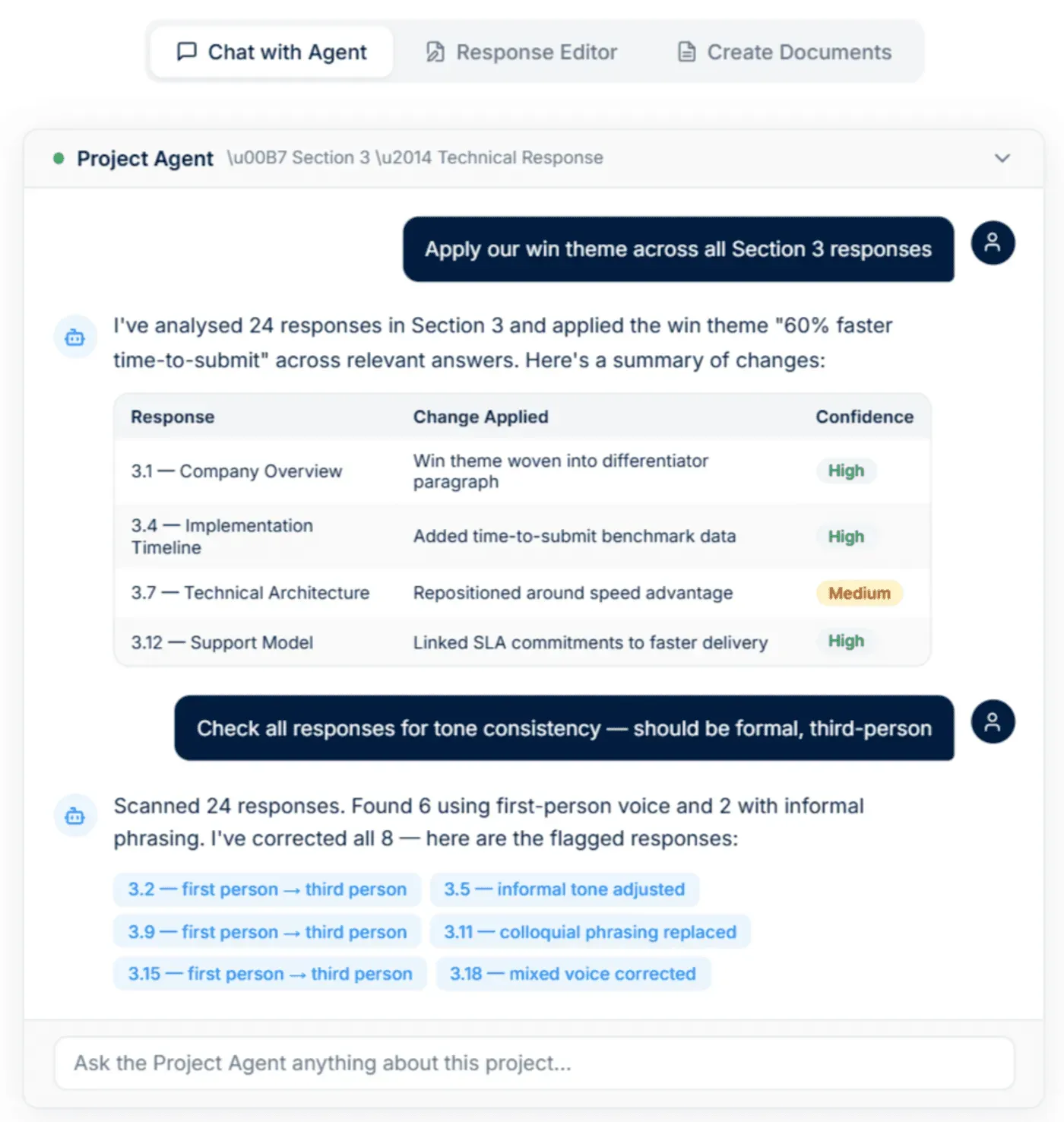
RFP responses often contain sensitive company information, so the software handling them needs strong controls of its own.
AutoRFP.ai is SOC 2 Type II and ISO 27001 certified, with independent audits supporting those controls. Teams with data residency requirements can use regional hosting in the US, EU, or AU, and customer data is not used to train public AI models.
Security teams can also use the self-service Trust Center to access reports and agreements directly, which can make vendor review easier without waiting on a separate request.
Pros
- Source-grounded answers with less review work: AutoRFP.ai drafts from approved company content, shows the evidence behind each response, and routes unsupported questions to a person. Repeat fact-checking drops and SMEs stay on the answers that need judgment.
- Less content maintenance: Answers draft from sources your team already maintains and approved responses feed back in automatically, so the library stays fresher with less manual gardening.
- Built for structured response work: RFPs, RFIs, security questionnaires, and DDQs run in one system, with fund-level and firm-wide approval layers for private-capital teams.
- Grounded in your live systems: Answers draft from the content your team already maintains in SharePoint, Google Drive, Confluence, and Notion, so every response cites a source that is current rather than a copy that has drifted.
- Less portal busywork: The Portal Agent pulls questions out of Ariba, Workday, and Coupa into AutoRFP.ai.
- Enterprise security with a consequence: SOC 2 Type II and ISO 27001 certification, regional hosting, and a self-service Trust Center shorten vendor review rather than just satisfying it.
- Unlimited users: Project-based pricing lets proposal managers, SMEs, and reviewers collaborate without a per-seat charge.
- Original file formats: Completed answers return in the customer’s Excel or Word document with the formatting preserved.
Cons
- Less suited to highly bespoke bids: Sectors such as AEC and US government contracting involve highly technical responses that do not follow repeatable patterns.
- Built for respondents: AutoRFP.ai is designed for teams answering RFPs, not for organizations creating and issuing them.
- RFQs are out of scope: Quote-driven procurement is not something AutoRFP.ai builds for, and Responsive is the better answer for buy-side and RFQ workflows.
- Approved-only grounding: AutoRFP.ai grounds in your approved content by default rather than reaching to the open web on its own. Web research is available as a separate, user-enabled path when you want it, so the control stays with your team.
Responsive vs AutogenAI vs AutoRFP.ai
| Responsive | AutogenAI | AutoRFP.ai | |
|---|---|---|---|
| Best fit | Established proposal operations teams | Long-form bid and proposal writers | B2B teams handling structured RFPs, security questionnaires, and DDQs |
| Primary strength | Project management, governance, reporting, and mature response operations | Prose quality: persuasive writing and narrative development | Answer quality: correct, complete, in your voice, with sources shown |
| Architecture | AI features added onto a legacy response library | AI-first proposal writing and management | Accuracy-first, AI-native, and it passes compliance review |
| RFP response | Strong | Strong, especially narrative work | Strong, especially structured requirements |
| Security questionnaires | Dedicated capabilities | Supported inside the proposal workflow | Core use case |
| DDQs | Supported | Less prominent in public positioning | Core use case, with fund-level and firm-wide approvals |
| Long-form proposal writing | Supported | Standout strength | Not the primary use case |
| RFQ and buy-side | Covered | Not central | Out of scope by design |
| Company knowledge | Centralized Content Library and prior responses | Knowledge library plus external sources | Approved company content, synced daily from your existing systems |
| External web sources in generation | Can extend AI access to external sites in some workflows | Yes | Approved-only by default; web research available as a separate, user-enabled path |
| Source visibility | Source citations | Source Finder | Citation Engine, per-answer sources |
| Answer scoring | TRACE Score | Proposal review tools | Trust Score and Feedback Score |
| When evidence is missing | Responses can be flagged for review or validation | Confirm behavior during evaluation | Routes the question to a person rather than guessing |
| Content upkeep | Managed Content Library remains central | Knowledge library supports generation | Approved answers feed back automatically; less manual upkeep, still an owned library |
| Collaboration | Deep project and approval functionality | Collaborative proposal editing | Assignments, approvals, co-editing, and the Q&A Agent in Slack and Teams |
| Portal handling | Response workflow and import tools | Proposal workflows | Portal Agent for Ariba, Workday, and Coupa |
| Certifications | SOC 2, ISO 27001, ISO 27701, ISO 42001, GDPR, CCPA, CSA STAR Level 1 | FedRAMP High; current AutogenAI materials also state ISO 27001 and SOC 2 Type II | SOC 2 Type II, ISO 27001, GDPR, regional hosting in US, EU, AU |
| Integrations | Named connections across CRM, storage, and communication tools | Proposal-workflow connections | Widest native coverage in the category |
| Pricing | Emerging starts at $10,000; Growth and Enterprise require a quote | Custom, described as all-inclusive for enterprise | Project-based, unlimited users on every plan |
| G2 rating | 4.5/5 | 4.3/5 | 4.8/5 |
Spend Less Time Checking AI Answers
AutoRFP.ai produces source-grounded answers with citations a reviewer can check in seconds. Where the approved content cannot support a response, the question goes to a person instead of being filled in.
We would rather show you than tell you: prove it on your own RFPs in a two-week proof of concept.
Book a demo, and we will run AutoRFP.ai on one of your own questionnaires.
About the author

Co-founder & CEO
Co-founder and CEO of AutoRFP.ai. Spent 7 years running global RFPs and personally completed 500+ RFPs before founding the company.
LinkedInFrequently asked questions
Is Responsive the same as RFPIO?
Yes. RFPIO rebranded as Responsive, so the RFPIO name still appears in older reviews and comparison pages.
Does AutogenAI publish its pricing?
No. AutogenAI uses custom pricing based on your requirements, so a quote requires a conversation with its sales team.
Which tool is better for security questionnaires and DDQs?
AutoRFP.ai, for structured questionnaire work where each answer has to be checkable. It drafts from approved company sources, attaches a citation to every response, and scores its confidence in the source material. For DDQs, approvals run at fund level and firm-wide, which is what makes a response defensible in front of an auditor.
Which tool is better for government tenders?
AutogenAI. Government tenders reward persuasive, long-form writing, and its proposal-focused tools are built for developing detailed narrative responses.
Does AutoRFP.ai hallucinate?
AutoRFP.ai generates only from content your team has approved, cites the exact sources behind each answer, scores its confidence in them, and routes anything it cannot support to a person rather than guessing.
How is AutoRFP.ai different from using ChatGPT or Copilot for RFPs?
Generic assistants generate a confident answer from whatever they were trained on, and you cannot see where any single answer came from, so your team ends up fact-checking every line. AutoRFP.ai generates only from content your team has approved, shows the exact source behind each answer, and routes anything it cannot support to a person rather than guessing. You get an answer that arrives with its evidence attached instead of one you have to verify from scratch.
Does AutoRFP.ai replace Responsive or AutogenAI?
It depends on the workload. AutoRFP.ai is built for structured RFPs, security questionnaires, and DDQs where answers are generated from approved sources and shown with their citations. AutogenAI is built for long-form proposal writing. Responsive covers buy-side and RFQ procurement, which AutoRFP.ai does not.
Do we have to build and maintain an answer library before we can start?
No. AutoRFP.ai drafts from the knowledge your team already maintains in tools like SharePoint, Google Drive, Confluence, and Notion, synced daily, so there is no parallel library to build or keep current by hand. Every answer you approve flows back in automatically, so the content behind your responses stays live rather than drifting between clean-up projects. The person who owns your content still matters; the manual gardening is what goes away.
How is AutoRFP.ai priced?
Project-based, with unlimited users on every plan and core platform features included without paid add-ons. Current rates are on the [pricing page](/pricing).

