Responsive (Previously RFPIO) Competitors & Alternatives in 2026
Discover top RFPio competitors, compare features, pricing, and use cases, and find the best proposal software alternative for your team.

Co-founder & CEO, AutoRFP.ai·Updated ·9 min read
The short answer: for most teams leaving Responsive (formerly RFPIO), AutoRFP.ai is the strongest overall alternative in 2026. Teams weighing Responsive against AutogenAI specifically can start with our Responsive vs AutogenAI comparison. It is built accuracy-first for RFPs, security questionnaires, and DDQs: drafts come only from content your team has approved, each answer shows its sources, and unsupported questions are routed to a person. Responsive remains the honest pick when you need the deepest proposal-ops project management and reporting stack. Loopio suits library-first teams with a dedicated content manager, Inventive.ai fits smaller AI-first software teams, and Qvidian still fits Word-centric enterprise proposal ops. Security-heavy buyers who started with a Trust Center specialist can also review a side-by-side Conveyor comparison when questionnaire deflection is no longer the only job.
| Tool | Best for | Standout feature | Starting price |
|---|---|---|---|
| AutoRFP.ai | High-volume RFPs, DDQs, and security questionnaires that need cited, accurate drafts | Self-maintaining library with meaning-based retrieval and exact-format import/export | $899/month |
| Loopio | Cross-functional RFP workflows with clear SME assignment and consistent reuse | Governed response library with ownership tracking | $20,000/year |
| Inventive.ai | AI-first drafting from connected sources | Slack-friendly SME workflows | $250/month |
| Qvidian | Enterprise proposal teams working primarily in Microsoft Word and Excel | Deep Microsoft Office integration for governed content reuse in-document | Contact sales |
| 1up | Teams with low RFP volumes who want to test value first | Lightweight AI drafts from connected sources and works inside web questionnaires | $300/month |
| PandaDoc | Sales teams that need proposal-to-signature speed (with tracking) | Drag-and-drop proposals plus eSignature (and payments/CPQ support) | $35/year |
| Proposify | Sales teams that need fast, on-brand proposals with tracking | Buyer engagement tracking plus e-signatures | $29/month |
1. AutoRFP.ai: Best for High-Volume RFP, DDQ, and SQ Automation With Semantic Search and Exact-Format Import/Export
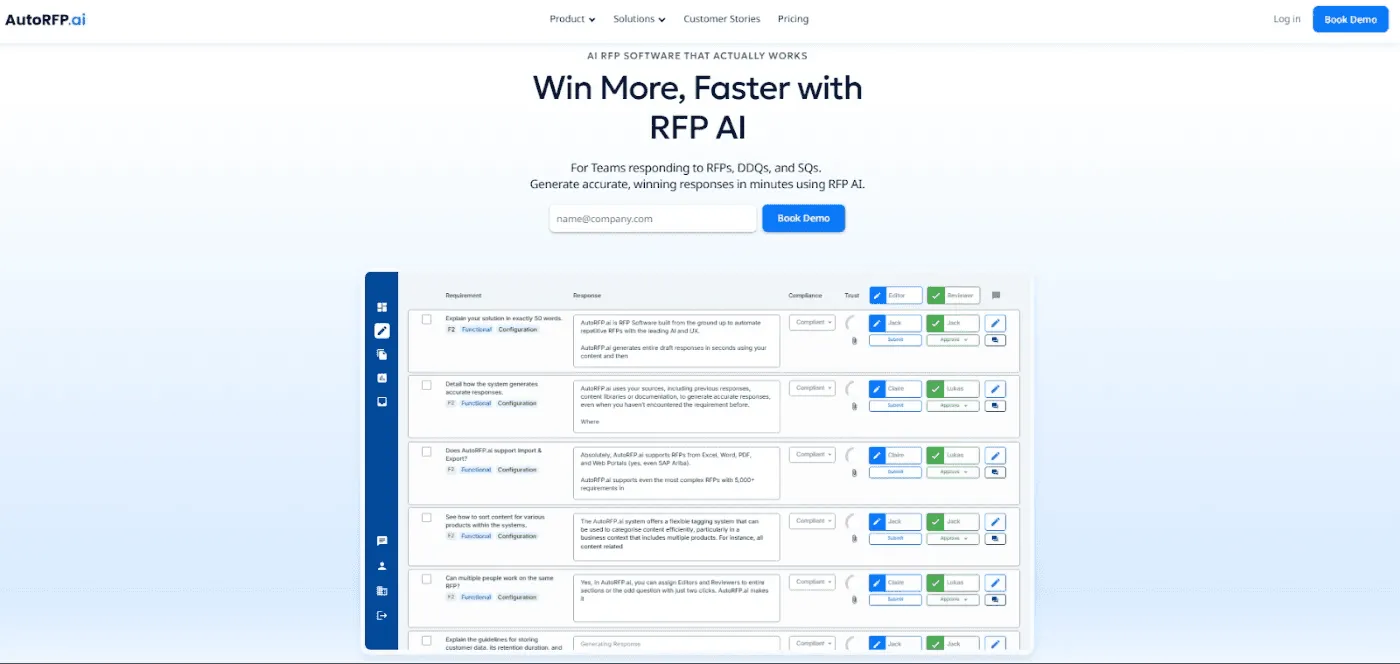
AutoRFP.ai drafts accurate responses to RFPs, DDQs, and SQs from content your team has approved, with the sources shown on every answer.
Draft quality is the decision criterion on Responsive alternatives. Correct means sources you approved; complete means the requirement is covered; in your voice means it reads like your company. AutoRFP.ai scores sources and completeness before a reviewer opens the draft, and learns tone from the material you already signed off.
Used by teams at Fortune 500 companies and high-growth tech firms, AutoRFP.ai reports up to 80% of drafts usable as-is with minimal edits.
Key Features
These features highlight the real advantage AutoRFP.ai has over Responsive.
1. Import and Export in the Customer’s Original Format
Upload any RFP in Word, Excel, or PDF, and AutoRFP.ai auto-parses sections, requirements, and context so the AI can draft immediately.
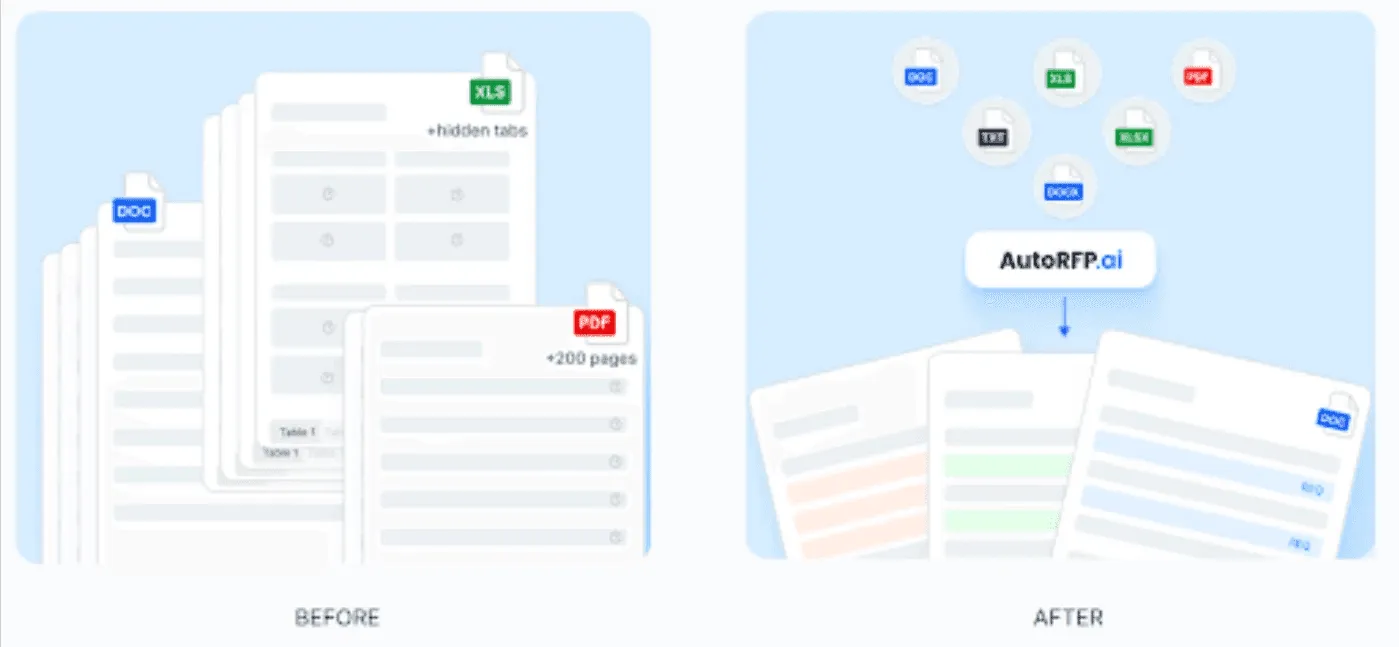
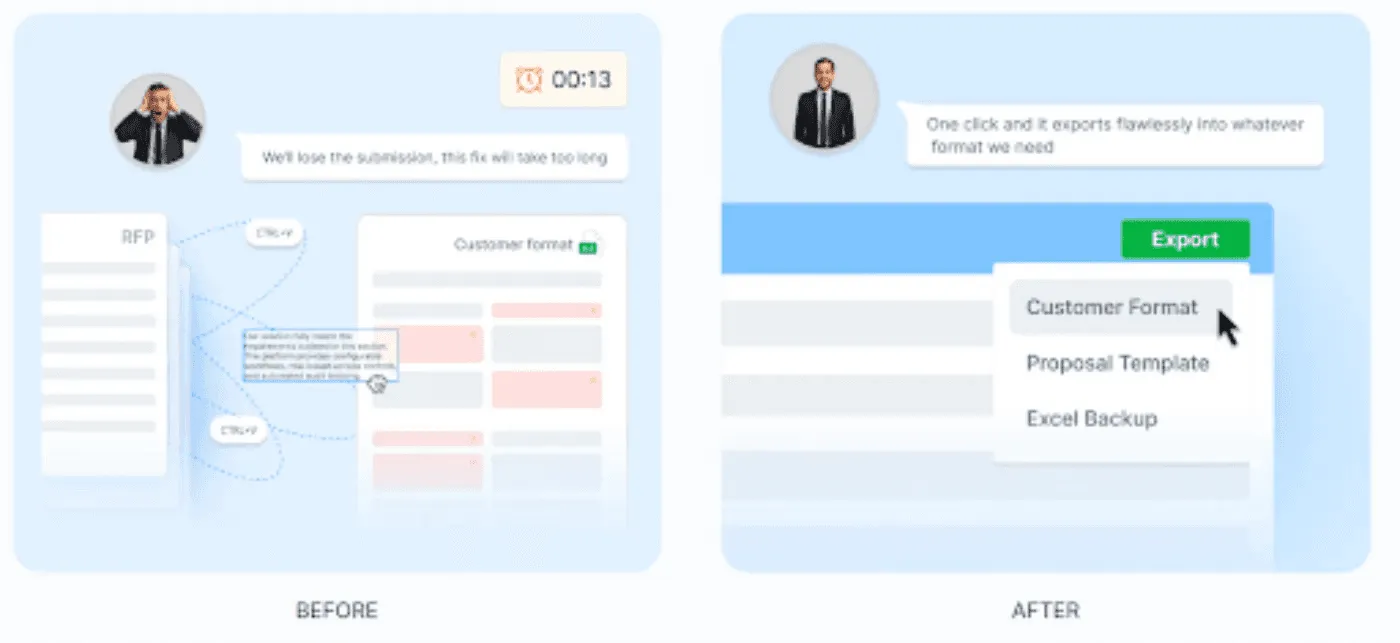
It also avoids common export and formatting headaches Responsive teams face by keeping outputs clean and preserving the prospect’s required format, including Excel macros, dropdown validations, and custom templates, so you can submit without reformatting.
2. Instant First Draft Engine
AutoRFP.ai generates on-brand first drafts from your best past responses and approved internal documentation.
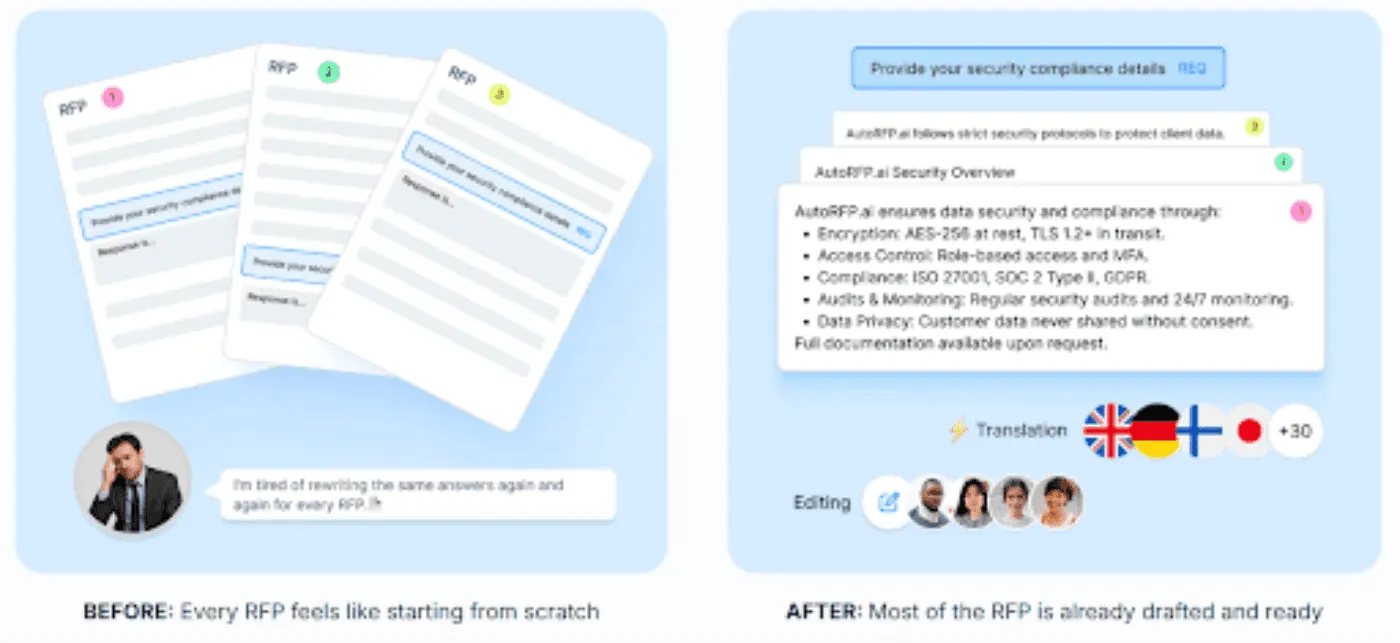
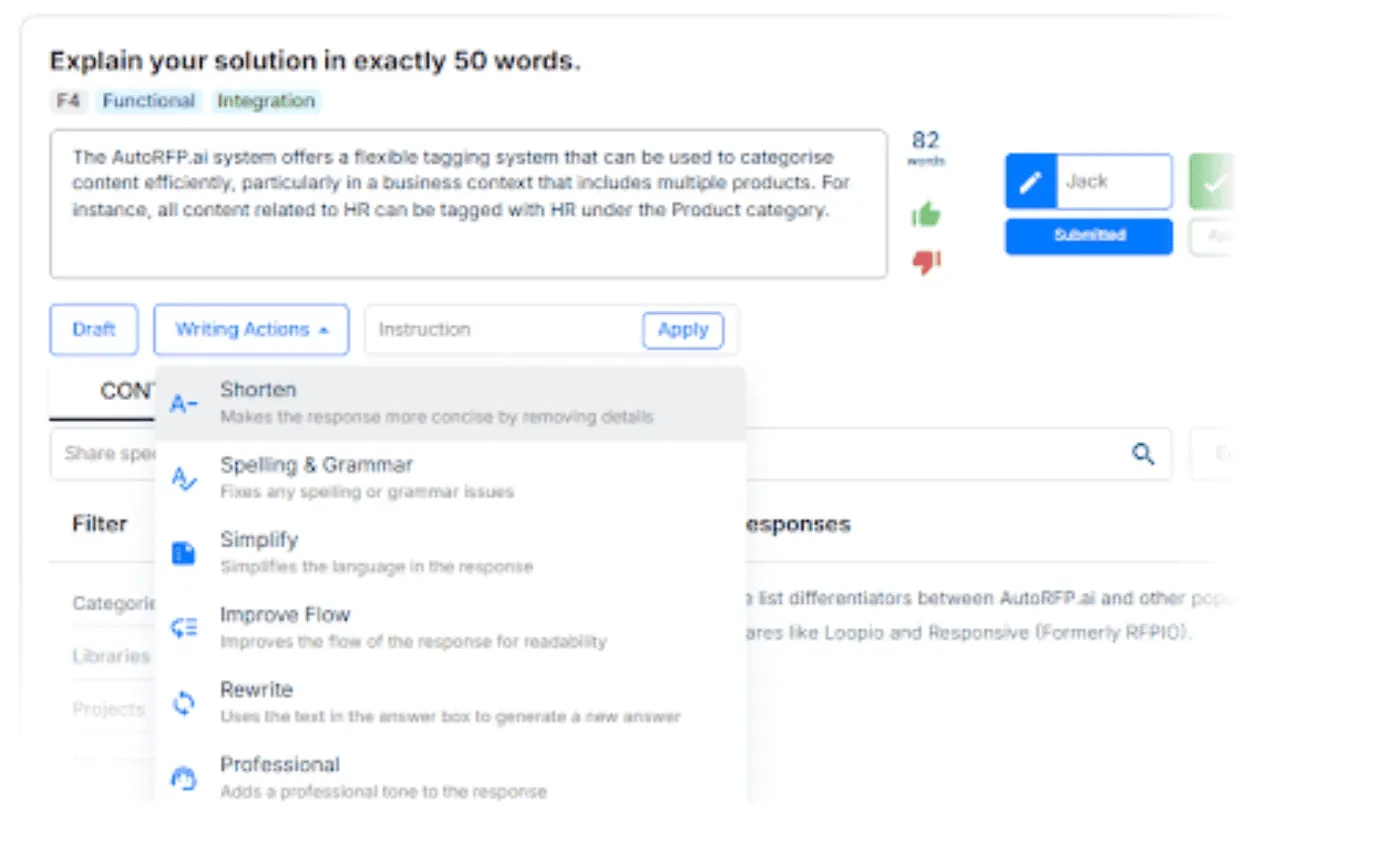
You skip the copy-paste loop by refining answers with quick, one-click edits instead of rewriting.
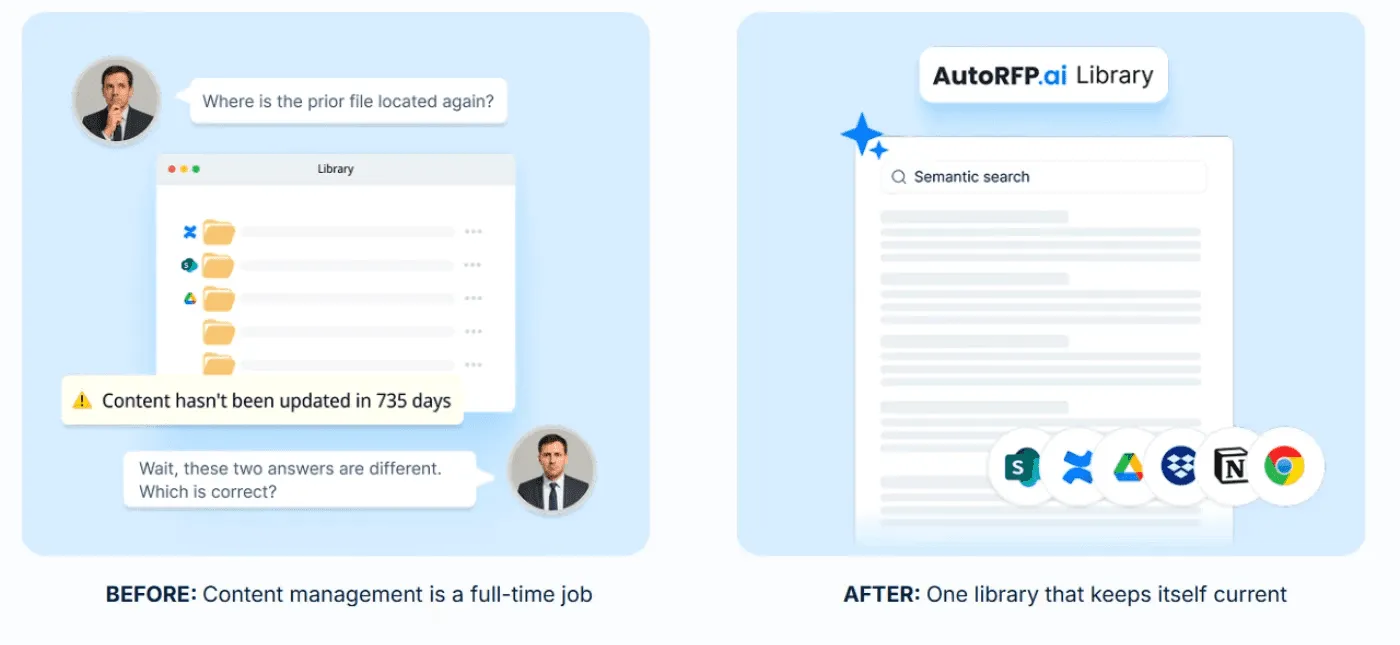
3. Self-Maintaining Library With Meaning-Based Retrieval
AutoRFP.ai retrieves answers by meaning, not keywords, across your content library, past projects, and documentation, so reworded questions still surface approved material.
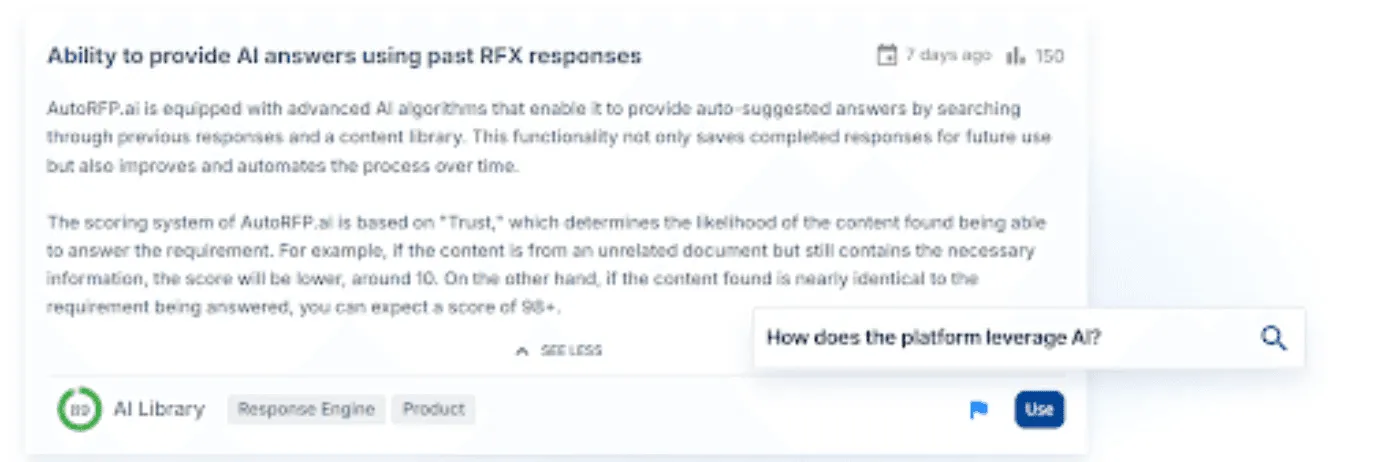
Approved answers flow back into the library automatically, and connected-source updates help keep knowledge current as messaging and security details change. Content owners control what is reviewed, organized, and approved for reuse.
4. Capacity and Win Rate Dashboard
AutoRFP.ai consolidates win rate, volume, velocity, and workload in one dashboard so you can assess capacity before committing.
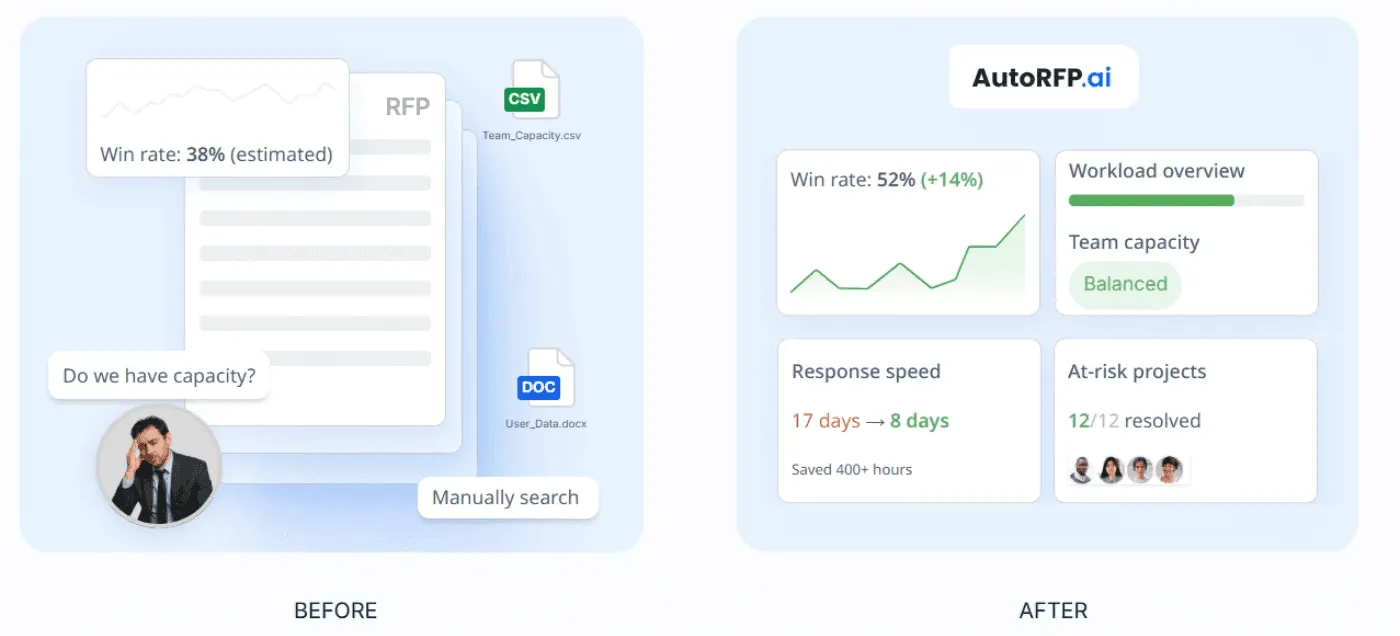
It makes it easier to forecast next quarter’s RFP load and avoid SME bottlenecks.
5. ROI Proof and Savings Tracking
AutoRFP.ai tracks automation rate, reuse, and manual effort per project to quantify time saved and efficiency gained.
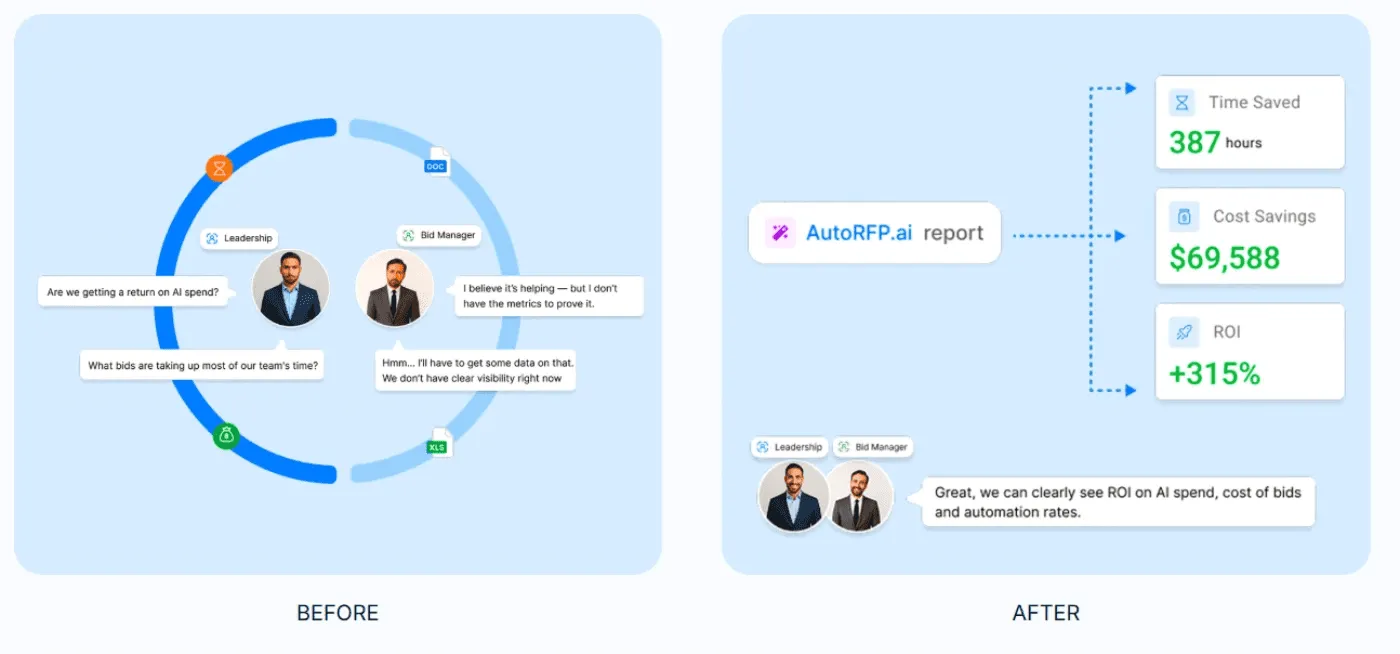
You get ROI reporting that shows where AI delivered value and where human input drove the final win.
Pricing
| Plan | Monthly Cost | Key Inclusions |
|---|---|---|
| Scale | $899 | Unlimited AI responses, users, content, and integrations |
| Accelerate | $1,299 | Everything in Scale, plus advanced analytics and priority support |
| Enterprise | Custom | Custom integrations, a dedicated success manager, and tailored security and compliance features with SSO |
AutoRFP.ai provides a 30-day money-back guarantee, personalized onboarding, and tailored training so teams can launch fast. Every plan comes with unlimited users (no per-seat fees), and teams can be up and running in as little as 48 hours.
Where AutoRFP.ai Shines
Portal questionnaire automation: Pull questions straight from portals, draft answers, then push them back in automatically. Supports Ariba, UpGuard, and Jaggaer.
Go/no-go risk screening: Auto-check incoming RFPs against your go/no-go criteria before you invest time. Flags deal-breakers and impossible requirements early.
Q&A Agent: Ask once, get a sourced answer from the library inside Slack or Microsoft Teams with no tab switching.
Broad integrations: Connect around 16 tools across SSO, knowledge bases, comms, help centers, file storage, and CRM. Keeps everything in sync.
Where AutoRFP.ai Falls Short
- Not ideal for AEC, US GovCon/defense, custom software development, or highly bespoke professional services: Responses in these sectors are often too unique to follow repeatable patterns.
Customer Reviews
Saxon W., a Senior Workforce Management Consultant, wrote in a Capterra review that, “Without AutoRFP.ai I simply wouldn’t have the time to complete RFPs regularly it saves an exceptional amount of time the responses are infinitely better than other systems because AutoRFP.ai understands context most systems I’ve used just regurgitate irrelevant answers setup was painless and the team actively works with customers and continues to innovate.”
In a Reddit thread about buying RFP software, one user said that “AutoRFP.ai isn’t bad, has a nice enough UI, is easy to manage projects in, and offers decent support. It also seemed to be significantly cheaper than competitors like Loopio and Responsive when we were shopping last year.”
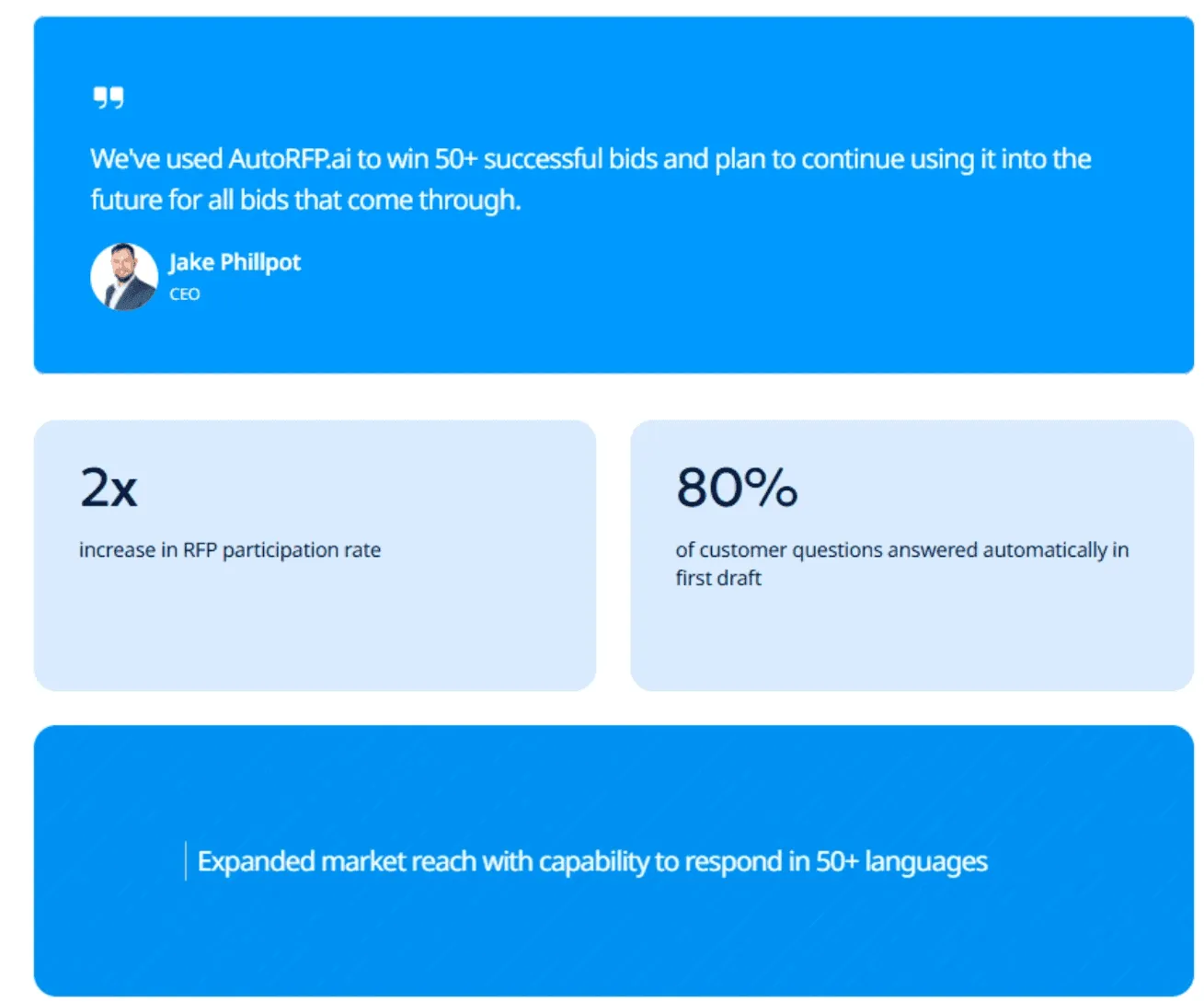
Jake Phillpot, CEO of Workforce, said, “We’ve used AutoRFP.ai to win 50+ successful bids and plan to continue using it into the future for all bids that come through.”
Who AutoRFP.ai Is Best For
Mid-to-large B2B SaaS: Teams handling high volumes of enterprise RFPs and RFIs that need consistent first drafts with citations, clear progress tracking, and SME ownership.
Enterprise deal teams: RFP managers/bid writers, pre-sales engineers, and enterprise AEs coordinating SME-heavy responses across tight timelines.
Financial services: Managed funds, insurance firms, and asset managers running high-stakes DDQs and security reviews that need sourced answers, strict approvals, and ROI reporting.
Regulated enterprises: Healthcare, fintech, and cybersecurity teams answering compliance-heavy DDQs and security questionnaires, including portal workflows and exact-format import/export.


Video transcript
Transcript is auto-generated and may contain minor errors.
Hey, I'm Rob from autoRFP.ai. What is autoRFP.ai? Well, autoRFP.ai is an AI software as a service or SaaS application that does AI for proposal or RFP responses. That includes RFIs, like request for informations, includes due diligence questionnaires or DDQs, and includes security questionnaires. So, you can find all about us at autoRFP.ai. So, we're a technology company. We have offices all across the globe including Brisbane, Australia, Vancouver as well. And effectively, our tool allows, whether it be bid managers, sales people, proposal writers, RevOps team members, sales leadership, answer complicated request for proposals. So, what is a request for proposal? You can see one of our other videos below in the description. But effectively, our system
looks something like this. And it lets team members, and you can have unlimited number of people log in to autoRFP.ai, good product, allows people to go in, create projects, which would be for instance an RFP. I can go in here, create my information from my zip file, and that includes, you know, like an Excel spreadsheet, PDF, Word doc. We can run an AI go no go project analysis on the RFP. And then effectively from that, we can bring in all the information in terms of what are the questions, where our AI automatically scans the documents and figures out what is being asked of the RFP, whether it's multiple tabs in an Excel spreadsheet and everything else, whether it's drop-downs. And that all happens automatically through the power of AI. Then, we generate our response, and we can do it in in 40 plus different languages and adding languages all the time. Once you've imported your RFP into order rfp.ai,
you can collaborate with your team members assigning different people to answer the questions, review the questions, looking at an overview of the entire project and project managing due dates. Now AI effectively starts automatically answering those different questions based on your knowledge documentation. So that might be your website, your help docs, your technical documentation, your past RFP answers or security questionnaires, your security policies. But effectively all that different company information you import into order RFP and then our AI leverages that to create an AI first draft of an RFP response. Once we're happy with all those requests, we can approve it. That goes into the model to learn from and add to. So your current responses are automatically used for new responses and then you can export that as well. And then the final cool thing about order RFP is you have a lot of different
integrations that you can pull in, whether it's knowledge documentation from places like Notion, Google Drive and so on. So that's order RFP. We're an AI SaaS app. Uh you can host globally. We do not use customer data for training purposes or to send it back to LLMs. So we're secure and private. We have our ISO 2701 certificate and our SOC 2 certificate and then you can find up-to-date pricing and information on our website. Or if you came to learn more, you can book a demo and schedule time with our team. Thanks.
2. Loopio: Best For Managing Cross-Functional RFP Workflows With Clear SME Ownership
Loopio is response management software for RFPs, RFIs, DDQs, and security questionnaires. As a Responsive competitor, it helps teams reuse approved answers, collaborate with SMEs, and ensure consistent responses across bids.
Key Features
Content library: Stores approved answers so you can reuse and update them fast.
AI drafting: Suggests initial drafts based on your existing RFP library content.
Collaboration workflow: Assigns questions to SMEs and tracks review status end-to-end.
Integrations: Connects with common sales and document tools to reduce copy-paste work.
Pricing
| Plan | Monthly Cost |
|---|---|
| Foundations | $20,000/year |
| Enhanced | Contact sales |
| Enterprise | Contact sales |
Where Loopio Shines
Ease of use: Feels straightforward for teams adopting a library-first workflow.
Answer consistency: Keeps messaging aligned by pulling from approved content.
Where Loopio Falls Short
Library maintenance: Scheduled freshness nudges still assume a content-manager role is gardening the library.
Export formatting: Can require cleanup depending on your template and destination format.
Content governance: Needs strong upkeep, or the library can get stale and duplicated.
Learning curve: Can take time for new users, especially with advanced workflows.
Customer Reviews
Jonathan R., Director, said, “Loopio has improved our response speed with the organizational and new library stack features, giving us back valuable time to review with key stakeholders and present a polished proposal.”
Ankit J., Sr. Proposal Specialist, mentioned in his Capterra review: “Overall experience was good but not excellent. A few functionalities like interface, Database handling were good, but Export functionality and Template handling is bit of a problem. The export functionality doesn’t work properly. Always face issues with formatting changes.”
Who Is Loopio Best For
Proposal teams: Handling recurring RFPs with lots of repeated questions.
Sales enablement teams: Maintaining a single source of truth for approved messaging.
3. Inventive.ai: Best for AI-First Drafting From Connected Sources With Slack-Friendly Collaboration
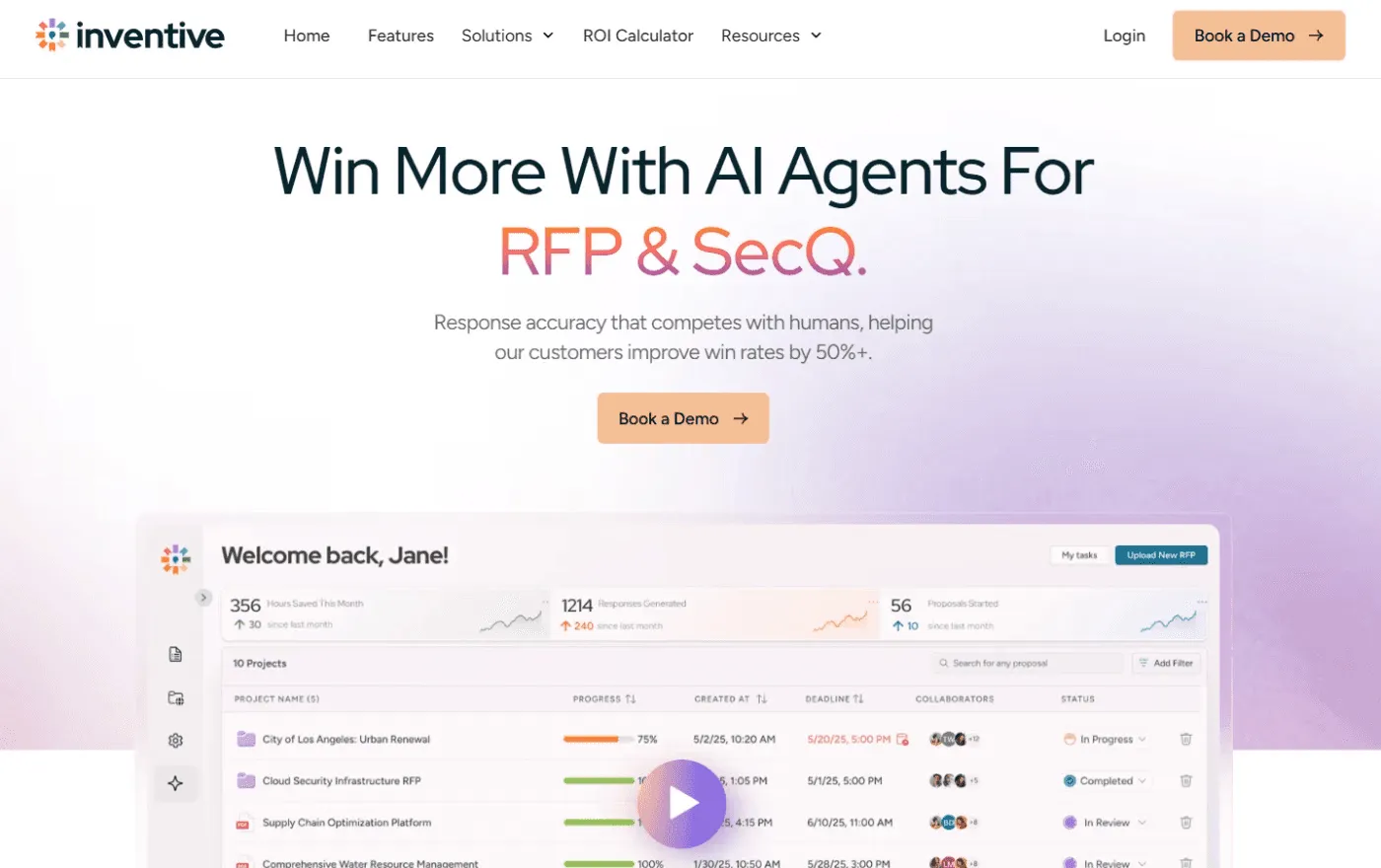
Inventive.ai is an AI-native RFP platform that generates first drafts from your connected knowledge and keeps answers grounded with citations and confidence signals. It’s built for teams that want faster drafting without losing control over accuracy and review, making it a good Responsive alternative.
Key Features
Cited answer generation: Produces drafts with source citations and confidence scoring.
Knowledge source integrations: Connects to systems like Google, Microsoft, Slack, and Salesforce.
SME collaboration: Assigns questions, tracks progress, and supports review workflows.
Pricing
| Plan | Monthly Cost |
|---|---|
| Starter | $250/month |
| Plus | $500/month |
| Pro | $850/month |
| Enterprise | Contact sales |
Where Inventive.ai Shines
Response quality: Reasons across multiple sources and supports higher-trust drafting.
Workflow coverage: Handles RFPs plus security questionnaires in common formats.
Where Inventive.ai Falls Short
Reporting and analytics: Needs more flexible dashboards and performance insights.
Set up and integrations: Onboarding and integrations can take time to get fully right.
Learning curve: May require ramp-up time to use more complex workflows consistently.
Access and user management: Reviewers ask for more granular permissions and controls.
Notification noise: Slack alerts can get noisy without better filtering.
Customer Reviews
In a Capterra review, Shikha C., Sr. Product Manager, shared that, “Inventive helps speed up RFP responses and keeps things organized. There’s a small learning curve, but it’s a useful tool.”
A verified reviewer on Capterra said, “At times, the AI-generated content needs manual fine-tuning to align perfectly with the company’s tone and requirements. The reporting and analytics features could also be more detailed.”
Who Is Inventive.ai Best For
Proposal ops teams: Managing high-volume RFP workflows with tight review requirements.
Sales engineering and SMEs: Needing faster drafting while keeping answers defensible.
Security and compliance teams: Handling security questionnaires that require traceability.
A fuller head-to-head lives in AutoRFP.ai vs Inventive AI.
4. Qvidian: Best for Enterprise Proposal Teams Working in Word and Excel
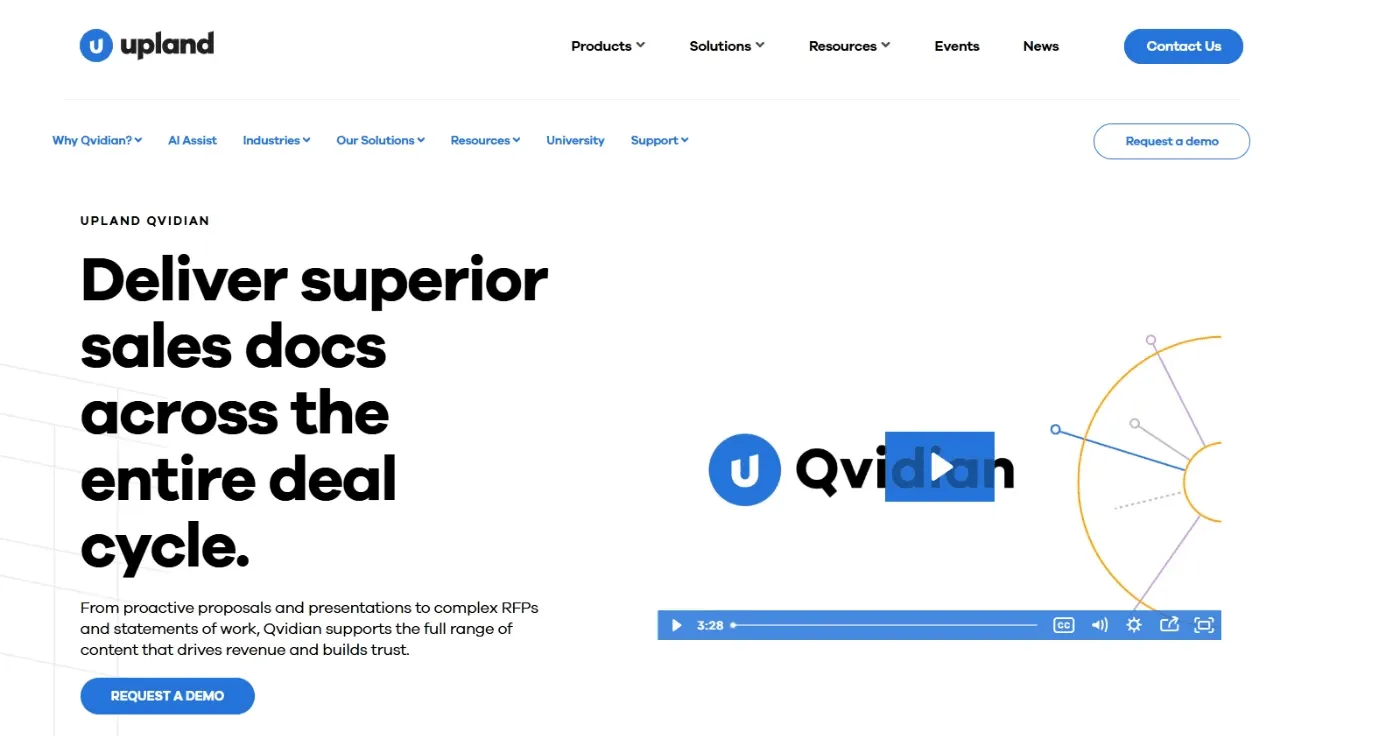
Qvidian is an AI-powered RFP response and proposal management platform that helps sales and proposal teams collaborate, find answers quickly, and deliver polished, compliant submissions faster. It’s commonly used by enterprise teams that build final deliverables in Microsoft Word and Excel.
Key Features
Microsoft Office integration: Supports answering and updating content directly in Word and Excel workflows.
AI assist: Adds AI-supported drafting to speed up first-pass responses.
Pricing
Qvidian’s pricing isn’t publicly listed, so you’ll need to contact Upland’s sales team for a quote.
Where Qvidian Shines
Office-first execution: Fits teams that build final submissions inside Microsoft documents.
Enterprise controls: Works well for structured, deadline-driven proposal operations.
Where Qvidian Falls Short
User interface and ease of use: Can feel dated and harder to navigate for new users.
Performance on large workloads: Can lag and feel slow on heavier projects.
Cost and licensing model: Can be pricey, especially if SMEs need paid access to contribute.
Content maintenance overhead: Managing duplicates and keeping content clean can be time-consuming.
Integration gaps: Some teams report friction in Office-adjacent workflows and weaker e-signature capabilities than competitors’. For a closer side-by-side look at how it stacks up against Responsive on pricing, AI quality, and ease of use, see our Responsive vs Qvidian comparison.
Customer Reviews
David M., Proposal Specialist, said: “I have used Qvidian for almost two years now and couldn’t see myself doing my job without it. It’s very easy to navigate and download the specific information I need for proposals, presentations, and RFPs. Customer service has always been prompt and follows through. Often, it does move a little slow (not sure if that’s their servers or ours), which is why I rated it 4 stars overall.”
Kartik M., Senior Manager – Sales Operations, expressed his view that “Lot of human intervention is needed in order to fully utilize all features and functionalities of this tool.”
Who Qvidian Is Best For
Proposal operations teams: Running formal review and approval workflows across many contributors.
Enterprise sales teams: Producing responses primarily in Word and Excel with structured governance.
5. 1up: Best For Teams With Low RFP Volumes Who Want To Test Value First
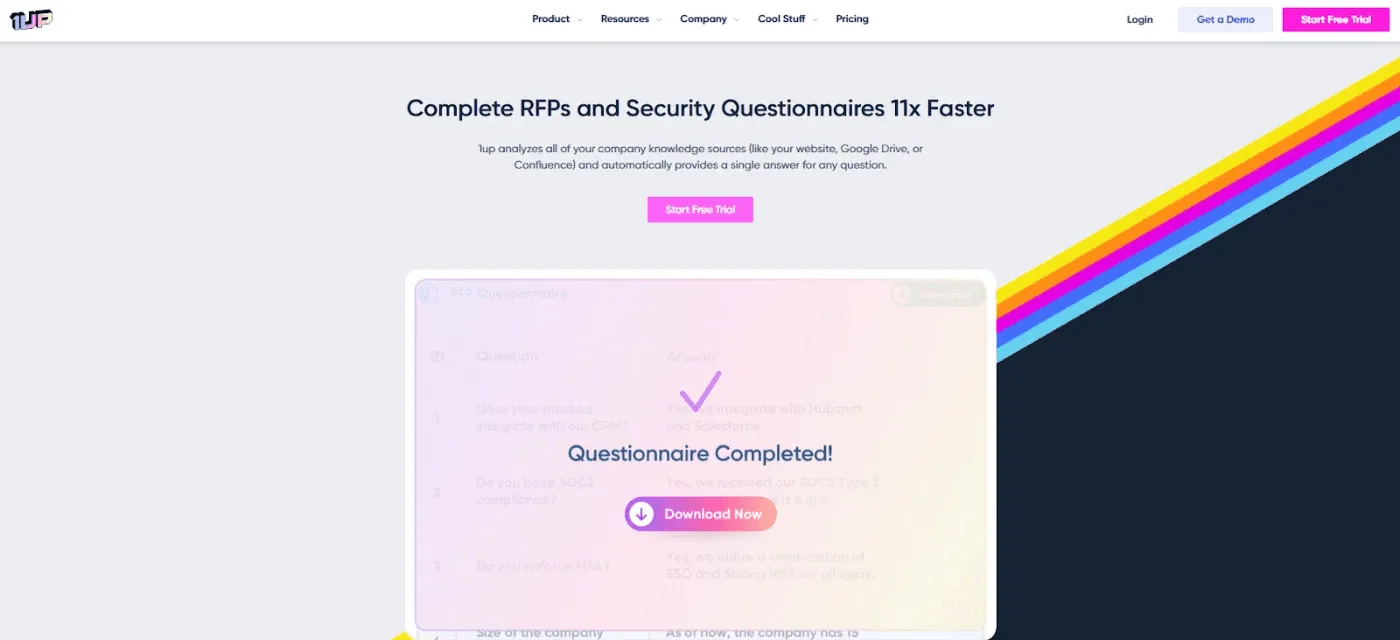
1up is an AI RFP and security questionnaire tool that generates draft answers from sources you connect, like your website, docs, and knowledge bases. It also includes a browser extension so you can answer directly inside web-based questionnaires without copy-pasting. As a Responsive alternative, it’s built for quick proof of value with a free trial and a lightweight setup.
Key Features
Connected knowledge sources: Pulls answers from your website and tools like Google Drive, Notion, and Confluence.
Browser extension: Generates answers inside web-based portals on Chrome and Edge.
Pricing
| Plan | Monthly Cost |
|---|---|
| Starter | $300/month |
| Plus | $600/month |
| Pro | $1000/month |
| Enterprise | Contact sales |
Where 1up Shines
- Fast first drafts: Produces quick answers from connected sources for common questionnaire formats.
Where 1up Falls Short
Answer review still needed: Can draft quickly, but teams still need human checks for accuracy and nuance.
Workflow depth: Can feel light if you need complex approvals, governance, and enterprise reporting.
Knowledge quality dependency: Output quality depends heavily on the cleanliness and timeliness of your sources.
Scaling by volume: Plans are tied to questionnaire limits, which can get restrictive as volume grows.
Customer Reviews
As one Reddit user put it: “1up is cheap (like half the price of the other ones), so if you’re on a strict shoestring budget, your decision is made for you. Overall, though, I think it’s a ‘you get what you pay for’ type of situation in the space.”
Another user in the same Reddit conversation shared that, “It occasionally skips questions it can’t answer. It also doesn’t have all the project management capabilities I’ve seen in other tools.”
Who 1up Is Best For
Lean proposal teams: Handling a small number of RFPs and needing speed over a heavy process.
Sales and SMEs: Answering customer and security questions directly inside web portals.
Looking beyond this option? Our roundup of Iris AI competitors covers the main alternatives worth reviewing.
6. PandaDoc: Best For Sales Teams Sending Proposals With Built-In eSignature And Payments
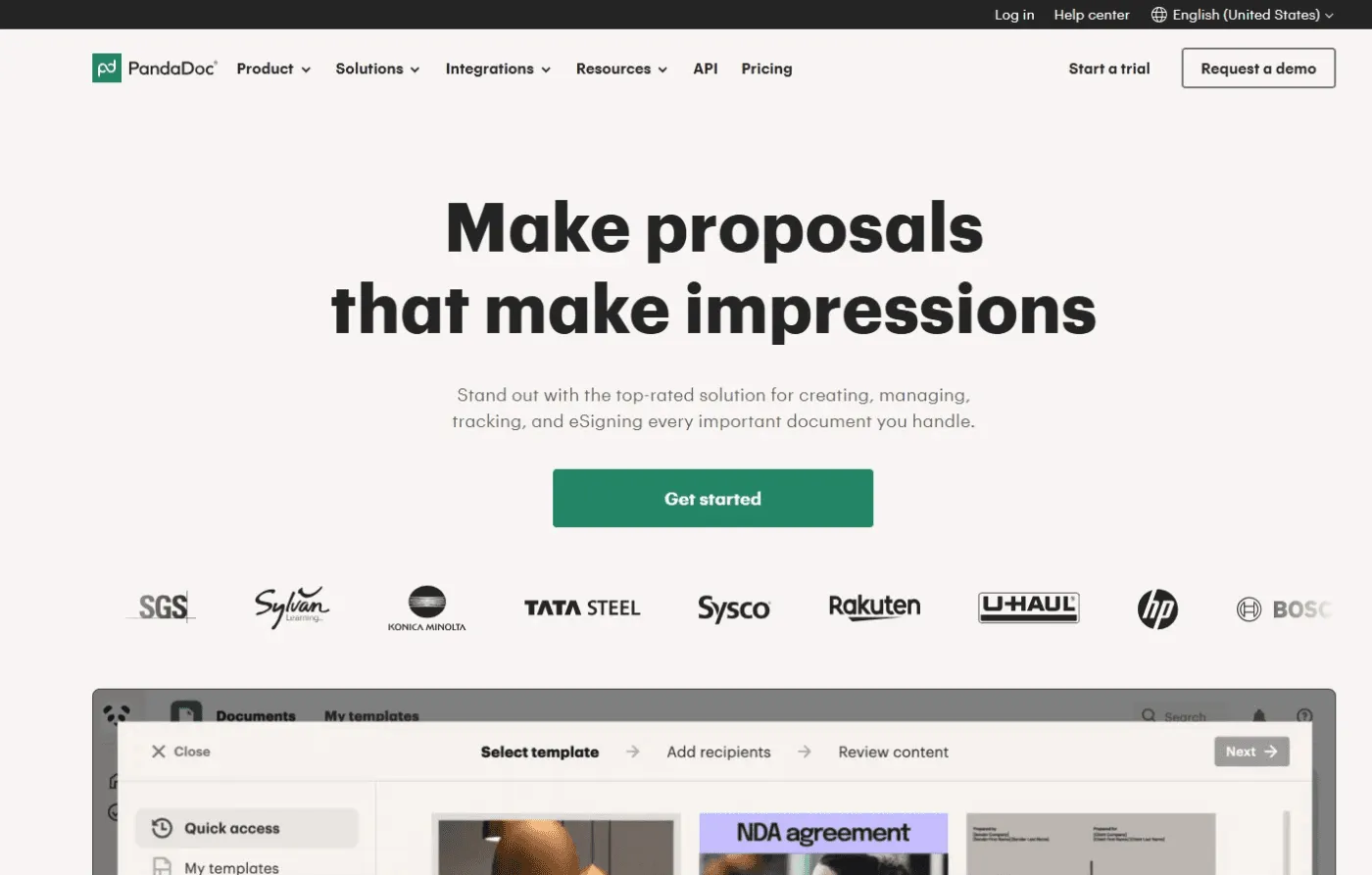
PandaDoc is a document automation platform for proposals, quotes, and contracts that helps teams create, send, track, and get documents signed in one workflow. This tool is popular with revenue teams that want faster turnaround from draft to signature without jumping between tools.
7. Proposify: Best For Sales Teams That Need Fast Proposals With Tracking
Proposify is a proposal automation tool that helps teams create on-brand proposals using templates, pricing tables, and reusable content blocks.
It also adds buyer activity tracking so you can see when prospects view and interact with a document, then close with built-in e-signatures. As a Responsive competitor, it’s strongest for proposal execution, not deep RFP workflows.
Reasons to Consider an Alternative to Responsive (Previously RFPIO)
Here are a few reasons you might look for an alternative to Responsive and switch to a modern AI RFP software instead:
1. Source Visibility on Every Draft
Library-first AI assistance typically points at a stored library entry. Reviewers still have to decide whether that entry still supports the question.
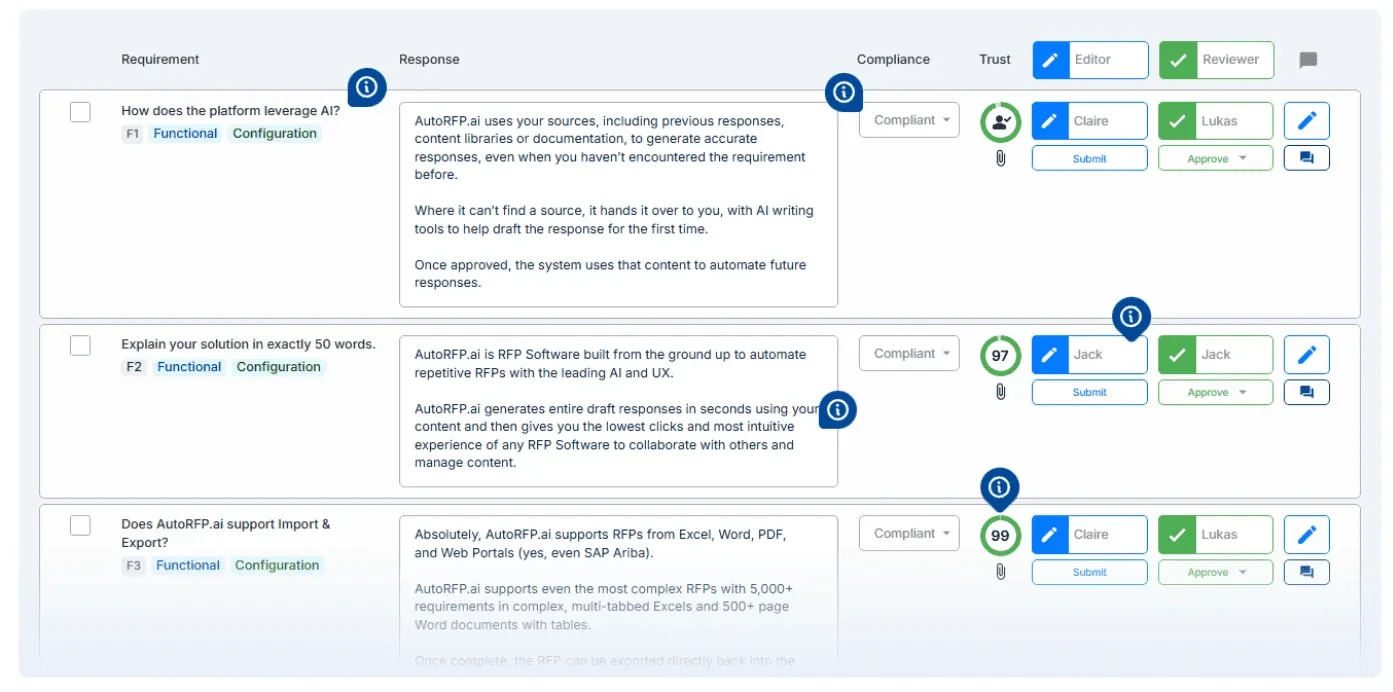
AutoRFP.ai drafts only from approved material and shows sources, content age, and a Trust Score on every answer, so you know what was used and why before you edit (zero hallucination by design: unsupported questions are routed to a person rather than guessed).
2. Meaning-Based Retrieval
Keyword search works when everyone remembers the exact phrase used last quarter. Buyers rarely ask the same question the same way twice.
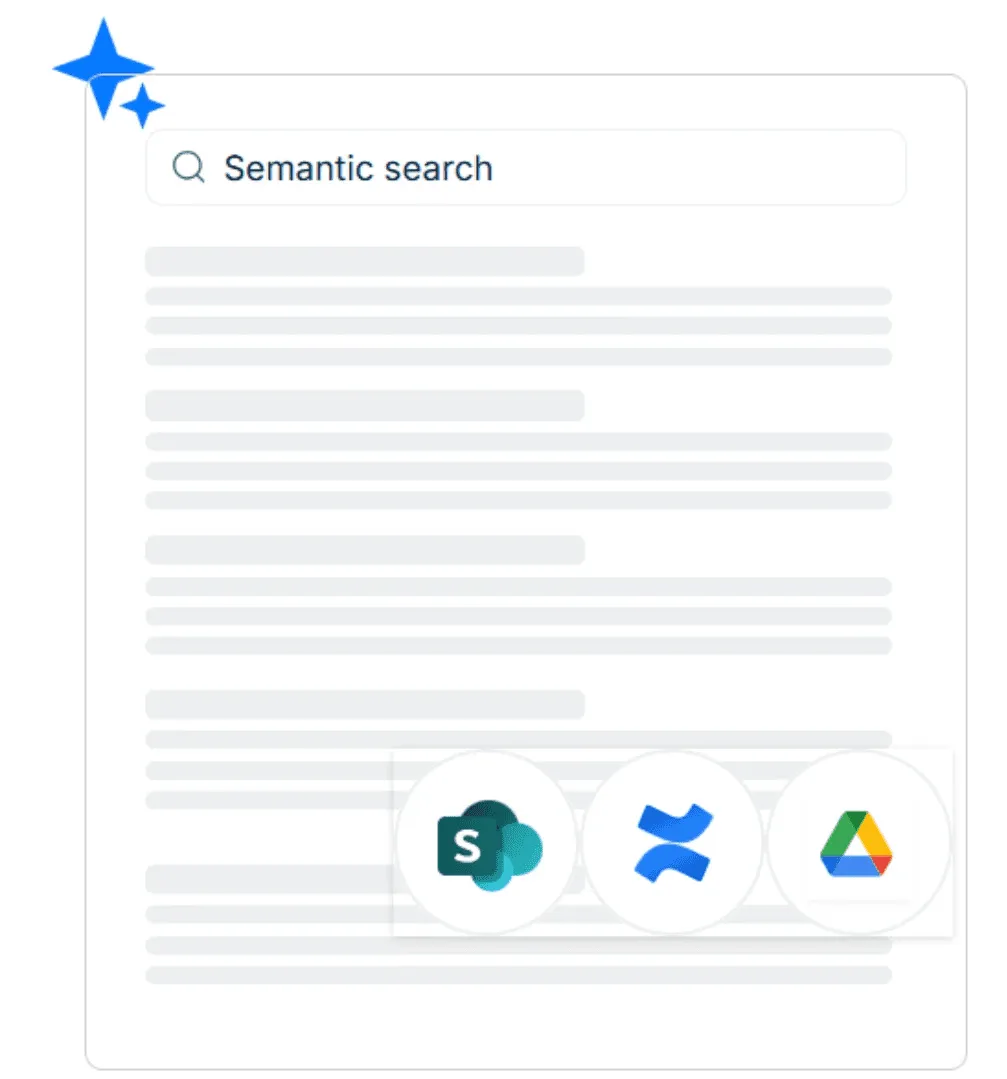
AutoRFP.ai matches on meaning across library, past projects, and docs, then re-ranks candidates, so a reworded requirement still finds the answer your team already approved. Literal matches still appear alongside.
3. Export and Formatting Issues
Responsive exports can introduce spacing errors, merge-tag issues, and extra cleanup work when reusing content outside the platform.
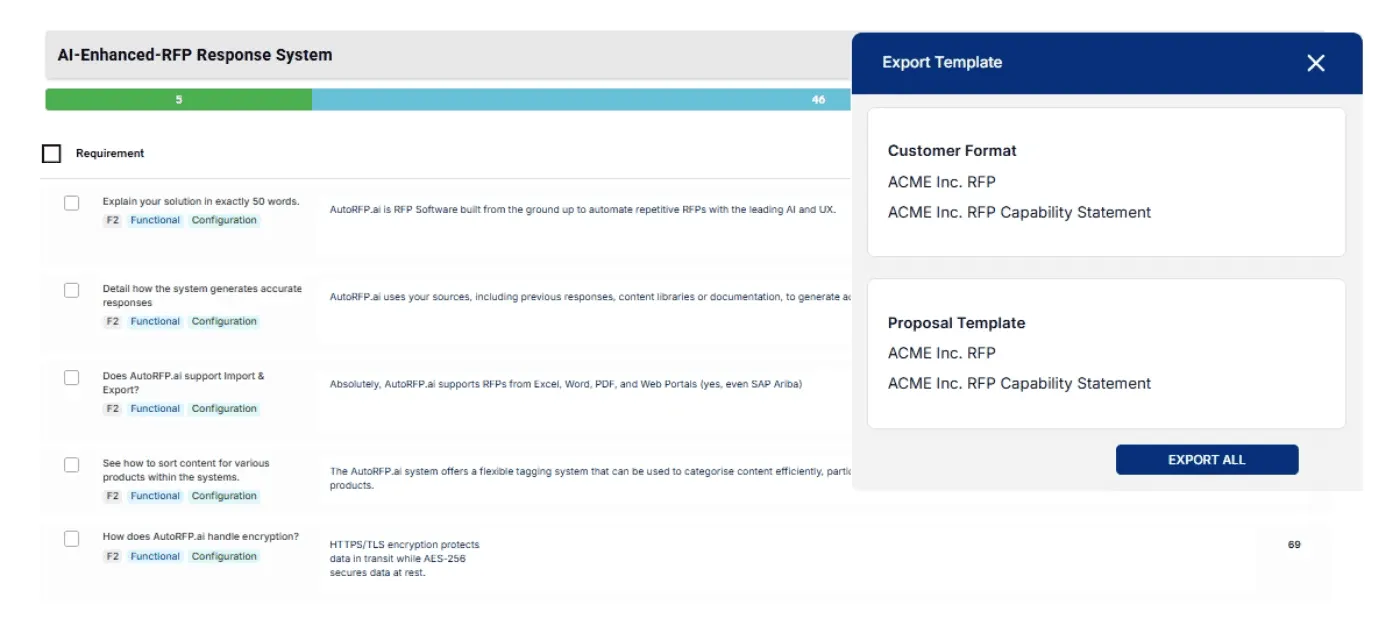
AutoRFP.ai exports directly into the prospect’s original Word or Excel templates, preserving formatting, macros, dropdowns, and complex multi-tab structures.
4. Time to Value
Responsive is the heavyweight for proposal ops: that depth is a genuine strength for large programs, and it usually means more implementation weight.
AutoRFP.ai is built for shorter time-to-value: clear guides, practical walkthroughs, and a workflow from draft to final that most response teams can run without a multi-month rollout.
Automate Your RFP Workflow with AutoRFP.ai
If you are comparing Responsive alternatives, start with the job: cited drafts from approved content, one platform for RFPs, DDQs, and security questionnaires, and exact-format import/export that returns the buyer’s file intact. AutoRFP.ai is built for that job. Responsive remains the right lane when board-level proposal analytics and heavyweight project management are the deciding criteria.
Bring your hardest recent RFP to a two-week proof of concept and measure the difference on your own numbers. Book a demo
About the author

Co-founder & CEO
Co-founder and CEO of AutoRFP.ai. Spent 7 years running global RFPs and personally completed 500+ RFPs before founding the company.
LinkedInFrequently asked questions
What are Qvidian competitors that integrate security questionnaire and DDQ automation?
Look for platforms that handle RFPs, security questionnaires, and DDQs in one response workflow rather than bolting questionnaires onto a separate GRC tool. AutoRFP.ai drafts all three from approved content with sources shown and routes unsupported questions to a person. Vanta, Drata, and Conveyor are strong when answers should stay anchored to a live compliance or trust-center program; Loopio remains a solid library-first option for teams with a dedicated content manager.
What are the best Responsive alternatives that help reduce RFP response editing time?
Measure editing time by the share of AI answers you can submit without changes. Platforms that draft only from approved content, show passage-level sources, and abstain when unsupported usually need fewer edits. AutoRFP.ai reports 63% of AI-generated answers requiring no edits; Inventive.ai also attaches citations and confidence signals. Responsive remains the heavyweight when you need deep proposal-ops project management and board-level reporting more than first-draft coverage.
What's a good alternative to Loopio for teams on a tighter budget?
Compare total cost of ownership, not sticker price alone: per-seat library tools add cost as collaborators grow, while project pricing with unlimited users can be cheaper for SME-heavy teams. AutoRFP.ai starts at $899/month with unlimited users. Inventive.ai and 1up sit lower on entry price for smaller volumes. Loopio’s clean UI and mature library still suit small, low-collaboration teams that prefer per-user pricing.
What RFP automation software is SOC 2 certified and safe to use with confidential client data?
Require SOC 2 Type II (and ideally ISO 27001), a published Trust Center, no training on customer data, and tenant isolation. AutoRFP.ai is SOC 2 Type II and ISO 27001 certified and independently audited, with a self-service Trust Center so security teams can clear it without a bespoke review. Confirm the same controls on any shortlisted alternative before a proof of concept on your own documents.

