
Your Guide on The Most Accurate AI RFP Software Solutions in 2026
The most accurate AI RFP software in 2026 includes AutoRFP.ai, Arphie, Responsive, and Loopio, ranked by first draft quality, citations, and trust scoring.

Technical Account Manager, AutoRFP.ai··26 min read
If a team has to verify every AI-generated answer from scratch, the automation has not solved much. Accurate AI RFP software should reduce that burden by showing the evidence behind each response, surfacing uncertainty, and indicating when human input is still needed.
But platforms handle those tasks very differently. This guide compares the leading platforms on source grounding, citations, confidence signals, review controls, and governance.
Most Accurate AI RFP Software Solutions: At a Glance
| Name | Best for | Standout feature | Price starting point |
|---|---|---|---|
| AutoRFP.ai | Accuracy you can defend in high-stakes RFPs | Source-grounded answers with Trust Scores, citations, and abstention when evidence is missing | $899/month |
| Arphie | Transparent AI answers and reviewer confidence | Source visibility with AI confidence levels and full answer auditing | Quote-based; indicative pricing from $36,000/year |
| Responsive | Enterprise AI quality scoring and governance | TRACE Score evaluates Trustworthiness, Relevance, Accuracy, Completeness, and Explainability | From $10,000 |
| Loopio | Mature library-led answer quality | Automated Answers with Confidence Pulse for reviewer prioritization | From $20,000/year |
| SiftHub | Verified responses with broader presales context | Verified-source generation with source tracing and deal-context workflows | Contact sales |
| AutogenAI | Evidence-backed narrative proposal quality | Source Finder and Gamma Review for sourced, evaluator-focused proposal writing | Contact sales |
| 1up | Lightweight trusted-source RFP automation | Trusted-source generation with knowledge segmentation and questionnaire autofill | Free tier; RFP plans from $300/month |
What Makes AI RFP Software Accurate
Accurate AI RFP software does more than generate plausible answers. It makes every response verifiable, complete, and grounded in approved company knowledge.
- Source-grounded answers: Responses are generated from approved company content, not unrestricted model knowledge.
- Source citations: Every answer links back to the exact evidence used to generate it.
- Confidence scoring: Trust Scores help reviewers quickly identify which answers need closer attention.
- Abstention when evidence is missing: The AI flags unsupported questions for human review instead of guessing.
- Multi-step AI checking: Retrieval, re-ranking, drafting, redrafting, and checking improve response quality before review.
- Completeness checks: The system evaluates whether the response actually addresses every part of the question.
- Current content: Approved responses and authoritative sources keep future answers grounded in up-to-date information.
- Human review: SMEs validate sensitive, low-confidence, or approval-dependent responses before submission.
1. AutoRFP.ai: Best for Accuracy You Can Defend in High-Stakes RFPs
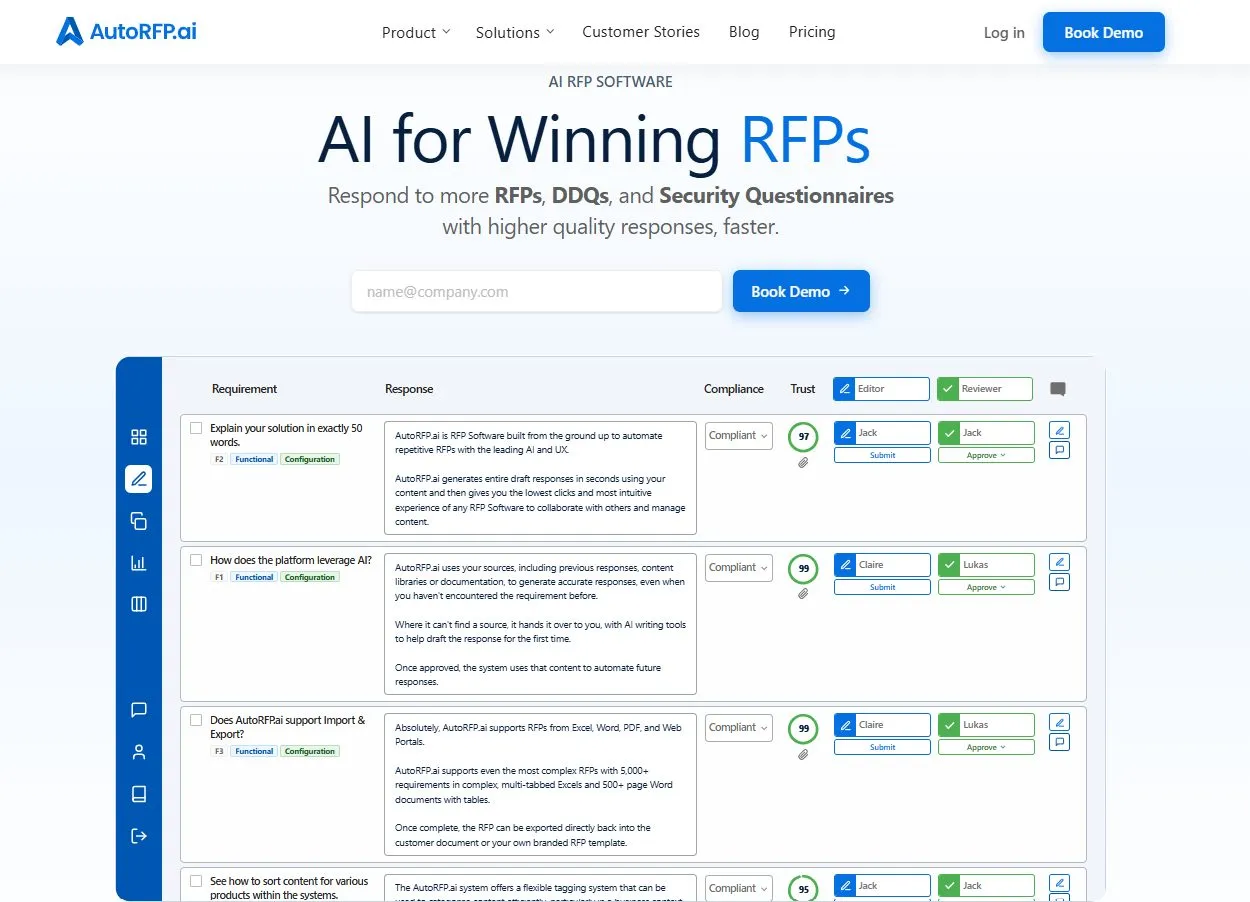
AutoRFP.ai ranks first for accuracy because it does not ask reviewers to trust a black-box accuracy percentage. It makes the quality of each individual answer inspectable.
AutoRFP.ai is the accuracy-first, AI-native platform for RFPs, security questionnaires, and DDQs. Drafts are written from approved company content rather than unrestricted model knowledge, and each response shows the sources behind it. Teams keep ownership and review controls without running a separate snippet-library maintenance cycle.
Its defining approach is zero hallucination by design. AutoRFP.ai only writes when approved sources support the response. If that evidence is missing, it flags the question and routes it for human review instead of filling the gap with a plausible guess. Reviewers can then see the sources behind the response, its Trust Score, and whether the answer fully addresses what the buyer asked.
That matters because RFP accuracy is broader than factual correctness. A submission-ready answer also needs to be complete, appropriate to the question, written in the company’s voice, sized for what the evaluator requested, and defensible when an SME, security reviewer, auditor, or customer checks the evidence behind it.
Key Features
1. Source-Grounded Answers With Trust Scores and Citations
AutoRFP.ai’s Response Engine grounds generated answers in content the organization has approved, including previous responses, policies, product documentation, security material, and connected company knowledge.
Its Citation Engine exposes the exact sources supporting each response, while the Trust Score gives reviewers an answer-level signal about the evidence behind it, including source confidence and freshness.
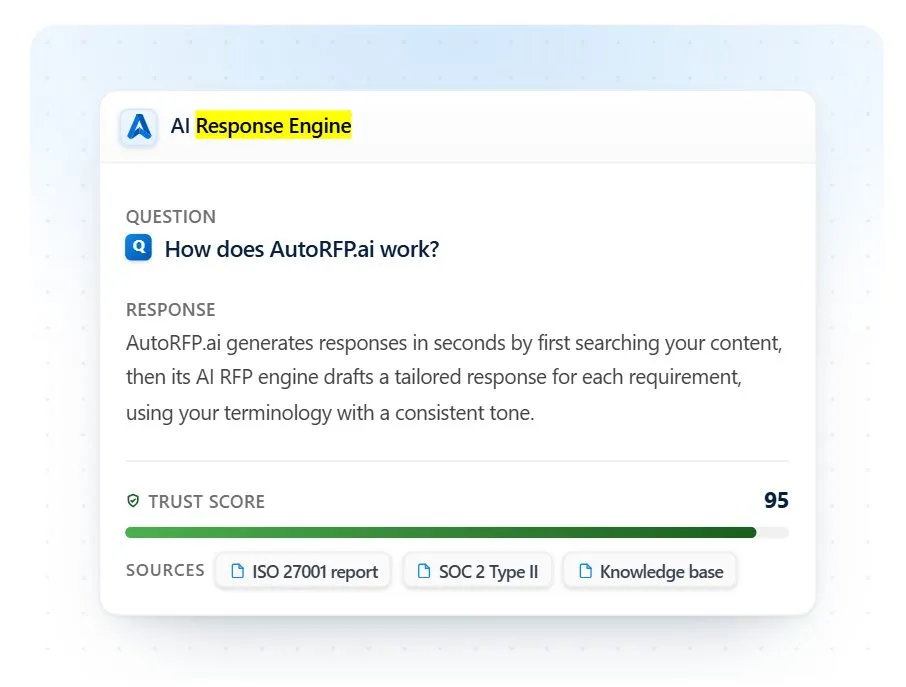
The result is a different review workflow from simply receiving an AI-generated paragraph. A reviewer can inspect why an answer was produced, verify the supporting information, and focus attention where confidence is weaker instead of treating every draft as equally trustworthy.


Video transcript
AutoRFP.ai is like having a team member that never sleeps. We've responded to more than double the number of RFPs after implementing AutoRFP.ai than we did the year before. I'll look back on 2025, we'd saved something like 949 hours. It was mind-blowing. Oh my gosh, this can be done automatically. Being able to answer those consistently and accurately puts us in a position to be a trusted vendor for our clients.
Using AutoRFP.ai has definitely helped me increase my closing ratio. Before, we were using Google Drive to store all of our library content and previous responses. It was a very manual process. If the keyword was there, you would find it. If not, then you wouldn't. I would say 60% of the deals that come through in my market are RFP bids.
But as the team was scaling, it quickly became apparent that this wasn't sustainable. I, of course, looked at tools that we had available to us in-house. Became clear that it worked in some ways, but it wasn't built to respond to complex RFPs with multiple questions and moving parts. So what was different about AutoRFP.ai is that we're able to upload multiple documents in all different formats, PDF, Word, Excel, and it will ingest all of those documents and pull out the requirements, even tables within documents instantly.
The Excel sheets just blew our mind because we hadn't seen this anywhere else. As we work in multiple regions, the ability of AutoRFP.ai to translate into multiple languages is really impressive, and it really felt like it was going to be a partnership rather than a transaction. We spend a lot more time now focusing on the strategy for a bid.
The bids are a lot more tailored and a lot more focused on the prospect in a way that we couldn't do before. The quality of our output is just completely different. Do you feel like it's gonna blow their mind because they're like, "Oh, you've said exactly what we needed to hear." Thinking back to that particular deal in Q3, the deadline was coming up.
Having missed the deadline would have meant for me not hitting my quarter, but I also didn't wanna let down my team. Having a bank of information of answers that I could trust really allowed me to just push everything out as quickly as possible, knowing that what I was saying was accurate and true.
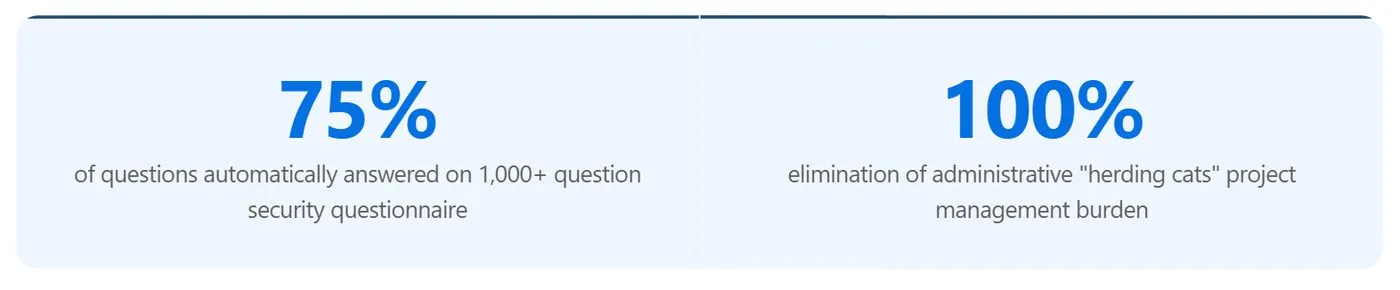
Trusting that when that is submitted, more than 50% of the job is done, and I'm really excited to say that, yes, we did win the deal, made me look like a hero, so thank you. We've been able to respond to 20 to 30% more RFPs quarter on quarter. We've been able to increase the capacity of the team. We've saved 45% of the time it would've taken us to respond to the same number of RFPs.
Our shortlist rate has been outstanding, and it just gets better and better I would say don't wait until volumes spike and quality starts to drop. Every bid that your team submits manually is costing you more than you think, not just in hours, but in quality and consistency There's absolutely no way we would want to go back to the previous way AutoRFP.ai is like having a team member that never sleeps, keeps getting smarter, and allows my team to focus on the stuff that they're really good at
2. Feedback Scores for Complete, Right-Sized Responses
Being factually grounded is not enough if the AI answers only half the question.
AutoRFP.ai uses a Feedback Score to evaluate how completely a response addresses what the buyer actually asked. For example, an answer may be factually correct but still miss a requested example, implementation detail, limitation, supporting explanation, or second part of a multi-part requirement.

This two-score approach separates source trust from answer completeness. It also supports responses that match the question’s scope, so a simple compliance question can receive a concise answer while a strategic requirement can receive the additional context it needs.
3. Abstention When Approved Evidence Is Missing
One of AutoRFP.ai’s strongest accuracy controls is what happens when the system does not know.
If it cannot find approved evidence strong enough to support a response, AutoRFP.ai can flag the question and route it for human review rather than guessing. Missing knowledge therefore appears as a visible gap instead of being hidden inside convincing AI prose.
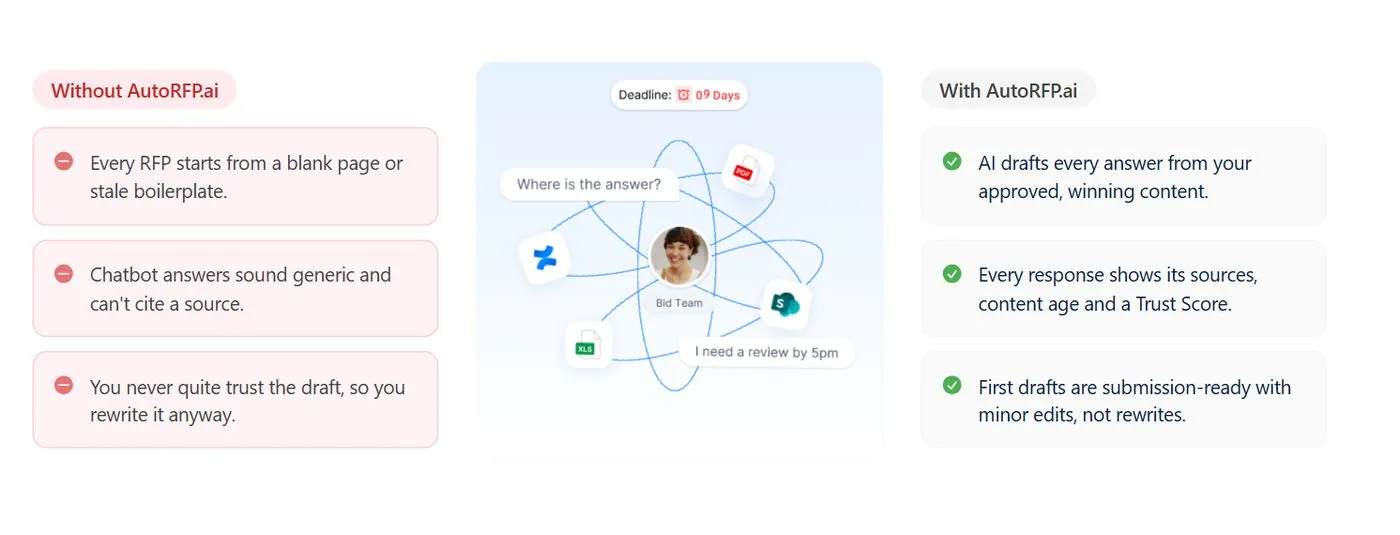
For a 500-question RFP or detailed security questionnaire, that distinction matters. The response team can see which questions genuinely need an SME rather than discovering unsupported claims during final review, or after the submission has already reached the buyer.
4. Multi-Model Retrieval, Re-Ranking, Drafting, and Rechecking
AutoRFP.ai does not rely on a single prompt sent to a single language model.
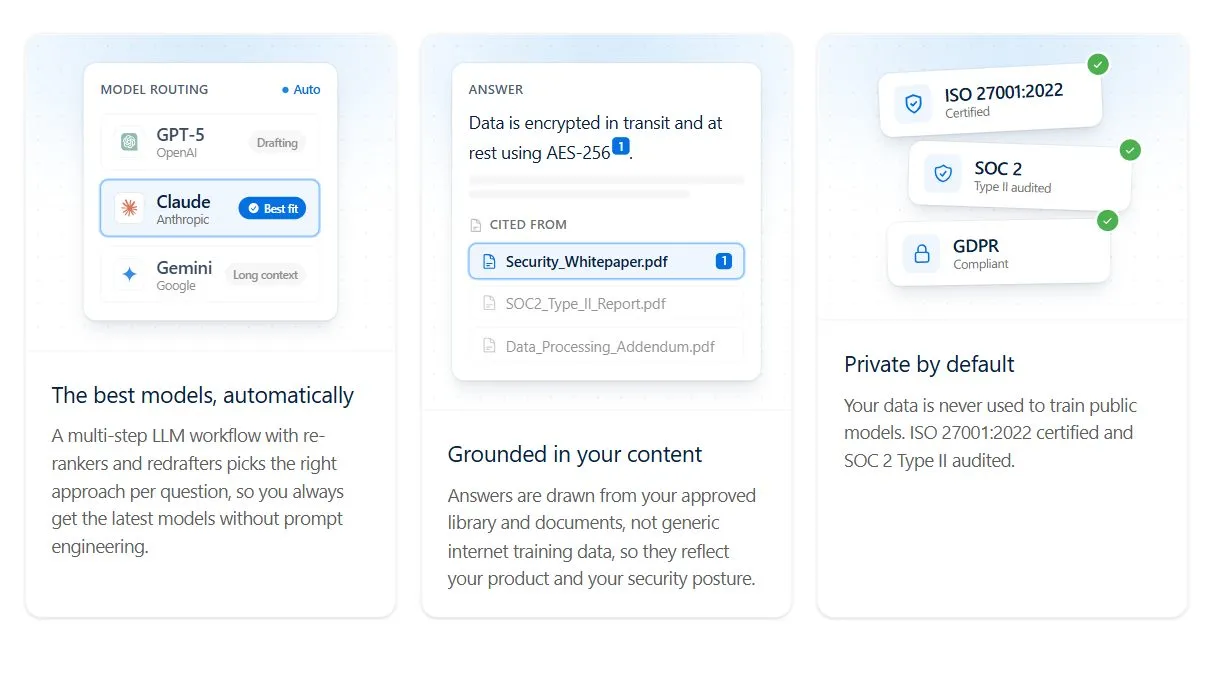
Its multi-model pipeline handles retrieval, re-ranking, drafting, redrafting, and checking across models selected for different parts of the task. Semantic search first identifies relevant company knowledge by meaning rather than depending only on identical keywords or previously used wording.
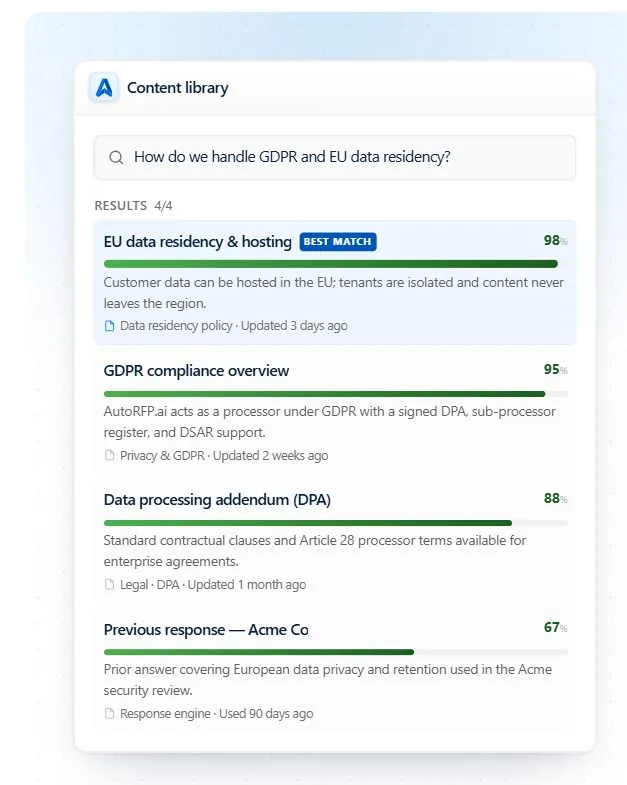
That architecture matters when the new RFP asks an old question in a completely different way. The system can connect conceptually related approved information, rank the strongest supporting material, generate the response, and recheck it before it reaches the reviewer.
5. Current-Source Governance With Zero Library Maintenance
An AI response is only as accurate as the knowledge it retrieves.
AutoRFP.ai connects with systems such as SharePoint, Confluence, Google Drive, OneDrive, Notion, and other company repositories, then searches that knowledge semantically.
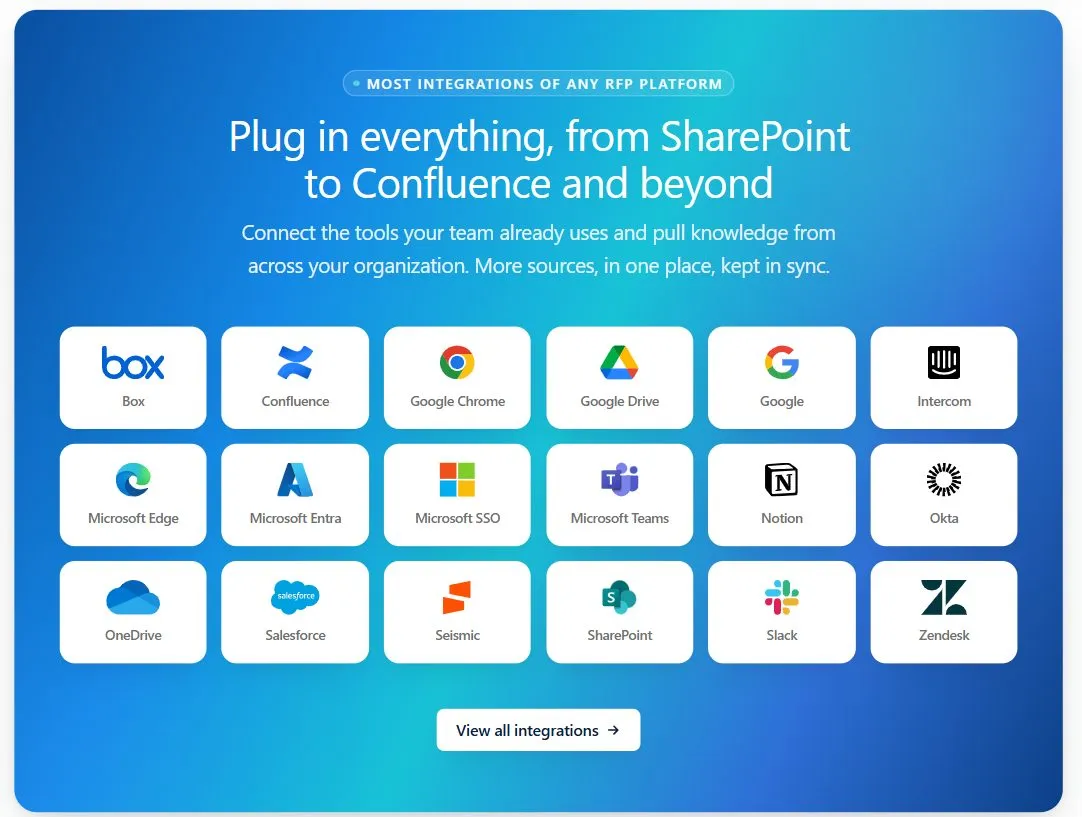
Source governance can surface recency and authority when competing versions of information exist, helping teams avoid drafting from superseded material.
Every approved response can also improve future work automatically. Teams retain ownership, approvals, review controls, and governance without continually maintaining a traditional library of snippets, folders, tags, and taxonomies.
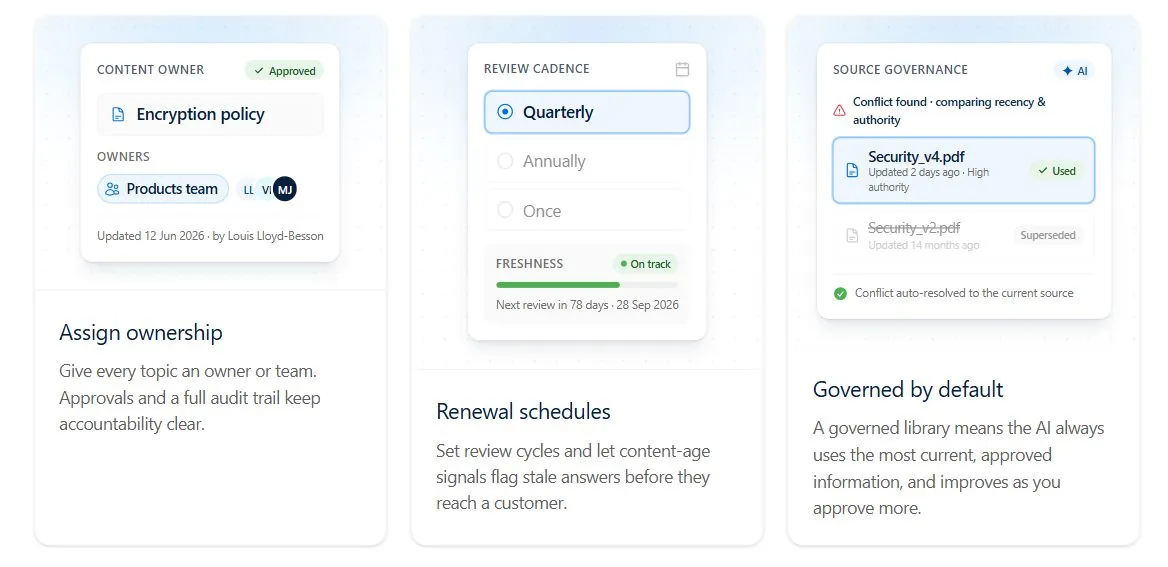
That is where zero library maintenance becomes part of the accuracy model. The goal is not merely less administration. It is reducing the chance that the AI confidently retrieves a perfectly organized answer that stopped being true six months ago.
6. Human Review, Approvals, and Audit Trails
Accuracy still needs human accountability, particularly for security, legal, compliance, financial, and commercially sensitive responses.
AutoRFP.ai supports assignments, sequential reviews, role-based permissions, version history, approval-gated updates, and audit trails. Teams can see who contributed information, what was changed, and who approved the final response.
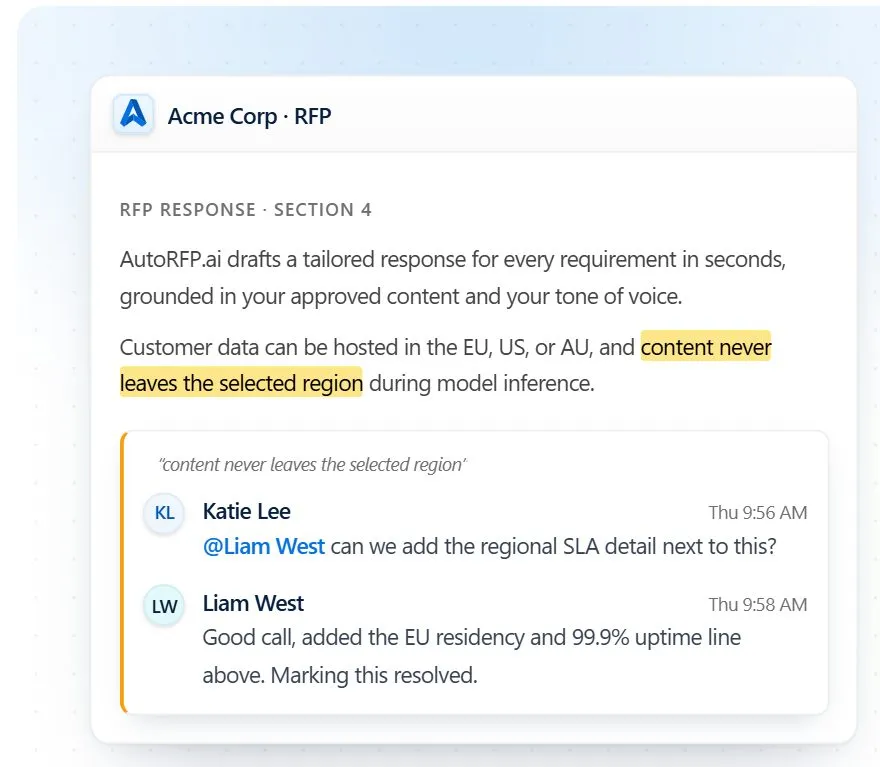
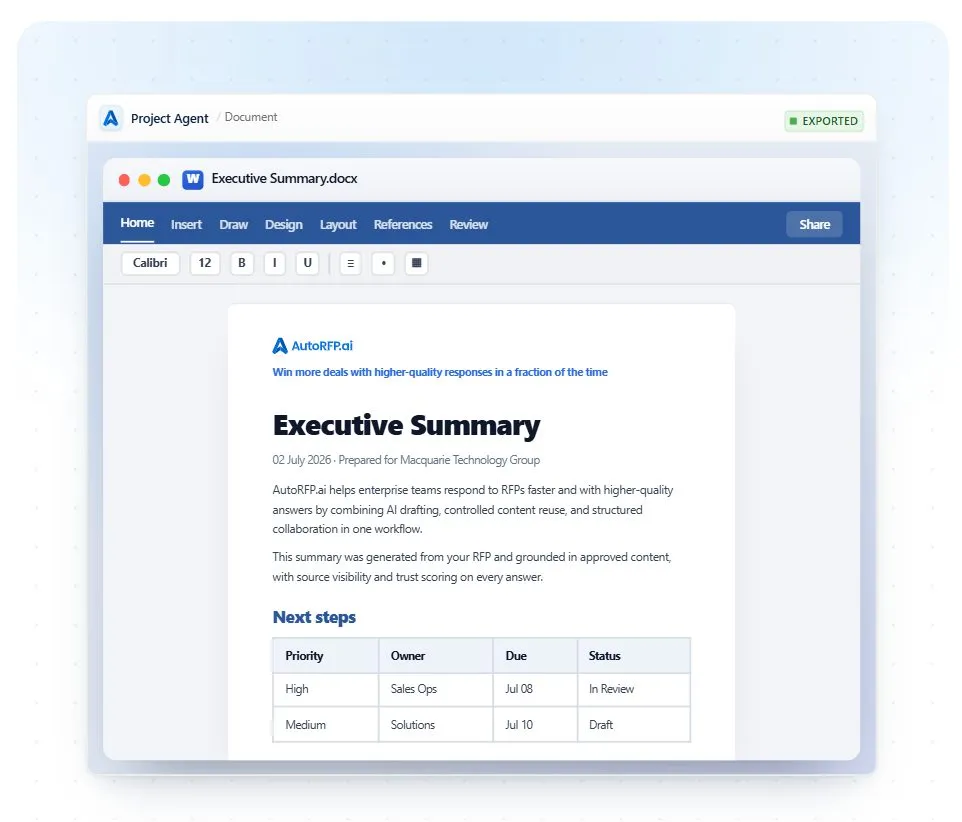
Subject matter experts therefore spend more of their time validating important answers rather than drafting repeated responses from scratch. The AI handles repeatable work, while people retain control over what ultimately leaves the organization.
7. Complex Document and Portal Handling
Accuracy can break down before drafting even begins if software misreads the buyer’s questionnaire.
AutoRFP.ai can import Word documents, PDFs, and complex Excel files, including multi-tab workbooks, nested tables, hidden tabs, macros, dropdowns, and validation fields.
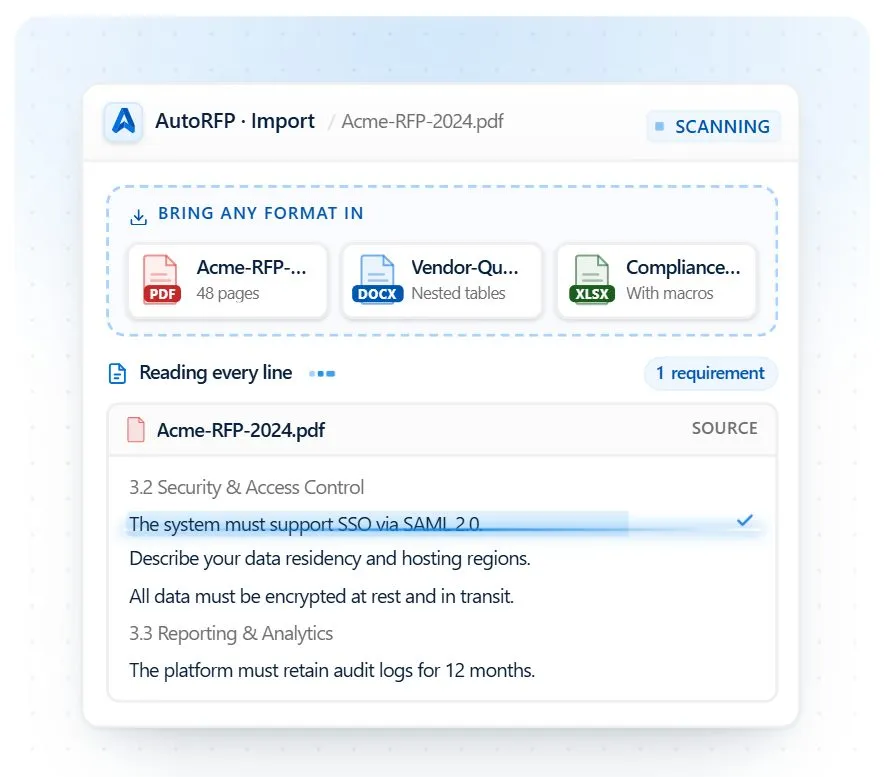
Reviewed responses can then be returned to the buyer’s required format rather than being manually reconstructed before submission.
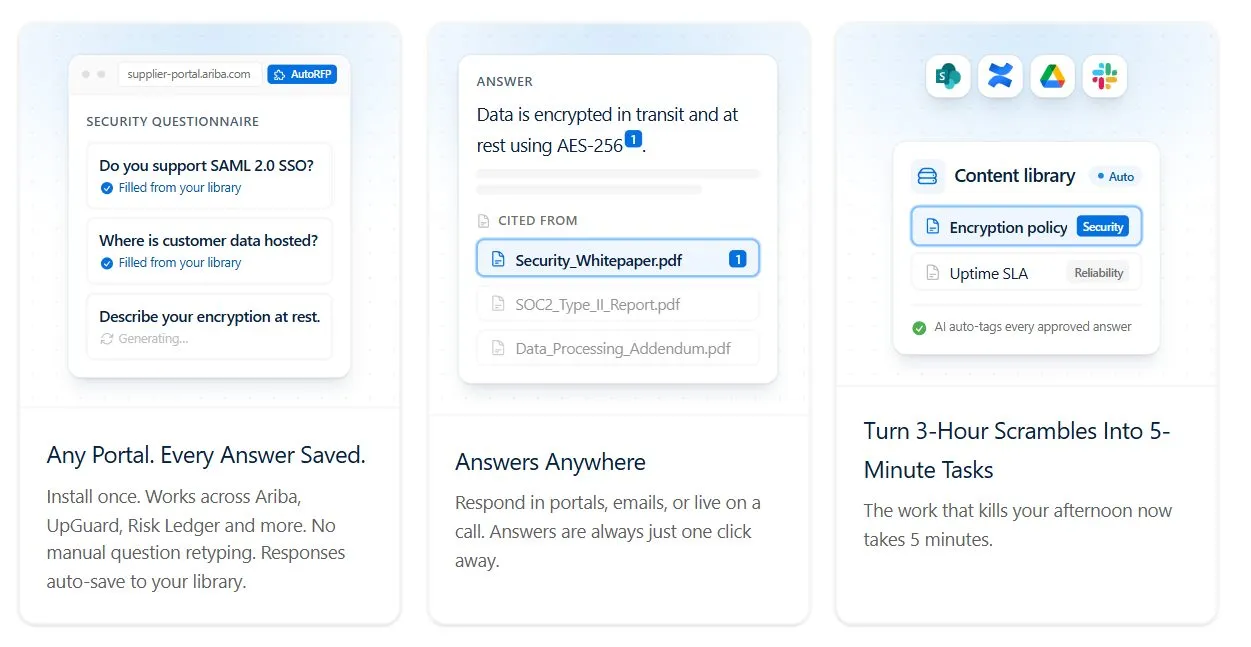
For questionnaires hosted in procurement or security portals, its browser-based Portal Agent can capture requirements and move approved responses back into the web workflow. That gives teams the same governed response process even when the buyer does not provide a clean downloadable questionnaire.
Pricing
| Plan | Monthly Cost | Key Inclusions |
|---|---|---|
| Scale | $899 | 24 projects per year, unlimited AI responses, content and users, all features, SSO, 18+ integrations, ISO 27001:2022 and SOC 2, unlimited support and online training |
| Accelerate | $1,299 | 50 projects per year, everything in Scale, advanced analytics and priority support |
| Enterprise | Custom | Scalable projects per year, everything in Accelerate, bespoke implementation, custom integrations, tailored security and compliance, dedicated success support and bespoke terms |
Where AutoRFP.ai Shines
- Answer-level verifiability: Reviewers can inspect the sources and Trust Score behind an individual response instead of relying on an unexplained AI output.
- Unsupported-answer handling: When approved evidence is insufficient, the system can flag the question for human review rather than hiding uncertainty inside plausible copy.
- Completeness as part of quality: The Feedback Score evaluates whether the response actually answers everything the buyer asked, not simply whether relevant information was retrieved.
- Current approved knowledge: Semantic search, source governance, and automatic learning from approved responses reduce the risk of repeatedly using stale library content.
- High-stakes governance: Sequential approvals, permissions, version history, and audit trails make responses easier to defend during security, legal, compliance, customer, or regulatory review.
- Real-world RFP handling: Complex Excel files, Word documents, PDFs, and web portals can move through the same response workflow without forcing teams into manual copy and paste.
- Blended response workloads: RFPs, security questionnaires, RFIs, and DDQs can be managed in one governed system instead of applying different accuracy controls in separate tools.
Where AutoRFP.ai Falls Short
- Open-web generation by default: Core response generation is deliberately grounded in approved company knowledge. Teams that want unrestricted web content used as the default source for answers may prefer a more open research-oriented workflow.
- Long-form proposal authoring: Teams primarily producing narrative-heavy tenders, highly persuasive long-form bids, or design-intensive proposal documents may prefer specialist proposal-writing and desktop-publishing software.
- Buyer-side procurement and RFQs: AutoRFP.ai is built for organizations responding to RFPs and questionnaires, not procurement teams issuing RFPs, evaluating suppliers, or managing quote-driven RFQ workflows.
Customer Reviews
Trevor C., Solution Consulting Director, said that “AutoRFP has genuinely been a game changer for our team across APAC. It has significantly reduced the time required to respond to RFPs while still maintaining a high standard of quality and accuracy. I also really appreciate the Agent functionality and the ability to refine responses by providing additional context. Being able to guide the Agent with organisation-specific information helps produce responses that are more relevant, accurate and tailored to the opportunity.”
David F., Head of Sales, shared that “AutoRFP turns messy Excel into accurate answers and streamlines RFPs. I love how it takes a dirty Excel and magically converts it into highly accurate answers. Pre-AutoRFP, the RFP process was so, so, so painful. I’m not going to lie, RFPs are still challenging, but with AutoRFP, it’s removed a lot of that laborious admin and formatting work.”
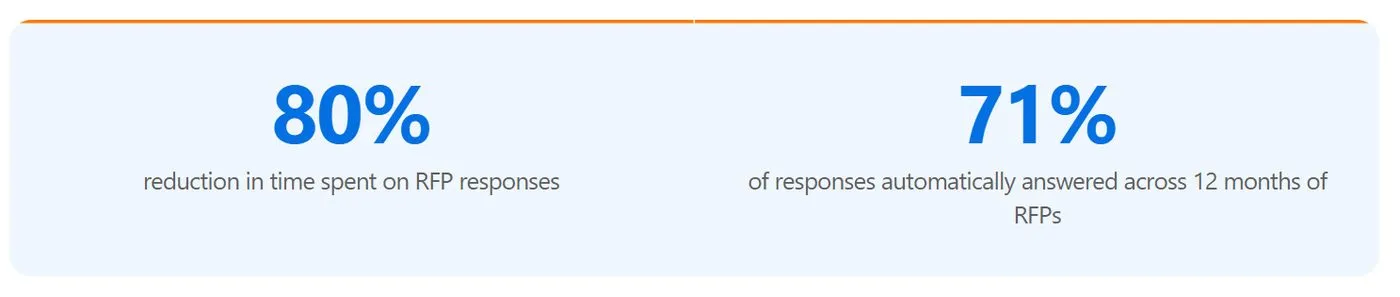
Raphael Schmideg, Chief Operating Officer at IMTC, said that “Reaching the RFP stage with clients is now a smooth process. With a 90% automation rate, we can quickly produce a first draft based on previous responses, making the RFP process efficient and stress-free.”
Katie Huff, Sr. Director, Sales Operations at MedeAnalytics, shared that “AutoRFP.ai has been one of the most life-changing tools that I’ve used in my career.”
Who AutoRFP.ai Is Best For
- Teams prioritizing accuracy over autofill: RFP organizations that care more about how an answer can be verified than how many questionnaire cells AI can populate.
- B2B SaaS companies selling to enterprises: Teams handling recurring commercial RFPs and security questionnaires where product, technical, and security claims need approved evidence.
- Security-questionnaire-heavy organizations: Sales engineering and InfoSec teams responding to detailed buyer assessments where unsupported answers create real risk.
- Financial services and DDQ teams: Private capital, asset management, insurance, and other firms that need responses defensible to LPs, auditors, compliance teams, and regulators.
- Cross-functional response teams: Organizations involving bid managers, sales engineers, product, legal, compliance, security, finance, and other SMEs in the same submission.


Video transcript
Did you know the average RFP can take thirty-two hours of manual grueling work? Now, in this video, in under ten minutes, I'm gonna show you how you can use AI RFP automation to drastically reduce the amount of time it takes to get to a first draft for your RFP, DDQ or security questionnaire using AutoRFP.ai. Sick. Let's jump into it. So at AutoRFP, we're an AI RFP software automation platform, across the globe with hundreds of customers using our software every day, battle-tested AI to help you automate RFPs. First, what's the problem? So an RFP or request for proposal or due diligence questionnaire or security questionnaire is a pain felt across all industries, whether it's construction, software, technology, finance, healthcare, anyone selling
to government or private businesses. And these glorified question and answers take hours and hours for people to complete, for them to win new business. It's a crucial part for your business to win enterprise and government contracts, which really help you grow sustainably and quickly. But when you go to bid on one, you are met with the RFP. Average response times are thirty to forty hours, usually involve five to eight people, seventy percent of content is reused but hard to find, and the average win rate across all industries is only forty-three percent. So you're spending hours with uncertainty that you may win, which is where efficiency and writing better responses, leveraging AI helps you win more faster. Now, looking into RFP automation, you have a number of options.
You can pick up a legacy RFP software. They've been around since the late nineties. They brought software to the RFP problem. Effectively, a glorified question and answer bank, like a database. You upload Q&A pairs, and then they try to use keyword matching to find the most relevant to then help you answer questions that you get in your new RFPs and tenders. You can also do AI builds yourself. So you might use ChatGPT or Claude, and you can see our other videos about how you can potentially use them. But effectively, you hit a ceiling where it's hallucinating, it's taking more time now to fix things than it should, and just doesn't have enough context to find the right answer most of the time. Or you can choose an actual AI native leader like AutoRFP.ai. Built from AI from the get go and have built the engine around zero
hallucination, multimodal architecture to leverage the latest models across all your major providers, library-less approach, so it doesn't take a lot of time to maintain the system, really high automation rates and enterprise security built in from day dot. So why do teams choose AutoRFP.ai? The reason is your knowledge is always current. We integrate with over twenty different systems, and we pull in from all your various file management and different software to make sure that your data is always up to date, and you don't have to maintain it across multiple different places. We're most accurate in the category because we leverage the different models, including specialized re-ranker models, embedding models, search models, and your large language models where they're best. And our team of over fifteen software engineers and AI engineers make sure that this is battle-tested, evals are correct, and it produces the correct answer based off your source context. And it's one platform for every stage of the RFP journey, from intake to new RFP
to AI-powered go/no-go to drafting to reviewing and using agents to review and update your RFP response, translation to collaboration across SMEs and different team members, ensuring that they can easily collaborate in an easy-to-use platform, and then exporting as well. Let's start with the AI native auto library. This is the core of the platform where your different content sources and past projects and up- and web scraping all live in the one place and- Any question that comes up, whether it's in an RFP or a team member asking the question, can be automatically answered with trust-based scores, specific semantic search, and ensures that the correct answer is found and used to then answer and generate an appropriate response. Then effectively, you upload a blank RFP.
The AI-powered response engine then automatically generates responses, translates it and everything to have the correct answers. Then your team can very easily edit, review, integrates with Slack and Teams, and everyone's notified on project deadlines. Now, I've spoken enough. Let's jump into the actual product, and you can see AI RFP automation from the start. We start by creating a project, which is a new RFP. We've got our portal agent that can scrape your requirements from web portals like SAP, Ariba and others, automatically ingesting those answers into your AutoRFP.ai instance, and then automatically drafting responses for you to easily enter back into the portal. Or you can upload a zip that contains a PDF, Excel, Word doc of your RFP and import that into the platform.
First we have our AI go, no-go. This ask different questions of your RFP based on your company context to ensure that should we actually bid on this RFP before we start it. It'll automatically grab out key details and link it to our CRM via our integration with Salesforce and so on. And here it's answered each question, and you can see it has confidence levels, it has trust built in, and you can then look back and see where the original source and what, for instance, table or other information. Our AI importer automatically selects every requirement, child requirements, dropdown pick lists response cells, everything else that's required for that RFP. We can manually change it if needed, but it automatically pulls that in. Then we can choose what content from our library or just choose every content, and our intelligent tagging and hierarchy system will make sure that the most relevant content is used for that response. And then I can create my project.
Next, the AI response engine then automatically starts sourcing the correct content from your auto library, re-ranking and finding the most relevant information, using that to then draft, redraft, and edit responses vi- with AI, and then provide those responses back to you in matter of seconds. And you can see here my thirty or so requirements automatically being filled out across the entire project. It's chosen the relevant pick lists, and each one of these have trust scores that I can understand further where this came from. It also has our AI-powered feedback score, and this is where AutoRFP is different to other systems. We don't wanna just help you source the correct answers. We wanna help you write better responses. And this goes into our feedback loop, where as you use the platform and write better responses, the AutoRFP system learns from those responses, and continually, your responses get better to help you win more faster.
Here we can do inline comments, so I can notify my team and so they can jump in, get notifications. I can submit, approve, add attachments, and everything else I can do in this platform. Finally, we have our project overview, which is our project management HQ for this particular RFP, making sure everyone understands deadlines. You can send reminders out to team members and just know when something needs to be completed by and when completed by and who is completing it, making sure that your RFP response is submitted on time and you're not faced with five PM Friday deadlines, calling someone to make sure you can get the correct answer to the correct question that's our short introduction to AutoRFP.ai. There's a lot more in RFP automation and AI RFP software that you can learn but feel free to reach out to our team. We'd love to provide a detailed demonstration to you so you can understand if this is a good fit for your business Already, AutoRFP.ai is in forty-four-plus countries across the globe with hundreds
of customers across different industries like technology, finance, and healthcare, and our customers are winning more faster. One of our customers like Shana Sweeney from SugarCRM won fifteen of their top twenty-five enterprise customers using AutoRFP.ai. They're using AI RFP automation to win more today, and it's a competitive advantage for their businesses. Our pricing is incredibly transparent. You can find more information on our website, to get in touch with our team, head over to our website, AutoRFP.ai. Book in a demo today and learn more and see if we can help you win more faster.
2. Arphie: Best for Transparent AI Answers and Reviewer Confidence
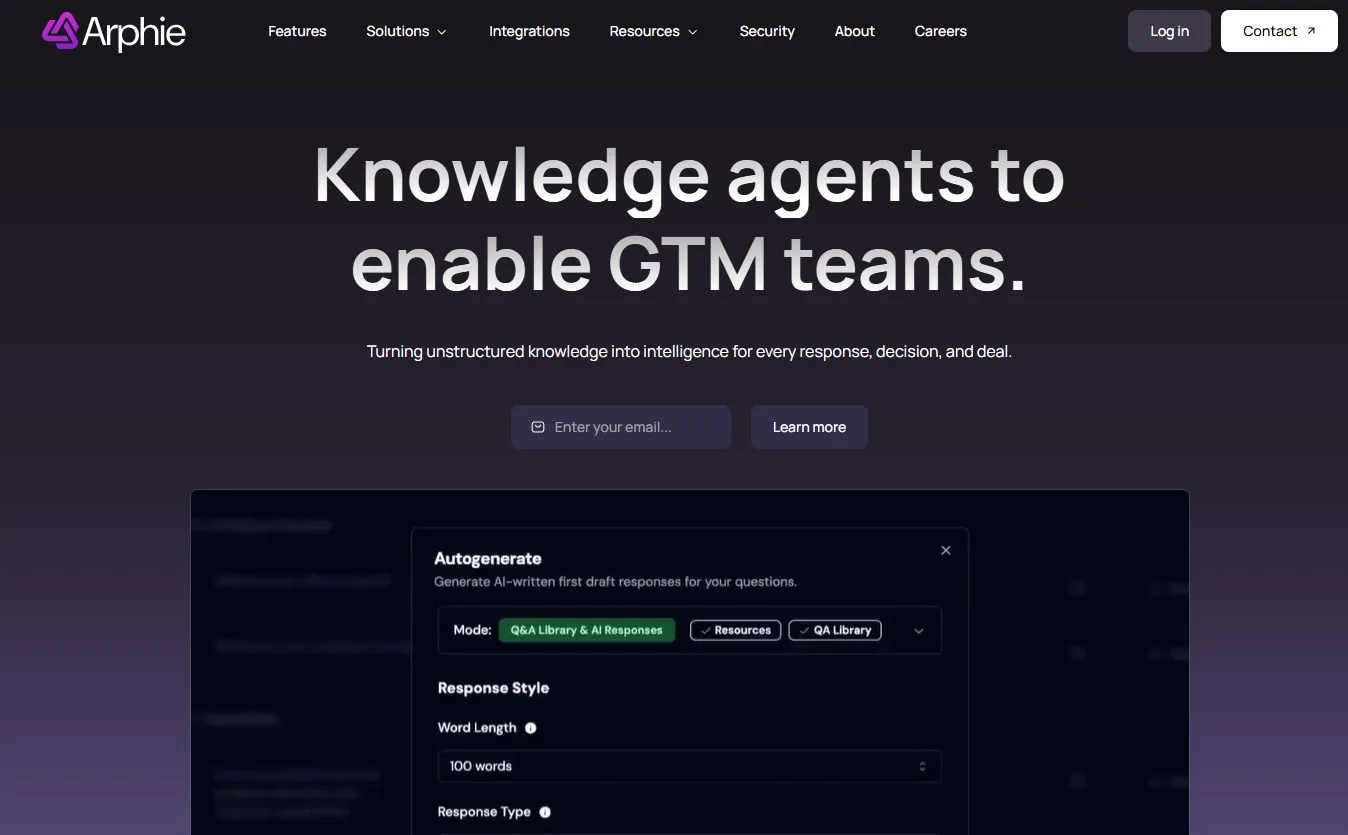
Arphie is a modern RFP, DDQ, and questionnaire platform that puts source transparency at the center of its AI workflow.
Generated responses show the underlying sources and an AI confidence level, while reviewers can inspect how the system arrived at an answer. Arphie also connects directly to company repositories so generated content can reflect current product, marketing, and security information.
Key Features
- Source visibility: Shows the exact sources used to generate each response.
- AI confidence levels: Gives reviewers another signal for prioritizing validation.
- Connected knowledge: Pulls current files from common repositories, including SharePoint, Drive, Confluence, Notion, Seismic, Highspot, Dropbox, and public documentation sites.
- Full auditing: Lets reviewers examine how AI agents constructed individual answers.
- Writing controls: Adjusts tone, vocabulary, formatting, and level of detail.
- Content cleanup: Smart Merge and recency-aware workflows help manage duplicate or outdated material.
Pricing
Arphie does not publish a self-serve price sheet. Buyers request a quote, and the number typically reflects questionnaire volume, workflow complexity, and how much implementation help the team needs.
Public signals still point to an indicative annual range, even though the full plan catalog stays behind sales.
| Annual cost range | Pricing model | Key features | Implementation cost |
|---|---|---|---|
| $36,000–$60,000+ | Concurrent projects | Advanced AI, transparent sourcing, rapid implementation | White-glove included |
Arphie states that its model does not add standard implementation or onboarding fees.
Where Arphie Shines
- Black-box reduction: Particularly useful when reviewers want to understand why the AI produced an answer before approving it.
- Current distributed knowledge: Live connections suit organizations whose authoritative information exists across several repositories.
- Cross-functional reviews: Unlimited seats make it easier to involve occasional security, legal, product, or engineering SMEs.
- Writing flexibility: Teams can control how underlying facts are translated into customer-facing language.
Where Arphie Falls Short
- Shorter enterprise history: Arphie has less long-term market history than Loopio or Responsive.
- File workflow development: Some reviewers have mentioned remaining areas for improvement in imports, exports, and formatting.
- No public dollar price: Buyers need to contact sales before comparing exact total cost.
Customer Review
A Technical PM shared on Gartner, “Arphie is easy to use and helps save time on repetitive questionnaires that require input from multiple stakeholders. Its platform has significantly reduced the effort involved in managing recurring questionnaires, and overall, we are happy with the product.”
A Marketing Manager said, “Arphie connects with our internal SharePoint and website documentation, reducing the time spent on content management and allowing us to focus on revenue-generating work.”
Who Arphie Is Best For
- Transparency-focused teams: Buyers that want evidence and confidence indicators attached to AI responses.
- Solutions engineering organizations: Teams handling significant technical questionnaire volume.
- Distributed-knowledge companies: Organizations with current content spread across several repositories.
- Lean cross-functional teams: Groups that want broad SME access without per-seat friction.
3. Responsive: Best for Enterprise AI Quality Scoring and Governance
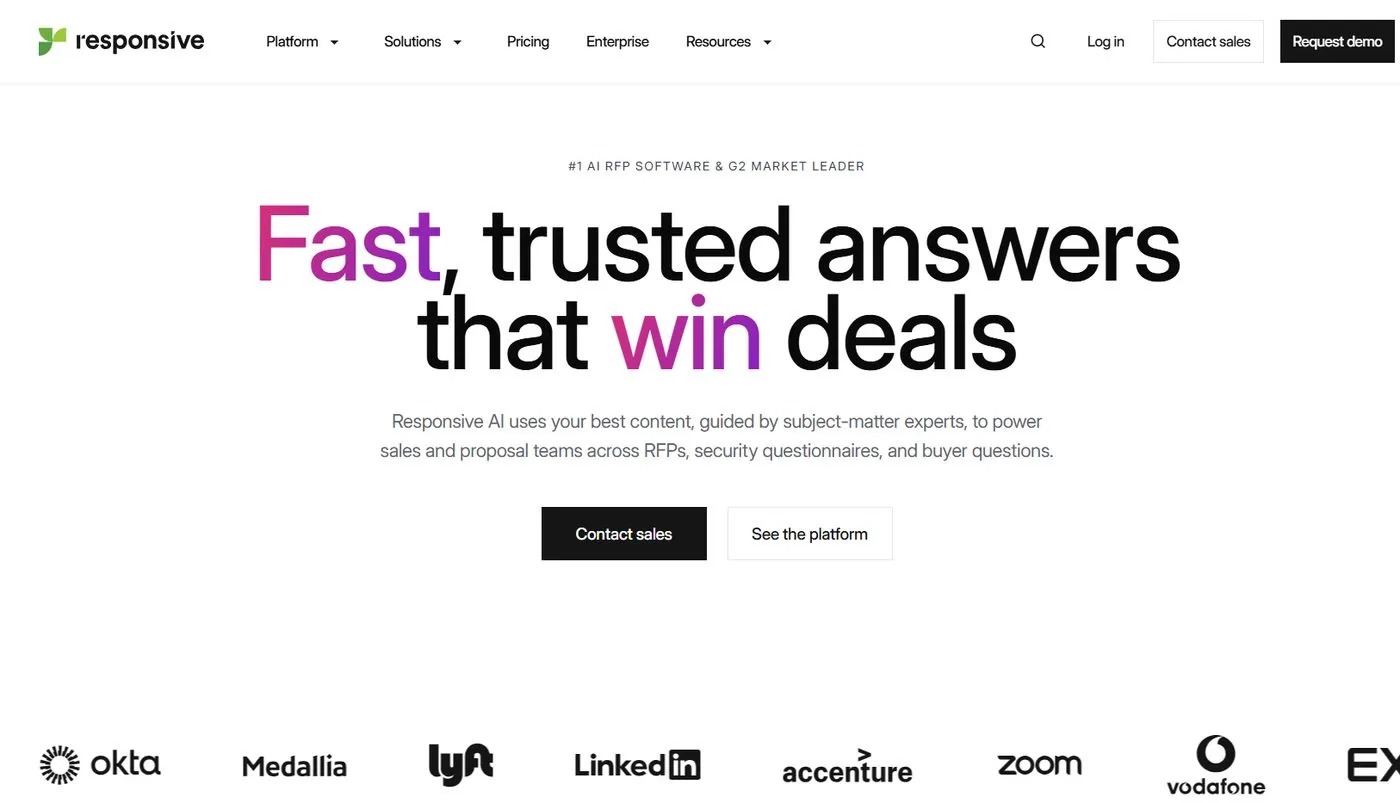
Responsive is an enterprise response-management platform with one of the more explicit multidimensional scoring systems in this comparison.
Responsive’s TRACE Score grades each AI draft on five named dimensions: Trustworthiness, Relevance, Accuracy, Completeness, and Explainability. That gives enterprise reviewers more than a single confidence label, and the score sits inside a broader stack of library governance, project management, and formal approvals.
Key Features
- TRACE Score: Evaluates AI responses across five quality dimensions.
- AI drafting: Generates content from verified organizational knowledge.
- Content Library: Centralizes approved reusable response material.
- Content governance: Supports owners, reviews, permissions, and content-health processes.
- Requirements Analysis: Helps teams analyze complex requirements before and during response work.
- Enterprise workflows: Coordinates large numbers of projects, contributors, and approval processes.
Pricing
| Plan | Pricing | Notes |
|---|---|---|
| Emerging Edition | From $10,000 | Unlimited Response Projects, AI and automation, content, collaboration, integrations, reporting, and support |
| Growth Edition | Contact sales | Adds intake workflows, advanced integrations, access controls, and flexible hosting |
| Enterprise Edition | Contact sales | Adds flexible custom AI, enterprise security, governance, and advanced reporting |
Responsive pricing can also include user licenses and selected services or add-ons.
Where Responsive Shines
- Multidimensional quality review: TRACE gives enterprise reviewers more information than a simple AI-generated confidence label.
- Large response operations: Strong project-management depth helps organizations govern quality across many simultaneous submissions.
- Formal approval environments: Useful when legal, compliance, security, product, and proposal teams all participate.
- Management visibility: Reporting supports leaders who need to monitor broader response operations alongside AI quality.
- Enterprise maturity: Responsive has an established deployment footprint and extensive independent customer feedback.
Where Responsive Falls Short
- Library administration: The platform remains centered on centralized response content that requires ongoing governance.
- Search accuracy: Users note that they sometimes find specific content difficult to locate.
- Platform complexity: Smaller teams may not need the full project-management, reporting, and administration stack.
- Pricing structure: User licensing and additional services can make total cost less straightforward than the starting platform fee.
Customer Review
Hector T., Sr. Director of Presales CoE in Computer Software, said, “Responsive makes RFPs easier by providing a central repository for responses and enabling collaboration across teams. This allows people from different departments to work on proposals in parallel and improves overall productivity.”
Ishaan B., Product Security Governance Lead, said, “Answer suggestions can often be inaccurate because the tool sometimes relies on simple keyword matching. Even when keywords match, the suggested answers may not fit the question, requiring users to rely on their expertise to find the correct responses in the library.”
Who Responsive Is Best For
- Large enterprises: Organizations managing substantial proposal volume.
- Formal proposal functions: Teams with defined governance and review processes.
- Quality-conscious enterprise buyers: Organizations that value a multidimensional scoring framework.
- Complex response programs: Teams managing RFPs, DDQs, and security questionnaires together.
4. Loopio: Best for Mature Library-Led Answer Quality
Loopio combines a mature approved-content Library with newer AI answer-generation and confidence capabilities.
Automated Answers searches the Library, previous projects, and standalone documents to produce responses. Confidence Pulse then indicates whether a generated response carries High or Medium Confidence, helping teams identify where closer human review may be appropriate.
Key Features
- Automated Answers: Generates responses using available approved content sources.
- Confidence Pulse: Marks generated answers with a confidence indicator.
- Content Library: Maintains vetted reusable responses and supporting information.
- Customizable sourcing: Lets users control which sections and content sources should inform an answer.
- Review workflows: Routes generated material to contributors for editing and approval.
- Connected knowledge: Extends beyond the Library into sources such as SharePoint and Google Drive.
Pricing
| Plan | Pricing | Notes |
|---|---|---|
| Foundations | From $20,000/year | 10 seats, unlimited projects and Library entries, generative AI, and standard support |
| Enhanced | Custom quote | Adds multi-language content, confidential projects, and multi-step reviews |
| Enterprise | Custom quote | Adds separate business units, sandboxes, custom seat counts, and premium support |
Where Loopio Shines
- Controlled content reuse: Mature teams can establish a clear bank of vetted answers and reuse them consistently.
- Human review prioritization: Confidence Pulse gives SMEs a quick signal for deciding where closer validation is worthwhile.
- Established workflows: The product is familiar to dedicated proposal teams with formal content owners and review cycles.
- Broad RFx coverage: The same content operation can support RFPs, RFIs, DDQs, and security questionnaires.
Where Loopio Falls Short
- Library accuracy depends on library health: An approved answer can still be outdated if the underlying Library is not reviewed consistently.
- Content-management effort: Owners, review cycles, and organization remain important parts of the operating model.
- Confidence detail: Loopio currently describes Confidence Pulse through High and Medium confidence labels, with further calculation detail still being developed.
- AI refinement: Users provide feedback that AI accuracy could still improve.
- Entry cost: Foundations start at $20,000 annually.
Customer Review
Mario P., VP of Sales Engineering, said, “Loopio’s clean interface, collaboration tools, project tracking, and end-to-end workflow make it easy for teams without a dedicated RFP function to manage proposals. After organizing the content library, our turnaround improved from 5–6 days or longer to 2–3 days, saving significant time and resources.”
Dalton T., Sales Operations Manager, said, “RFP ingestion can be a significant lift because RFPs arrive in different formats and need to be imported properly. The screenshot drag-and-drop functionality could also use some improvements, although the current experience is still effective.”
Who Loopio Is Best For
- Dedicated content managers: Teams with people responsible for maintaining approved responses.
- Mature proposal organizations: Businesses with established response processes.
- Library-first buyers: Organizations that prefer controlled reusable Q&A over a lower-maintenance knowledge model.
- Enterprise teams: Companies handling repeat RFP and questionnaire volume.
5. SiftHub: Best for Verified Responses With Broader Presales Context
SiftHub combines RFP automation with a wider presales and deal-orchestration platform.
Its RFP workflow grounds answers in verified content, traces responses back to the source document, owner, and modification date, and supports reviewers when specialist input is required. The broader platform can also incorporate CRM, call, and deal context into other sales workflows.
Key Features
- Verified-source generation: Drafts responses from approved product documentation, policies, previous submissions, and connected knowledge.
- Source tracing: Shows the document, owner, and modification date behind generated answers.
- No-source handling: SiftHub states that it identifies when it cannot find a verified source.
- Confidence scoring: Uses validation checks and customized confidence scoring within its response pipeline.
Pricing
| Plan | Pricing | Notes |
|---|---|---|
| RFP Agent | Contact sales | RFP and questionnaire automation, verified knowledge, portal workflows, collaboration, and response management |
| Full Platform | Contact sales | Adds wider sales and presales workflows, including AI Teammate and deal orchestration |
SiftHub customizes pricing based on team size and use case.
Where SiftHub Shines
- Deal-aware presales workflows: Useful when accurate RFP responses need to sit inside a wider revenue-team process.
- Native work environments: Teams can remain inside common documents and portals rather than continually importing and exporting projects.
Where SiftHub Falls Short
- Proprietary accuracy claims: SiftHub publishes an accuracy percentage, but buyers should ask how the figure is defined and reproduce the test using their own RFPs before comparing it with another vendor.
- Broader platform scope: Teams only seeking formal RFP automation may not need its surrounding deal-orchestration capabilities.
- No public dollar pricing: Contract cost requires a custom quote.
- Current-source behavior should be tested: Some reviewers have reported the system selecting older spreadsheet responses despite newer files being available.
Customer Review
A Bid Manager wrote, “SiftHub can sometimes misinterpret similar functional and technical requirements, resulting in answers from the wrong context. Bulk updates to outdated Q&A pairs can also require vendor support, while exported documents or Excel files with complex tables may have formatting issues.”
He also expressed his concerns, saying that “While SiftHub helps generate contextually correct answers for most customer requirements, it sometimes fails to differentiate between functional and technical requirements when they have similar connotations and wording. In such cases, it sometimes responds to a functional question from a technical point of view and vice versa. Managing Q&A repositories can also be difficult, as bulk updates to outdated Q&A pairs depend on the vendor, although manual updates can be done easily. Exported documents or Excel files with complex tables can also have formatting issues.”
Who SiftHub Is Best For
- Presales organizations: Teams where solutions engineers manage RFP and questionnaire work.
- Deal-context-heavy teams: Companies that want response knowledge connected with wider sales workflows.
- SaaS companies: Organizations with frequently changing technical and product information.
- Mixed customer-response teams: Groups handling RFPs, security questionnaires, and customer questions.
6. AutogenAI: Best for Evidence-Backed Narrative Proposal Quality
AutogenAI takes a different approach to quality than questionnaire-first RFP tools.
It is built primarily around proposal writing, helping teams qualify opportunities, structure narratives, generate content, trace sourced statements, and review the resulting proposal against requirements. Its Source Finder lets writers trace sourced text back to original library documentation, while Gamma Review evaluates writing against selected criteria or bid-specific requirements.
Key Features
- Source Finder: Traces sourced proposal text back to its original documentation.
- Trusted-source drafting: Uses organizational knowledge and selected external material during generation.
- Gamma Review: Checks content against proposal or bid-specific review criteria.
- Proposal Editor: Provides writing transformations designed for bid and proposal professionals.
- Qualification tools: Extracts and evaluates requirements before proposal development.
- Microsoft Word workflow: Extends proposal writing and review into Word.
Pricing
AutogenAI keeps commercial terms behind a sales conversation. Quotes usually follow proposal volume and how widely the writing environment will be deployed.
The enterprise package typically bundles proposal management, reviewer-only seats, Word integration, security controls, and configuration.
Where AutogenAI Shines
- Narrative quality: Particularly strong when accuracy must coexist with persuasive, evaluator-focused writing.
- Evidence-backed writing: Source Finder helps writers validate the factual foundation of narrative claims.
- Professional proposal workflows: Qualification, outlines, writing, evidence, and review sit within one proposal environment.
- Complex tenders: Useful for long-form submissions where compliance and narrative quality both matter.
- Human-led refinement: Its workflow explicitly keeps proposal professionals involved in review and improvement.
Where AutogenAI Falls Short
- Structured questionnaire focus: Teams mainly answering repetitive RFP Q&A or security questionnaires may not need its full writing environment.
- Human governance remains important: Source grounding does not remove the need to verify nuance, compliance, and complex claims.
- Learning curve: Users find parts of the interface or workflow harder to learn.
- No public pricing: Exact cost requires a sales process.
Customer Review
Independent reviews of AutogenAI are still sparse on the major third-party sites. Enterprise proposal teams use it for AI-assisted writing, strategy, and review, but there is not yet a large enough sample to treat any single quote as representative.
Who AutogenAI Fits
- Professional proposal writers: Teams where long-form quality matters heavily.
- Narrative-heavy bids: Organizations producing substantial tenders and competitive proposals.
- Evidence-conscious writing teams: Groups that want source tracing inside the writing process.
- Microsoft Word-centered proposal teams: Writers who prefer to remain close to traditional proposal documents.
7. 1up: Best for Lightweight Trusted-Source RFP Automation
1up is a lower-cost RFP and knowledge-automation platform designed for sales, presales, and technical teams.
It generates questionnaire answers from trusted internal sources such as previous RFPs, websites, Google Drive, SharePoint, and other connected information. 1up also attempts to prioritize recent information when generating responses.
Key Features
- Trusted-source generation: Builds RFP answers from connected company information.
- Knowledge segmentation: Lets companies separate information by product or business line.
- RFP and questionnaire autofill: Supports Word, Excel, and browser-based responses.
- Collaboration: Allows teammates to review and improve generated answers.
- Messaging integrations: Makes company knowledge accessible through Slack, Microsoft Teams, and Google Chat.
- MCP Server: Connects organizational knowledge with supported external AI workflows.
Pricing
| Plan | Pricing | Notes |
|---|---|---|
| Free | $0 | 1 admin, 50 knowledge uploads, 50 answers/month |
| MCP | $50/month + usage | MCP Server plus usage-based questionnaire automation |
| Starter | $300/month | Unlimited users and answers, integrations, 1 questionnaire/month |
| Plus | $900/month | Expanded knowledge features and 6 questionnaires/month |
| Enterprise | Custom | Enterprise administration and support |
Where 1up Shines
- Accessible entry point: Teams can test trusted-source automation without committing to a large annual contract.
- Lean-team fit: Unlimited users on Starter and Plus suit organizations where several employees contribute occasionally.
- Everyday knowledge access: The platform can support normal sales and technical questions in addition to formal RFPs.
Where 1up Falls Short
- Enterprise governance depth: Complex approval structures may require more formal workflow controls.
- Accuracy features are lighter: It does not expose the same two-score quality framework as AutoRFP.ai or multidimensional TRACE scoring as Responsive.
- Monthly questionnaire limits: Starter and Plus include defined questionnaire allowances.
Customer Review
A Director of Sales said on Gartner, “1up is easy to work with and highly responsive. Its exceptional customer support provides quick answers, while questionnaire automation saves time on first drafts. Content discovery, source references, and the Ask 1up feature also make it easier to create and validate responses.”
A Sales Manager said, “1up has significantly improved the quality and accuracy of RFQ responses while providing a useful knowledge base across multiple solutions. It requires little training, and the team is responsive to feature requests, even for smaller packages. However, the product is still relatively young, so some desired features are not yet available.”
Who 1up Is Best For
- Lean presales teams: Organizations without a large proposal department.
- Budget-conscious buyers: Teams that want published entry pricing.
- Technical sales organizations: Companies handling RFPs and security questionnaires alongside normal customer questions.
- Teams starting with AI automation: Organizations that want a lower-complexity entry point.
How to Test Accuracy Before You Buy
Do not judge AI RFP software on a polished vendor demo. Test it against completed RFPs, approved source material, difficult questions, and real reviewers. The goal is to see whether the system produces responses a team can verify and approve with minimal rewriting, not simply whether it fills more cells.
1. Run a Proof of Concept With a Real RFP
Use a recently completed RFP that represents the work the team actually handles. Include straightforward questions, technical requirements, ambiguous wording, and questions where the correct information is missing.
Give each vendor the same source material and compare:
- How many answers are correct and complete
- How much editing SMEs need to make
- Whether answers match the company’s terminology and tone
- How often the AI produces an answer when it should have escalated the question
- How quickly reviewers can verify the result
AutoRFP.ai, for example, recommends testing the platform on the buyer’s own RFPs during a two-week proof of concept rather than relying solely on preconfigured demo data.
Pro tip: Include several questions where you deliberately remove the supporting information. A reliable system should expose the gap instead of producing convincing copy from weak evidence.
2. Check the Evidence Behind Every Answer
Accuracy should be inspectable. For each generated response, ask the vendor to show exactly where the information came from.
Check whether reviewers can see:
- The original source
- The specific supporting content
- How current that source is
- A confidence or trust indicator
- What happens when multiple sources disagree
AutoRFP.ai, for instance, shows the approved sources behind each response alongside a Trust Score, while low-confidence questions can be flagged rather than guessed.
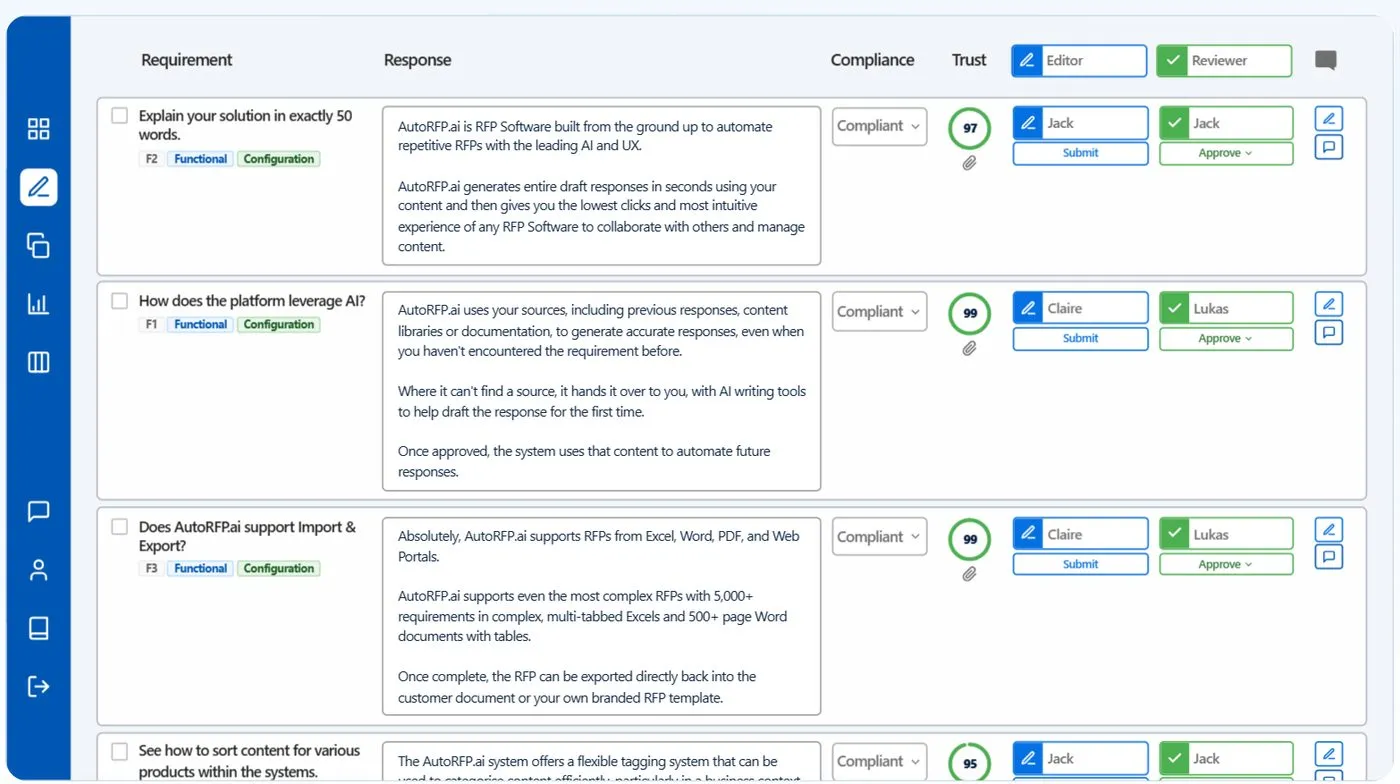
A percentage-based accuracy claim is much less useful if a reviewer still has to hunt through SharePoint or old proposals to determine which individual answers can be trusted.
3. Test What Happens When the AI Does Not Know
One of the most revealing tests is not whether the AI answers correctly, but whether it knows when it should not answer.
Add questions that:
- Have no approved answer
- Refer to a product the company does not support
- Contain outdated information
- Have conflicting answers across two documents
- Require context that is not present in the knowledge base
Then watch what happens. Does the system flag the uncertainty, route the question, or quietly produce something plausible?
That distinction matters in high-stakes RFPs, DDQs, and security questionnaires, where a confident unsupported answer can create more review work than a flagged one.
4. Measure Editing, Not Just Autofill
A first draft is only useful if the team can actually use it.
Track the percentage of answers that require:
- No changes
- Minor edits
- Major rewrites
- Complete replacement by an SME
This gives a much better picture of response quality than asking how many questions the AI can populate.
Pro tip: Have the normal reviewers score the AI drafts without telling them which vendor produced each one. It removes some demo-room bias and makes differences in edit burden much easier to spot.
5. Test Accuracy With Messy Source Content
Do not clean the knowledge base before the trial. Real RFP environments contain duplicate answers, stale policies, old proposals, conflicting documents, and inconsistent terminology.
That is exactly what the software should receive.
AutoRFP.ai’s 2026 Proposal Win Rate Report found that 51% of teams without content automation were in the Low Win Cohort, compared with 29% of teams using content automation. The report does not claim automation alone causes higher win rates, but it does show that governed content operations support stronger proposal processes.
The test should therefore examine whether the system can distinguish authoritative information from merely similar information, rather than only performing well against a perfectly curated library.
6. Test Complete Answers, Not Just Correct Facts
An answer can contain accurate facts and still fail the RFP question.
Give the software multi-part requirements such as:
- Describe your encryption standards, explain how keys are managed, and provide your approach to key rotation.
Then check whether the response addresses every part. Strong AI RFP software should evaluate both whether its evidence is trustworthy and whether the final response actually answers what the evaluator asked.
7. Compare Review Burden Across Vendors
At the end of the trial, do not ask which product generated the most answers. Ask which one left the team with the least risky work.
Compare:
- Major edits per RFP
- Unsupported answers generated
- Questions correctly escalated to SMEs
- Time spent verifying sources
- Missing parts of multi-part questions
- Conflicting or stale content surfaced
- Reviewer confidence in approving the final response
The strongest accuracy test is simple: take the same difficult RFP, the same source material, and the same reviewers, then see which system produces the most defensible submission with the least corrective work.
See How Accurate Your RFP Answers Really Are
Accuracy claims are easy. Your own RFP is harder to fake. AutoRFP.ai writes from approved content, cites the sources it used, scores trust and completeness, and routes anything it cannot support to a reviewer.
Bring a real RFP, messy files included, and see how much your reviewers actually need to change.
Book a demo and test AutoRFP.ai on your own data.
About the author

Technical Account Manager
Technical Account Manager at AutoRFP.ai. Background in asset management completing institutional RFPs and DDQs; now implements AutoRFP.ai for some of the company's largest accounts.
LinkedInFrequently asked questions
Is ChatGPT Accurate Enough for RFP Responses?
ChatGPT can help draft and refine RFP responses, but general-purpose AI is not designed to automatically ground every answer in approved company knowledge. Purpose-built AI RFP software like AutoRFP.ai adds source controls, citations, confidence signals, governance, and review workflows that make responses easier to verify before submission.
Does a High Confidence Score Mean an AI-Generated RFP Answer Is Correct?
No. A confidence or trust score is a useful review signal, not proof that an answer is correct. Teams should still inspect the supporting sources, especially for security, legal, compliance, financial, or contractual claims. The strongest platforms such as AutoRFP.ai make both the score and the evidence behind the response visible.
How Should Teams Measure AI RFP Accuracy Over Time?
Track how often AI-generated responses are approved unchanged, require minor edits, need major rewrites, or are replaced entirely by SMEs. Teams can also monitor unsupported answers, incorrect source selection, missed question requirements, and verification time to see whether accuracy is genuinely improving.
Can a Larger RFP Content Library Make AI Answers Less Accurate?
Yes. More content does not automatically mean better answers. A library filled with outdated, duplicate, contradictory, or poorly governed information can make it harder for AI to retrieve the right evidence. Accuracy depends more on source quality, freshness, authority, and retrieval than the sheer amount of stored content.
Are AI RFP Tools Accurate on Security Questionnaires?
They can be, provided responses are grounded in current, approved security documentation and reviewed when necessary. Security questionnaires contain precise claims about controls, certifications, data handling, encryption, and compliance, so reliable AI should cite supporting evidence and escalate questions when authoritative information is missing or uncertain.

