
AutoRFP.ai vs Arphie: Enterprise RFP Comparison
Compare AutoRFP.ai and Arphie on source transparency, enterprise scale, global support, security certifications, and pricing.

Ops Lead, AutoRFP.ai··14 min read
AutoRFP.ai vs Arphie is the head-to-head for teams comparing citation-forward AI drafting with an enterprise response operation. AutoRFP.ai writes every draft from approved material, sits a Trust Score and a Feedback Score on the answer, and hands anything it cannot support to a person. Both compete in mid-market RFPs, security questionnaires, and DDQs. They separate on who owns the process, how far the integrations reach, and what a security review turns up. This comparison covers those three, then response quality, reporting, and pricing. The same researched data also feeds the Arphie alternative page.
At a glance
Both products serve mid-market teams. AutoRFP.ai carries that workflow into larger enterprise deployments.
| Capability |  AutoRFP.ai AutoRFP.ai |  Arphie Arphie |
|---|---|---|
| AI-native platform (built on generative AI, not added later) | Yes | Yes |
| Built for mid-market teams | Yes | Yes Clean UX for mid-market SQ workflows |
| Scalable to Enterprise | Yes | Partial Enterprise customers; limited published support footprint |
| Dedicated support team (24/6) | Yes | No White-glove onboarding; no published support hours |
| ISO 27001 certified | Yes | No SOC 2 Type 2 published; ISO 27001 not listed |
Comparison based on public product information and verified user reviews as of October 2026. – indicates the capability isn't clearly documented, or that the row does not apply.
Evidence comes from Arphie’s product, security, about, and AI RFP software pages captured 23 August 2026; its 14 November 2024 seed announcement; LinkedIn’s company profile, retrieved 24 August 2026; Arphie’s Loopio vs Responsive comparison; and a G2 review this site already quotes on portal questionnaires. AutoRFP.ai claims resolve to the Trust Center, About us, and pricing.
Implementation and support
This is the widest gap between the two, so it goes first. Onboarding happens once. Support matters on every deadline after it.
| AutoRFP.ai | Arphie | |
|---|---|---|
| Largest presence | North America | San Francisco |
| Customer success coverage in North America | Dedicated Technical Account Managers | Team is US-based; role detail not public |
| Support hours | 24/6 across North America, EMEA, APAC | Not published |
| Data hosting regions | US, EU, AU | Not published |
| Operating footprint | Global support across regions | 8 employees on LinkedIn, 24 August 2026 |
AutoRFP.ai’s largest presence is in North America, with dedicated Technical Account Managers who handle implementation, configuration, and the account afterwards, so the person answering a question already knows the deployment. Fortune 500 response teams use the platform.
Arphie’s FAQ, retrieved 23 August 2026, says switching usually takes less than a week with white-glove onboarding through migration. That fast, hands-on start is a genuine strength. Its site names a fully US-based customer success team, and LinkedIn lists eight Arphie employees with San Francisco as headquarters as of 24 August 2026. Support hours, regional coverage, and hosting regions are not published.
Published support hours and data hosting for the Americas, EMEA, and APAC.
| Capability | AutoRFP.ai | Arphie |
|---|---|---|
| Dedicated support team (24/6) | Yes | No White-glove onboarding; no published support hours |
| Data hosting and support (Americas) | Yes Separate US deployment | Partial San Francisco base; no published regional hosting |
| Data hosting and support (EMEA) | Yes Separate EU deployment | No |
| Data hosting and support (APAC) | Yes Separate Australia deployment | No |
Comparison based on public product information and verified user reviews as of October 2026. – indicates the capability isn't clearly documented, or that the row does not apply.
SCIM provisioning and MCP replies share the project’s permission boundary.
Who the workflow is built around
Sales engineers are primary AutoRFP.ai users too. They hold the product knowledge and often carry the first draft. The question is whether the software treats the RFP as an SE task or as a company workflow.
| Arphie | AutoRFP.ai | |
|---|---|---|
| Published focus | Sales engineering and GTM efficiency | The full response workflow |
| Teams the proof names | Solutions engineering | Bid management, enterprise sales, and SMEs |
| Headline outcome | Time returned to pre-sales | Volume, answer quality, and deals won |
Each vendor’s flagship customer story shows the emphasis. Arphie’s Betterworks story reports roughly 120 RFPs a year and over 200 days of SE productivity reclaimed:
Time redirected from manual document hunting to high-value sales engineering work like demos, POCs, and solution design.
That is real proof of time returned to pre-sales. The Perk story starts in the same place, more than doubling RFP volume without new headcount and saving 949 hours, then keeps going into quality and revenue:
The quality of our output is just completely different. Our shortlist rate has been outstanding, and it just gets better.
Amy Dudbridge, Bid Manager, Perk
It was a tight deadline. I used AutoRFP.ai for the response, and could trust its output. I won that deal and it saved my quarter. AutoRFP.ai has definitely increased my closing ratio.
Sophia Georgeo, Enterprise Sales Executive, Perk
Note who is speaking. A bid manager on output quality and shortlist rate, and an enterprise seller on a closed deal. Efficiency is the start, not the finish. Time saved buys room for bid strategy and prospect-specific answers, and the result shows up in shortlist and close rates.
What the published proof measures
Both companies publish a similar number of customer stories: 13 on AutoRFP.ai, and 12 live case study pages on Arphie as of 26 August 2026, of which its case studies index lists 6. The difference is what those headlines measure.
| Headline outcome | Arphie | AutoRFP.ai |
|---|---|---|
| Time or hours saved | Ivo, OfficeSpace, Recorded Future, commercetools, Contentful | Red Rover, ecoPortal, FintechOS, BDS Solutions, Cubiko, Fiddler AI |
| Automation or accuracy | Cyberhaven, BillingPlatform | Workforce.com, IMTC |
| Throughput or capacity | Navan, Betterworks | Perk, Pacific Northwest Utility |
| Deals and revenue won | Not published as a headline | Perk (closing ratio), SugarAI (60% of top 25 customers won, $2M+ ARR win) |
Grouped from each vendor’s own case study titles on 26 August 2026. Arphie’s proof is strong on speed, automation, and accuracy. AutoRFP.ai publishes those too, and adds the commercial outcome.
Collaboration and reviewers
A single response usually passes through several people: an engineer checks a technical claim, legal reads a clause, then someone approves it. Two things decide whether that runs smoothly. Does every reviewer need a paid seat, and can they review from the chat tool they already have open?
Both products include unlimited users, so nobody is left out over licence cost. Arphie’s comparison post, retrieved 23 August 2026, describes project-based pricing with unlimited users plus Slack and email notifications that link straight to the question. AutoRFP.ai adds Microsoft Teams, which matters when the reviewers you need most do not use Slack.
Who can contribute, how many people can review, and what must happen before content is approved.
| Capability | AutoRFP.ai | Arphie |
|---|---|---|
| Unlimited collaborator users (no per-seat fees) | Yes Live co-editing, comments, and assignments | Yes Project-based quotes; unlimited users |
| Multiple reviewers on one answer | Yes Any or all reviewers can be required | – |
| Sequential approval layers | Yes Ordered review stages and locks | – |
| Approval-gated saves to shared content | Yes | – |
| Answer edit history and restoration | Yes | – |
| Slack | Yes | Yes Slack/email notifications with deep links |
| Microsoft Teams | Yes | No No published Microsoft Teams page |
| Q&A Agent in Slack and Teams | Yes Unlimited users can ask sourced questions | – |
Comparison based on public product information and verified user reviews as of October 2026. – indicates the capability isn't clearly documented, or that the row does not apply.
What each product does with the file
This section is the practical stuff: the language answers come out in, what happens when two approved sources disagree, and whether you can see a price without booking a call.
Arphie handles Word and Excel questionnaires, importing the file and exporting the finished response in the format the customer sent, per its presales page. For a team whose questionnaires arrive as spreadsheets, that covers the job.
AutoRFP.ai takes the same files plus PDF and ZIP, keeps macros and validation lists intact on the way back out, and answers questionnaires that only exist inside a portal. It writes in 44+ languages, and Scale and Accelerate prices are listed on the pricing page. Arphie publishes no language list and no plan prices.
When two approved documents disagree, AutoRFP.ai resolves the conflict rather than handing the reviewer a queue of clashes to sort out.
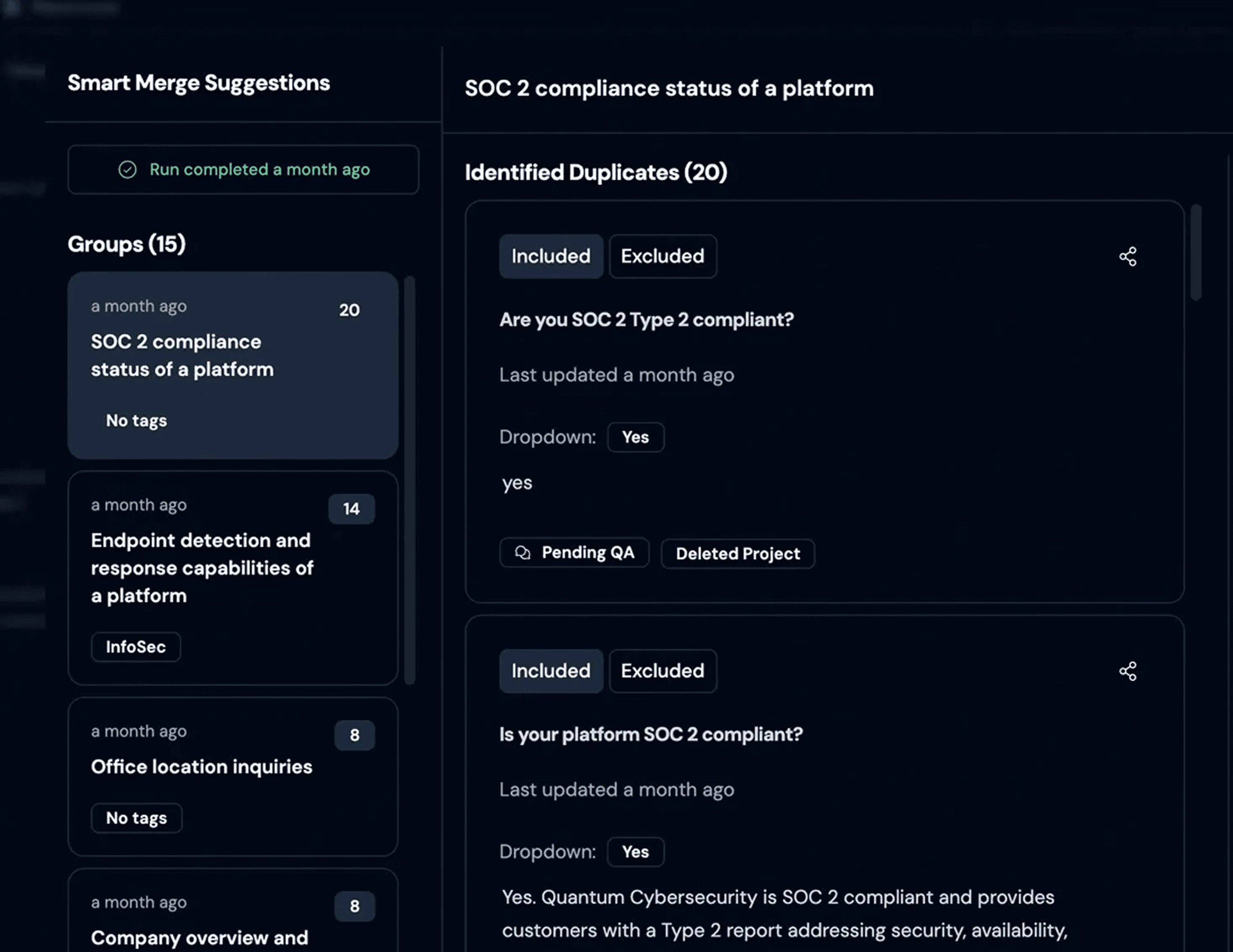
Arphie’s homepage also describes Smart Merge for grouping duplicate Q&A items. It is a useful content-maintenance feature for teams that still run a response library.
What the product does on a file: AI-native drafting, translation, conflicts, and public price.
| Capability | AutoRFP.ai | Arphie |
|---|---|---|
| AI-native platform (built on generative AI, not added later) | Yes | Yes |
| Built-in translation and localization (44+) | Yes | No No published localization set |
| Automatic conflict resolution | Yes | No |
| Public, transparent pricing | Yes | No Quote-based; no public plan prices |
Comparison based on public product information and verified user reviews as of October 2026. – indicates the capability isn't clearly documented, or that the row does not apply.
Security review
Both products clear the basics. Both are SOC 2 Type II, both offer single sign-on, and neither trains shared models on your content. Three things separate them.
Certifications. Arphie’s security page, retrieved 23 August 2026, publishes SOC 2 Type 2, annual penetration testing, and encryption in transit and at rest. It does not publish ISO 27001 certification, and it does not state that Arphie is GDPR compliant. AutoRFP.ai’s Trust Center publishes ISO 27001:2022 alongside SOC 2 Type II, GDPR controls, regional hosting in the US, EU, and AU, and a public subprocessor register.
Where the answer comes from. Zero hallucination by design: AutoRFP.ai writes only from content your team has approved, shows the sources on each answer, and hands anything it cannot support to a person. Arphie shows sources and a confidence score, which is genuine transparency, but a score is a judgment about an answer rather than a rule about what the system may write.
Access control. Arphie documents read-only and read-and-write roles. AutoRFP.ai adds SCIM provisioning and deprovisioning, so leavers lose access automatically, and applies the same permission boundary to retrieval as to people.
What InfoSec and IT will check: identity lifecycle, permissions, auditability, certifications, and grounding.
| Capability | AutoRFP.ai | Arphie |
|---|---|---|
| SOC 2 Type II certified | Yes | Yes |
| ISO 27001 certified | Yes | No SOC 2 Type 2 published; ISO 27001 not listed |
| Single sign-on (SSO) | Yes | Yes SAML 2.0 for enterprise customers, plus Google auth |
| Zero hallucination by design (100% source-grounded answers) | Yes | Partial Sources and confidence scores |
| Enterprise Permissions | Yes | Partial Read-only and read-and-write roles |
Comparison based on public product information and verified user reviews as of October 2026. – indicates the capability isn't clearly documented, or that the row does not apply.
Handling certifications inside a response
Questionnaires ask for the certificate itself, a standard statement about it, and a compliance value in a table. AutoRFP.ai treats all three as managed content rather than a copy-paste job:
- Managed attachments hold the certificate files centrally, so a new SOC 2 report is swapped once and every project uses the current version.
- Snippets hold the approved wording for a certification statement. Compliance owns the text, updating it updates every response that uses it, and a submitted figure can be frozen so it does not silently change.
- Compliance dropdowns and response columns fill the Yes, No, and Partial cells in a compliance table, picking the value against criteria your team defines.
Arphie describes pulling the latest security certifications into a draft from connected sources, which keeps answer text current. Its public pages do not document a central certificate library, a single approved statement that syncs across responses, or criteria-driven compliance columns.
Integrations
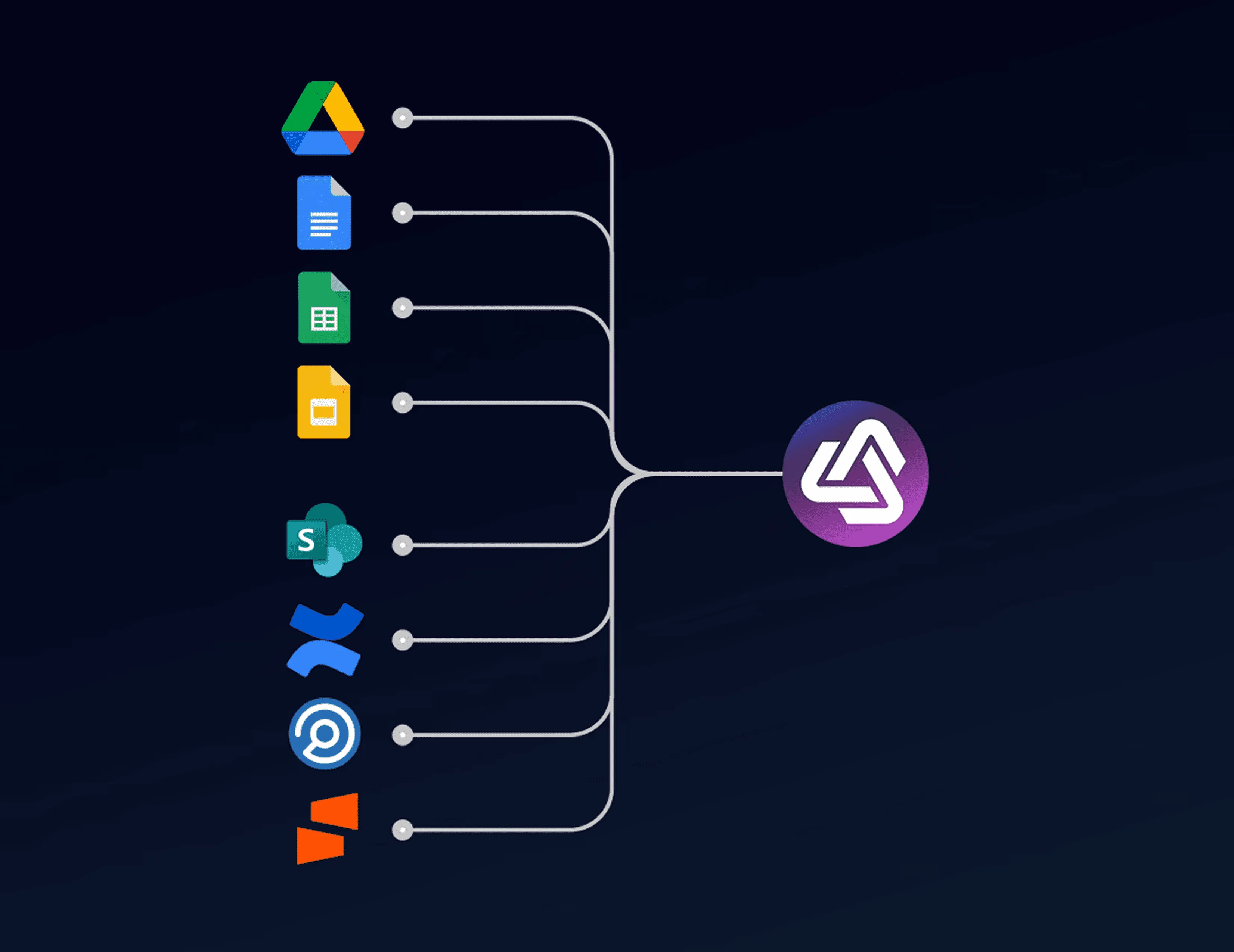
Arphie connects to a strong set of knowledge sources. On every other source type, and on the platform layer underneath, AutoRFP.ai connects to more.
| Connects to | AutoRFP.ai | Arphie |
|---|---|---|
| CRM | 4 | 1 |
| Knowledge, files, and help centers | 12 | 12 |
| Communication | 3 | 1 |
| Identity and single sign-on | 4 | 0 |
| AI assistants and browser | 6 | 1 |
| Revenue intelligence | 1 | 0 |
| Procurement and security portals | 2 | 0 |
| Named integrations | 32 | 15 |
Counted from the AutoRFP.ai directory and Arphie’s directory on 26 August 2026, one count per listed product. Arphie’s security page documents SAML single sign-on with Okta, OneLogin, Microsoft Azure, and ADFS even though its directory lists no identity cards, so treat that row as a directory gap rather than a missing capability.
A fixed app list is only part of it. These are the routes in and out for systems that are not on either list:
| Platform layer | AutoRFP.ai | Arphie |
|---|---|---|
| MCP server for AI assistants | Claude, ChatGPT, Microsoft Copilot, Gemini | Claude, ChatGPT, Cursor |
| MCP client into other systems | GitHub, Grain, HubSpot, Intercom, Linear, Notion, Slack | Not published |
| Any custom MCP server | Yes | Not published |
| REST API | Content, projects, teams, and users | Not published |
| Webhooks | Fire on project events and status changes | Not published |
| Browser extension for portals | Ariba, Workday Strategic Sourcing, Jaggaer, Coupa | Chrome extension |
AutoRFP.ai works in both directions. Assistants reach your approved knowledge through the AutoRFP.ai MCP server, and AutoRFP.ai reaches other systems as a client, including any MCP-compatible server you add. Arphie’s MCP entry runs one way, bringing Arphie data into AI tools.
Depth matters more than the count
Two products can both say “Salesforce” and mean very different things. AutoRFP.ai installs a managed Salesforce app from the AppExchange that creates a dedicated RFP project object with 14+ synced properties. Project status, response counts, due dates, owner, and intake decisions sync both ways, so sales sees live bid progress on the Opportunity and RevOps can report on RFP data next to pipeline. HubSpot, Microsoft Dynamics 365, and DealCloud connect through MCP to bring live opportunity context into the response.
Arphie’s directory describes its Salesforce integration as creating a new Arphie project from within a Salesforce opportunity. That covers intake. Its public pages do not document a synced project object, two-way field updates, or CRM-side reporting on response data.

'%20d='M10.913%2053.581h109.15c6.028%200%2010.914%204.886%2010.914%2010.913v109.151c0%206.027-4.886%2010.913-10.913%2010.913H10.913C4.886%20184.558%200%20179.672%200%20173.645V64.495C0%2058.466%204.886%2053.58%2010.913%2053.58'/%3e%3cpath%20fill='%23fff'%20d='M94.208%2095.125h-21.82v59.416H58.487V95.125H36.769V83.599h57.439z'/%3e%3c/svg%3e)
The CRM opens the project
Salesforce in this example. The opportunity and the response record stay on one intake path.
Source: AutoRFP.ai product. Captured August 17, 2026.
Knowledge, communication, and identity
- Knowledge and files. Both list 12 systems, and this is where Arphie is genuinely strong. AutoRFP.ai covers SharePoint, Google Drive, OneDrive, Box, Confluence, Notion, Seismic, Highspot, Zendesk, Intercom, Vanta, and Drata. Arphie covers Google Drive, SharePoint, Confluence, Notion, Seismic, Highspot, Box, Dropbox, Egnyte, Vanta, Front, and any web page.
- Communication. AutoRFP.ai lists Slack, Microsoft Teams, and Outlook. Arphie lists Slack.
- Identity. AutoRFP.ai lists Okta, Microsoft Entra, Microsoft single sign-on, and Google Workspace, with SCIM for joiners and leavers. Arphie supports SAML single sign-on for enterprise customers.
What the bid lead can see in the product
Approval stays in the project
The request reaches the reviewer in Teams. The decision stays on the record.
Source: AutoRFP.ai product. Captured August 17, 2026.
Three-layer approval
A user, a team, then another user sign off on the same response.
Source: AutoRFP.ai product. Captured August 23, 2026.

Claude shows the governed source
The assistant asks through MCP. The reply cites the approved passage.
Source: AutoRFP.ai product. Captured August 17, 2026.
Portals
Some questionnaires never arrive as a file. They sit inside a procurement or security portal, and someone has to type answers into a web form. Portal Agent pulls those questions into a project, and the browser extension answers them in place across Ariba, Workday Strategic Sourcing, Jaggaer, and Coupa.
A verified G2 review already published on this site says Arphie “doesn’t work well with internet portal questionnaires” and points reviewers to a quick-ask feature and a Chrome extension for those files. Arphie’s directory does not name a procurement or security portal.
Response accuracy
Arphie competes on transparency, and it does that well. Its homepage, retrieved 23 August 2026, tells buyers to review answer sources, confidence scores, and the reasoning behind each draft. The AI RFP software page on the same date publishes “84% of AI-generated responses accepted as-is” and, in the FAQ, that first-draft accuracy is “often reported ~85-95%” when trained on quality corporate documents. Those figures do not say accuracy of what, measured how, on which dataset, or verified by whom.
Zero hallucination by design: drafts are written only from approved material, the source passage sits next to a Trust Score, and a question with no supporting evidence is marked No Search Results at zero trust and handed to a person. A second check, the Feedback Score, asks whether the draft actually answered the question. Showing a source tells a reviewer where text came from. Withholding the draft decides what gets written in the first place.
Every answer shows its source
The draft cites the approved file. Missing evidence is flagged and routed to a person.
Source: AutoRFP.ai product. Captured August 17, 2026.
Reporting & Insights
An owned queue needs capacity, automation, and recurring-gap views. A list of generated drafts will not plan the year or brief management. This section is what each vendor publishes about that operating layer.
What a bid lead can see across the queue: automation, workload, win/gap analysis, and enterprise reporting.
| Capability | AutoRFP.ai | Arphie |
|---|---|---|
| Enterprise Reporting | Yes | No No published win-rate or ROI reports |
| Workload Reporting | Yes | Partial MCP workload and volume trends |
| Win/Gap Analysis Reporting | Yes | No No published win/gap analysis |
Comparison based on public product information and verified user reviews as of October 2026. – indicates the capability isn't clearly documented, or that the row does not apply.
Reporting is how a queue becomes manageable:
- AutoRFP.ai reports automation rate from the actual answer history.
- It shows workload, project performance, modeled ROI, and recurring compliance gaps.
- The ROI model exposes the assumptions behind its savings estimate.
- Scheduled reports take the results to management.
Arphie’s homepage, retrieved 23 August 2026, says MCP can pull workload and project-volume trends for a person or team. That is a published operating signal. It is not the same as win-rate, gap analysis, or an ROI model a bid lead can send to finance.
Go/no-go and gap analysis belong in the same operating layer:
- AutoRFP.ai screens an incoming RFP against the team’s own criteria before drafting begins.
- Each result keeps its source.
- The analysis exports for approvers.
- Gap Analysis then shows which requirements keep causing trouble across completed work.
Fact-checking Arphie’s AutoRFP comparison
Arphie’s AutoRFP alternative page, retrieved 26 August 2026, makes several claims that the public record does not support.
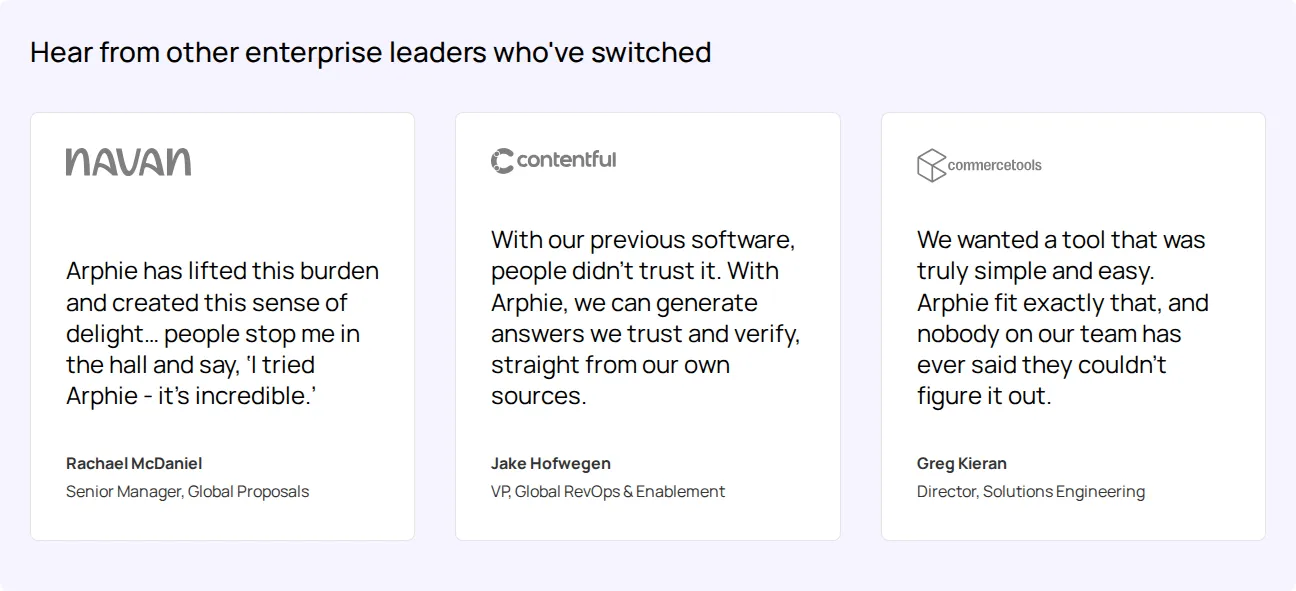
“Hear from other enterprise leaders who’ve switched.” On a page about AutoRFP.ai, that heading sits above customer proof from Navan, Contentful, and commercetools. None of the three was an AutoRFP.ai customer, so none switched from AutoRFP.ai. Arphie’s own product page identifies Navan and commercetools as Responsive migrations, and Contentful as a Loopio migration.
“Trusted by Fortune 500 and publicly traded companies.” The page gives Arphie a check and AutoRFP.ai a cross on this row. AutoRFP.ai serves Fortune 500 and publicly traded companies, so the cross does not match the customer record.

“While AutoRFP focuses on speed.” The Perk story measures both speed and quality: tailored, prospect-specific bids; higher shortlist and closing rates; and a named enterprise seller who credits AutoRFP.ai with helping win a deal that saved her quarter. Speed gave the bid team more time to improve the response.
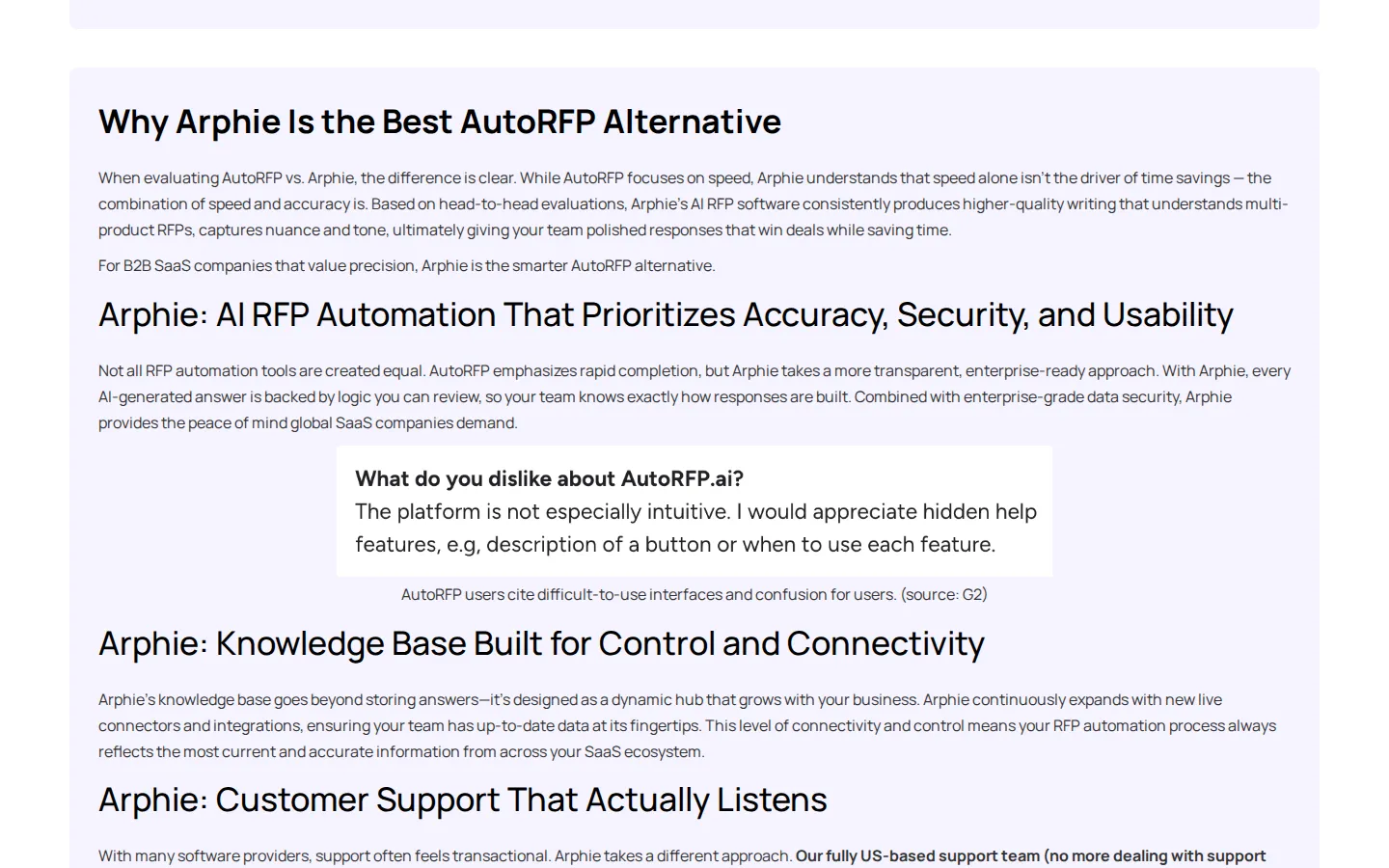
“No ‘gates’ or ‘caps’ on features.” This appears as an Arphie advantage, while the same page calls AutoRFP.ai’s project allowance restrictive. Every AutoRFP.ai plan includes all features, unlimited AI, unlimited content, unlimited users, SSO, integrations, support, and training. Plans differ by annual project allowance. That is a usage allowance, not a feature gate or a seat cap.

“Fully US-based customer success team” and “AutoRFP … primarily based in Australia.” AutoRFP.ai’s largest presence is in North America, with dedicated Technical Account Managers. The team provides 24/6 support across North America, EMEA, and APAC. Australia is one part of that coverage, not the centre of it.
AutoRFP.ai vs Arphie pricing
Arphie does not publish a price list. Arphie pricing records a quote-based concurrent-project model with unlimited users, which is the commercial shape Arphie’s own comparison post describes. Indicative annual ranges on that guide are not a public rate card.
AutoRFP.ai pricing lists Scale at $899 a month, Accelerate at $1,299 a month, and Enterprise on quote. Billing is yearly, and every plan carries unlimited users.
Test the platform on a live questionnaire
Run both products on one live file against the same approved sources:
- Seed a control with two conflicting values.
- Ask something the library cannot support, and require the product to flag it for a person.
- Write the finished answers back into the issuer’s original Excel workbook.
Conflict handling, abstention, and submission fidelity are the three artifacts that matter.
A printable scorecard lives in the Go/No-Go decision template.
The buyer cut
Arphie is a citation-forward, AI-native product with a clean UX and strong sales-engineering positioning. AutoRFP.ai works with those same SE teams, then carries the response through sales context, bid ownership, security and legal review, product input, and final approval. It is the AI-native platform that passes compliance review and treats the RFP as a shared revenue workflow.
Run a two-week proof of concept on a questionnaire your team already has. Keep the artifacts from that live file.
The Arphie alternatives roundup is the wider shortlist. Parallel roundups cover other AI RFP vendors, including platforms that compete with Steerlab. For this pair, bring the actual volume, the actual access model, and the actual workbooks.
About the author

Ops Lead
Ops Lead at AutoRFP.ai. Designs the pipeline, content, and handoff systems bid teams use to run RFPs end-to-end, and co-hosts live sessions on winning workflows.
LinkedInFrequently asked questions
AutoRFP.ai vs Arphie: which should I pick?
Arphie is a genuine pick when the team wants a clean, modern UX and citation-forward drafts on mid-market security questionnaires. AutoRFP.ai fits the same mid-market, then scales into enterprise programs that need a dedicated 24/6 support team, Microsoft Teams as well as Slack, ISO 27001:2022, and regional hosting.
Arphie vs AutoRFP.ai: what is the difference?
Arphie publishes source citations, confidence scores, Slack and email notifications, SOC 2 Type 2, SAML, and Zero Data Retention agreements with OpenAI and Anthropic. AutoRFP.ai publishes Slack and Microsoft Teams, ISO 27001:2022 plus SOC 2 Type II, regional hosting, SCIM, a public Trust Center, GDPR controls, and a dedicated 24/6 support team. Arphie does not publish a Microsoft Teams integration page, ISO 27001 certification, a GDPR compliance statement on its security page, or support hours. Pricing also differs: Arphie is quote-only by concurrent projects; AutoRFP.ai publishes Scale at $899 a month and Accelerate at $1,299 a month.
Does Arphie have Microsoft Teams?
Arphie's comparison pages describe Slack and email notifications with deep links. They do not publish a Microsoft Teams product page. AutoRFP.ai publishes both Slack and Microsoft Teams, so review can stay in the channel the team already uses.
What does Arphie charge vs AutoRFP.ai?
Arphie does not publish a plan list. Quotes are arranged around concurrent projects, with unlimited users included on that model. AutoRFP.ai publishes Scale at $899 a month and Accelerate at $1,299 a month, billed yearly, both with unlimited users. The Arphie pricing guide covers the commercial comparison in more detail.
Does Arphie cite sources on every answer?
Yes. Arphie's platform and AI RFP software pages, retrieved 23 August 2026, describe reviewing answer sources, confidence scores, and the reasoning behind each draft. That citation-forward positioning is a real strength. AutoRFP.ai contests the same slot with a Citation Engine plus a Trust Score and a Feedback Score on every draft, and routes anything it cannot support to a person.
Is Arphie built for sales engineers or bid teams?
Both products work with sales engineering teams. Arphie's published positioning leads with SE efficiency. AutoRFP.ai treats the RFP as a cross-functional revenue workflow: sales brings deal context, solution engineers shape the technical answer, bid teams own the submission, and security, legal, and product reviewers approve what the company can stand behind.
Which has more integrations, AutoRFP.ai or Arphie?
Counted from both public directories on 26 August 2026, AutoRFP.ai lists 32 named integrations and Arphie lists 15. Both list 12 knowledge and file sources. AutoRFP.ai adds CRM, communication, identity, AI assistant, revenue intelligence, and portal connections, plus a REST API, webhooks, and a two-way MCP layer that also connects to any custom MCP server.
How does AutoRFP.ai vs Arphie look for an enterprise team?
Both platforms serve mid-market response teams. AutoRFP.ai adds the operating footprint larger deployments usually need: a global customer support footprint, a dedicated 24/6 support team, regional hosting, ISO 27001:2022, SCIM, layered approvals, Microsoft Teams review, portal handling, and enterprise reporting. Arphie publishes connected knowledge, Word and Excel round-trip, citations, Slack and email review, and MCP workload trends.
Does AutoRFP.ai emphasize speed over accuracy compared with Arphie?
No. AutoRFP.ai is the accuracy-first, AI-native, source-grounded platform for RFPs, security questionnaires, and DDQs. Every draft is written from approved content, scored with a Trust Score and a Feedback Score, and routed to a person when it cannot be supported. The Perk customer story measures shortlist rate and a closed enterprise deal, not draft speed alone. Arphie's citation-forward drafts are a real strength. That does not make AutoRFP.ai a speed-only tool.
Did Navan, Contentful, or commercetools switch from AutoRFP.ai to Arphie?
No. None of the three was an AutoRFP.ai customer. Arphie's AutoRFP alternative page, retrieved 26 August 2026, places those names under a switched-customer heading. Arphie's own product pages identify Navan and commercetools as Responsive migrations and Contentful as a Loopio migration.
Does AutoRFP.ai gate features or cap seats versus Arphie?
No. Every AutoRFP.ai plan includes all features, unlimited AI, unlimited content, unlimited users, SSO, integrations, support, and training. Plans differ by annual project allowance. That is a usage allowance, not a feature gate. Arphie quotes by concurrent projects and also includes unlimited users.
How do AutoRFP.ai and Arphie compare on G2?
As verified on 26 August 2026, AutoRFP.ai is rated 4.8/5 on G2. Use the live G2 listings for current review counts, because those change. Rating is not a substitute for a live proof of concept on your own files.

