
Best RFP Software for Asset Managers: 8 Tools Compared (2026)
The best RFP software for asset managers includes AutoRFP.ai, Loopio, Responsive and Qvidian, ranked on DDQ automation, ILPA support and audit trails.

Technical Account Manager, AutoRFP.ai·Updated ·29 min read
One of the hardest parts of RFP management for asset managers is that the “right” answer can change depending on the fund, strategy, vehicle, investor, or jurisdiction. Reusing old responses without the right controls can quickly create inconsistencies across DDQs and institutional questionnaires. The best RFP software helps firms manage those variations while keeping responses governed, reviewable, and easy to trace. Below, we compare eight leading platforms and where each one fits best.
8 Best RFP Software for Asset Managers in 2026: At a Glance
We weighted five criteria, in order of importance: DDQ and questionnaire handling (30%), data privacy and audit trails (25%), response accuracy and tailoring (20%), content-maintenance burden (15%), and pricing transparency (10%). The ratings below reference G2 and Capterra for vendors with at least 20 reviews. Niche DDQ tools with limited public review counts are marked accordingly. We do not assign our own star ratings.
| Name | Best for | Standout feature | Handles narrative RFPs | DDQ templates | Price starting point | G2 rating |
|---|---|---|---|---|---|---|
| AutoRFP.ai | Asset managers needing defensible RFP, security questionnaire, and DDQ automation | Source-grounded answers with Trust Scores, citations, approval controls, and a library that stays current as the team works | Yes | Yes | $899/month | 4.8/5 |
| Loopio | Firms with dedicated content managers and mature response libraries | Structured content library with established review and collaboration workflows | Partial | Yes | $20,000/year | 4.7/5 |
| Responsive | Large asset managers with complex proposal operations | Deep project management, reporting, governance, and enterprise workflow controls | Partial | Yes | Contact sales | 4.5/5 |
| Qvidian | Document-heavy asset-management proposal teams | Microsoft Office-centered proposal automation with governance and reporting | Partial | Yes | Contact sales | 4.3/5 |
| DiligenceVault | Managers handling high volumes of institutional investor DDQs | Structured allocator-manager diligence exchange and template workflows | No | Yes | 300+ AI credits/month, with subscription pricing available by request | Thin data |
| Dasseti | Asset managers primarily focused on institutional diligence requests | Asset-management-specific diligence workflows with scoring and analytics | No | Yes | Contact sales | Thin data |
| Blueflame.ai | Private-markets firms seeking a broader AI knowledge assistant | AI support across research, memos, firm knowledge, and diligence content | Partial | Partial | Contact sales | Thin data |
| GovernGPT | Fund managers needing fund- and strategy-specific DDQ automation | Automated organization and drafting across funds, strategies, and investor requests | No | Partial | Contact sales | Thin data |
For asset managers, the real difference between these platforms is not how quickly they can populate a questionnaire. It is how well they protect the integrity of investor-facing information as it moves from approved documentation through IR, compliance, legal, InfoSec, and final sign-off.
AutoRFP.ai combines RFP and DDQ automation with source-level evidence, Trust Scores, approval controls, current-source governance, and original-format submission support.
Want to see how that performs on your own investor questionnaires? Book a demo with AutoRFP.ai.
1. AutoRFP.ai: Best for Defensible RFP and DDQ Response Automation
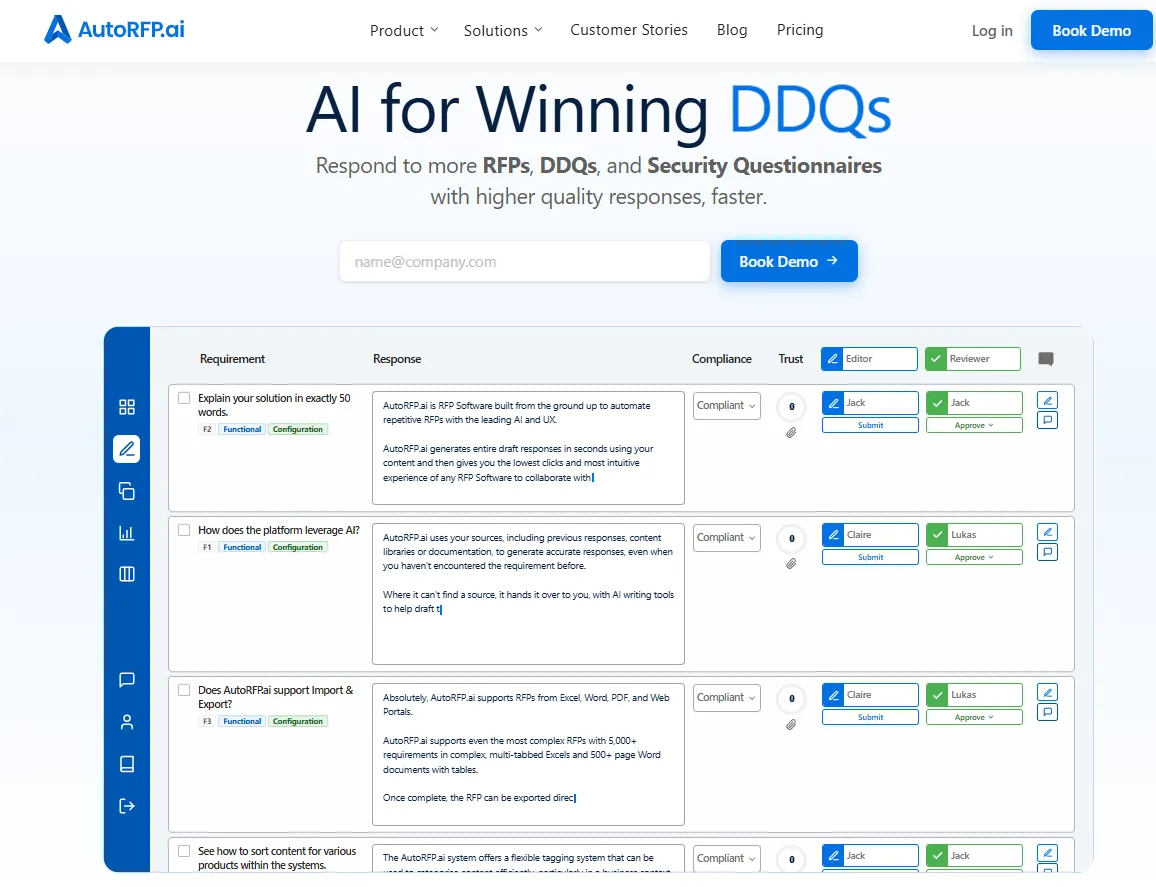
Asset managers get source-grounded, citable answers from AutoRFP.ai, the accuracy-first AI platform for RFPs, security questionnaires, and DDQs, in a library that stays current as the team works.
For asset managers, that means investor-facing answers can be drafted from approved DDQs, governance policies, investment documentation, security records, audit reports, and connected internal systems rather than open-ended model knowledge.
Each answer exposes its supporting evidence, and questions without enough approved support remain with a human reviewer rather than being filled with an unsupported response. This gives IR and compliance teams a clearer way to defend what ultimately reaches an LP, consultant, auditor, or regulator.
Key Features
1. Source-Grounded DDQ Responses With Trust Scores
AutoRFP.ai generates due diligence responses from approved firm content and shows the sources behind each answer. A Trust Score helps reviewers understand how strongly the available evidence supports the draft.
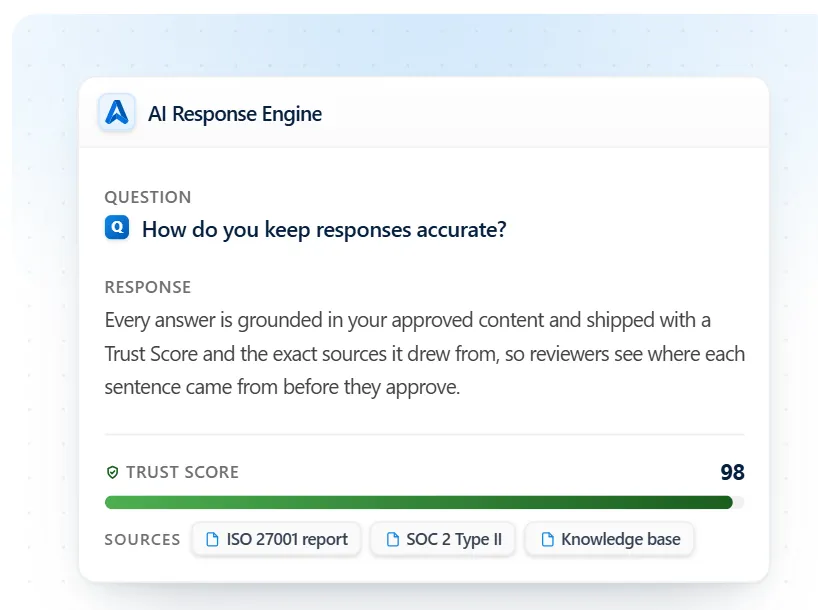
If the system cannot find sufficient approved material, it flags the question for human review rather than guessing. This is particularly useful for sensitive questions covering governance, valuation methodology, ownership, cybersecurity, data handling, or operational controls.
2. ILPA and Complex Questionnaire Automation
Asset-manager DDQs often arrive as large Excel workbooks rather than clean web forms. AutoRFP.ai can identify questions within ILPA templates and multi-tab spreadsheets, including merged cells, dropdowns, free-text fields, nested structures, and supporting context.
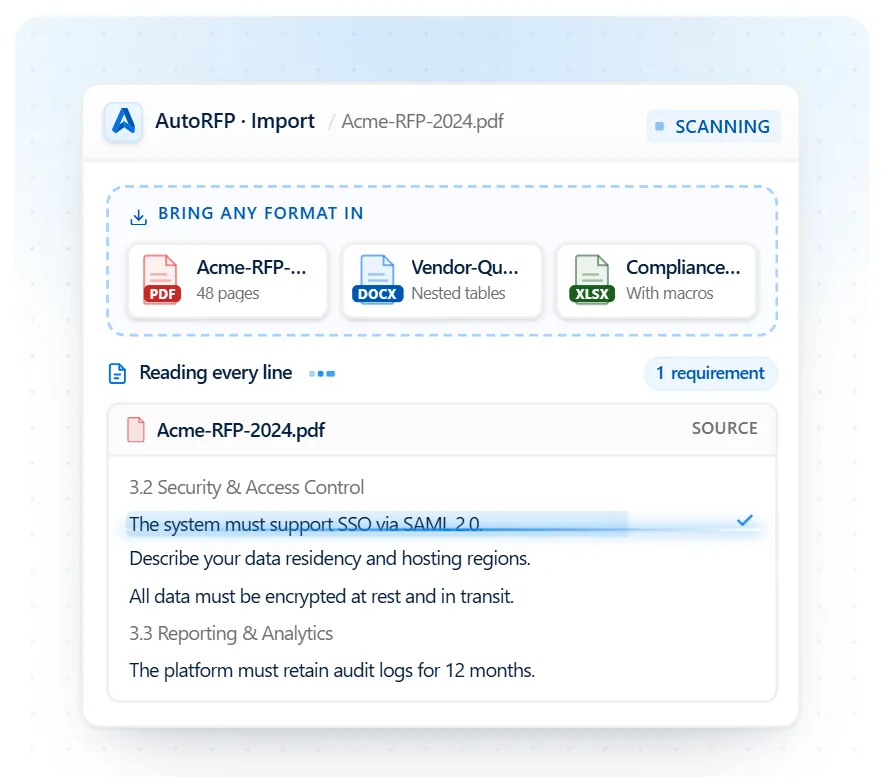
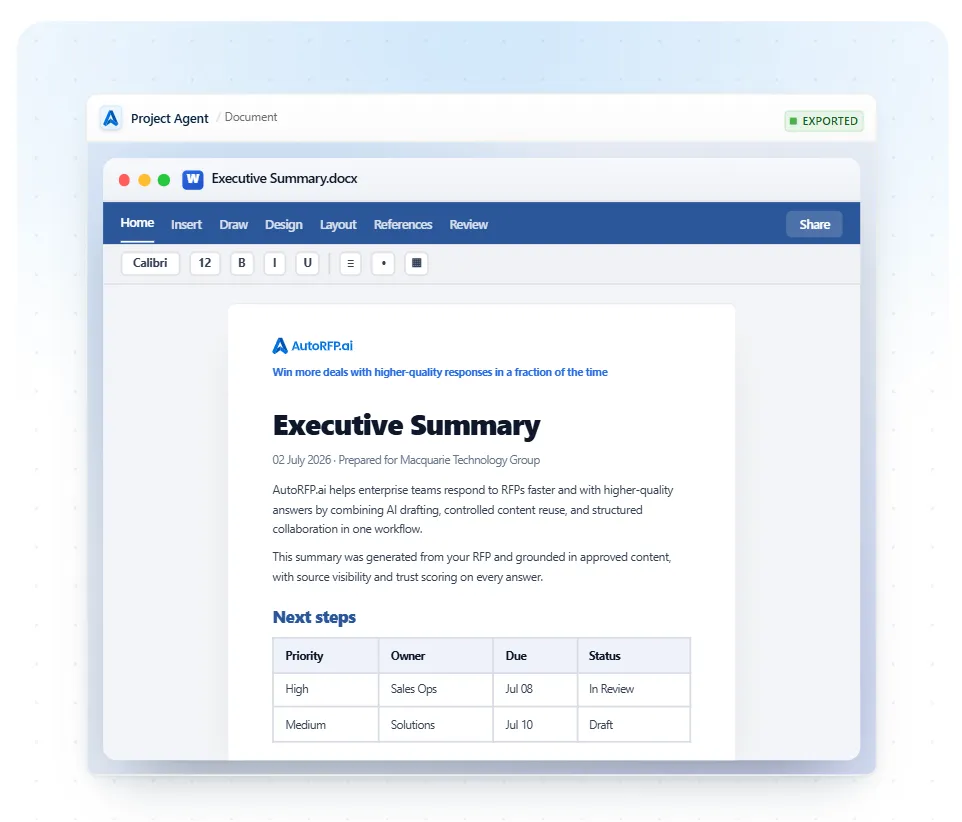
It also handles PDF and Word questionnaires. After review, approved responses can be exported back into the investor’s original format, reducing the need for IR teams to manually transfer answers between systems.
3. Compliance Review Cycles and Audit Trails
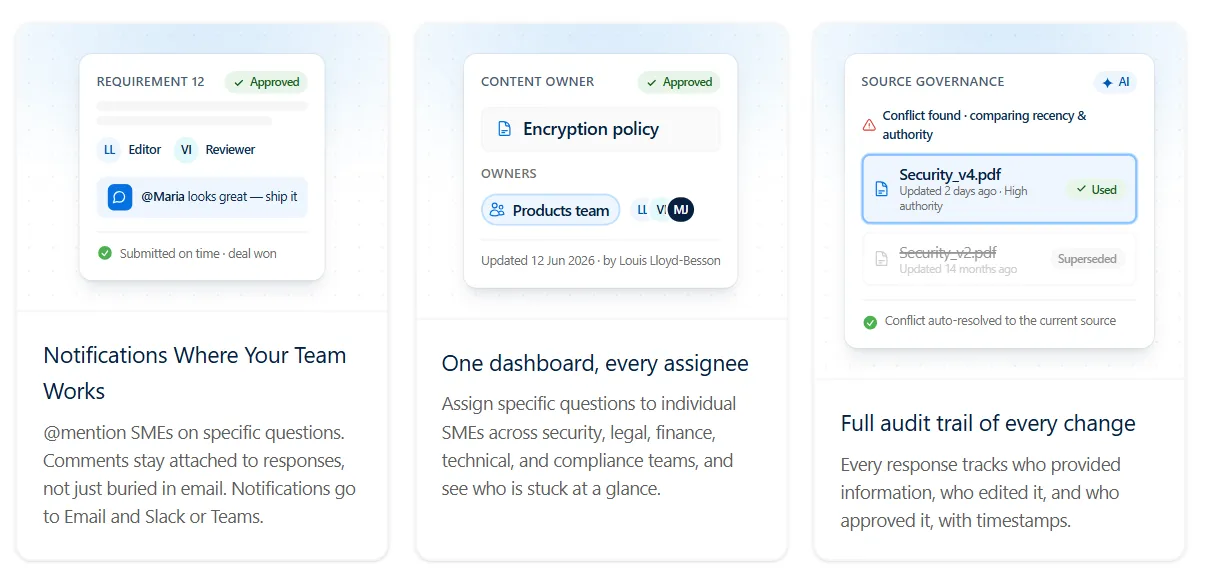
Sensitive DDQ answers can move through Draft, In Review, and Approved stages with named reviewers. Version history and audit trails preserve who provided information, who changed it, and who approved the final response.
4. Current-Source Governance With a Self-Maintaining Library
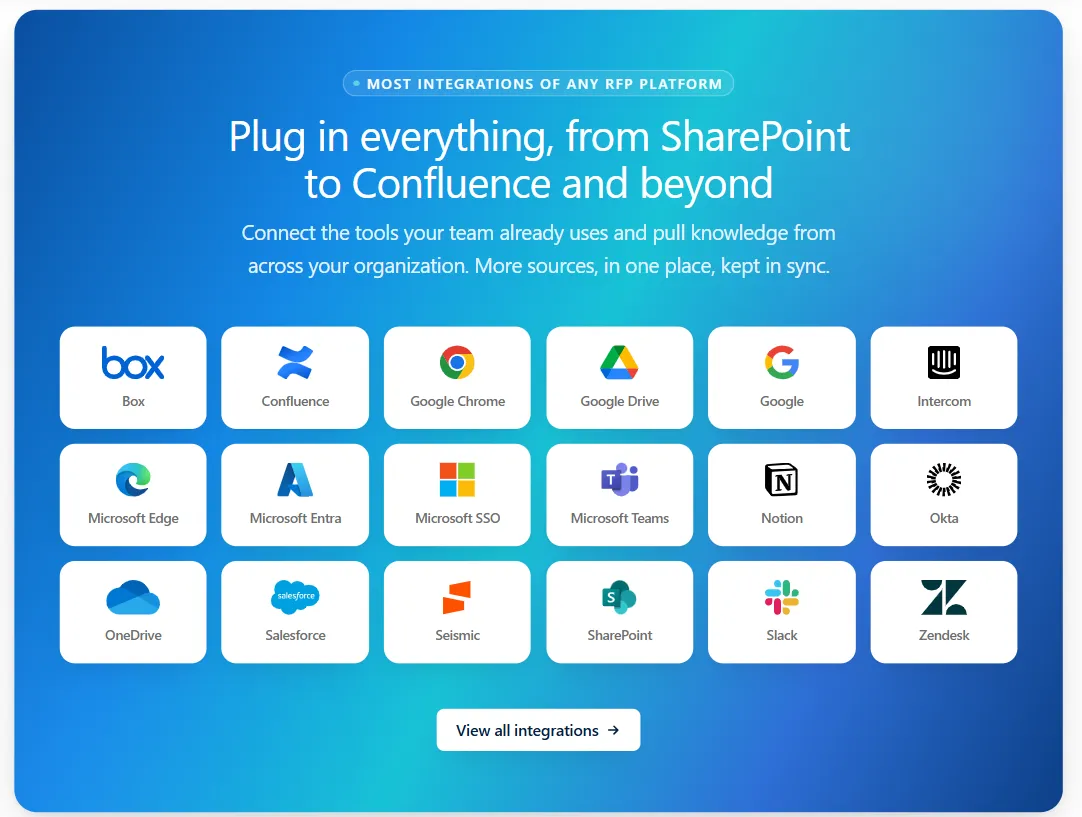
AutoRFP.ai connects with systems such as SharePoint, Confluence, Notion, Google Drive, OneDrive, Box, and other company repositories.
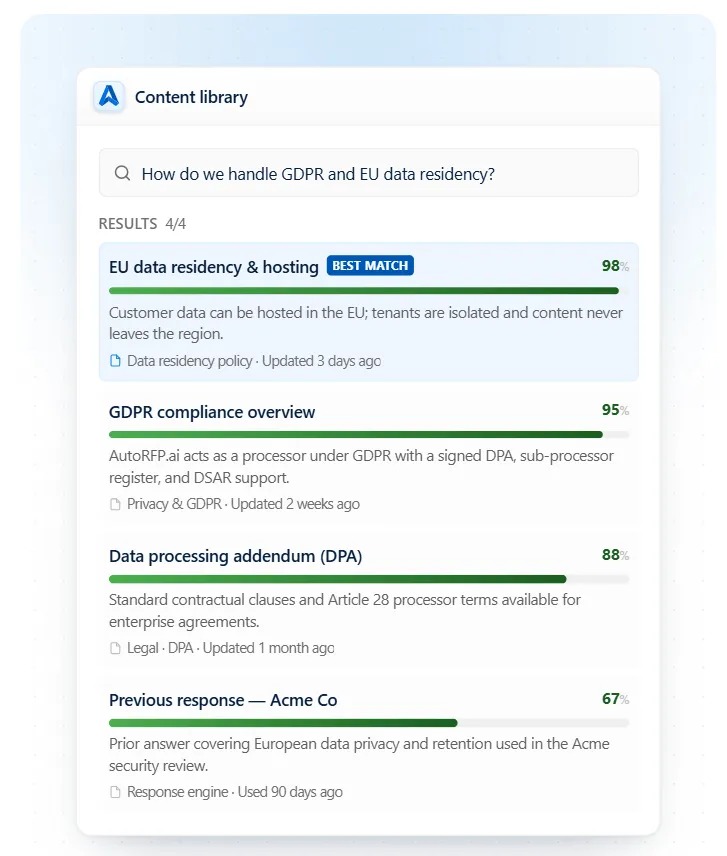
Semantic search finds relevant information by meaning rather than relying only on filenames, keywords, or manually maintained tags.
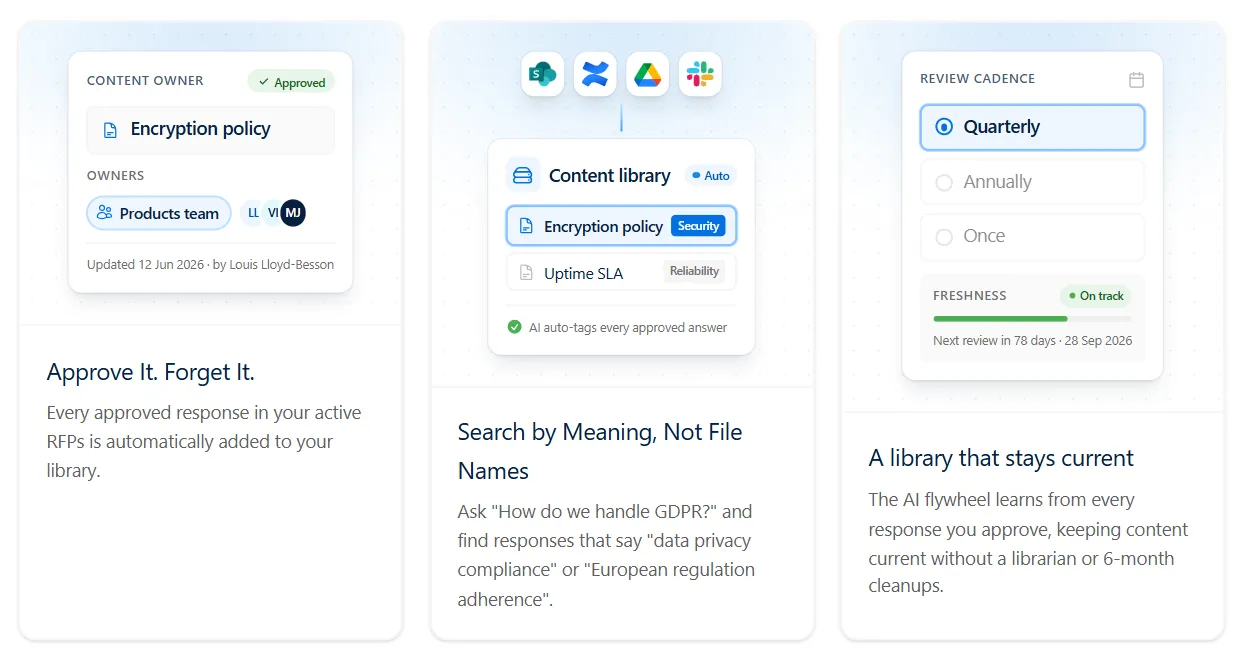
When conflicting content exists, the platform can compare recency and source authority and identify superseded information. Approved responses also become available for future projects, reducing repetitive library administration while preserving ownership and review controls.
5. Private AI and Regional Data Residency
AutoRFP.ai is ISO 27001 certified and SOC 2 Type II audited. Customer data is not used to train AI models, and tenant isolation helps keep firm information separated during use.
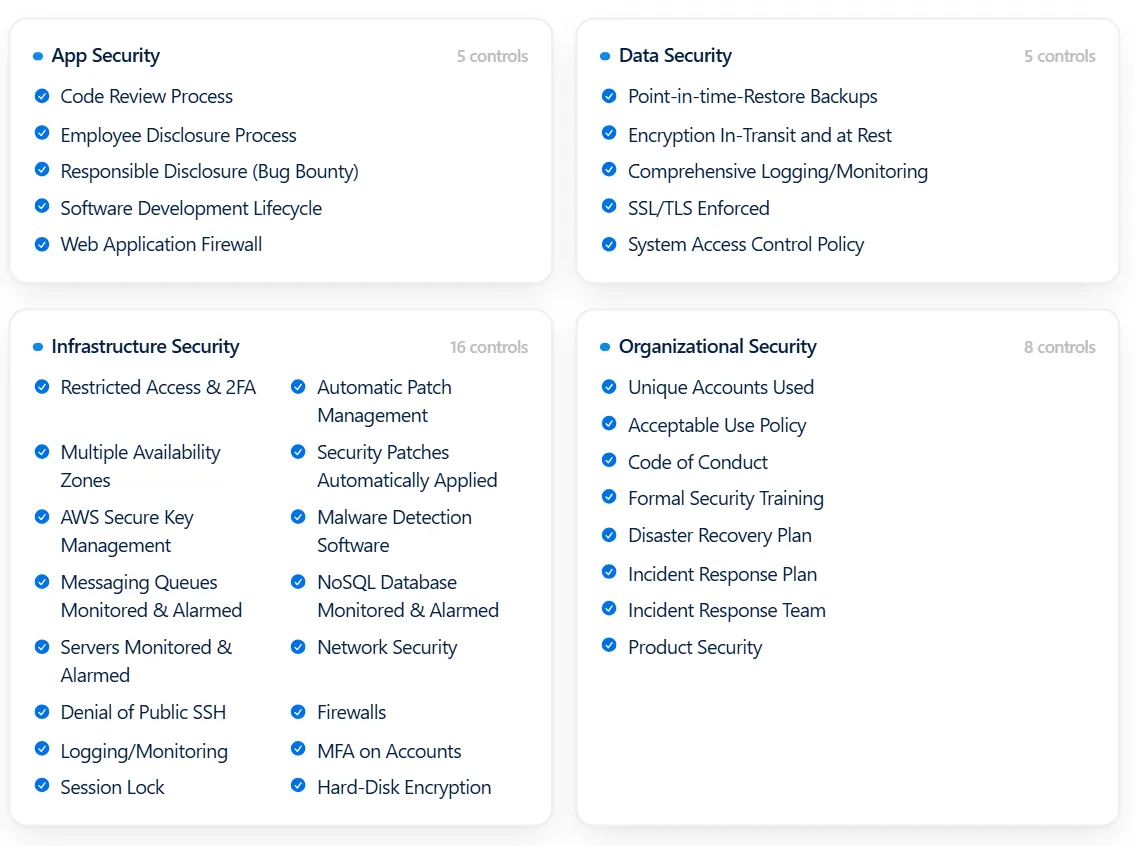
Asset managers can also choose regional data residency in the US, EU, or AU, with private and single-tenant options available for organizations with stricter data-isolation requirements.
6. Cross-Functional Collaboration for IR, Legal, and Compliance
AutoRFP.ai gives IR, legal, compliance, InfoSec, and other subject matter experts one workspace for reviewing investor responses. Contributors can be assigned specific requirements, add comments at the answer level, and approve content through a controlled review process.
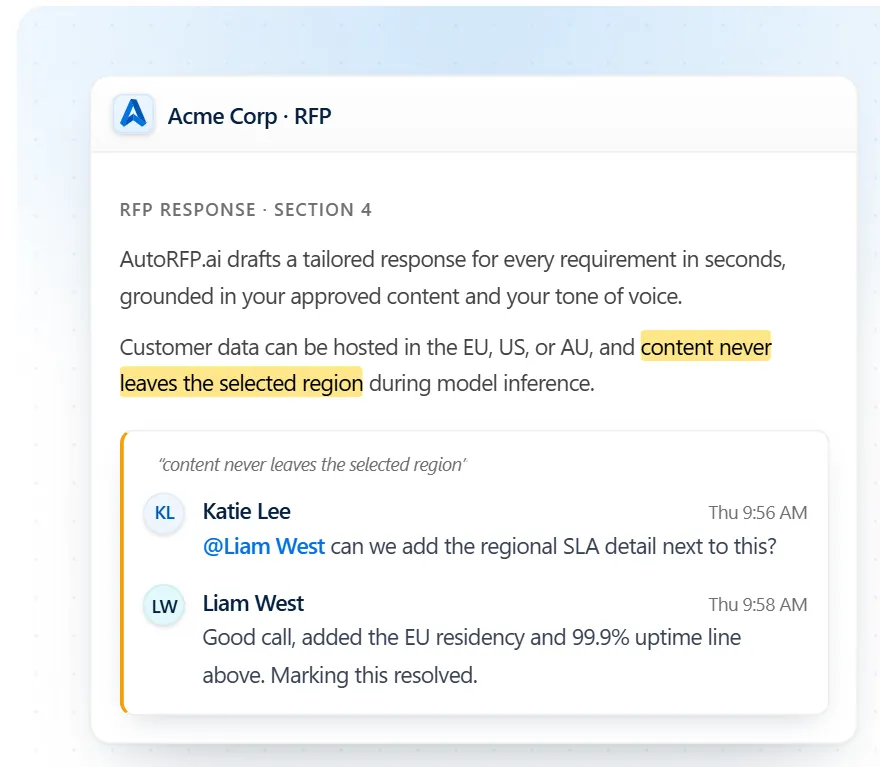
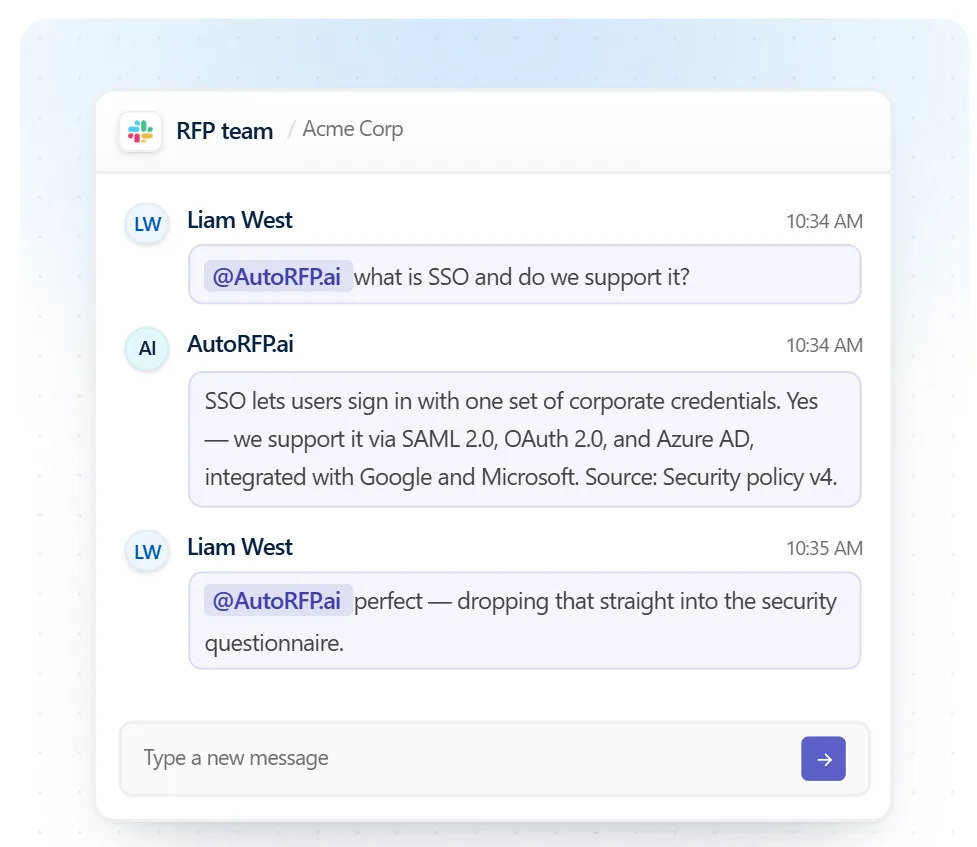
Slack, Microsoft Teams, and email notifications help bring reviewers into the workflow without relying on separate status spreadsheets or long email chains. Unlimited users also make it easier to involve specialists who only participate in selected DDQs.
Pricing
| Plan | Price | Key Inclusions |
|---|---|---|
| Scale | $899/month (paid yearly) | 24 projects per year, unlimited AI, unlimited content, unlimited users, all features, SSO (Google & Microsoft), 18+ integrations, ISO 27001:2022 and SOC 2, unlimited support, online training |
| Accelerate | $1,299/month (paid yearly) | 50 projects per year, unlimited AI, unlimited content, unlimited users, all features, SSO (Google & Microsoft), 18+ integrations, ISO 27001:2022 and SOC 2, unlimited support, online training |
| Enterprise | Flexible pricing that scales with your business | Scalable projects per year, unlimited AI, unlimited content, unlimited users, all features, SSO (Google & Microsoft), 18+ integrations, ISO 27001:2022 and SOC 2, unlimited support, bespoke implementation, bespoke terms |
Where AutoRFP.ai Shines
LP-facing defensibility: Reviewers can trace important claims back to the approved evidence used to support them.
DDQ-specific document handling: ILPA templates, complex spreadsheets, Word files, PDFs, and original-format export are built into the workflow.
Consistent investor communications: Current-source controls help reduce the risk of different investors receiving contradictory versions of the same firm information.
Lower content-administration burden: Approved responses improve future projects without requiring continuous snippet and taxonomy maintenance.
Cross-functional governance: IR, compliance, legal, risk, and InfoSec teams can work within the same approval process.
Broader response coverage: Asset managers can manage DDQs alongside commercial RFPs and security questionnaires rather than maintaining separate systems for each workload.
Where AutoRFP.ai Falls Short
Allocator-side diligence: AutoRFP.ai is designed for firms answering DDQs and RFPs, not allocators evaluating managers through a two-sided diligence marketplace.
Long-form proposal design: Teams primarily producing highly designed or narrative-heavy proposals may prefer specialist proposal-authoring software.
Lowest entry price: It is built for governed response operations rather than teams seeking the least expensive tool for occasional questionnaires.
Customer Review
David F., Head of Sales, said, “I love how it takes a dirty Excel file and magically converts it into highly accurate answers. Before AutoRFP, the RFP process was so, so, so painful. I’m not going to lie, RFPs are still challenging, but AutoRFP has removed a lot of the laborious administrative and formatting work.”
Sam B., Global Bid Manager, said that AutoRFP.ai offers “Fast search and collaboration to improve our entire bid management process,” adding, “I love being able to quickly search through our large content library. It genuinely feels like a collaborative tool, especially when I’m combining or improving answers.”
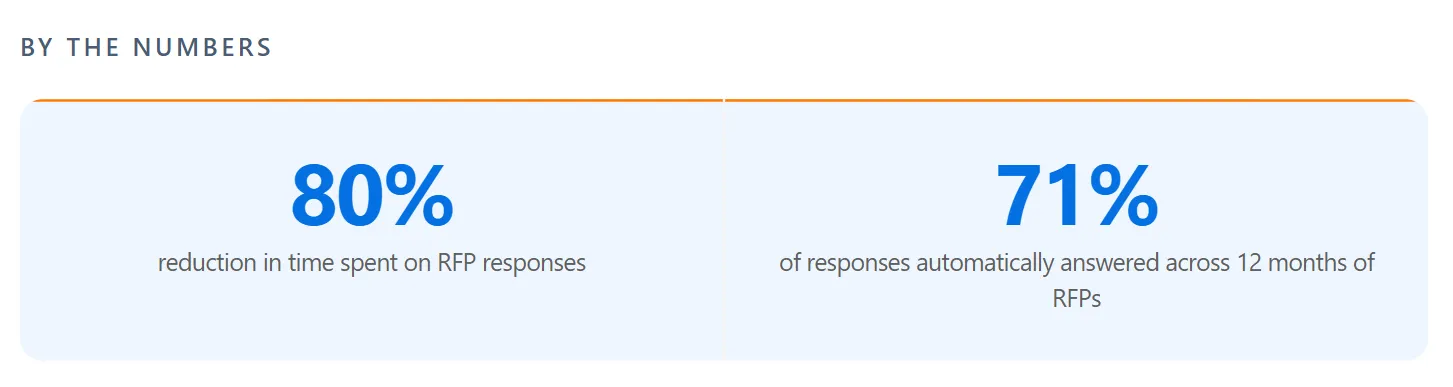
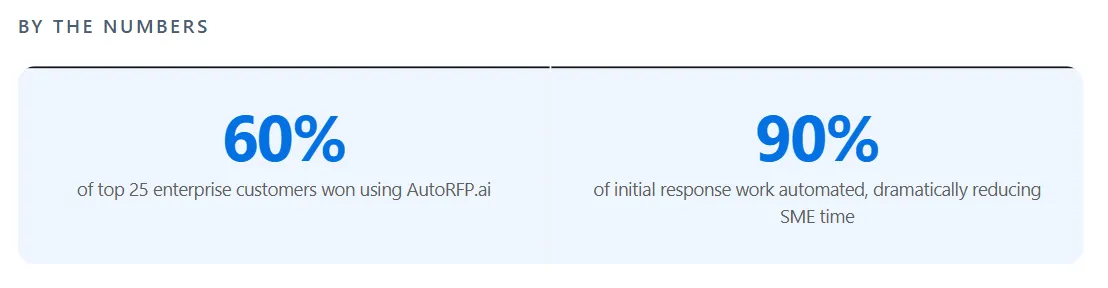
Raphael Schmideg, Chief Operating Officer at IMTC, said, “Reaching the RFP stage with clients is now a smooth process. With a 90% automation rate, we can quickly produce a first draft based upon previous responses, making the RFP process efficient and stress-free.”
Shana Sweeney, Executive Leader at SugarAI, said: “We won the deal because they had faith in our security posture, and that trust came from our ability to answer all the questions. We were the only company that took the time to fully respond to every security question.”
Who AutoRFP.ai Is Best For
Asset managers: Firms responding regularly to institutional investor RFPs and DDQs.
Multi-strategy investment firms: Organizations that need controlled, current information across several products or investment strategies.
DDQ-heavy IR teams: Lean teams handling frequent investor questionnaires with substantial SME involvement.
Compliance-led organizations: Firms where customer-facing answers must survive audit, legal, or regulatory scrutiny.
Private capital firms: Managers that need formal approvals and evidence behind recurring LP diligence responses.


Video transcript
Did you know the average RFP can take thirty-two hours of manual grueling work? Now, in this video, in under ten minutes, I'm gonna show you how you can use AI RFP automation to drastically reduce the amount of time it takes to get to a first draft for your RFP, DDQ or security questionnaire using AutoRFP.ai. Sick. Let's jump into it. So at AutoRFP, we're an AI RFP software automation platform, across the globe with hundreds of customers using our software every day, battle-tested AI to help you automate RFPs. First, what's the problem? So an RFP or request for proposal or due diligence questionnaire or security questionnaire is a pain felt across all industries, whether it's construction, software, technology, finance, healthcare, anyone selling
to government or private businesses. And these glorified question and answers take hours and hours for people to complete, for them to win new business. It's a crucial part for your business to win enterprise and government contracts, which really help you grow sustainably and quickly. But when you go to bid on one, you are met with the RFP. Average response times are thirty to forty hours, usually involve five to eight people, seventy percent of content is reused but hard to find, and the average win rate across all industries is only forty-three percent. So you're spending hours with uncertainty that you may win, which is where efficiency and writing better responses, leveraging AI helps you win more faster. Now, looking into RFP automation, you have a number of options.
You can pick up a legacy RFP software. They've been around since the late nineties. They brought software to the RFP problem. Effectively, a glorified question and answer bank, like a database. You upload Q&A pairs, and then they try to use keyword matching to find the most relevant to then help you answer questions that you get in your new RFPs and tenders. You can also do AI builds yourself. So you might use ChatGPT or Claude, and you can see our other videos about how you can potentially use them. But effectively, you hit a ceiling where it's hallucinating, it's taking more time now to fix things than it should, and just doesn't have enough context to find the right answer most of the time. Or you can choose an actual AI native leader like AutoRFP.ai. Built from AI from the get go and have built the engine around zero
hallucination, multimodal architecture to leverage the latest models across all your major providers, self-maintaining library approach, so it doesn't take a lot of time to maintain the system, really high automation rates and enterprise security built in from day dot. So why do teams choose AutoRFP.ai? The reason is your knowledge is always current. We integrate with over twenty different systems, and we pull in from all your various file management and different software to make sure that your data is always up to date, and you don't have to maintain it across multiple different places. We're most accurate in the category because we leverage the different models, including specialized re-ranker models, embedding models, search models, and your large language models where they're best. And our team of over fifteen software engineers and AI engineers make sure that this is battle-tested, evals are correct, and it produces the correct answer based off your source context. And it's one platform for every stage of the RFP journey, from intake to new RFP
to AI-powered go/no-go to drafting to reviewing and using agents to review and update your RFP response, translation to collaboration across SMEs and different team members, ensuring that they can easily collaborate in an easy-to-use platform, and then exporting as well. Let's start with the AI native auto library. This is the core of the platform where your different content sources and past projects and up- and web scraping all live in the one place and- Any question that comes up, whether it's in an RFP or a team member asking the question, can be automatically answered with trust-based scores, specific semantic search, and ensures that the correct answer is found and used to then answer and generate an appropriate response. Then effectively, you upload a blank RFP.
The AI-powered response engine then automatically generates responses, translates it and everything to have the correct answers. Then your team can very easily edit, review, integrates with Slack and Teams, and everyone's notified on project deadlines. Now, I've spoken enough. Let's jump into the actual product, and you can see AI RFP automation from the start. We start by creating a project, which is a new RFP. We've got our portal agent that can scrape your requirements from web portals like SAP, Ariba and others, automatically ingesting those answers into your AutoRFP.ai instance, and then automatically drafting responses for you to easily enter back into the portal. Or you can upload a zip that contains a PDF, Excel, Word doc of your RFP and import that into the platform.
First we have our AI go, no-go. This ask different questions of your RFP based on your company context to ensure that should we actually bid on this RFP before we start it. It'll automatically grab out key details and link it to our CRM via our integration with Salesforce and so on. And here it's answered each question, and you can see it has confidence levels, it has trust built in, and you can then look back and see where the original source and what, for instance, table or other information. Our AI importer automatically selects every requirement, child requirements, dropdown pick lists response cells, everything else that's required for that RFP. We can manually change it if needed, but it automatically pulls that in. Then we can choose what content from our library or just choose every content, and our intelligent tagging and hierarchy system will make sure that the most relevant content is used for that response. And then I can create my project.
Next, the AI response engine then automatically starts sourcing the correct content from your auto library, re-ranking and finding the most relevant information, using that to then draft, redraft, and edit responses vi- with AI, and then provide those responses back to you in matter of seconds. And you can see here my thirty or so requirements automatically being filled out across the entire project. It's chosen the relevant pick lists, and each one of these have trust scores that I can understand further where this came from. It also has our AI-powered feedback score, and this is where AutoRFP is different to other systems. We don't wanna just help you source the correct answers. We wanna help you write better responses. And this goes into our feedback loop, where as you use the platform and write better responses, the AutoRFP system learns from those responses, and continually, your responses get better to help you win more faster.
Here we can do inline comments, so I can notify my team and so they can jump in, get notifications. I can submit, approve, add attachments, and everything else I can do in this platform. Finally, we have our project overview, which is our project management HQ for this particular RFP, making sure everyone understands deadlines. You can send reminders out to team members and just know when something needs to be completed by and when completed by and who is completing it, making sure that your RFP response is submitted on time and you're not faced with five PM Friday deadlines, calling someone to make sure you can get the correct answer to the correct question that's our short introduction to AutoRFP.ai. There's a lot more in RFP automation and AI RFP software that you can learn but feel free to reach out to our team. We'd love to provide a detailed demonstration to you so you can understand if this is a good fit for your business Already, AutoRFP.ai is in forty-four-plus countries across the globe with hundreds
of customers across different industries like technology, finance, and healthcare, and our customers are winning more faster. One of our customers like Shana Sweeney from SugarCRM won fifteen of their top twenty-five enterprise customers using AutoRFP.ai. They're using AI RFP automation to win more today, and it's a competitive advantage for their businesses. Our pricing is incredibly transparent. You can find more information on our website, to get in touch with our team, head over to our website, AutoRFP.ai. Book in a demo today and learn more and see if we can help you win more faster.
2. Loopio: Best for Mature Asset-Management Content Libraries
Loopio is an established response-management platform centered on a curated library of reusable answers.
That approach works well for asset managers that already have a dedicated proposal or content-management function. Approved responses can be organized centrally, reused across investor requests, assigned to owners, and placed on recurring review schedules.
The tradeoff is that someone still needs to maintain that library as fund terms, personnel, policies, performance disclosures, and operating procedures change.
Key Features
Centralized response library: Stores approved RFP and DDQ content for reuse.
AI-assisted recommendations: Matches new questions with stored responses and connected information.
Content ownership: Assigns responsibility for reviewing reusable material.
Review cycles: Helps teams schedule recurring content checks.
Collaboration workflows: Routes questions and responses among proposal teams and subject matter experts.
Pricing
| Plan | Cost |
|---|---|
| Foundations | $20,000/year |
| Enhanced | Contact sales |
| Enterprise | Contact sales |
Where Loopio Shines
Mature operating model: Works well for firms with formal proposal processes and dedicated content ownership.
Organized knowledge: Gives teams a structured repository for substantial volumes of approved responses.
Established product: Offers a mature interface and an established customer base.
Repeatable questionnaires: Particularly useful when investor requests contain large amounts of familiar content.
Where Loopio Falls Short
Ongoing curation: Fund, strategy, governance, and compliance information still requires regular library maintenance.
Content-manager dependency: Larger repositories may require someone whose role includes keeping responses current.
Changing disclosures: Outdated answers can remain available if review cycles and owners are not managed carefully.
High DDQ volume: Manual maintenance can become more burdensome as the number of investor requests and answer variations grows.
Customer Review
Brian F., Senior Proposal Manager, shared on Capterra, “I love the ‘Close the Loop’ functionality because it makes adding to your library much easier. It is easy to categorize content, add alternative questions, and update existing content with better material from a recent response. Their customer support team is fantastic, and I could not ask for more from them. They are fast, creative, and always make you feel supported. The pricing is also very competitive and offers great value.”
Lisa S., Business Development, said, “The import function can be clunky at times. When uploading a PDF I sometimes see formatting issues.”
Who Loopio Is Best For
Established asset managers: Firms with mature proposal and investor-relations processes.
Dedicated content teams: Organizations with employees responsible for maintaining approved responses.
Library-first operations: Teams comfortable managing DDQ knowledge through a structured repository.
Repeatable investor workloads: Firms answering similar diligence questions across many institutional investors.
3. Responsive: Best for Large Asset-Management Response Operations
Responsive is a broad enterprise response platform for organizations managing substantial volumes of RFPs, questionnaires, contributors, and concurrent deadlines.
Its main advantage is operational depth. Large asset managers can combine response projects with extensive project management, analytics, content governance, reporting, and enterprise collaboration.
That makes it a strong fit for staffed bid or proposal functions, but potentially more platform than a lean IR team needs for recurring DDQs.
Key Features
Enterprise project management: Tracks assignments, owners, deadlines, sections, and approvals.
Content management: Centralizes verified reusable proposal information.
AI-assisted drafting: Uses available company content to prepare first-pass responses.
Reporting and analytics: Gives leaders visibility into workloads and response operations.
Enterprise collaboration: Supports large groups working across multiple concurrent projects.
Pricing
| Plan | Monthly Cost |
|---|---|
| Lite Edition | Contact sales |
| Emerging Edition | Contact sales |
| Growth Edition | Contact sales |
| Enterprise Edition | Contact sales |
Where Responsive Shines
Operational depth: Supports sophisticated proposal functions with many contributors and active projects.
Project management: Strong coordination capabilities help larger response teams manage deadlines and ownership.
Reporting: Provides more extensive visibility into activity, workload, and performance.
Enterprise scale: Suitable for complex organizations with several teams, strategies, or business units.
Where Responsive Falls Short
Implementation weight: Broader functionality can require more setup, training, and administration.
Library upkeep: Verified content still needs ongoing ownership and review.
Lean-team fit: Smaller IR functions may not require the full project-management and analytics stack.
Complex DDQ answers: Firms should test generated responses against difficult regulatory, operational, and investment questions rather than judging output only on routine items.
Pricing visibility: Enterprise packages require a custom quote.
Customer Review
A Sales Manager said: “The product is very user-friendly, fast, and structured. It offers multiple options and provides a better user experience, especially with RFIs.”
A Sales and Marketing Manager in the insurance industry said, “Wish there was one more level for sorting responses between collections and tags. When copying/pasting responses directly into a Word document, the search term has the odd ‘bubble’ spaces around the word you used to search, which formats differently than a regular space in Word and has to be manually corrected. It was quickly corrected, but the search bar was briefly moved and made much smaller with an update. Please don’t do that again :)”
Who Responsive Is Best For
Large asset managers: Firms operating complex response functions across multiple strategies or teams.
Staffed bid desks: Organizations with dedicated proposal managers and content owners.
Reporting-heavy operations: Teams that need detailed management visibility.
High-volume response groups: Firms managing numerous concurrent RFP and questionnaire projects.
4. Qvidian: Best for Document-Heavy Asset-Management Proposal Teams
Qvidian, part of Upland Software, is an established proposal platform centered on content management, Microsoft Office workflows, document automation, governance, and reporting.
It is particularly relevant to asset managers with formal proposal departments that already build substantial investor documents in Word and depend on structured review processes.
Its AI Assist capabilities can help draft and revise content, but the broader operating model remains based around an established content library and document workflow.
Key Features
Microsoft Office integration: Supports proposal work conducted primarily in Word, Excel, and PowerPoint.
Central content library: Stores reusable responses, supporting information, and templates.
AI Assist: Helps draft, revise, and adapt existing content.
Multi-step reviews: Supports formal approval processes across contributors.
Reporting and governance: Provides permissions, versioning, auditing, and activity reporting.
Pricing
Qvidian’s pricing isn’t publicly listed, so you’ll need to contact Upland’s sales team for a quote.
Where Qvidian Shines
Microsoft Office workflows: Strong fit for teams that complete most proposal work inside familiar document tools.
Formal governance: Structured reviews, permissions, and audit controls support controlled environments.
Reporting depth: Gives established proposal teams visibility into activity and content usage.
Enterprise maturity: Suits organizations that prefer a long-established proposal-management model.
Where Qvidian Falls Short
Library administration: Approved material requires continued organization and maintenance.
Administrative overhead: Complex document workflows can require dedicated platform ownership.
Fund-specific configuration: Asset managers may need to adapt a general-purpose proposal system around fund and strategy-specific requirements.
AI-led DDQ workflow: Firms looking to make AI the core of their DDQ process may find the traditional architecture less aligned with that objective.
Customer Review
Philip L., an Analyst in Financial Services, said, “Continuous improvements in making it easier to search documents for various purposes such as RFPs and DDQs. Ensuring there’s a way to view previews of documents without having to download or open them makes it efficient.”
An Administrative Officer said: “The service and support staff is just not at all of any standard. The system is really slow and lags a lot. Takes a lot of time to integrate.”
Who Qvidian Is Best For
Document-heavy asset managers: Firms producing complex Word-based investor proposals.
Mature proposal departments: Teams with established processes and administration resources.
Governance-focused organizations: Firms requiring multi-stage approvals, permissions, reporting, and audit records.
Template-driven teams: Organizations producing highly standardized proposal packages.
5. DiligenceVault: Best for Structured Allocator-Manager DDQ Workflows
DiligenceVault is a digital due diligence platform that connects institutional allocators and managers through a structured diligence environment.
Its main strength is not general-purpose proposal generation. It is the diligence exchange itself, making it relevant to asset managers that regularly receive institutional investor questionnaires and want a purpose-built process for that interaction.
Key Features
Structured DDQ exchange: Connects managers and allocators within a standardized diligence workflow.
Template-based diligence: Supports repeatable institutional questionnaire processes.
High-volume DDQ handling: Helps managers organize recurring investor requests.
Institutional workflow: Built specifically around investment due diligence.
Shared diligence environment: Keeps the manager-allocator process within a structured system.
Pricing
DiligenceVault does not publicly disclose subscription pricing. Its plans include monthly AI credit allowances, with usage varying by plan, while actual pricing is available by request.
| Plan | Scale | Key Features |
|---|---|---|
| Pulse Core | 300 AI credits/month; 10–50 projects | Content Library, DDQ Automation, Industry DDQs, Blaze profile |
| Pulse Growth | 750 AI credits/month; 75–250 projects | Everything in Core, plus AI Compliance Analyst, Investor Letters, database management |
| Pulse Enterprise | Customized AI credits; 250+ projects | Everything in Growth, plus full API access, custom reporting, customized AI credits |
Where DiligenceVault Shines
Institutional focus: Built specifically around investment-industry diligence.
Two-sided workflow: Particularly useful when the manager and allocator both work within the diligence platform.
DDQ specialization: Keeps the workflow centered on recurring investor diligence rather than general sales proposals.
Structured processes: Helps standardize how firms exchange diligence information.
Where DiligenceVault Falls Short
General RFP coverage: It is narrower than a full RFP response platform.
Security questionnaires: Teams with substantial InfoSec questionnaire volume may need an additional workflow.
Narrative proposals: Persuasive or commercial proposal creation is not its primary focus.
Tool consolidation: Firms managing several response types may still need another platform alongside it.
Customer Review
Independent third-party customer review coverage for DiligenceVault is currently limited. Buyers should validate DDQ workflow fit, manager-allocator collaboration, document handling, and implementation requirements through current product documentation, customer references, and a live evaluation.
Who DiligenceVault Is Best For
Institutional asset managers: Firms dealing with a high volume of allocator diligence.
DDQ-heavy IR teams: Groups whose primary workload is investor questionnaires.
Managers using structured diligence exchanges: Firms that value a standardized allocator-manager workflow.
6. Dasseti ENGAGE: Best for Asset Managers Focused Primarily on Due Diligence
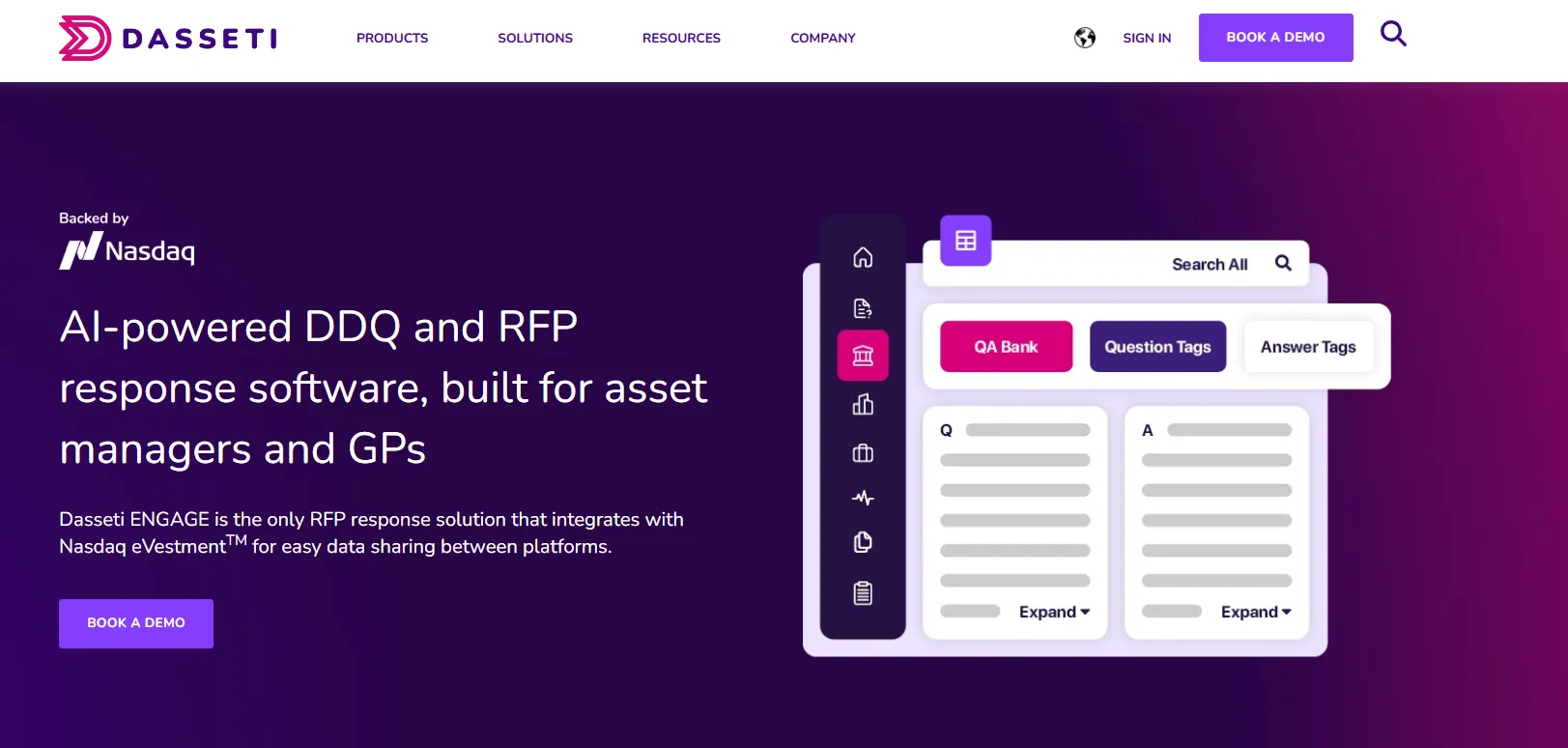
Dasseti ENGAGE is an AI-enabled RFP and DDQ response platform built specifically for asset managers, private equity firms, and other investment managers. It combines a centralized content store with AI-assisted response suggestions, collaboration tools, and workflows for completing investor questionnaires in Word, Excel, and browser-based portals.
Its investment-management focus makes it particularly relevant to IR and RFP teams that need to keep investor-facing information consistent across DDQs, RFPs, consultant databases, and recurring client requests.
Key Features
Centralized content store: Maintains approved questions, answers, and supporting content that teams can reuse across investor requests.
AI Smart Search and Smart Writer: Suggests responses from historical content and approved language, while supporting content extraction, rewriting, tone adjustment, and formatting.
Word, Excel, and browser workflows: Lets teams respond to questionnaires in familiar document formats or through a Chrome browser workflow.
Team collaboration and approvals: Supports question assignments, workflow monitoring, approval processes, audit trails, and content versioning.
Nasdaq eVestment integration: Connects approved data between Dasseti ENGAGE and Nasdaq eVestment Omni, helping teams reuse consultant-database information across RFP and DDQ responses.
Content review reminders: Automatically prompts subject matter experts to review and refresh information at defined intervals.
Pricing
Dasseti ENGAGE uses annual, per-user pricing based on the firm’s specific use case. Pricing is provided directly by Dasseti rather than through publicly listed standard tiers.
Where Dasseti ENGAGE Shines
Investment-management specialization: Workflows, terminology, and content management are designed specifically for asset managers and GPs.
Consultant database connectivity: Its two-way Nasdaq eVestment Omni integration can reduce duplicate data entry between consultant databases and investor questionnaires.
Flexible response formats: Teams can work across Word, Excel, and browser-based questionnaires instead of moving every request into a proprietary format.
Structured content governance: Approval workflows, versioning, audit trails, and recurring SME reminders help teams keep reusable investor information controlled and current.
Where Dasseti ENGAGE Falls Short
Ongoing content management: The platform is built around maintaining a centralized bank of approved questions and answers, so firms still need processes for reviewing and refreshing that content.
Per-user pricing: Annual pricing is calculated per user, which firms with large groups of occasional reviewers should factor into their evaluation.
Broader response workloads: Firms that also handle substantial security questionnaires or non-investor enterprise RFPs should test whether ENGAGE provides enough coverage outside its investment-management-focused workflows.
AI verification: Teams handling sensitive fund, compliance, or operational disclosures should test how clearly reviewers can validate the evidence behind AI-suggested responses before approval.
Customer Review
Independent customer feedback for Dasseti ENGAGE is limited across major third-party review platforms. While the platform has an established presence in investment due diligence and DDQ workflows, there is currently not enough independent review coverage to provide a representative customer quote or confidently summarize broader user sentiment.
Who Dasseti ENGAGE Is Best For
Private equity IR teams: Firms regularly responding to institutional investor DDQs and RFPs.
Asset managers: Organizations that want a response platform designed around investment-management workflows.
Consultant-database-heavy teams: Firms that maintain Nasdaq eVestment content alongside investor questionnaires.
Content-led response teams: Organizations comfortable maintaining a structured bank of approved investor-facing information.
7. Blueflame.ai: Best for Private-Markets Knowledge and Research Workflows

Blueflame.ai is an AI assistant designed for private-markets and alternative-investment firms.
Its role is broader than RFP automation. It can support research, internal knowledge work, memos, and diligence content across the firm, making it appealing to organizations that want an AI layer for more than questionnaire completion alone.
That breadth also means teams should verify how deeply it supports the formal mechanics of a DDQ process, including answer approvals, audit evidence, and final submission workflows.
Key Features
Private-markets AI assistance: Designed around alternative-investment workflows.
Firm-wide knowledge access: Helps teams work with information distributed across the organization.
Research support: Assists with investment and market research workflows.
Memo support: Extends into broader private-markets writing and analysis.
Diligence assistance: Helps teams work with diligence-related content alongside other knowledge tasks.
Pricing
Blueflame.ai does not publicly list fixed pricing. Contact the vendor for a quote.
Where Blueflame.ai Shines
Private-markets focus: Designed for the terminology and workflows of investment firms.
Broader AI utility: Useful beyond RFPs and DDQs, including research and internal knowledge work.
Firm-wide adoption: Can support multiple teams rather than functioning solely as a proposal application.
Research-oriented workflows: Particularly relevant when diligence work overlaps with broader investment analysis.
Where Blueflame.ai Falls Short
Formal response workflow: Asset managers should confirm the depth of named approvals, response-level audit trails, and DDQ project management.
Original-format submission: Teams should test whether investor questionnaires can move through the full import, approval, and export process they require.
RFP specialization: It is a broader private-markets AI assistant rather than a dedicated response-management platform.
Governance testing: Firms should evaluate how formal investor-facing content is separated from broader research and internal knowledge workflows.
Customer Review
Independent customer feedback for Blueflame AI remains limited across major third-party review platforms, making it difficult to draw reliable conclusions about broader user sentiment. The company publishes customer testimonials from investment firms, but these are vendor-hosted rather than independent reviews.
Who Blueflame.ai Is Best For
Private-markets firms: Organizations wanting an AI assistant across several investment workflows.
Research-heavy teams: Groups combining diligence with memos and broader research activity.
Firms seeking broad AI adoption: Organizations that want a knowledge layer rather than only RFP automation.
8. GovernGPT: Best for Fund-Specific DDQ Automation
GovernGPT focuses on fund managers answering institutional investor RFPs and DDQs.
It is particularly relevant when similar investor questions need different answers depending on the fund, strategy, jurisdiction, or investor context. Information can be organized around those distinctions rather than treated as one firm-wide reusable answer set.
Key Features
Automated content ingestion: Imports prior questionnaires and supporting documents without relying entirely on manually tagged Q&A pairs.
Dynamic organization: Categorizes information by fund, strategy, question type, and answer variation.
Pre-approved drafting: Builds responses from approved material and adapts them to investor-relations language.
Fund-level controls: Separates information across funds and strategies.
Source provenance and approvals: Supports sourcing, version controls, restricted access, and reviewer sign-off.
Pricing
GovernGPT does not publicly list fixed pricing. It uses custom, subscription-based pricing, so you need to contact its sales team for a quote.
Where GovernGPT Shines
Asset-management focus: Built around fund-manager RFPs and institutional DDQs.
Answer variation: Useful for firms where similar questions need different disclosures by strategy or fund.
Lean-team fit: Automated organization may reduce setup demands for smaller IR functions.
Investor-relations language: Its specialization can help responses better reflect institutional fundraising communications.
Where GovernGPT Falls Short
Earlier market presence: It has a shorter established enterprise track record than longstanding proposal platforms.
Narrower workload: Firms handling substantial security-questionnaire or commercial RFP volume should verify broader coverage.
Enterprise controls: Buyers should confirm current certifications, regional hosting, private deployment, and related security requirements directly.
Broader proposal operations: Teams requiring extensive project management or narrative proposal workflows may need additional functionality.
Customer Review
There are few independent third-party reviews of GovernGPT online, with most available feedback coming from positive customer testimonials on its own website that highlight easier RFP and DDQ completion, streamlined document management, improved collaboration, and time savings.
Who GovernGPT Is Best For
Fund managers: Firms responding frequently to institutional investor DDQs.
Multi-fund organizations: Managers that need firm, fund, and strategy information kept distinct.
Lean IR teams: Smaller investor-relations teams seeking specialized DDQ automation.
Fundraising teams: Groups needing structured responses across several investor types and mandates.
How to Choose the Right RFP and DDQ Software for Asset Managers
Asset managers should evaluate response software by asking what happens to an answer from the moment an investor asks the question until a named reviewer approves the final response. The strongest platform for your firm will depend on evidence requirements, fund complexity, compliance workflows, document formats, and how much specialist time the process consumes.
1. Test How the Platform Controls AI Hallucination Risk
For asset managers, an AI-generated answer needs to be defensible, not just convincing. Responsive and APMP’s 2026 State of Strategic Response Management Report highlights this risk, with Vodafone Senior Bid Manager Ken Lebek cautioning that AI is “still hallucinating a lot” and emphasizing the importance of the knowledge foundation behind the LLM.
When evaluating RFP software, test what happens when approved information is incomplete, conflicting, or unavailable. The platform should make supporting evidence visible and flag uncertainty rather than filling gaps with plausible answers.
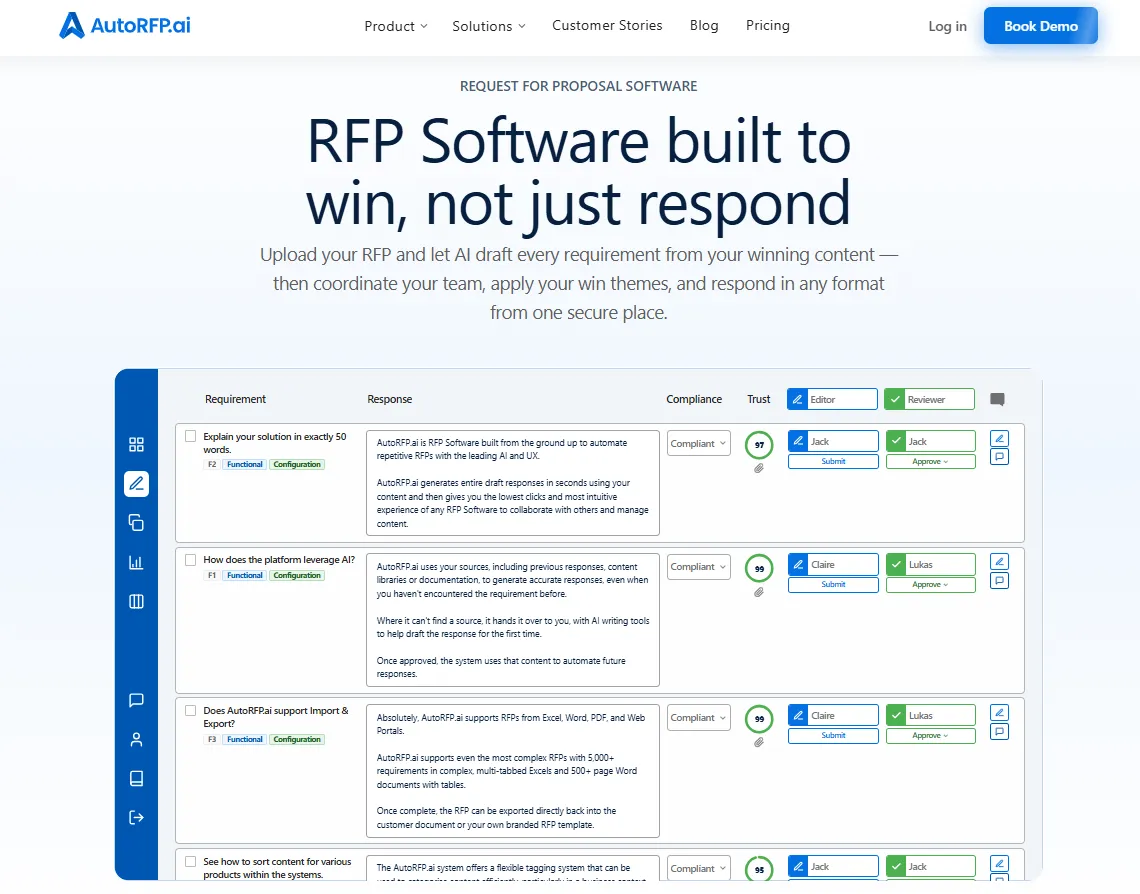
AutoRFP.ai is designed around this approach, grounding responses in approved sources, showing supporting evidence and Trust Scores, and routing questions for human review when there is not enough evidence to support an answer.
2. Test Fund, Strategy, and Investor-Level Boundaries
Asset managers rarely have one answer that works across every fund and mandate. The same investor question can require different disclosures depending on strategy, jurisdiction, vehicle, product, or investor type.
GovernGPT is especially relevant when fund- and strategy-specific variations are central to the workflow. DiligenceVault and Dasseti are also worth considering when structured institutional diligence is the dominant use case.
During evaluation, deliberately give the platform similar questions that require different answers. Check whether it keeps those distinctions clear instead of collapsing them into a generic firm-wide response.
3. Check How the Platform Handles Changing Compliance Context
Policies and approved internal documents are only part of the problem. Some investor questions relate to regulatory requirements or data-residency expectations that continue to evolve.
AutoRFP.ai’s Project Agent can bring current compliance context into a project, map that context against existing controls and evidence, and flag open items for human review. Its DDQ workflow also supports recurring compliance review cycles for approved content.
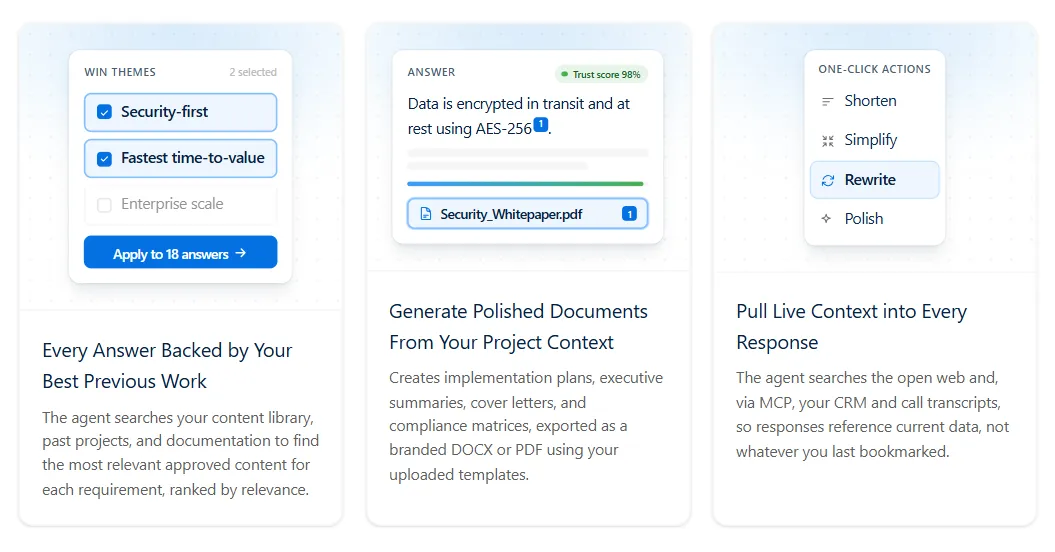
Whatever platform you choose, separate two questions during evaluation: Is the firm’s approved answer current, and has the external requirement itself changed?
4. Run the Hardest DDQ File Through the Platform
Do not test software with a clean 20-question demo spreadsheet. Use the kind of file that causes work today.
Include an ILPA workbook with multiple tabs, merged cells, dropdowns, repeated questions, supporting context, and several reviewer assignments. If your team also creates document-heavy proposals, Qvidian’s Microsoft Office workflow may be attractive. If investor DDQs dominate, test whether specialist tools such as DiligenceVault or Dasseti handle your actual templates and submission process cleanly.
The final check should be the exported file. A fast draft does not save much time if IR still has to rebuild the investor’s workbook manually before submission.
5. Measure Reviewer Effort and Recurring Gaps
Completion time alone can hide a weak automation system. A platform might fill 90% of a questionnaire while leaving compliance and investment specialists rewriting most of those answers.
Track how many responses require little or no editing, where manual work remains concentrated, and which questions repeatedly expose missing firm knowledge.
AutoRFP.ai’s Automation Reporting tracks response mix and automation impact, while Gap Analysis can surface recurring weak or unsupported requirements across projects. Responsive also offers strong enterprise reporting for firms that want broader proposal-operations visibility.
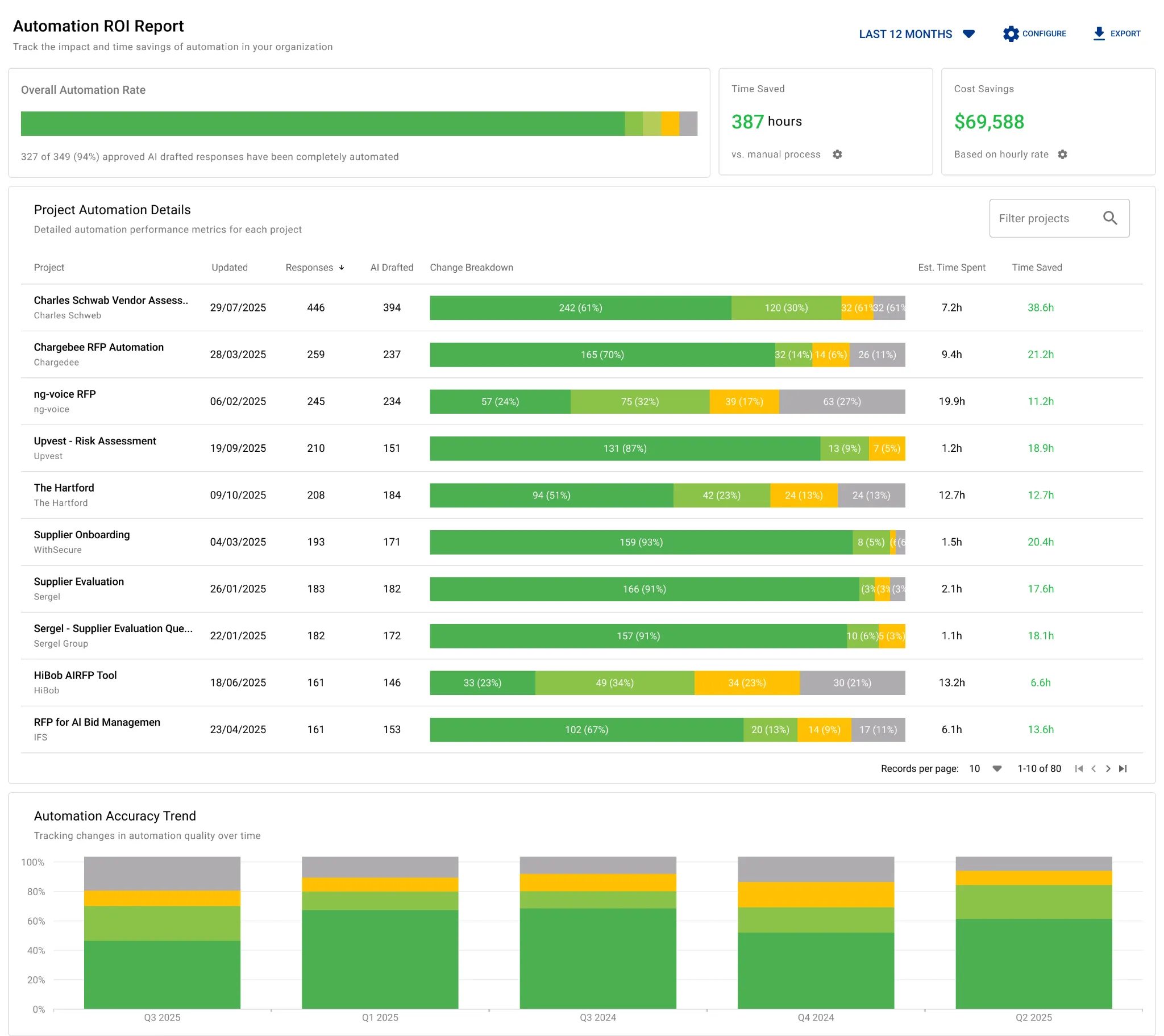
The better long-term question is not simply, “How quickly did we finish this DDQ?” It is, “What did the system learn about our response process, our content gaps, and where our experts are still spending time?”
Questions to Ask Your Vendor
Consider asking potential vendors the following questions before making a decision.
- Do you use our data to train any public models? Where is our data stored?
- Can you show the full answer lineage and provide an exportable audit trail for a submitted DDQ?
- How do you handle annual DDQ refreshes? Do we need to re-answer questions, or can you draft responses from updated source documents?
- Can you produce a complete narrative RFP, or do you only support structured Q&A?
- What is the total annual cost, including access for every reviewer who needs to participate?
Future of RFP and DDQ Automation for Asset Managers
RFP and DDQ automation for asset managers is moving toward a more governed model in which evidence, fund context, reviewer accountability, and knowledge quality travel with every response.
For IR and investment teams, this matters because the cost of a weak answer is not limited to extra editing. An inconsistent valuation statement, outdated governance disclosure, or unsupported security claim may need to be explained later to an LP, consultant, auditor, regulator, or internal compliance team.
1. Evidence Will Become Part of the Answer
Future DDQ systems will increasingly treat the answer and its evidence as one unit.
A reviewer will expect to see where a statement originated, how recently the source was reviewed, who approved it, and whether conflicting information exists elsewhere. Black-box drafting becomes much less useful when hundreds of investor-facing answers still need to be independently rechecked.
2. Fund and Strategy Context Will Become More Important
Asset managers will also expect systems to understand that “approved” does not always mean “approved everywhere.”
The correct response for one fund, investment strategy, vehicle, or jurisdiction may be inappropriate for another. Future automation will therefore need stronger context controls that determine not only whether information is approved, but whether it is approved for this specific investor request.
3. DDQ Data Will Become Business Intelligence
Repeated investor questions contain useful information.
If multiple LPs ask about the same missing policy, reporting capability, operational control, or disclosure, that pattern can help compliance, operations, product, and leadership understand what the market increasingly expects.
Instead of disappearing into completed spreadsheets, recurring gaps can become structured intelligence for the firm.
4. IR and SMEs Will Shift From Writing to Validation
The strongest automation model for asset managers is not one that removes experts from the process. It changes where they spend their time.
IR can coordinate and shape investor-specific responses, while compliance, legal, InfoSec, operations, and investment specialists validate the material that requires their expertise instead of repeatedly writing standard answers from scratch.
This is consistent with the broader findings in AutoRFP.ai’s 2026 Proposal Win Rate Report, where stronger proposal performance was associated with structured ownership and governance rather than AI adoption alone. Among the High Win Cohort, 71% used Go/No-Go qualification and 65% had formal review and governance.
5. Automation Will Be Judged by Quality, Not Volume
The number of automatically populated cells will become a weaker measure of success.
Asset managers will increasingly track how much editing reviewers perform, how often questions require escalation, whether outdated content is caught before submission, where bottlenecks remain, and whether automation creates meaningful capacity for investor relations and compliance work.
For asset managers, the next generation of RFP and DDQ software will therefore be less about replacing human judgment and more about giving that judgment better evidence, cleaner workflows, and fewer repetitive tasks.


Video transcript
You've just received that monster RFP. It's a lot of work, and you're excited to dive in and potentially win this massive contract. You've started using AI, but how do I actually win? What is the RFP response that I need to write to win this deal? That's what takes from basic level of proposal writing to what wins. I'm Rob from AutoRFP.ai. We're an AI RFP software. I personally complete and win RFPs on the daily, and I'm keen to dive in today about using AI for an RFP response that actually helps you win RFPs. I'm gonna be covering win themes. I'm gonna be covering leveraging customer insights to write strategic narrative that helps you actually win RFPs. Yes, we're gonna be talking about AI automation and saving time,
but it's not just about that. It's not about doing an RFP as fast as possible with as little effort as possible and just putting out slop into the world. It's about writing and winning RFPs. But first, as I did say, it's about RFP automation with AI for our RFP response process. It's about automating the mundane. Before you dive into how you can use AI to help you win RFPs for RFP response, take a step back and think about, what are the activities I do related to RFPs that don't actively help me win RFPs? So automate the mundane. AI's real job in an RFP, isn't to do what you do well and what humans do well, and that is writing strategic narrative. It is to do what it does well, and that is hunting and pecking throughout
your past responses, automating kind of the basic responses and really making sure that those are compliant as Jasper Cooper, our CEO and co-founder at AutoRFP.ai, put in our proposal win rate report for 2026, the real advantage isn't automating content, it's what teams do with the time they get back. So automate as much as you can on the mundane So firstly, these are some clear things you can hand to AI from the start. The clear yes or no. Does your product or service do this? And it has a yes box or a tick box or a radio button or a drop-down selection. Yes, . AI should be completing those 99% of the times. Of course, having a human to review if appropriate, but that is where AI is good, the black and white. Company information all the content forms you get about company legal name, company entity, where the office is based, and so on.
If there isn't a place to kinda put your flair there, of course, just basic information, AI is good for that. Boilerplate. Then you've got boilerplate and your security and compliance questions. Across our customer base, 63% of every AI-generated answer is approved with zero to one-word changes. That is 63% of AI-generated answers are perfect. A human still reviews them, but it doesn't require any manual editing. That's freeing up enormous time for teams using our software and the other software out in the market to then, take that time back to do what wins. So what are those activities you can do to help win? First Automate the answer everyone gives and write the answer only you can give. But first, let's cover off what a great answer looks like, and I'll give you both a good and a bad example. So what does a great answer look like?
And this is subjective, of course, to your industry, to your country your buyer. It's all dependent on so many factors. My background is in technology RFPs. That's where I've spent ten years working and selling and writing RFP responses across local government, national government, state government, as well as private enterprise RFPs in Australia, in the UK, in Europe and it is very subjective what a great answer looks like. But I'm gonna take on a couple of core principles that are gonna help you think about what a great answer looks like for your use case. So leads with the verdict. I'm a big believer in front-running the value of the response in the first sentence or two. What that means is effectively, if we're thinking about how humans read, and especially if your job is to read a handful of RFP responses, it's pretty
hard work to continually stay focused and read an entire response and remember everything that you read in there. You wanna make sure that it's easy for the reader to understand the value in your response, and tick off and give you the points that you need in that evaluation criteria. Second, mirror the buyer's words. This is where your understanding of that industry, of that country, of that buyer goes into how you talk about the response. Three, specific enough, no competitor could paste it. Again, imagine you have an evaluation criteria and you are marking this RFP, and you have two responses that look exactly the same. How are you gonna differentiate? That's where being specific enough no competitor could could paste it is so important to make your response stand out, short and scannable. Now, short is dependent on the type of RFP or RFI that it may be and what they're expecting for responses. Make it scannable. Make it a pleasure to read. Don't make it giant block paragraphs that are incredibly hard, again,
for that evaluator to give you the marks for that response. Make it have bullet points. Make it have flowing paragraphs. Make it have a summary or conclusion at the end if reasonable. Make it short and concise and scannable this is probably the biggest sin I see in executive summaries. Someone writes an executive summary, maybe it's the CEO has the standard template one that they use, and it's all about them. It's all about your company, it's all about your experience, and it's boring to read. Make it about the buyer. Easy way to do this is scan the left margin. How often do the sentences start with we, our, your company's name, and so on? How often is this talking about you? Leverage your customer insights and incorporate it into your win themes to make it about them. Tie your solution into the pain and the problems that they are living, and write about them, not about you. But you're tying everything back into their world because it's just more contextual, and it's easier for them to map your response to the evaluation
criteria and how it meets their stated objectives and goals for the RFP. So this is what a great answer can look like. This answer was actually is using social proof. It's one of our answers that we would write, and effectively it's talking about a migration. So SugarCRM migrated from Qvidian to AutoRFP.ai in 2024 and deployed in two weeks. The first sentence has the value. Social proof time. Because we're thinking about migrations. The buyer might be thinking about how long does that take? What's the risk here? How long does it take is answered in the first sentence, and social proof helps alleviate the risk. Then the next three dot points, again, incredibly skimable and readable and has numbers to draw attention. So this requirement was regarding do you have any customers who have migrated? A forgettable answer. AutoRFP.ai.ai, so leads with me, leads with us. Maintains version control automatically through the History tab. First of all, a lot of flowing commas, a pretty long sentence. We've kinda cut off the response, but it keeps going.
No hook, no numbers no so what for the buyer. And effectively it's correct, and for a functional question in a response, it could be a great response if it was looking for a black-and-white response. So it's a forgettable response. So how would we improve this response? We might say Audibility and traceability is core to the platform. This extends to the history tab in which… and then you might use then dot points to list out all the relevant comma points there. So I'm gonna give you some concrete examples of how you can use AI to incorporate win themes and customer insights to help you write winning RFP responses. First of all, the data. We did a survey of over a hundred winning bid teams and asked them what do they do to win. These are teams that win more than 50% of the RFPs they bid on. 71% of high win teams use win themes, 42% of low win teams use win themes.
So a clear distinction, the difference there. This is a strategic part of your RFP response use your intuition and your knowledge of the buyer, your knowledge of your company and your products and services to really fine-tune it. But it can definitely be helpful in thinking of ideas and going back and forth and helping you once you've generated those win themes, actually deploying the win theme across an RFP response. So the RFP, what you receive from the buyer, often will have a bunch of context about their current situation That is gold to help you understand exactly what to incorporate. Once you have the win themes, then you go into applying win themes everywhere. Try to win th-thread these win themes consistently throughout every section. Flag answers that drift, especially on the answers where it matters. I'm using my project agent here so it's talking about differentiation, and then it has access to the web, it has access to my content library, it has access to my CRM, and it's gone
through and looked at all that in different information and found a bunch of different information relevant to this RFP that I'm currently working on and helped create some win themes. So win themes are, it's a scalable platform. Win theme number two, reduces security and compliance risk. It's easy to use and it's integration flexibility integrates with their entire tech stack. Maybe that is also a point of competitive differentiation. If I understand the market and the competitors really well, potentially my solution might be the only one that has a particular integration with a particular system in the buyer. So I wanna highlight that fact consistently that we have the experience of integrating their entire technology stack to our solution, and that is important because of X, Y, Z, because of what's stated in the RFP, because the buyer has told us or we've spoken to the buyer about it. Okay, so we've got all these different win themes that was created via AI, and now I'm gonna ask it, can you now incorporate these win themes across functions?
The AI is now going to start incorporating the win themes by editing these responses for me, by searching my past content, and effectively giving me a stronger narrative of why this buyer should choose our solution Now, it's generating those responses. I can go through, I can see the changes it made, and I can accept this or not. Okay, cool. That looks good. And then I can go through, and I can look at these responses and accept and change them as well, and make sure it incorporates what I want in the responses as well. Let's try and find one here You can see it keeps using the word configurable. So it's reasserting though that vocabulary that ties to integration strengths of our platform, But that's just an example of how we, how I used AI and the AutoRFP.ai project agent to generate win themes based off the RFP project, based off my knowledge of the buyer. And then from that we work to incorporate four win themes, and
then I've used AI to help apply that. I would then go through and edit and make changes here if necessary. And then we've got a strategic narrative throughout that section on the functional requirements. So what are customer insights? It's not just that we know who the buyer is and we've spoken to them a couple of times, but it's actually understanding their current state. It's about understanding their pain, their problems, why they're looking to go out to market, what has been their history of solutions, and everything we understand about that customer, about industry, about the geography and other relevant customers in the space to, understand their world and help pitch a solution that would generally provide value to them. So where can customer insights live? First of all, in your CRM. There's a goldmine of information in your CRM Then you've got your recorded discovery calls. This could be from systems like Gong or Clari and effectively any calls or demonstrations or workshops that you've had with the prospect before the RFP
strategy and workshop sessions. This is really important, in the world of capture, is helping shape that RFP in a subtle way. And a big way is strategy and workshop sessions or giving updates on the state of the market and other information that helps you position the buyer to understand the world and the category that they're looking to procure their products or services in. Team interviews. So again, you might have a sales team, pre-sales team or legal compliance, they all know incredibly well what the buyer is looking for, especially if they've spoken to buyer and, or they understand the industry well. And speak to them, talk to your team, bring out internal meetings that add value and help you understand the customer and provide their knowledge into things like the strategic narrative, like the win theme for that RFP. So content is what you say and your past content, but insight is why it matters.
You can say a bunch of stuff in an RFP, and it can come out looking like gobbledygook and be of no value to the buyer, and you can get a really low mark and not tick off any evaluation criteria or compliance matrices, and you're gonna lose. Anyone can generate an RFP with AI, but insight is why it matters. And why does that matter? Again, tying back to the proposal win rate report where we interviewed and asked winning bid teams what do they rate most highly as to why they win, customer insights was the number one reason, and 88% of high win teams were doing customer insights, whereas only 67% of low win teams had a defined customer insights process. But again, of all the reasons why they win, the number one reason for high win teams was customer insights. So all that information we just spoke about, they're leveraging
that to win competitive RFPs in my same response, we're gonna jump back into our section, and we're going to ask my agent, my project agent, to look at my CRM notes, I have a couple of call transcripts in there that have been made up, and help them edit these responses based off the knowledge of that CRM. So there's my prompt. It's gonna look inside HubSpot. This is the made-up company, and it's going to go through and look at these notes without me having to effectively point it to it. It's gonna hunt and peck. And it's all fake, and it's going to use that to help respond to my fake RFP. So here you can see it's used a bunch of tool calls via the MCP. So effectively, my AI in AutoRFP.ai is speaking to HubSpot's server and grabbing all that information and then parsing that and contextualizing that for the RFP because my AI understands the RFP because it's right there in front of it. And it's going through, and it can look at all the information, and then
it's pulled out a stakeholder map. All the stakeholders and role in the decision, what they care about, and where it sourced that information. So that's really important, especially with thinking about it's actually a person behind the marking criteria. Could be procurement, could be a decision-maker and then it's talking about the actual drivers and pain points. And you can see here it's actually pulled out a lot of different information from those calls about what's important for this RFP. And it's then going to effectively take all that information, take my library content, so it's still sourced in reality of what my product and company can actually achieve, and it's going to take those win themes and must-win sections, and it's going to effectively craft that into a response. And now I'll ask it, "Cool. Can you now update section B?" Based off the context information there Again, here's two responses where it's worked in that context to that response. And you can see that I can accept that, easily make those
changes, and pretty happy with it. Those responses. That's how it would incorporate the customer insights and so on into it. I And one big thing I wanna call out is SME-led drafting, so the subject matter expert writing the response from a blank page, is a low-win habit. Ninety-four percent of high-win teams from our survey and our interviews, the proposal team writes, the SMEs review. So SMEs write for precision, whereas proposal teams write for persuasion. And we're talking back through the entire thing about customer insights, about win themes, about what makes a great response. We're talking about persuasive narrative and writing, and SMEs will write for the technical correct answer, which can be a good answer, but proposal teams write for a great answer that will actually win you that RFP. So don't fall into that trap. Make sure that when you have SMEs, they're just reviewing and approving information.
Or even better, you're sourcing that from an approved library of content that SMEs already approved, so they don't even need to approve it, but they're just reading over and approving things. But someone else is actually incorporating everything we've spoken about today into that response, and they're just approving the technicalities. One model actually that can really help speed up SME time and reduce the time as well is that AI can draft the repeatable responses, again, sourcing from approved content and then sourcing from the context of your company and the SMEs just going in and validating low-confidence bespoke responses So that's how you can use AI to help raise the floor and incorporate insight, themes, and narrative into your RFP response and really use AI to automate the mundane. Now, if you wanna get a hold of the 2026 Proposal Win Rate report that I covered throughout some of the great stats throughout today's video you can see the link in the description below. All right, thanks. I'm Rob from AutoRFP.ai.ai. Cheers.
Make Every Investor Response Easier to Defend With AutoRFP.ai
AutoRFP.ai gives asset managers one governed platform for institutional DDQs, RFPs, and security questionnaires. It drafts from approved and synchronized documentation, exposes the evidence and Trust Score behind each answer, and routes unsupported questions for human review rather than filling gaps with unsupported content.
Compliance review cycles, audit trails, ILPA and complex Excel handling, original-format export, regional data residency, enterprise security, and a library that stays current help IR, legal, compliance, and InfoSec teams keep investor responses current and defensible without rebuilding the same process for every questionnaire.
We would rather show you than tell you: prove it on your own DDQs in a two-week proof of concept. Book a demo with AutoRFP.ai. If you sell into hospitals or clinical buyers, see the RFP software for health tech comparison.
About the author

Technical Account Manager
Technical Account Manager at AutoRFP.ai. Background in asset management completing institutional RFPs and DDQs; now implements AutoRFP.ai for some of the company's largest accounts.
LinkedInFrequently asked questions
How Much Does RFP Software for Asset Managers Cost?
Pricing varies considerably by platform. AutoRFP.ai starts at $899 per month with unlimited users, while Loopio’s Foundations plan starts at $20,000 per year. Responsive, Qvidian, DiligenceVault, Dasseti, and GovernGPT use custom or quote-based pricing. Asset managers should compare the total annual cost, including user limits, project volume, implementation, integrations, support, and any required add-ons.
What Is the Difference Between an RFP and a DDQ for Asset Managers?
An RFP typically evaluates whether an asset manager is suitable for a mandate and may cover investment strategy, team, performance, operations, fees, and other selection criteria. A DDQ goes deeper into the firm’s investment, operational, governance, risk, compliance, cybersecurity, and organizational practices. Asset managers may also receive standardized questionnaires such as ILPA or AIMA DDQs. Because the documents serve different purposes, firms should evaluate whether their software can handle both narrative RFP responses and detailed recurring diligence questionnaires.
Do Asset Managers Need RFP Software or a Dedicated DDQ Tool?
It depends on the firm’s response mix. Asset managers focused primarily on institutional diligence may prefer a specialist platform such as DiligenceVault or Dasseti. Firms that also manage RFPs, security questionnaires, consultant questionnaires, and other investor requests may benefit from a broader response platform that keeps approved information, reviews, and response workflows governed in one system. The right choice depends on whether specialization or consolidation matters more to your team.
What Security and Governance Controls Should Asset Managers Look For in RFP Software?
Asset managers should evaluate ISO 27001 certification, SOC 2 Type II audit coverage, customer-data training policies, regional data residency, SSO, role-based permissions, tenant isolation, version history, approval controls, and audit trails. For confidential fund, investor, performance, or compliance information, firms should also confirm where data is stored and processed and whether the vendor’s contractual and technical controls meet their internal compliance requirements.
Can RFP Software Handle Narrative Proposals, Not Just Structured Q&A?
Some platforms are better suited to structured questionnaires, while others provide stronger support for long-form proposal writing. If your firm responds to consultant RFPs, institutional mandates, or other opportunities requiring substantial narrative content, test whether the software can develop longer responses, manage review and approval, preserve document structure, and work alongside recurring DDQs.
How Should an Asset Manager Test RFP and DDQ Software Before Buying?
Test the platform with a real investor questionnaire rather than relying only on a simplified vendor demo. Include fund- or strategy-specific questions, difficult compliance requirements, missing or conflicting source information, several reviewers, and a complex Excel or Word file. Then assess whether reviewers can verify supporting evidence, keep fund-specific answers separate, identify unsupported questions, track approvals, and return the completed response in the required format.

