
XaitPorter vs Loopio: RFP Software Comparison for 2026
Compare XaitPorter vs Loopio for RFPs, proposals, AI, collaboration, pricing, and content management, plus where AutoRFP.ai fits.

Co-founder & CEO, AutoRFP.ai··12 min read
| XaitPorter | Loopio | |
|---|---|---|
| Best for | Complex, co-authored long-form documents | Library-driven RFP and questionnaire response |
| Core approach | Collaborative document production | AI suggestions from a maintained content library |
| AI architecture | AI peripheral to co-authoring | AI added onto a legacy content library |
| Per-answer citations | No | Library search, not per-answer scoring |
| Review governance | Built for authoring, not structured Q&A | Governance depth, tied to library upkeep |
| Pricing | Quote-only, per user, premium end | Quote-only, tier names and seats |
| Rating | 4.6 on G2 | 4.6 on G2 |
Which Problem Are XaitPorter and Loopio Really Solving?
A 100-page proposal and a 300-question security questionnaire can both be called “RFP work,” even though completing them can feel like two completely different jobs.
When several people are contributing to one large proposal, keeping the document organized becomes part of the job itself. XaitPorter gives those contributors one place to write while handling formatting and version control around them.
Loopio becomes more useful when the workload is packed with questions your company has seen before, pulling approved content from a shared library so teams can reuse it across new RFPs and questionnaires.
If your team is trying to decide between those two workflows, this guide breaks down where each platform fits and what to look for before you choose. But first…
Why AutoRFP.ai Can Speak to This Comparison
AutoRFP.ai supports response teams working in 44+ languages across APAC, EMEA, and North America, bringing experience with a wide range of RFP workflows.
Workforce.com, for instance, doubled its RFP participation rate with AutoRFP.ai and has won more than 50 bids using the platform. AutoRFP.ai’s Workforce.com case study (published January 2025) reports that around 80% of its questions are answered automatically in the first draft, helping the team take on more RFPs with less manual response work.

XaitPorter for Complex, Co-Authored Documents
XaitPorter is built for teams producing large proposals and technical tenders with input from several specialists. Contributors work in the same document, with section-level permissions controlling access and version history keeping track of changes.
Predefined templates handle formatting as the document develops, so subject-matter experts can focus on their sections without spending time fixing layouts or numbering.
The core workflow includes:
- Real-time co-authoring: Multiple contributors can write in the same document at once.
- Section-level control: Permissions determine which content each contributor can access.
- Automated formatting: Templates manage layout and numbering as content changes.
- Version tracking: Teams can review previous changes and restore earlier work when needed.
Xait also brings AI into the authoring process through XaitAI, which can help extract requirements from an incoming RFP and surface relevant material from approved company content as authors write.
XaitPorter makes the most sense when creating and controlling the final document takes up a large part of the response process. Teams handling structured security questionnaires or DDQs can also consider XaitRFI, which Xait offers separately for those workflows.
XaitPorter Pros
- Complex document production: XaitPorter supports large proposals where many contributors need to work in the same document.
- Automatic formatting: Templates manage layout and numbering across the proposal.
- Real-time co-authoring: Contributors can work concurrently with section permissions and version history.
- Engineering-heavy bids: Xait has a strong presence across energy, engineering, construction, and government contracting.
- Connected pricing workflows: XaitCPQ can bring configured pricing into XaitPorter for proposals involving complex products or services.
XaitPorter Cons
- Quote-only pricing: Xait does not publish a standard XaitPorter price, so buyers need to request a quote.
- Learning curve for advanced use: G2 and Capterra reviewers note that onboarding for more advanced workflows can take time for occasional contributors.
- Customization limitations: G2 feedback mentions friction around image handling and customization.
- Questionnaire workflows use another Xait product: XaitRFI is positioned separately for RFIs, DDQs, and security questionnaires.
Loopio for Library-Driven RFP Response
Loopio is an RFP response-management platform built around reusable content. When a new RFP or questionnaire arrives, teams create a Project and use approved company knowledge to start working through the requirements.
Much of that knowledge lives in Loopio’s Content Library, where previous answers can be maintained and reused. Several features help teams put that content to work:
- Magic Requests: Loopio’s one-click automation pulls approved answers from existing content for repeat questions.
- Confident Answers: Can use connected sources such as SharePoint, with confidence indicators helping reviewers prioritize responses.
- Freshness alerts: Flags aging content when it is due for expert review.
- Project feedback: Approved work can feed updates back into the Library for future responses.
The same workflow extends to RFPs, security questionnaires, and DDQs. SmartScan can map requirements from Word, PDF, and Excel files, and Loopio’s browser extension can pull questions in from online portals.
Loopio notes that SmartScan currently works best with shorter, consistently formatted documents and recommends reviewing what the AI detects before responding.
Loopio Pros
- Dedicated response workflow: Loopio supports RFPs, DDQs, security questionnaires, and sales proposals.
- Governed content library: Freshness alerts and project feedback help teams manage reusable answers.
- Questionnaire support: SmartScan handles Word, PDF, and Excel files, with a browser extension for online portals.
- Established customer base: Loopio says more than 1,700 organizations use its platform.
- Cross-functional collaboration: Teams can assign questions to SMEs and manage the response inside each Project.
Loopio Cons
- All tiers are quote-only: Foundations, Enhanced, and Enterprise pricing all require a sales conversation.
- Paid add-ons: Project Translations, Onboarding Packages, and Industry Integrations are listed as additional options.
- Content needs ownership: Freshness Scores help identify content that needs attention, but teams still need people to review and maintain the Library.
- Paid portal access: Loopio’s browser extension is included across its current plans, but the person using it needs a paid licence.
XaitPorter vs Loopio: Pricing Comparison
XaitPorter and Loopio both require a sales conversation before you can get a final price, so the total cost depends on how your team plans to use each platform.
XaitPorter is priced per user, with implementation and migration quoted separately. Third-party estimates from ITQlick put a single-user licence at around $150 per month, with larger enterprise deployments reaching five figures per month.
Loopio also keeps its dollar pricing private, though it does publish seat counts by tier, with Foundations including 10 seats. Vendr’s procurement data puts the median annual Loopio contract at about $24,100 across 267 purchases, with deals ranging from roughly $15,000 to more than $150,000 a year depending on scope.
Where XaitPorter and Loopio Fall Short
When your team is answering a security questionnaire or DDQ, every response needs to be easy to verify. Reviewers need to know where an answer came from and quickly spot questions that the available company content cannot support.
XaitPorter keeps verification with the people writing and reviewing the document. Loopio uses its Content Library and connected sources to generate responses, with teams responsible for keeping that knowledge current and checking the resulting answers. Buyers who want a broader shortlist can also compare alternatives to Loopio on library upkeep, AI accuracy, and day-to-day fit.
AutoRFP.ai brings that verification closer to each individual response, helping teams see the evidence behind an answer before it is approved.
How AutoRFP.ai Compares
AutoRFP.ai is the accuracy-first, AI-native platform for RFPs, security questionnaires, and DDQs: every answer is written from content your team has approved, and shows the sources behind it. Its standard response workflow drafts from that approved content, giving reviewers evidence they can check before submission.
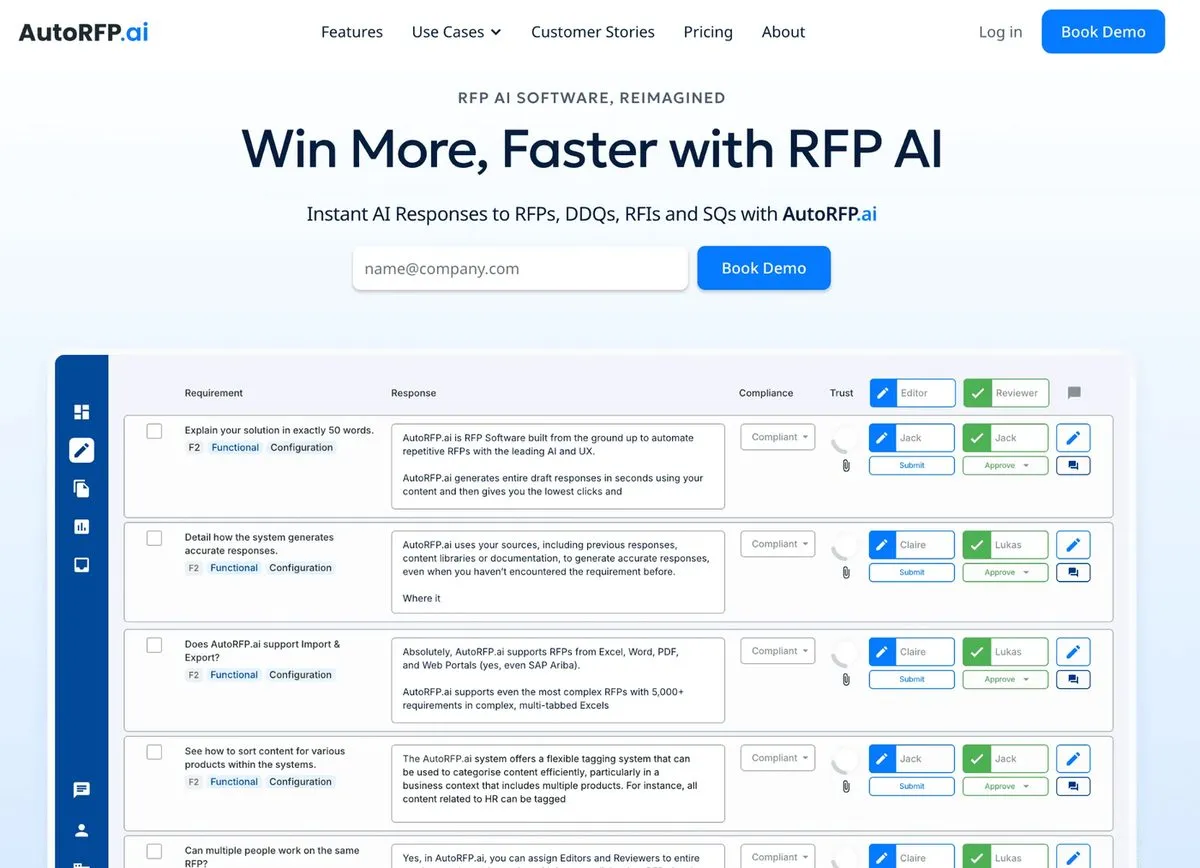
When outside information is useful, a separate, user-enabled Response Agent can search the web. This keeps external research separate from the standard source-grounded response workflow.
Check the Source and the Answer Separately
AutoRFP.ai gives reviewers two different signals for each response:
- Trust Ranking: Shows how strongly the response is supported by company content, ranging from Exact Match to No Results Found.
- Feedback Score: Checks how well the response addresses the requirement and flags areas that still need work.
Exact Matches can reuse a previously approved response verbatim. A well-sourced answer can also be flagged when it does not fully address what the customer asked, helping reviewers focus on responses that need more attention.
Send Unsupported Questions to the Right Person
Admins can set a Requirement Satisfaction Threshold for generated responses. Answers that fall below that threshold are held back for human input instead of moving through the normal auto-answer workflow.
This is the mechanism behind zero hallucination by design. AutoRFP.ai uses approved content for its standard response flow and sends unsupported requirements to a person instead of filling the gap with a plausible answer.
Keep Structured Response Work in One Product
AutoRFP.ai handles structured RFPs, security questionnaires, and DDQs in the same platform. Teams can:
- Import questionnaires: Bring in Word, Excel, and PDF files, including spreadsheets with multiple response fields.
- Handle online portals: Use the Portal Agent to bring requirements from browser-based portals into an AutoRFP.ai project.
Xait separates some of this work across XaitPorter and XaitRFI, making AutoRFP.ai worth considering when your team wants these structured response workflows in one product.
Set Clear Rules for Approval
AutoRFP.ai gives admins control over what happens to an answer once it enters review. They can decide when responses lock and who can reverse a submission or approval.
Export Approval adds another checkpoint by preventing a completed project from being downloaded before the designated approver clears it. These controls are useful when security or legal teams need formal sign-off on what gets sent to a customer.
Bring More SMEs Into the Project
AutoRFP.ai uses project-based pricing with unlimited users across its plans, so bringing another SME into a response does not add a seat charge. The AutoRFP.ai pricing page (September 2026) lists:
- Scale: $899 per month, paid yearly, for 24 projects.
- Accelerate: $1,299 per month, paid yearly, for 50 projects.
- Enterprise: Custom pricing and project volume.
Plans include unlimited AI and content alongside the unlimited-user model. This can suit response teams that regularly need input from people outside the core proposal function.
Improve the Answer Before It Goes Out
AutoRFP.ai focuses quality checks on the individual response. Reviewers can see the supporting evidence and separately check whether the draft answers enough of the requirement.
Previously approved Exact Matches can be reused verbatim, and new requirements can be drafted from relevant company material. The goal is to get each response closer to submission-ready with fewer reviewer edits.
Keep People in Control of Content
AutoRFP.ai has a shared content library with people responsible for maintaining its quality. Content Managers can manage source material, while approved project responses can become useful material for future work.
Placeholders can be preserved when approved responses return to the library. Teams can also use Snippets for language that needs tighter control across responses.
Track the Work Around the Draft
AutoRFP.ai can screen incoming projects against configurable questions before the response work begins. Once a project is underway, the dashboard gives teams visibility into completion and outstanding responses.
That makes AutoRFP.ai a stronger fit when the work centers on managing structured answers through review, with XaitPorter remaining more focused on producing complex, co-authored documents.
AutoRFP.ai Pros
- Source-grounded answers: AutoRFP.ai drafts from approved content, can reuse strong approved matches, shows the supporting sources, and routes unsupported requirements to a person.
- Visible citations: The Citation Engine shows reviewers the source behind each answer.
- Separate quality signals: Trust Scores assess source support, while Feedback Scores check how well the response addresses the requirement.
- Less library upkeep: Approved responses can feed future work, reducing manual maintenance while keeping content owners in control.
- One response platform: RFPs, security questionnaires, and DDQs run through the same system.
- DDQ governance: Fund-level approvals, version history, and audit trails support private-capital response workflows.
- Original formatting preserved: Completed answers return in the client’s Excel or Word file, formatted as they sent it.
- Unlimited users: Project-based pricing lets SMEs and reviewers participate without additional seat charges.
AutoRFP.ai Cons
- Newer market presence: AutoRFP.ai has a shorter track record than established platforms such as Loopio and XaitPorter.
- Not built for long-form co-authoring: XaitPorter is a more natural fit for large, multi-author tenders and similar document-heavy work.
- Focused use cases: RFQs, construction bid sheets, and heavy public-sector procurement fall outside AutoRFP.ai’s core focus.
- Approved content comes first: The standard workflow uses approved company content, with web research available separately when users choose to use it.
XaitPorter vs Loopio vs AutoRFP.ai
| XaitPorter | Loopio | AutoRFP.ai | |
|---|---|---|---|
| Best Fit | Large, complex technical proposals and tenders | Mature RFP response teams with recurring questionnaire volume | B2B teams handling structured RFPs, security questionnaires, and DDQs |
| Core Approach | Database-driven co-authoring and document automation | Library-centered response management | Accuracy-first, AI-native, source-grounded response automation |
| Large Document Co-Authoring | Standout strength | Supported through Projects | Supported, but not the primary focus |
| Automated Formatting | Standout strength | Import/export formatting support | Original document import/export for structured response workflows |
| RFP Response | Yes | Core use case | Core use case |
| Security Questionnaires | XaitRFI is the specialist Xait product | Core use case | Core use case |
| DDQs | XaitRFI is the specialist Xait product | Core use case | Core use case |
| Content Library | AI-powered reusable content library | Centralized governed Content Library | Shared source library with content ownership and approved-response reuse |
| AI Source Grounding | Suggestions from approved Xait content | Answers from Library and connected sources | Standard response flow grounded in selected organizational content |
| Exact Approved Answer Reuse | Reusable library content | Reuses approved Library answers | Exact Match can reuse an approved response verbatim |
| Source Visibility | Public material emphasizes approved-content suggestions | Sources available with generated answers | Source material visible per response |
| Confidence Signal | AI surfaces high-scoring content suggestions | Confidence indicators | Trust Rankings |
| Completeness Evaluation | Not publicly documented as a separate per-answer score | Proposal and answer-quality AI tools | Separate Feedback Score |
| Unsupported Requirements | Human writing and review workflow | Human review remains part of response process | Low Trust / No Results Found plus configurable satisfaction threshold |
| Portal Handling | Not a primary public XaitPorter workflow | Browser extension and SmartScan | Portal Agent and browser extension |
| Approval Governance | Section workflows, permissions, version history | Multi-step reviews on Enhanced and higher | Response Policies, version history, and Export Approval |
| Complex Technical Documents | Major strength | Capable | Not the primary focus |
| Construction / Energy Tenders | Major strength | Supported | Not a primary target |
| RFQs / Complex Quoting | XaitCPQ integrates with XaitPorter | Not a central positioning area | RFQs are out of scope |
| Pricing Visibility | No public standard rate | Quote-only; about $20,000/year entry estimate (third-party) | Scale and Accelerate published |
| Users / Seats | Not publicly stated | Foundations includes 10 seats | Unlimited users on every plan |
| G2 Rating | 4.6/5 | 4.6/5 | 4.8/5 |
See How AutoRFP.ai Handles Your Own RFP
XaitPorter makes sense for large technical documents where several contributors need to work together. Loopio suits established response teams that want a library-driven system for recurring RFPs and questionnaires.
AutoRFP.ai is built for teams that want closer control over each individual answer:
- Check the evidence: See the approved sources supporting each response.
- Find gaps before submission: Separate Trust and Feedback Scores help reviewers focus on answers that need more work.
- Bring in the right people: Unlimited users let SMEs join the response process without additional seat costs.
- Test it on familiar work: A two-week proof of concept lets you run AutoRFP.ai on your own RFPs or questionnaires before deciding.
Scale starts at $899 per month, paid yearly, with unlimited users and all features included (AutoRFP.ai pricing page, September 2026).
We would rather show you on a live questionnaire. Book a demo and see how AutoRFP.ai handles one of your own RFPs, security questionnaires, or DDQs.
About the author

Co-founder & CEO
Co-founder and CEO of AutoRFP.ai. Spent 7 years running global RFPs and personally completed 500+ RFPs before founding the company.
LinkedInFrequently asked questions
Are XaitPorter and Loopio the Same Kind of Tool?
No. XaitPorter is built for co-authoring large, complex documents with multiple contributors. Loopio is an RFP response-management platform centered on reusable content and recurring response work.
Which Is Better for Large, Complex Tenders?
XaitPorter is the stronger fit when several contributors are building a long technical tender. Its co-authoring and automatic formatting are designed around that type of document production.
Which Is Better for Security Questionnaires and DDQs?
Loopio supports security questionnaires and DDQs within its response-management platform. Xait handles these workflows through XaitRFI, a separate product from XaitPorter. AutoRFP.ai is another option when your team needs requirement-level verification, with visible sources and separate signals for source support and answer completeness.
Does XaitPorter or Loopio Publish Pricing?
Neither publishes specific dollar pricing. Buyers need to contact the vendors for a quote, so figures found elsewhere online should be treated as third-party estimates unless confirmed by the company.
Do XaitPorter and Loopio Use AI?
Yes. Xait offers XaitAI, which can help extract RFP requirements and surface content from approved company knowledge. Loopio uses AI for response generation and [content management](/features/content-management). Its Confident Answers workflow can draw from the Loopio Library and connected internal sources, with confidence indicators helping reviewers prioritize answers.
Does Loopio Show the Sources Behind Its Answers?
Loopio says generated responses can draw from selected content sources and gives users visibility into the content behind them. Confident Answers also provides confidence indicators for individual responses.
How Is AutoRFP.ai Different From Loopio?
Loopio centers its response workflow on a governed Content Library and Projects. AutoRFP.ai takes an accuracy-first, AI-native approach with separate Trust and Feedback Scores, helping reviewers assess source support and answer completeness independently. Unsupported requirements can also be held back for human input based on the team's configured quality threshold.
Does AutoRFP.ai Always Generate a New Answer?
No. An Exact Match can reuse a previously approved response verbatim. Other requirements can be answered using relevant approved source material.
Can AutoRFP.ai Search the Web?
Yes. Its standard response workflow centers approved company content, with a separate user-enabled research path available when outside information is needed. Users review the resulting material before accepting it into the response.
Does AutoRFP.ai Still Need a Content Library?
Yes. AutoRFP.ai has a shared content library, and people remain responsible for its quality. Approved responses and reusable Snippets can reduce repetitive upkeep without removing content ownership.
How Much Does AutoRFP.ai Cost?
AutoRFP.ai uses project-based pricing with unlimited users. Scale starts at $899 per month, paid yearly, for 24 projects, with higher-volume plans available as your response workload grows.
