7 Best Tender Management Software & Tools (Updated for 2026)
Compare the 7 best tender management software tools for teams responding to government, enterprise, and commercial tenders, with pricing, features, and fit.

Ops Lead, AutoRFP.ai·Updated ·15 min read
Most tender teams can deliver the work. What costs them contracts is the process around it: every tender still lives in spreadsheets, email chains, and random folders, and team members are scattered across dozens of other opportunities.
As a result, qualification is slow, content is inconsistent, and deadlines are always a scramble. Tender management software turns that chaos into a trackable, repeatable process rather than a heroic effort each time.
In this guide, we will cover what tender management software is, the essential features to look for, the 7 best tools, how they improve efficiency for enterprise B2B teams, how AI changes library upkeep, and how to choose the right platform for your team.
Our verdict: AutoRFP.ai is the best tender management software for B2B teams responding to commercial, government, and enterprise tenders at volume, because every draft is written from content your team has approved, with the sources shown for review. GovDash is the stronger pick for US federal capture-to-contract work, MyTender.io suits small teams that want a simple end-to-end path, and Tendium fits public-sector teams that need tender discovery as much as response.
| Tool | Best for | Standout feature | Starting price |
|---|---|---|---|
| AutoRFP.ai | High-volume tenders, short-form requirements, and portal questionnaires | Meaning-based retrieval with automatic library growth and exact-format import/export | $899/month |
| MyTender.io | Tender tracking, deadlines, and submission coordination | AI requirement extraction that turns tender packs into structured tasks | Contact sales |
| Tendium | Public sector tender discovery plus response management | AI tender monitoring that surfaces best-fit opportunities | Contact sales |
| GovDash | US federal long-form narrative proposals | RFP shredding and compliance matrix generation | Contact sales |
| UseRogue | Long-form proposal creation with structured inputs | Instant Pink Team Draft | $600/month |
| Altura | Lightweight tender response management and reuse | Tender analysis that extracts key criteria and constraints | Contact sales |
| BidScript | End-to-end tender workflows from discovery to submission | “Biddy” agent assistant for requirement extraction and draft generation | Contact sales |
What is Tender Management Software?
Tender management software automates and streamlines the complete tender lifecycle from opportunity discovery to submission and win/loss tracking.
The system handles content generation, team collaboration, compliance checks, version control, and submission formatting using your company’s real information and tone. Instead of hunting through past responses and copy-pasting into spreadsheets, AI-powered platforms generate a solid first draft in minutes.
Side note: With a tender management software, you stop losing days to coordination. Rather than spending 40 hours per tender chasing seven people across multiple documents, the software turns the work around in hours, not weeks.
Essential Features of Tender Management Software
These are the essential features for running tenders faster and more efficiently.
| Feature | What it enables |
|---|---|
| AI-led first drafts | Generate accurate first-pass answers using past responses and context, so teams spend less time writing and more time tailoring. |
| Content library | Store approved answers, evidence, and attachments in one place to keep responses consistent and reduce repeat work. |
| AI document importer for tenders | Upload Word, Excel, or PDF tenders and automatically extract questions, sections, and requirements without any formatting issues. |
| Integrations | Connect with CRM, document tools, email, Teams, or Slack to reduce tool-switching and improve adoption. |
| Project management | See who is stuck, send reminders, assign owners, and keep SMEs accountable from a single dashboard. |
| Capacity and win-rate insights | View win rate, team capacity, volume, and velocity in one place to decide what to bid and when. |
7 Best Tender Management Software Solutions Compared
Let’s look at how the leading tender management software solutions compare in practice.
1. AutoRFP.ai: Best for High-Volume Tender Automation With Semantic Search and Exact-Format Import/Export
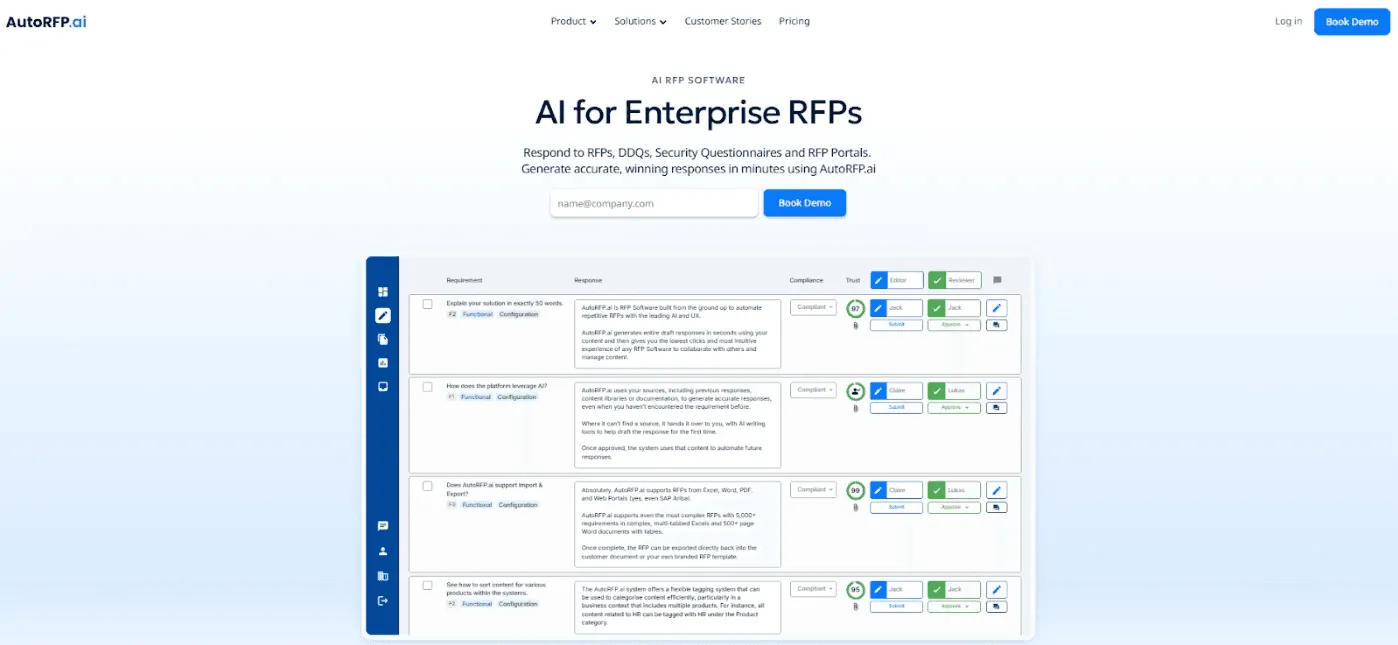
AutoRFP.ai is the accuracy-first, AI-native platform for RFPs, security questionnaires, and DDQs: every answer is written from content your team has approved, and shows the sources behind it. Tenders and portal submissions run through the same engine, with accurate first drafts generated in minutes and semantic search that understands meaning, not just keywords.
Legacy tools lean on keyword matching and copy-paste. AutoRFP.ai retrieves conceptually related content across your library, past projects, and uploaded documentation, even when the wording changes.
Trusted by teams from Fortune 500 companies to Silicon Valley unicorns, it consistently delivers 80%+ of AI-automated responses, so your team can spend more time tailoring and validating what matters.
Key Features
Here are the key AutoRFP.ai features that help your team draft faster, stay consistent, and submit stronger tenders with less manual work.
1. Import Their Tender Files and Submit In The Prospect’s Exact Format
Drop in ZIPs, PDFs, Excel, or Word docs, and AutoRFP.ai turns them into a structured project with every requirement extracted.
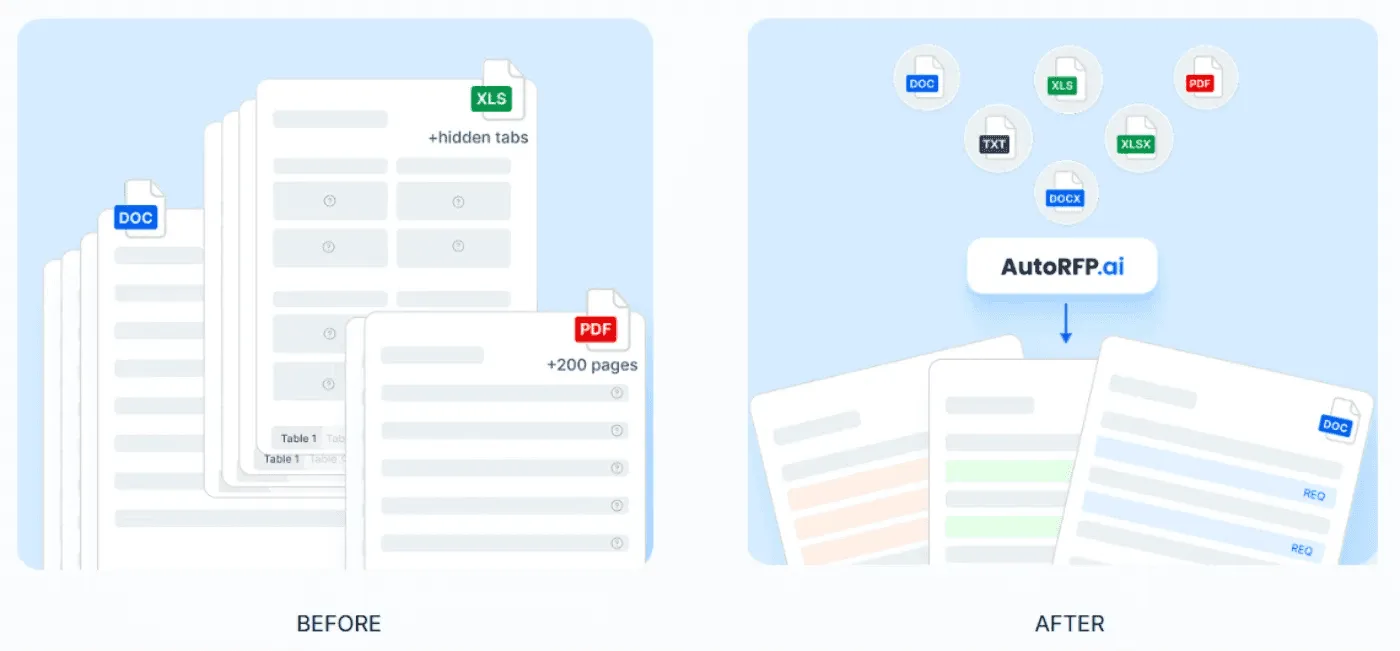
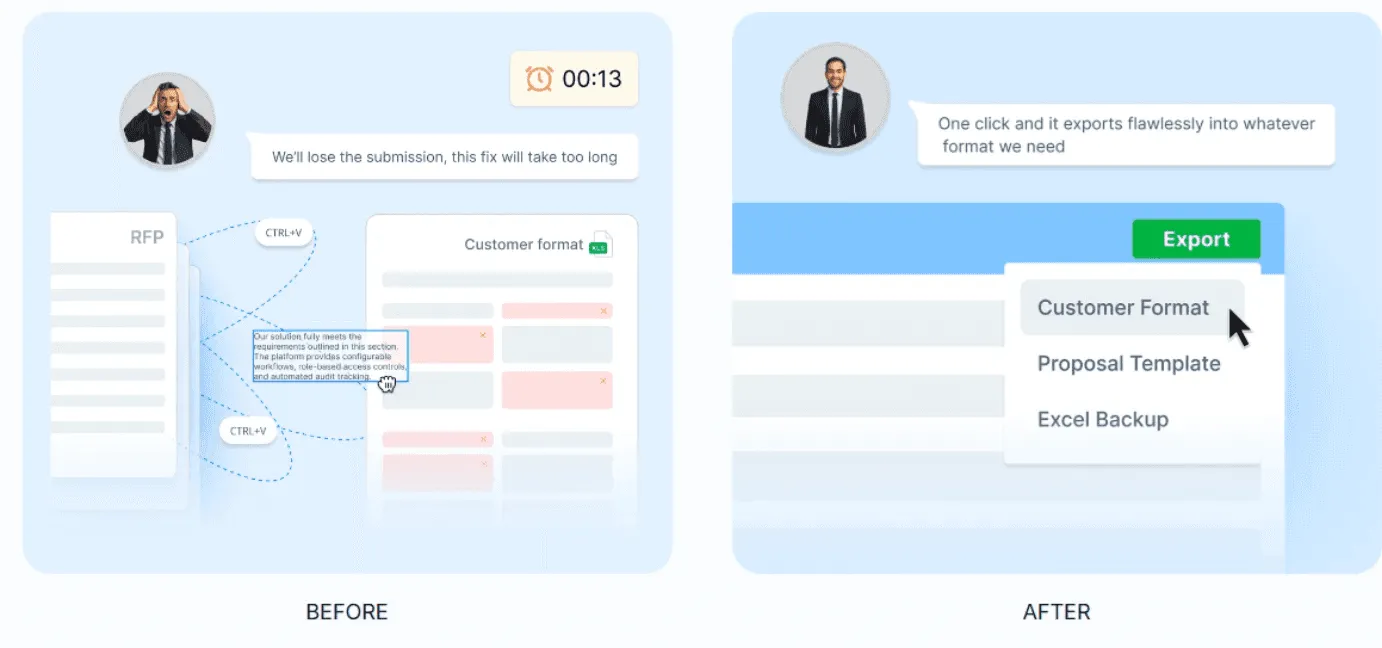
Export the finished response in the customer’s original format, including macros, dropdown validations, and custom templates. Submit with one click, without the reformatting headache. Excel and Word tenders round-trip through the issuer’s original file; PDFs are answered in the platform and export as a clean Word document.
2. Get AI-First Tender Responses In Seconds With Sources And Confidence
Generate accurate, on-brand first drafts based on your winning responses, then refine with one-click edits.
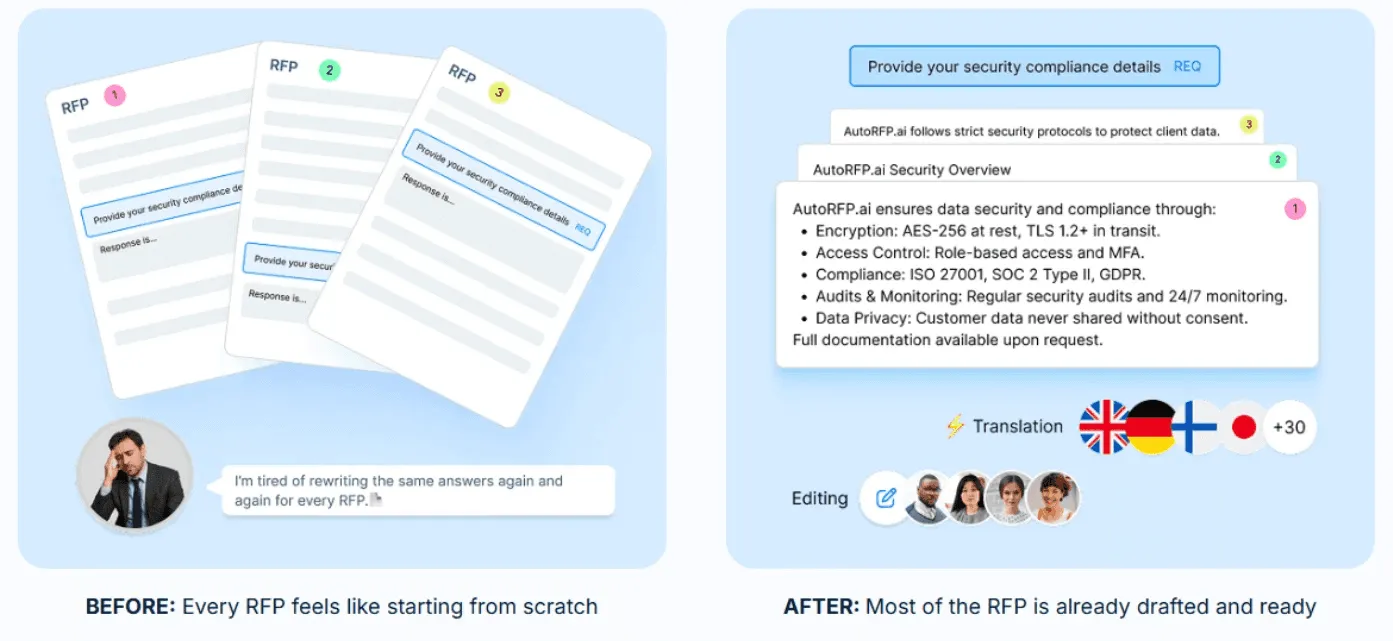
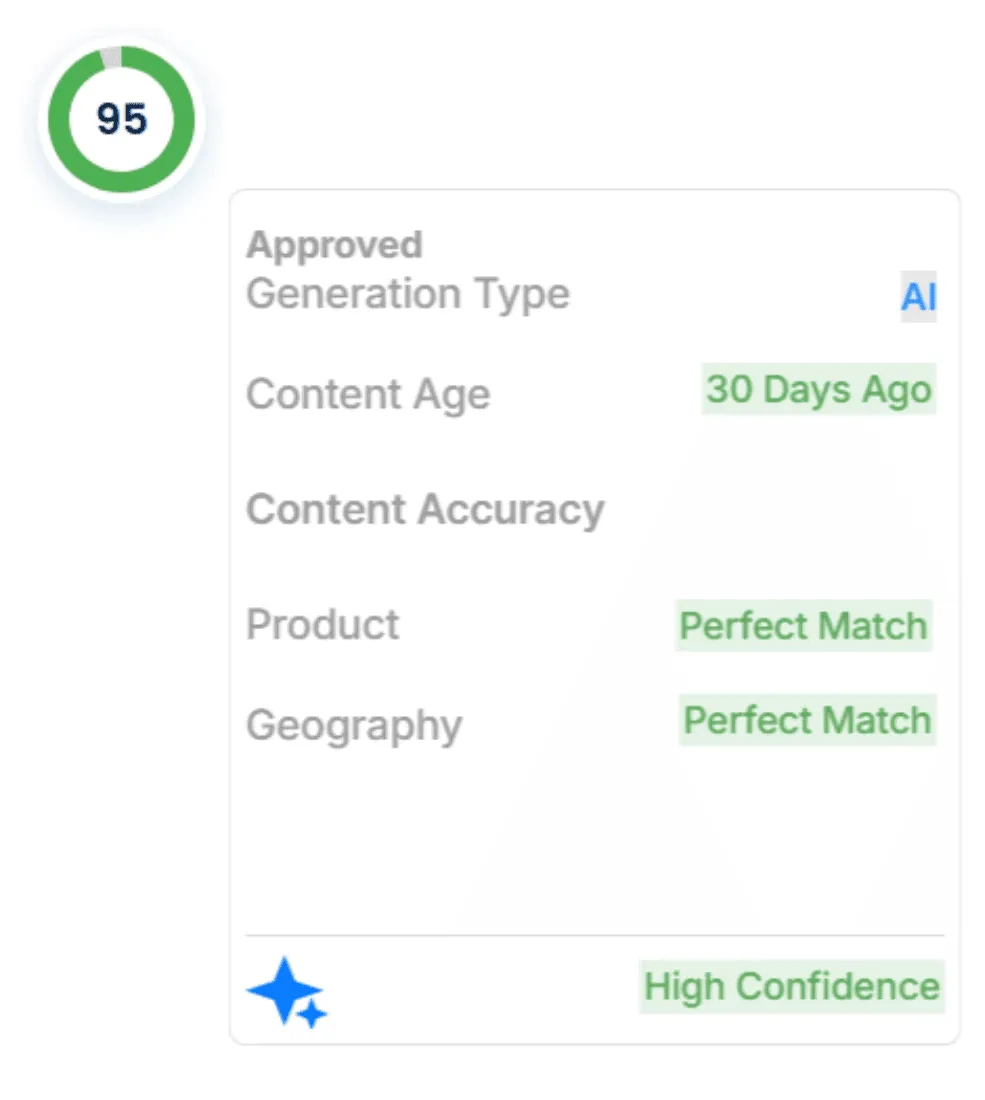
Every answer shows its sources, content age, and a confidence score, so you can verify what the AI used and why before anything reaches the customer.
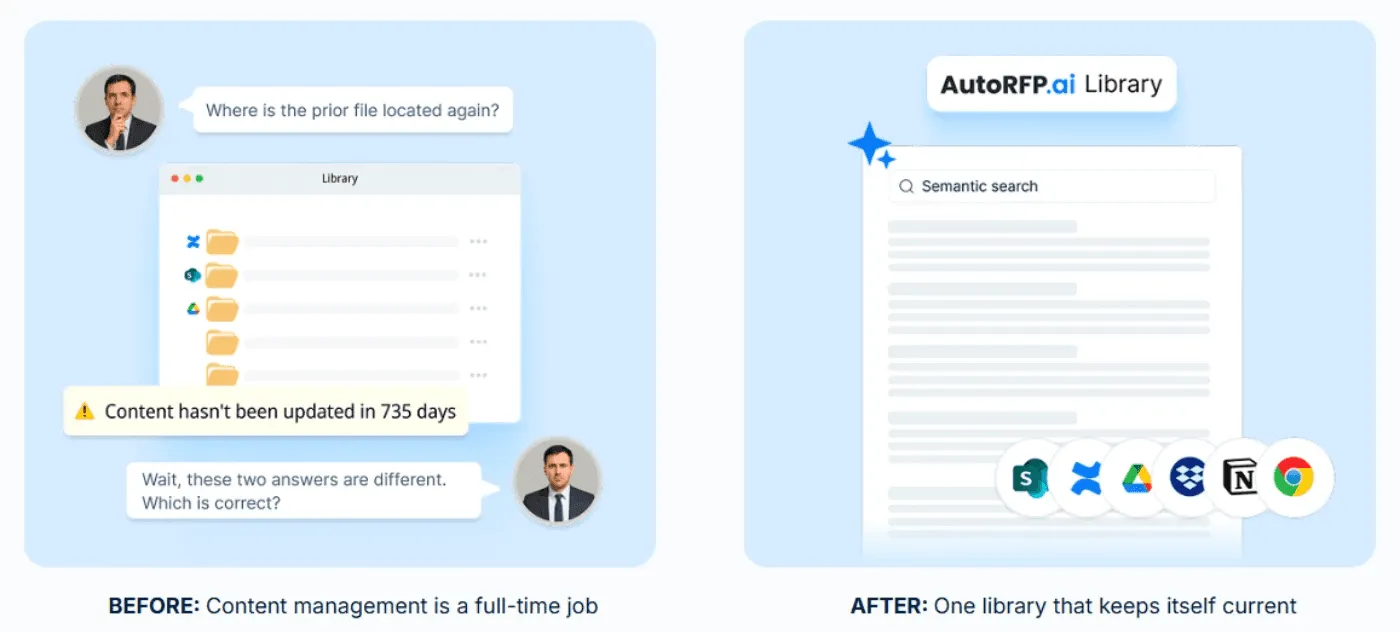
3. Smarter Reuse With Automatic Library Growth
Turn scattered files into a living response library by searching across SharePoint, Drive, Confluence, and 15+ other sources using semantic search (meaning-based retrieval).
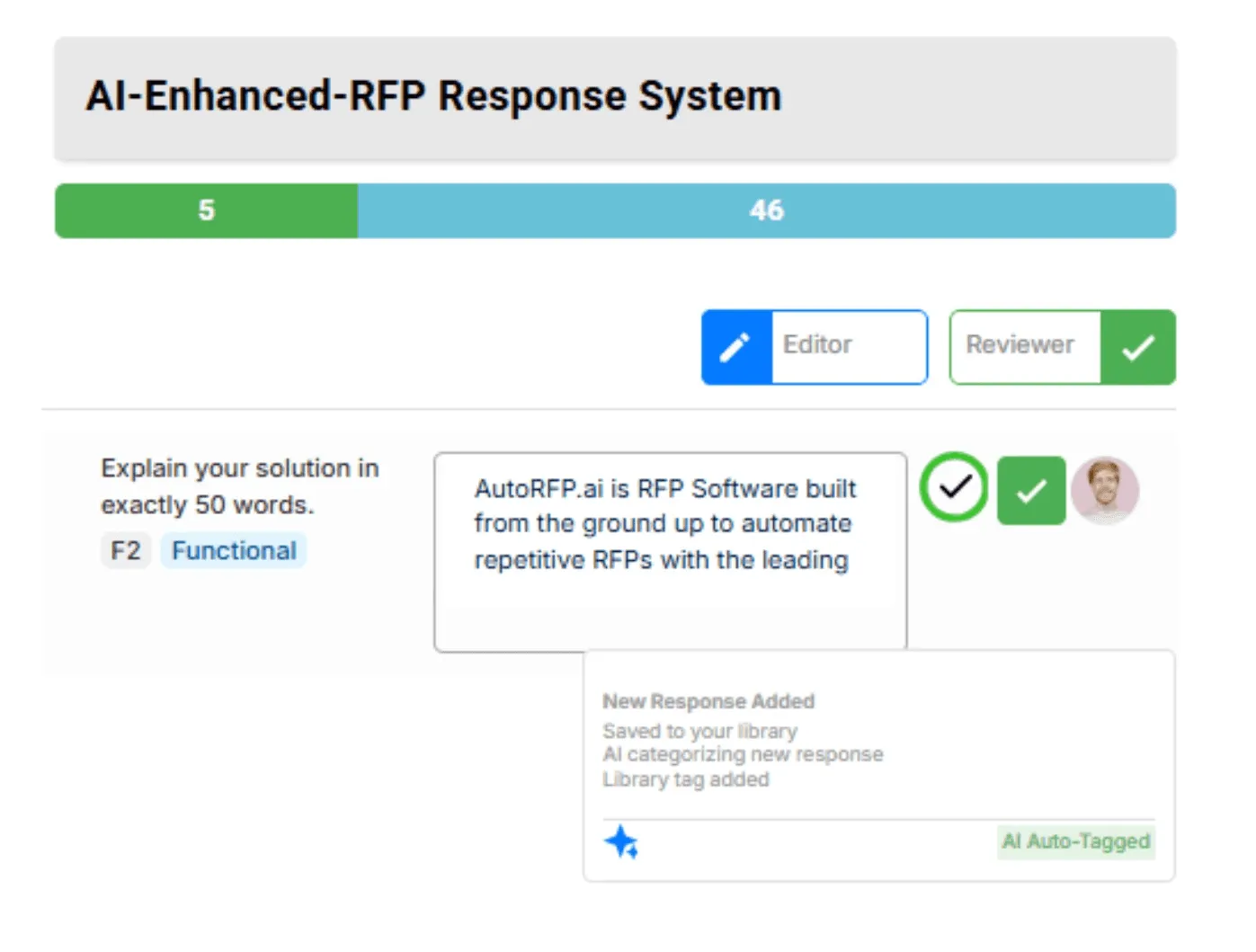
AutoRFP.ai learns from approved responses automatically: each signed-off answer files itself back into the library with its tags carried over, so reuse keeps improving with every tender and quarterly clean-up work shrinks. The estimated savings versus Loopio/Responsive (formerly RFPIO) are 60-80 hours/year.
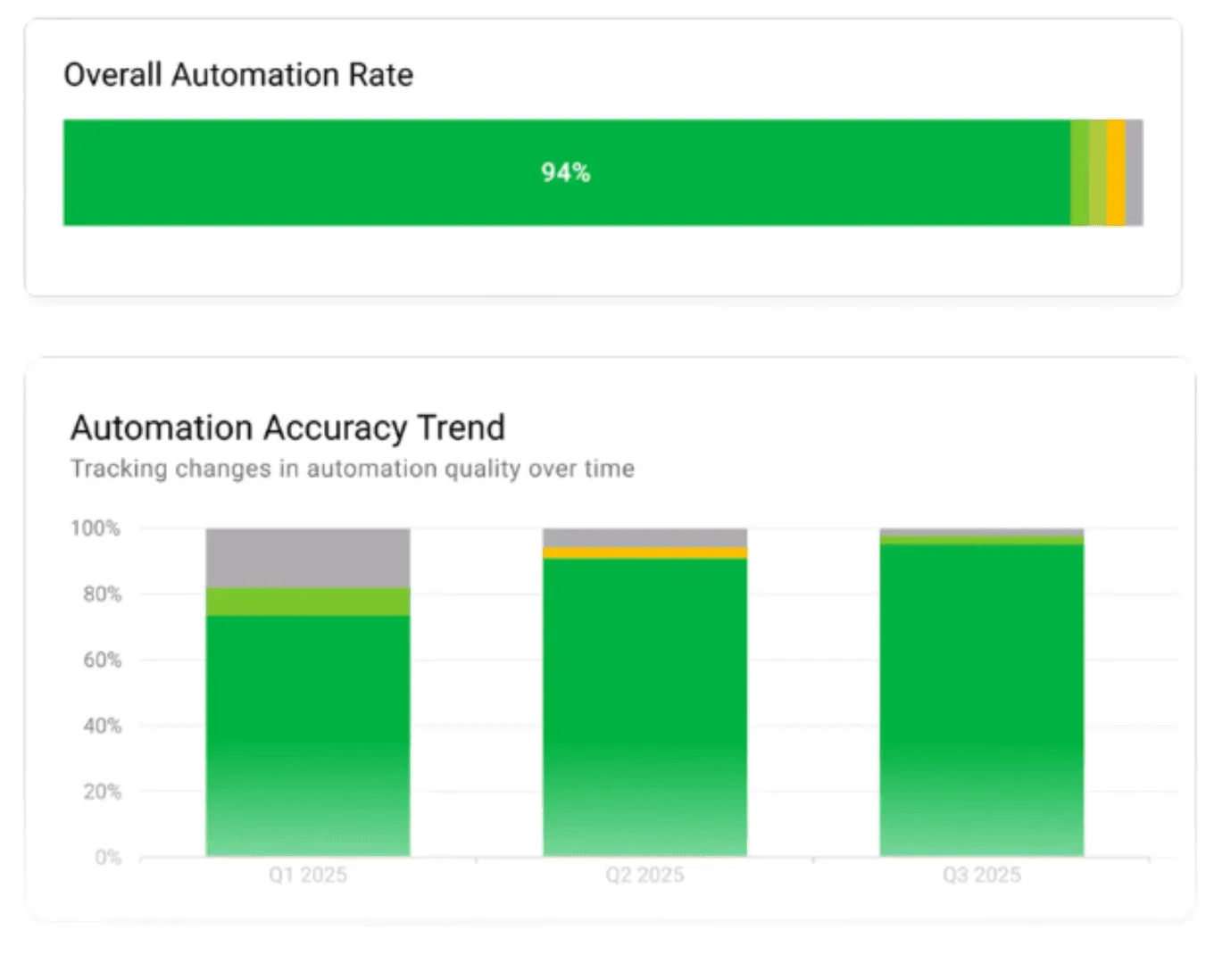
4. Prove ROI With Automation And Efficiency Reporting
AutoRFP.ai’s ROI reporting tracks automation rate, time saved, and efficiency across every project.
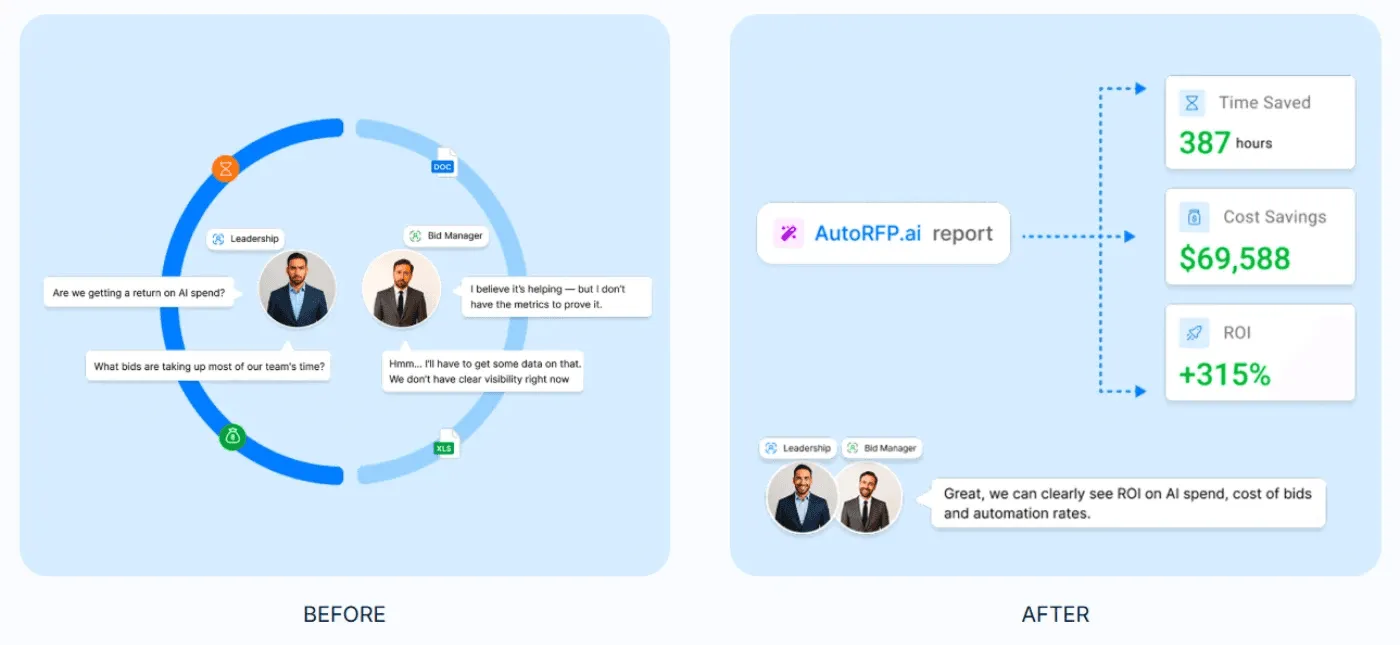
Show how AI reduces effort, increases capacity, and lowers cost per response. It makes the value clear for leadership, procurement, and scaling teams.
5. Run Tender Projects From One Dashboard
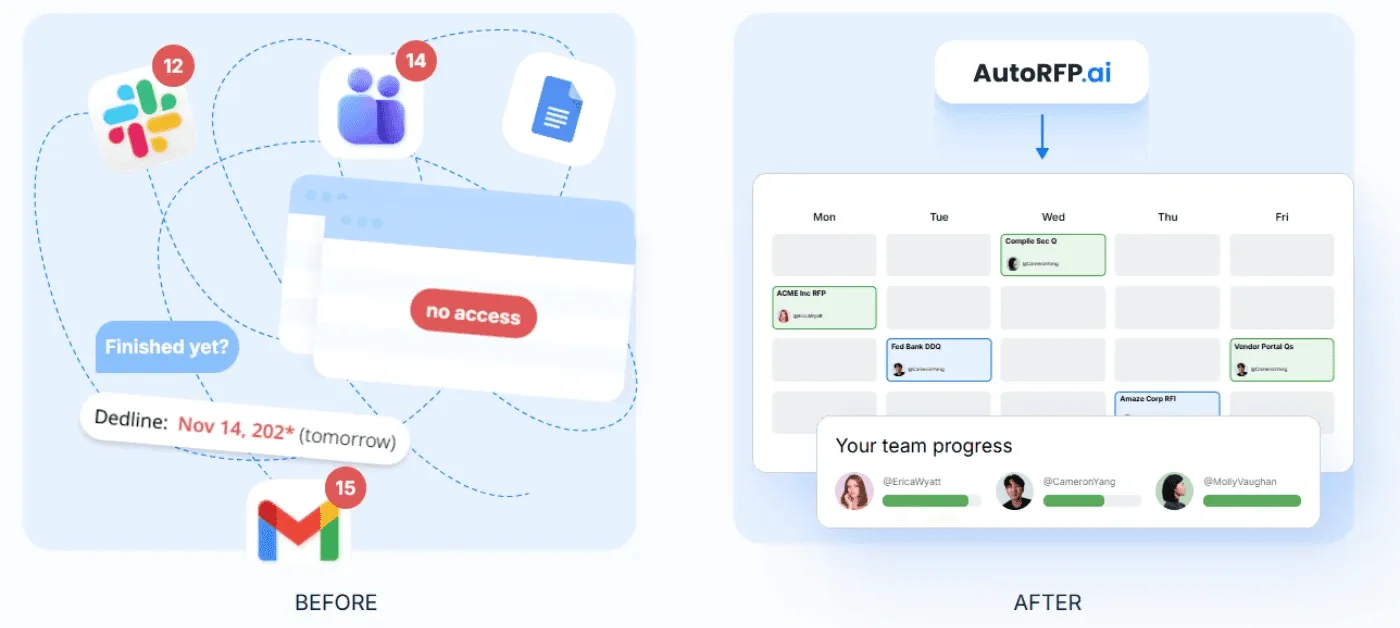
Track everything without chasing anyone. Get real-time progress across every tender, see who is stuck, send reminders, and keep SMEs accountable from one dashboard.
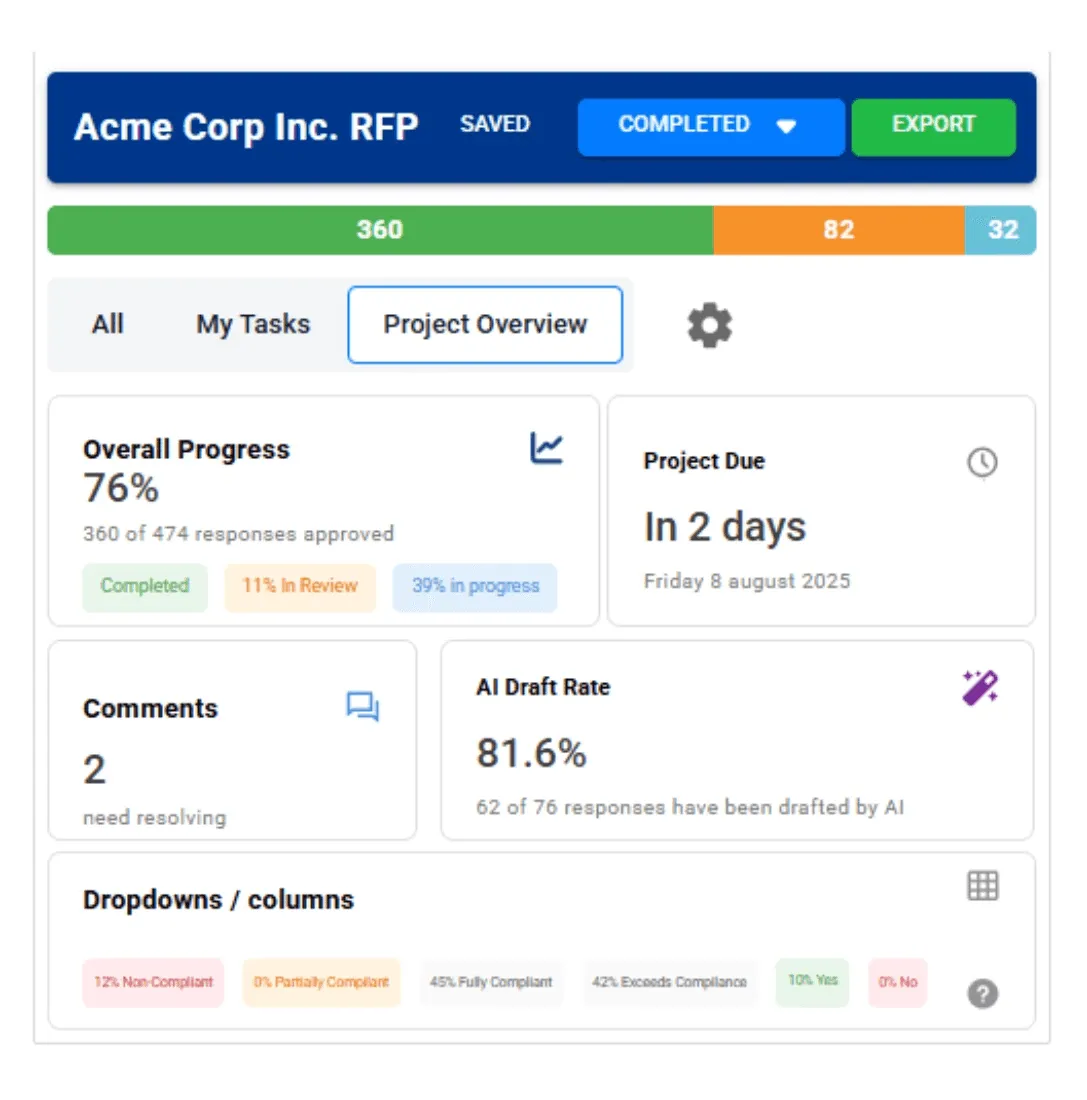
Replace spreadsheets, email chains, and daily status meetings with clear ownership and instant visibility.
Pricing
| Plan | Monthly Cost | Key Inclusions |
|---|---|---|
| Scale | $899 | Unlimited AI responses, users, content, and integrations |
| Accelerate | $1,299 | Everything in Scale, plus advanced analytics and priority support |
| Enterprise | Custom | Custom integrations, a dedicated success manager, and tailored security and compliance features with SSO |
Every AutoRFP.ai plan comes with unlimited users, a 30-day money-back guarantee, and hands-on onboarding and training, with launch possible in as little as 48 hours.
Where AutoRFP.ai Shines
Portal Agent for portal tenders: The browser extension pulls questions out of procurement portals such as SAP Ariba, UpGuard, and Jaggaer, then streams drafted answers back beside the portal, one click to copy each into its field.
Go/No-Go risk screening: Auto-check RFPs against your Go/No-Go criteria and flag deal-breakers early.
Q&A Agent: Get sourced answers in seconds inside Slack or Microsoft Teams, filtered to what the asker is allowed to see.
Broad integrations: Connect ~16 tools across SSO, CRM, file storage, comms, and knowledge bases.
Where AutoRFP.ai Falls Short
Weaker fit where every response is bespoke: AEC, US GovCon/defense, custom software development, and one-off professional-services bids rarely repeat, so there is less approved content for the AI to draw on.
Needs a base of real documentation: Early-stage startups with minimal collateral will not see strong automation rates until they have approved content to ground answers in.
Customer Reviews
On Capterra, Senior Workforce Management Consultant Saxon W. called the output “infinitely better than other systems because AutoRFP.ai understands context,” adding that “setup was painless” and the team “continues to innovate.”
Over on Reddit, a sales engineer weighing RFP tools described AutoRFP.ai as “easy to manage projects in” with a “nice enough UI” and “decent support.”
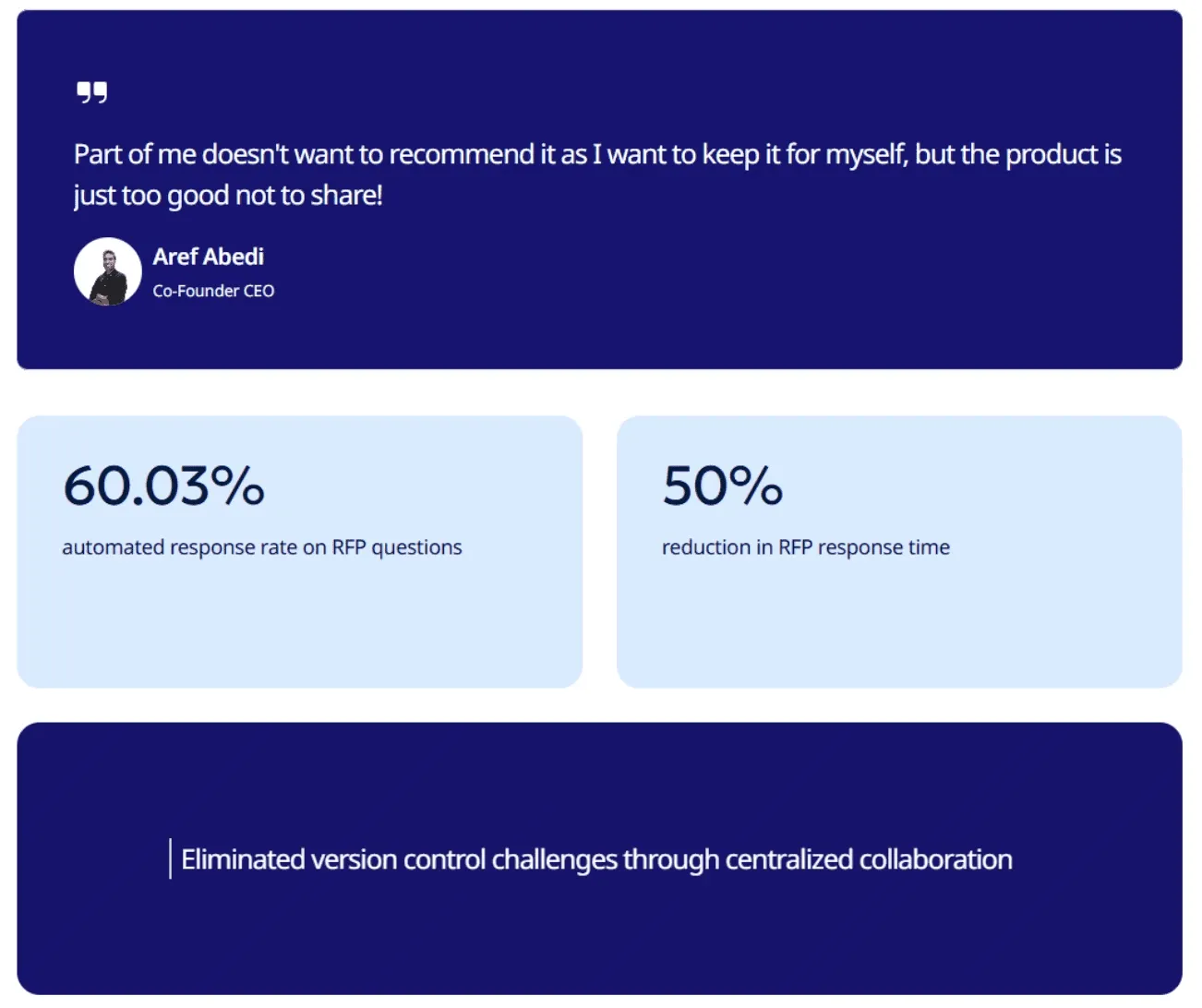
Jobylon Co-Founder and CEO Aref Abedi put it simply: “the product is just too good not to share!”
Who AutoRFP.ai Is Best For
Mid-to-large B2B teams handling 40-200 tenders a year: You need fast first drafts, clear ownership, and progress tracking to keep submissions moving on tight timelines.
Security-conscious industries: Financial services, healthcare, fintech, and cybersecurity teams managing compliance-heavy tenders that require sourced answers, strict approvals, and audit trails.


Video transcript
Transcript is auto-generated and may contain minor errors.
Hey, I'm Rob from autoRFP.ai. What is autoRFP.ai? Well, autoRFP.ai is an AI software as a service or SaaS application that does AI for proposal or RFP responses. That includes RFIs, like request for informations, includes due diligence questionnaires or DDQs, and includes security questionnaires. So, you can find all about us at autoRFP.ai. So, we're a technology company. We have offices all across the globe including Brisbane, Australia, Vancouver as well. And effectively, our tool allows, whether it be bid managers, sales people, proposal writers, RevOps team members, sales leadership, answer complicated request for proposals. So, what is a request for proposal? You can see one of our other videos below in the description. But effectively, our system
looks something like this. And it lets team members, and you can have unlimited number of people log in to autoRFP.ai, good product, allows people to go in, create projects, which would be for instance an RFP. I can go in here, create my information from my zip file, and that includes, you know, like an Excel spreadsheet, PDF, Word doc. We can run an AI go no go project analysis on the RFP. And then effectively from that, we can bring in all the information in terms of what are the questions, where our AI automatically scans the documents and figures out what is being asked of the RFP, whether it's multiple tabs in an Excel spreadsheet and everything else, whether it's drop-downs. And that all happens automatically through the power of AI. Then, we generate our response, and we can do it in in 40 plus different languages and adding languages all the time. Once you've imported your RFP into order rfp.ai,
you can collaborate with your team members assigning different people to answer the questions, review the questions, looking at an overview of the entire project and project managing due dates. Now AI effectively starts automatically answering those different questions based on your knowledge documentation. So that might be your website, your help docs, your technical documentation, your past RFP answers or security questionnaires, your security policies. But effectively all that different company information you import into order RFP and then our AI leverages that to create an AI first draft of an RFP response. Once we're happy with all those requests, we can approve it. That goes into the model to learn from and add to. So your current responses are automatically used for new responses and then you can export that as well. And then the final cool thing about order RFP is you have a lot of different
integrations that you can pull in, whether it's knowledge documentation from places like Notion, Google Drive and so on. So that's order RFP. We're an AI SaaS app. Uh you can host globally. We do not use customer data for training purposes or to send it back to LLMs. So we're secure and private. We have our ISO 2701 certificate and our SOC 2 certificate and then you can find up-to-date pricing and information on our website. Or if you came to learn more, you can book a demo and schedule time with our team. Thanks.
2. MyTender.io: Best for Managing Complex Tender Pipelines With Multiple Concurrent Opportunities
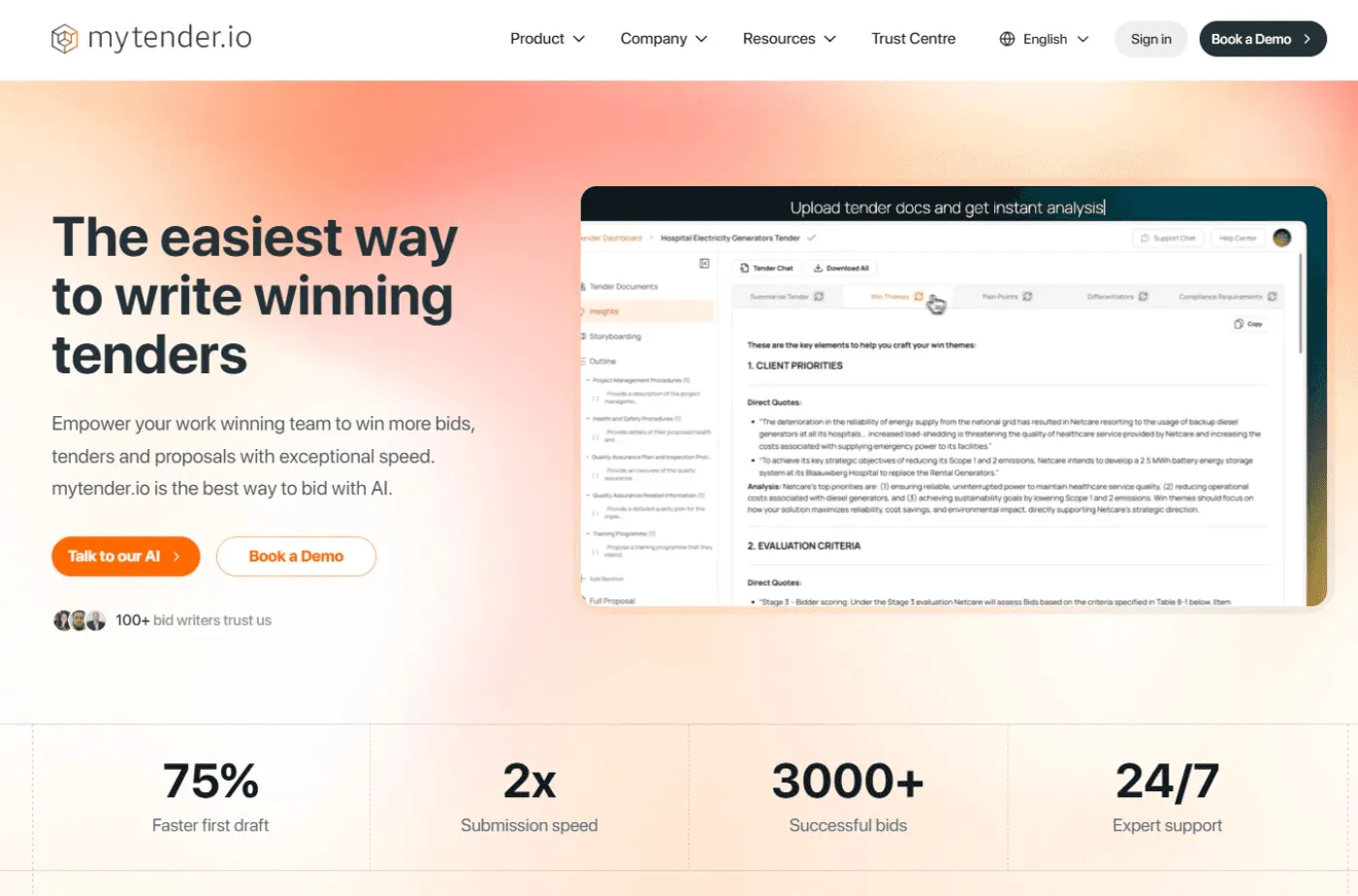
MyTender.io is an AI tender and bid-writing platform that helps teams analyze documents, extract requirements, and generate first drafts for RFPs and other tender responses.
It combines drafting, a content library, and project workflows so teams can move faster from intake to submission.
Key Features
Requirement extraction: Pull deadlines, criteria, and mandatory requirements from tender docs.
AI drafting: Generate first-pass answers and sections with an AI writing assistant.
Content library: Reuse past answers through a smart knowledge base and retrieval.
Integrations: Connect with CRMs and document systems to reduce manual copy-paste.
Pricing
- Contact them for a quote or book a demo at mytender.io.
Where MyTender.io Shines
Tender qualification: Speed up the Go/No-Go by surfacing requirements and evaluation signals early.
End-to-end workflow: Keep drafting, collaboration, and compliance checks in one place.
Where MyTender.io Falls Short
Newest platform: Limited track record and customer base versus established suites.
Enterprise proof points: Less proven in security-conscious enterprise sectors with strict compliance demands.
Project management overhead: Workflow depth can feel like extra steps for pure response drafting needs.
Library upkeep: Reuse quality depends on curated content and governance over time.
Customer Reviews
- As of now, mytender.io doesn’t have customer reviews yet on major software review platforms.
Who Is MyTender.io Best For
Bid and tender teams: Managing frequent tenders that need fast extraction plus first drafts.
Small to mid-sized teams: Wanting an AI-led tender workflow without heavy enterprise setup.
3. Tendium: Best For AI-Powered Tender Search Plus Response Workflows
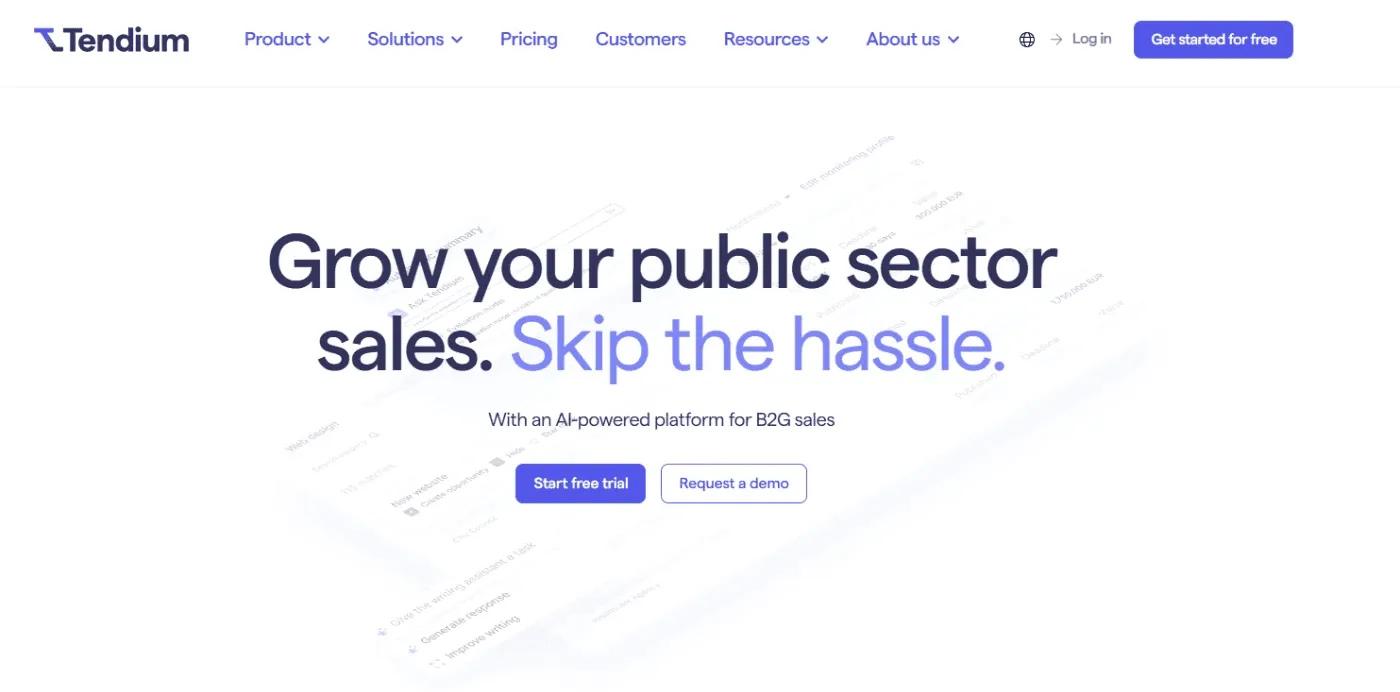
Tendium is an AI tender search and response platform designed to help teams discover public-sector opportunities, qualify them faster, and draft stronger bid responses.
This tool combines monitoring, requirement extraction, and collaboration workflows so teams can move from discovery to submission with less manual effort.
Key Features
Tender monitoring: Track new tenders and surface best-fit opportunities faster.
Qualification workflows: Summarize requirements and decide Go/No-Go with less manual reading.
AI drafting: Generate first-pass responses using your saved content and inputs.
Collaboration workspace: Assign owners, manage reviews, and track progress in one place.
Pricing
- Contact them for a tailored quote
Where Tendium Shines
Upstream discovery: Find and shortlist more relevant tenders with less time spent searching.
Early qualification: Pull key requirements quickly to avoid wasting effort on poor-fit bids.
Where Tendium Falls Short
Public-sector focus: May not suit commercial B2B workflows that start in CRM and sales-led pipelines.
Geographic coverage: Limited coverage outside Tendium’s core markets can reduce value for global teams.
Newer platform: Smaller customer base and shorter track record than legacy bid suites.
Customer Reviews
- As of now, Tendium has no customer reviews published on major review sites
Where Tendium Is Best For
Public-sector bid teams: Managing frequent tenders and needing faster discovery plus qualification.
Lean proposal teams: Wanting monitoring and response workflows in one tool.
4. GovDash: Best For US Federal Tenders And Compliance
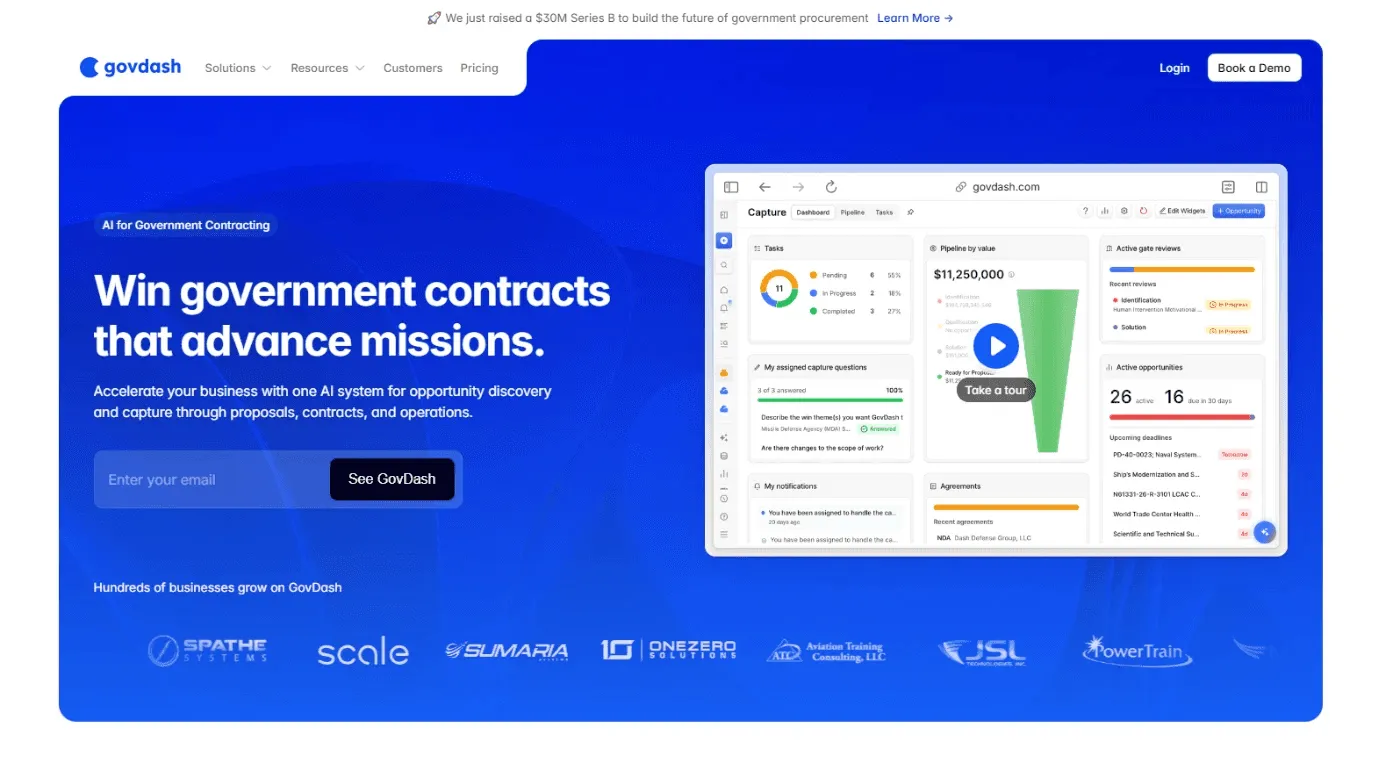
GovDash is an AI platform purpose-built for US federal contractors, covering opportunity discovery, capture, proposal development, and post-award workflows in one system.
It’s strongest when you need long-form proposal drafting plus compliance-style structuring for federal solicitations.
Key Features
Opportunity discovery: Identify and track federal opportunities in one pipeline.
Capture workflows: Organize pursuits, stakeholders, and key info before writing starts.
RFP shredding and compliance: Extract requirements and build matrices to guide responses.
Proposal drafting: Generate structured drafts using your documents and past performance inputs.
Pricing
- Contact them for a tailored quote
Where GovDash Shines
Federal-first workflow: Aligns well with the US government solicitation structure and compliance needs.
End-to-end coverage: Connects discovery, capture, proposals, and contracts in one platform.
Where GovDash Falls Short
US federal market only: Coverage is centered on federal contracting workflows.
Cost for non-federal teams: Can feel expensive if you are not primarily selling to the US government.
Overkill for commercial bids: Commercial tenders may not need capture-to-contract depth.
International fit: Limited value if your tenders are outside core US government processes.
Long-form bias: Built for narrative proposals, not short requirement-only tender replies.
Customer Reviews
A user mentioned in a Reddit thread on pipeline management tools that, “I can’t speak to GovDash’s UI or user experience, but their engineers and VPs are amazing people who will tailor pricing to your company size.”
In a Reddit discussion, a user shared, “I just got the demo from GovDash, and it looked good, but it’s a bit expensive for my needs right now.”
Where GovDash Is Best For
US federal contractors: Managing frequent solicitations that require structured, compliance-led proposals.
Lean proposal teams: Increasing bid throughput without adding headcount across discovery and drafting.
Capture-led organizations: Running disciplined capture workflows before proposal writing begins.
5. UseRogue: Best For US Federal Long-Form Proposals
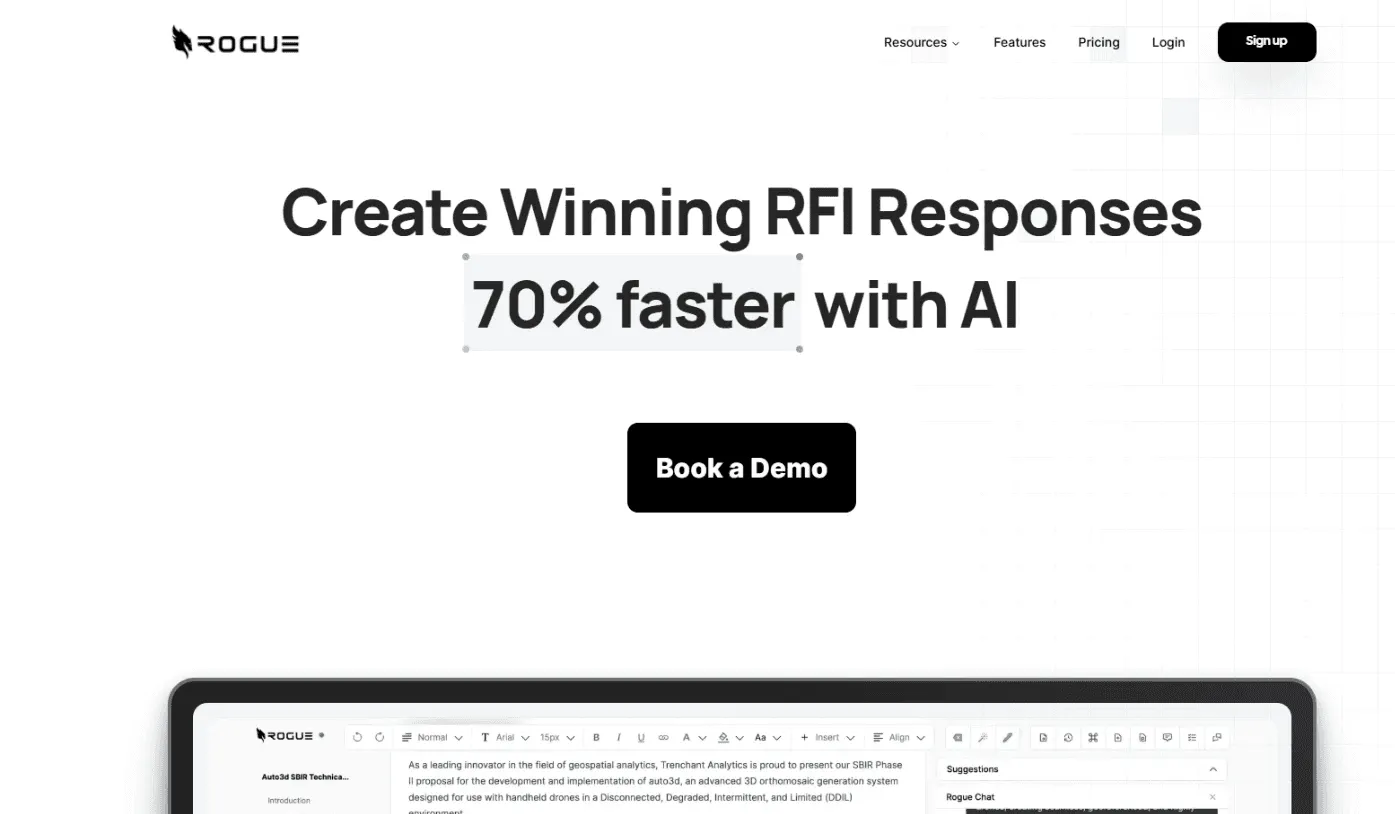
Built specifically for GovCon, UseRogue is an AI proposal-writing platform that helps teams respond faster to Sources Sought, RFIs, and RFPs with GovCon-focused drafting tools.
Core workflows like RFP Writer, Instant Pink Team Draft, and Compliance Matrix Generator help turn large solicitations into structured drafts and compliance-ready outlines.
Key Features
AI RFP Writer: Generate a structured proposal document from a title, description, and template.
Compliance matrix generator: Extract requirements and organize them into a compliance matrix in minutes.
Instant Pink Team Draft: Pull existing document context to produce a fast first draft.
Smart Bar editing: Edit and rewrite sections without prompt engineering using guided actions.
Pricing
| Plan | Monthly Cost |
|---|---|
| Solo | $600/month |
| Starter | $750/month |
| Professional | $1850/month |
| Enterprise | Contact sales |
Where UseRogue Shines
GovCon-specific drafting: Stay focused on RFP-style writing instead of generic AI outputs.
Compliance structure: Turn long RFPs into actionable requirements and response plans quickly.
Where UseRogue Falls Short
GovCon-first focus: Fit can be weaker for commercial B2B proposals that do not follow federal formats.
Learning curve: Feature breadth can take time to learn, especially for new users.
Output depends on inputs: Draft quality improves when your uploaded past proposals and source content are clean and up to date.
Limited third-party depth: Most detailed feature explanations come from Rogue’s own materials, not independent evaluations.
Customer Reviews
- As of now, UseRogue has no customer reviews published on major review sites
Where UseRogue Is Best For
- GovCon proposal teams: Managing frequent federal-style responses and needing faster first drafts.
6. Altura: Best for Companies With Mature Bid/No-Bid Processes
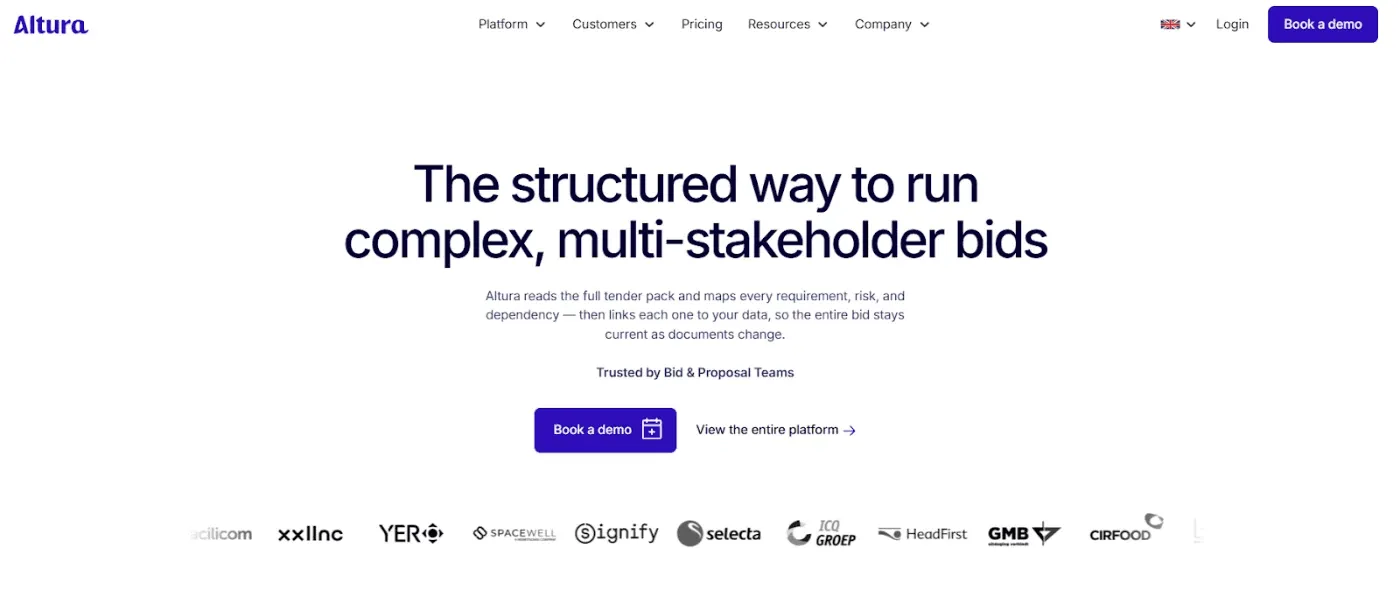
Designed as a bid-team workspace, Altura turns tender packs into structured requirements your team can assign, answer, and track in one place. The core value is cutting the “admin grind” of scanning, sorting, and reusing old proposal text so teams can spend more time on bid strategy.
Key Features
Tender analysis: Extract key requirements, criteria, and constraints from tender documents.
AI drafting support: Generate and improve text using AI tools and past proposal content.
Content library and search: Find reusable proposal text fast through a centralized content base.
Pricing
| Plan | Monthly Cost |
|---|---|
| Starter | Request a quote |
| Professional | Request a quote |
| Advanced | Request a quote |
Where Altura Shines
Qualification speed: Surface what matters early so teams bid on better-fit tenders.
End-to-end bid workflow: Keep qualification, drafting, and collaboration in one workspace.
Where Altura Falls Short
Pricing transparency: Quote-based pricing can slow down quick comparisons.
Setup effort: Guided setup may feel heavy for teams wanting instant self-serve onboarding.
Library upkeep: Reuse improves only when content is curated and maintained over time.
Smaller market presence: Some comparisons note a smaller footprint than well-funded enterprise competitors.
Customer Reviews
- As of now, Altura has no customer reviews published on major review sites
Where Altura Is Best For
- Bid and tender teams: Running multiple tenders that need faster qualification, plus structured drafting.
7. BidScript: Best for Companies Handling Domestic Tenders Across Public and Private Sectors With a Focus on Procurement Compliance
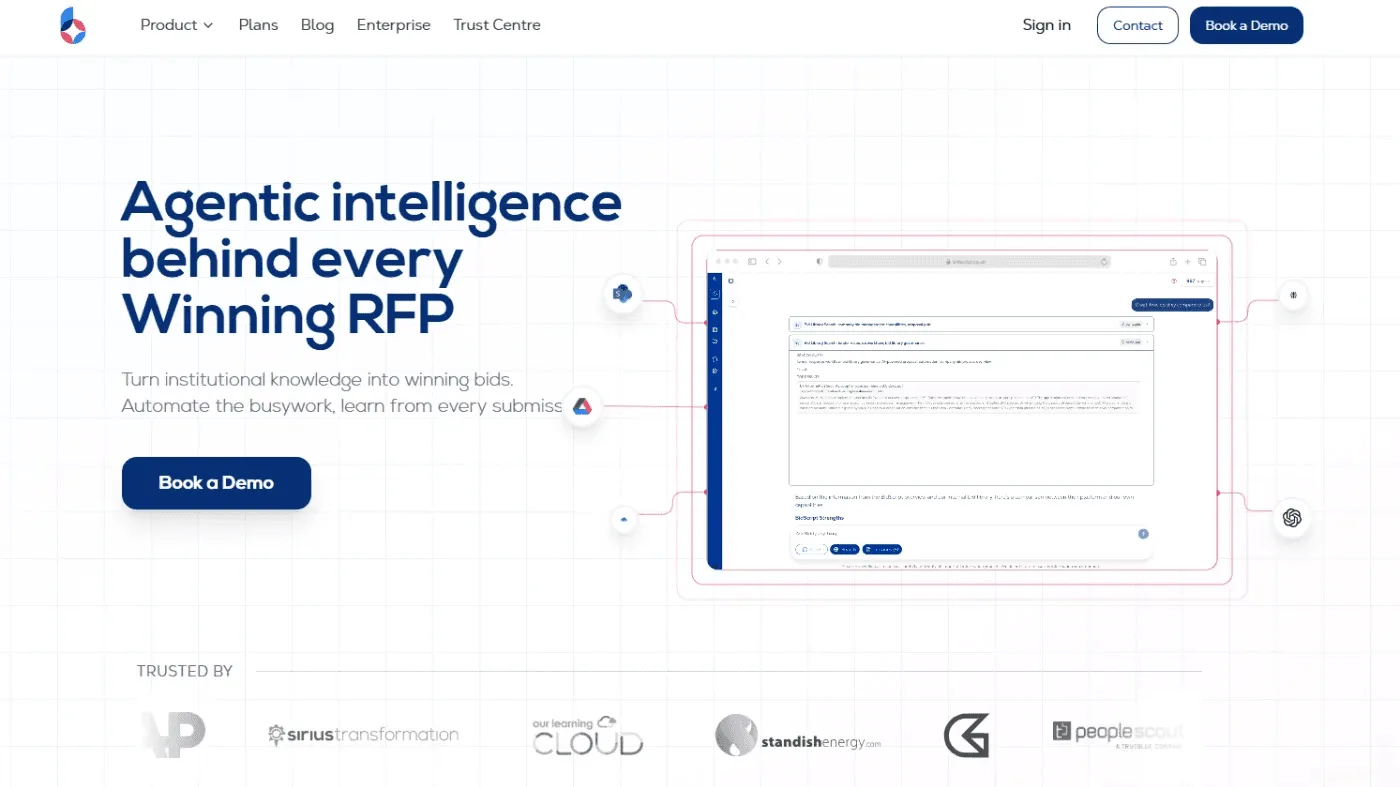
BidScript is a full-lifecycle bid management platform that covers the path from tender discovery to submission, including analysis, Go/No-Go, drafting, and collaboration. An agent-style assistant (“Biddy”) supports requirement extraction, sourcing, and draft generation inside the same workflow
Key Features
Agentic tender search: Find, filter, and recommend tenders based on fit signals.
Go/No-Go analysis: Extract requirements with sources to support bid decisions.
AI draft generation: Generate grounded drafts using your Bid Library and Q&A content.
Project workflow: Manage tasks, collaboration, and submission steps in one place.
Pricing
| Plan | Monthly Cost |
|---|---|
| Lite | Contact sales or book a demo |
| Business | Contact sales or book a demo |
| Enterprise | Contact sales or book a demo |
Where BidScript Shines
Upstream-to-submission flow: Connect discovery, qualification, drafting, and collaboration in one system.
Structured bidding decisions: Make Go/No-Go faster with sourced requirement extraction.
Where BidScript Falls Short
Newer platform: Founded in 2023, so the enterprise track record can be thinner than legacy suites.
Credit-based limits on lower tiers: Some plans use project credits and document caps, which can constrain higher-volume teams.
Integration clarity: Integrations are positioned as broad, but specifics often require a demo to confirm exact connectors and depth.
Library quality dependency: Drafting is grounded in your Bid Library and Q&A store, so results improve only when content is curated and current.
Customer Reviews
One user mentioned in a Reddit discussion, “Use BidScript. Great project management and tracking tools. They are also integrating a portal to search for jobs.”
In another Reddit thread, a user shared, “I am part of a team of four, and we pay for BidScript. There have been a few problems, but we mainly use it for the bid library features, as it can retrieve information for drafts quickly and accurately. It does miss sometimes, but that’s to be expected from AI.”
Where BidScript Is Best For
Bid and tender teams: Managing regular tenders that benefit from discovery, qualification, and drafting in one workflow.
SME-heavy responses: Coordinating contributors with a clear structure from requirements to draft completion.
To make shortlisting easier, this video explains the top tender platforms and where they shine.


Video transcript
Transcript is auto-generated and may contain minor errors.
Do you do tenders? Then this video is for you. And you'll want to wait till the end because I'm going to share something pretty awesome about changing your tender approach and leveraging the latest in AI. In this video, we're going to cover off some of the best tender response software in the market. Let's jump into it. So, where we've gone to is a bid manager community called Stargazy or stargazy.io. They look at all kinds of proposal tech to really understand what's available in the market, and you can join that community and take part in it and talk to hundreds of other kind of tender and bid professionals across the globe and how they answer tenders and RFPs. So, let's look at the first one, Tendium. They are one of the newer AI-native
tender response software in the market. Really, they're all about growing your public sector sales. The first part of when you're doing a tender is finding and sourcing those tenders. You might be already subscribed to a bunch of tender databases, notifications from all kind of different counties and local government principalities in the UK and elsewhere, all your kind of different tender notifications for your business. And the categories are confusing and you just get overwhelmed with what's there because you get these emails every single day and you have to sift through it. That's where software like Tendium and other kind of tender aggregators can help you find the right opportunities. Then you can leverage AI to help respond to those tenders and you read more about them. There isn't too much about their product on their website, but I'm sure you can get in contact with their team and then sign up for a free trial. Next, we have GovDash. Now, I've included GovDash, even though they're
much more suited for US federal or US sled government tenders. GovDash, if you are doing US federal or US sled government tenders, this is the software for you. So, they also help you use different capture programs and source those proposals and contracts. They're really well suited for your long-form tender response, where you might get 100-page PDFs and you have to provide a very persuasive narrative response for the tender. You can find out more information on their website or the different integrations they have. You can book in for a demo and understand more about their product at govdash.com. Next, for our tender response software, we have Use Rogue. Similar to GovDash, really well suited for US federal tenders and sled, but they can also be used across any long-form narrative
tender. You generally will have three different types of tenders. That is your long-form narrative response, short-form response, and your tender portals. Your long-form tender response, what that looks like, and you will know if you receive these because you're writing in response to the tender tens of thousands of words in Word doc and PDFs. It's very much a narrative about your business, about your product and services, and how that will meet the requirements in the tender. Now, that's long-form. So, your providers like Use Rogue, GovDash, Tendium, and a quite a few of these providers are really well suited for long-form response. Using those software will feel like using Google Docs or Word Doc, where effectively you're in a document editor writing a response and leveraging AI to help you
write that response. Then you also have a short-form tender response. You might also get in Word Doc, Excel, PDF. Usually there's more requirements, so they might get into the hundreds of thousands of requirements. They're asking shorter questions, and they expect a shorter response. Usually the response might be five sentences max. Your short-form tender response often is in Excel, can be in a Word document with tables throughout. And then finally you have your tender portals, where you're answering every single question in that portal. Use Roq. They're really great for your long-form tender responses that might come in an RFP, an RFI, a tender. And as you can see, it's more of that Google Doc style editor, except that you can leverage AI. It has all your organizational context, so your past tender responses to leverage that with AI to then answer the tender. Has AI assistance to really help you provide that. Really interesting is
their non-compliance feature, where effectively can go back to the compliance or evaluation criteria that you often will see in a tender, and then flag any inconsistencies or anything where you're not meeting those compliance matrices that you received from the tender. If you want to find out more information about Use Roq, you can definitely go to useroq.com, sign up, or book in a demo. There's more information on their website. Next we have Altura. Altura are a AI native tender response software, where effectively it has some really strong go no go features, where you can upload the tender requirements and it can analyze them to see if you will even match that tender based off your organizational context. It has a database of all your previous tender responses and everything about your organization to help answer that tender. There's more information about Altura on their website. You can book in for a demo and another kind of like a
long-form tender response editor. Then you have BidScript. BidScript, newer player into the market, free trial you can get started with by going into their website and have a look at their product, bidscript.co.uk. Very much built for the UK tender market. It has your bid library where you can pull in uh all your past winning RFPs and tenders. Uh it has your go no go uh decision matrices as well, so it can help with deciding whether you want to go ahead and proceed with a tender or not. Especially useful in the UK when you see public tenders and you want to make a quick decision on whether to start bidding on that tender or not. Then it also has other features like sourcing and analyzing those tenders. So similar to GovDash, which had sourcing for US FedCon, BidScript can help you with sourcing UK tenders. And that's really powerful to have the sourcing and the response in
the same platform. Again, really useful for your kind of long-form narrative style responses, pre-bid intelligence to understand more about the tender and their buyer before you get into it. You can find out more at bidscript.co.uk. Then you have mytender.io. Definitely probably the newest entrance into the tender response software market. Again, AI-native tender software. You can go to their website and have a go at their software or book in a demo just to understand more about them. But effectively, like a lot of the other software, it really helps you with the tender response. So, it you can upload a document, whether that's a PDF, Word doc, and then it can start summarizing that tender and answering it for you based off your organizational context. I think what's cool with them is you can really understand more of that project management angle with regards to your tenders. So, it really helps with managing your pipeline of different responses as you progress through.
Then, for our last one, we have auto rfp.ai. That's actually where I'm from. So, I'm brought from auto rfp.ai. Different to the others, where we're really powerful is in your short-form tender response. So, if you receive a lot of tenders in Excel spreadsheets, in Word doc, and PDF with tables, and it's less about a narrative over tens of thousands of words and more about answering questions about your product or services, what is your encryption for data in transit or at rest, those hundreds of questions, that's where rfp.ai shines. An Australian company with offices all across the globe, including Australia, Vancouver in Canada, and Sweden in Europe. Our strongest features is to do with our ability to import anything, whether that's an Excel spreadsheet, Word doc, PDF, and our AI OCR processor automatically scans the document and
finds every single requirement, response cell, everything that you need to effectively respond to in that tender and gathers the context of that tender without you having to really do anything. Then, you've got our browser extension, which I mentioned. If you are answering in tender portals, where you actually have to answer questions, that's what our browser extension is built for, effectively allowing you to quickly ingest and respond to any tender portal questionnaires. So, once you have your document in order, our AI response workflow then uses the context about your company. So, you would upload past RFPs, past tenders, your documentation, your internal docs, anything you have about your company that you can use in your tender response. You would upload that to Auto RFP. Then our semantic search, which effectively is an LLM searching across your context, finds the most relevant information to then use to generate that
new response. What's AutoRFP.ai's unique proposition is around the transparency and understanding exactly where that response came from. We call this our trust score. And you can effectively source down to exactly what response was used to generate that response. And it's just AI you can trust. Then there's a lot more about our collaboration features in relation to workflows to assign different SMEs and different team members to answer the tender and so on. And AutoRFP, our pricing model, unlimited contributors, so you can have as many team members log in as well. Now, if you want to find out more about AutoRFP.ai, you can book in for a demo to chat to our team and find out more there. I mentioned at the start of the video to watch the end for something really exciting. So, we've spoken a little bit about tender search and aggregating and understanding your tenders. What if AI
could help look at all available and public tenders and find the most relevant ones for your company? You can get started with that with AutoRFP's tender search, and you can use it for free. Enter your email, and within 24 hours our AI would have scraped and looked at every relevant tender in the globe for your company. So, get started at auto rfp.ai, search tender opportunities, or you can find it in our footer. Thanks. See you.
How Tender Management Software Improves Efficiency for Enterprise B2B Teams
Here’s how tender management software improves efficiency for enterprise B2B teams.
| Efficiency gain | How it improves efficiency |
|---|---|
| Faster assembly | Automation surfaces searchable, governed content right at draft time. By implementing sales enablement automation, teams spend less time hunting, copying, and stitching files together and more time on strategy |
| Less manual load, more capacity | When automation is part of the operating model, it reduces repetitive work, reinforces consistency, and frees time for higher-value work like insights and narrative shaping. |
| Higher reuse (real behavior change) | Once libraries are automated and easy to access, teams reuse approved answers more often, reducing rework and preventing version drift. |
| Increased scalability | Teams can handle a higher volume of tenders without needing headcount to grow at the same pace. |
| Higher win rates | With less admin burden, teams can tailor responses more strategically and validate claims faster. AI tooling is common in stronger workflows too: 65% of high-win team uses AI proposal tech. |
| Improved supplier relationships | Centralized records, clearer communication, and more consistent evaluation help build stronger long-term vendor partnerships. |
How to Use AI in Tender Management
AI earns its keep in the stages that repeat from tender to tender. A workable sequence:
Qualify before you commit. Screen each incoming tender against your own go/no-go checklist rather than a canned one. AutoRFP.ai answers uploaded tenders against your criteria automatically, each answer tied to a source file with a confidence badge, so deal-breakers surface before anyone starts writing.
Extract the requirements. Turn the tender pack into a structured list of questions, deadlines, and mandatory items instead of reading for them manually.
Draft from approved content. First-pass answers should come from material your team has signed off, with the sources attached; web research belongs behind an explicit, clearly labeled opt-in.
Review by exception. Send experts to the weakest drafts first instead of reading everything top to bottom. This is where a per-answer confidence signal matters: sorting by AutoRFP.ai’s Trust Score puts the drafts the AI was least sure about at the front of the review queue.
Export and measure. Return the issuer’s file with answers in place, then track how much your team edited before submitting: the closer to zero, the more of the workload the AI is genuinely carrying.
Bid strategy, pricing, and final sign-off stay with people. The AI’s job is to make their review time count.
Manual vs AI-Automated Library Management
The table below compares manual-first and AI-automated approaches to the same library workflows.
| Category | Manual-first library approach | AI-automated library approach |
|---|---|---|
| Content library | People add and maintain reusable answers | Existing libraries import with their categories and metadata, then approved work feeds future answers |
| Organization | Content owners organize tags, folders, and updates | AI assists with tagging and filing while content owners retain control |
| Freshness | Scheduled reviews and re-imports keep content current | Connected-source updates and approved-answer capture reduce repetitive refresh work |
| Setup time | Teams build or migrate the library before broad reuse | Teams bring their existing library and can start with the highest-value content |
| Content discovery | Search quality depends heavily on keywords and categorization | Meaning-based retrieval searches the library, past projects, and documentation |
| Improvement over time | People add new approved answers and update existing entries | Approved responses become available for reuse automatically, with review controls |
| Maintenance burden | Content managers handle filing, audits, and updates | Automation reduces routine upkeep while owners keep approval, editing, and review decisions |
Tender Software That Integrates With Existing Content Libraries
The best tender software integrates with the content libraries your team already maintains instead of asking you to rebuild them inside a new tool. Two questions separate the platforms:
Does it sync, or does it copy? Tools built around a static repository need someone to re-import content every time it changes. AutoRFP.ai connects SharePoint, Google Drive, OneDrive, Box, Confluence, and Notion as live knowledge sources, re-syncs them daily, and names the source system behind each answer, so the spec your engineers updated last week is what the next tender draws on.
What happens to your old library? Moving off Loopio, Responsive, or Qvidian does not mean re-keying: their library exports are detected on upload and come in with categories, metadata, and answers intact.
A dedicated content manager with a well-governed answer library is also a strong fit for AutoRFP.ai: existing categories and metadata come across on import, while automatic capture and connected-source updates reduce repetitive work without removing ownership or review. Loopio and Responsive remain credible choices for their mature library workflows, and teams that live inside Microsoft 365 sometimes prefer QorusDocs, which works natively in Word, PowerPoint, and Teams.
Responding to Government and Enterprise Tenders: What to Look For
Start by separating the two sides of the exchange. SAP Ariba, Coupa, Jaggaer, and Bonfire are buyer-side sourcing suites: procurement teams use them to issue tenders and score the bids that come back. A team responding to government and enterprise tenders needs a response-side platform, and that shortlist is judged on different things:
Compliance you can evidence. Government evaluators and enterprise security teams expect proof. AutoRFP.ai is ISO 27001 certified and SOC 2 Type II audited (reports are downloadable from its Trust Center), so a security reviewer can clear it quickly instead of running a bespoke review, and every drafted answer keeps its sources attached for the audit file.
Governance that survives review. Sequential approvals, role-based permissions, and version history keep a multi-reviewer government bid defensible when an evaluator asks who signed off on what.
Portal handling. Many public and enterprise tenders arrive through procurement portals rather than email. AutoRFP.ai’s Portal Agent pulls the questions straight out of portals like SAP Ariba so nothing gets retyped.
Language coverage. Multi-market teams can draft and review in their working language while the finished tender exports in the document’s language, across 44+ languages.
The honest lanes still apply: for US federal work, GovDash covers capture-to-contract workflows that response-side platforms do not attempt, AutogenAI’s long-form prose craft is the stronger pick when a bid is won on persuasive narrative writing (see AutogenAI commercial terms before you budget), and Tendium pairs discovery with response for public-sector teams outside the US.
How to Choose the Right Tender Management Software for Your Team
Not one-size-fits-all. The right choice depends on five critical factors specific to your situation, and if your team also handles broader RFPs alongside tenders, our roundup of the best RFP software is worth a look. Here’s how you can choose:
Factor 1: Tender Response Type
Choose a platform that matches the format you produce most often, because tooling that’s great for narratives can be clunky for hundreds of Q&A fields.
| Response type | Best platform | Alternative options |
|---|---|---|
| Long-form narrative (100+ page proposals) | GovDash | UseRogue, Altura, BidScript |
| Short-form requirements (hundreds of specific questions) | AutoRFP.ai | - |
| Portal responses (answering directly online) | AutoRFP.ai (browser extension) | - |
| Mixed types | AutoRFP.ai | A platform that matches your primary volume |
Factor 2: Market Focus
Pick based on where you bid, since public-sector rules and workflows differ a lot from commercial tenders.
| Market | Best platform | Alternative options |
|---|---|---|
| US federal contractors | GovDash | UseRogue |
| Public sector (non-US) | AutoRFP.ai | BidScript |
| Commercial B2B tenders | AutoRFP.ai | - |
| Mixed public/private | AutoRFP.ai | Tendium |
Factor 3: Industry vertical
Your industry determines how heavy your compliance, evidence, and review cycles need to be.
| Industry | Best platform | Alternative options |
|---|---|---|
| Government/public sector (US) | GovDash | UseRogue |
| Government/public sector (non-US) | Tendium | BidScript |
| B2B SaaS/technology | AutoRFP.ai | - |
| Financial services | AutoRFP.ai (security certifications critical) | - |
| Professional services | AutoRFP.ai | BidScript |
Factor 4: Tender Volume
Volume decides whether you need automation for speed and consistency, or whether lightweight processes are enough.
| Annual tender volume | Best platform | Alternative options |
|---|---|---|
| Under 30 annually | Manual processes | May not justify software investment yet |
| 30-100 annually | AutoRFP.ai | BidScript, Tendium, or MyTender.io |
| 100-200 annually | AutoRFP.ai | Platform matching your response type |
| 200+ annually | AutoRFP.ai | Enterprise-grade platform |
Factor 5: Security Requirements
Security is a deal filter, so make it a non-negotiable early, especially for regulated buyers.
| Need | Best platform | Alternative options |
|---|---|---|
| Government tenders (ISO 27001 required) | AutoRFP.ai | GovDash |
| Financial services (SOC 2 + ISO 27001 + data residency) | AutoRFP.ai | - |
| Healthcare (data residency critical) | AutoRFP.ai | - |
| Standard commercial | Less critical | Most platforms acceptable |
Transform Your Tender Process Today
If you’re handling 40 to 200 tenders a year, you don’t need more effort. You need a process that isn’t trapped in spreadsheets, email chains, and scattered folders.
The right platform gives you AI-led first drafts, clear ownership, and one source of truth for multi-market teams across regions.
If you’re tired of library maintenance and want to reclaim 60 to 100 hours a year, choose a tool that can deliver 63% perfect automation rates, where AI answers are submitted without edits, and go live fast for scale-ups.
Take one live tender through a two-week proof of concept and judge the platform on your own no-edit rate. Book a demo to set it up.
About the author

Ops Lead
Ops Lead at AutoRFP.ai. Designs the pipeline, content, and handoff systems bid teams use to run RFPs end-to-end, and co-hosts live sessions on winning workflows.
LinkedInFrequently asked questions
What is the best tender management software for teams responding to government and enterprise tenders?
For commercial and enterprise responders, AutoRFP.ai is the strongest pick: it is ISO 27001 certified and SOC 2 Type II audited, so security reviewers can clear it without a bespoke review, and every drafted answer shows the sources behind it for the audit file. GovDash is the honest choice for US federal capture-to-contract work, and Tendium suits public-sector teams that want tender discovery and response in one tool.
Which tender software integrates with existing content libraries?
AutoRFP.ai connects the libraries teams already keep in SharePoint, Google Drive, OneDrive, Box, Confluence, and Notion, re-syncs them daily, and names the source system behind each answer. Library exports from Loopio, Responsive, or Qvidian are recognized on upload and come in with categories and answers intact. Dedicated content managers can keep their existing organization and review practices while automatic capture and connected-source updates reduce routine upkeep.
How do I use AI in tender management?
Apply AI to the stages that repeat: screening incoming tenders against your own go/no-go checklist, extracting requirements from the tender pack, drafting first-pass answers from approved content, and routing weak or unsupported answers to subject matter experts. Bid strategy, pricing, and final sign-off stay with people. AutoRFP.ai covers that loop with source-backed screening, cited drafts, and a Trust Score on each answer so reviewer time goes where it is needed.
Are SAP Ariba, Coupa, and Jaggaer tender management software?
They sit on the buyer side of the exchange: procurement teams use them to issue tenders, run sourcing events, and score supplier bids, and they do that job well. A vendor answering the tenders those systems send out needs a response-side platform instead, one built for drafting, reviewing, and returning answers in the format the issuer expects.
What is the best tender software for automating bids and RFP responses?
Judge automation by how little your team edits before submitting. AutoRFP.ai measures exactly that: at approval, each final answer is compared word by word against its AI draft, so its automation rate reflects answers that genuinely shipped unchanged. For narrative-heavy US federal proposals, UseRogue and GovDash automate more of the long-form workflow and are the better lane.
