GovSpend Pricing in 2026: What It Costs and What Records Show
GovSpend publishes no price list. See what it says about pricing, what buyer data and public contract records show, and when to look at alternatives.
Written by

Ops Lead, AutoRFP.ai
- Published
- Reading time
- 11 min
GovSpend does not publish pricing. Its FAQ says it has no tiered packages and prices after an exploratory conversation, on an annual subscription with multi-year options. The best dated estimate is buyer-reported: Vendr’s GovSpend page, last updated February 2026, shows a median of $11,576 a year across 37 purchases, ranging from $7,900 to $49,470. GovSpend’s own GSA schedule price list and a public City of Lincoln agreement add two hard data points for narrower cases.
GovSpend is a US government spend and bid intelligence platform. It sells purchase orders, bids, contracts, meeting records and agency contacts, mostly for state, local and education markets, and sells federal data through a second platform, Fedmine. This guide covers the cost, what shapes a quote, and when another tool fits the job better. For the wider picture of finding US public-sector work, see the US government contracts hub and the public tenders hub.
How much does GovSpend cost?
There is no list price, so every number below is a statement, a report or a record. Each carries its date and source.
| Source | What it shows | Date |
|---|---|---|
| GovSpend FAQ | No tiered pricing; priced after a conversation; annual subscription, multi-year options | April 29, 2026 |
| Vendr | Median $11,576 a year; range $7,900 to $49,470; 37 buyer-reported purchases | Last updated February 2026 |
| GSA MAS price list (Fedmine, federal only) | One-user annual subscriptions from $2,919.90 to $6,652.39 | Generated October 17, 2026 |
| City of Lincoln and Lancaster County agreement | $2,000 for one year, up to 5 users, 5,000 monthly exports | November 2022 to November 2023 |
A median is not a quote. Vendr’s range covers sales-led annual contracts reported by buyers, and your price depends on the inputs GovSpend names below.
Some other pages print neat tier tables for GovSpend. One competitor post attributes its range to buyer quotes shared in forums and chat groups (fed-spend.com, June 8, 2026), which is not a source you can check, so this guide does not use it.
GovSpend publishes no pricing or tiers
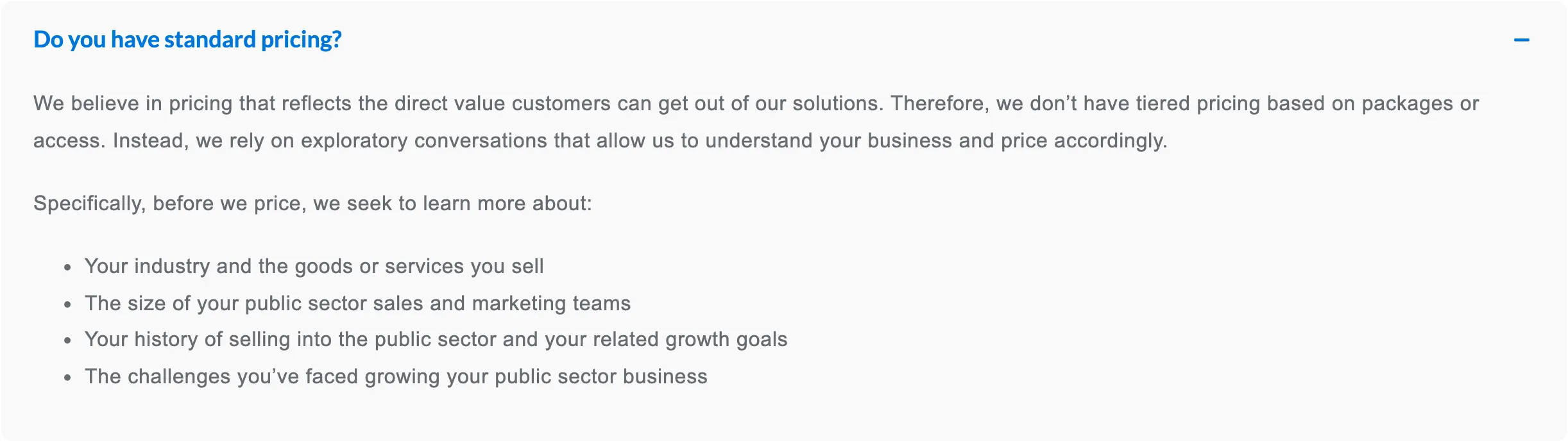
No. In its FAQ, GovSpend describes an annual subscription with multi-year options, and says it does not use “tiered pricing based on packages or access.” It prices through conversations that cover your industry and what you sell, the size of your public-sector sales and marketing teams, your history selling into the public sector, and the challenges you have faced growing that business.
GovSpend’s comparison page (July 29, 2026) adds that a subscription includes “full-platform access with unlimited searches” with no token fees or search up-charges.
On trials, G2’s pricing page labels GovSpend “Free Trial” (updated July 28, 2026). GovSpend’s own FAQ does not mention one. Treat the G2 label as a prompt to ask, not a promise.
What public contract records show
Two public records give prices that sit outside a sales conversation. Both have limits.
GovSpend’s federal price list. GovSpend’s federal arm, SmartProcure Fedmine, LLC, holds a GSA Multiple Award Schedule contract (GS-35F-0267X). Its published price list, generated October 17, 2026, covers the Fedmine federal product, not the state and local platform. Prices are GSA prices including the Industrial Funding Fee.
| Fedmine item (GSA wording, shortened) | GSA price |
|---|---|
| One-user annual subscription, small business only | $2,919.90 |
| One-user annual subscription, iContractor Plus | $3,846.85 |
| One-user annual subscription, iContractor Pro | $4,738.04 |
| One-user annual subscription, Pro plus the Goaling Suite | $4,738.04 |
| One-user annual subscription, Goaling Suite plus Anomaly Reports (Premium) | $6,652.39 |
| Unlimited download units | $12,395.47 |
| Additional user subscriptions (five product levels) | $509.82 to $1,285.64 each |
A City of Lincoln agreement. The City of Lincoln and Lancaster County bought a GovSpend subscription for November 15, 2022 to November 14, 2023: spending and purchase orders, bids and RFPs, co-ops and contracts, and contacts, for up to 5 users and 5,000 exports a month, at $2,000 for the year. The City’s contract record now shows the term renewed through November 14, 2027, with the amount recorded as $2,000. This was an agency buying price research, in 2022. It is not a price a sales team should expect, and it shows that agencies and suppliers are quoted differently.
What the records do not show is a supplier price for the state and local platform. For that, you still need a quote.
What shapes a GovSpend quote
GovSpend names four inputs: your industry and what you sell, the size of your public-sector sales and marketing teams, your selling history and growth goals, and the challenges you face. The contract shape adds the rest.
- Seats and exports. GovSpend recommends at least three people dedicated to using the platform (FAQ, April 29, 2026). Subscriptions include monthly export credits, and in the Lincoln agreement unused credits do not carry over.
- Platform. GovSpend covers state, local and education. Fedmine covers federal. They are separate products with separate price lists.
- Term and renewal. Annual with multi-year options. The Lincoln agreement renews annually “at the then current rate offered by GovSpend,” so ask what the renewal rate is before you sign.
- Negotiation. G2’s pricing page shows an average discount of 16% from user reviews (July 28, 2026). That is G2’s figure, not GovSpend’s, and Vendr’s discount bands are not used here because Vendr does not state their sample.
What a GovSpend subscription includes
GovSpend sells purchase-order data and the workflow around it, on two platforms. Its platform page names these modules: Spending & POs, Bids & RFPs, Meetings, Contacts, Co-Ops & Contracts, AI Search and Notebook, Alerts and CRM Integration. It also offers an MCP server.
GovSpend says it adds data daily, with refresh cycles of 1 to 90 days depending on the agency, and that onboarding “typically lasts 3 months” with a Relationship Manager (FAQ, April 29, 2026). On its data advantage page it claims 291K agencies tracked, 56K+ agencies with contact data, “$12T+” in documented spend data and 15 years of head start. These are GovSpend’s own claims, read on November 10, 2026.
GovSpend is also clear about what it does not do. Its Lincoln agreement says it “is not a bid hosting or submission tool” and does not guarantee every open solicitation. That matters for the decision below.
Where GovSpend is strong
The depth of its state and local purchase-order data is the reason buyers pay for it. GovSpend says its data comes from direct agency relationships, requested and verified rather than scraped, and that it has spent 15 years building them.
A competitor reaches the same view. Starbridge’s alternatives post says “for teams researching what an agency has already bought, that depth is genuinely valuable” (starbridge.ai, accessed November 10, 2026). On G2, GovSpend is rated 4.3 out of 5 across 103 reviews (G2, July 2026). If your job is price research on what agencies have bought, and who bought it, that is GovSpend’s lane.
What reviewers say about GovSpend’s value
Reviewers praise ease of use and flag data accuracy. Two recent reviews sit on G2’s pricing page, and G2 marks both as incentivized invitations.
- Laura T., field sales specialist, small business, February 19, 2026, 5 out of 5: “GovSpend provides RFPs and past POs, helping me determine price points and understand competitors.”
- Jack R., account executive, updated December 11, 2025, 3.5 out of 5: “Some of the information is wrong.”
Two reviews are a thin sample for value. Read the full set on G2 before you decide.
What are the alternatives to GovSpend?
The right alternative depends on the job: spend history, finding open bids, federal capture intelligence, or free federal data.
| If this matters most | Then consider |
|---|---|
| Purchase-order history and agency contacts for state and local sales | GovSpend |
| Finding open bids and awards across portals, with saved filters and alerts | AutoRFP.ai Opportunity Search |
| Federal capture intelligence | Deltek GovWin IQ (see GovWin alternatives) |
| Free federal listings and award data | SAM.gov and USAspending.gov |
G2 lists Deltek GovWin IQ (4.5 out of 5, 159 reviews), EZGovOpps Market Intelligence (5 out of 5, 10 reviews) and Govly (4.9 out of 5, 87 reviews) as top-rated GovSpend alternatives (G2, July 28, 2026).
AutoRFP.ai is an accuracy-first, AI-native platform that drafts RFP, questionnaire and DDQ responses from approved content and cites each source. Its Opportunity Search extends that to the front of the funnel. It searches tenders and awarded contracts across around 10,000 procurement portals, with saved filters, alerts and semantic search, and it covers US state and local bids as well as purchase-order and award history. For US coverage, see US state and local bid search. Opportunity Search is priced separately from the response platform, so ask for a quote against the territories you sell into. AutoRFP.ai is rated 4.9/5 on G2 from 67 reviews.
The two products answer different questions. GovSpend’s own agreement says it is not a bid hosting or submission tool, and it excels at what agencies have already bought. Opportunity Search finds what agencies are buying now across portals, then hands the bid into Go/No-Go and response, so the search, the decision and the response sit in one place. Some teams use both. If your priority is deep purchase-order history and contacts, GovSpend is the stronger fit. Iris also integrates with GovSpend for teams that want that data inside a response workflow; see Iris pricing.
How to test GovSpend before you buy
Take five questions and three real searches to the call.
Platform. State and local, federal, or both, and whether they are quoted separately.
Seats and exports. How many named users and monthly exports the quote includes.
Term. The contract length, the onboarding time and the renewal rate.
Coverage. Whether your territory and category are covered, tested with three searches you can already answer.
Open bids. Whether you also need open bids, and where those will come from.
If open bids are the gap, how to find RFPs lays out where they are published. We would rather show you than tell you: book a demo and run Opportunity Search against your own state and local territories, then compare what it finds with what you already track.
About the author

Ops Lead at AutoRFP.ai. Designs the pipeline, content, and handoff systems bid teams use to run RFPs end-to-end, and co-hosts live sessions on winning workflows.
LinkedIn