Pink Team Review: Process, Tips & Solutions for Proposal Teams
A pink team review is an early proposal review of the first draft, checking structure, compliance, and win strategy before the team polishes the writing.

Co-founder & CEO, AutoRFP.ai··18 min read
You do not want to reach the final proposal review only to realize the strategy was weak from the start. By then, every change takes longer, reviewers are frustrated, and the team has to fix problems that should have been caught earlier.
This guide breaks down the pink team review process, practical tips to improve it, and solutions proposal teams can use to optimize reviews before small issues become major rework.
What Is a Pink Team Review?
A Pink Team review is an early internal proposal review that happens before the full response is drafted.
It is run by the vendor or proposal team responding to the RFP, not by the buyer issuing it. The goal is to check whether the team has the right strategy, structure, requirements understanding and win themes before writers and SMEs spend days building the full response.
Where the Pink Team Fits in the Colour Team Review Process
Here’s where the Pink Team review fits in the wider colour team review process: it happens early, after the opportunity has been qualified and the response strategy is taking shape, but before the full proposal is written.
The colours are Shipley naming labels, not a literal quality scale. Pink is not “less serious” than Red, and Red is not automatically “better” than Pink. Each colour marks a different review point in the proposal lifecycle.
| Review stage | When it happens | What it checks | Main outcome |
|---|---|---|---|
| Blue Team Review | Before the RFP is released or early in capture | Customer needs, competitive position, solution fit, win themes and pursuit strategy | A stronger capture plan and clearer bid strategy |
| Black Hat Review | Before or during proposal planning | Competitor strengths, likely positioning and how they may attack the opportunity | A sharper competitive strategy |
| Pink Team Review | After initial planning, before full drafting | Storyline, compliance plan, section outlines, win themes, response strategy and evidence gaps | Approval to start drafting with a clear direction |
| Red Team Review | After the full draft is written | Whether the proposal is persuasive, compliant, clear and aligned with the buyer’s evaluation criteria | Major revisions before final polishing |
| Gold Team Review | Near final submission | Executive-level messaging, pricing, risk, final positioning and business approval | Leadership sign-off |
| White Glove Review | Right before submission | Formatting, page numbers, attachments, forms, signatures, file names and portal requirements | A clean, submission-ready proposal |
The Pink Team review is the point where the team asks: “Are we building the right proposal before we spend serious time writing it?”
That makes it different from a Red Team review. The Red Team reviews the draft. Pink Team reviews the plan behind the draft. It catches weak win themes, unclear section direction, missing proof, compliance gaps and SME confusion before those problems become expensive rewrites later.
What a Pink Team Review Evaluates
A Pink Team review usually checks:
RFP requirements: Whether the team understands what the buyer is asking for, including mandatory criteria, submission rules, attachments and evaluation priorities.
Go/No-Go decision: Whether the opportunity is worth pursuing based on fit, risk, capacity, timeline and win probability.
Buyer priorities: What the customer actually cares about, not just what the RFP says on the surface.
Win themes: The main reasons the buyer should choose your solution over competitors.
Response strategy: How the proposal should be positioned, structured and supported with proof.
Section plans: What each section should cover before full drafting starts.
SME responsibilities: Which subject matter experts need to contribute, validate or approve specific answers.
Risks and gaps: Missing evidence, weak differentiators, unclear requirements or areas that could hurt the submission later.
The practical point is simple: a Pink Team review catches strategy problems early.
The Pink Team Review Process (Checklist)
Before the Pink Team review happens, the proposal team has already done the early pursuit work.
Here is where the process sits:
Receive the RFP: The sales, bid or proposal team receives the RFP from the buyer.
Review the requirements: The team checks the scope, deadlines, submission format, pricing needs, compliance requirements, evaluation criteria and risks.
Run Go/No-Go qualification: The team decides whether the opportunity is worth pursuing based on fit, win probability, requirements, timing and available resources.
Build the proposal strategy: If the RFP is a “go,” the team defines win themes, buyer pain points, customer insights, differentiators, competitor positioning, solution approach and pricing direction.
Create the proposal outline: The team maps out what each section should cover before full drafting starts.
Run the Pink Team review: The Pink Team checks whether the early strategy, structure and response direction are strong enough to move into full writing.
For a closer look at the full RFP workflow, this video breaks down the RFP management process high-win bid teams use to manage competitive proposals from kickoff to submission.


Video transcript
So you've just received an RFP. Maybe it's the first time you're doing it. Potentially you're an experienced bid manager, and you wanna understand what is the RFP management process, like process, challenges, and how do you win these highly competitive and challenging bids? In this video I'm gonna show you through the exact RFP management process, challenges, share with you some data in relation to winning bid teams and how they win these complex bids that can really elevate your business. Let's jump into it So why does RFP management matter? An RFP or request for proposal is when a large organization, let's say an enterprise with 10,000 staff, or federal government body wants to procure products or services. Where RFP management matters is we surveyed with between AutoRFP.ai and Stargazy over ninety-seven bid professionals in our twenty
twenty-six proposal win rate report. You can find the link below if you wanna have a look yourself of the proposal win rate report. In this report, we found that fifty-one percent of teams without content automation sit in the low win cohort. So in our RFP management video today, we're gonna go into content automation. We're gonna talk about how ninety-four percent of high win teams use joint collaboration with their subject matter experts, not having the subject matter expert drafting. And where this all matters is the median shortlist rate. So the rate of which your RFP makes it to the next stage and isn't disqualified is sixty-three percent for high win teams versus thirty-eight percent for low win teams. So the teams that have very strong RFP management processes and structure, not only are they winning more, but they're making it through the RFP process to the next step almost double or triple the rate of other teams with content automation, joint collaboration with SMEs, and a lot of other things.
So let's jump into it. But before that, I wanted to leave you with this quote: " Most teams lose RFPs because their system is perfectly designed to produce the results they currently achieve." That was in the Proposal Win Rate report from Christina, the founder of the Stargazy community, a bid manager community, and that really stuck with me, is that if you have a poor system for your RFP management and response, you are setting yourself up to fail, which is why RFP management and systems and processes matter a lot more than heroic efforts one-off bid that you spent, hours and hours fine-tuning. But actual process and repeatable ways to win will get you and your business more revenue than just the one-off effort of trying to win a random bid. And finally, sixty-five percent of the bid teams that win the most
use AI proposal tech, which is what Audirfp.ai is and where I'm from. So what is RFP management? RFP management is how you organize everything that happens between receiving an RFP and submitting your response. Think about it could be everything from when you first discover an RFP on a public tender notice board. Let's say it was for a public tender notice board. Receiving an RFP and submitting your response. It involves people, content, and process. So what is the RFP management process? It starts off with a kickoff meeting. When you see it or you receive that private or public RFP, think about who needs to be involved. Get executive stakeholders on board quickly, especially if it's a very highly competitive and commercial bid. What is the response strategy? How are we going to make our response best fit for the evaluation criteria to win the RFP? Draft and assign. Who is doing what section?
How are we going to complete those sections? And overall, what does a great first draft look like? That is where AI can help the most. Review and submit. Who gets final say on the pricing and commercial? Who gets final say on legal? Who gets final say privacy, security, and compliance measures? Make sure that's clear from the start, and be ready when you have your first draft and everything is ready to be reviewed, that it can be submit cleanly to the right people at the right time. Audit and analyze. Something we don't do often enough in bid management is think about how could we do better with this bid? What feedback can we do, and how can we improve for next time? Which leads into that next one, continuous improvement, and that is the difference between a one-off effort and a systematic approach to RFP management and bid response that will get you to win bid after bid versus just that random one bid that you were lucky to get. An effective kickoff meeting does not just rehash to everyone
exactly what the RFP is saying. It is about establishing clear deadlines, where we talked about who is going to submit each answer each section, who's gonna draft each section, who's going to review each section. That's where you wanna have all those people there to establish clear deadlines for each of those contributors. Then you should already have somewhat of an understanding here, but this is where you can kinda lean on the people in this meeting to develop win themes. A win theme is what is your clear competitive advantage or way that you are going to structure your response with persuasive writing, with clear customer stories, that will get you the win in this RFP. For instance it could be an enterprise that cares a lot about security and privacy, and it could be based in the EU, is looking for a vendor who meets certain requirements. And you could be the only vendor, and you may know that you're the only vendor who meets the high-level requirements in relation to security and privacy, and you believe that's a competitive advantage for your company and for this bid.
Overall make sure that you plan all your supporting documents, so everything that the final submission should include. And you can use like an RFP checklist. We've got a pre-submission checklist in the links below. But you can use a pre-submission checklist to make sure, again, all of that is taken care of when you go to submit. And then assign a single project owner who drives accountability. This would often be a bid manager or at least, or a project manager, someone who is keeping an eye on all the deadlines. Clarification questions is an often overlooked part of the RFP process that can really help you understand that buyer and should be used every time. What you don't wanna be doing is submitting a question for the sake of submitting a question. Don't ask something that is very clear in the RFP. That could reflect negatively. But do think of some useful questions, that you can submit back to the buyer that will, help understand their current solution better and what they're currently doing. Map requirements to identify capabilities.
You could look at, for instance, there could be Moscow ratings, there could be mandatory nice to have, must-have, and so on. But each of those requirements you can compare to, evaluation criteria, and you can look at where do you stack up. But every single one of those requirements, where do you stack up just at a first glance? Even better is that step is in your AI go, no go or your go, no-go process before you even start to bid on, start contributing resources. You've already seen if you're actually a good fit for this bid before jumping headfirst. Build a response plan with section owners, deadlines, and review cycles. We discussed that just before. And decide your competitive angle before writing a single word Now, drafting response and assigning owners.
So this is where we actually start to write. So each of the reviewers and writers they begin to work. Use real-time collaboration so multiple people can work simultaneously. You never wanna have a bid that only one person can access at a time. That's not very conducive to strong teamwork. Pull from your your content library for common questions instead of writing from scratch. So at the start of the video, I mentioned how a strong content library often underpins a winning bid team, and here is the time that you can use that. So if you have pre-filled answers or approved answers in regulatory environments that you can pull from readily to answer common requirements, then this is where you use that. Make sure, though, you're not just mindlessly copy and pasting. Make sure that where appropriate, you're weaving in that win theme throughout the RFP and bid response. AI tools, and this is where a company like and product like ours, AutoRFP.ai, really shines, is generating that first draft.
AutoRFP will demonstrate a first draft in a matter of seconds from a blank RFP document and it'll leverage your content library for that, really speeding up the RFP response time, increasing participation rate, and giving you more time to write even stronger and better responses. So it goes into kind of like an AI feedback loop to continuously improve your responses. That can be one part tooling, and tooling can be one part of your RFP management process and response process that can really underpin a winning strategy. Some larger bids and structured processing involve a different colored reviews, where it goes through multiple and sequential reviews of different sections for relevant people. One trap around reviewing is making sure that the value of the bid and that win theme isn't lost through people's opinion. If you have ten different people review a section, you're gonna have ten lots
of different feedback and potentially some of them are contradictory or some of them are the same. But you wanna make sure that, of course, you're applying feedback if they're experts in that space. But you as the editor or project owner of that section should ensure that the win theme and what makes that a winning bid isn't lost. That's the review trap And finally, just before you go to that final review, run your pre-submission checklist, spelling, grammar, compliance, consistency and so on. And again, in the description below, we've got our pre-submission checklist that you can download for free, and that can be part of your winning process. Finally, we've now submitted that RFP. So some kinda top-level metrics that you should track is your stages the bid goes through. How many do you not bid for because it wasn't a good fit? That's a good thing to measure. Make sure there's endless opportunities, but you wanna bid what actually makes sense. The ones that you bid for, what were the outcomes of those b-
The ones that you bid for, what are the outcomes for those bids? Was it won? Was it lost? Did you withdraw? Did you stop the bid because of resourcing issues and never submitted it? Next level, once you have that data in terms of the status of your bids , is what were the size of the bids and what was the cost of the bid? That's a really tricky thing to measure. There's some great resources out there around cost of bid, but effectively you wanna make sure that these bids are profitable. So if there's a ten percent chance on a ten million dollar bid, but it costs two hundred grand to bid, that's a really tough one to make. And then also make sure that, you wanna make sure, in a good system or a good AI RFP software like AutoRFP or other software out there in the RFP software market, should automatically be using your responses that you're working on and add them into your library and intelligently store that and categorize that content so it can be used for next time. That's where it's really important to consistently write better and
better, and your content library kind of builds over time, and your systems are set up to produce better results as your company gets, makes bid management and RFP response and the management, RFP management process a competitive advantage of the company And finally, continuous improvement. So it's really not out there to ask for feedback, whether that's a private enterprise bid or if it's government bid. Often this may even be posted publicly. But you wanna make sure you get feedback on the bid, and not just on the bids that you win, but the bids that you lose are sometimes more important. You may unearth that you shouldn't have bid on that in the first place, that it wasn't a good fit from the start. You may realize a flaw in your RFP management process and where something needs to be sharpened up for next time. And continuous improvement in your RFP management process implementing that will just kinda make it better and better every time, and that's what really helps companies go from winning the occasional RFP worth a million dollars
to consistently winning million-dollar RFPs and substantially growing the business's footprint in the enterprise so what are some of the common RFP management challenges? Outdated systems and bottlenecks. Thinking about that process is where is the most amount of friction? That could be following up people to review. So you're always having to message them and be like, "Hey, can you review a section? This was due yesterday." It could be that your content lives in ten different systems. You can never find the right answer. It could be technical docs. It could be SharePoint. It could be Google Drive or whatever. And then and then content library paralysis. So if forty percent of saved references may reference outdated information, no one has the full data to update them. Now, here's some best practices to help you win RFPs consistently and land those million-dollar contracts. Automate the repetitive work. AI has come so far and can help out in particular places of the RFP management process.
Whether it be automating the repetitive work of a first draft and finding the relevant information out of your content library, AI is incredibly strong in that. AutoRFP.ai customers consistently get eighty percent plus AI first draft rate off their existing content, and you wanna make sure that standardized templates. Centralize everything, so it's easy to find the right and source the right information. Cross-functional collaboration, multiple people can edit at once. Reviewers it's easy for someone to review. It's an easy-to-use system. You don't want some clunky software that they have to log in, and an SME can never use it, and therefore, they hate having to help you on an RFP. And track performance metrics automatically. Every time you are moving through your CRM or your relevant software, these opportunities that the bid software is also updating, or at least your bid process data is there. Automating routing questions to the right SMEs, so you don't have to think about who should this go to. Real-time progress tracking so nothing falls through the cracks, and automatic importing of different documents to get a really high level of AI first
draft, and trust scores telling you which answers need human review. So the AI is doing a lot of heavy lifting. That's kinda what AI RFP management looks like is the AI is taking care of that manual work, and the human is coming in to ensure that the win themes are strong, that the pricing is competitive, and that evaluation criteria are met, and they're going to win that bid. All right. What I wanted to leave you with today was a live demo of just the project management capabilities with an AutoRFP.ai and how that can help your RFP management process. So looking in here, we have an RFP project. You can see here that already forty-five of my responses have been submitted and reviewed, nine have been, nine have been submitted but not reviewed, and there's still fourteen left drafted. So I can quickly click into my Drafted, see what ones are left left need to be edited, and then I can look after those as needed. So I can click into my fourteen draft and see, okay, we're still waiting for someone here to to submit those, and I can go in, submit, and make changes. So it's a very easy kinda multiplayer capability, seeing where everything's at.
Can go to my Project Overview and see that the project is due in five days. This is everyone who worked on that project, when it's due. My first draft was highly AI automated, ninety-seven point one percent draft. And overall we have sixty-two percent exceed compliance, thirty-five percent fully compliant, and I can quickly see what response is partially compliant and understand why that's partially compliant and kinda review that. By just having one look and a couple of clicks, I can see, against the evaluation criteria, what responses need to be improved or where we're potentially weak on this competitive bid before having to really do a lot of work. I can see project attachments and everything else going into this bid. And so that's what a project overview dashboard for a competitive bid looks like. If you wanted to have a look at AutoRFP and give it a try, you can go to our website autorfp.ai. Here, you can have a look and learn more about our product and everything else that kind of goes into it and what kind of automation rates our customers are achieving with autorfp.ai. And you can also book a demo to spend time with our team, and in this demo, they'll
provide a really guided walkthrough of the platform, help understand your business, and see really if it's a good fit or not. Thanks. I'm Rob from autorfp.ai. Hopefully, that was helpful in relation to your RFP management process. See ya.
Step 1: Confirm the RFP Requirements
The Pink Team review starts by checking whether the team actually understands what the buyer is asking for.
This is where teams look past the headline scope and break the RFP into real work: requirements, instructions, attachments, pricing rules, compliance needs, page limits, submission steps and evaluation criteria.
Check:
Mandatory requirements: What the response must include to stay compliant.
Evaluation criteria: What the buyer will likely score most heavily.
Submission rules: Deadlines, portals, file formats, forms, signatures and attachment rules.
Technical requirements: Product, security, implementation, service, integration or support needs.
Pricing requirements: Required pricing format, assumptions, commercial model and exceptions.
Hidden work: Requirements buried in appendices, spreadsheets, portals or attachment lists.
AutoRFP.ai can help here because missed requirements are not a small admin issue. They become rework, compliance risk and lost scoring points.
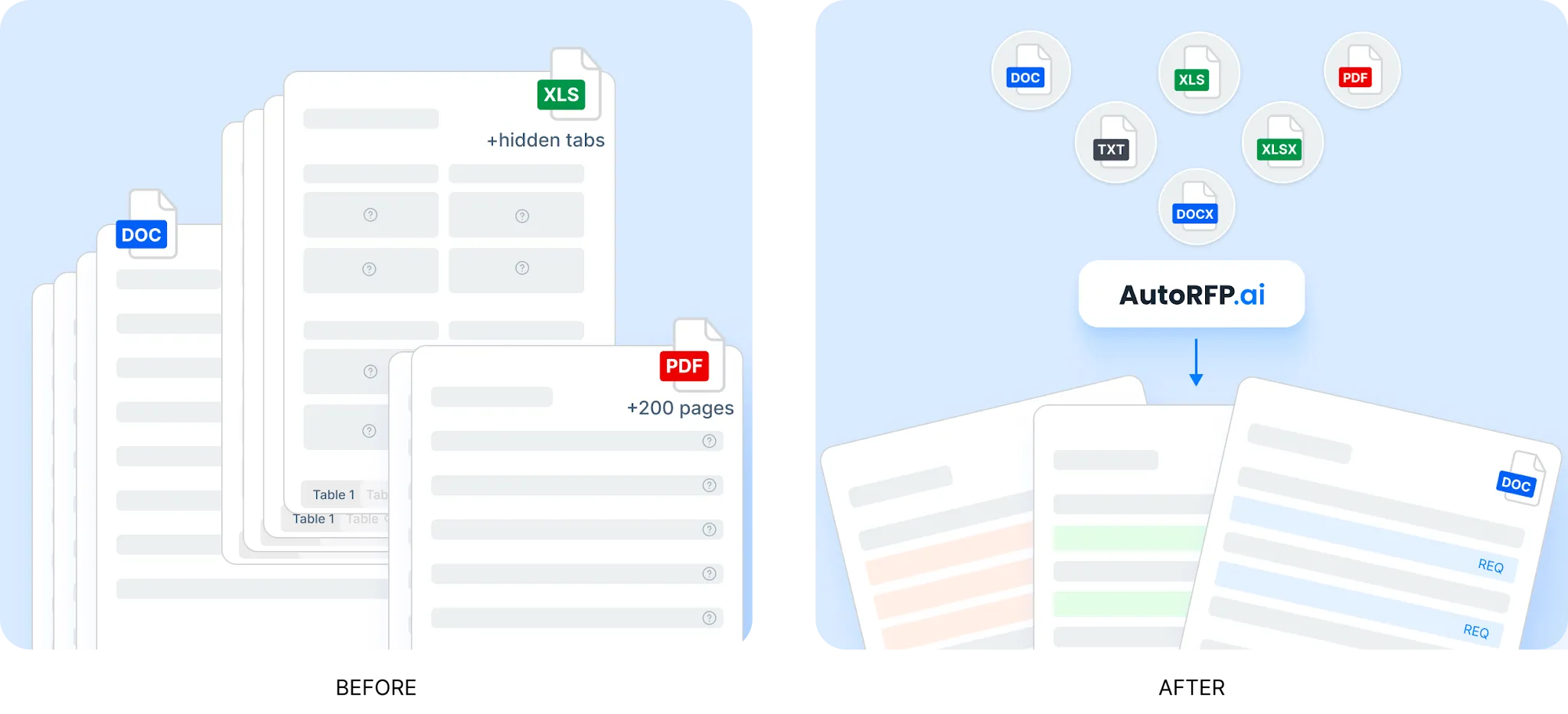
Teams can drop in an RFP in Word, Excel or PDF, and AutoRFP.ai extracts the requirements, sections and context automatically, so the team starts from a complete requirement set instead of manually hunting through the document.
Step 2: Identify Compliance Gaps Early
The Pink Team review should catch compliance gaps before writers start drafting.
Manual reviews can miss these gaps because requirements are often spread across the main RFP, Excel sheets, attachments, portals and buyer instructions. By the time someone spots the issue later, the team may already have built the wrong response.
Check:
Unmet requirements: Requirements the company cannot fully satisfy.
Partial compliance: Areas where the answer needs qualification or careful positioning.
Missing evidence: Claims that need proof, documentation or SME confirmation.
Recurring weaknesses: Requirements the team keeps marking as non-compliant across multiple RFPs.
Product gaps: Buyer needs that point to roadmap, hosting, security, integration or service limitations.
Submission risks: Forms, attachments or certifications that may be missing.
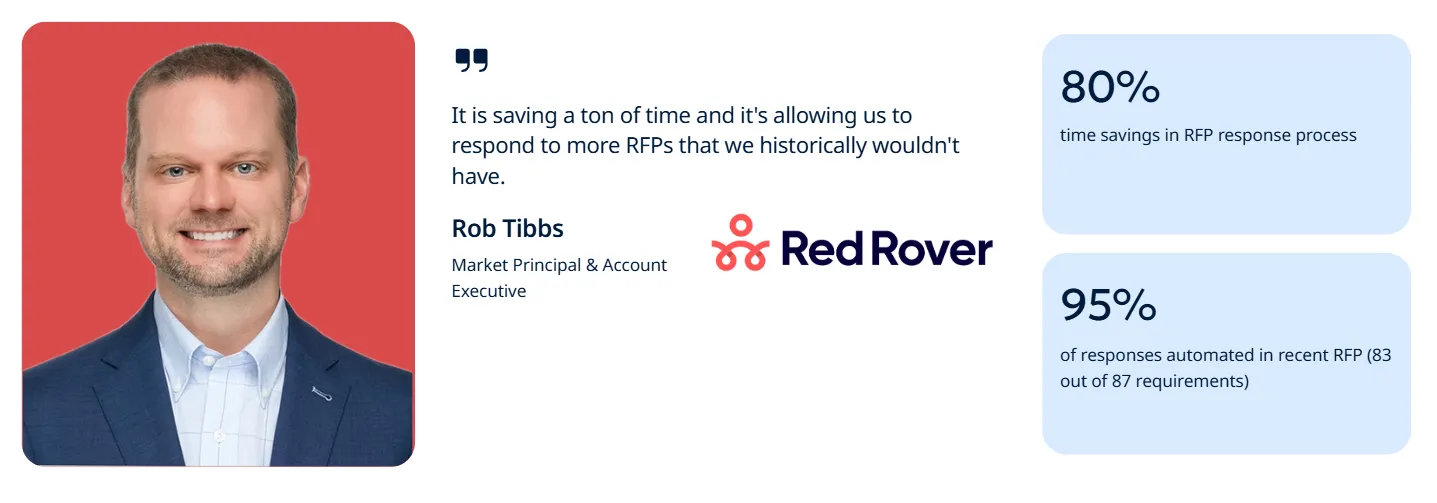
This is where gap analysis becomes more than a review task. If the team keeps marking “non-compliant” on the same requirement, that is not random. It may be a product, security, hosting or process gap that is costing deals.
AutoRFP.ai’s RFP gap analysis helps teams aggregate compliance data across RFPs and spot those patterns without digging through old responses or building spreadsheets manually. The value is not just finding one gap. It is seeing which gaps keep showing up and deciding what to fix.
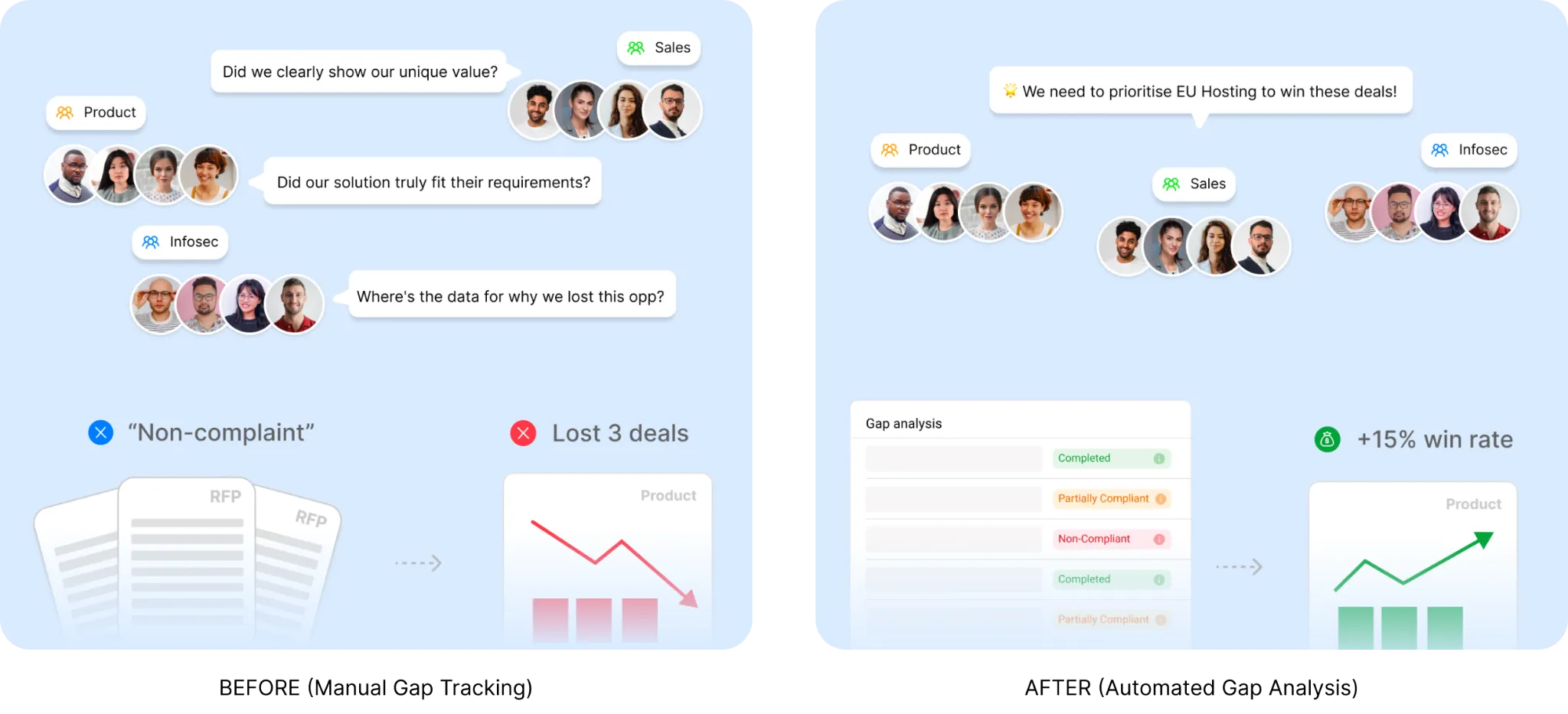
For example, one AutoRFP.ai customer, Red Rover, was able to reduce RFP response time by 80% by automating answers from existing documentation.
In one recent RFP, the team automated 95% of responses, accurately answering 83 out of 87 requirements. For Pink Team reviews, this shows how centralized requirements and approved content make it easier to catch gaps, reduce SME back-and-forth and move faster.
Step 3: Validate Customer Insights
A Pink Team review should test whether the proposal strategy is built around the buyer, not just the RFP document.
The team needs to understand what the customer is trying to solve, what risk they are trying to reduce and what outcome they need to defend internally. AutoRFP.ai’s 2026 Proposal Win Rate Report found that 71% of high-win teams conduct formal customer research, which makes this a practical performance habit, not a nice-to-have.
Check:
Buyer pain points: What problem is driving the RFP?
Decision criteria: What will likely matter most to evaluators?
Internal stakeholders: Who needs to approve, use or defend the decision?
Business outcomes: What measurable result does the buyer need?
Risk concerns: What could make the buyer hesitate?
Existing relationship: What does the sales team already know from discovery, account history or prior conversations?
A weak Pink Team review only checks whether the outline matches the RFP. A strong one checks whether the response direction matches the customer’s real buying situation.
Step 4: Lock the Win Themes
The Pink Team review should pressure-test the win themes before the team starts writing.
Win themes are the core reasons the buyer should choose your company. They should not be generic claims like “great service” or “innovative solution.” They need to connect your strengths to the buyer’s pain, scoring criteria and risk concerns and 71% of high-win teams use defined win themes.
Check:
Customer alignment: Does each win theme speak to a real buyer priority?
Proof: Can the team support each theme with evidence, examples or outcomes?
Differentiation: Does the theme separate you from likely competitors?
Repeatability: Can the theme show up across the proposal without sounding forced?
Evaluator value: Would the buyer care, score it and remember it?
A Pink Team review is the right time to kill weak themes. If the theme cannot be proven, tied to the buyer or carried across the response, it should not survive into the full draft.
For a deeper look at how win themes, customer insights and strategic narrative shape a stronger RFP response, watch this walkthrough on writing a great RFP response with AI. It explains how proposal teams can use AI for repetitive response work, then spend more time on the strategy, buyer insight and messaging that actually influence the win.


Video transcript
You've just received that monster RFP. It's a lot of work, and you're excited to dive in and potentially win this massive contract. You've started using AI, but how do I actually win? What is the RFP response that I need to write to win this deal? That's what takes from basic level of proposal writing to what wins. I'm Rob from AutoRFP.ai. We're an AI RFP software. I personally complete and win RFPs on the daily, and I'm keen to dive in today about using AI for an RFP response that actually helps you win RFPs. I'm gonna be covering win themes. I'm gonna be covering leveraging customer insights to write strategic narrative that helps you actually win RFPs. Yes, we're gonna be talking about AI automation and saving time,
but it's not just about that. It's not about doing an RFP as fast as possible with as little effort as possible and just putting out slop into the world. It's about writing and winning RFPs. But first, as I did say, it's about RFP automation with AI for our RFP response process. It's about automating the mundane. Before you dive into how you can use AI to help you win RFPs for RFP response, take a step back and think about, what are the activities I do related to RFPs that don't actively help me win RFPs? So automate the mundane. AI's real job in an RFP, isn't to do what you do well and what humans do well, and that is writing strategic narrative. It is to do what it does well, and that is hunting and pecking throughout
your past responses, automating kind of the basic responses and really making sure that those are compliant as Jasper Cooper, our CEO and co-founder at AutoRFP.ai, put in our proposal win rate report for 2026, the real advantage isn't automating content, it's what teams do with the time they get back. So automate as much as you can on the mundane So firstly, these are some clear things you can hand to AI from the start. The clear yes or no. Does your product or service do this? And it has a yes box or a tick box or a radio button or a drop-down selection. Yes, . AI should be completing those 99% of the times. Of course, having a human to review if appropriate, but that is where AI is good, the black and white. Company information all the content forms you get about company legal name, company entity, where the office is based, and so on.
If there isn't a place to kinda put your flair there, of course, just basic information, AI is good for that. Boilerplate. Then you've got boilerplate and your security and compliance questions. Across our customer base, 63% of every AI-generated answer is approved with zero to one-word changes. That is 63% of AI-generated answers are perfect. A human still reviews them, but it doesn't require any manual editing. That's freeing up enormous time for teams using our software and the other software out in the market to then, take that time back to do what wins. So what are those activities you can do to help win? First Automate the answer everyone gives and write the answer only you can give. But first, let's cover off what a great answer looks like, and I'll give you both a good and a bad example. So what does a great answer look like?
And this is subjective, of course, to your industry, to your country your buyer. It's all dependent on so many factors. My background is in technology RFPs. That's where I've spent ten years working and selling and writing RFP responses across local government, national government, state government, as well as private enterprise RFPs in Australia, in the UK, in Europe and it is very subjective what a great answer looks like. But I'm gonna take on a couple of core principles that are gonna help you think about what a great answer looks like for your use case. So leads with the verdict. I'm a big believer in front-running the value of the response in the first sentence or two. What that means is effectively, if we're thinking about how humans read, and especially if your job is to read a handful of RFP responses, it's pretty
hard work to continually stay focused and read an entire response and remember everything that you read in there. You wanna make sure that it's easy for the reader to understand the value in your response, and tick off and give you the points that you need in that evaluation criteria. Second, mirror the buyer's words. This is where your understanding of that industry, of that country, of that buyer goes into how you talk about the response. Three, specific enough, no competitor could paste it. Again, imagine you have an evaluation criteria and you are marking this RFP, and you have two responses that look exactly the same. How are you gonna differentiate? That's where being specific enough no competitor could could paste it is so important to make your response stand out, short and scannable. Now, short is dependent on the type of RFP or RFI that it may be and what they're expecting for responses. Make it scannable. Make it a pleasure to read. Don't make it giant block paragraphs that are incredibly hard, again,
for that evaluator to give you the marks for that response. Make it have bullet points. Make it have flowing paragraphs. Make it have a summary or conclusion at the end if reasonable. Make it short and concise and scannable this is probably the biggest sin I see in executive summaries. Someone writes an executive summary, maybe it's the CEO has the standard template one that they use, and it's all about them. It's all about your company, it's all about your experience, and it's boring to read. Make it about the buyer. Easy way to do this is scan the left margin. How often do the sentences start with we, our, your company's name, and so on? How often is this talking about you? Leverage your customer insights and incorporate it into your win themes to make it about them. Tie your solution into the pain and the problems that they are living, and write about them, not about you. But you're tying everything back into their world because it's just more contextual, and it's easier for them to map your response to the evaluation
criteria and how it meets their stated objectives and goals for the RFP. So this is what a great answer can look like. This answer was actually is using social proof. It's one of our answers that we would write, and effectively it's talking about a migration. So SugarCRM migrated from Qvidian to AutoRFP.ai in 2024 and deployed in two weeks. The first sentence has the value. Social proof time. Because we're thinking about migrations. The buyer might be thinking about how long does that take? What's the risk here? How long does it take is answered in the first sentence, and social proof helps alleviate the risk. Then the next three dot points, again, incredibly skimable and readable and has numbers to draw attention. So this requirement was regarding do you have any customers who have migrated? A forgettable answer. AutoRFP.ai.ai, so leads with me, leads with us. Maintains version control automatically through the History tab. First of all, a lot of flowing commas, a pretty long sentence. We've kinda cut off the response, but it keeps going.
No hook, no numbers no so what for the buyer. And effectively it's correct, and for a functional question in a response, it could be a great response if it was looking for a black-and-white response. So it's a forgettable response. So how would we improve this response? We might say Audibility and traceability is core to the platform. This extends to the history tab in which… and then you might use then dot points to list out all the relevant comma points there. So I'm gonna give you some concrete examples of how you can use AI to incorporate win themes and customer insights to help you write winning RFP responses. First of all, the data. We did a survey of over a hundred winning bid teams and asked them what do they do to win. These are teams that win more than 50% of the RFPs they bid on. 71% of high win teams use win themes, 42% of low win teams use win themes.
So a clear distinction, the difference there. This is a strategic part of your RFP response use your intuition and your knowledge of the buyer, your knowledge of your company and your products and services to really fine-tune it. But it can definitely be helpful in thinking of ideas and going back and forth and helping you once you've generated those win themes, actually deploying the win theme across an RFP response. So the RFP, what you receive from the buyer, often will have a bunch of context about their current situation That is gold to help you understand exactly what to incorporate. Once you have the win themes, then you go into applying win themes everywhere. Try to win th-thread these win themes consistently throughout every section. Flag answers that drift, especially on the answers where it matters. I'm using my project agent here so it's talking about differentiation, and then it has access to the web, it has access to my content library, it has access to my CRM, and it's gone
through and looked at all that in different information and found a bunch of different information relevant to this RFP that I'm currently working on and helped create some win themes. So win themes are, it's a scalable platform. Win theme number two, reduces security and compliance risk. It's easy to use and it's integration flexibility integrates with their entire tech stack. Maybe that is also a point of competitive differentiation. If I understand the market and the competitors really well, potentially my solution might be the only one that has a particular integration with a particular system in the buyer. So I wanna highlight that fact consistently that we have the experience of integrating their entire technology stack to our solution, and that is important because of X, Y, Z, because of what's stated in the RFP, because the buyer has told us or we've spoken to the buyer about it. Okay, so we've got all these different win themes that was created via AI, and now I'm gonna ask it, can you now incorporate these win themes across functions?
The AI is now going to start incorporating the win themes by editing these responses for me, by searching my past content, and effectively giving me a stronger narrative of why this buyer should choose our solution Now, it's generating those responses. I can go through, I can see the changes it made, and I can accept this or not. Okay, cool. That looks good. And then I can go through, and I can look at these responses and accept and change them as well, and make sure it incorporates what I want in the responses as well. Let's try and find one here You can see it keeps using the word configurable. So it's reasserting though that vocabulary that ties to integration strengths of our platform, But that's just an example of how we, how I used AI and the AutoRFP.ai project agent to generate win themes based off the RFP project, based off my knowledge of the buyer. And then from that we work to incorporate four win themes, and
then I've used AI to help apply that. I would then go through and edit and make changes here if necessary. And then we've got a strategic narrative throughout that section on the functional requirements. So what are customer insights? It's not just that we know who the buyer is and we've spoken to them a couple of times, but it's actually understanding their current state. It's about understanding their pain, their problems, why they're looking to go out to market, what has been their history of solutions, and everything we understand about that customer, about industry, about the geography and other relevant customers in the space to, understand their world and help pitch a solution that would generally provide value to them. So where can customer insights live? First of all, in your CRM. There's a goldmine of information in your CRM Then you've got your recorded discovery calls. This could be from systems like Gong or Clari and effectively any calls or demonstrations or workshops that you've had with the prospect before the RFP
strategy and workshop sessions. This is really important, in the world of capture, is helping shape that RFP in a subtle way. And a big way is strategy and workshop sessions or giving updates on the state of the market and other information that helps you position the buyer to understand the world and the category that they're looking to procure their products or services in. Team interviews. So again, you might have a sales team, pre-sales team or legal compliance, they all know incredibly well what the buyer is looking for, especially if they've spoken to buyer and, or they understand the industry well. And speak to them, talk to your team, bring out internal meetings that add value and help you understand the customer and provide their knowledge into things like the strategic narrative, like the win theme for that RFP. So content is what you say and your past content, but insight is why it matters.
You can say a bunch of stuff in an RFP, and it can come out looking like gobbledygook and be of no value to the buyer, and you can get a really low mark and not tick off any evaluation criteria or compliance matrices, and you're gonna lose. Anyone can generate an RFP with AI, but insight is why it matters. And why does that matter? Again, tying back to the proposal win rate report where we interviewed and asked winning bid teams what do they rate most highly as to why they win, customer insights was the number one reason, and 88% of high win teams were doing customer insights, whereas only 67% of low win teams had a defined customer insights process. But again, of all the reasons why they win, the number one reason for high win teams was customer insights. So all that information we just spoke about, they're leveraging
that to win competitive RFPs in my same response, we're gonna jump back into our section, and we're going to ask my agent, my project agent, to look at my CRM notes, I have a couple of call transcripts in there that have been made up, and help them edit these responses based off the knowledge of that CRM. So there's my prompt. It's gonna look inside HubSpot. This is the made-up company, and it's going to go through and look at these notes without me having to effectively point it to it. It's gonna hunt and peck. And it's all fake, and it's going to use that to help respond to my fake RFP. So here you can see it's used a bunch of tool calls via the MCP. So effectively, my AI in AutoRFP.ai is speaking to HubSpot's server and grabbing all that information and then parsing that and contextualizing that for the RFP because my AI understands the RFP because it's right there in front of it. And it's going through, and it can look at all the information, and then
it's pulled out a stakeholder map. All the stakeholders and role in the decision, what they care about, and where it sourced that information. So that's really important, especially with thinking about it's actually a person behind the marking criteria. Could be procurement, could be a decision-maker and then it's talking about the actual drivers and pain points. And you can see here it's actually pulled out a lot of different information from those calls about what's important for this RFP. And it's then going to effectively take all that information, take my library content, so it's still sourced in reality of what my product and company can actually achieve, and it's going to take those win themes and must-win sections, and it's going to effectively craft that into a response. And now I'll ask it, "Cool. Can you now update section B?" Based off the context information there Again, here's two responses where it's worked in that context to that response. And you can see that I can accept that, easily make those
changes, and pretty happy with it. Those responses. That's how it would incorporate the customer insights and so on into it. I And one big thing I wanna call out is SME-led drafting, so the subject matter expert writing the response from a blank page, is a low-win habit. Ninety-four percent of high-win teams from our survey and our interviews, the proposal team writes, the SMEs review. So SMEs write for precision, whereas proposal teams write for persuasion. And we're talking back through the entire thing about customer insights, about win themes, about what makes a great response. We're talking about persuasive narrative and writing, and SMEs will write for the technical correct answer, which can be a good answer, but proposal teams write for a great answer that will actually win you that RFP. So don't fall into that trap. Make sure that when you have SMEs, they're just reviewing and approving information.
Or even better, you're sourcing that from an approved library of content that SMEs already approved, so they don't even need to approve it, but they're just reading over and approving things. But someone else is actually incorporating everything we've spoken about today into that response, and they're just approving the technicalities. One model actually that can really help speed up SME time and reduce the time as well is that AI can draft the repeatable responses, again, sourcing from approved content and then sourcing from the context of your company and the SMEs just going in and validating low-confidence bespoke responses So that's how you can use AI to help raise the floor and incorporate insight, themes, and narrative into your RFP response and really use AI to automate the mundane. Now, if you wanna get a hold of the 2026 Proposal Win Rate report that I covered throughout some of the great stats throughout today's video you can see the link in the description below. All right, thanks. I'm Rob from AutoRFP.ai.ai. Cheers.
Step 5: Review the Proposal Outline and Section Plans
The Pink Team should check whether the proposal structure is strong enough before drafting starts.
This is where the team looks at the planned response section by section. The question is not “Do we have headings?” The question is “Does every section have a job?”
Check:
Section purpose: What each section needs to prove.
Evaluator logic: How the structure helps the buyer follow the answer.
Requirement mapping: Which RFP requirements each section addresses.
Content owners: Who owns each section and who needs to review it.
Evidence needs: What proof, attachments, examples or data each section requires.
Gaps: Sections that are thin, unclear, duplicated or missing buyer context.
AutoRFP.ai’s Project Agent can help teams generate implementation plans, executive summaries, cover letters and compliance matrices from the project context.
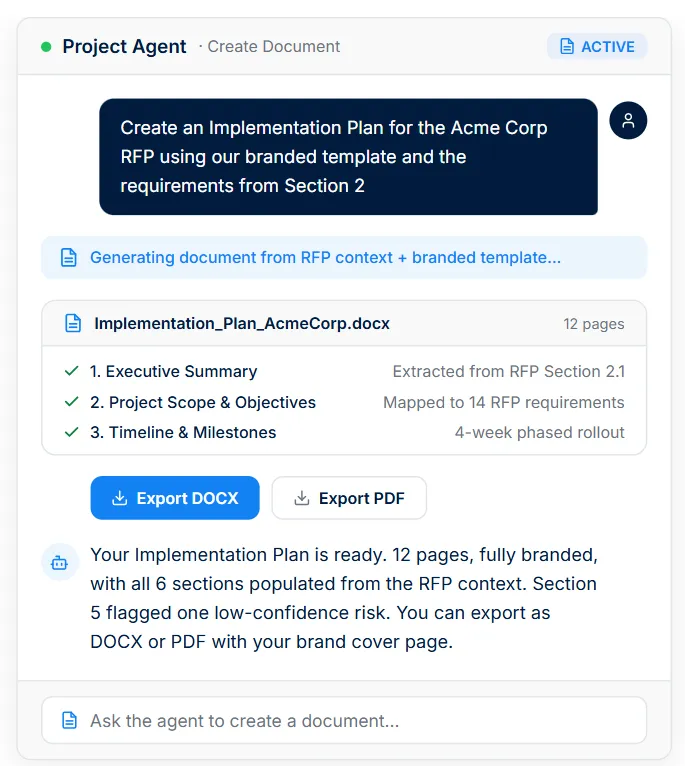
That means the proposal outline can be informed by the RFP requirements, attachments and approved content, instead of starting from generic boilerplate.
To see how this works in practice, this demo walks through AutoRFP.ai’s AI proposal agent for RFPs, DDQs and bids. It shows how the agent researches prospects, pulls context from approved content libraries, edits responses inside the document, generates branded attachments and connects to tools like Salesforce, HubSpot, Slack, Gong, Jira and Google Calendar through MCP connectors.
Step 6: Check Rough Content Direction
The Pink Team review does not need polished writing.
It needs enough rough content direction to confirm that the response is heading the right way. That may include storyboards, bullets, early answer notes, section summaries, key messages or draft response angles.
Check:
Opening direction: How each major section will lead.
Key messages: The main points each section needs to land.
Evidence placement: Where proof should appear.
SME input: Which sections need expert validation before drafting.
Tone: Whether the response sounds like a confident vendor, not a generic template.
Risks: Any claims that feel unsupported, too vague or too aggressive.
This step keeps the team from writing 30 pages before realizing the story is wrong. The Pink Team should be tough here because vague content direction becomes expensive rewriting later.
Step 7: Review Draft Messaging Before Full Writing
Draft messaging should be reviewed before the team commits to full response writing.
At this stage, the team is checking the message, not polishing the prose. The goal is to make sure the response is direct, compliant, differentiated and supported by approved evidence.
Check:
Answer direction: Does the draft answer the buyer’s question directly?
Compliance: Does it satisfy the requirement without overpromising?
Proof: Is the claim backed by approved content or evidence?
Consistency: Does the message align with the win themes and customer insights?
Confidence: Would the sales, proposal and SME teams stand behind this answer?
Review needs: Which answers need technical, legal, pricing or executive approval?
AutoRFP.ai’s AI RFP Response Enginecan create first drafts from approved organizational content, but the important part is control. Every generated answer includes a visible Trust Score and links back to the approved source behind it. If AutoRFP.ai cannot find approved evidence to support an answer, it leaves the gap blank rather than making something up.
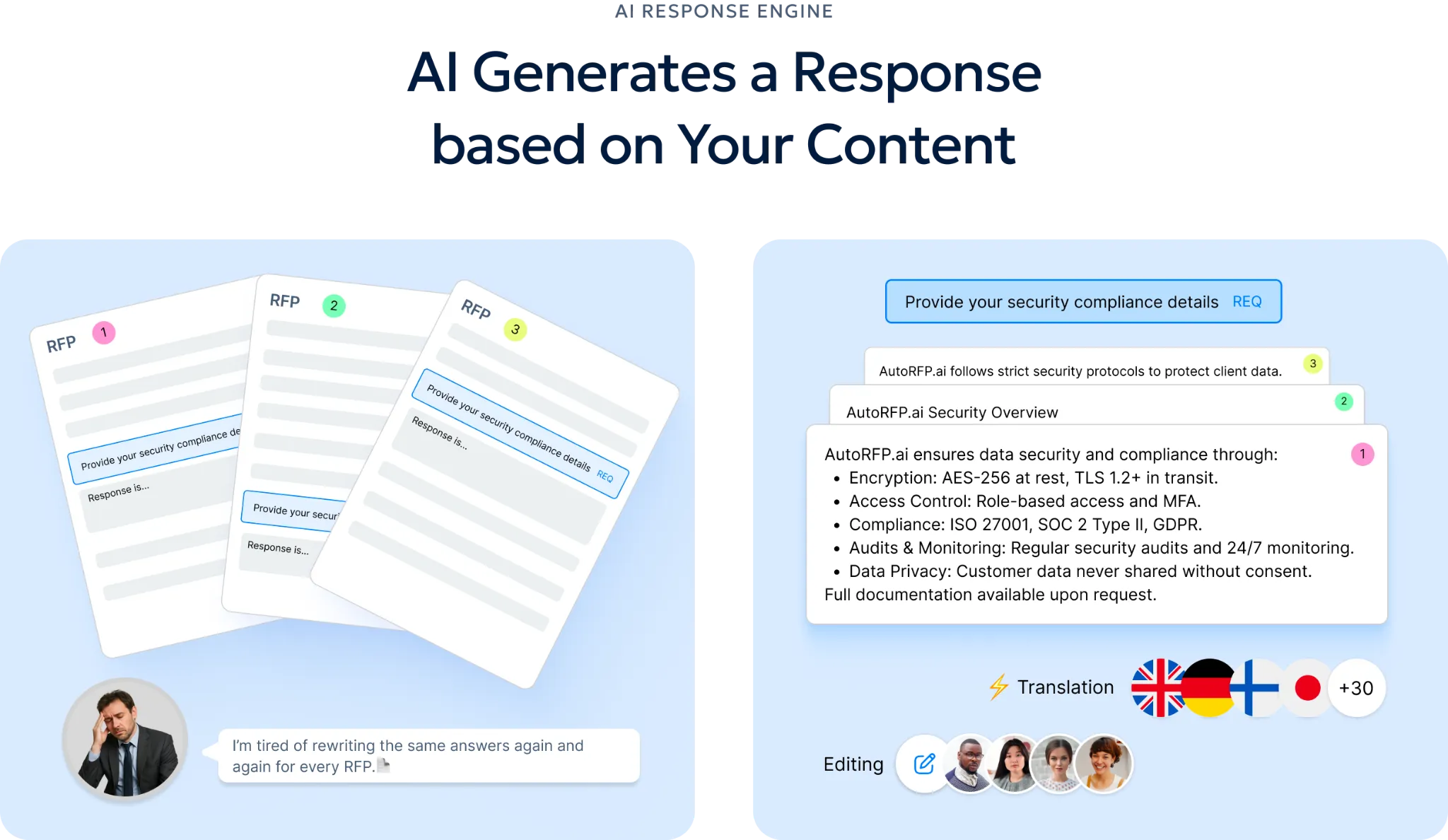
That changes the review job. Instead of checking every answer from scratch, reviewers can focus on low-trust answers, missing evidence and sections that need expert judgment.
Step 8: Decide Whether the Response Is Ready for Full Writing
The Pink Team review ends with a decision.
The team should not leave the meeting with vague feedback like “looks good” or “needs work.” It should decide whether the proposal plan is ready for full drafting, or whether the strategy needs another pass.
Check:
Requirements: Are all major requirements captured?
Compliance: Are known gaps identified and owned?
Strategy: Are win themes clear and defensible?
Customer insight: Does the response reflect what the buyer cares about?
Structure: Does the proposal outline make sense?
Section plans: Does each section have a clear purpose, owner and evidence plan?
Messaging: Are early messages strong enough to guide drafting?
Next steps: Does every action have an owner and deadline?
The practical standard is simple: do not move into full writing until the proposal team knows what they are building, why it should win and what evidence will support it. A good Pink Team review saves time because it stops the team from drafting the wrong proposal faster.
Related resource: The Ultimate Pre-submission RFP Checklist
In high-stakes RFPs, one missed requirement, attachment or formatting issue can put the entire deal at risk. A final pre-submission checklist helps proposal teams confirm the response is compliant, complete and ready to submit before the deadline.
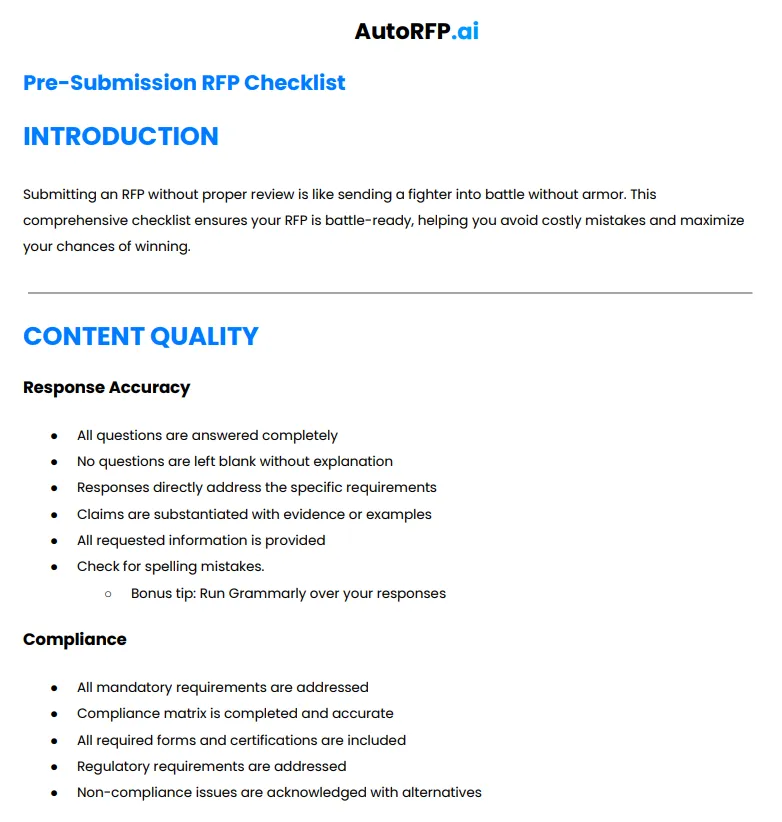
Download the complete checklist
Pink Team vs Red Team Review
A Pink Team review checks whether the proposal strategy is strong enough before full drafting starts. A Red Team review checks whether the full draft is strong enough before final submission.
Both matter, but they solve different problems. Pink Team prevents the team from building the wrong proposal. The Red Team improves the proposal once the full draft exists.
| Area | Pink team review | Red team review |
|---|---|---|
| Main purpose | Check the proposal strategy, structure, and response direction before full writing begins. | Checks the completed draft for clarity, compliance, persuasiveness, and buyer alignment. |
| When it happens | Early in the process, after Go/No-Go, strategy, and section planning. | Later in the process, after the first full proposal draft is ready. |
| Main question | Are we building the right proposal? | Is this proposal strong enough to submit? |
| What it reviews | RFP requirements, compliance gaps, customer insights, win themes, proposal outline, section plans, and rough messaging. | Full draft, executive summary, section responses, proof points, compliance, scoring alignment, and overall persuasiveness. |
| Level of detail | Strategic and structural. It focuses on direction before the team spends serious time writing. | Detailed and evaluative. It focuses on improving the actual draft before final polish. |
| Best use | Preventing weak strategy, unclear win themes, missing requirements, and poor section planning. | Catching weak arguments, unclear answers, compliance misses, unsupported claims, and buyer-facing issues. |
| Who is usually involved | Proposal lead, sales lead, solution lead, SMEs, capture team, and key reviewers. | Senior reviewers, proposal leaders, sales leadership, SMEs, legal, pricing, and executive stakeholders. |
| Output | A clearer proposal plan, stronger win themes, fixed gaps, and approval to move into full drafting. | A marked-up draft with revisions, risks, gaps, and final improvement actions. |
| Risk if skipped | The team may write a complete proposal around the wrong strategy. | The team may submit a proposal that is compliant on paper but weak in front of the buyer. |
Tips & Solutions for Optimizing The Review Process
Follow these tips to make the review process faster, cleaner, and more useful for the people who actually need to improve the proposal:
| Tip | What to do |
|---|---|
| Start with a clear review goal | Define whether the review is checking strategy, compliance, messaging, pricing, technical accuracy, or final submission quality. |
| Separate Pink Team and Red Team feedback | Use Pink Team reviews for strategy, outline, win themes, and section direction. Use Red Team reviews for full draft quality, scoring alignment, and buyer-facing strength. |
| Use AI to create the first proposal outline | Use AI RFP tools to instantly generate a compliant, structured proposal outline based on the exact government or buyer instructions. |
| Map every section to the RFP requirements | Build a compliance matrix that links each response section to the buyer’s requirements, attachments, forms, and evaluation criteria. |
| Assign review owners by section | Give each section a clear owner, reviewer, and final approver before the review starts. |
| Give reviewers specific questions | Ask focused questions like “Does this answer the requirement?” or “Is this proof strong enough?” instead of asking for general feedback. |
| Review source-backed answers first | Check whether every answer links back to the source document it came from, including source context such as the date it was last updated when available. |
| Flag low-confidence or missing answers early | Separate strong answers, weak answers, missing evidence, and SME-dependent responses before the main review meeting. |
| Keep comments tied to action | Every review comment should say what needs to change, who owns it, and when it must be fixed. |
| Use one live review workspace | Keep requirements, comments, assignments, source documents, and status updates in one place. |
| Check buyer alignment before polish | Confirm that the response matches the buyer’s pain points, evaluation criteria, win themes, and risk concerns before editing language. |
| End with a final submission checklist | Check attachments, file names, signatures, pricing forms, page limits, portal fields, formatting, and deadlines before submission. |
Automate First Drafts and Save Your Team Time!
Pink Team reviews are supposed to stop bad strategy before it becomes a full draft, but manual requirement checks, scattered evidence and SME back-and-forth slow the team down.
AutoRFP.ai helps teams extract requirements, identify gaps, generate source-backed first drafts and focus reviewers on low-trust or missing answers instead of checking every line from scratch.
That means cleaner reviews, fewer late rewrites and more time for win themes, buyer insight and solution fit.
About the author

Co-founder & CEO
Co-founder and CEO of AutoRFP.ai. Spent 7 years running global RFPs and personally completed 500+ RFPs before founding the company.
LinkedInFrequently asked questions
What Does Pink Team Stand For in a Proposal Review?
Pink Team is not an acronym. It is a proposal review label used in the colour team review process, often associated with Shipley-style proposal management. A Pink Team review happens early, before the full proposal is drafted. The team checks whether the proposal strategy, win themes, outline, compliance plan and response direction are strong enough before writers and SMEs spend serious time building the full draft.
How Long Does a Pink Team Review Take?
A Pink Team review can take a few hours for a smaller proposal or one to two days for a complex RFP. The timing depends on the size of the opportunity, the number of sections, the number of reviewers and how complete the early strategy is. If the team already has a clear outline, compliance matrix and win themes, the review moves faster. If requirements are unclear, it takes longer.
Can You Skip the Pink Team Review?
You can skip a Pink Team review, but it usually creates risk later. Without it, teams may move into full drafting with weak win themes, unclear section plans, missed requirements or unsupported claims. Those problems are much harder to fix during the Red Team review because the full draft already exists, reviewers are under pressure and rewrites take more time.
Is a Pink Team Review Only For Government Proposals?
No. Pink Team reviews are useful for government proposals, but they are not limited to them. Any team responding to complex RFPs, tenders, DDQs, security questionnaires or enterprise sales proposals can use a Pink Team review. The value is the same: check the strategy and structure early so the team does not waste time writing the wrong response.
