
How to Generate Trustworthy AI RFP Answers Without Hallucination in 2026
Trustworthy AI RFP answers come from software that grounds every response in approved content, cites its sources, and flags gaps instead of guessing.

Co-Founder & CTO, AutoRFP.ai··15 min read
The real hallucination risk is not nonsense. It is plausible language backed by nothing. Trustworthy AI RFP answers depend on keeping generation tied to approved evidence and making uncertainty obvious to reviewers.
Better prompts can help, but they are not the control layer. This guide breaks down where hallucinations enter the RFP process, which safeguards actually matter, how to structure a no-hallucination workflow, and how to test whether an AI RFP platform deserves your trust.
Where Hallucinations Enter the AI RFP Response Process
Hallucination risk does not come from AI alone. It comes from how the model is given company knowledge, how that knowledge is retrieved, and what happens when the evidence is weak or missing.
That distinction matters because teams now use AI for RFPs in three very different ways: general-purpose assistants, internally built RAG systems, and dedicated AI RFP software. Each can produce useful answers. Each also creates a different trust problem.
1. General-Purpose AI Assistants Such as ChatGPT and Claude
ChatGPT and Claude can produce polished RFP answers in seconds. The problem with out-of-the-box use is that good writing can hide missing company context.
Paste in a question such as “Do you support SAML 2.0 SSO?” and a general-purpose model does not automatically know:
- which capabilities your product currently supports
- which security policy is approved
- whether a certification is current
- which SLA applies to this customer
- whether an older proposal answer has since been superseded
That is where plausible answers become dangerous. OpenAI explicitly warns that ChatGPT can produce incorrect or misleading information and can sound confident even when it is wrong.


Video transcript
Transcript is auto-generated and may contain minor errors.
Hey there. My name's Rob, and I'm from Auto RFP.ai. Today, we're going to be jumping into how you can use Chat GPT projects and the powers of Chat GPT's latest models to answer all of your requests for proposals, your requests for informations, requests for quotes, security questionnaires, and any expression of interest you might get from your potential buyers. Let's jump into it. So, here I'm going to create a new project. We're going to call that our RFP response project. And in this project, what are we going to be doing is pulling in all of our relevant company information, whether that be things like our policies and procedures, for instance, our business continuity policy. We're going to pull in other relevant information like our customer stories or case studies. We're going to pull in and most importantly, our past RFP responses. If you don't have any past RFP responses, potentially if you have other areas like your help documentation or
service documentations in relation to what kind of services or products you offer, that might be really helpful for kind of like functional or non-functional requirements that you might get in a request for proposal. All righty, let's jump into it. So, first we're going to start with instructions. Now, I've got one pre-planned here. And in an instruction, what that is is providing Chat GPT a lot of context and kind of like a master prompt that it uses in every single time it looks to answer any of our additional requests res- prompts in a chat. And so, it's really important to set up a master prompt or uh instruction here for success. So, what we have here is I'm giving it what part is it playing? So, it's a B2B SaaS sales professional cuz my fake company is a HR tech company in the US. We're an RFP manager and response writer, And its primary responsibility is to complete RFPs, RFIs, security questionnaires, and other relevant
information for this SaaS company. It's only going to be using official content provided and uploaded project files. So, I'm being really restrictive here in my instructions to really try to reduce the chance of hallucination. What I don't want happening is the AI to provide an incorrect response that it's made up on one of my RFPs. Of course, I'm going to be checking it before I submit it to the customer, but I want to make sure it's still pulling the information from the relevant files rather than just giving me kind of made up and hallucinated answers. So, I've provided a bunch of different prompts here and instructions to really make that less likely. Then, and then here, what I have is what kind of answers do I want ChatGPT to give? So, yes or no, one to two sentence explanations. I always like where it's, you know, yes, {comma} and then has information for that RFP. So, that's what I'm asking here. I'm going to click save, and I've just added that instruction to my ChatGPT
project. And you can see it here, and that's going to always going to use that when I'm going forward. Next, I want to add my files. Your files might be things in relation to your company like your company pro overview, your policies, your procedures, customer stories or case studies, and most importantly is your past RFP responses. So, if you've previously done RFPs or and proposals and so on, you want to make sure you're providing that information there. Again, make sure the information is timely, relevant, and don't provide too much here. Although I just said provide as much as possible, if you have too much, you're going to wait A, potentially hit the context window of the the token limit of ChatGPT when it goes to answer, and might not be able to look through all the documents, but B, it's actually more likely that you hit the limit that you can have in a project. But, start by giving it as much as possible, and then try to remove things if it's not as relevant for those
particular answers, or when you go to answer particular RFP, ask it to only refer to certain project files that are relevant for that RFP. So, here I'm going to add my documents. So, I have past RFP answers and business continuity plan, and I have a company document that's all really relevant for my request for proposals. So, I'm going to add that in, and then like I said, ChatGPT will be able to search those documents. Uh these are all in document .docx, they could be in PDF, PowerPoint, and so on, Excel, and it's going to then use that what I'm going to answer. And you can see there, there's my project files. Next, I'm going to be trying to answer a new RFP here. Can you help me answer this RFP? So, I'm going to add that file, and here's my fake RFP. This RFP is a fake library in the United States, uh and they're looking for HR tech,
specifically applicant tracking software, which is what my software, or fake software company, provides. Jumping in here, it's going to And you can see there, I haven't provided much of a prompt. Usually, if when I'm using ChatGPT, I provide a lot more information, but because I have those custom instructions and project files, it's using all that context when answering this particular information. So, even though this is quite straightforward, it's actually going to be looking through and then try to answer that information. It's now looking at You can see here, it's going through and analyzing. It actually did pick up that my fake RFP had two sheets. So, I've got a sheet for my non-functional requirements and a sheet for my functional requirements. And it's going to be going through here and answering that information. And there we go. It's answered that. So, let's have a quick look at it. So, I'll download that information.
Great. So, ChatGPT has gone through there that project instructions and looked to answer all of the Excel questions. So, jumping in here, we can see that it's completed the functional RFP responses. And you can see that I've kind of chatted through and asked it to have a look at all the relevant information. It's gone through and answered that information. And then I can kind of download those relevant CSVs. This one's a little bit confusing cuz I've had multiple tabs. So, it's kind of worked through all separately and then yeah, it tried to answer each one as it can. And you kind of see this information here. It's It's done pretty well. There's some pretty useful information. Uh and once I export that and pull it back together into a spreadsheet, I can have a look at what my functional and non-functional requirements look like. So, here I have my requirements. And you can see here it's kind of answered those different details. So, does my system support SSO integration with active directory? Uh yeah, it says it's a pre-built AD connectors are available. Um
whether this analysis is my fake customer, so whether this is correct or not, I'm not sure. So, I gave it some fake information to base it off. But, you can kind of work through it. And obviously, you would know your company best whether this information was actually correct. It hasn't really followed my instructions too well in terms of yes, {comma}. It's kind of just provided more generic description and comments. But, I can obviously go through here and answer those. Either way, it saved me a lot of time. It saved me from having to either A, manually go through and find those answers, or B, it saved me time from having to look back and kind of copy and paste between those responses. That's pretty good for a $20 a month subscription. Now, if you're doing anything larger than this, or if you want to save even more time, so I'm Rob and we're from AutoRFP.ai. We're an AI RFP software. So, you can kind of see here, we do everything that ChatGPT might be helping you with and a lot more. We have great collaboration
features, built-in trust scores, so you know how reliable that answer is, and not just and no project limit in terms of how many different content items you can have. You can load as many as you'd like. You can upload PDFs, Word docs, automatically answer and generate responses for you. We're trusted by some of the world's largest companies from startups to Fortune 500s, including software companies like Sugar CRM, Red Rover, or Fintech OS. And we're rated 4.9 stars and more on G2, Gartner, and other review sites. But, you can find out all about us at AutoRFP.ai. And if you're interested in learning more, you can of course book an online demonstration. I'm Rob from AutoRFP and I hope you found that run-through really interesting around RFP response with ChatGPT projects.
The issue is not that ChatGPT or Claude inherently cannot be used for RFP work. It is that the model needs access to governed company knowledge instead of being expected to fill the gaps itself.


For example, AutoRFP.ai’s MCP server can connect approved RFP knowledge to assistants such as ChatGPT, Claude, Microsoft Copilot, and Gemini.
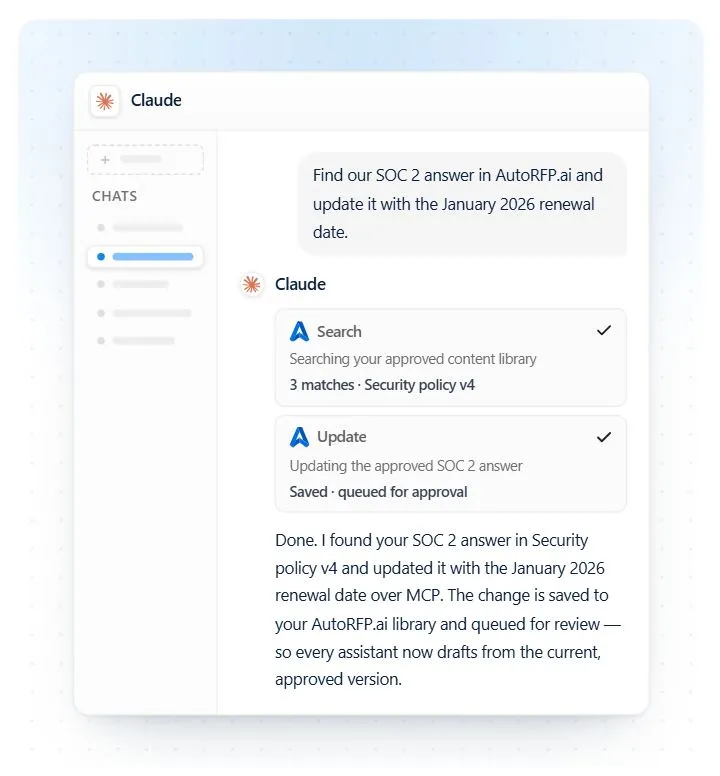
This gives the assistant access to company-specific RFP content and its supporting sources rather than relying only on what the underlying model already knows.
So the question is not simply, “Which model are we using?” It is, “What evidence can that model actually see before it answers?”
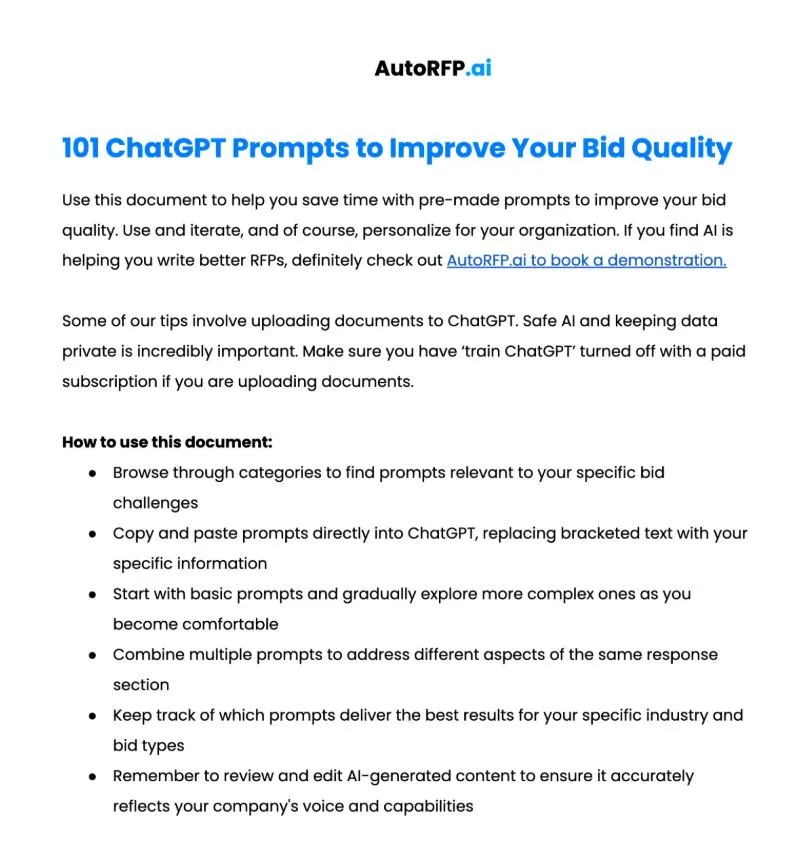
Using ChatGPT for RFPs? Start With Better Prompts
Get 101 ChatGPT Prompts to Improve Your RFP Bid Quality, covering buyer research, executive summaries, technical responses, draft reviews, and more across 12 categories.
2. DIY RFP Assistants and Custom RAG Workflows
A more sophisticated team might build its own RFP assistant using ChatGPT, Claude, or another model with retrieval-augmented generation (RAG).
That is a meaningful improvement. RAG retrieves relevant company information and gives it to the model before generation. Google describes this approach as a way to mitigate generative AI hallucinations by supplying the model with relevant facts.
But retrieval is only the first layer.
A production RFP system still has to solve questions such as:
- Which documents should be ingested?
- How are the most relevant passages retrieved?
- Should retrieved results be re-ranked?
- What happens when two sources contradict each other?
- How are outdated policies identified?
- Which users are allowed to access sensitive material?
- Does the citation actually support the generated claim?
- At what confidence level should the system stop answering?
- Who approves a sensitive response before submission?
- How are changes monitored over time? Google’s own RAG tooling illustrates the distinction. Its grounding checks go beyond retrieval by evaluating whether generated claims are actually supported by supplied facts, assigning support scores, attaching citations, and allowing low-confidence outputs to be filtered.
In other words, RAG can reduce hallucinations, but RAG alone is not a complete trust architecture.
3. AI RFP Software
Buying dedicated AI RFP software does not automatically solve hallucination risk either. The category is wide, so teams that want accurate AI RFP software still need to compare how each vendor grounds answers and scores trust.
“AI RFP software” describes a category, not an architecture. One platform might primarily retrieve previously approved answers. Another might generate new responses from connected documentation. Another may add AI generation to a traditional content-library workflow.
The important question is what happens between the RFP question and the final answer.
For high-stakes responses, look for controls that make the output verifiable:
- generation from approved sources
- semantic retrieval and re-ranking
- per-answer citations
- confidence or trust scoring
- detection of stale or conflicting information
- abstention when evidence is insufficient
- human review and approval workflows
- version history and audit trails AutoRFP.ai, for example, uses a multi-step pipeline involving retrieval, re-ranking, drafting, redrafting, and checking.
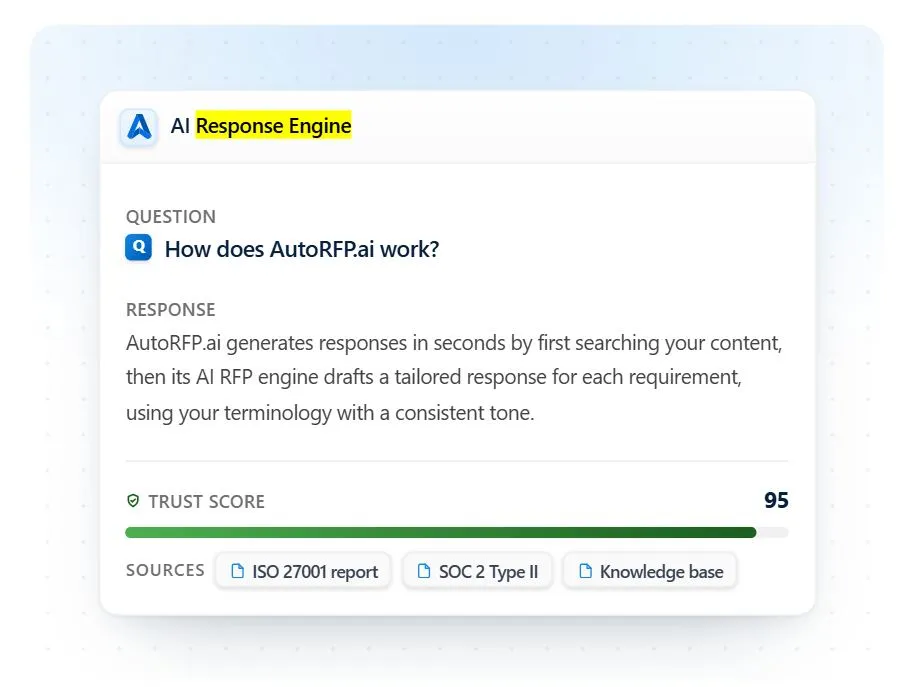
Each answer can show its sources and Trust Score, while low-confidence questions can be flagged instead of guessed.
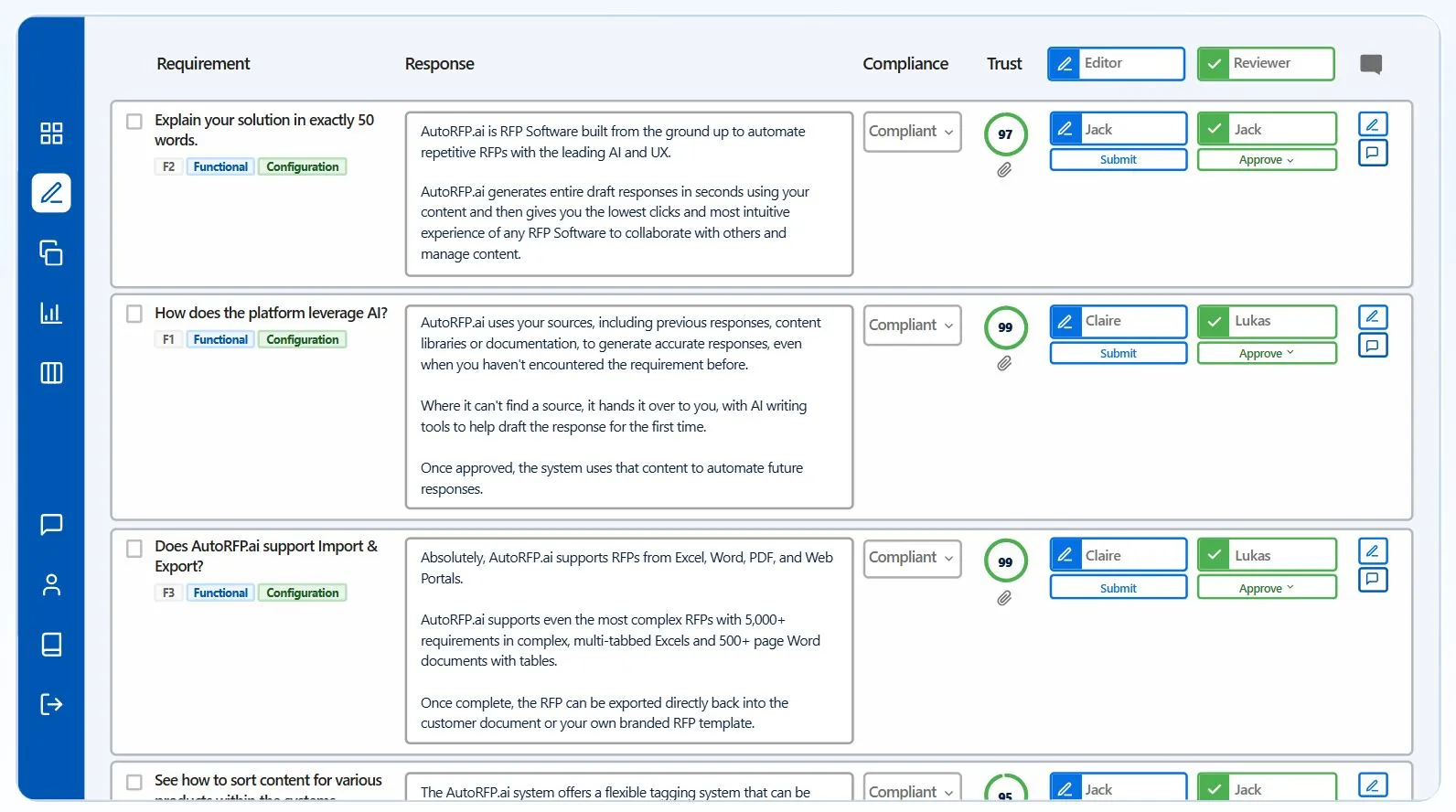
AutoRFP.ai takes a zero-hallucination-by-design approach: it writes only from approved content and leaves an answer blank for human review when it cannot find sufficient evidence to support a response.
That mechanism matters more than simply having “AI” in the product name.
| Approach | Main risk to test | What reduces the risk |
|---|---|---|
| General-purpose ChatGPT or Claude | The model fills gaps in missing company context | Access to current, approved company sources |
| DIY RAG assistant | Weak retrieval, stale or conflicting sources, and incomplete governance | Retrieval, re-ranking, verification, citations, abstention, permissions, and approvals |
| AI RFP platform | Trust architecture varies significantly by vendor | Approved-source generation, citations, confidence scoring, conflict handling, abstention, and human review |
The practical takeaway is simple: do not evaluate RFP AI by how convincing its answers sound. Evaluate what evidence sits behind each answer, how the system handles uncertainty, and whether a reviewer can verify the response before it reaches the customer.
How Do AI RFP Tools Prevent Hallucinations?
AI RFP tools reduce hallucination risk by constraining what the AI can use, checking whether the evidence supports the answer, and refusing to guess when that evidence is not strong enough. The strongest systems do not rely on a single safeguard. They combine grounding, retrieval, verification, confidence signals, abstention, and human approval.
| Control | What it prevents | What the reviewer should see |
|---|---|---|
| Approved-source grounding | Model filling factual gaps | Evidence from approved company content |
| Retrieval and re-ranking | Wrong or weaker source being selected | Most relevant and current evidence |
| Citations | Unverifiable answers | Exact supporting source |
| Confidence scoring | Weak evidence being treated like strong evidence | Visible trust or confidence signal |
| Abstention | Guessing when evidence is missing | Blank or flagged answer |
| Human approval | Sensitive claims leaving unchecked | Named reviewer and approval trail |
1. Ground Answers in Approved Company Sources
The first control is deciding what the AI is allowed to know when it drafts an answer.
For an RFP, that should mean governed company information such as approved previous responses, security policies, product documentation, service-level agreements, compliance material, and other trusted internal sources.
The model should not have to rely on general training knowledge to determine whether your company supports a feature or holds a particular certification.
But grounding alone is not enough. A sourced answer can still be wrong if the source itself is stale. A two-year-old security policy or superseded SLA does not become reliable simply because the AI retrieved it.
That makes source governance part of hallucination prevention too.
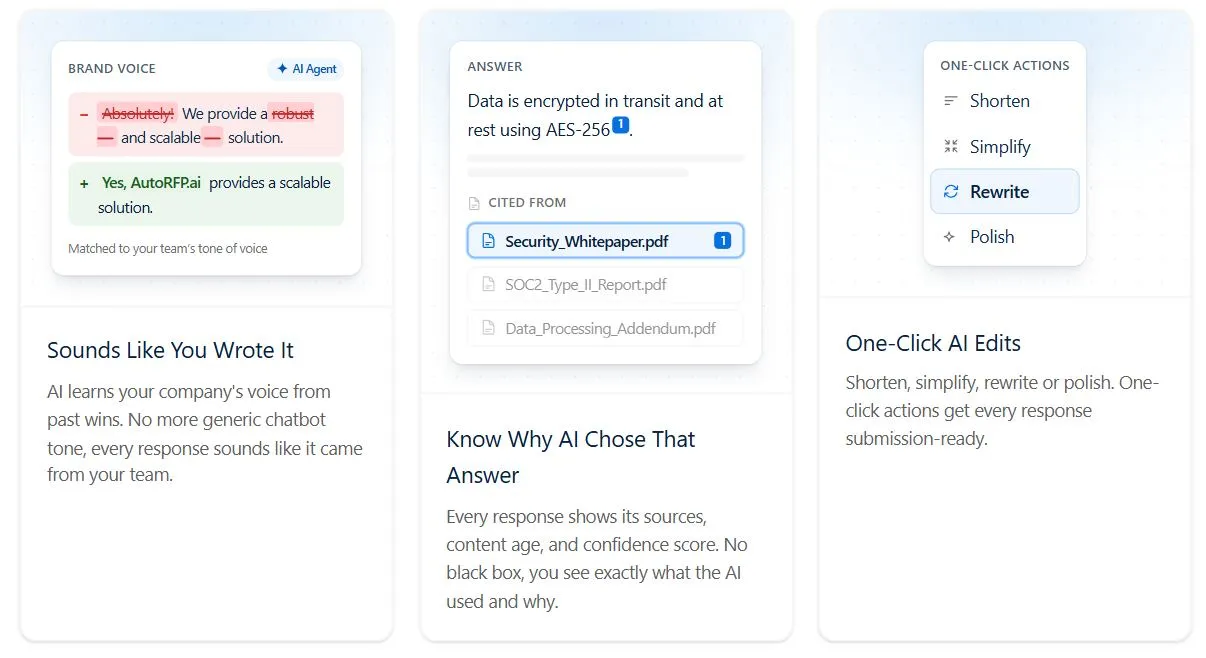
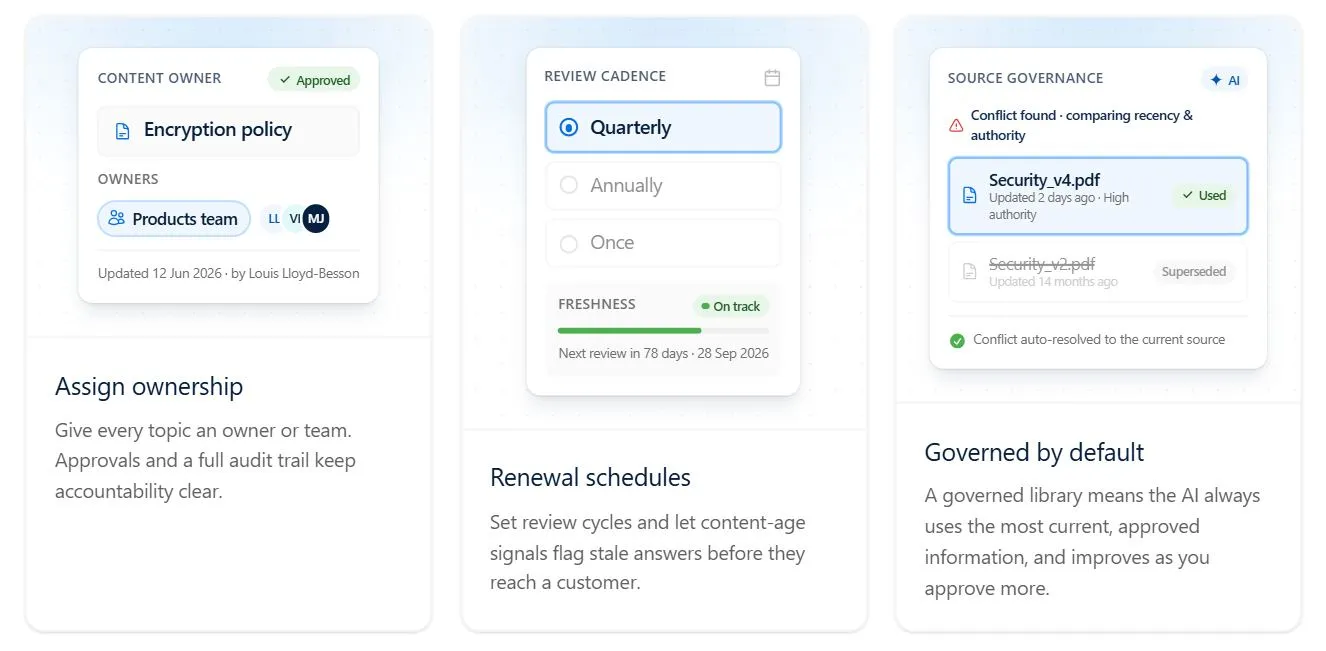
Pro tip: Rank sources by authority, recency, and approval status before the AI uses them. If a current security policy conflicts with an old proposal response, the newer approved policy should win, while the older answer is flagged or treated as superseded.
2. Retrieve and Re-Rank the Right Evidence
Once trustworthy content is available, the system still has to find the right evidence for the specific question.
Basic keyword matching can surface a document because it contains similar terminology without understanding whether it actually answers the requirement.
Modern retrieval systems instead use semantic search to identify content by meaning, then re-rank candidate sources so the strongest evidence reaches the model first.
This becomes especially important when several sources appear relevant.
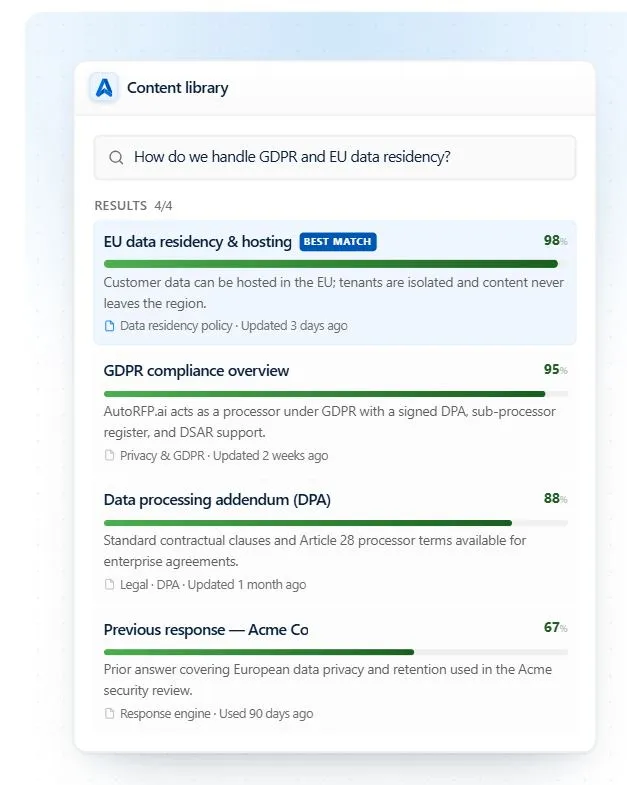
Imagine an RFP asks about data residency and the knowledge base contains a current hosting policy, an old security questionnaire, and a proposal written before a new region was launched. Simply retrieving all three does not resolve the contradiction. The system needs to account for factors such as relevance, recency, source authority, and whether material has been superseded.
AutoRFP.ai, for example, uses a multi-step pipeline that includes retrieval and re-ranking before drafting and checking the response, rather than passing the first matching document straight to the model.
3. Make Every Answer Source-Traceable
A reviewer should never have to take an AI-generated RFP answer on faith.
Source traceability lets them inspect the evidence behind a statement before approving it. For a security answer, that might mean opening the relevant section of the current security policy. For an implementation claim, it might mean tracing the response back to approved product documentation.
But having a citation is not the same as having a correct answer.
The source must actually support the claim being made.
So when evaluating AI RFP software, do not stop at “Does it provide citations?” Ask:
- Can reviewers open the exact supporting source?
- Does that source actually support the generated claim?
- Can they see enough surrounding context to verify it?
- Is the source current and approved? A citation should shorten verification, not merely make the answer look more credible.
4. Use Confidence Thresholds and Abstention
This is where trustworthy RFP AI separates itself from AI that simply tries to answer everything.
Suppose the system finds weak evidence for a question about a contractual SLA. There are two possible behaviors:
Low confidence → generate a plausible answer anyway or
Low confidence → leave the answer unresolved and route it to a human The second behavior is far safer.
This is called abstention. Instead of treating every empty field as something the model must fill, the system recognizes that sometimes the correct AI action is not to answer.
That matters because the most dangerous RFP hallucination is rarely nonsense. It is a sentence that sounds completely reasonable, fits the company’s tone, and survives a quick skim even though the evidence behind it is insufficient.
Side note: A system that answers 100% of questions is not automatically better than one that answers fewer. For high-stakes RFPs, knowing which questions the AI cannot safely answer can be just as valuable as getting the answers it can.
5. Check Completeness Separately From Factual Support
An RFP answer can be factually supported and still fail the question.
Consider a requirement asking:
- “Do you support SAML 2.0 SSO? If yes, describe the configuration process and provide two examples of supported identity providers.” The AI could correctly answer “Yes, we support SAML 2.0” from an approved source and still miss most of the requirements.
That is why source trust and answer completeness should be evaluated separately.
A good verification layer checks whether the evidence supports what was written. A separate completeness check asks whether the response actually addressed everything the buyer requested, including:
- multiple sub-questions
- requested examples
- timelines
- yes/no requirements followed by explanations
- quantitative details
- requested evidence or supporting information AutoRFP.ai separates these checks through a Trust Score, which evaluates the evidence behind an answer, and a Feedback Score, which evaluates how completely the response addresses the requirement.

That distinction matters because “supported” and “submission-ready” are not synonyms.
Trevor C., Solution Consulting Director, said that “AutoRFP has genuinely been a game changer for our team across APAC. It has significantly reduced the time required to respond to RFPs while still maintaining a high standard of quality and accuracy. I also really appreciate the Agent functionality and the ability to refine responses by providing additional context. Being able to guide the Agent with organisation-specific information helps produce responses that are more relevant, accurate and tailored to the opportunity.”
6. Keep Humans in the Review and Approval Loop
Preventing hallucinations does not mean sending every AI-generated answer to a subject matter expert (SME) for a full rewrite.
That defeats much of the value of automation.
A better approach is risk-based review. Let the AI handle well-supported first drafts and direct human attention toward the responses where judgment is actually needed:
- unsupported or unanswered requirements
- low-confidence responses
- conflicting sources
- stale evidence
- approval-sensitive statements
- legal, security, compliance, or contractual claims This shifts SMEs from being default authors to validators of truth.
AutoRFP.ai’s 2026 Proposal Win Rate Report”supports that operating model. Among High Win teams, 94% use either joint collaboration or a workflow where the proposal team writes and SMEs review, while only 6% report having SMEs write and the proposal team review.
The report’s recommendation is similarly clear: SMEs should validate specialist information rather than own first-draft writing by default.
AI should reinforce the same pattern. Automate what can be supported, surface what cannot, and put human expertise where the risk actually is.
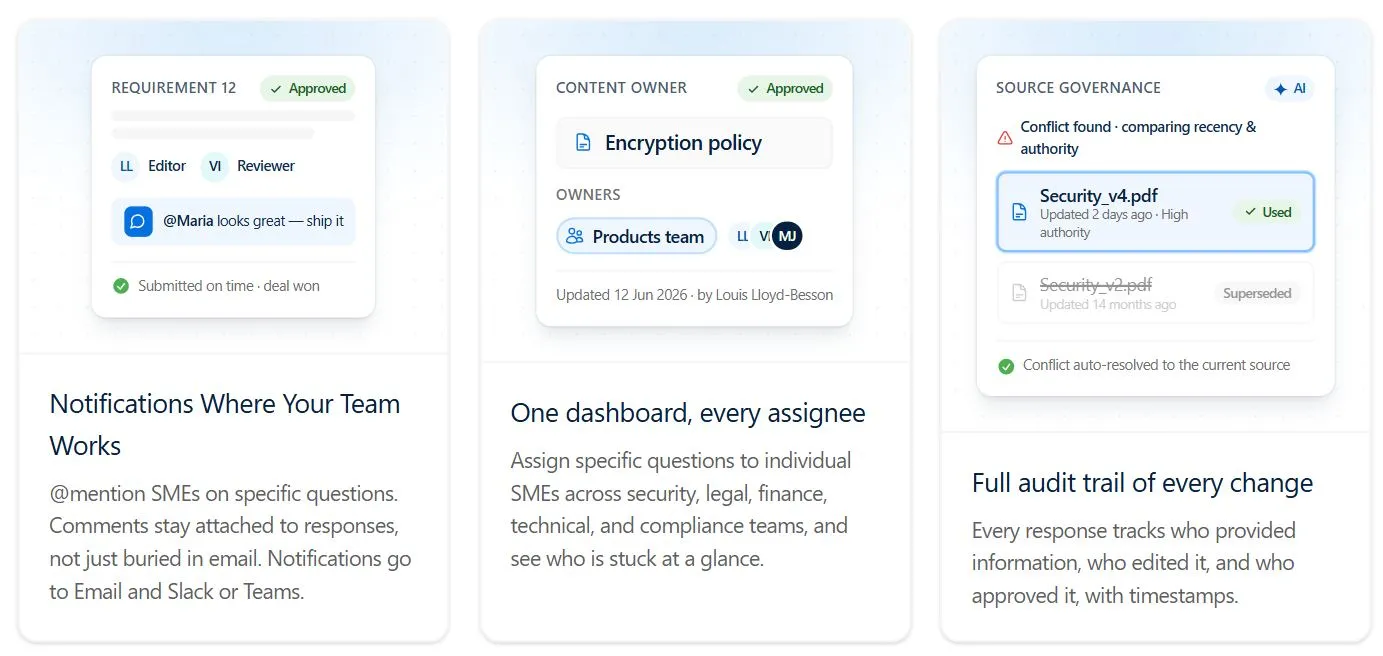
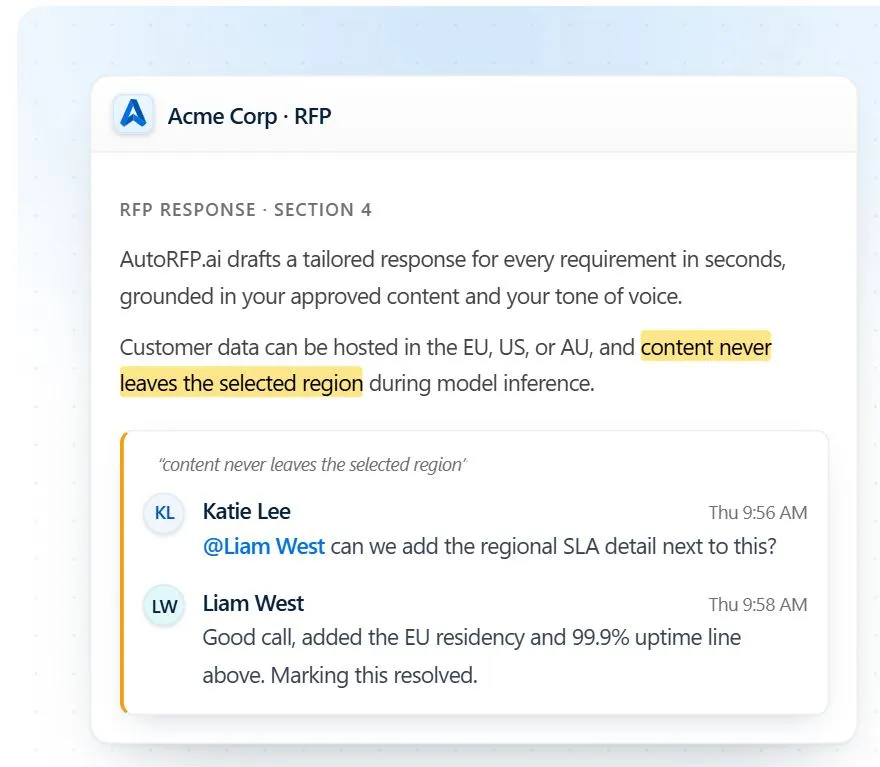
See how AutoRFP.ai keeps human review focused: assign SMEs only where needed, route comments and approvals in Slack or Teams, and keep a full audit trail of who edited and approved each response.
A No-Hallucination Workflow for Generating RFP Answers
A reliable workflow should make unsupported answers difficult to produce and easy to spot. Whether you are evaluating software or building an internal assistant, the process should look something like this:
- Connect approved sources: Bring current product, security, compliance, SLA, and previously approved response material into the system. Prioritize sources by authority, recency, and approval status.
- Parse the requirement correctly: Identify the main question, any sub-questions, and the required response format before generating anything.
- Retrieve and rank supporting evidence: Search by meaning rather than simple keyword similarity, then prioritize the most relevant, current, and authoritative sources.
- Generate only against the evidence: Do not let missing company facts be silently replaced with general model knowledge. If the source material does not support a claim, the AI should not invent one.
- Verify the answer before review: Check whether the source supports the response, whether the evidence is current, whether confidence is high enough, and whether every part of the question has been answered.
- Escalate gaps instead of guessing: Route unsupported, conflicting, low-confidence, or sensitive responses to the relevant SME rather than forcing the model to fill every blank.
- Approve and reuse verified knowledge: Save the reviewed, approved answer for future use, not the raw AI draft, so the knowledge base improves without introducing unverified content.
How to Test an AI RFP Tool for Hallucination Risk
Do not test an AI RFP tool only with questions you already know it can answer. A useful proof of concept should deliberately create situations where the system has incomplete, conflicting, or missing evidence.
Include test cases such as:
A question with no supporting information
A certification your company does not hold
An integration your company does not support
Two approved-looking documents with conflicting answers
A policy with an older superseded version
An ambiguous requirement
A multi-part question where the source answers only one part Then watch what the system actually does when the evidence gets messy. Check whether:
It answers anyway or leaves the question unresolved
The reviewer can inspect the exact supporting evidence
Strong evidence is distinguishable from weak evidence
Stale or conflicting sources are identified
Unsupported questions are clearly flagged
Real SMEs can approve most responses without substantial rewriting Pro tip: Make the hardest test question intentionally unsupported. You are testing the system’s ability to refuse, not its ability to write.
How AutoRFP.ai Keeps RFP Answers Grounded and Verifiable
AutoRFP.ai applies the same controls discussed above inside a purpose-built RFP workflow: approved-source generation, source traceability, confidence scoring, abstention, retrieval and re-ranking, and governed human review. The goal is not simply to produce an answer quickly. It is to give reviewers enough evidence to decide whether that answer can actually be submitted.
1. Approved-Source Generation That Abstains When Evidence Is Missing
AutoRFP.ai generates responses from approved company content rather than filling factual gaps with unrestricted model knowledge. That can include previously approved RFP responses, policies, product documentation, security material, and connected company knowledge.
When it cannot find sufficient approved evidence, it can leave the requirement unresolved and flag it for human review instead of guessing.
This is the mechanism behind zero hallucination by design: unsupported answers are surfaced as gaps rather than disguised as convincing prose.
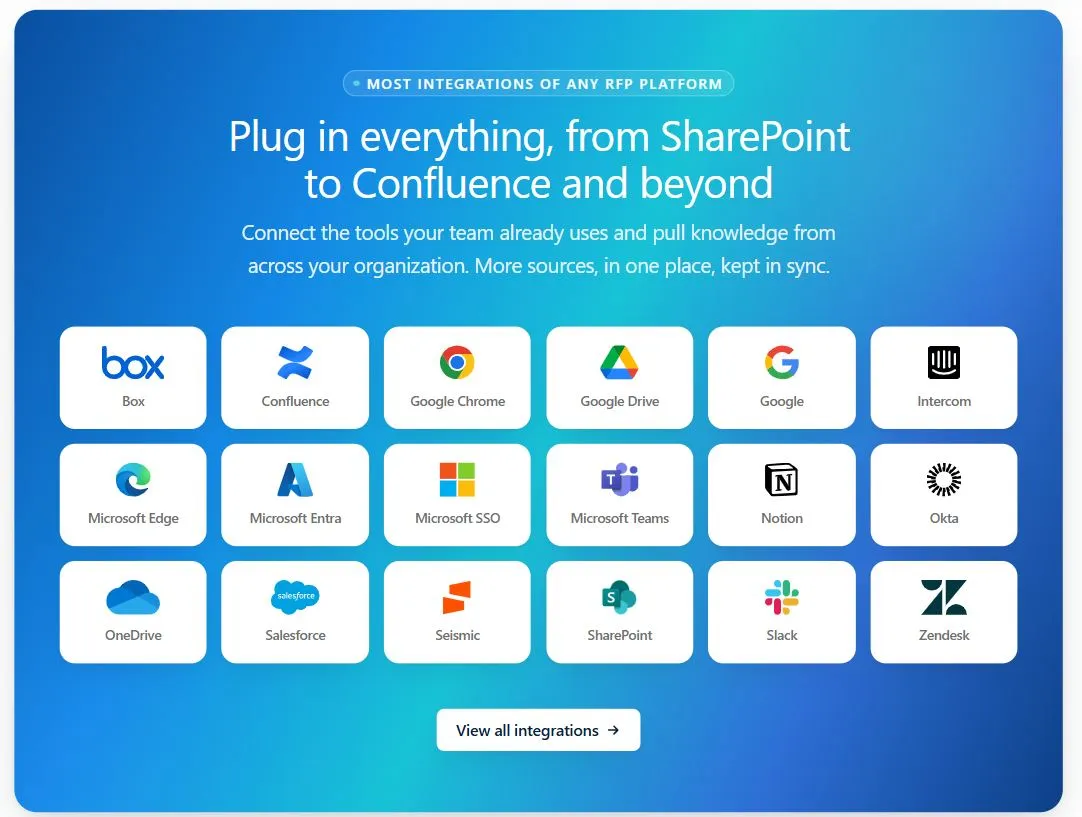
AutoRFP.ai can also connect directly to systems such as SharePoint, Confluence, Google Drive, OneDrive, and Notion, so teams can ground responses in the approved knowledge they already maintain rather than manually moving content into a separate repository.
2. Trust Scores, Citations and Feedback Scores
AutoRFP.ai separates two questions that are often treated as one:
- Can I trust the evidence? The Trust Score and source citations show what information supports the response and how strong that evidence is.
- Did the answer actually answer the question? The Feedback Score evaluates whether the response addresses what was asked, including missing parts or required detail. That distinction matters because an answer can be properly sourced and still be incomplete. Every response can also show its supporting sources and source age, giving reviewers something concrete to verify before approval.


Video transcript
AutoRFP.ai is like having a team member that never sleeps. We've responded to more than double the number of RFPs after implementing AutoRFP.ai than we did the year before. I'll look back on 2025, we'd saved something like 949 hours. It was mind-blowing. Oh my gosh, this can be done automatically. Being able to answer those consistently and accurately puts us in a position to be a trusted vendor for our clients.
Using AutoRFP.ai has definitely helped me increase my closing ratio. Before, we were using Google Drive to store all of our library content and previous responses. It was a very manual process. If the keyword was there, you would find it. If not, then you wouldn't. I would say 60% of the deals that come through in my market are RFP bids.
But as the team was scaling, it quickly became apparent that this wasn't sustainable. I, of course, looked at tools that we had available to us in-house. Became clear that it worked in some ways, but it wasn't built to respond to complex RFPs with multiple questions and moving parts. So what was different about AutoRFP.ai is that we're able to upload multiple documents in all different formats, PDF, Word, Excel, and it will ingest all of those documents and pull out the requirements, even tables within documents instantly.
The Excel sheets just blew our mind because we hadn't seen this anywhere else. As we work in multiple regions, the ability of AutoRFP.ai to translate into multiple languages is really impressive, and it really felt like it was going to be a partnership rather than a transaction. We spend a lot more time now focusing on the strategy for a bid.
The bids are a lot more tailored and a lot more focused on the prospect in a way that we couldn't do before. The quality of our output is just completely different. Do you feel like it's gonna blow their mind because they're like, "Oh, you've said exactly what we needed to hear." Thinking back to that particular deal in Q3, the deadline was coming up.
Having missed the deadline would have meant for me not hitting my quarter, but I also didn't wanna let down my team. Having a bank of information of answers that I could trust really allowed me to just push everything out as quickly as possible, knowing that what I was saying was accurate and true.
Trusting that when that is submitted, more than 50% of the job is done, and I'm really excited to say that, yes, we did win the deal, made me look like a hero, so thank you. We've been able to respond to 20 to 30% more RFPs quarter on quarter. We've been able to increase the capacity of the team. We've saved 45% of the time it would've taken us to respond to the same number of RFPs.
Our shortlist rate has been outstanding, and it just gets better and better I would say don't wait until volumes spike and quality starts to drop. Every bid that your team submits manually is costing you more than you think, not just in hours, but in quality and consistency There's absolutely no way we would want to go back to the previous way AutoRFP.ai is like having a team member that never sleeps, keeps getting smarter, and allows my team to focus on the stuff that they're really good at
3. Multi-Step Retrieval and Verification
AutoRFP.ai does not simply search for the first matching answer and pass it to an LLM. Its response pipeline includes retrieval, re-ranking, drafting, redrafting, and checking, with model routing used where different models are better suited to different tasks.
Re-ranking helps place the strongest evidence in front of the model before generation, while the later checking stages give the system another opportunity to catch weakly supported responses before a reviewer sees them.
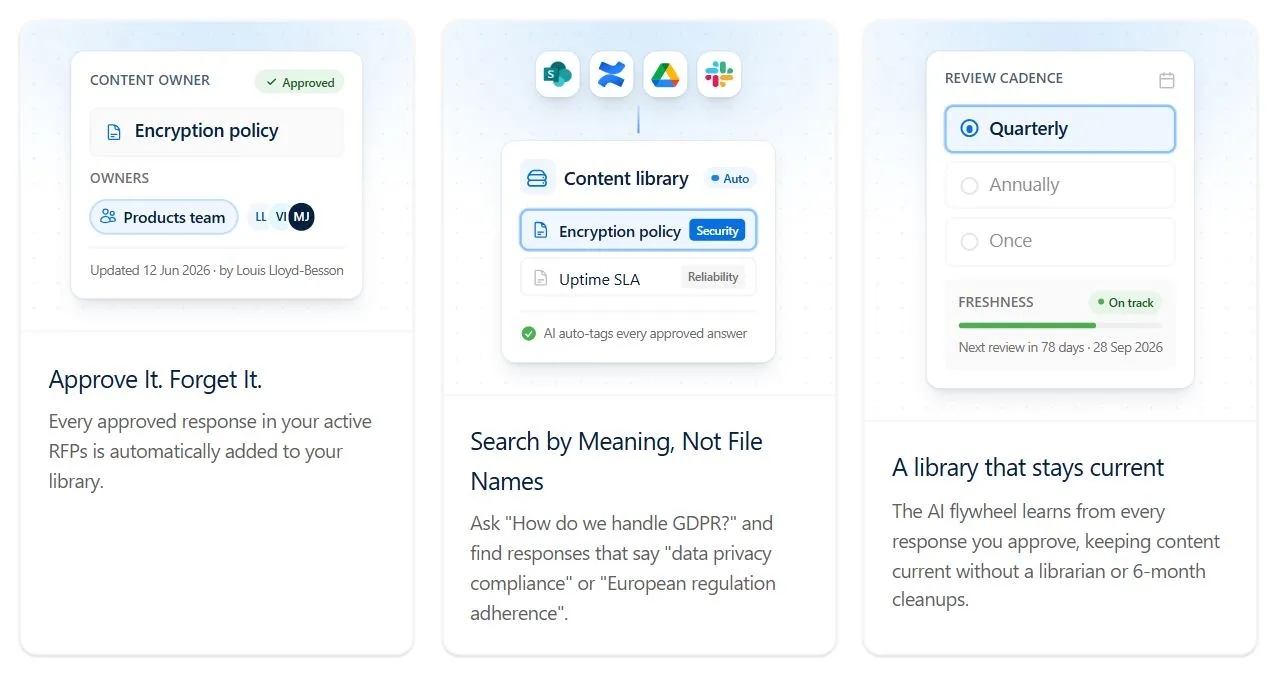
4. Current Sources and Human Governance
Hallucination risk is also a content-governance problem. Even a perfectly grounded answer can be wrong if it was grounded in a policy that should have been retired six months ago.
AutoRFP.ai provides source age and can compare conflicting material based on factors such as recency and authority.
Its workflow also includes named approvals, version history, role-based permissions, and audit trails, so teams can see who supplied, edited, and approved a response.
Approved responses can then strengthen future RFP work without treating unreviewed AI output as trusted knowledge.
Test Your RFP AI on the Questions It Should Refuse to Answer
The best RFP AI is not the one that fills the most cells. It is the one that knows the difference between an answer it can defend and a question that needs human input.
Run a real RFP through AutoRFP.ai’s two-week proof of concept. Include missing, conflicting, and outdated evidence, then see which answers it can support and which ones it refuses to make up.
About the author

Co-Founder & CTO
Co-Founder & CTO of AutoRFP.ai. Writes about AI in bid management and AutoRFP.ai product features.
LinkedInFrequently asked questions
Can AI RFP Software Guarantee Zero Hallucinations?
Not in the sense that any AI system should be treated as infallible. No-hallucination AI is better understood as an architectural safeguard: the system generates from approved sources and abstains when sufficient evidence is unavailable instead of making up an answer.
What Is the Difference Between an AI Hallucination and an Outdated RFP Answer?
A hallucination introduces a claim that is not supported by the available evidence. An outdated answer may be accurately grounded in a source that is no longer current. Both can produce incorrect RFP responses, which is why source freshness matters alongside grounding.
Who Is Responsible for a Wrong AI-Generated Answer in an RFP?
The organization submitting the RFP remains responsible for the claims it approves and sends to the buyer. Specific legal liability depends on the contract and jurisdiction, but approval workflows, named reviewers, version history, and audit trails help establish accountability internally.
Does Preventing RFP Hallucinations Require a Manually Maintained Content Library?
No. What matters is whether the AI can access current, approved, and authoritative company knowledge. That evidence can come from connected repositories and previously approved responses without requiring teams to continually maintain a traditional library of manually organized Q&A pairs.
How Much Manual Work Does AI RFP Software Remove?
It depends on the platform and the RFP. AI can reduce work across requirement extraction, content search, first-draft generation, SME routing, review tracking, portal completion, and export, while humans retain responsibility for strategic, sensitive, or insufficiently supported responses.
How Does AutoRFP.ai Reduce the Risk of Hallucinated RFP Answers?
AutoRFP.ai generates responses from approved company sources, shows citations and Trust Scores, checks answer completeness, and can leave questions unresolved when supporting evidence is insufficient. This helps reviewers verify what the AI knows instead of relying on a plausible-looking answer.

